Years of Benjamin's recorded travels
Route across three continents
Jewish centers described in his book
Unmatched geography of medieval Jewish learning
I. The Man and His Journey
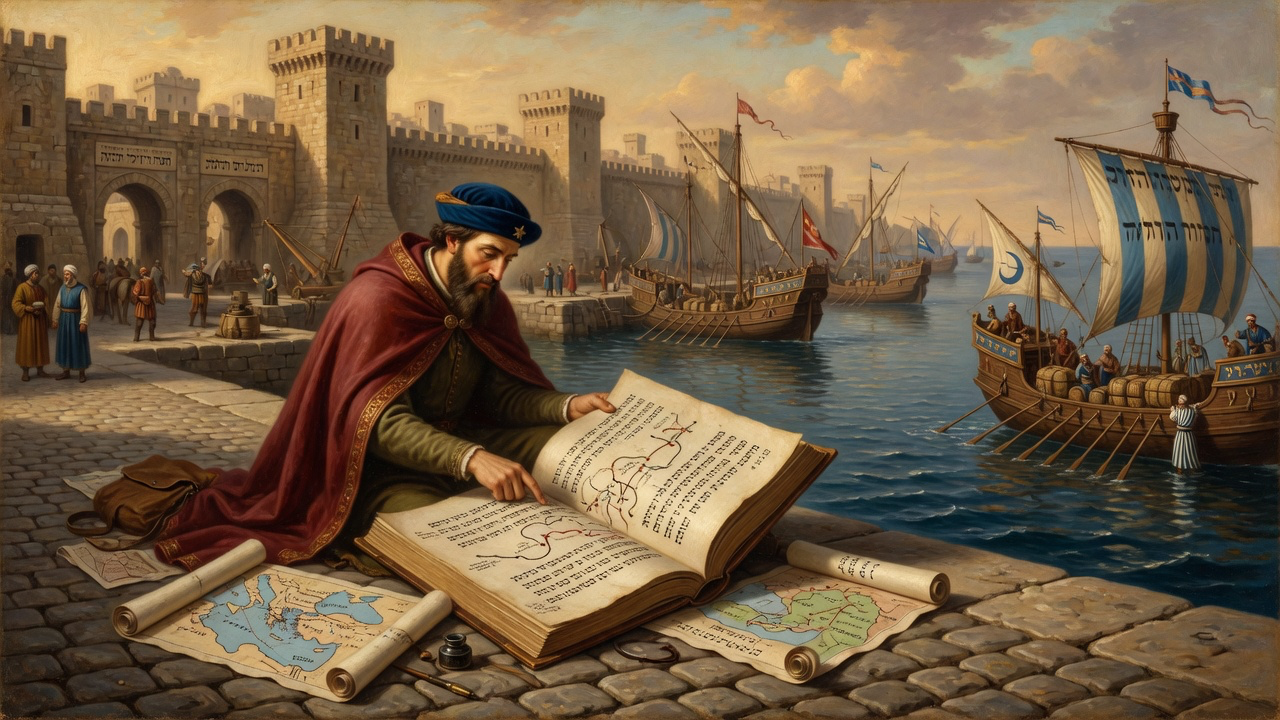
Benjamin of Tudela was a Jewish merchant from Tudela in the Kingdom of Navarre who set out around 1169 on a commercial and observational tour that would carry him across Europe, the eastern Mediterranean, Mesopotamia, and possibly as far as the Indian Ocean. His travelogue, preserved in Hebrew as סֵפֶר מַסָּעוֹת (Sefer ha-Massa'ot, Book of Travels), records population figures, occupations, communal leaders, and scholars in more than 300 localities.
Benjamin was not a professional Bible scholar, but his account is indispensable for the history of Jewish biblical culture. Wherever he found a significant Jewish community, he noted its scholars (ḥakhamim), its academies (yeshivot or battei midrash), and its relationship to the great centers of learning in Babylonia and the Land of Israel. His itinerary traces the pathways along which Masoretic codices, commentaries, and grammatical treatises traveled in the 12th century.
Although Benjamin wrote in Hebrew, his journey was made possible by the multilingual culture of medieval long-distance trade. He moved through corridors where Arabic, Judeo-Arabic, Greek, and the various Romance and Germanic vernaculars overlapped. Jewish merchants, physicians, and scholars formed a trans-regional network whose shared language of literacy was Hebrew and whose shared scriptural culture was the Masoretic Bible.
Tudela itself was a revealing place from which to begin. A town in the Christian kingdom of Navarre with a prosperous Jewish quarter, it looked south toward al-Andalus and east toward the Mediterranean ports. Its Jews spoke Romance and Arabic, traded across religious boundaries, and produced the kind of mobile, literate merchant who could recognize a valuable codex as readily as a bale of cloth. Benjamin's point of departure thus encapsulates the conditions that allowed Masoretic books to circulate far beyond the places where they were copied. → Spain notes
Benjamin's Sefer ha-Massa'ot is the earliest surviving Hebrew account of a journey across Europe, Asia, and Africa, and it was consulted by Jewish, Christian, and Arab geographers long before the age of print.
II. Spain: The Heartland of Hebrew Learning
Benjamin's journey began in the Iberian Peninsula, then the most vibrant center of Jewish biblical scholarship outside Palestine. He visited Saragossa, Barcelona, Gerona, Lerida, and other cities, recording the names of leading scholars and the size of each community. In Toledo, which he describes as a great city with a large Jewish population: he notes the presence of learned men, reflecting the city's role as a crossroads of Christian, Arabic, and Jewish intellectual life.
This was the world that had produced Jonah ibn Janach's Sefer ha-Rikmah (Book of the Thread), Abraham ibn Ezra's biblical commentaries, and the young Maimonides (who had recently fled Cordoba). Benjamin's Spain is a landscape where Hebrew grammar, philosophy, and Masoretic precision were living trades. The scholars he names in Saragossa and Barcelona belonged to the same milieu that refined Hebrew phonology and the nakdanim's vocalization systems. → Full Spain notes
The libraries of these cities: whether private collections in scholars' houses or communal chests in synagogues: were built around the Bible and its interpreters. A copy of the Mikra'ot Gedolot (Rabbinic Bible) or a finely vocalized codex of the Prophets represented both a spiritual treasure and a considerable financial investment. When Benjamin lists the learned men of a town, he is implicitly describing the guardians of those collections, the men who decided which readings to copy and which commentaries to teach.
III. Italy, Provence, and the Rhineland
Crossing into Italy, Benjamin visited Rome, Pisa, and other ports, nodes in the manuscript trade that distributed vocalized Bibles northward. In Germany he catalogued the communities of the Rhineland: Speyer, Worms, and Mainz, the cradle of Ashkenazi Tosafist learning. These communities prized the study of law and custom above all, but their biblical engagement, through Rashi's commentary, liturgical reading, and the copying of Torah scrolls, depended on the same Masoretic Text the Spanish grammarians analyzed with greater philological rigor.
The Rhineland communities also developed distinctive biblical customs that illustrate how the Masoretic Text shaped daily worship. Their humashim (Pentateuch codices) were often copied with legal glosses and selihot poetry arranged around the weekly lectionary, while their Torah readers relied on the te'amim (accent signs) to regulate public chanting. This nexus of liturgy, law, and reading produced a culture in which the correct text of the Torah was simultaneously a devotional, communal, and juridical concern. → France notes
Provence, which Benjamin passed through on his way north, occupies a special place in this geography. Its Jewish communities mediated between the rationalist Arabic learning of Spain and the legal dialectic of northern France, producing translators and commentators who shaped medieval biblical exegesis. → Provence notes
Benjamin's account of Crusade-ravaged Rhineland communities, written just decades after the massacres of 1096, also documents the vulnerability of the libraries and scrolls that embodied biblical scholarship.
IV. Byzantium, the Holy Land, and Egypt
In Constantinople Benjamin marveled at the wealth of Romaniot Jews and their beautiful synagogues. In the Land of Israel he visited Jerusalem, Hebron, Tiberias, and Acre, cities directly linked to the Masoretic tradition. He records that in Jerusalem there were only two Jewish dyers (the community was tiny under Crusader rule), but notes the tombs of biblical figures and the ongoing pilgrimage traffic that kept the land symbolically central to Jewish biblical imagination.
The Romaniot communities of Byzantium preserved an older Palestinian liturgical and biblical tradition distinct from the Babylonian rite that predominated in Egypt and Mesopotamia. Benjamin's admiration for their synagogues hints at the material culture: scrolls, ark curtains, and readers' platforms, in which biblical texts were performed. → Italy notes
Their liturgical cycle preserved readings, piyyutim, and customs associated with the Palestinian minhag, including a distinctive distribution of the Torah portions and a repertoire of vernacular Greek refrains. For Benjamin, the Byzantine synagogues were not merely beautiful buildings. They were auditoria in which an alternative sounding of the Masoretic text was maintained alongside the better-known Babylonian and Tiberian traditions.
In Egypt, Benjamin describes Fustat (Old Cairo) as a major Jewish center with two synagogues, the Palestinian (Rabbanite) and the Iraqi, and reports that the head of the Babylonian academy in Baghdad, Samuel ben Ali, was the preeminent authority for Egyptian Jewry. This was the milieu in which Maimonides would soon settle and in which the Cairo Genizah was quietly accumulating the biblical fragments that would revolutionize Masoretic studies eight centuries later.
V. Mesopotamia: The Geonic Academies
Benjamin's account of Baghdad is among the most detailed in his entire travelogue. He describes a vast Jewish population, the caliph's regard for the Exilarch (Resh Galuta), and the two great academies, Sura and Pumbedita, where thousands assembled during the two annual kallah months to hear the Geonim lecture on law and biblical interpretation.
Benjamin reports that Daniel ben Azariah was Exilarch, and that Samuel ben Ali headed the academy, and that all Jews, near and far, submitted questions (she'elot) to these authorities. The Geonic responsa literature is itself a major source for how biblical verses were cited, vocalized, and interpreted in law.
The Babylonian academies were the heirs of Saadia Gaon, whose Arabic translation of the Torah (Tafsir) and polemical biblical exegesis had set the standard for the Arabic-speaking Jewish world. → Middle East notes
The Geonim were not only jurists. Their responsa, liturgical poetry, and scriptural interpretation shaped how Jews across the Arabic world read and vocalized the Bible. Benjamin's report of their authority is therefore a direct witness to the institutional prestige behind Babylonian and Tiberian textual traditions.
VI. What Benjamin Teaches Us About Biblical Scholarship
Benjamin's world has no single capital of biblical learning. Spain, Babylonia, Egypt, and the Rhineland each nurture distinct scholarly cultures united by a shared Masoretic Text.
Like a modern academic directory, Benjamin names the leading ḥakhamim of each city, evidence that communities measured their prestige partly by the quality of their Torah teaching.
His commercial itinerary follows the same Mediterranean and overland routes that carried codices, commentaries, and genizah deposits between communities.
Benjamin visited Fustat just before Maimonides' arrival, a snapshot of the community that would soon produce the most influential biblical legal rulings of the medieval period.
Across dialects and rites, Hebrew letters and Masoretic signs gave merchants and scholars a shared textual code that made long-distance learning possible.
VII. The Travels as a Historical Source
Modern historians treat Benjamin's population figures with caution: he clearly exaggerates in places, but his geography of scholars, synagogues, and academies is broadly corroborated by Genizah documents, Geonic responsa, and Arabic historiography. Marcus Nathan Adler's English translation (1907) remains the standard entry point. Hebrew editions by Asher and others supply critical notes. For Masoretic studies specifically, Benjamin helps us visualize the human infrastructure, schools, scribes, patrons, that sustained the text the Masoretes had fixed a century earlier.
Recent scholarship has begun to treat Benjamin's itinerary as a structured dataset for network analysis, plotting the density of Jewish scholarly connections and comparing them with the geographical distribution of Masoretic manuscripts and Genizah fragments. The emerging picture is not of isolated centers of learning but of an integrated, and sometimes competitive: commonwealth of biblical culture, linked by travel, trade, and the authority of a shared text.
VIII. The Travels as a Text: Manuscripts, Editions, and Versions
Benjamin's account survives not as a polished monograph but as a working itinerary that was copied, excerpted, and recopied for centuries. The Hebrew original, סֵפֶר מַסָּעוֹת (Sefer ha-Massa'ot), is preserved in more than a dozen medieval manuscripts, the earliest complete copies dating from the late thirteenth and fourteenth centuries. No autograph has come down to us, so every printed edition depends on a chain of scribal choices about spelling, place names, and numbers.
Scholars have therefore learned to read Benjamin's itinerary as an archive of institutional memory. When he names a leading scholar in Barcelona or Baghdad, he is also identifying a node in the network that trained scribes, adjudicated readings, and authorized copies of the Bible. The accumulation of such names, over three hundred localities, supplies enough data to test hypotheses about where Masoretic expertise clustered and how it migrated.
For Masoretic studies, the book's importance lies less in direct textual criticism than in social geography. Benjamin records which communities owned carefully copied scrolls, which academies were consulted on difficult biblical readings, and which trade routes carried codices and commentaries from one city to another. His testimony thus helps explain how the Tiberian reading established authority from Spain to Babylonia within a single generation.
| Locality | Region | What Benjamin reports | Masoretic relevance |
|---|---|---|---|
| Tudela | Navarre | Benjamin's home and the journey's starting point | A base of Iberian Hebrew scholarship connected to the wider diaspora |
| Toledo | Castile | A great city with a large Jewish population and learned men | Crossroads of Arabic, Christian, and Jewish biblical culture |
| Rome | Italy | Ancient community with scholars and scribes | Port through which vocalized Bibles moved northward |
| Constantinople | Byzantium | Wealthy Romaniot synagogues | Preserves Byzantine liturgical and biblical traditions |
| Jerusalem | Land of Israel | Tombs, dyers, and pilgrimage traffic | Symbolic center of the Tiberian Masoretic tradition |
| Fustat | Egypt | Palestinian and Iraqi synagogues. Ties to Baghdad | Foreshadows the biblical riches later recovered from the Cairo Genizah |
| Baghdad | Mesopotamia | Sura and Pumbedita academies. The Geonim | Guardians of Babylonian Masoretic recensions and legal interpretation |
The Hebrew text was first printed in Constantinople in 1543, and Latin translations in the sixteenth century introduced Benjamin to Christian geographers and Hebraists. The modern critical edition remains Marcus Nathan Adler's 1907 English translation and Hebrew text, which collated several manuscripts. Earlier Hebrew editions by A. Asher (1840-1841) and others still supply useful variant readings.
Benjamin's book is a merchant's memory, not a notary's record. Its dates, distances, and population figures must be read against the conventions of medieval travel writing, but its named scholars, academies, and synagogues are broadly corroborated by Genizah documents and Geonic responsa.
IX. Methodological Debates: How Trustworthy Is Benjamin?
Modern historians approach Benjamin's figures with a mixture of gratitude and skepticism. His population totals for major cities often run to the tens of thousands, while estimates derived from Genizah tax lists, Arabic chronicles, and archaeological surveys suggest smaller communities. Similarly, his distances become elastic in the eastern half of the itinerary, and scholars continue to debate whether he personally reached the Persian Gulf, the Indian Ocean, or merely recorded reports from merchants who had.
These debates matter for biblical scholarship because they shape how we weigh Benjamin's testimony about any given academy or scribal center. If his account of Baghdad rests on direct observation, it carries different weight than if it were assembled from second-hand reports. Most specialists accept the core institutional information, the names of Geonim, Exilarchs, and leading scholars, because these details align with responsa and Genizah documents.
Benjamin is usefully read alongside other medieval travelers. Petahiah of Regensburg, another Jewish traveler who journeyed eastward shortly after Benjamin, offers a more wonder-filled and less systematic narrative. Christian pilgrims such as John of Würzburg describe the Holy Land from a different perspective, while Arabic geographers preserve independent data on the same urban Jewish populations.
A particularly productive approach is to triangulate Benjamin's testimony with the Cairo Genizah. Genizah letters and book lists name many of the same scholars and academies, specify the prices of biblical codices, and record disputes about correct readings. Where Benjamin gives a panoramic overview, the Genizah supplies the receipts, drafts, and marginal notes that make his geography concrete. → Cairo Genizah notes
Treat Benjamin's numbers as relative markers of prestige rather than census data. They often follow the rhetorical conventions of medieval travel literature.
The easternmost sections may rely on merchant informants, yet they preserve accurate names of ports, products, and Jewish communities.
Lists of ḥakhamim, Geonim, and Exilarchs are the most reliable element and match external evidence.
His account of academies, synagogues, and courts confirms that biblical learning remained anchored in real institutions.
X. Legacy and Modern Relevance
Benjamin's itinerary remained a model for later Jewish travel writing. In the late fifteenth century, Meshullam of Volterra and Obadiah of Bertinoro composed their own accounts of the eastern Mediterranean and the Land of Israel, using Benjamin's blend of commerce, pilgrimage, and scholarly reportage as a template. Latin and vernacular translations also made him a source for Renaissance and early modern cartographers trying to map Asia and the Levant.
For contemporary scholarship, Benjamin is more than a colorful witness. Digital-humanities projects now plot his route against Genizah provenances, manuscript findspots, and responsa networks, treating his itinerary as a proxy for the movement of people, books, and ideas. This work reinforces a central insight of modern Masoretic studies: the Masoretic Text was not a static monument but a living tradition sustained by mobile communities of scribes, scholars, and merchants.
- Benjamin's network anticipates the codicological study of how Bibles traveled.
- His testimony links the great Masoretic centers treated separately in the Diaspora hub.
- His blend of geography and institution makes him a forerunner of today's spatial humanities.
From medieval Spain and Provence to Italy, the Rhineland and France, the Middle East, and Fustat, Benjamin's journey binds together the regional histories that shaped medieval Jewish biblical culture.
XI. Travel, Trade, and the Physical Bible
Benjamin's itinerary is also a map of the medieval book trade. The same ships and caravans that carried silk, spices, and dye-stuffs carried codices, scrolls, and commentaries. A merchant bound from Barcelona to Alexandria might travel with a trunk that held bills of exchange, medicaments, and a carefully wrapped Torah scroll or a copy of Abraham ibn Ezra's commentary. The portability of Hebrew books made them unusually mobile commodities: written in a compact square script, often on fine vellum or paper, they could be traded, pledged, or presented as gifts to academies and patrons.
This traffic helps explain how the Tiberian system of vocalization and accentuation achieved such rapid authority. Within a few decades of the Masoretes' work, manuscripts written according to the Tiberian conventions were being copied in Spain, imported into Provence, and carried by Italian and Byzantine scribes to the Rhineland. Benjamin's unnamed fellow travelers, the merchants, physicians, and shipmasters he mentions only in passing, were the logistical backbone of this textual network.
Hebrew codices appear in medieval customs records, estate inventories, and dowry lists alongside jewelry and household goods.
Cities such as Pisa, Constantinople, and Fustat served as transshipment points where manuscripts were repaired, copied, or rebound.
The Masoretic Bible was not only read in academies. It was packed, shipped, and sold. Understanding its medieval circulation means understanding the roads, ports, and merchant partnerships that Benjamin traversed.
XII. Benjamin and the Karaite Question
Benjamin wrote from a firmly Rabbanite perspective, and his travelogue is largely a directory of Rabbanite scholars, synagogues, and academies. Yet the Jewish world he moved through was not uniform. Karaite communities were well established in Constantinople, the Land of Israel, Egypt, and parts of the eastern Arabic world, and they maintained their own biblical learning, textual practices, and liturgical customs. Benjamin's silence about them in many cities is itself a datum: it suggests how completely Rabbanite networks dominated the channels of long-distance scholarship he chose to record.
Where Benjamin does allude to non-Rabbanite Jews, the implications for biblical scholarship are significant. His report that Fustat had separate Palestinian and Iraqi synagogues reflects the rite-based diversity of Egyptian Jewry rather than Karaism as such, but it reminds us that the Masoretic Text was transmitted through competing reading traditions. Karaite scholars often favored a more literal approach to scripture and produced their own grammatical and exegetical works. Some Karaites accepted a form of the Masoretic Text while rejecting Rabbinic exegesis. The textual arguments between the two camps helped sharpen the standards by which biblical manuscripts were judged.
The Masoretic Text became authoritative partly through Rabbanite institutions. Benjamin's itinerary traces those institutions, while his omissions point to communities, especially Karaites, whose alternative readings preserved important variants.
XIII. Reception and Afterlife of the Travels
Benjamin's book did not disappear into library oblivion after his death. The Hebrew text was copied repeatedly in the later Middle Ages and became a staple of Jewish geographical knowledge. The first printed edition, issued in Constantinople in 1543, made the itinerary available to a wide reading public at the very moment that Christian Hebraists were beginning to study Jewish sources systematically. Latin translations followed, and by the seventeenth century Benjamin's place names and population figures were being quarried by cartographers compiling atlases of the Ottoman Empire and the Holy Land.
For Jewish readers, Benjamin offered a template. Travelers such as Obadiah of Bertinoro and Meshullam of Volterra adopted his blend of itinerary, community statistics, and scholarly observation when they wrote about the Land of Israel in the late fifteenth century. Their accounts, in turn, influenced the reports of early modern shadarim (emissaries) and the growing genre of Hebrew travel literature.
Modern scholarship has treated Benjamin differently in each generation. Nineteenth-century editors such as A. Asher saw him as a source for Jewish antiquities. Early twentieth-century historians such as Marcus Nathan Adler emphasized geography and institutional history. More recently, digital humanists have extracted his data into network graphs and GIS maps, revealing clusters of learning and commerce that are invisible when the text is read linearly. For Masoretic studies, this digital turn is especially promising: it allows scholars to correlate Benjamin's scholarly centers with the provenance of Genizah fragments and dated biblical codices.
Christian Hebraists and Jewish geographers used Benjamin to locate lost tribes, identify biblical sites, and chart trade routes.
Network analysis and spatial humanities treat the Travels as a structured dataset of medieval Jewish cultural geography.
XIV. Hebrew, Pronunciation, and the Soundscape of Scripture
Benjamin's Hebrew is not the polished prose of a professional grammarian, but it preserves valuable clues about how the language sounded and was written in the later twelfth century. His spelling of place names, his transliteration of foreign terms, and his occasional use of Romance or Arabic loanwords all reflect the multilingual environment of Sephardic and Mediterranean Jewry. For historians of Hebrew, these details help trace the transition between the classical Biblical Hebrew studied in academies and the regional forms of Hebrew used in commerce and correspondence.
More specifically, Benjamin's account illuminates the pronunciation traditions that underpinned different Masoretic systems. In Spain and Provence he moved through communities that followed the Sephardic realization of the Tiberian vowels. In the Rhineland he encountered Ashkenazi liturgical Hebrew. In Constantinople and the eastern Mediterranean he heard the Byzantine-Romaniot tradition. And in Baghdad he encountered the Babylonian recension that had once rivaled Tiberian authority. The very fact that he could travel from one pronunciation world to another while remaining within a single Hebrew textual culture testifies to the unifying power of the consonantal text and the nakdanim's notation.
The nakdanim supplied vowel points and accents that allowed the same consonantal text to be read aloud consistently across diverse dialects. Benjamin's geography makes audible the plural soundscape those signs were meant to discipline. → Hebrew & Aramaic notes