The New Testament in the Original Greek.
Alexandrian witnesses preferred.
Vaticanus and Sinaiticus at the center.
English Revised Version follows WH.
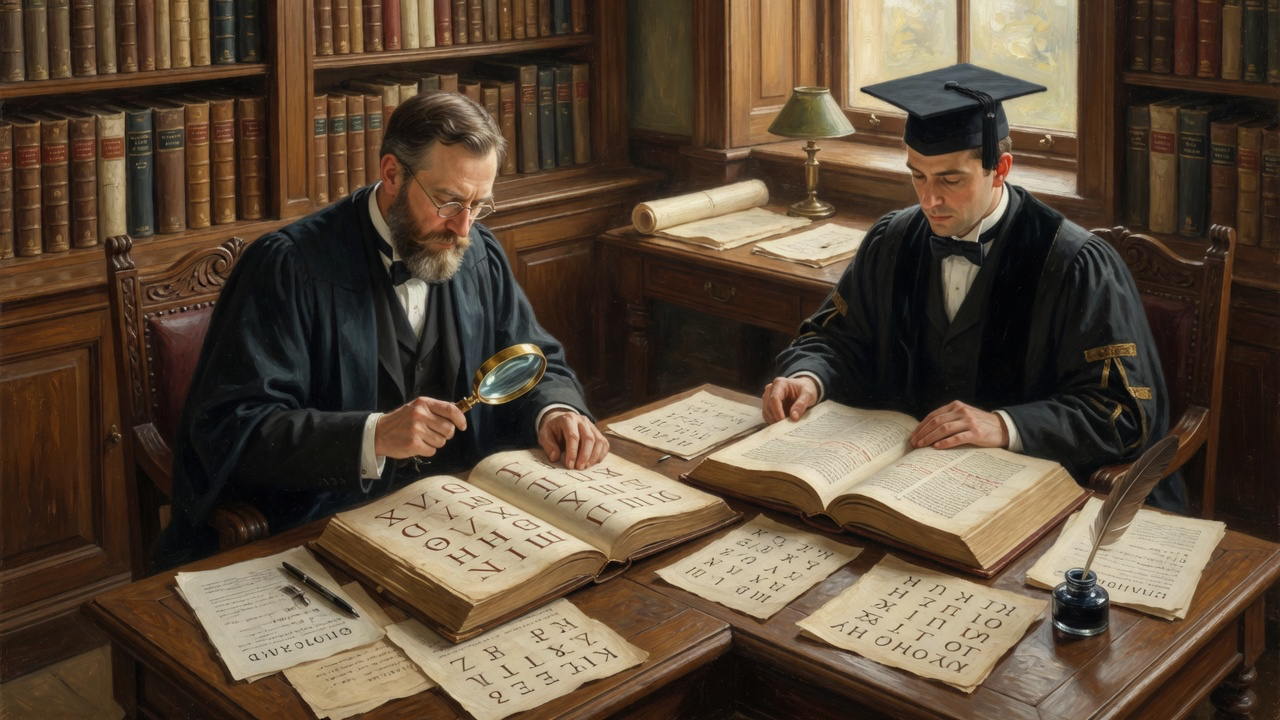
I. Two Cambridge Editors
Brooke Foss Westcott (1825–1901) and Fenton John Anthony Hort (1828–1892) spent nearly three decades preparing a Greek text of the New Testament. Both were Cambridge scholars steeped in classical and patristic learning. Their collaboration combined Westcott’s pastoral and historical instincts with Hort’s relentless attention to textual detail. The result, published in 1881 as The New Testament in the Original Greek, was not merely another printed edition: it was a theory of the text embodied as a continuous reading.
They worked against a background in which the Textus Receptus still dominated English pulpits and many lecture halls. Constantin von Tischendorf had already forced the great uncials into public view, especially Codex Sinaiticus. Westcott and Hort absorbed those discoveries and went further: they proposed a genealogical map of the manuscript tradition and then reconstructed what they called the earliest recoverable text.
II. The 1881 Edition as Master Text
The printed Greek of Westcott and Hort presented a continuous text without a full critical apparatus on every page. Their companion volume of introduction and notes explained the method. They ranked witnesses not by sheer numbers but by age, independence, and freedom from later smoothing. In practice this meant elevating the early Alexandrian stream, above all Codex Vaticanus (B) and Sinaiticus (ℵ), over the mass of later Byzantine manuscripts that undergirded the Received Text.
They coined influential labels. The “Neutral” text (roughly the early Alexandrian) was treated as the purest surviving form. The “Western” text was ancient but free and paraphrastic. The “Alexandrian” text proper was a polished literary revision of the Neutral. The “Syrian” or Byzantine text was, in their judgment, a late fourth-century recension that blended earlier streams and produced the majority of medieval copies. That last claim has been debated ever since, but it justified setting the Byzantine tradition aside as secondary for establishing the earliest wording.
“Knowledge of documents should precede final judgement upon readings.”, F. J. A. Hort, Introduction (1881)
III. Genealogical Method and the Four Text-Types
Westcott and Hort adapted classical textual criticism, methods honed on Homer and the Latin classics, to the New Testament. They asked how manuscripts relate to one another, not merely how many share a reading. A reading supported by independent early witnesses was preferred to one supported by a large family of late copies that ultimately depend on a single ancestor.
Their fourfold classification can be summarized as follows:
| Type (WH term) | Key witnesses | Character | WH judgment |
|---|---|---|---|
| Neutral | Vaticanus, Sinaiticus | Early, relatively pure | Primary base for the text |
| Alexandrian | Later Egyptian MSS | Literary revision of Neutral | Secondary but early |
| Western | Codex Bezae, Old Latin | Free, expansions | Ancient but unreliable for wording |
| Syrian / Byzantine | Majority of medieval MSS | Smooth, conflated | Late recension; least weight |
Modern scholars often speak of “Alexandrian,” “Western,” and “Byzantine” text-types rather than “Neutral” and “Syrian,” and many doubt that the Byzantine tradition is a single deliberate recension. Even so, the Westcott–Hort instinct, to privilege early, carefully copied witnesses over later majority agreement, still structures the hand editions used in universities and translation committees. For the broader story of methods, see Textual Criticism and Modern Critical Editions.
IV. Vaticanus, Sinaiticus, and the Rejection of the Received Text
The practical effect of Westcott and Hort’s theory was dramatic. Readings long familiar from the King James Version and the Textus Receptus were set aside when early codices disagreed. The longer ending of Mark, the pericope adulterae (John 7:53–8:11), and the Johannine Comma (1 John 5:7–8 in the TR) are among the best-known cases. In each, Westcott and Hort judged that the shorter or older form better explained the later expansions.
This was not hostility to Scripture but confidence that the autographs could be approached through patient comparison of witnesses. They believed the congregation’s faith rests on the text as originally written, not on the particular form printed in 1633. Their critics charged them with discarding the text “received by all.” Their reply was that the Received Text was a historical product of the printing age, not a miracle sealed once and for all. Related hub notes on Vaticanus, Sinaiticus, and the Textus Receptus set out the manuscript and printed background they inherited.
V. The Revised Version and English Reception
The same year as the Greek edition, 1881, saw the New Testament of the English Revised Version (RV). Westcott served on the New Testament company of revisers; Hort’s text heavily influenced the Greek base underlying many RV decisions. For the first time a major English Bible intentionally departed from the Textus Receptus tradition that had shaped Tyndale, the Geneva Bible, and the Authorised Version (see Hampton Court & AV and Tyndale’s Legacy).
Public reaction was mixed. Many welcomed a text closer to the earliest manuscripts. Others saw the RV as an assault on the Bible of the English Reformation. The controversy hardened into two streams that still shape popular debate: one that follows the critical tradition from Westcott–Hort through Nestle–Aland, and one that defends the Received Text and the King James wording as the proper standard. Scholarly consensus has largely followed the former, while acknowledging that every edition remains a fallible reconstruction. For later English translations, see Modern Translations.
VI. Legacy and Limits
Westcott and Hort did not have the early papyri that twentieth-century discoveries would supply, Chester Beatty, Bodmer, and the Oxyrhynchus fragments (see Major Discoveries and Earliest Papyri). Their confidence in a pure “Neutral” text has been tempered. The Byzantine tradition is now often treated as a genuine stream with early roots rather than a single late fabrication. Western readings are sometimes valued for antiquity even when not preferred for the main text.
Yet their achievement remains foundational. Nestle–Aland and the United Bible Societies Greek New Testament stand in the line they opened: an eclectic text weighted toward early Alexandrian witnesses, printed with an apparatus that invites the reader into the decision. Every student who opens NA28 or UBS5 works, knowingly or not, in a room Westcott and Hort furnished. On this hub their edition marks the hinge between the age of the Received Text and the age of the modern critical master text.
Transmission insight
Where the Masoretes stabilized a pointed Hebrew Bible by exhaustive annotation, Westcott and Hort sought to stabilize a Greek New Testament by genealogical criticism of manuscripts. Both projects aim at faithful transmission; both remain open to later refinement as new witnesses and methods appear.
Selected Bibliography
B. F. Westcott and F. J. A. Hort, The New Testament in the Original Greek (Cambridge and London: Macmillan, 1881); with Introduction and Appendix.
Bruce M. Metzger and Bart D. Ehrman, The Text of the New Testament: Its Transmission, Corruption, and Restoration, 4th ed. (New York: Oxford University Press, 2005).
Kurt Aland and Barbara Aland, The Text of the New Testament, 2nd ed., trans. Erroll F. Rhodes (Grand Rapids: Eerdmans, 1989).
Eldon Jay Epp and Gordon D. Fee, eds., Studies in the Theory and Method of New Testament Textual Criticism (Grand Rapids: Eerdmans, 1993).
D. C. Parker, An Introduction to the New Testament Manuscripts and Their Texts (Cambridge: Cambridge University Press, 2008).
Related hub notes: Modern Critical Editions · Textual Criticism · Textus Receptus · Tischendorf · Vaticanus · Sinaiticus · Erasmus