Saadia's pioneering Hebrew word list
Menahem ibn Saruq's root dictionary
Ibn Janach's standard lexicon
David Kimhi's enduring reference
I. Why Lexicography Mattered
By the early Middle Ages, Hebrew was no longer anyone's mother tongue. Jews spoke Arabic, Aramaic, Romance, or Germanic dialects in daily life. Yet the Hebrew Bible remained the touchstone of law, liturgy, poetry, and study. Lexicography, the disciplined explanation of what biblical words mean: became the bridge between a fixed sacred text and changing spoken languages.
The Masoretes had told readers how to pronounce and chant every word. The lexicographers told them what it meant. Their dictionaries organized the biblical vocabulary by root, alphabet, or semantic field, and they supported their definitions with quotations, cognates, and grammatical analysis.
The task complemented that of the nakdanim, who had supplied the vowels, accents, and spacing that made the consonantal text readable. A reader might know from the niqqud how to pronounce a rare form, but only a lexicon explained whether the word meant "mercy," "womb," or an architectural feature. In synagogue, academy, and private study, dictionaries turned the Masoretic text into a living curriculum.
Fixed prayers and biblical cantillation required confidence in every word's sense.
Piyyutim and liturgical verse demanded precise biblical vocabulary and synonyms.
Halakhic argument often turned on the exact meaning of a biblical term.
II. Saadia's Sefer Egron: The First Hebrew Dictionary
Saadia Gaon composed the Sefer Egron in the early tenth century. It is the earliest known Hebrew dictionary arranged alphabetically, and it had a practical purpose: to help poets find biblical words with which to compose Hebrew piyyutim according to strict metrical and acrostic rules.
The Egron lists words under their first two letters and gives brief definitions. Although modest compared with later works, it established the principle that the biblical lexicon could be systematically arranged and consulted. It also showed that Hebrew was not merely a liturgical memory but a language whose vocabulary could be classified like any other. → Saadia Gaon
The work survives in two principal arrangements: a shorter version that lists words by their first two consonants, and a longer version that adds fuller definitions and sometimes groups entries by final letter as well. Fragments recovered from the Cairo Genizah show that the Egron traveled along Mediterranean trade routes and was studied as far east as Iraq and as far west as al-Andalus. Later Karaite scholars adapted Saadia's format for their own biblical lexica, and the work's fusion of Hebrew, Arabic, and Judeo-Arabic terminology made it a genuinely bilingual reference tool.
III. Menahem ibn Saruq and the Mahberet
Menahem ibn Saruq (c. 920-970), court secretary in Córdoba, produced the Mahberet, a dictionary of biblical Hebrew arranged alphabetically by root. Menahem was a conservative: he resisted comparing Hebrew too closely with Arabic and defended the integrity and antiquity of the Hebrew language.
His work became the target of Dunash ibn Labrat's famous attack, which itself generated a small library of grammatical polemics. Out of this controversy emerged the consensus that Hebrew roots are overwhelmingly triliteral and that dictionaries should be organized accordingly. → Medieval Hebrew Grammar
The Mahberet is more than a dictionary. It is a programmatic defense of Hebrew's autonomy. Menahem avoided the technical vocabulary of Arabic grammar, preferring to illustrate meaning through biblical context and Hebrew paraphrase. His opponents, above all Dunash ibn Labrat, objected that this caution blinded him to the regular sound laws that linked Hebrew with Arabic and Aramaic. The ensuing pamphlet war, with replies from Menahem's students and counter-replies from Dunash's defenders, fixed the terms in which Hebrew philology would be debated for the next two centuries.
IV. Jonah ibn Janach: Sefer ha-Shorashim
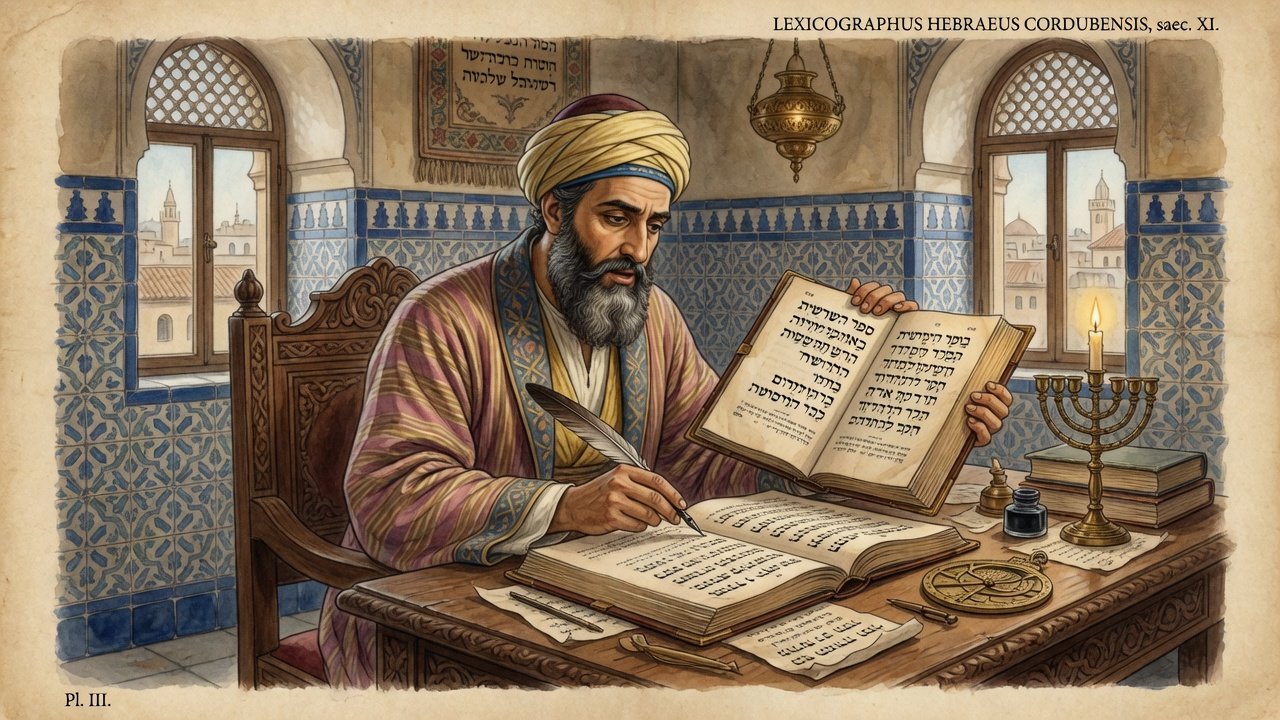
The crowning achievement of medieval Hebrew lexicography was Jonah ibn Janach's Sefer ha-Shorashim (Book of Roots). Composed in 11th-century Córdoba, it arranged the entire biblical vocabulary by triliteral root and supplied for each entry:
- The range of meanings attested in the Bible
- Morphological forms built from the root
- Biblical citations illustrating each usage
- Occasional comparisons with Arabic and Aramaic cognates
Ibn Janach's dictionary was not an isolated reference book. It was the companion to his Sefer ha-Rikmah, the first complete Hebrew grammar. Together they made the study of biblical Hebrew a self-sufficient discipline. His works were translated into Latin by Christian Hebraists and influenced European biblical scholarship well into the Renaissance.
Ibn Janach wrote in Arabic, the language of contemporary science, and he expected readers to grasp such grammatical concepts as the triliteral root, the verbal binyanim, and the distinction between literal and metaphorical usage. His entries regularly note whether a form is primary or derived through the addition, loss, or transposition of radicals. In the twelfth century Judah ibn Tibbon translated both Sefer ha-Shorashim and Sefer ha-Rikmah into Hebrew, opening them to readers in Provence, Italy, and northern Europe who did not read Arabic.
V. David Kimhi (Radak): The Standard Reference
David Kimhi (Radak, c. 1160-1235) of Narbonne wrote a new Sefer ha-Shorashim that became the standard medieval lexicon. Radak was concise, well organized, and deeply indebted to Ibn Janach, but he wrote for a European audience that lacked easy access to Arabic. His definitions therefore relied more on Hebrew synonyms and biblical parallels than on Arabic cognates.
Radak's Sefer ha-Shorashim was printed repeatedly from 1477 onward and became a fixture of the Mikraot Gedolot. For centuries, a student's first encounter with a difficult biblical word was likely to be Radak's brief, lucid entry.
Radak belonged to a dynasty of grammarians: his father Joseph Kimhi and elder brother Moses Kimhi had already composed influential Hebrew textbooks, and Radak's own Mikhlol wove grammar and lexicon into a compact teaching syllabus. His Sefer ha-Shorashim follows the same root order, supplying one or two crisp definitions, noting the relevant binyanim, and often comparing rare words with more familiar biblical synonyms. Because he wrote in Hebrew rather than Arabic, and because he deliberately minimized Arabic cognates, his work could be copied and studied in Jewish communities where Arabic learning was unavailable. → Provence
VI. Lexicography and the Survival of Biblical Hebrew
Lexicography preserved biblical Hebrew as a usable language. Prayer, poetry, law, and exegesis all depended on a shared, retrievable vocabulary. The medieval dictionaries fixed that vocabulary in alphabetical and root-based order, turning the Bible from a repository of sacred memory into a linguistic reference library.
The Masoretes gave the text its letters and sounds. The lexicographers gave the reader the meanings. Together they ensured that the Hebrew Bible remained comprehensible across languages, centuries, and diasporas.
Modern critical editions of the Bible, BHS, BHQ, the Jerusalem Crown, still rely on the Masoretic consonants and vowels that the medieval lexicographers interpreted. Their entries may be updated, but their questions: what does this word mean, where else is it used, what root does it belong to, remain the foundation of biblical philology.
VII. Comparing the Major Medieval Lexicons
Each major lexicon answered the same need: reliable access to biblical meaning, but approached it with different assumptions about arrangement, language, and audience. The table below summarizes their distinctive contributions.
| Work | Author | Date & Region | Arrangement | Distinctive Features |
|---|---|---|---|---|
| Sefer Egron | Saadia Gaon | c. 900, Iraq / Egypt | First two letters, then final letter | Designed for poets. Earliest alphabetical Hebrew dictionary |
| Mahberet | Menahem ibn Saruq | c. 950, Córdoba | Alphabetical by root | Defended Hebrew autonomy. Sparked grammatical controversy |
| Sefer ha-Shorashim | Jonah ibn Janach | 11th c. Córdoba | Triliteral root | Comprehensive biblical citations. Arabic grammatical framework |
| Sefer ha-Shorashim | David Kimhi (Radak) | c. 1200, Narbonne | Triliteral root | Concise Hebrew definitions. Standard Mikraot Gedolot lexicon |
This sequence also traces a geographical shift: from the Near Eastern academies of Saadia, to the Arabic-speaking courts of al-Andalus, to the Hebrew-speaking schools of Provence and Christian Europe. → Medieval Hebrew Studies
VIII. Manuscripts, Transmission, and the Physical Survival of Lexicons
Medieval Hebrew lexicons have come down to us through a fragile chain of codices, fragments, and early printed books. The Cairo Genizah has yielded leaves and quires of Saadia's Egron, Menahem's Mahberet, and related grammatical compendia, often in hands that mix Hebrew, Aramaic, and Arabic script. These scraps confirm that the works were copied, corrected, and carried by traveling scholars long before they reached print.
After the decline of Spanish Jewish learning in the late fifteenth century, manuscripts of Ibn Janach and Radak moved with exiles to Italy, the Ottoman Empire, and North Africa. Copyists added glosses, cross-references, and occasional marginal emendations, so that no two manuscripts are identical. Early printed Bibles and Mikraot Gedolot editions then froze one recension in type, but modern scholars still return to the manuscripts to recover variant readings and lost sources.
Scraps of parchment and paper preserve the earliest witnesses of tenth-century lexicography.
Radak's Shorashim appeared in print by 1477, fixing the standard text for generations.
Later scholars such as Immanuel of Rome and Joseph Kara annotated the classic lexicons.
IX. From Scriptoria to Christian Hebraism: The Latin Afterlife
The medieval Hebrew lexicons did not remain inside Jewish libraries. As early as the thirteenth century, Latin-literate scholars recognized that a correct understanding of the Bible required Hebrew grammar and vocabulary. In the sixteenth century, Cardinal Giles of Viterbo commissioned a literal Latin translation of Ibn Janach's Sefer ha-Shorashim, preserved today in two manuscripts. The work circulated among Christian Hebraists who studied the Hebraica veritas at first hand.
Johann Reuchlin and Sebastian Münster drew heavily on David Kimhi: Münster's Hebrew Dictionarium and Reuchlin's De rudimentis Hebraicis adapted Radak's roots and definitions for Protestant and Catholic readers alike. Later, Johannes Buxtorf the Elder made Kimhi and Ibn Janach central to his Basel grammars. Through these channels, the medieval Jewish analysis of biblical Hebrew shaped Reformation exegesis and the rise of modern Semitic philology.
The Hebrew lexicon that Jewish scholars had compiled to preserve their own scripture became, in Latin dress, one of the foundations of Europe's renewed encounter with the Bible.
The same labor contributed to the long survival of Hebrew as a written language. Today the questions they posed. What does this word mean? Where else is it used? What root does it belong to?, still drive critical lexicography. Modern dictionaries such as BDB, HALOT, and the Dictionary of Classical Hebrew answer them with comparative Semitic evidence and textual criticism, but they inherit the root-based entry structure and citation habits of their medieval predecessors. → Hebrew & Aramaic Languages