Late antique roots–21st c.
Ethiopian highlands; Israel (modern)
Ge'ez (liturgy), Amharic/Tigrinya, Hebrew
Orit corpus; priestly reading; modern Hebrew integration
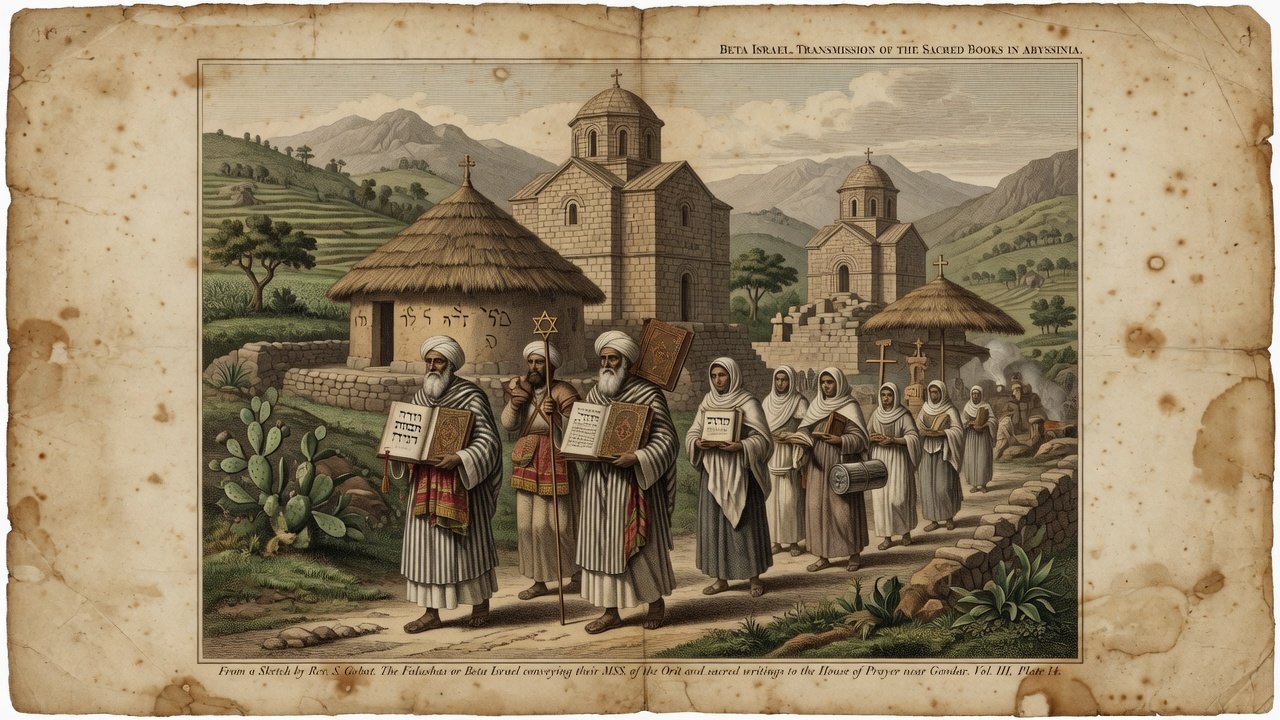
I. Scope, Names, and Historiography
Beta Israel (“House of Israel”) denotes the historic Jewish community of Ethiopia and its descendants, primarily in Israel after late-twentieth-century aliyah. Older outsider labels (including “Falasha,” now widely rejected as pejorative) appear in travel literature and early scholarship; contemporary academic and communal usage prefers Beta Israel or Ethiopian Jews. Origins narratives within the community and in Ethiopian tradition link memory to antiquity, the Solomonic legend, and regional religious history; modern historians emphasize long local development within Ethiopian Christian and political contexts, with debated timelines for ethnogenesis.
For this site, the focus is scriptural culture: which books were sacred, how they were read and taught, how religious leadership worked, and how contact with rabbinic and Masoretic norms transformed Bible education after the nineteenth century. Comparative frames include Mizrahi sociology in Israel and the wider diaspora hub of biblical cultures—without forcing Beta Israel into a medieval European yeshiva model it did not historically share.
“Beta Israel Scripture was not a footnote to European Bibles. It was a highland canon performed in Ge'ez—later brought into dialogue with the pointed Hebrew page.”
II. The Orit and the Shape of a Biblical Religion
The sacred corpus known as the Orit (related to “Torah/law” in sense) comprises the Pentateuch and other biblical books transmitted in Ge'ez, Ethiopia’s classical liturgical language. Religious life centered on purity laws, Sabbath, festivals, monastic-like ascetic ideals in some circles, and priestly leadership. Scripture was heard and taught in a society where Ge'ez functioned as a holy tongue analogous, in social role, to Hebrew elsewhere—even though the language family and literary history differ.
Beta Israel religion is thus a form of biblical Judaism without the Talmudic curriculum that defines Rabbanite Jewry from Babylonia to Ashkenaz. That fact does not make it “less Jewish” in communal self-understanding; it makes it a distinct historical path. Comparative scholars sometimes place it alongside other non-Talmudic Jewish or Judaizing groups, while Ethiopian Jewish intellectuals insist on continuity of Israelite identity through highland history.
III. Leadership, Literacy, and Ritual Expertise
Kessim (priests) and other religious experts taught law, supervised ritual slaughter and purity, and led liturgy. Literacy in Ge'ez sacred texts was specialized—more like clerical literacy than the near-universal male humash literacy of some Yemenite or Eastern European settings. Oral instruction, memorized prayer, and communal festival cycles carried biblical knowledge for broad populations. Women maintained domestic religious practice and narrative memory of biblical heroes and laws of purity.
Monastic and priestly patterns in Ethiopian Christianity form a comparative backdrop for understanding highland sacred literacy, but Beta Israel maintained separate identity, calendar features, and refusal of Christian claims—often under pressure.
IV. Contact with World Jewry and Missionary Contexts
Nineteenth-century Protestant missionaries, European travelers, and Jewish activists (including figures connected to Jacques Faitlovitch and earlier Joseph Halévy) brought Beta Israel into global Jewish awareness. Missionary schools taught European languages and sometimes challenged communal religion; Jewish responses sought educational alternatives that would strengthen Jewish identity. Printed Hebrew Bibles and modern Jewish textbooks entered alongside Ge'ez tradition.
These contacts initiated a long negotiation: how to relate Orit-centered religion to rabbinic Judaism’s Oral Law, halakhic status questions, and the Masoretic Hebrew text as global Jewish standard. The negotiation continues in Israeli rabbinic, educational, and cultural arenas.
V. Rabbinic Recognition, Conversion Debates, and Hebrew Bible Schooling
Israeli chief rabbinate policies and rabbinic opinions debated the status of Beta Israel and procedures for formal conversion or affirmation. Whatever one’s view of those legal debates, their educational effect was clear: state and religious schools taught Hebrew, the pointed Masoretic text, and rabbinic literature to Ethiopian immigrants and their children. Kessim sometimes retained roles; younger generations often trained in mainstream Israeli yeshivot or state religious schools.
The result is a layered Bible culture: inherited Orit and Ge'ez liturgical memory; modern Israeli humash and Tanakh curriculum; and communal efforts to honor both. For Masoretic studies, this is a rare documented case of a full community adopting (or adding) Tiberian-pointed Hebrew education after centuries of a different scriptural language ecology.
VI. Aliyah Waves and Demographic Reconstitution
Operations Moses (1984), Joshua, Solomon (1991), and later migrations relocated most of the community to Israel under dramatic political conditions in Ethiopia and Sudan. Absorption challenges—language, racism, religious bureaucracy, economic inequality—shaped who became teachers of Scripture for the next generation. Ethiopian-Israeli authors, musicians, and rabbis now contribute publicly to Israeli biblical culture, including new piyyut and educational initiatives.
VII. Contemporary Scholarship and Heritage Work
Academic fields—Ethiopian studies, Jewish history, anthropology, and linguistics—publish on Beta Israel origins, manuscripts, liturgy, and migration. Communal heritage projects document elders’ knowledge of Orit-related practice and festival customs. Museums and curricula in Israel increasingly include Ethiopian Jewish history as part of Jewish peoplehood, not as an exotic appendix.
For this site’s map of biblical transmission, Beta Israel widens the definition of how Scripture can structure a Jewish people: Ge'ez sacred literacy first, then dialogue with the Masoretic Hebrew page that most other communities had shared since the Middle Ages.
VIII. Comparative Notes
Unlike Teimani or Ashkenazi paths, Beta Israel did not historically organize advanced learning around Talmud. Unlike Kaifeng, it maintained a large communal population into modernity. Its story is essential to any honest encyclopedia of Jewish biblical cultures in the Common Era.
IX. Orit, Tanakh, and Translation Horizons
As Ethiopian Israelis study the Masoretic Tanakh, questions arise about translating between Ge'ez scriptural memory and Hebrew critical or traditional editions. Educational publishers produce materials for Amharic- and Tigrinya-speaking immigrants. The translation horizon is itself a chapter of biblical transmission—new vernacular bridges to an old text.
X. Arts, Public Culture, and Scripture
Ethiopian-Israeli music, visual art, and literature often rework biblical themes of exodus, exile, and Zion—now read through highland and Israeli experience. Public culture becomes a teaching medium for biblical imagination beyond the classroom humash.
XI. Kessim and Rabbis: Dual Leadership Horizons
In Israel, traditional kessim and rabbinic institutions sometimes cooperate, sometimes compete, over who authorizes marriage, conversion-related processes, and religious teaching. For Bible education, dual leadership means children may hear Ge'ez liturgical echoes at communal events and Masoretic Tanakh in school—the encyclopedic present tense of a historical encounter still unfolding.
XII. Racism, Dignity, and Access to Sacred Study
Discrimination against Ethiopian Israelis has affected school tracking, religious prestige, and public trust. Access to advanced yeshiva or academic Bible study is not only a curricular matter; it is a justice matter. An honest encyclopedia notes that transmission fails when societies block teachers and students from the table where the humash is open.