Antiquity–20th c. CE
Mashriq, Maghreb, Yemen
Dhimmi status under Islam
Mass exodus c. 1948–1970s
I. Scope, Terms, and Historiography
“Jews of the Arab lands” is a modern analytical phrase for communities that lived for centuries in territories where Arabic became the dominant public language after the Islamic conquests: the Mashriq (Iraq, Syria, Lebanon, Palestine, Egypt, parts of the Arabian Peninsula), the Maghreb (North Africa west of Egypt), and related zones such as Yemen. It overlaps with, but is not identical to, Mizrahi identity (Jews of Middle Eastern and North African origin in Israeli and diaspora usage) and with post-1492 Sephardi settlements in Ottoman and Maghrebi cities.
Scholarship long treated these communities as a backdrop to European Jewish history. That imbalance has been corrected by archival work on the Cairo Genizah, Ottoman sijill records, Alliance Israélite Universelle school reports, and oral-history projects after the mid-century exodus. Foundational syntheses include S. D. Goitein’s Mediterranean society studies, Norman A. Stillman’s sourcebooks, Bernard Lewis’s surveys of Jews under Islam, and more recent work by historians of Yemen, Iraq, and the Maghreb who insist on local specificity rather than a single “Arab Jewish” essence.
This note emphasises biblical and textual culture: how communities copied, pointed, chanted, translated, and legislated around the Masoretic Text while living under Islamic rule. Companion regional studies include the MENA Region, Middle East, and North Africa notes, and the site’s city histories from Baghdad to Tunis.
“The history of Jews in the Arab lands is not a single story of either golden age or perpetual decline. It is a history of legal subordination, cultural productivity, and local contingency—anchored, in the synagogue, by a vocalized Hebrew Bible.”
II. Antiquity to the Islamic Conquests
Jewish presence in what became the Arab lands long predates Islam. The Babylonian exile established communities in Mesopotamia that produced the Babylonian Talmud and, later, the Geonic academies of Sura and Pumbedita. Egypt hosted Hellenistic and Roman-period Jewries; Alexandria’s Greek-speaking Jews commissioned the Septuagint. North Africa and the Arabian Peninsula also knew Jewish tribes and settlements before the seventh century, attested in epigraphy, Islamic tradition, and later Jewish memory.
When Arab-Muslim armies conquered the Near East and North Africa in the seventh and eighth centuries, most Jews became subjects of Islamic polities rather than of Byzantine or Sasanian empires. Continuity of settlement mattered as much as conquest: the same families who had prayed with Aramaic Targum and Hebrew Scripture under earlier regimes continued to do so under caliphs, now negotiating a new legal status.
| Period | Political frame | Textual landmark |
|---|---|---|
| Biblical–Second Temple | Assyrian, Babylonian, Persian, Hellenistic, Roman | Exile literature; early diaspora communities |
| Late antique | Sasanian Iraq; Byzantine Levant & Egypt | Talmud; liturgical Hebrew; Greek Bible in Egypt |
| Early Islamic (7th–10th c.) | Umayyad & Abbasid caliphates | Geonim; Judeo-Arabic; Masoretic consolidation |
III. Dhimmi Status and Communal Autonomy
Under classical Islamic law, Jews (and Christians) were classified as ahl al-dhimma—protected non-Muslim monotheists who paid the jizya poll tax and accepted social and legal disabilities in exchange for security of life, property, and communal worship. The so-called Pact of ʿUmar traditions, whatever their precise historical origin, codified expectations about dress, building synagogues, public ritual, and deference to Muslim space.
In practice, enforcement varied by dynasty, city, and crisis. Periods of relative openness—Abbasid Baghdad, Fatimid and Ayyubid Egypt, much of Ottoman Salonica and Istanbul—allowed Jews to trade, practice medicine, and maintain courts and schools. Periods of reformist or populist pressure—most famously the Almohad campaigns in the Maghreb and al-Andalus—could collapse the dhimmi bargain into forced conversion, flight, or death. Historians stress contingency: the same legal category framed both the career of Maimonides in Fustat and the Farhud in 1941 Baghdad.
Communal autonomy remained robust for centuries. Rabbis adjudicated marriage, divorce, inheritance, and many commercial disputes; the Exilarch in Iraq and later communal heads (nagid, çelebi, muqaddam) mediated with the state. That autonomy made the synagogue and the house of study the durable carriers of biblical text and cantillation when political power lay elsewhere.
IV. Babylonia, the Geonim, and Judeo-Arabic Scripture
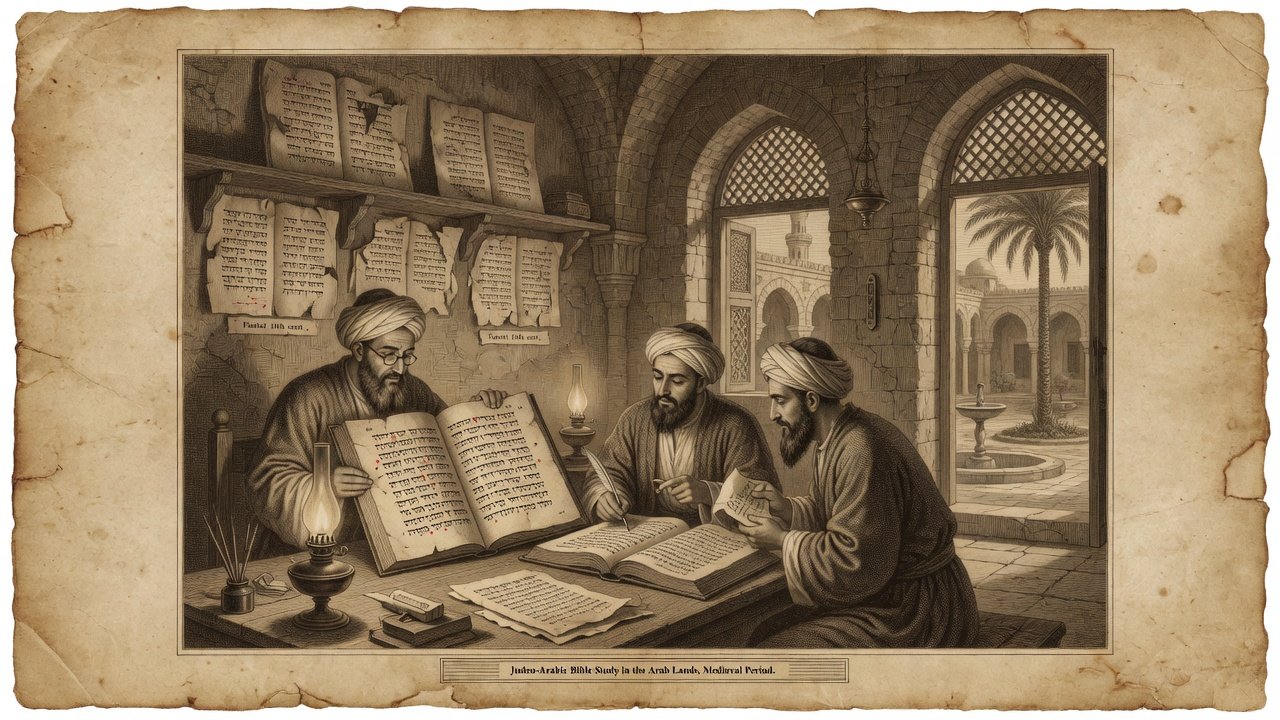
No region shaped medieval Jewish law and Bible culture more than Iraq. Under the Abbasids, Baghdad became the political hub of Babylonian Jewry while the academies of Sura and Pumbedita issued responsa that bound communities from the Maghreb to Central Asia. Every Geonic answer that quoted a biblical verse presupposed a stable, increasingly pointed Hebrew text—the same tradition Tiberian Masoretes were perfecting in the Land of Israel.
Saadia Gaon (882–942) stands as the paradigmatic Arab-land biblical intellectual: Gaon of Sura, philosopher, grammarian, and author of the Arabic Tafsir on the Torah written in Hebrew characters. His work made the Masoretic Bible speak to Arabic-fluent Jews and answered Karaite and Muslim critiques of rabbinic tradition. The broader Arabic influence on Jewish exegesis—and the bilingual world of Arabic and Hebrew—is inseparable from this Abbasid milieu.
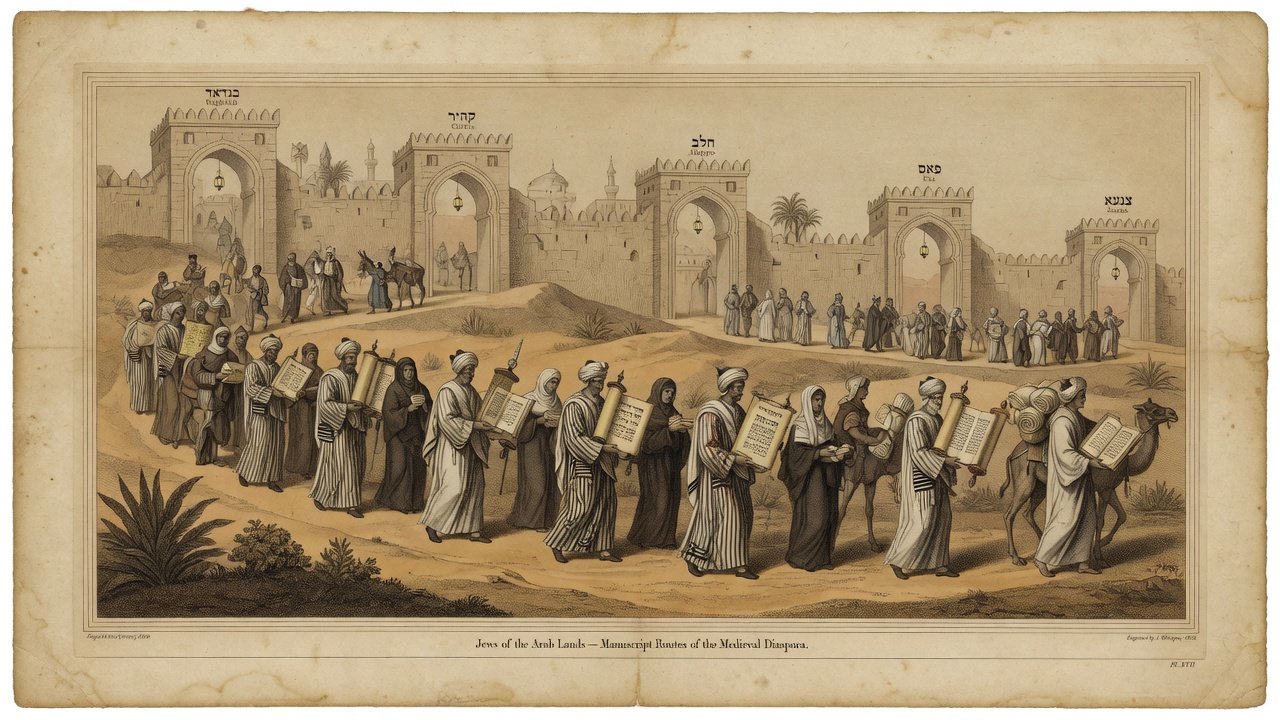
Benjamin of Tudela, traveling in the twelfth century, still found in Baghdad a large community, an honored Exilarch, and academies that projected authority far beyond Iraq. Genizah letters show Egyptian, North African, and Yemenite Jews writing to Babylonian authorities and circulating biblical and legal manuscripts along the same routes that carried silk and spices.
V. Egypt, Syria, and the Levantine Corridor
Cairo/Fustat became, after Baghdad’s medieval decline, the greatest documentary capital of Arab-land Jewry. The Cairo Genizah preserved biblical fragments in Tiberian, Babylonian, and Palestinian vocalization; children’s writing exercises; marriage contracts listing Bibles as property; and the everyday paperwork of a community that lived by the weekly parasha. Maimonides, settling in Fustat after Almohad exile, legislated standards for Torah scrolls that enshrined Ben Asher Masoretic norms for the wider Jewish world.
Syrian cities formed a manuscript corridor. Aleppo guarded the Aleppo Codex (Keter Aram Tzova) for centuries as a communal crown. Damascus preserved the Damascus Crown and the Damascus Pentateuch. Smaller centers such as Homs and Hama linked inland trade to the same liturgical calendar. These cities did not merely “store” books; they trained readers, paid scribes, and treated codices as legal and sacred witnesses.
VI. Maghreb, al-Andalus, and the Almohad Shock
North African Jewry—centered in places later known through notes such as Tunis, Algiers, Oran, and Casablanca—linked the Sahara and Atlantic to Egypt and Iberia. Kairouan was an early medieval beacon of learning; Fez and other Moroccan cities absorbed Andalusian refugees and later Spanish exiles. Maghrebi scripts, piyyutim, and derashot wove local custom into a shared Masoretic core.
Iberian cities under Muslim rule—Córdoba, Granada, Seville, Toledo (before and after Christian reconquest)—belong to the wider story of Jews under Islam even when modern labels say “Spain.” The Golden Age of Hebrew grammar and poetry flowered in Arabic-speaking courts; the Almohad persecution of the twelfth century then drove scholars such as Maimonides’ family into Maghrebi and Egyptian exile. After 1492, the expulsion from Spain and the rebuilding of Sephardi life in the Ottoman Empire reconfigured Arab-land communities yet again, blending Iberian rites with indigenous Mizrahi traditions.
VII. Yemen: Guardians on the Edge of Arabia
Yemenite Jewry developed one of the most conservative biblical cultures in the Jewish world. Scribes produced meticulously pointed Pentateuchs; oral reading traditions preserved phonological features of interest to modern Semitists; and Maimonidean legal allegiance coexisted with deep local custom (Baladi and Shami rites). Isolation was never absolute—Aden connected Yemen to Indian Ocean trade and to Egyptian and Iraqi books—but Yemen’s manuscript discipline made its Bibles a benchmark for later critical and communal editions.
Twentieth-century airlifts (notably Operation Magic Carpet, 1949–1950) transferred most of Yemen’s Jews to Israel, where their cantillation and scribal ethos entered national religious culture. The Yemenite case illustrates a pattern true across the Arab lands: political rupture could be sudden, but textual habits had been centuries in the making.
VIII. Ottoman Centuries: Stability, Hierarchy, and Mobility
From the sixteenth century, much of the Arabic-speaking world fell under the Ottoman Empire. Ottoman Jewish policy, shaped by the millet system and by the economic value of skilled subjects, generally allowed communal self-government while ranking Jews below Muslims in public hierarchy. Sephardi refugees from Iberia transformed Salonica, Istanbul, Izmir, and parts of the Arab provinces; indigenous Arabic-speaking communities continued in Baghdad, Damascus, Aleppo, Cairo, and the Maghreb (the latter under Ottoman, local, or, later, European control depending on the century).
Mobility increased. Merchants of Iraqi and Syrian origin built networks to India and East Asia; the Sassoon family, rooted in Baghdad, later produced the bibliophile David Solomon Sassoon, whose collection rescued medieval Hebrew Bibles for modern scholarship. Pilgrimage and charity linked Arab-land communities to the Old Yishuv in the Land of Israel. Through all of this, the weekly Torah reading and the prestige of accurate scrolls remained markers of communal honor.
IX. Colonial Modernity and the Alliance Israélite
Nineteenth- and early twentieth-century European expansion—French rule in Algeria (from 1830) and later Tunisia and Morocco, British influence in Egypt and Iraq, Italian rule in Libya—reordered Jewish life. The Crémieux Decree (1870) granted French citizenship to most Algerian Jews, legally separating them from Muslim neighbors. Elsewhere, Jews often became intermediaries in colonial economies, gaining schools and professions while attracting nationalist resentment.
The Alliance Israélite Universelle, founded in Paris in 1860, planted French-language schools from Morocco to Iran. Alliance classrooms taught modern subjects alongside Jewish studies, reshaping gender norms, dress, and aspirations. Traditional ḥeder and yeshiva cultures did not vanish, but a new bilingual elite emerged—Arabic or local dialects at home, French (or English) at school, Hebrew in liturgy and, increasingly, in Zionist youth movements.
Modernity also brought new vulnerabilities: blood libels such as the Damascus Affair (1840), press agitation, and the racial politics of late colonial and nationalist movements. Legal emancipation in some places coexisted with social exclusion in others; the dhimmi framework was formally abolished under colonial and nationalist law even as informal hierarchies persisted.
X. Nationalism, Zionism, and the Mid-Century Exodus
The collapse of Ottoman rule, the rise of Arab nationalisms, European antisemitism’s global echoes, and the Arab–Israeli conflict converged on Jewish communities that had little power to shape any of those forces. The Farhud in Baghdad (June 1941) killed and wounded hundreds and shattered Iraqi Jewish security. Pogroms and riots in Aden, Libya, Syria, and elsewhere accompanied the 1940s. After 1948, denationalization laws, property sequestrations, show trials, and popular violence accelerated emigration from Iraq, Yemen, Egypt, Libya, and Syria; Maghrebi departures peaked during decolonization in the 1950s–1960s.
Historians debate causation weights—Zionist pull versus antisemitic and nationalist push; colonial entanglement versus long-term dhimmi inequality—but the demographic outcome is not in doubt. Roughly 800,000–900,000 Jews left Arab and Muslim countries in the decades after 1948, the majority resettling in Israel, with significant communities in France, North America, and elsewhere. Ancient centers such as Baghdad, Sanaa, and Aleppo retained only tiny remnants or none at all.
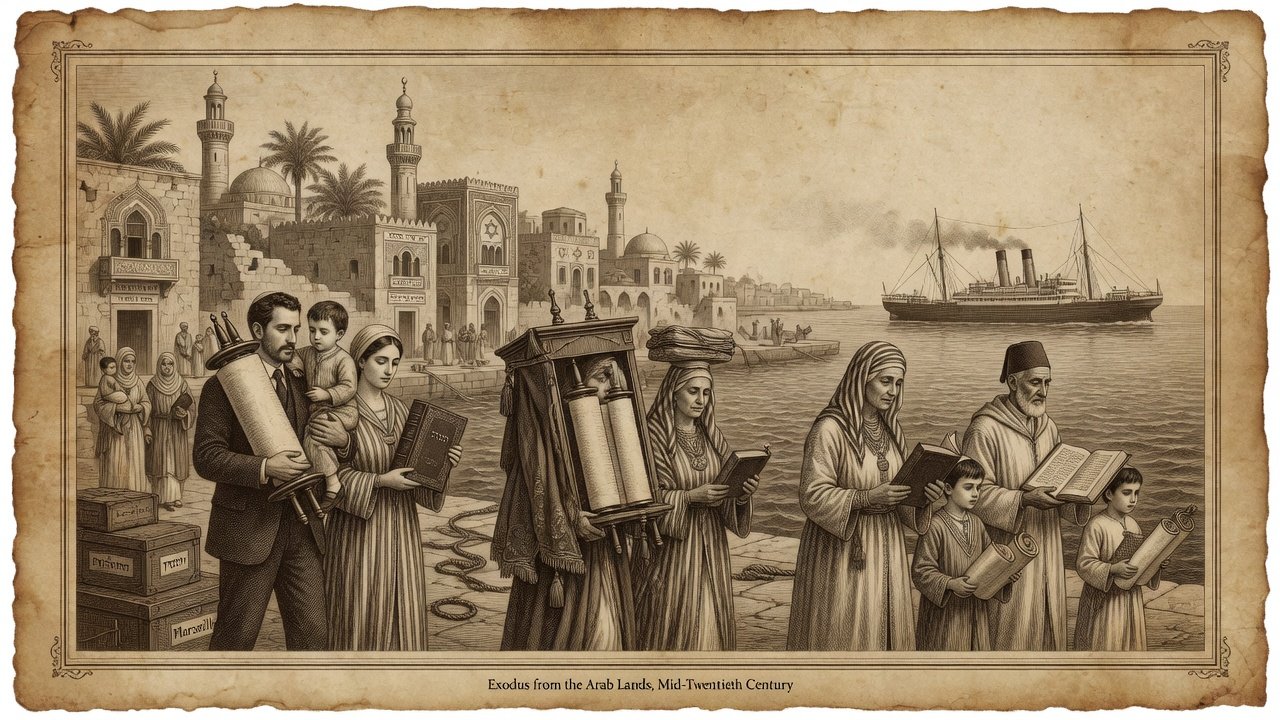
What traveled with the refugees was not only trauma but text: Torah scrolls, tikkun booklets, recorded cantillation, and family Bibles. Israeli and diaspora institutions became the new custodians of rites once tied to specific Arab cities—the same cities mapped on this site’s scholarship map.
XI. Languages, Liturgy, and the Masoretic Inheritance
Across the Arab lands, Jews typically spoke Arabic dialects (or Judeo-Arabic varieties written in Hebrew script), used Hebrew for Scripture and prayer, and retained Aramaic for Targum, legal phrases, and some liturgy. This trilingual ecology is explored further in notes on Hebrew and Aramaic, the survival of Hebrew, and the survival of Aramaic.
Liturgical diversity was enormous—Iraqi, Syrian, Yemenite, Moroccan, Tunisian, and Egyptian rites differed in piyyut, pronunciation, and melodic systems—yet nearly all communities treated the Tiberian Masoretic Text as the authoritative written Bible. Local vocalization memories (including traces of Babylonian pointing in some manuscripts) and distinctive teʿamim enriched, rather than replaced, that core. Rabbanite–Karaite debates, especially in medieval Iraq and Egypt, only raised the philological stakes of how Scripture was read; see Rabbanites and Karaites.
XII. Memory, Historiography, and Why It Matters for Bible Transmission
Post-exodus memory has been contested. Some narratives stress centuries of coexistence and cultural symbiosis; others stress structural inequality and recurrent violence. Serious history needs both structure and event: dhimmi law and Genizah commerce; Almohad terror and Abbasid patronage; Alliance schools and the Farhud. Comparative work also resists collapsing Maghrebi, Iraqi, Yemenite, and Egyptian experiences into one template.
For students of the Hebrew Bible’s transmission, the Arab lands are not peripheral. They hosted the Geonic defense of a stable text, the Judeo-Arabic opening of Scripture to Arabic speakers, the custodianship of the Aleppo Codex, the Genizah’s multi-vocalization fragments, Yemenite scribal precision, and Maghrebi–Sephardi grammatical traditions rooted in Arabic linguistic science. When modern editions such as the Mikraʾot Gedolot HaKeter or diplomatic editions based on the Aleppo and Leningrad codices reconstruct the Masoretic Text, they are still in conversation with communities that lived most of their history under Islam.