Tiberian Masorah
Moses ben David ben Naphtali
~860–875 listed differences
Mostly vowels & accents
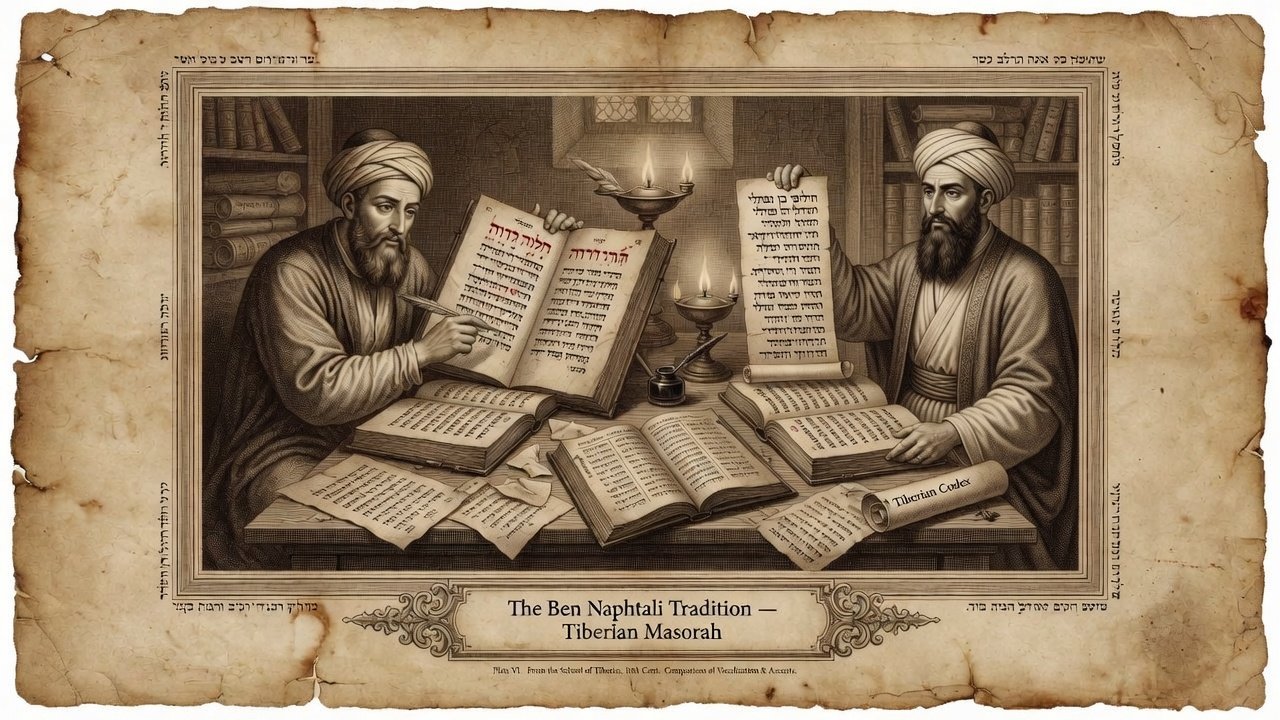
I. A Second Tiberian Voice
Popular introductions sometimes reduce Masoretic history to a single name: Ben Asher. That is historically understandable—Aaron’s system became the gold standard—but incomplete. Medieval Jewish scholarship preserved the memory of another authority, Ben Naphtali, who wrote (or whose school transmitted) a Bible with vowels, accents, and Masorah differing in specific respects from Aaron ben Moses ben Asher.
Those differences are not a second Hebrew Bible. They are almost entirely within the Tiberian pointing system: how a vowel is chosen, how an accent is placed, how a shewa or gaʿya behaves in edge cases. The consonants remain the shared Masoretic inheritance guarded by soferim and refined by the schools of Tiberias.
“Ben Naphtali wrote a Bible with vowels, accents, and Masorah, wherein he differed in some respects from his contemporary and rival, Aaron b. Moses ben Asher.” — Jewish Encyclopedia
II. Names and Identity
Sources refer to Ben Naphtali, Ben Naftali, and more fully to figures such as Moses ben David ben Naphtali (forms vary). As with many Masoretic “family” labels, the name can denote a person, a household workshop, or a branded reading tradition maintained by disciples. What medieval lists compare is less a modern genealogy than a profile of readings: “according to Ben Asher” versus “according to Ben Naphtali.”
He was a contemporary of Aaron ben Asher in the broad tenth-century window of Tiberian completion. Some evidence—especially readings in the circle of Moses ben Asher’s Cairo Prophets codex—suggests either contact between the schools or a shared older substrate that both refined differently.
III. How Many Differences—and of What Kind?
Standard surveys report on the order of 860–875 recorded differences between the two systems. Roughly nine-tenths concern minor vocalization and accentual choices; they rarely affect translation into other languages, and they almost never rewrite the consonants. A classic textbook example: Ben Asher’s consistent בְּיִשְׂרָאֵל (be-yisrael) versus Ben Naphtali’s בִּישְׂרָאֵל (bi-ysrael) for “in Israel”—same letters, different vowel strategy at the join.
Because the differences are fine, they are historically precious. They show a living laboratory in which experts could disagree without abandoning the project of a stable, pointed Bible.
IV. Rivalry, Subsystem, or Shared Inheritance?
Older handbooks speak of a “rivalry” between Ben Asher and Ben Naphtali. That language captures real competition for prestige. Yet M. H. Goshen-Gottstein cautioned that it may be “not too far from the truth to speak of two subsystems inside the Ben Asher family” and to treat the contrast as Ben Asher versus Ben Asher—variant refinements of one Tiberian enterprise rather than two foreign religions of the page.
Both metaphors help. Rivalry explains why lists of differences were compiled and taught. Subsystem explains why the two look so similar to anyone who has also studied Babylonian or Palestinian pointing. Relative to those other systems, Ben Asher and Ben Naphtali are siblings.
V. Manuscripts and Afterlives
No complete “Ben Naphtali codex” stands today as a simple counterpart to the Aleppo Crown. The tradition is reconstructed from difference lists, Masoretic notes, and readings embedded in manuscripts that are otherwise Ben Asher-leaning. The Cairo Prophets codex associated with Moses ben Asher has been discussed as containing readings attributed to Ben Naphtali—evidence of porous boundaries between workshops.
After the Middle Ages, printers and then critical editors standardized on Ben Asher. Ben Naphtali survived as a scholarly memory: a column in the apparatus of knowledge, a reminder that even the “final” Tiberian system had internal debate. For students of the Masoretic Text, that memory inoculates against the illusion that the pointed Bible fell from the sky in a single form.
VI. Why Ben Naphtali Still Matters
1. Philology — fine differences train the eye to see how niqqud and teʿamim encode grammar.
2. History of science — the Masoretes behaved like a research community with schools, not a monolith.
3. Humility about “the” text — even within the winning Tiberian tradition, excellence was argued.
4. Pairing with Ben Asher — reading both notes shows why Aaron’s system won without erasing the sibling who forced it to be precise.
Continue with Aaron ben Asher & family, Shlomo ben Buyaʾa, Aleppo Codex, and Who Were the Masoretes?.
Sources & Further Reading
| Work | Source | Relevance |
|---|---|---|
| Ben Naphtali | Wikipedia | Overview; scale of differences |
| Ben Naphtali | Jewish Encyclopedia | Rival Bible with vowels & Masorah |
| Aaron ben Moses ben Asher | Wikipedia / JE | Counterpart authority |
| Masoretic Text | Reference | Tiberian tradition context |
| Aaron ben Asher note | Masoretes site | Family & standard |
| Who Were the Masoretes? | Masoretes site | School overview |
| Aleppo Codex | Masoretes site | Ben Asher benchmark codex |