Antiquity–21st c. CE
Mashriq, Maghreb, Yemen, Iran, Caucasus
Hebrew, Aramaic, Judeo-Arabic, Judeo-Persian
Geonim, codex custodianship, oral traditions
I. Scope, Terms, and Historiography
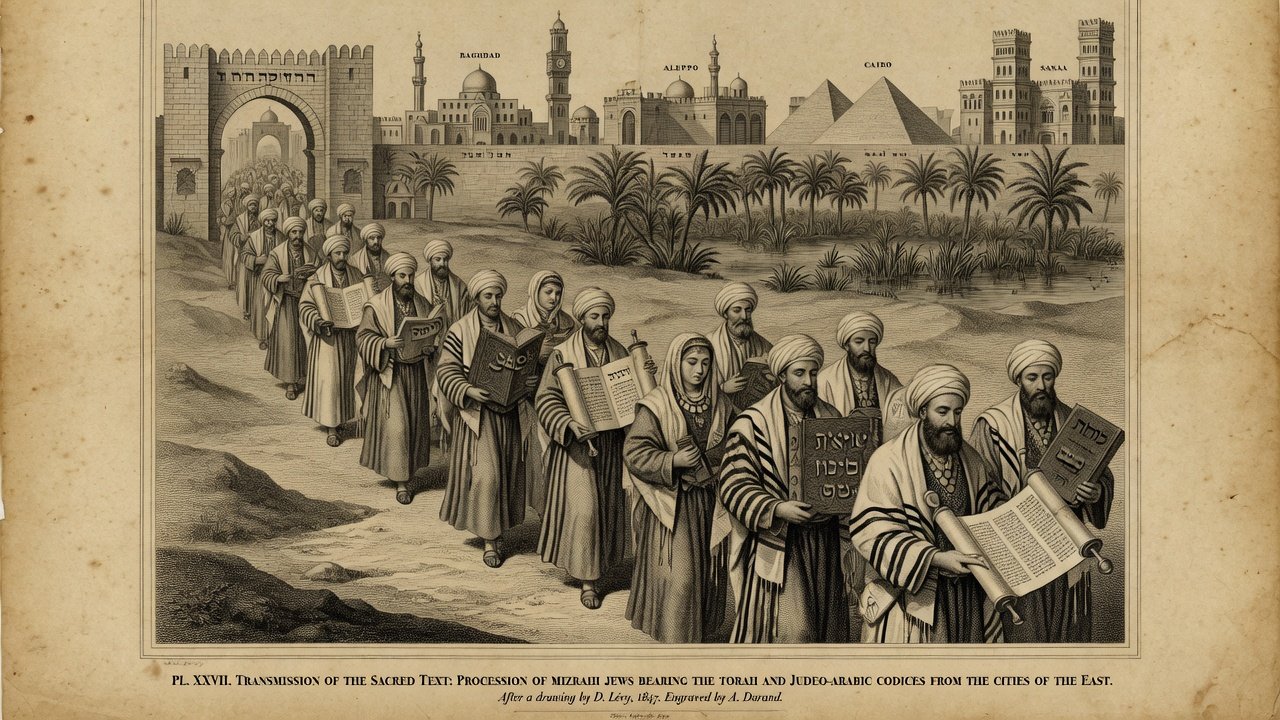
Mizrahi Jews (Hebrew Mizrahim, “Easterners”) is the modern umbrella for Jewish communities whose continuous history lies primarily in the Middle East, North Africa, and adjacent Asian lands—often under Islamic rule after the seventh century—as distinct from the medieval European trajectories of Ashkenaz and the Iberian-rooted trajectory of Sepharad. The word gained political and social force in twentieth-century Israel; historically, people identified by city, rite, and language: Baghdadi, Aleppine, Yemenite, Persian, Maghrebi, and many others.
Mizrahi is not identical to “Jews of the Arab lands,” though the categories heavily overlap. Persian, Kurdish, Georgian, Bukharan, and Mountain (Caucasus) Jews are often grouped with Mizrahim; some Maghrebi communities are simultaneously “Sephardi” by rite after 1492. This note stresses local specificity and biblical–textual culture: Geonic academies, Judeo-Arabic translation, Yemenite Masorah, Levantine codex guardianship, and the mid-twentieth-century exodus. See also Jews of the Arab Lands, MENA, Middle East, and North Africa.
“Mizrahi Jewry is not a single exile story told from Europe’s edge. It is a family of ancient diasporas that kept the pointed Hebrew Bible alive under caliphs, sultans, and shahs—and then rebuilt that life in new lands.”
II. Antiquity and the Islamic Centuries
Jewish communities in Mesopotamia, the Levant, Egypt, Arabia, Persia, and North Africa long predate Islam. Babylonian Jewry produced the Babylonian Talmud and, in the Geonic age, the academies of Sura and Pumbedita that answered legal queries across the Islamic world. Egyptian Jewry remembered Hellenistic Alexandria and later Fustat; the Cairo Genizah preserves their letters, Bibles, and Judeo-Arabic literature. Yemenite tradition claims deep antiquity and preserved distinctive pronunciation and scribal habits into the modern period.
After the Arab-Muslim conquests, most of these communities lived as dhimmis—protected but subordinated non-Muslims—under varying enforcement. Periods of relative prosperity (for example under certain Abbasid and Fatimid rulers) alternated with persecution (notably Almohad North Africa and Iberia, treated also in the Almohad note). Throughout, synagogue reading of the Torah scroll and study of the vocalized codex remained communal anchors.
| Period | Political frame | Textual landmark |
|---|---|---|
| Biblical–late antique | Empires of the Near East; Rome; Sasanian Iran | Exile communities; Talmud; early diaspora liturgy |
| Geonic–classical Islamic (7th–12th c.) | Caliphates; regional dynasties | Geonim; Judeo-Arabic; Masoretic consolidation |
| Mamluk–Ottoman–Safavid (13th–18th c.) | Sultanates & empires | Codex custodianship; local rites; print arrives unevenly |
| Colonial–national (19th–21st c.) | European empires; nation-states; Israel | Alliance schools; mass exodus; Israeli integration |
III. Geonim, Judeo-Arabic, and the Masoretic Text
The Geonim of Babylonia standardized much of rabbinic practice for communities from Spain to Yemen. Saadia Gaon modeled Judeo-Arabic Bible translation and philosophical defense of tradition. Meanwhile, the Tiberian Masoretes fixed the vocalization and accentuation that most communities—Mizrahi included—came to treat as the authoritative pointed text, even when local oral pronunciation diverged.
Great codices associated with the Near East—the Aleppo Codex, relatives of the Ben Asher tradition, and later community crowns such as the Damascus Crown—were guarded in Levantine and Egyptian settings. Maimonides, writing in Fustat after Almohad exile, treated a Ben Asher codex as a model for scroll norms. Mizrahi Bible culture is thus not peripheral to Masoretic history; it is one of its custodial heartlands.
IV. Major Subdivisions of Mizrahi Jewry
The following clusters are analytical; real communities used local names and sometimes rejected umbrella labels.
| Subdivision | Core areas | Notes for Bible culture |
|---|---|---|
| Babylonian / Iraqi | Baghdad, Basra, northern Iraq | Geonic legacy; Baghdadi mercantile diasporas to India & East Asia; strong Talmudic schools |
| Syrian / Levantine | Aleppo, Damascus, Beirut hinterlands | Codex guardianship; Aleppo & Damascus crowns; trade-route learning |
| Egyptian | Fustat/Cairo, Alexandria | Genizah archive; Maimonidean center; Mediterranean print & schools |
| Yemenite (Temani) | Sanaa and Yemeni highlands/coasts | Distinct pronunciation & scribal traditions; late mass aliyah (Magic Carpet) |
| Persian / Iranian | Isfahan, Tehran, Shiraz, and provinces | Judeo-Persian literature; continuous presence under shahs |
| Kurdish Jews | Kurdistan (Iraq, Iran, Turkey, Syria zones) | Neo-Aramaic speech in places; local minhagim |
| Maghrebi (pre- and post-Sephardi mix) | Morocco, Algeria, Tunisia, Libya | Indigenous Toshavim + Sephardi megorashim after 1492; rich piyyut & humash culture |
| Bukharan | Central Asia (Bukhara, Samarkand region) | Persianate Jewish culture; later Soviet & Israeli chapters |
| Georgian & Mountain (Kavkazi) Jews | Georgia; eastern Caucasus | Long local histories; languages distinct from Yiddish/Judeo-Arabic |
| Indian communities (partial overlap) | Bene Israel, Cochin; Baghdadi colonies | Multiple origin stories; Baghdadi layer is Iraqi-Mizrahi diaspora |
In Israeli sociology, “Mizrahi” sometimes functions as a broad non-Ashkenazi category that includes many Sephardi-identifying families from North Africa and the Balkans. Historians usually keep rite, language, and geography distinct even when social labels merge.
V. Languages and Liturgy
Sacred literacy used Hebrew and Aramaic. Vernaculars included Judeo-Arabic dialects, Judeo-Persian, Judeo-Aramaic varieties, Berber-influenced Jewish speech in parts of the Maghreb, and later French, English, or Hebrew through colonial and Israeli schooling. Liturgical rites vary: many Middle Eastern communities follow forms related to the Sephardi rite after early modern standardization, while Yemenite prayer and Torah reading preserve highly distinctive features.
Cantillation and pronunciation encode Masoretic accents differently across Yemen, Iraq, Syria, and the Maghreb. Comparative study of these oral traditions is a living laboratory for how the same Tiberian signs were performed far from Tiberias.
VI. Ottoman, Qajar, and Colonial Modernity
Under the Ottomans, Jewish communities of the Mashriq and Maghreb navigated millet structures, local notables, and growing European consular influence. Printing, Alliance Israélite Universelle schools, and new professions reshaped Bible pedagogy without always displacing traditional heders and synagogues. In Iran, Jewish life continued under Qajar and later Pahlavi states with its own modernization path. Maghrebi Jewry under French and Italian colonial rule saw rapid Francophone education alongside enduring Judeo-Arabic folk and liturgical culture.
City notes on this site—from Baghdad, Aleppo, and Cairo to Sanaa, Tunis, and Casablanca—trace how local soferim, rabbis, and schools handled the Masoretic page in these centuries.
VII. Exodus and Reconstitution (c. 1948–1970s)
The mid-twentieth century saw the departure—often under pressure, expropriation, or violence—of the vast majority of Jews from Arab countries and other Muslim-majority states. Hundreds of thousands resettled in Israel; others went to France, Britain, North America, and elsewhere. The result was a near-emptying of ancient communities and a reconstitution of Mizrahi life in new political contexts, especially the Israeli state, where ethnic hierarchies and cultural revival movements shaped identity politics for generations.
Manuscripts, crowns, and family Bibles sometimes traveled with refugees; others were lost, sold, or remain contested. The scholarly recovery of Genizah fragments, Yemenite codices, and communal archives continues to rewrite European-centered narratives of Jewish history.
VIII. Mizrahim and the Transmission of Scripture
Mizrahi communities contributed decisively to biblical transmission:
- Geonic and local legal authority over scroll and public reading;
- Custodianship of major Tiberian-tradition codices in the Levant and Egypt;
- Judeo-Arabic translations and grammars that taught sense alongside sound;
- Yemenite and other oral traditions preserving fine phonetic detail;
- Modern Israeli and diaspora institutions that reprint, record, and teach these traditions.
Any history of the Masoretic Text that skips Baghdad, Tiberias’s hinterland, Fustat, Aleppo, and Sanaa is incomplete.
IX. Relation to Sephardi and Ashkenazi Jewry
Sephardi exiles after 1492 settled among older Middle Eastern and North African communities, producing hybrid cultures (especially in the Maghreb and Ottoman ports). Ashkenazi encounter intensified through modern ideologies, European schools, and Israeli state institutions. Today the three labels—Ashkenazi, Sephardi, Mizrahi—operate simultaneously as ancestry, rite, and social categories. This site’s triad of encyclopedic notes keeps the historical paths distinct while linking them through shared Scripture.
XI. Print, Alliance Schools, and Modern Hebrew
Nineteenth-century print and Alliance Israélite Universelle schools restructured Mizrahi biblical pedagogy from Baghdad to Casablanca. French, English, or Italian literacy entered alongside Hebrew; modern textbooks supplemented heder methods. Zionist Hebrew education added national ideology to older synagogue literacy. These changes did not erase local cantillation; they layered new literacies onto the same Tiberian signs.
XII. Women and Domestic Scripture
Judeo-Arabic storytelling, women’s liturgical poetry in some regions, and later girls’ schools expanded who could access biblical narrative. Colonial and Israeli education further increased female literacy in Hebrew prayer and Tanakh study. Domestic transmission—Sabbath table discussion, festival preparation—remains a major channel of Mizrahi biblical culture.
XIII. Historiography and the Politics of the Category
“Mizrahi” as a pan-ethnic Israeli category can obscure differences among Yemenite, Iraqi, Moroccan, and Iranian Jews. Scholars urge local archives and languages; activists reclaim dignity against historic discrimination in Israeli society. For biblical studies, the corrective is clear: Masoretic history must be written from Sanaa, Baghdad, and Fez as seriously as from Vilna and Berlin.
XIV. Contemporary Transmission
Israeli schools teach Tanakh to all citizens; Mizrahi piyyut revivals, Yemenite cantillation schools, and Maghrebi heritage synagogues keep oral branches alive. Diaspora communities in France, the UK, Canada, and the US sustain Judeo-Arabic and Hebrew liturgical cultures. Codices once guarded in Aleppo or Cairo now inform critical editions and public memory—sometimes through trauma narratives of loss and recovery.