Luzhki (Belarus) to Jerusalem
Raised son Ittamar Ben-Avi in Hebrew
Monumental 16-Volume Lexicon
British Mandate recognized Hebrew
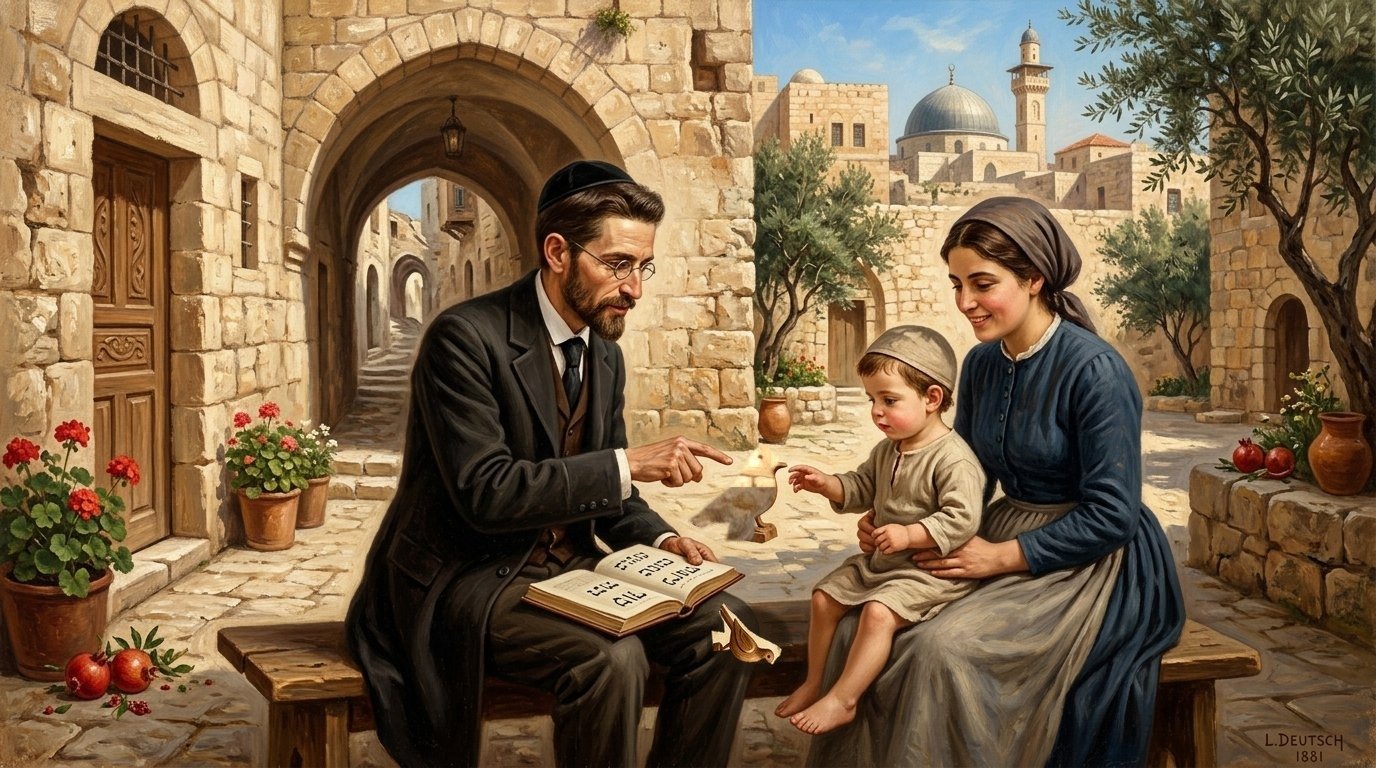
Eliezer Ben-Yehuda and Devora Jonas in their sunlit Jerusalem courtyard teaching young Ben-Zion (Ittamar Ben-Avi) his first Hebrew words, establishing history's first modern Hebrew-speaking home.
1. The Impossible Vision: A Language Without Speakers
In the late nineteenth century, the proposition that עִבְרִית (Hebrew) could once again be spoken as the everyday language of markets, children, kitchens, and laboratories was universally regarded by European philologists and Jewish intellectuals as an absurd impossibility. For nearly eighteen centuries—following the crushing of the Bar Kokhba Revolt in 135 CE—Hebrew had ceased to be a spoken mother tongue. It had survived with astonishing vitality, but strictly as a *Lashon Ha-Kodesh* (לְשׁוֹן הַקֹּדֶשׁ), the sacred language of liturgy, rabbinic disputation, poetry, and transnational correspondence.
Jewish communities from Warsaw to Baghdad and Sana'a read the Torah in Hebrew, corresponded across continents in rabbinic Hebrew, and prayed in the Tiberian vocalization perfected by the Masoretes. Yet no child uttered Hebrew as their first word, no merchant bartered in Hebrew on the street, and no domestic household conducted its daily arguments in the tongue of the prophets. The great linguist Theodor Nöldeke famously declared that Hebrew could no more be revived as a spoken vernacular than classical Latin or ancient Egyptian.
2. Early Life, Yeshiva Roots & Haskalah Awakening (1858–1877)
Eliezer Yitzhak Perlman was born on January 7, 1858, in the small shtetl of Luzhki in the Vilna Governorate of the Russian Empire (modern-day Belarus). Raised in a devout Hasidic family, he displayed extraordinary precocity in Talmudic studies. Following the death of his father Yehuda Leib when Eliezer was five, his uncle sent him to the prestigious Yeshiva of Polotsk at age thirteen to prepare for the rabbinate.
At Polotsk, the young Eliezer encountered the head of the yeshiva, Rabbi Joseph Blucker, who was secretly a sympathizer of the Jewish Enlightenment (הַשְׂכָּלָה, Haskalah). Blucker introduced Perlman to modern secular Hebrew literature, including Hebrew translations of world classics and the pioneering Hebrew grammar of Samuel David Luzzatto (Shadal). Reading Daniel Defoe's Robinson Crusoe rendered into Biblical Hebrew by Isaac Mordecai Jost was an electrifying revelation: Hebrew was capable of describing the physical world, ocean voyages, tools, and human solitude.
Expelled when his uncle discovered his secular reading, Eliezer relocated to Dunaburg (Daugavpils) to complete his gymnasium education. There he met Samuel Jonas, an enlightened merchant whose cultured home opened the worlds of Russian literature, French philosophy, and European national liberation movements. Jonas's daughter, Devora Jonas, became Eliezer's intellectual soulmate and future wife.
3. The 1879 Manifesto & The Paris Epiphany
The turning point in Ben-Yehuda's consciousness arrived during the Balkan Crisis and Russo-Turkish War (1877–1878). Watching the Bulgarians and Serbians rise to reclaim their national sovereignty and ancient languages from the Ottoman Empire, a lightning bolt of realization struck the nineteen-year-old:
In 1878, Perlman moved to Paris to study medicine at the Sorbonne, intending to acquire a practical skill for life in Ottoman Palestine. In Paris, he penned his historic ideological manifesto, She'elah Nikhbadah ("A Weighty Question"), published in 1879 in Peretz Smolenskin's prestigious Vienna-based Hebrew periodical Ha-Shahar. Writing under the pen name Eliezer Ben-Yehuda ("Eliezer, Son of Judah"), he articulated the radical thesis that a political national revival was meaningless without a shared living tongue.
In a Parisian boulevard café, Ben-Yehuda engaged in a historic conversation with Getzel Zelikovitz, a fellow scholar from Lithuania. For hours, the two young men conducted a dialogue exclusively in spoken Hebrew. As words for modern utensils and abstract ideas failed them, they improvised from Biblical roots. Ben-Yehuda realized with exhilarating clarity that spoken Hebrew was not merely a theoretical ideal—it could physically flow from human lips in real time.
4. The Monolingual Household in Jerusalem (1881–1890)
Diagnosed in Paris with pulmonary tuberculosis and given only a few months to live, Ben-Yehuda abandoned his medical studies to dedicate his remaining strength to Jerusalem. In 1881, he met Devora in Cairo, where they were married, and together they sailed to Jaffa, arriving in Ottoman Jerusalem in October 1881.
Upon arrival, Ben-Yehuda instituted a solemn covenant in their stone home in the Old City of Jerusalem: no language other than Hebrew would cross their threshold. This was a decree of unimaginable severity. Jerusalem in 1881 was a Babel of Yiddish, Ladino, Arabic, Turkish, French, Russian, and German. To insist on speaking solely a language that lacked words for "ice cream," "towel," "bicycle," "sidewalk," or "post office" required fanatical resolve.
In 1882, Devora gave birth to their first child, Ben-Zion Ben-Yehuda (later known as the writer and journalist Ittamar Ben-Avi). Ben-Zion became history's great linguistic experiment: the first native Hebrew speaker in nearly two thousand years. Ben-Yehuda forbade any visitor from speaking to the infant in any language other than Hebrew. When friends or curious scholars visited, Ben-Yehuda covered the child's ears if non-Hebrew words were uttered. Until the age of four, Ben-Zion did not speak a single word, prompting fears of developmental delay, until one day, in a burst of emotion, he uttered his first full Hebrew sentence to his mother.
5. The Fierce Conflict with the Old Yishuv & The Excommunication (Cherem)
Ben-Yehuda's campaign triggered furious opposition from the Ultra-Orthodox leadership of the Old Yishuv (הַיִּשּׁוּב הַיָּשָׁן) in Jerusalem. For centuries, traditional rabbis had revered Hebrew as the pristine language of God, angels, and the Torah. To use this holy tongue for secular commerce, ordering meat, chastising servants, or writing romantic poetry was condemned as grotesque sacrilege and desecration (חִלּוּל הַקֹּדֶשׁ).
The rabbinical court placed Ben-Yehuda and his household under repeated religious bans of excommunication (חֵרֶם, Cherem). Fanatics threw stones at his windows, spat at his wife in the narrow cobblestone alleyways, and plastered the walls of Jerusalem with denunciatory posters (*pashkevilim*). In 1891, tragedy struck: Devora died of tuberculosis at age thirty-six, followed shortly by three of their young children in an epidemic of diphtheria. The burial society (*Chevra Kadisha*) initially refused to bury Devora on the Mount of Olives, demanding payment of extortionate fines from the "heretic."
In 1893, opponents seized upon an article in Ben-Yehuda's newspaper Ha-Zvi celebrating Hanukkah, falsely translating the phrase "let us gather strength and go forward" to the Ottoman governor as a seditious call for armed Jewish insurrection against the Sultan. Ottoman gendarmes raided his home, arrested Ben-Yehuda, and threw him into the central prison in Jerusalem. He was sentenced to a year's imprisonment before European Jewish intervention secured his release on appeal.
Devora's younger sister, Paula Jonas, who took the Hebrew name Hemda Ben-Yehuda, arrived from Russia to marry Eliezer and care for the surviving children. Hemda became an essential intellectual partner, managing the household, writing for the newspaper, and helping finance the massive lexicographical project.
6. The Lexicographical Feat: Creating the Modern Hebrew Vocabulary
To transform Hebrew from a liturgical script into a functional national language, Ben-Yehuda had to bridge a vocabulary deficit spanning nearly two millennia of human technological, scientific, and cultural evolution. In 1890, he co-founded the Hebrew Language Committee (וַעַד הַלָּשׁוֹן הָעִבְרִית, Va'ad HaLashon Ha'Ivrit), which later evolved into the Academy of the Hebrew Language.
Ben-Yehuda developed rigorous philological principles for creating neologisms (חִדּוּשֵׁי מִלִּים):
- Extraction of Dormant Biblical & Talmudic Roots: Searching the Tanakh, Mishnah, Tosefta, Midrash, and Geonic responsa for forgotten roots and extending their semantic range.
- Exploitation of Semitic Verbal Molds (Mishkalim): Applying classical morphological patterns. For example, the instrument pattern מִקְטָל / מִקְטֶלֶת yielded words like מִבְרֶשֶׁת (mivreshet, brush) and מַזְלֵג (mazleg, fork).
- Cognate Borrowing from Arabic: Leveraging Arabic as a sister Semitic language possessing an unbroken living vocabulary. When Hebrew lacked a root, Ben-Yehuda adapted Arabic roots into Hebrew phonology (e.g., גְּזִיזָה from Arabic jaza).
Words Coined by Eliezer Ben-Yehuda
Everyday Hebrew words invented or popularized by Ben-Yehuda that form the backbone of modern conversational speech:
Dictionary (from מִלָּה, word)
Newspaper (from עֵת, time)
Bicycle (from אוֹפַן, wheel)
Restaurant (from סְעוּדָה, meal)
Doll / Toy puppet
Omelette
Ice Cream (from Aramaic גְּלִידָא, frost)
Train (from רֶכֶב, chariot)
Eyeglasses (from שָׁקַף, to look)
For four decades, Ben-Yehuda worked standing up at a high drafting desk for eighteen hours a day, indexing every single occurrence of every Hebrew word across thousands of manuscripts. His life's work culminated in the monumental 16-volume Complete Dictionary of Ancient and Modern Hebrew (מִלּוֹן הַלָּשׁוֹן הָעִבְרִית הַיְּשָׁנָה וְהַחֲדָשָׁה), a masterwork spanning thousands of pages of historical lexicography.
7. The 1913 War of the Languages (Milhemet HaSafot)
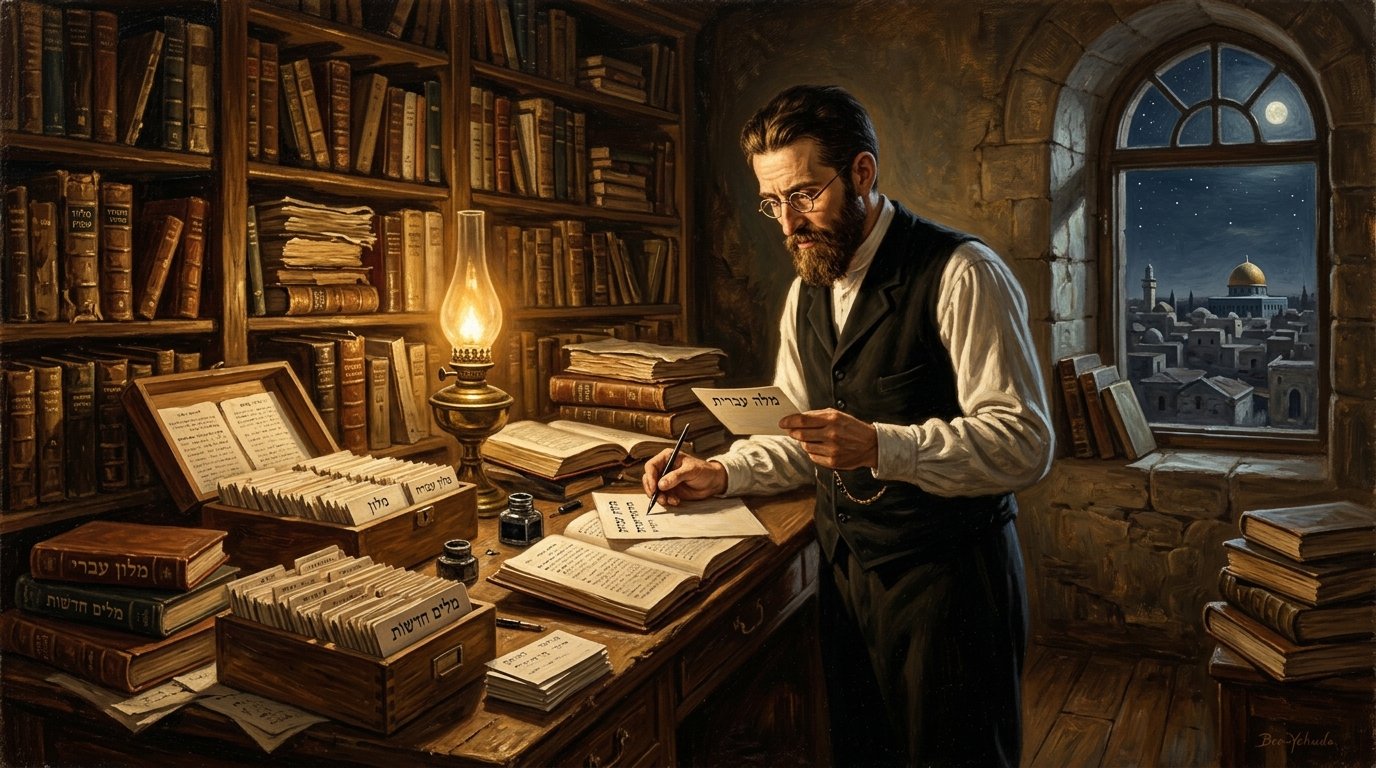
Ben-Yehuda standing late at night at his tall wooden drafting desk under kerosene lamplight, classifying thousands of handwritten index cards to compile the monumental dictionary of the Hebrew language.
By 1913, Hebrew had established itself in kindergarten and primary schools across the agricultural settlements (*moshavot*). However, a dramatic showdown erupted over higher education in the famous War of the Languages (מִלְחֶמֶת הַשָּׂפוֹת).
The German-Jewish philanthropic agency Hilfsverein der deutschen Juden was financing the construction of the country's first technical university, the Technion in Haifa. In October 1913, the board of trustees resolved that higher sciences and engineering would be taught exclusively in German, claiming Hebrew lacked the technical vocabulary for modern engineering.
The decision triggered a national explosion. Supported by Ben-Yehuda, the Hebrew Teachers' Association proclaimed a total strike. Students marched through the streets of Haifa, Jaffa, and Jerusalem; teachers resigned en masse from German-supported schools; and pioneering engineers rushed to create Hebrew terminology for physics, calculus, thermodynamics, and chemistry. In February 1914, the board capitulated: Hebrew was declared the sole language of instruction at the Technion. The victory proved decisively that Hebrew was capable of serving as the medium of modern global science and technology.
8. Final Triumphs, Official Recognition (1922) & Enduring Legacy
Following the British conquest of Palestine in World War I, Ben-Yehuda lobbied the first High Commissioner, Sir Herbert Samuel. On September 1, 1922, the British Crown issued the Palestine Order-in-Council, officially declaring Hebrew, English, and Arabic as the three official languages of Mandatory Palestine. For the first time since the Roman destruction of Judea, Hebrew possessed sovereign legal status.
Three months later, on December 16, 1922, Eliezer Ben-Yehuda succumbed to his lifelong struggle with tuberculosis at the age of sixty-four. His state funeral in Jerusalem was attended by over 30,000 mourners—nearly the entire Jewish population of the city. He was laid to rest on the Mount of Olives overlooking the Old City walls where he had begun his solitary campaign forty-one years earlier.
Following his death, his wife Hemda Ben-Yehuda and the philologist Professor Naftali Herz Tur-Sinai continued the mammoth dictionary project, publishing the final sixteenth volume in 1959. Today, Modern Hebrew is spoken by over nine million people worldwide as a mother tongue, vibrant vernacular, and the language of Nobel Prize-winning literature, global high-tech innovation, and daily cultural life.
References & Scholarly Bibliography
- Ben-Yehuda, Eliezer. A Complete Dictionary of Ancient and Modern Hebrew (16 vols.). Berlin & Jerusalem: Langenscheidt & Hemda Ben-Yehuda, 1908–1959.
- Ben-Avi, Ittamar. With the Dawn of Our Freedom: The Memoirs of the First Hebrew Child. Tel Aviv: Hotza'at Ivrit, 1961.
- Fellman, Jack. The Revival of a Classical Tongue: Eliezer Ben-Yehuda and the Modern Hebrew Language. The Hague: Mouton, 1973.
- Harshav, Benjamin. Language in Time of Revolution. Berkeley: University of California Press, 1993.
- Zuckermann, Ghil'ad. Revivalistics: From the Genesis of Israeli Hebrew to Language Reclamation in Australia and Beyond. Oxford: Oxford University Press, 2020.
- Rabin, Chaim. A Short History of the Hebrew Language. Jerusalem: Orot, 1973.
- St. John, Robert. Tongue of the Prophets: The Life Story of Eliezer Ben-Yehuda. New York: Doubleday, 1952.