Consonantal sofer
Aleppo Codex (~920)
Aaron ben Asher
Ketav ashuri, exact spacing
I. Why a Sofer’s Name Matters
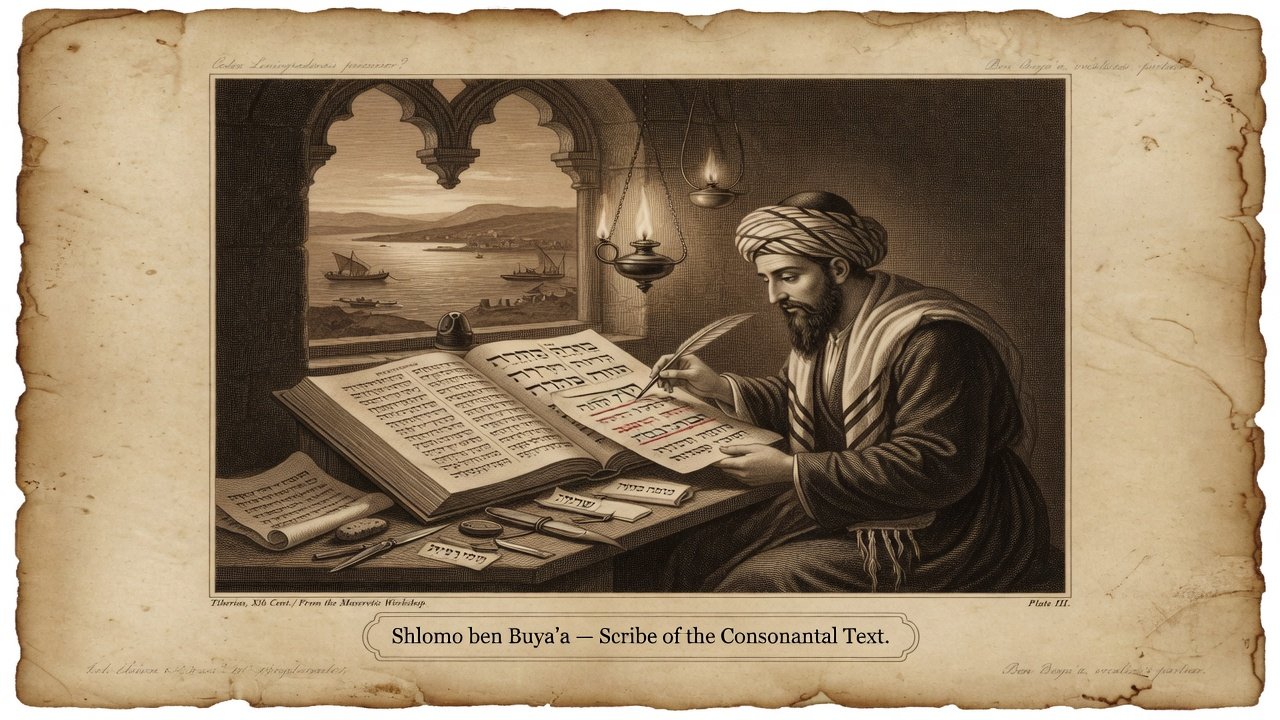
Most medieval Hebrew Bibles reach us without a signed consonantal scribe. Shlomo ben Buyaʾa is different. Colophonic and historical tradition identify him as the copyist who wrote the letters of the codex later known as the Keter Aram Tzova—the Aleppo Codex—in Palestine circa 920 CE. Aaron ben Moses ben Asher then examined, pointed, accented, and annotated that consonantal base. The partnership models the ideal division of labor in high Masoretic production: a sofer who does not invent text, and a Masorete who does not rewrite letters, but binds reading tradition to the page.
To understand the Masoretic Text as a living technology, one must see both crafts. This note focuses on the first: the man who made the black fire of the letters before the white fire of the pointing.
“Ben Buyaʾa was responsible for the lettering, while Ben Asher… added the notes. These notes are what made the Aleppo Codex the most authoritative Hebrew Bible of the Middle Ages.” — scholarly summary of the Tiberian partnership
II. Name, Place, and Dating
English sources write Solomon ben Buyaʾa, Shlomo ben Buyaʾa, or ben Buyaʿa. Hebrew orthography preserves שלמה בן בויאעא (forms vary slightly in modern transcription). He worked in the Land of Israel in the early tenth century, within the orbit of the Tiberian Masoretic schools that also produced the Ben Asher dynasty.
Dating follows the codex’s production history: consonants c. 920; Aaron ben Asher’s completion of vocalization and Masorah around 930. The codex did not become the “Aleppo” Crown until centuries later, when it was transferred to the Syrian community that guarded it until the twentieth century—a story told in notes on the Crown of Aleppo and Aleppo Codex (Friedman).
| Stage | Agent | Contribution |
|---|---|---|
| c. 920 | Shlomo ben Buyaʾa | Consonantal text of the whole Hebrew Bible |
| c. 930 | Aaron ben Moses ben Asher | Verification, niqqud, teʿamim, Masorah |
| Medieval–modern | Jerusalem / Aleppo custodians | Communal guardianship of the Crown |
| Post-1947 | Surviving leaves & scholarship | Reconstruction, photography, critical use |
III. The Craft of the Consonantal Codex
A sofer writing a codex (book form, not a synagogue scroll) still obeyed the grammar of soferim culture: square script (ketav ashuri), careful spacing, open and closed paragraphs (petuḥot and setumot), and the refusal to “improve” unusual spellings that tradition had fixed. What changes in the codex format is layout for study—columns designed to receive vowels, accents, and marginal Masorah without crowding the sacred line.
Shlomo’s work therefore had to be both beautiful and machine-ready for annotation. Too loose a line wastes parchment; too tight a line leaves no room for teʿamim. The Aleppo Codex’s surviving leaves show why later authorities trusted it: the consonants look like a deliberate invitation to the Masorete’s second pass.
IV. Partnership with Aaron ben Asher
The fame of the Aleppo Codex rests on collaboration. Britannica’s classic formulation states that the codex was “written by Solomon ben Buyaʾa” and “corrected, punctuated, and furnished with a Masoretic apparatus by Aaron ben Moses ben Asher about 930.” That sequence—write, then verify and point—matches how high-end Tiberian books were produced: the sofer’s responsibility ends where the Masorete’s begins, and mutual checking binds them.
Without Ben Buyaʾa, Ben Asher would have had no page; without Ben Asher, Ben Buyaʾa’s letters would have remained an unpointed monument. Modern editions that privilege Ben Asher readings are therefore also, silently, privileging the scribal quality of the base he chose to annotate. See the companion note on the Ben Asher family for the second half of the story.
V. From Tiberias to Aleppo and Modern Memory
The codex’s later biography—Jerusalem, transfer to Aleppo, veneration as the community’s Crown, damage in 1947, and the incomplete survival of leaves—belongs to communal and modern history more than to Shlomo’s lifetime. Yet every reconstruction of missing pages, every comparison with the Leningrad Codex, and every appeal to Maimonides’ preference for a Ben Asher codex returns to the same origin: a tenth-century sofer who wrote a Bible worthy of the most careful Masorah ever applied.
In popular language Shlomo is sometimes called “the swift scribe,” a nickname that should not be misread as haste. Speed in sofer culture meant trained fluency—hours of controlled motion without loss of form—not careless hurry. The surviving script argues for stamina and discipline, not haste.
VI. Place in the Craft Chain
Shlomo stands between the anonymous soferim of earlier centuries and the named Masoretes of Tiberias. He is not remembered for inventing a pointing system; he is remembered for writing a text that could carry one. That is why this site pairs his note with Soferim, Nakdanim, Who Were the Masoretes?, and the codex studies. Transmission is a relay: letters, then vowels, then communities that refuse to lose either.
Sources & Further Reading
| Work | Source | Relevance |
|---|---|---|
| Aleppo Codex | Wikipedia | Production history; ben Buyaʾa as sofer |
| Solomon ben Buyaʾa | Britannica | Consonants + Ben Asher apparatus |
| Aleppo Codex note | Masoretes site | Full codex history |
| Aaron ben Asher | Masoretes site | Vocalizer & family |
| Soferim | Masoretes site | Consonantal craft norms |
| Maimonides | Masoretes site | Legal reception of Ben Asher codex |
| Jewish Review of Books | Essay | Ben Buyaʾa & Ben Asher partnership |