Roman/Byzantine era–21st c.
Greece, southern Balkans, historically Constantinople orbit
Yevanic (Judeo-Greek), Greek, Hebrew
Romaniote rite; Greek vernacular gloss; later Sephardi contact
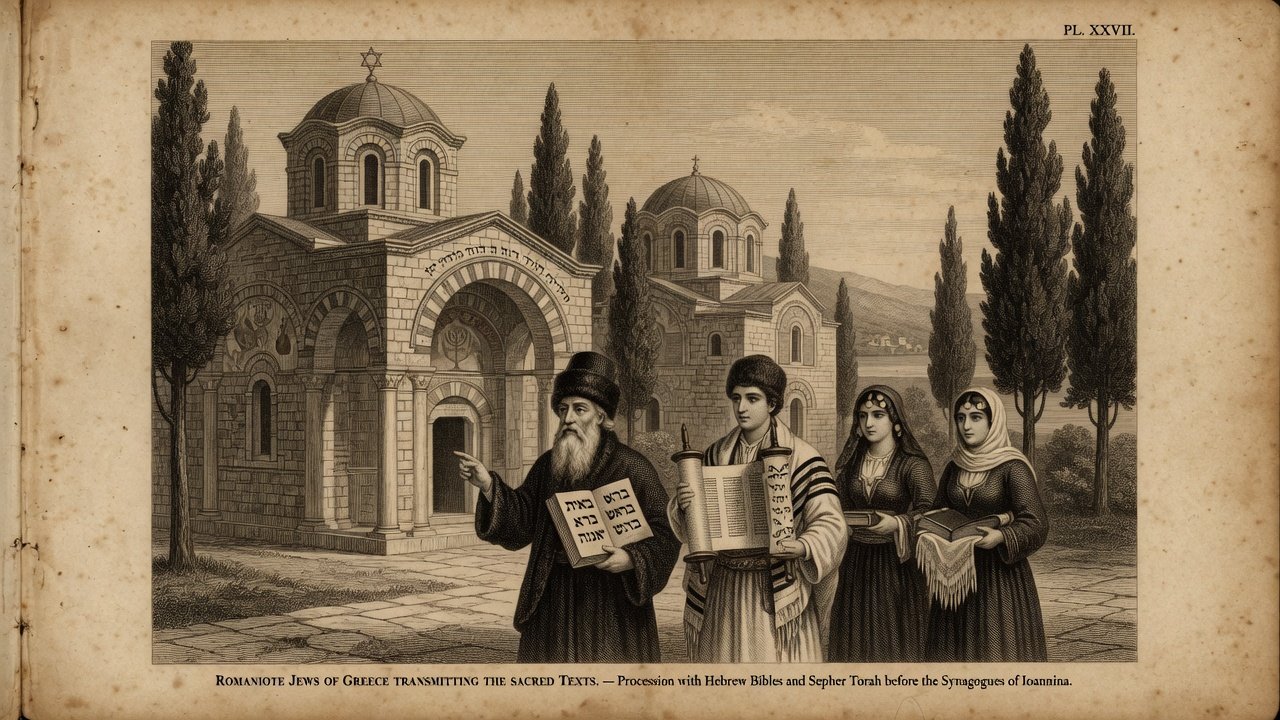
I. Who Are the Romaniotes?
Romaniote Jews are the historic Greek-speaking Jews of the Byzantine and post-Byzantine world—communities whose vernacular, liturgy, and biblical pedagogy predate the great Sephardi influx into the Ottoman Balkans after 1492. The name evokes the eastern Roman (Byzantine) empire. Unlike later Sephardi settlers who brought Judeo-Spanish (Ladino) and Iberian rite, Romaniotes historically spoke Greek dialects, including Judeo-Greek (Yevanic), and maintained a distinct prayer rite. This note surveys their history with emphasis on how they read and taught the Hebrew Bible under Christian empire and Ottoman rule.
Major historic centers include Ioannina (Janina), Chalcis (one of the oldest continuous Jewish communities in Europe), Crete, Corfu, parts of the Peloponnese, and Constantinople/Istanbul—where Romaniote and later Sephardi populations interacted. Companion pages include Sephardim in the Ottoman Empire and Italy.
“Romaniote Scripture culture is the memory of Jews who prayed in Hebrew, thought in Greek, and kept the pointed page under the shadow of Byzantium.”
II. Late Antique and Byzantine Foundations
Jewish communities in the Greek-speaking eastern Mediterranean continue patterns known from the New Testament period, late antique inscriptions, and Byzantine legal sources. Under Christian Roman rule, Jews faced legal disabilities and occasional violence yet maintained synagogues and communal structures. Greek was the language of daily life and often of biblical explanation; Hebrew remained the language of the scroll, formal prayer, and sacred study.
Byzantine hymnography and Christian biblical culture formed a surrounding soundscape. Romaniote Jews developed their own piyyut and liturgical customs. Manuscript evidence and genizah-adjacent Mediterranean finds show Greek Jewish participation in wider Hebrew book culture, including pointed biblical texts as Tiberian norms spread.
III. Ottoman Centuries and the Sephardi Demographic Tide
After Ottoman conquests, Greek-speaking Jewish communities became subjects of the empire’s millet-like arrangements for non-Muslims. The arrival of Iberian refugees transformed many cities demographically and culturally: Salonica became a Sephardi metropolis; Istanbul’s Jewish population grew heavily Sephardi. Romaniote nuclei nonetheless persisted—most famously in Ioannina—preserving older rite and Greek speech.
Interaction was constant: marriage, commerce, shared rabbinic authorities, and print. Sephardi books and legal codes (including the influence of Joseph Karo’s world) entered Romaniote shelves; Romaniote melodies and customs continued in local synagogues. Bible pedagogy thus often used Sephardi-printed humashim while sounding Romaniote in public reading.
IV. Language: Yevanic, Greek, and Hebrew
Yevanic (Judeo-Greek) historically provided vernacular access to biblical stories and domestic religious life. Modern Greek later dominated. Hebrew literacy for prayer and Torah reading remained the educational goal for boys in traditional settings. Gloss traditions and oral explanation in Greek parallel Judeo-Arabic gloss in the Maghreb or Yiddish Taytsh in Ashkenaz—each a vernacular bridge to the pointed page.
Yevanic is now severely endangered; documentation projects record remaining speakers and texts. Loss of vernacular does not erase the historical fact that Romaniote biblical culture was bilingual (and often trilingual with Ottoman Turkish in some settings).
V. Rite, Cantillation, and the Classroom
The Romaniote prayer rite differs in detail from both Ashkenazi and Sephardi rites—in order of prayers, piyyut selection, and some customs. Torah reading melodies likewise form a distinct oral branch. Schools taught the alphabet, pointing, and weekly portion; advanced students entered Talmud and codes. Printed books from Venice, Istanbul, and other presses supplied standard Masoretic text with classical commentators, integrating Romaniote readers into the Mediterranean commentarial canon (Rashi, Sephardi grammarians, etc.).
VI. Early Modern to Nineteenth-Century Transformations
European consular influence, Greek independence and nationalism, and modern schools restructured communal life. Some Romaniote Jews entered Greek civic culture while maintaining synagogue life; others emigrated. Rabbinic training sometimes occurred in larger Sephardi centers. The pointed Hebrew Bible remained the liturgical core even as vernacular preaching and newspapers adopted modern Greek.
VII. Catastrophe, Survival, and Heritage
The Holocaust devastated Greek Jewry. German occupation destroyed the majority of Jewish communities, Sephardi and Romaniote alike—including the near-annihilation of Ioannina’s Jews. Survivors and pre-war emigrants reconstituted tiny communities in Greece and larger diasporas in Israel and the United States. Museums, restored synagogues (including heritage sites), and cultural associations document Romaniote rite, Yevanic, and family humashim.
For Masoretic reception history, Romaniote Jewry is the bridge between late antique Greek Judaism and the modern Mediterranean—proof that the Tiberian text lived for centuries in Greek mouths before and alongside Ladino Sephardim.
VIII. Comparative Place
Romaniotes stand beside Italki Jews as European Jewish cultures that are neither Ashkenazi nor Sephardi in origin, and beside Sephardi Balkan communities as neighbors who shared empire but not always language or rite. Their encyclopedic recovery is part of correcting a historiography that too often jumps from ancient Greek Jews to modern Ashkenazi and Sephardi stories alone.
IX. Ioannina as Paradigm
Ioannina’s Romaniote community—its synagogue, educational patterns, and destruction in the Holocaust—often serves as paradigm for the whole. Local studies of Chalcis, Crete, and island communities add variation: not every Romaniote town followed identical rite details. Microhistory deepens the encyclopedic map.
X. Greek Nationalism and Jewish Bible Education
Modern Greek education taught Homeric and biblical Christian corpora to citizens; Jewish students navigated dual canons. Romaniote and Sephardi Jews of Greece negotiated Greek identity with Hebrew liturgy—sometimes fluently, sometimes under pressure. The pointed humash remained the marker of Jewish difference inside a Greek Christian national culture.
XI. Sephardi Books, Romaniote Voices
A typical early modern Romaniote reader might own Istanbul- or Venice-printed humashim with Sephardi editorial choices while chanting in Romaniote melody and explaining verses in Greek. Hybridity is the historical norm, not purity. Encyclopedias that force communities into single “rite boxes” miss how the Masoretic text actually circulated.
XII. Museums and the Ethics of Display
Greek Jewish museums display Torah ornaments, humashim, and photographs of pre-war classrooms. Display educates the public and risks freezing living culture as artifact. Romaniote revival groups navigate that tension by pairing exhibits with active synagogue reading wherever a minyan still forms.