~11,000 Jews (20.5%)
10 synagogues; yeshiva
Ha-Peles, Ha-Modia
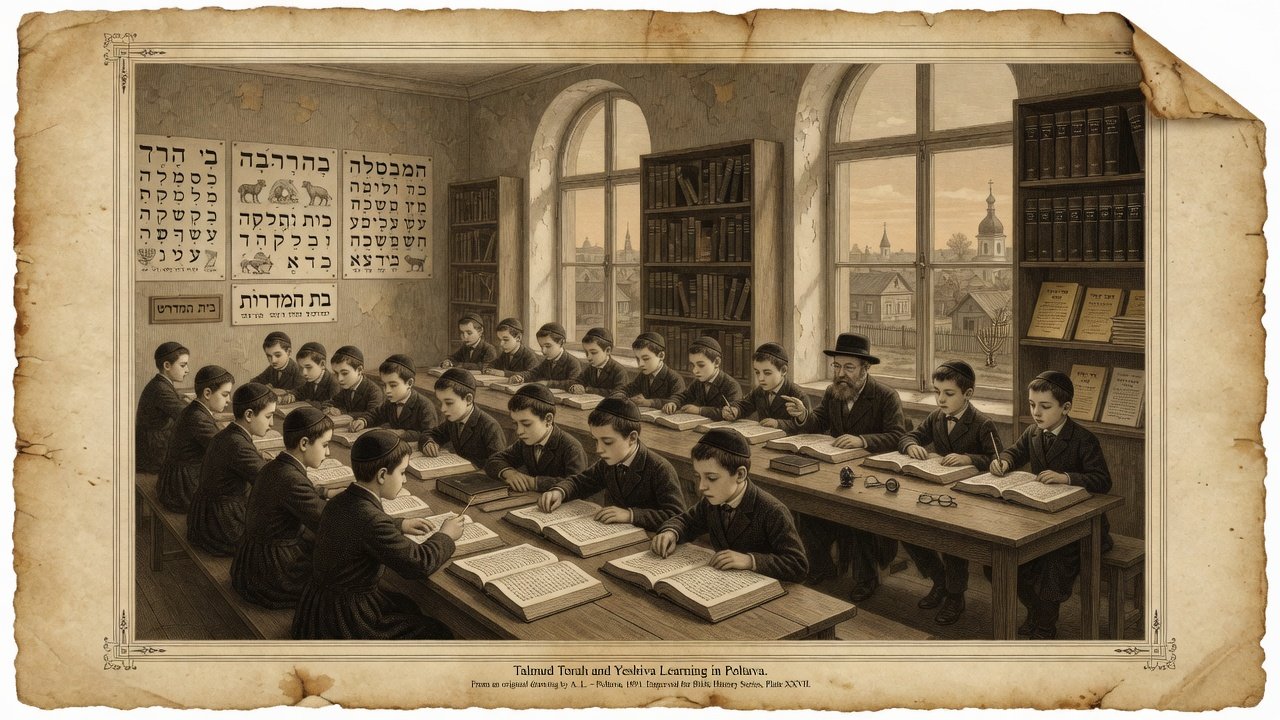
Talmud Torah + ḥadarim
I. Names Across Centuries
Poltava (Ukrainian and Russian Полтава) keeps a stable form across languages; Yiddish sources write Poltave / Poltava (פּאָלטאַווע). Hebrew periodicals printed in the city used the same toponym on mastheads that carried Orthodox polemics and biblical citation into the wider Pale.
Geographically Poltava sits on Left-Bank Ukraine, historically distinct from Right-Bank Hasidic strongholds such as Berdychiv, yet fully inside the imperial Pale of Settlement after the late eighteenth century.
| Form | Language / context | Relevance to Bible scholarship |
|---|---|---|
| Poltava | Ukrainian, Russian, English | Standard modern & imperial form |
| Poltave | Yiddish | Communal memoirs & letters |
| פּאָלטאַווע | Hebrew/Yiddish orthography | Periodical colophons |
| Left-Bank city | Geographic frame | Networks toward Kharkiv & Kyiv |
II. Settlement and Communal Organization
Jews settled in Poltava toward the end of the eighteenth century as the region entered the Pale. By 1801 the community already included merchants and townsmen; the mid-nineteenth century saw rapid growth, and the 1897 census counted 11,046 Jews (20.5% of the city), many of Lithuanian and Belorussian origin alongside local families.
Observers singled Poltava out as one of the best-organized Jewish communities in Russia: ten synagogues, a hospital and clinic with free care, an old-age home, a loan bank, and a Jewish library of some 8,000 volumes. Organization mattered for Bible scholarship because it funded teachers, books, and buildings—the infrastructure of the pointed page.
III. Talmud Torah, Yeshiva, and the Ḥeder Network
At the close of the nineteenth century Poltava’s traditional Talmud Torah was converted into a modern elementary school serving about 300 children with both religious and general subjects; staff included figures such as Alexander Siskind Rabinovitz. A girls’ vocational school supported by the Jewish Colonization Association, a yeshiva, and roughly twenty ḥadarim completed the educational map.
That mix is the Pale’s classic dual track: melamdim drilling nikkud and Rashi in small rooms, while a modernized Talmud Torah taught the same Masoretic Bible beside arithmetic and Russian. Neither track abandoned the weekly parashah; they argued about method and language of instruction, not about whether Genesis was the received Hebrew text.
“Poltava’s fame was not a single great press, but a complete ladder of Bible literacy—from ḥeder bench to yeshiva to public library shelf.”
IV. Hebrew Periodicals and Orthodox Defense of Tradition
Rabbi Eliyahu Akiva Rabinowich, rabbi of Poltava from 1893 to 1917, led an outspoken Orthodox campaign against secular Zionism and religious reform. From Poltava he published the Hebrew monthly Ha-Peles (1903–1906) and the weekly Ha-Modia (1910–1915), vehicles that cited biblical and rabbinic sources in a modern periodical format.
For the history of the biblical page, these papers matter because they show Scripture functioning as public argument in Hebrew print: not only chanted in synagogue, but marshaled in editorials that assumed readers could follow untranslated verses and masoretic allusions. Poltava thus joined Odessa and Warsaw as a node of Hebrew journalism, albeit from an Orthodox rather than Haskalah-Zionist editorial line.
V. Zionism, Intelligentsia, and Shared Text
Paradoxically, the same city that hosted Rabinowich’s anti-Zionist press was a cradle of Poʿalei Zion. Founders and early activists including figures associated with Ber Borochov’s circle, Yitzhak Ben-Zvi, and Yaʿakov Zerubavel had Poltava ties; the party’s founding conference connected the city to labor Zionism. The historian Elias Tcherikower was born in Poltava.
Political enemies still shared a childhood curriculum of pointed Torah. Whether one later read Scripture as national epic, rabbinic law code, or both, the letters and vowels came from the same Pale schooling system this site maps under Eastern Europe.
VI. Economy, Printing, and Civic Shelter
Jews in Poltava owned flour mills, distilleries, lumber warehouses, and two printing presses—small compared with Kiev’s industrial output, but enough to supply local liturgical and educational demand. The presence of a Russian intelligentsia sympathetic to Jews, associated in memory with the writer Vladimir Korolenko’s circle, helped the city avoid the worst pogroms of 1905 and 1917 that struck other Ukrainian towns.
Relative calm prolonged institutional life: libraries stayed open, schools collected fees, and Bibles continued to move from press to classroom. Bible scholarship in the narrow sense was less Poltava’s brand than Bible literacy as civic infrastructure.
VII. Place on the Masoretic Map
Poltava represents the organized provincial kehillah of Left-Bank Ukraine: systematic schooling, Hebrew Orthodox journalism, and a mixed political culture that never abandoned the Masoretic lectionary. Pair it with Kharkiv, Kiev, Berdychiv, and the Pale of Settlement overview.
On the scholarship map, Poltava marks the educational spine of the eastern Ukrainian Pale between the Dnieper and the steppe frontier.
Sources & Further Reading
| Work | Author / Source | Relevance |
|---|---|---|
| Poltava (Jewish Virtual Library) | Communal survey | Schools, press, demography |
| Poltava | Encyclopedic survey | City geography & history |
| History of the Jews in Ukraine | Survey | Ukrainian Jewish context |
| Pale of Settlement | Reference | Legal residence frame |
| Poalei Zion | Movement history | Poltava as early center |
| Pale of Settlement note | Masoretes site | Regional schooling systems |
| Eastern Europe note | Masoretes site | Ashkenazi curriculum frame |
| Berdychiv city study | Masoretes site | Right-Bank counterpart |
| Kharkiv city study | Masoretes site | Eastern Ukrainian neighbor |