Full presentation download below.
Two intertwined streams of preservation.
From Qumran jars to Nestle-Aland.
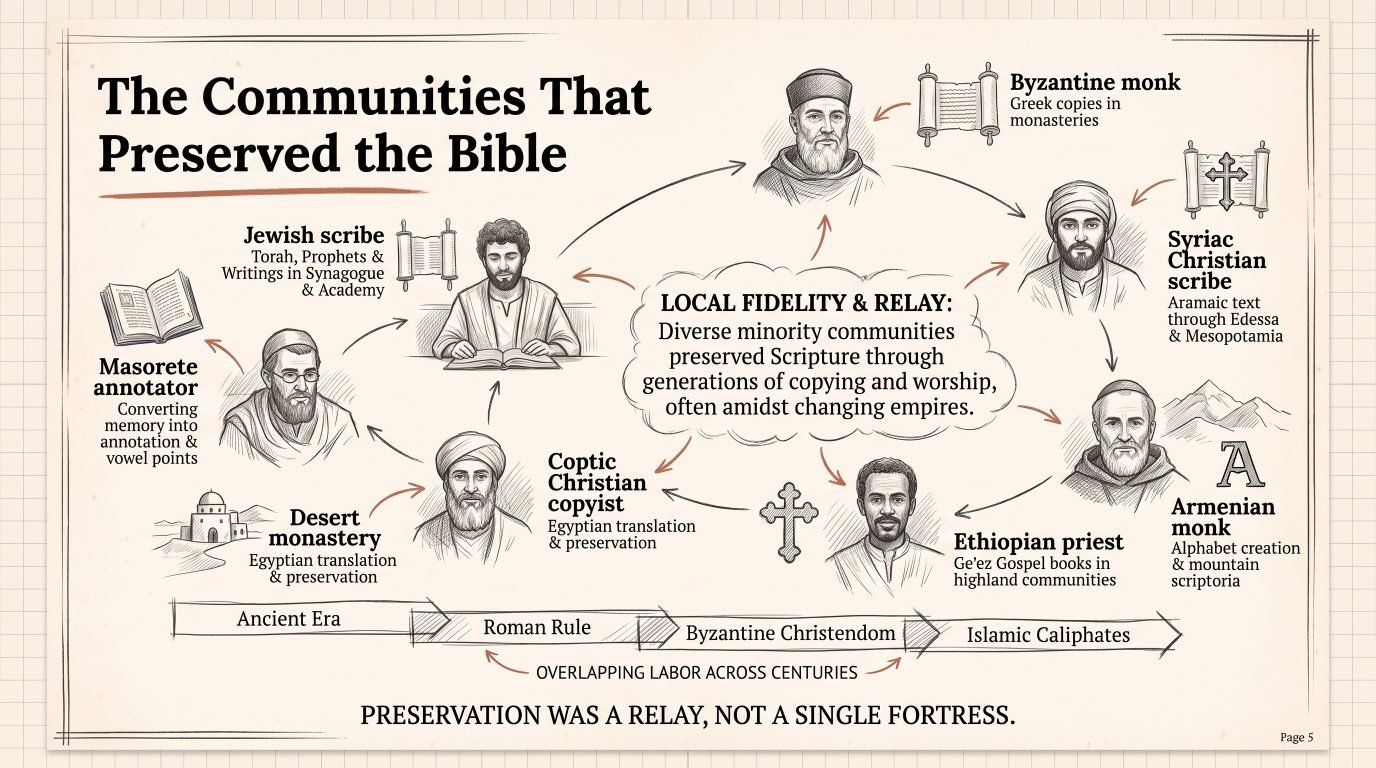
Syriac, Latin, Armenian, and more.

Presentation file, This page expands the deck The Preservation of the Holy Bible Since the Time of Jesus. Download the original slides or browse the on-site gallery.

I. What the Presentation Sets Out to Show
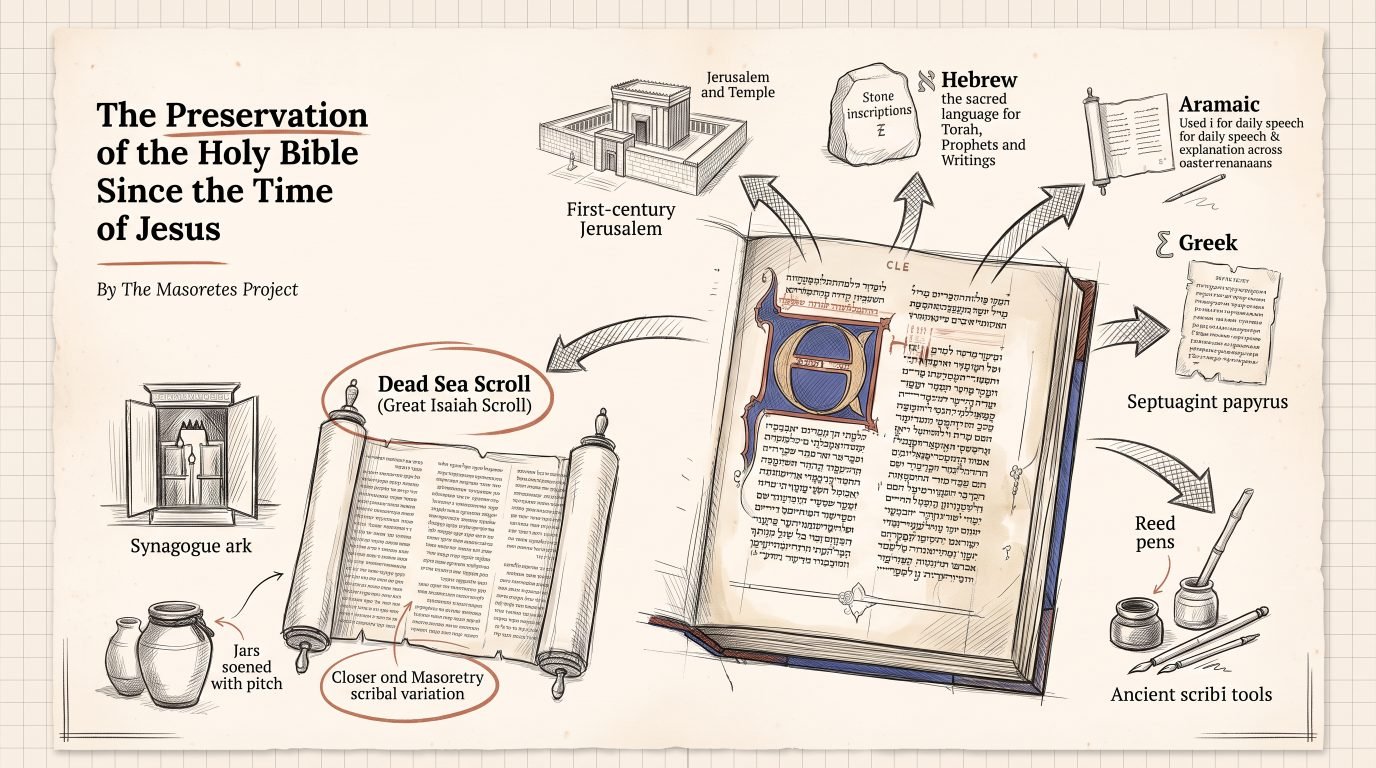
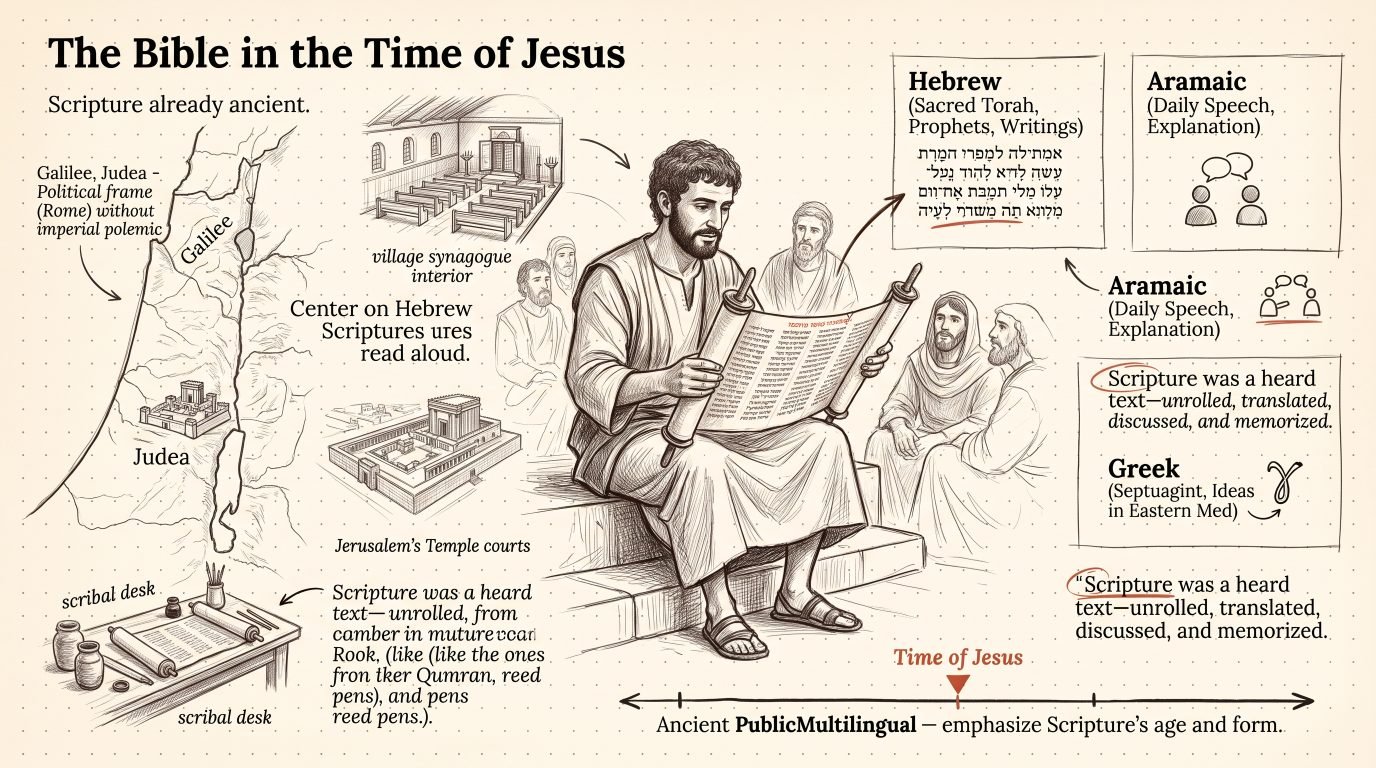
The deck opens with a simple claim: the Holy Bible did not appear fully formed in the modern world. It was already ancient when Jesus taught in Galilee and Judea. Hebrew was the sacred language of Torah, Prophets, and Writings; Aramaic carried daily speech and explanation; Greek, through the Septuagint and Mediterranean culture, made Israel’s Scriptures portable across the eastern empire. Preservation, in this story, is not a single miracle of one library. It is a chain of scribes, congregations, monasteries, printers, and finally digital scholars.
This companion note follows the presentation’s arc while linking each stage to deeper hub articles. For Greek survival under empire and persecution, see also Preservation of the Greek Bible Text. For the Jewish pointing tradition, see Soferim and Nakdanim.
II. The Bible in the Time of Jesus
Slide two places Scripture in a public, multilingual world. Village synagogues read Hebrew aloud; Temple courts and scribal desks framed a society in which texts were heard as much as privately studied. Scripture was unrolled, translated, discussed, and memorized. The presentation’s timeline marks the “Time of Jesus” on a continuum of ancient public multilingual life, not as Year Zero of the Bible’s existence.
That framing matters for transmission history. Jesus and his first hearers stood downstream of centuries of copying. The sacred core they quoted was already a preserved library, even as scribal variation and multiple language forms remained part of ordinary Jewish life. See Hebrew & Aramaic and Dead Sea Scrolls.
III. Hebrew Scriptures Before Jesus: Sacred Stewardship
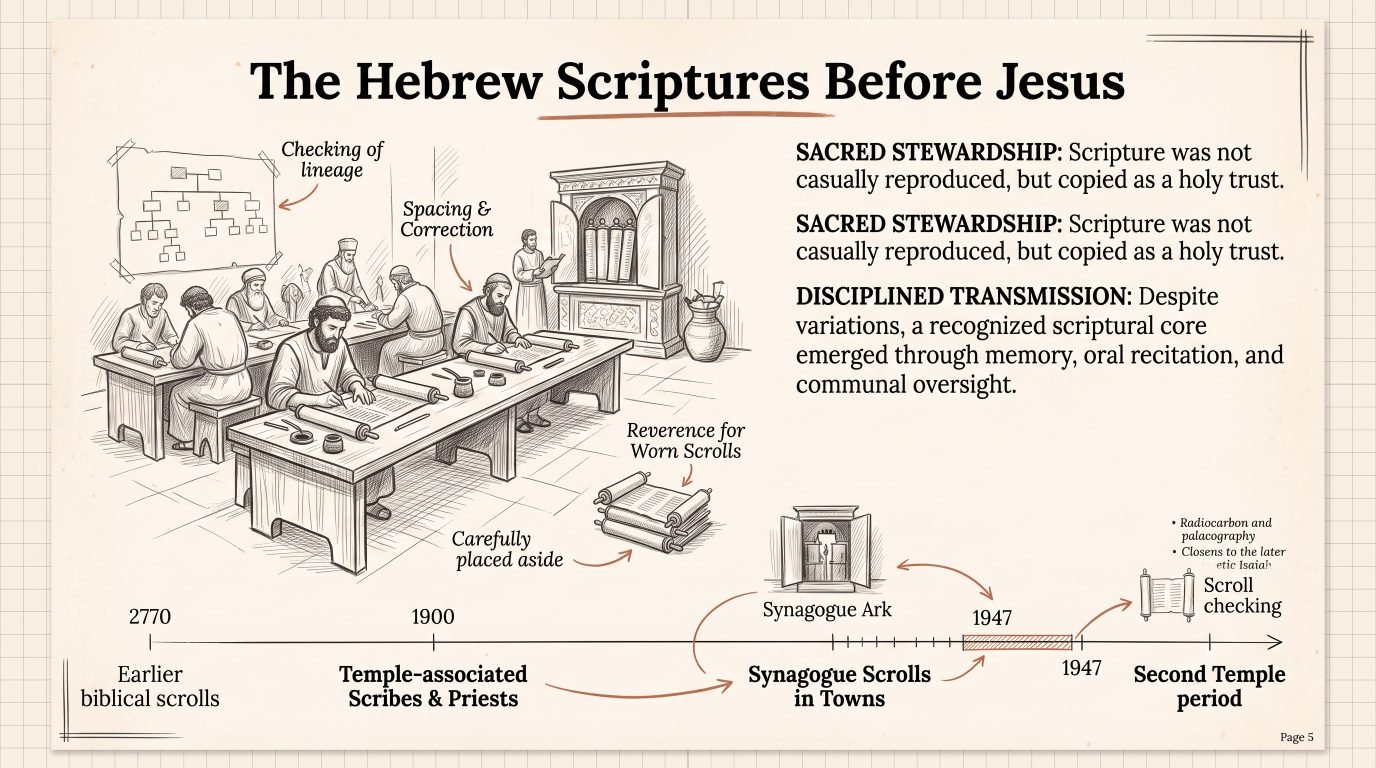
The deck stresses that Scripture was not casually reproduced. Temple-associated scribes and priests, synagogue scrolls in towns, careful spacing and correction, and reverence for worn scrolls all mark a culture of holy trust. A recognized scriptural core emerged through memory, oral recitation, and communal oversight despite ordinary variation.
That stewardship is the Jewish backbone of later Christian Bibles. Without Second Temple copying habits, there is no Isaiah scroll for Nazareth, no Psalms for prayer, no Law for dispute. The presentation’s timeline reaches back to earlier biblical scrolls and forward to the modern rediscovery of desert manuscripts that illuminate how close some ancient copies already were to the later Masoretic form.
IV. The Dead Sea Scrolls as a Preservation Window
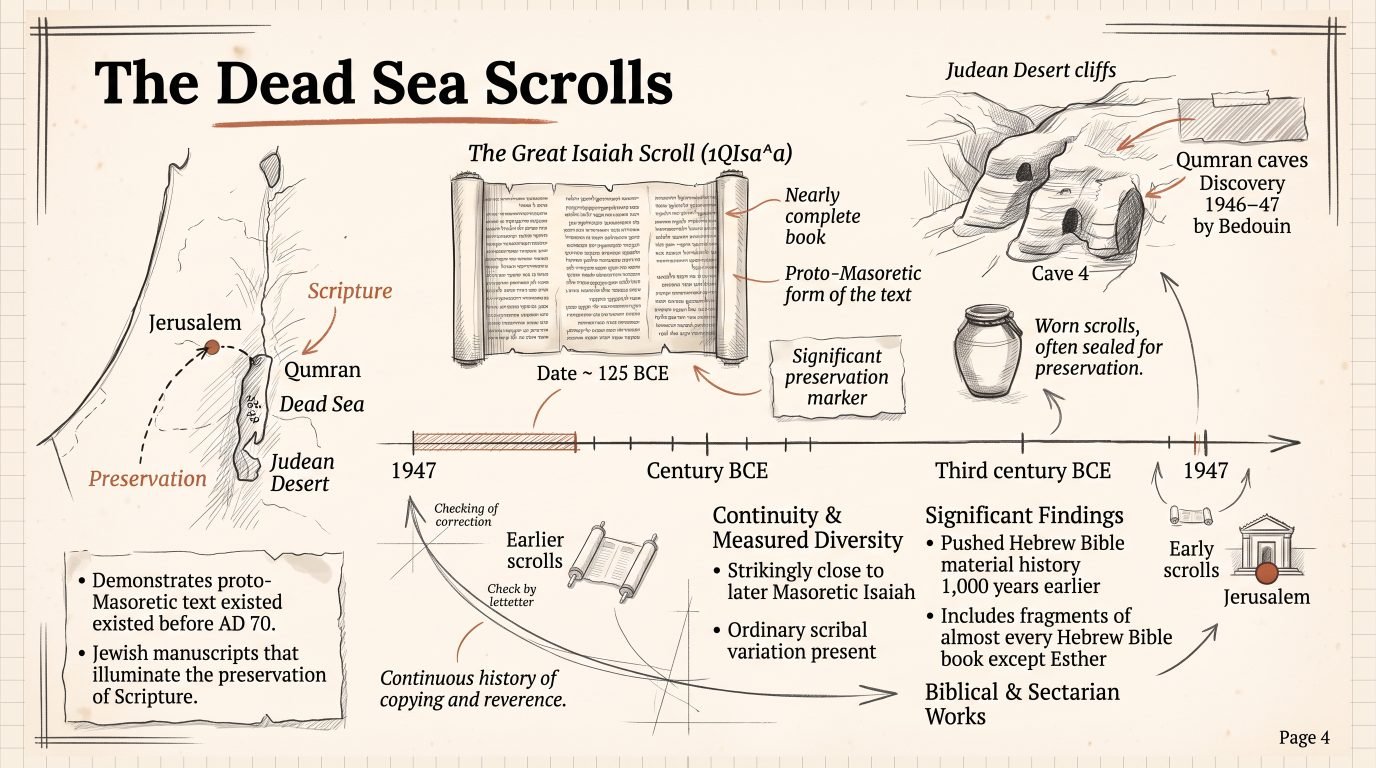
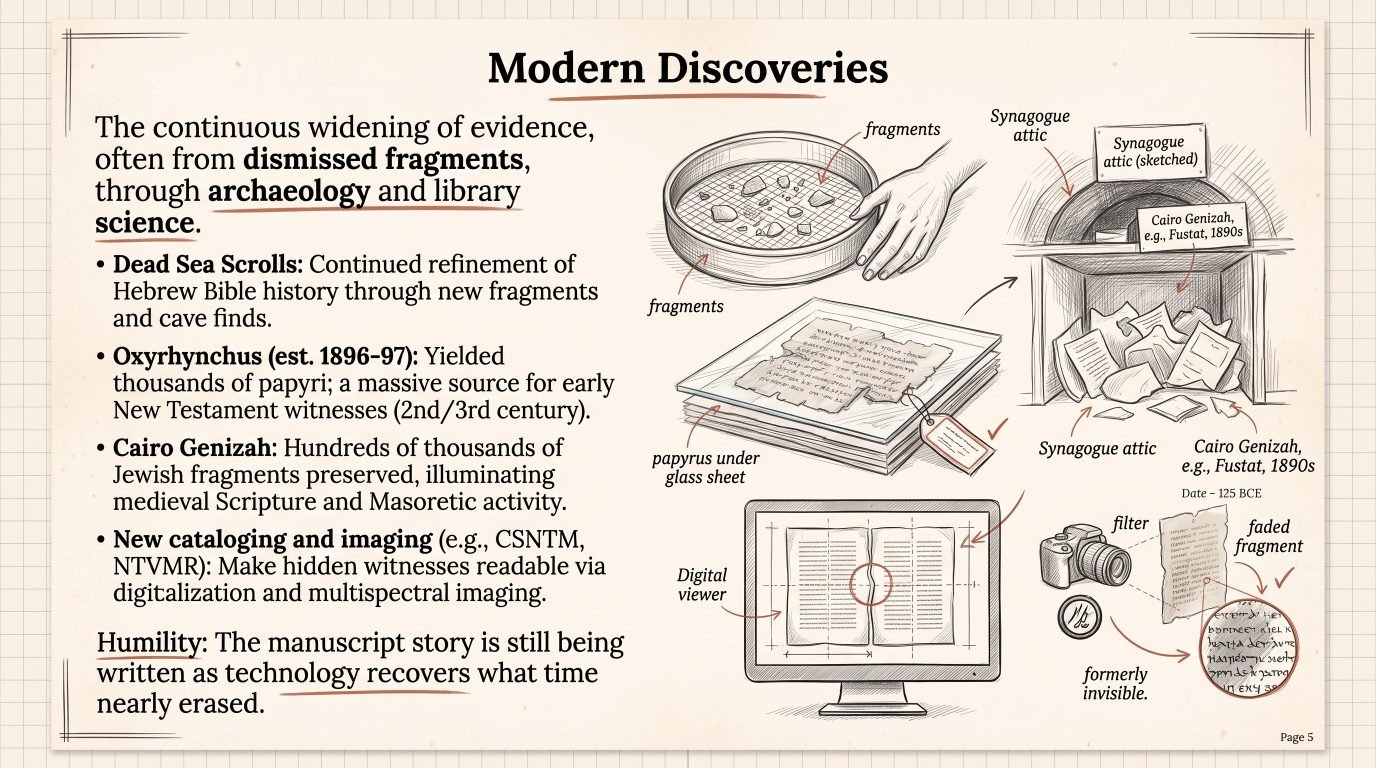
The Great Isaiah Scroll (1QIsaa), Qumran caves, and jars sealed for worn scrolls appear as a major case study. Discovery in 1946–47 pushed the manuscript history of the Hebrew Bible roughly a thousand years earlier for many books. Continuity with later Masoretic Isaiah is striking; measured diversity and ordinary scribal habits are also visible. Fragments touch almost every Hebrew Bible book except Esther.
For this hub, Qumran is both archaeology and theology of care: communities hid and treasured texts. Full treatment: Dead Sea Scrolls and Archaeology & DSS.
V. Jesus, the Apostles, and the Old Testament
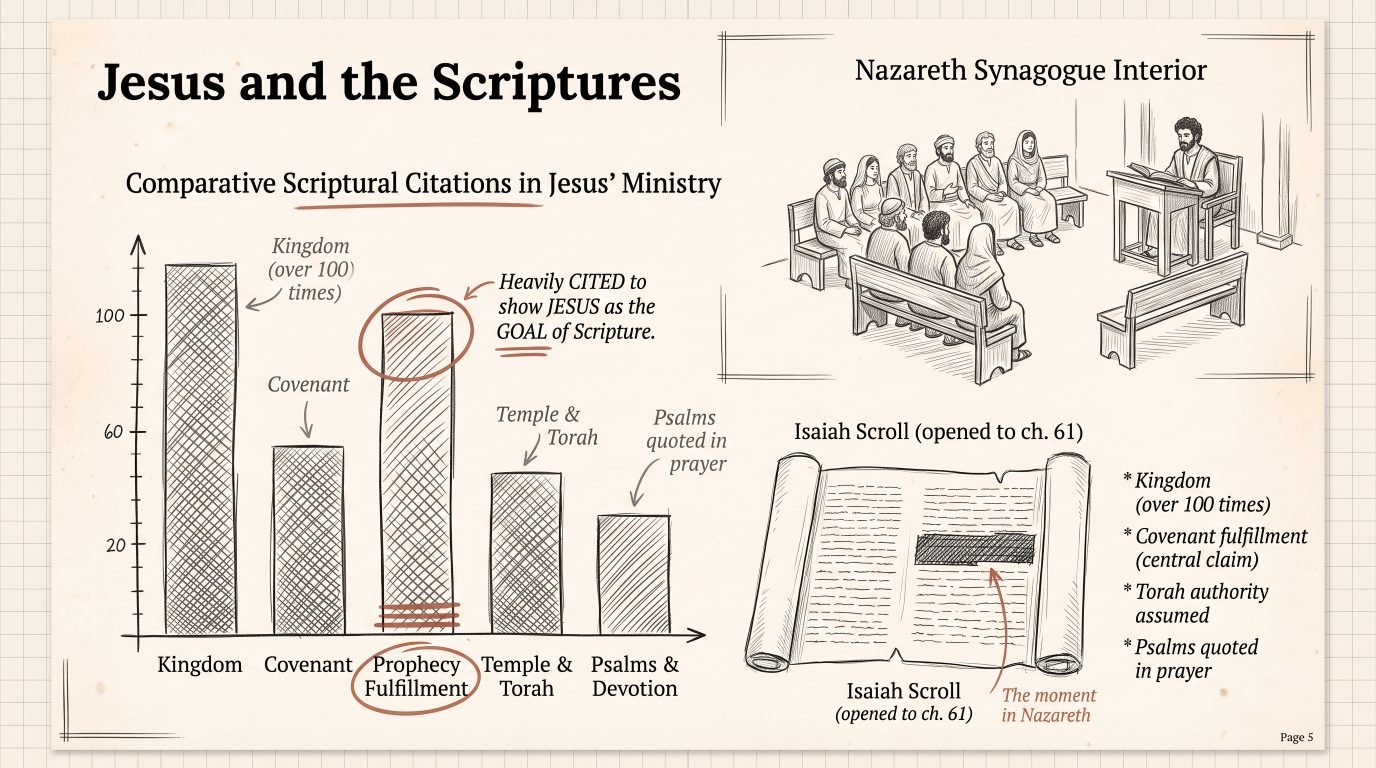
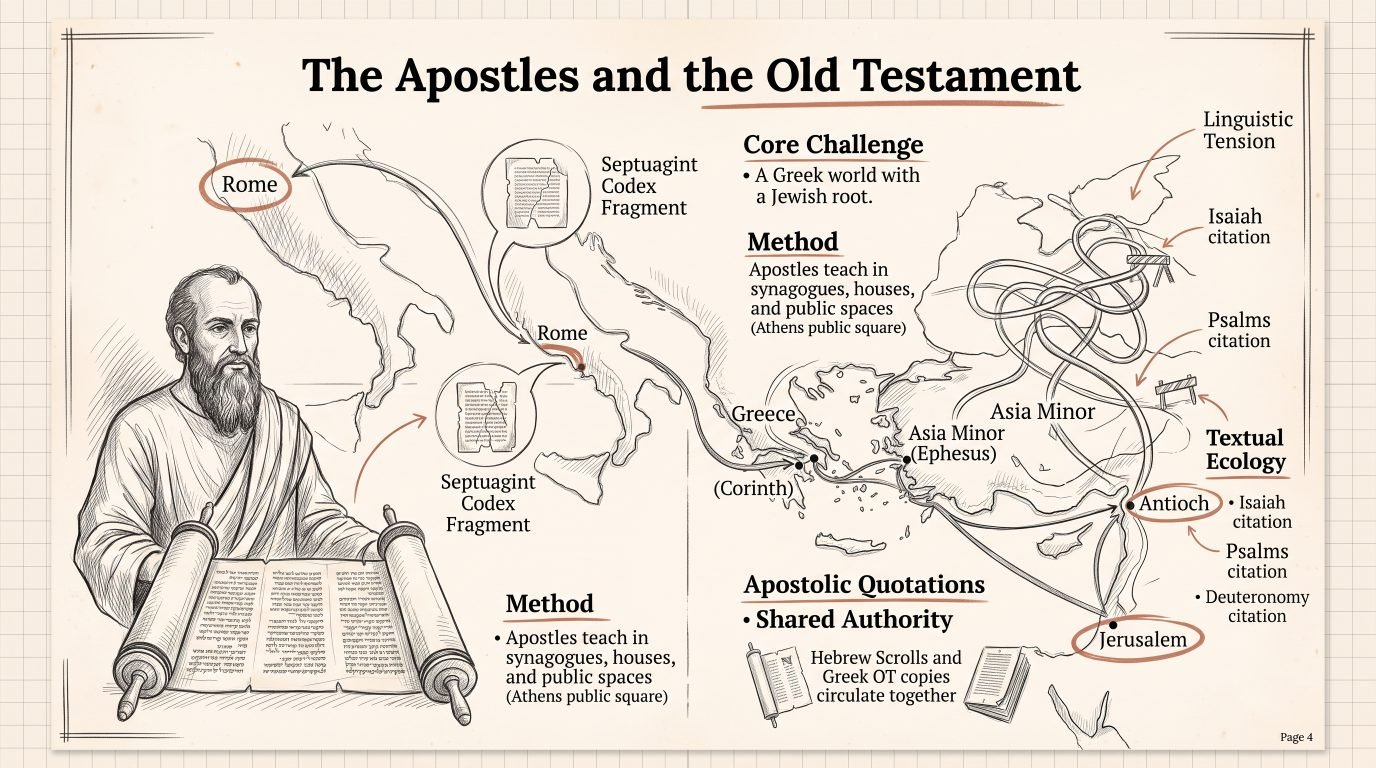
Slides on Jesus and the Scriptures highlight kingdom language, covenant fulfillment, Temple and Torah authority, and Psalms in prayer, with the Nazareth synagogue scene (Isaiah 61) as a signature moment. The apostles then carry a dual textual ecology: Hebrew scrolls and Greek OT copies circulating together across Jerusalem, Antioch, Asia Minor, Greece, and Rome. Teaching happens in synagogues, houses, and public squares. Isaiah, Psalms, and Deuteronomy citations structure proclamation.
The “core challenge” the deck names is still the historian’s challenge: a Greek-speaking mission with a Jewish scriptural root. Preservation of the Old Testament for the church was inseparable from Jewish transmission and from the Septuagint’s Mediterranean career.
VI. Writing and Circulating the New Testament
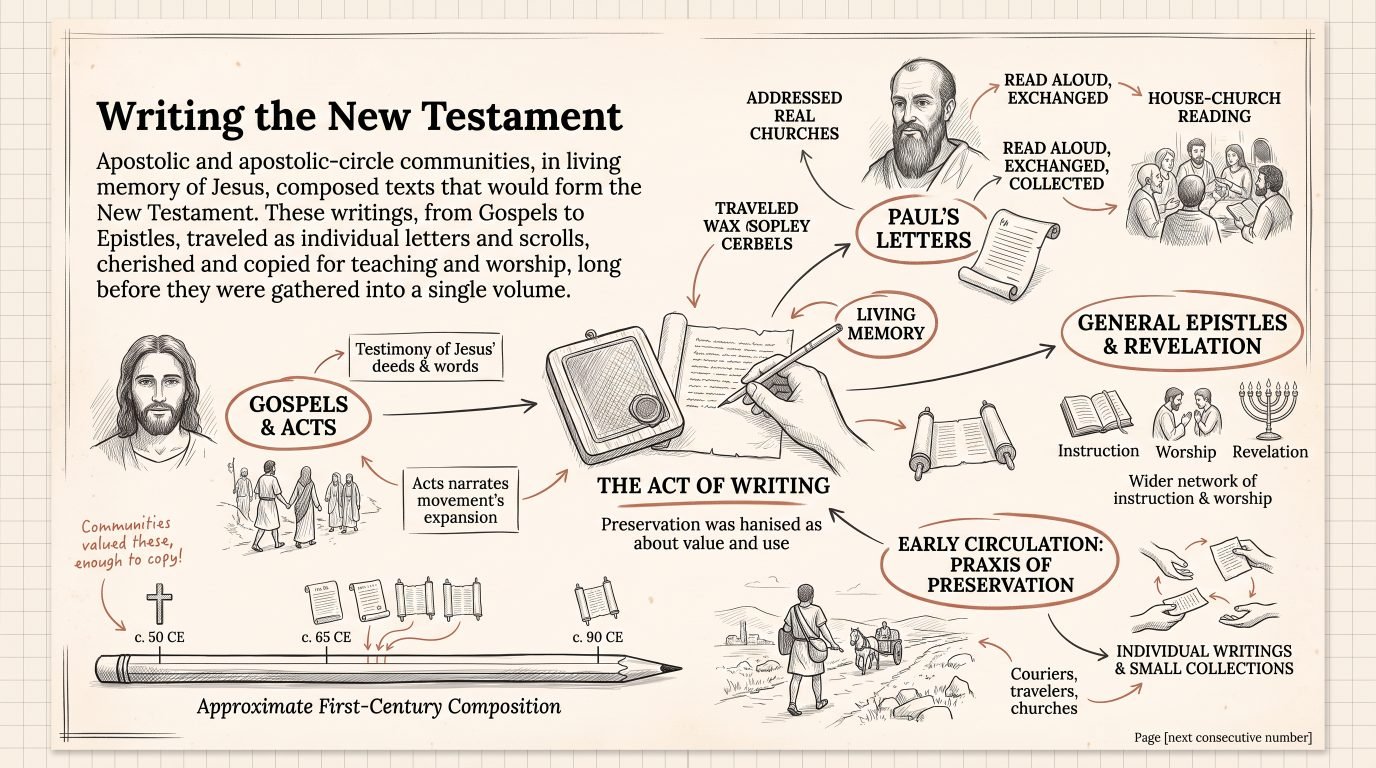
Gospels and Acts, Paul’s letters, general epistles, and Revelation arise in living memory of Jesus and in networks of real congregations. The presentation sketches early composition (c. 50–90 CE), exchange of letters, house-church reading, couriers and travelers, and small collections long before a single bound New Testament volume. Preservation here is first praxis: texts valued enough to copy, read aloud, and defend.
Related notes: Inspiration & Authors, Scribes & Copying, Scrolls to Codices.

VII. Earliest New Testament Manuscripts
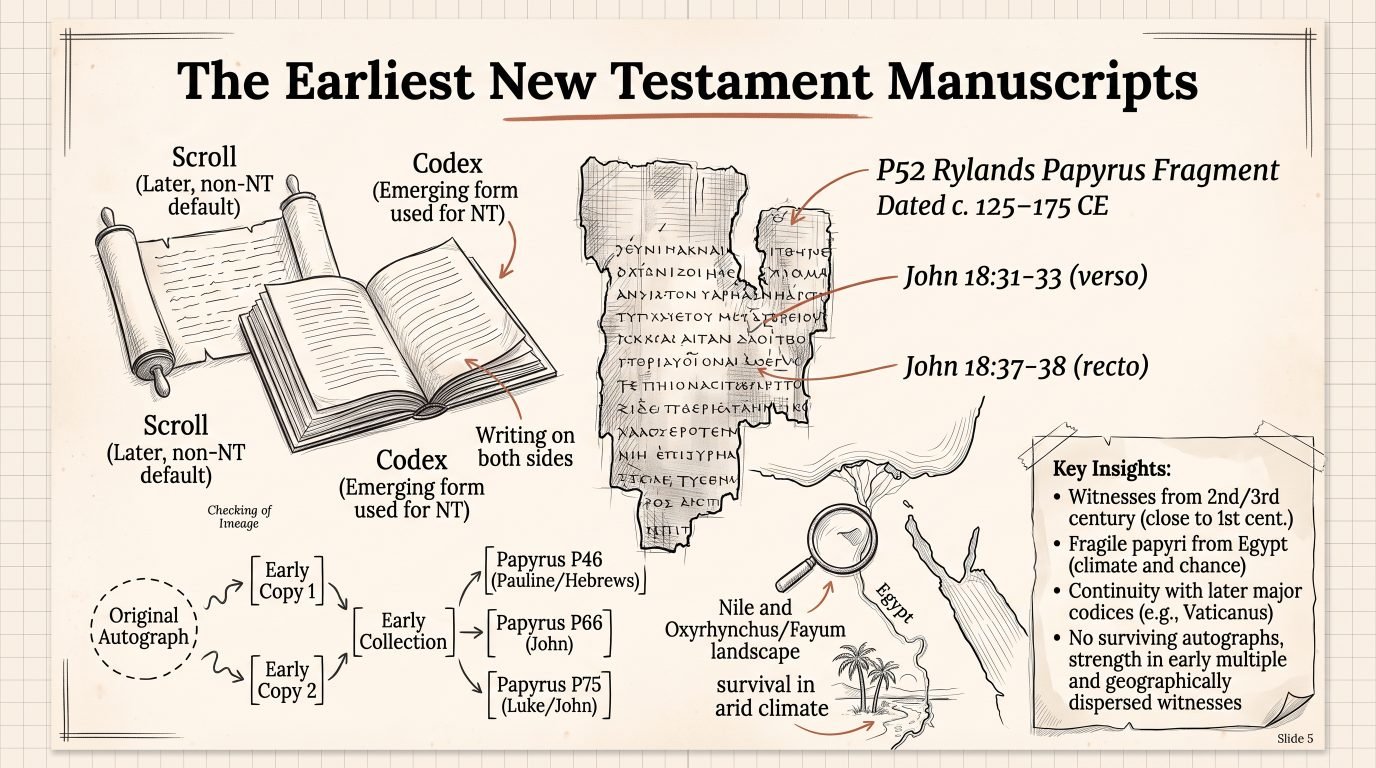
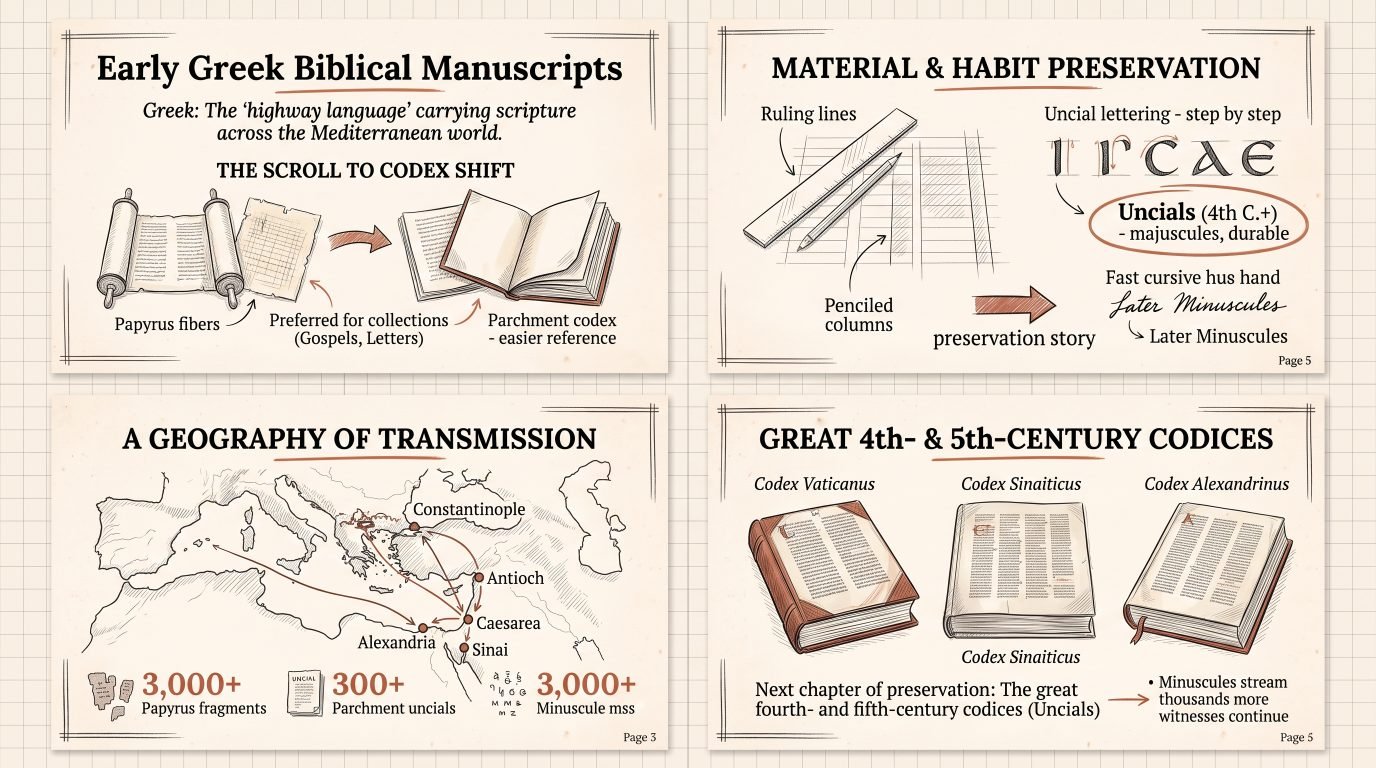
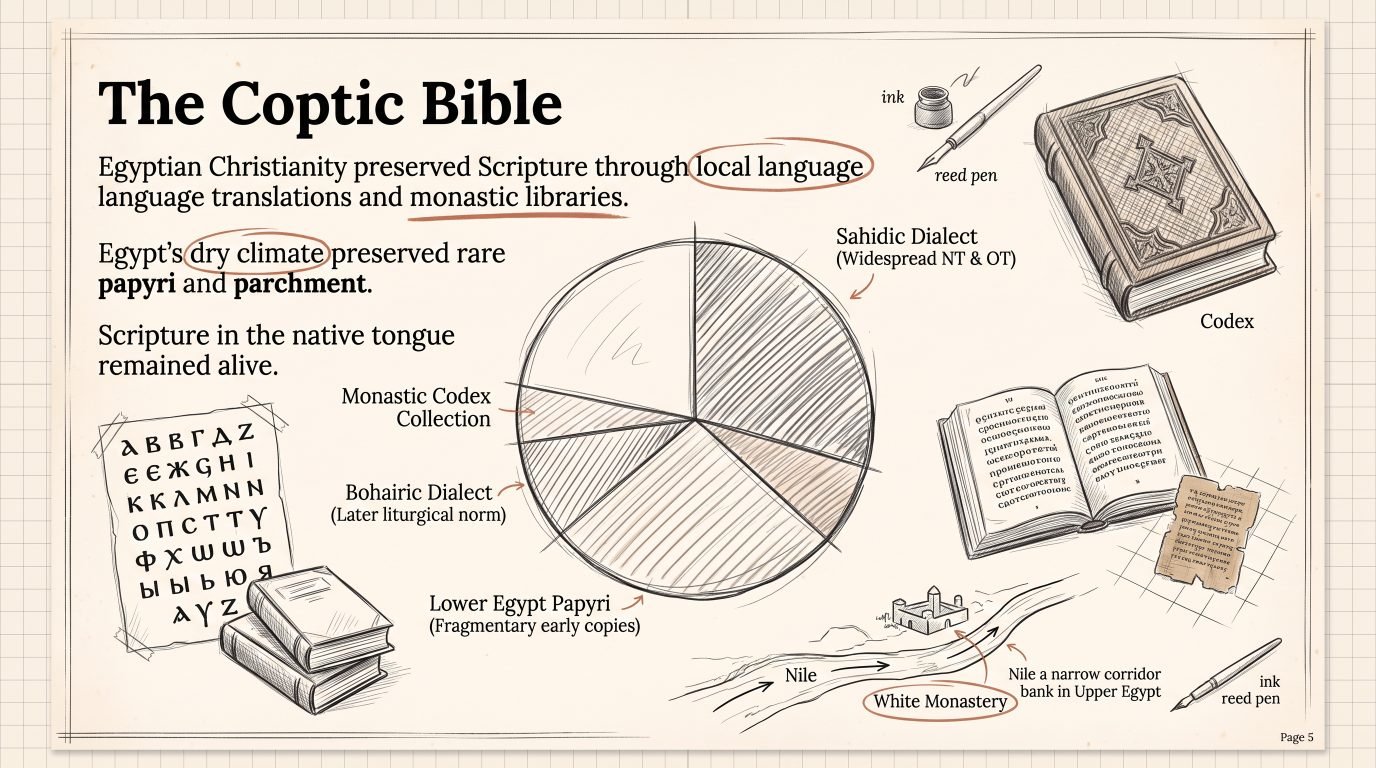
The codex emerges as the characteristic Christian book form. Papyri such as P52 (John), P46 (Paul), P66 and P75 (John/Luke) witness second- and third-century text within a generation or two of composition. Egyptian climate and sites such as Oxyrhynchus preserve fragile sheets. Key insight of the deck: no surviving autographs, yet strength in multiple, geographically dispersed early witnesses continuous with later majuscules such as Vaticanus.
See Earliest Papyri and Major Discoveries.
VIII. Persecution, Hiding, and Local Resilience
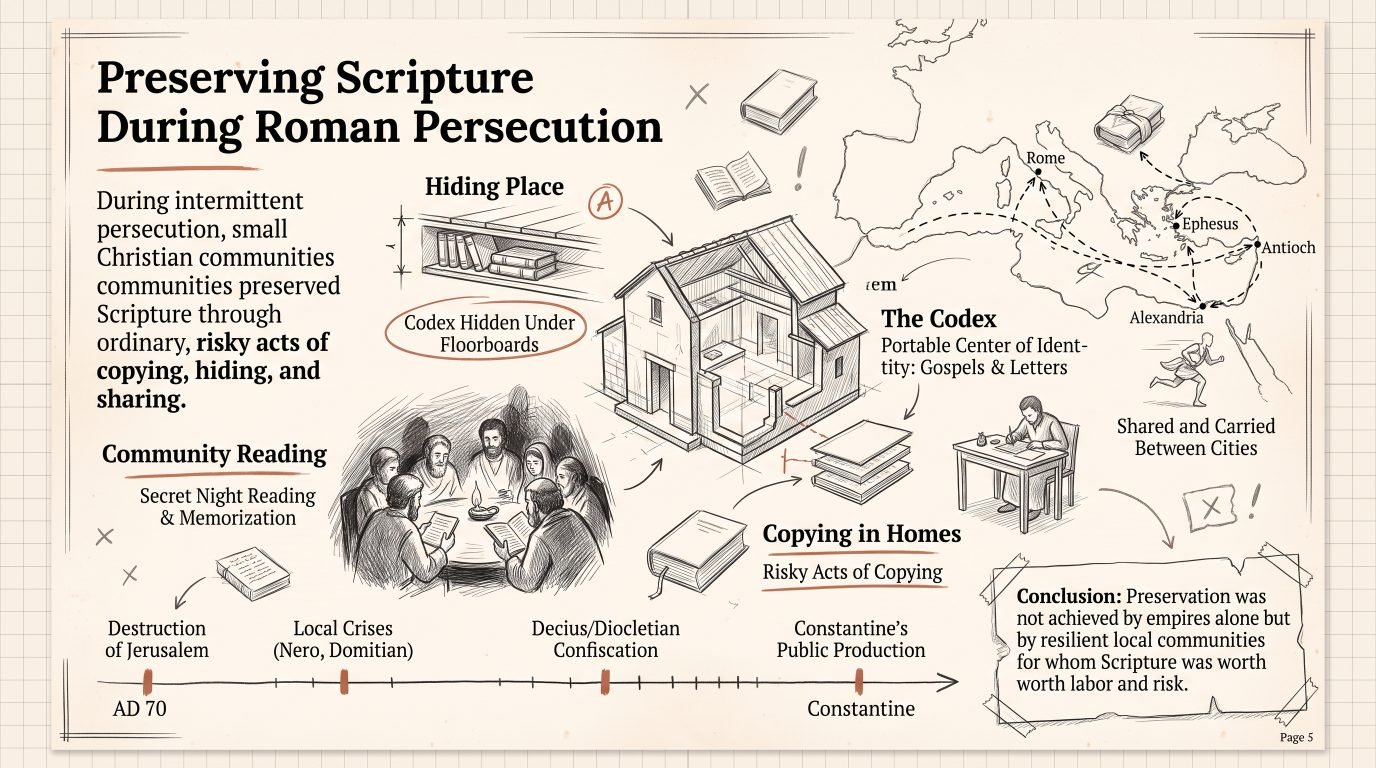
From the destruction of Jerusalem through Nero, Domitian, Decius, and Diocletian, Scripture survives by ordinary risky acts: night reading, memorization, home copying, codices under floorboards, books shared between cities. The deck’s conclusion is crucial: preservation was not achieved by empires alone but by resilient local communities for whom Scripture was worth labor and risk. Constantine’s later public production rests on that prior underground tenacity.
IX. Jewish Guardians After 70 CE and the Masoretic Apparatus
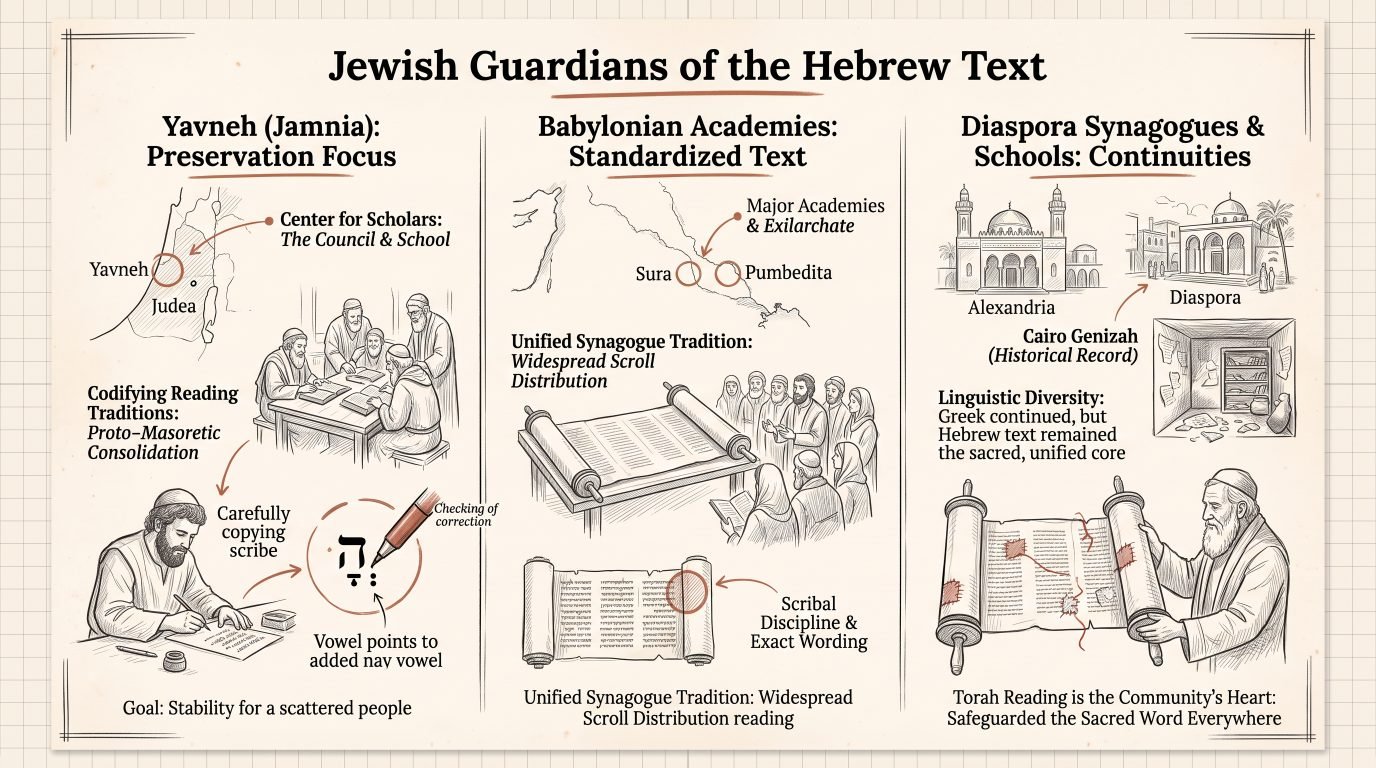
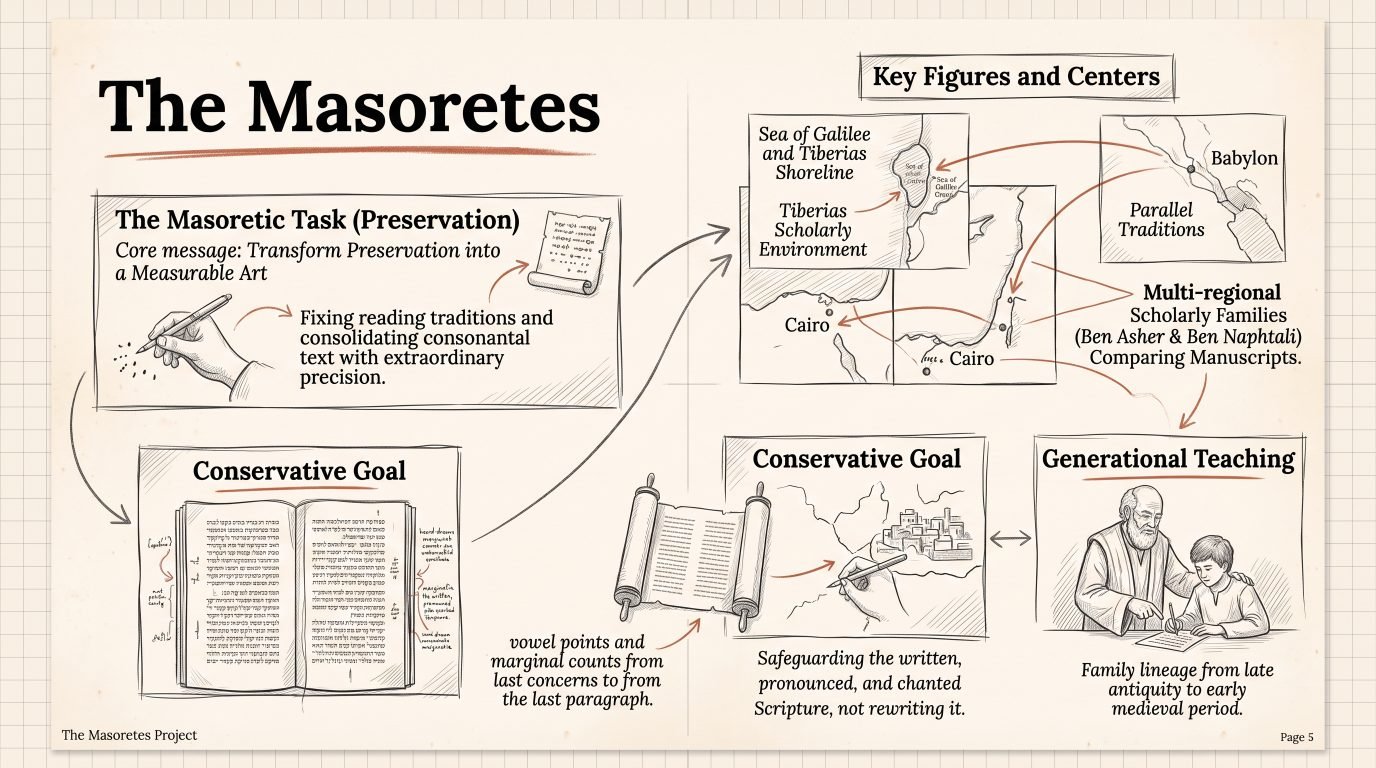
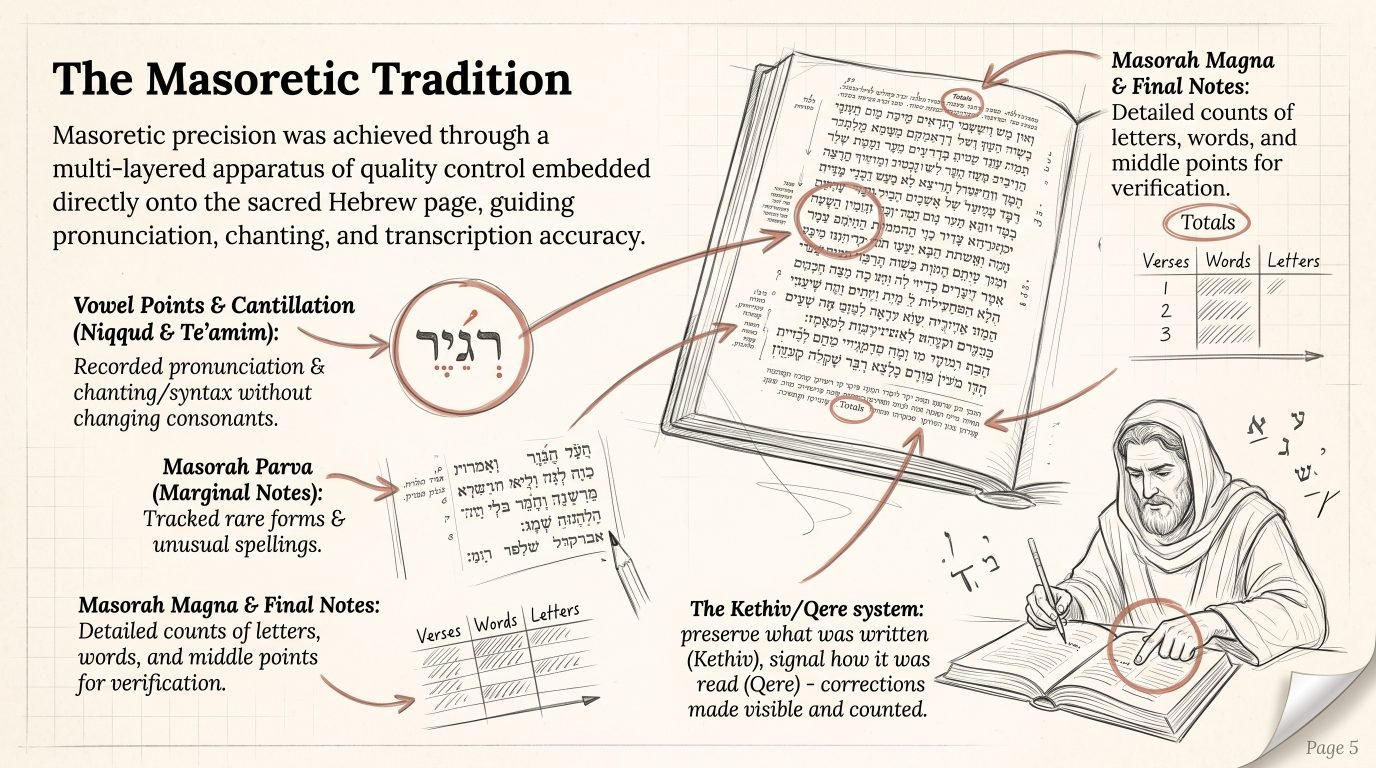
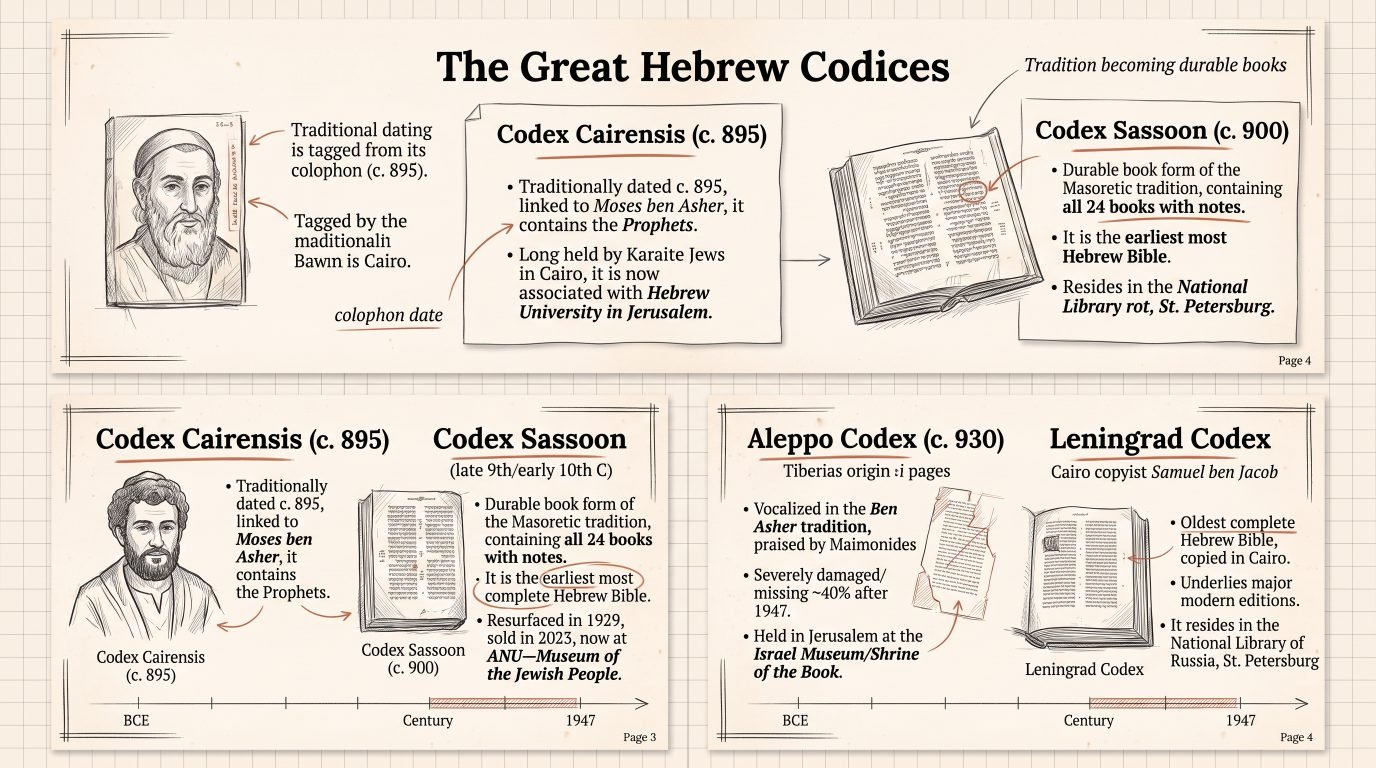
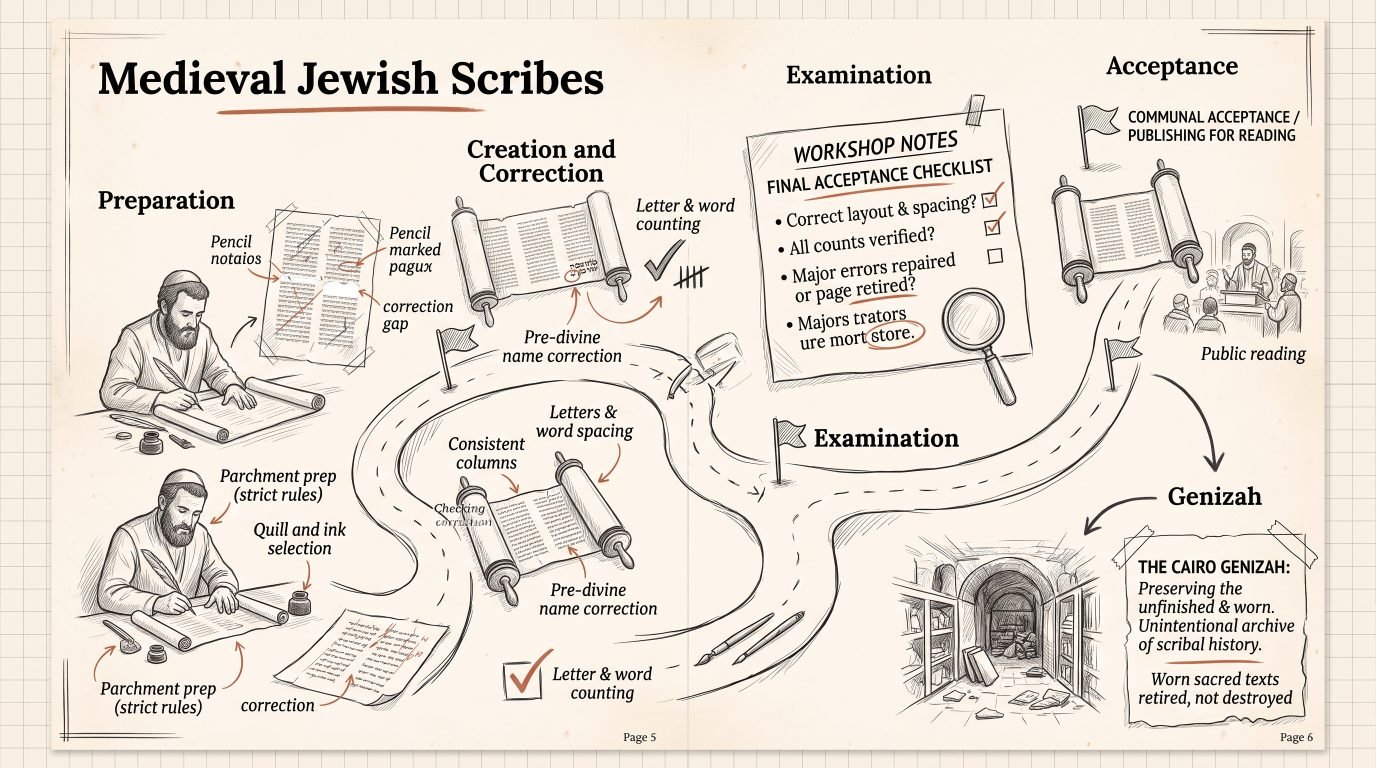
Yavneh (Jamnia) as a center for scholars and reading traditions; Babylonian academies at Sura and Pumbedita; diaspora synagogues from Alexandria to the Genizah world, all appear as guardians of a unified Hebrew core. Later slides detail Masoretic precision: niqqud and teʿamim, Masorah Parva and Magna, letter/word/verse counts, and the kethiv/qere system that makes written and read forms visible together.
Great medieval codices, Aleppo, Leningrad, Cairensis, are the monumental harvest of that apparatus. Hub notes: Medieval Hebrew Studies, Cairo Genizah.
X. Great Codices and Eastern Versions
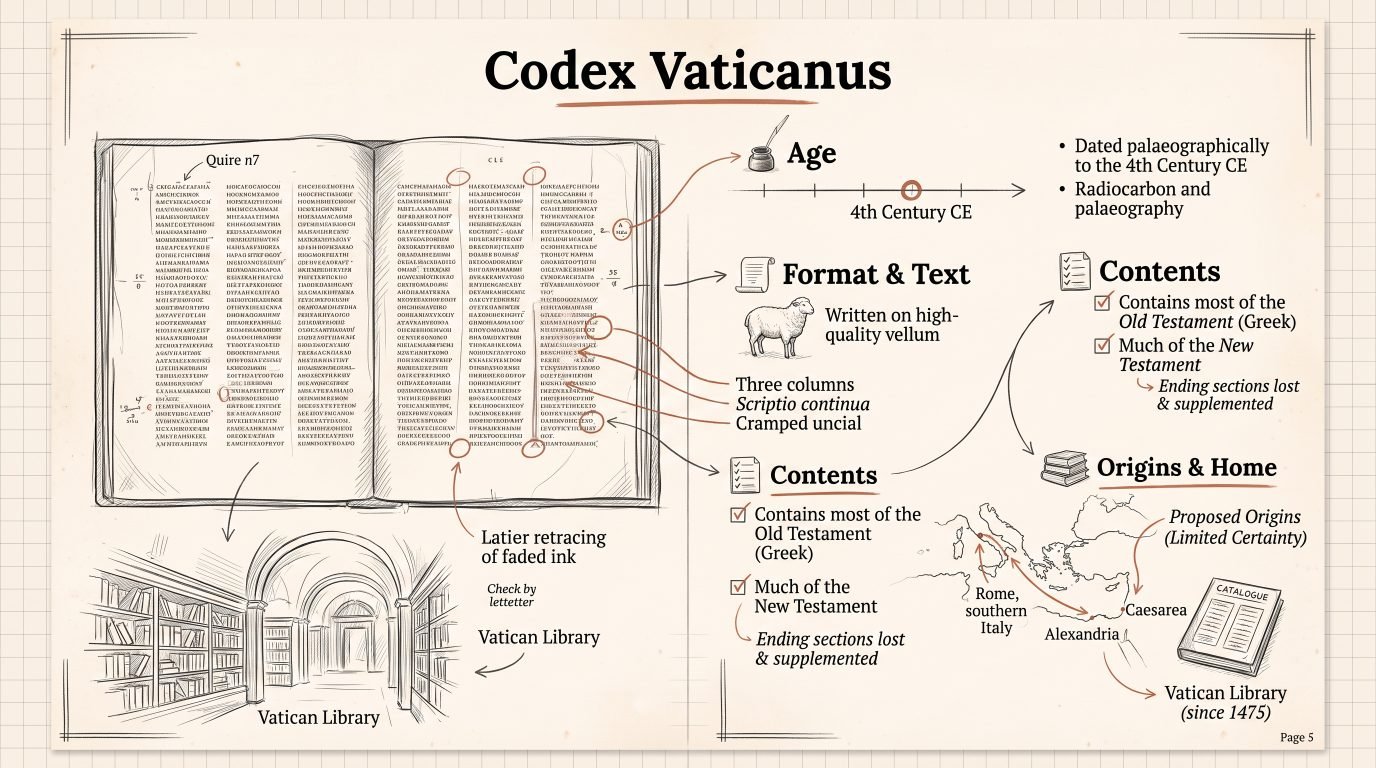
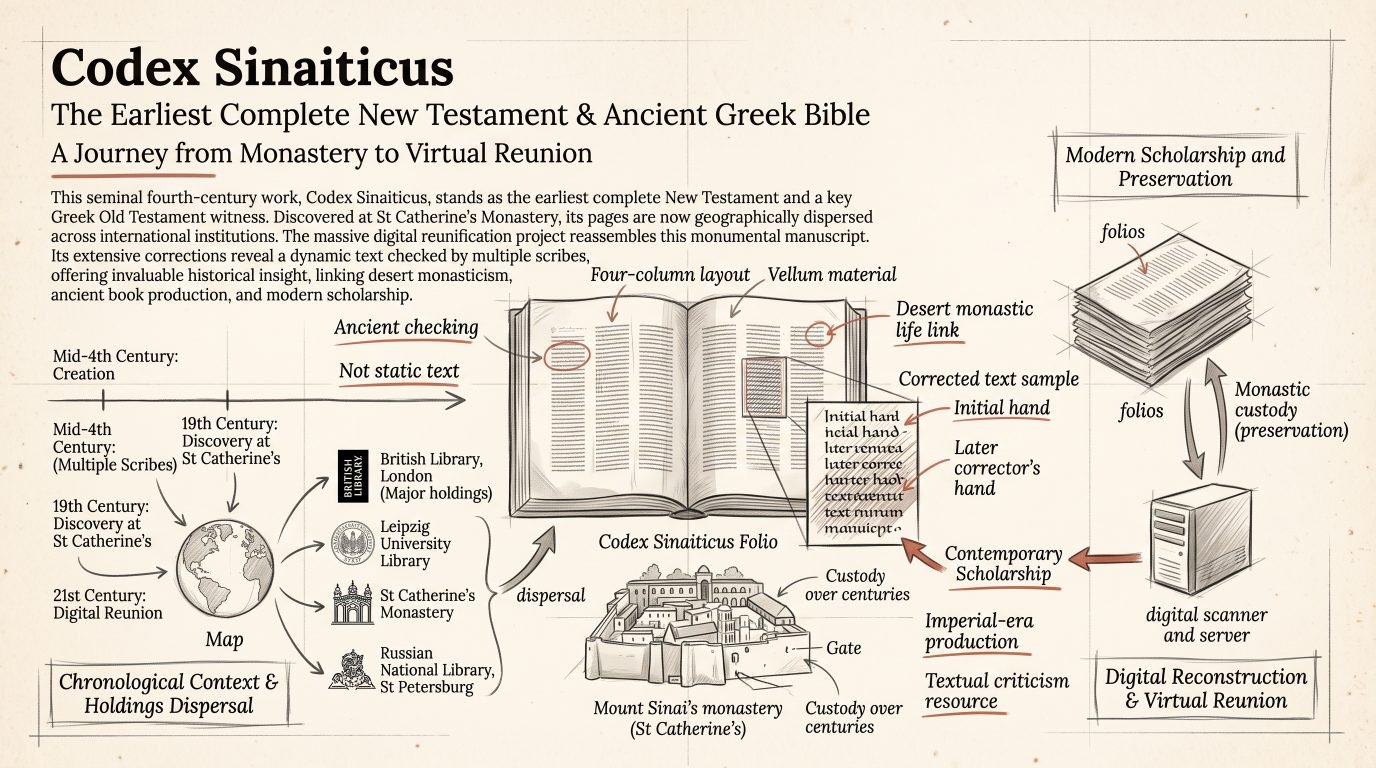
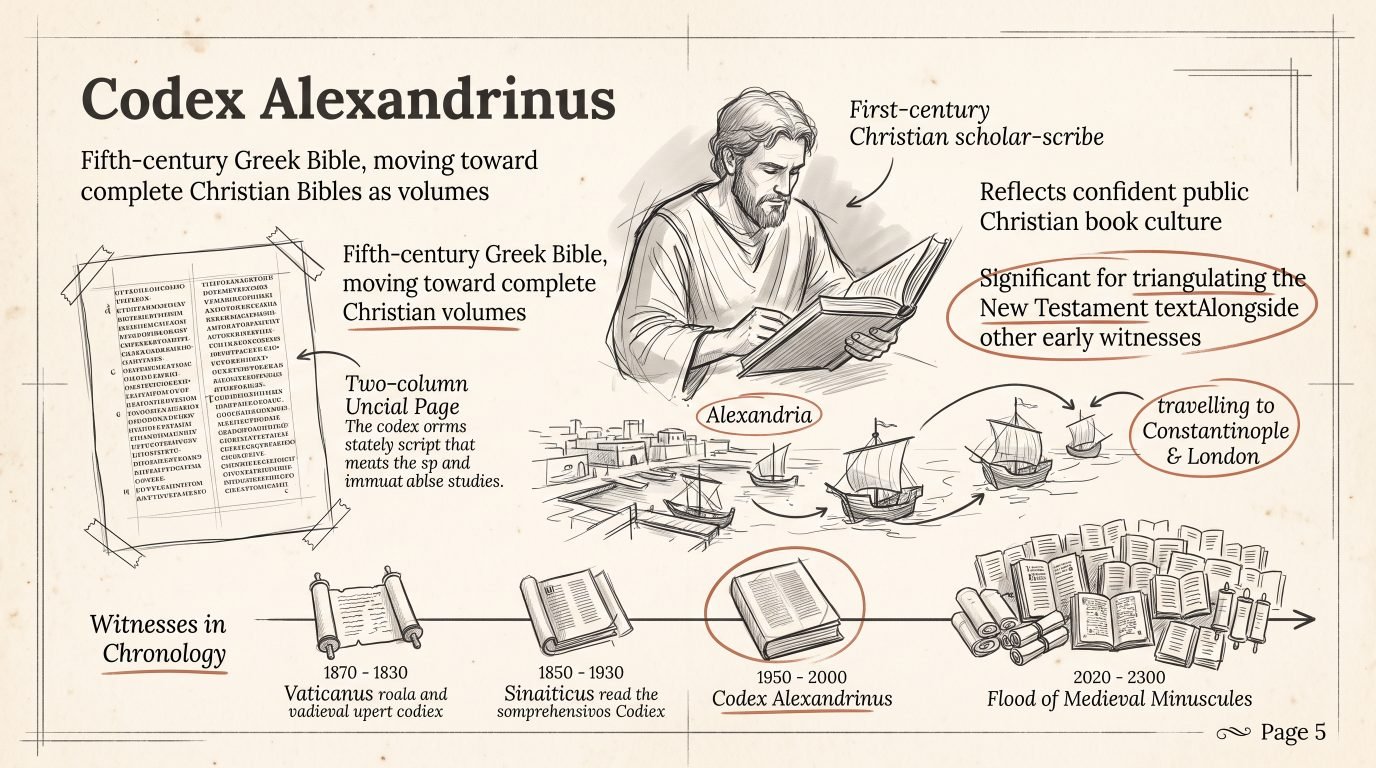
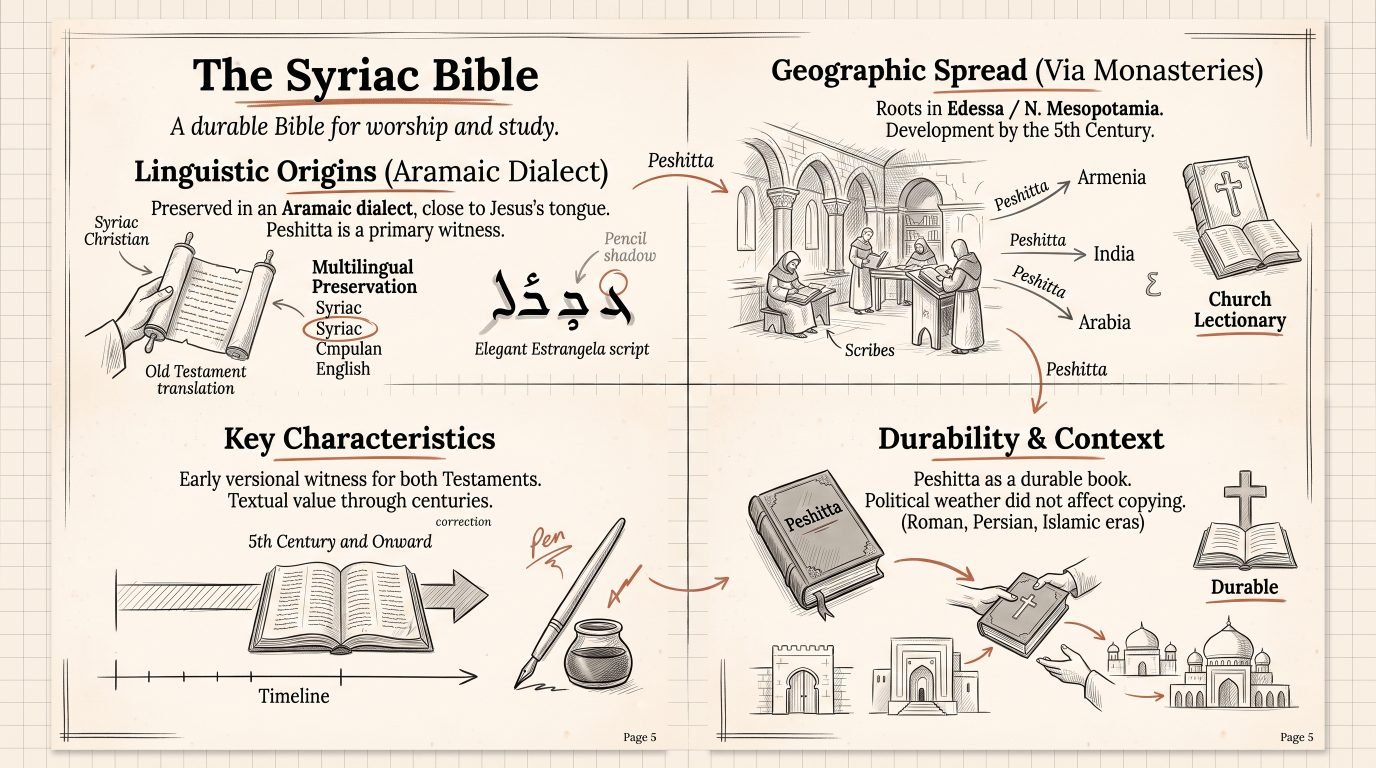
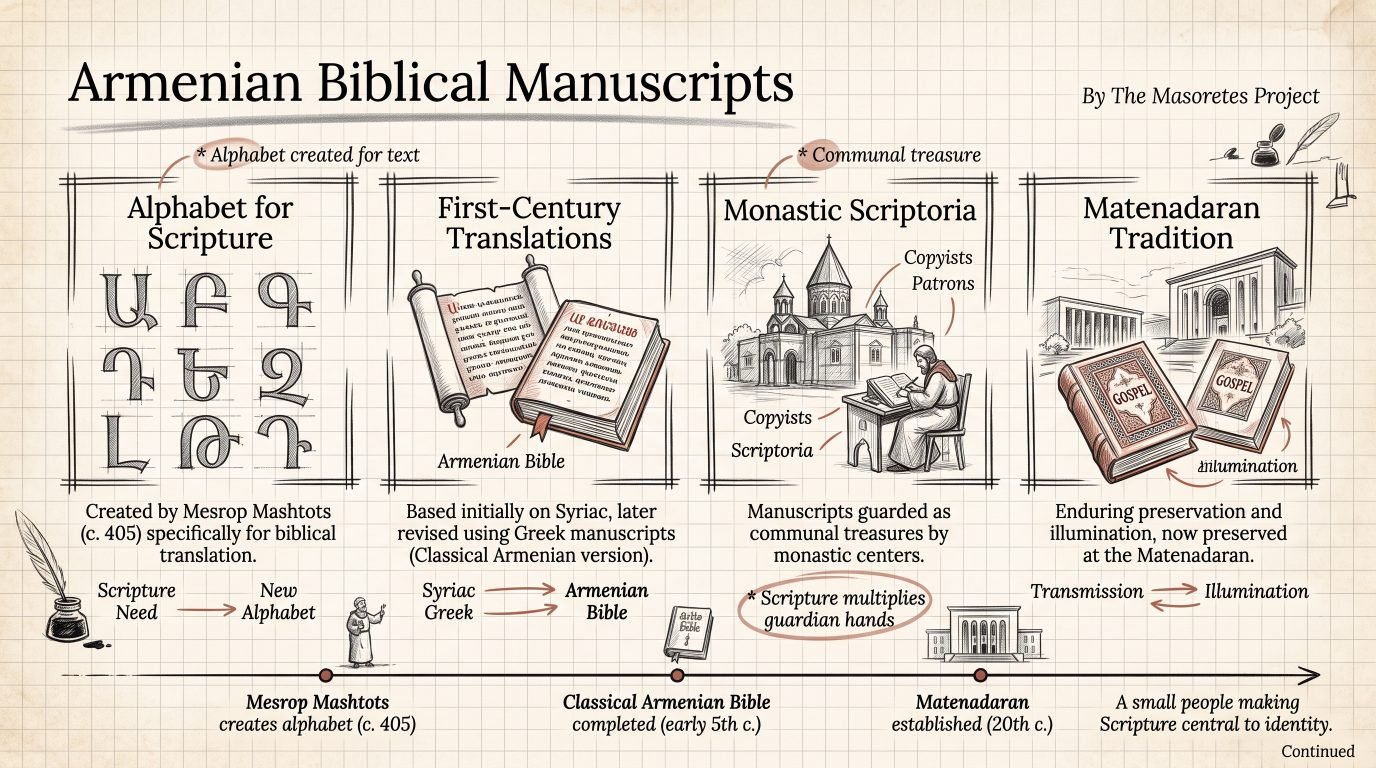
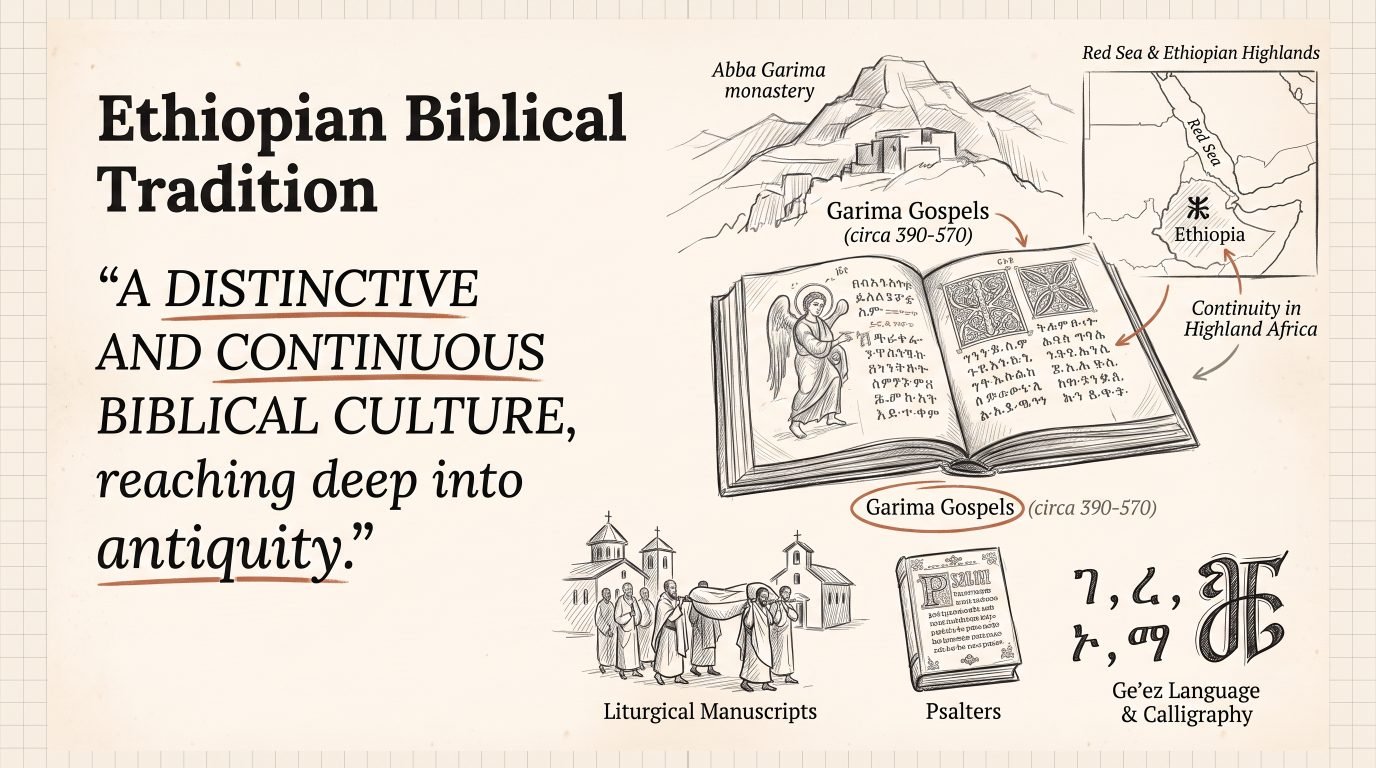
Codex Vaticanus, Sinaiticus, and Alexandrinus represent the fourth–fifth-century Greek pandect ideal: high-quality vellum, multi-column uncial, near-complete Testaments. The deck pairs them with versional worlds: Syriac Peshitta as a durable Aramaic-dialect Bible rooted in Edessa and monastic networks; Armenian tradition from Mesrop Mashtots’s alphabet (c. 405) through classical translation to the Matenadaran’s illuminated Gospels. Scripture multiplies guardian hands across languages.

XI. Comparing Manuscripts and the Work of Criticism
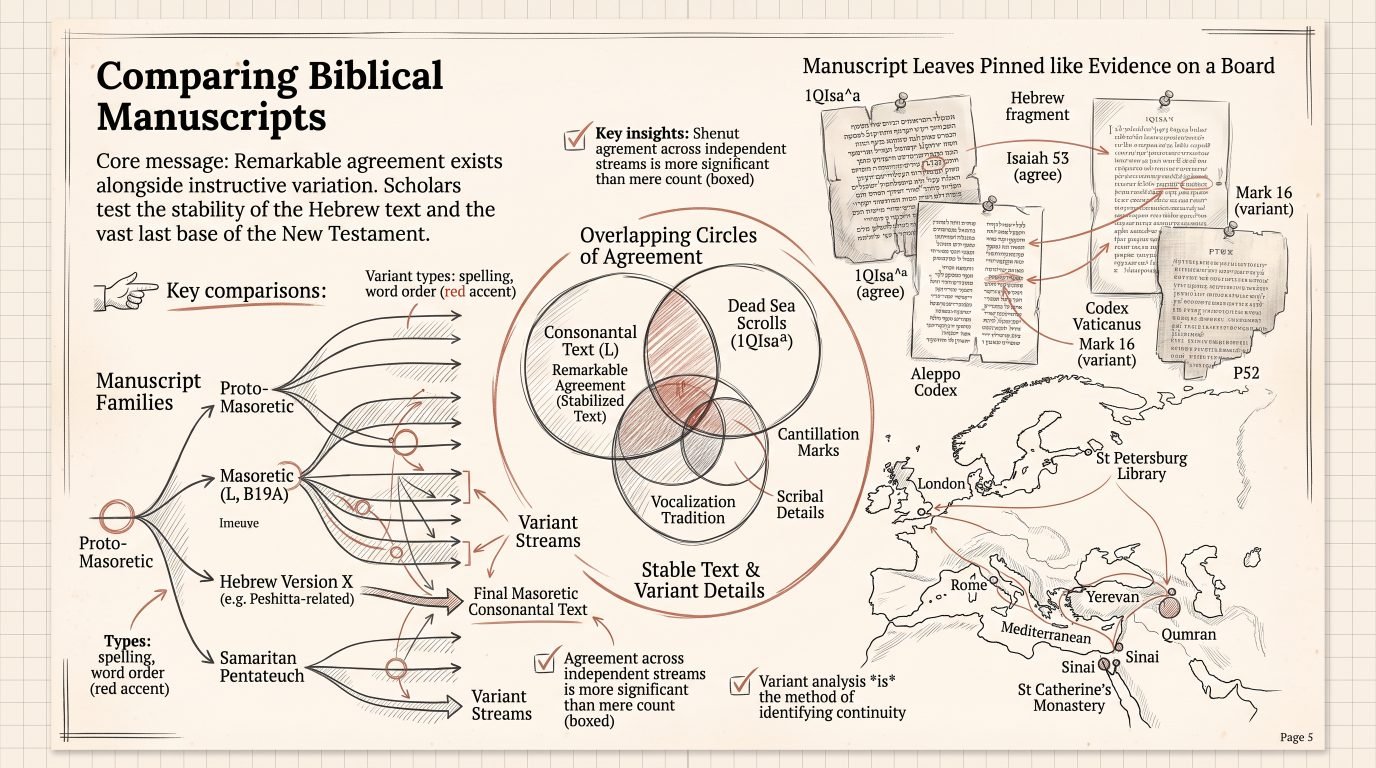
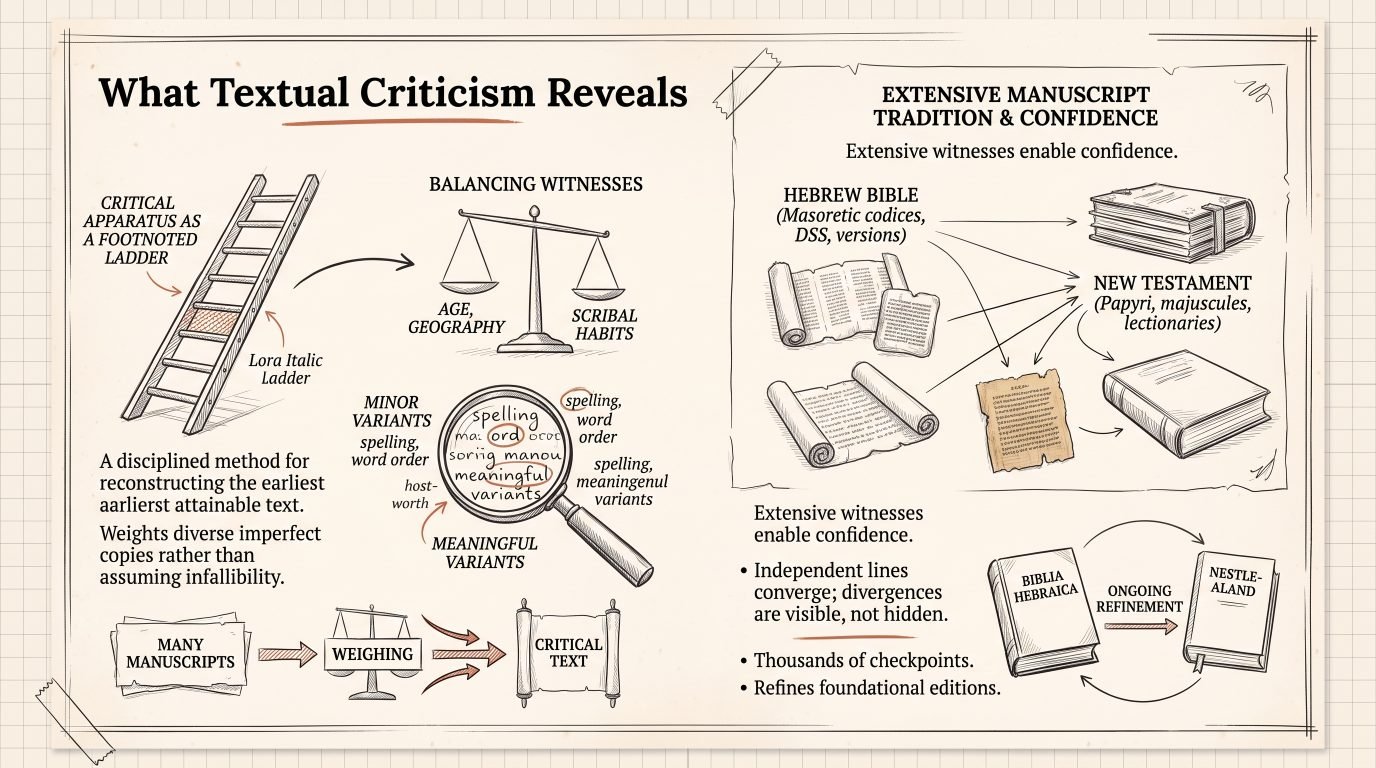
Later slides map families and streams: proto-Masoretic, Masoretic (e.g. Leningrad B19A), Samaritan Pentateuch, versional lines; agreement between 1QIsaa and later Isaiah; variants such as the ending of Mark. The method is not naïve counting of manuscripts but weighing age, geography, and scribal habits. Minor spelling and word-order differences sit beside rarer meaningful variants. Extensive independent witnesses enable confidence: lines converge; divergences are visible, not hidden. Critical editions such as Biblia Hebraica and Nestle–Aland refine the foundational printed text without pretending infallibility of any single copy.
Hub notes: Textual Criticism, Modern Critical Editions, Reliability.
XII. The Chain Through History, and Why It Matters
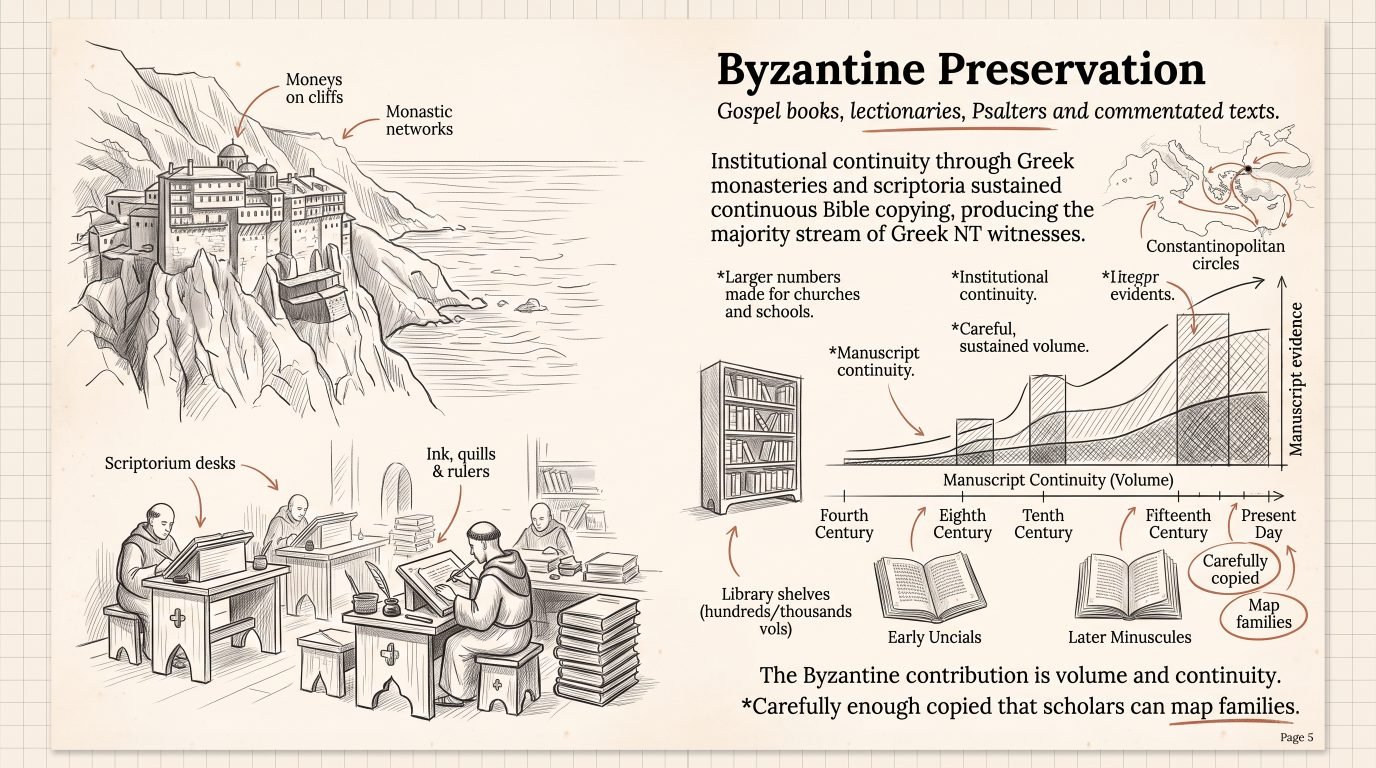
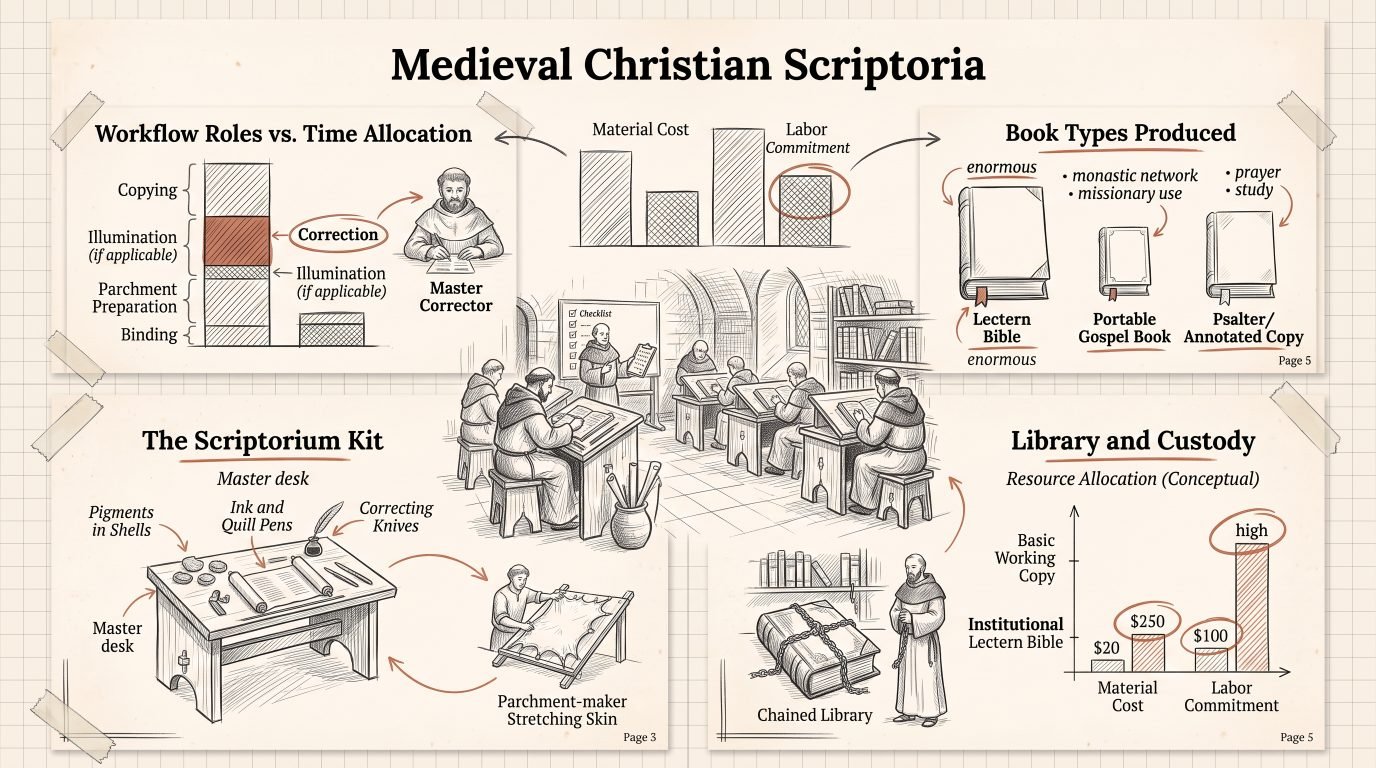
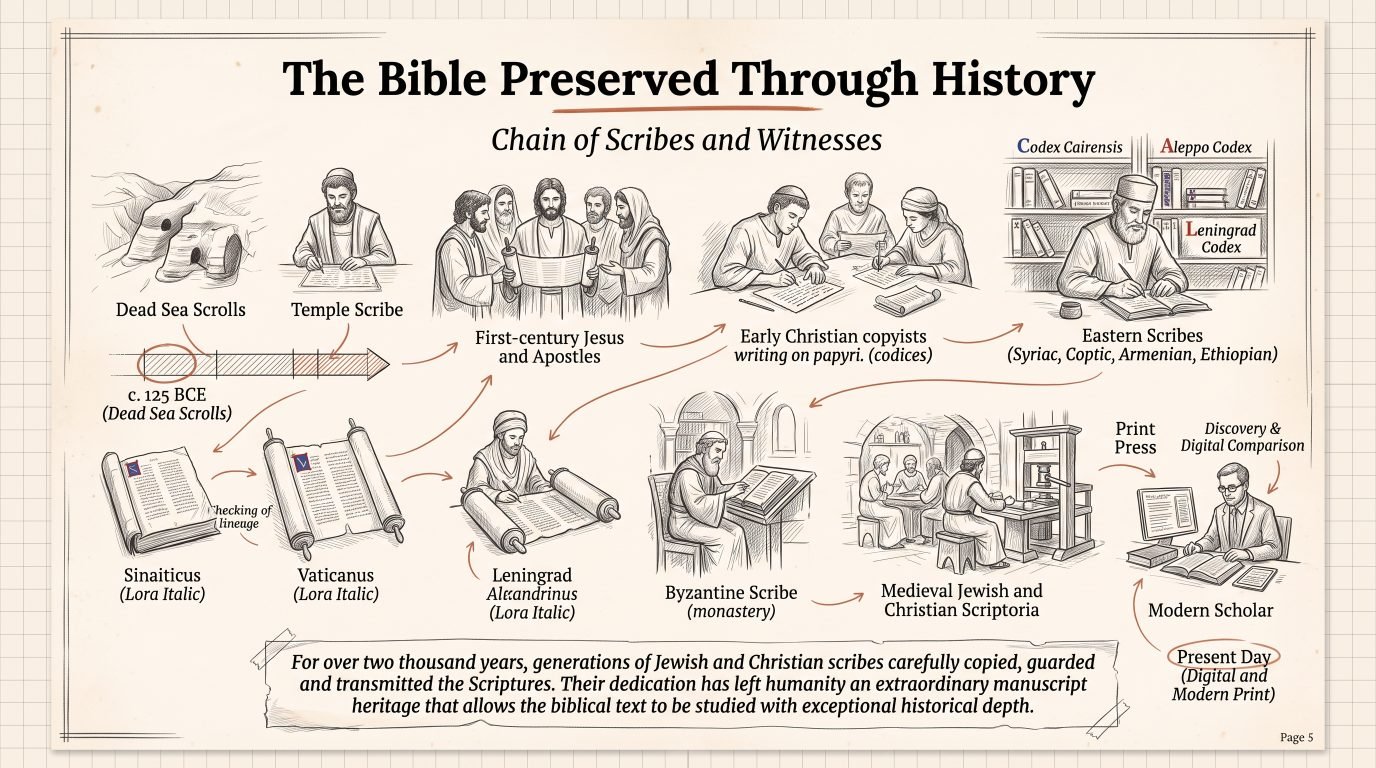
The closing slide, “The Bible Preserved Through History,” arrays Dead Sea Scrolls, Temple scribes, Jesus and the apostles, early Christian copyists on papyrus, eastern scribes (Syriac, Coptic, Armenian, Ethiopian), Byzantine monastic hands, medieval Jewish and Christian scriptoria, print, and modern digital comparison. The banner claim is historical as much as confessional: for over two thousand years, generations carefully copied and transmitted the Scriptures, leaving a manuscript heritage that allows exceptional historical depth.
That is the presentation’s gift to this site. It braids Hebrew and Greek streams, Jewish and Christian guardians, and material forms from jar to codex to screen, exactly the map this hub tries to hold together.
XIII. Slide Gallery (30 slides)
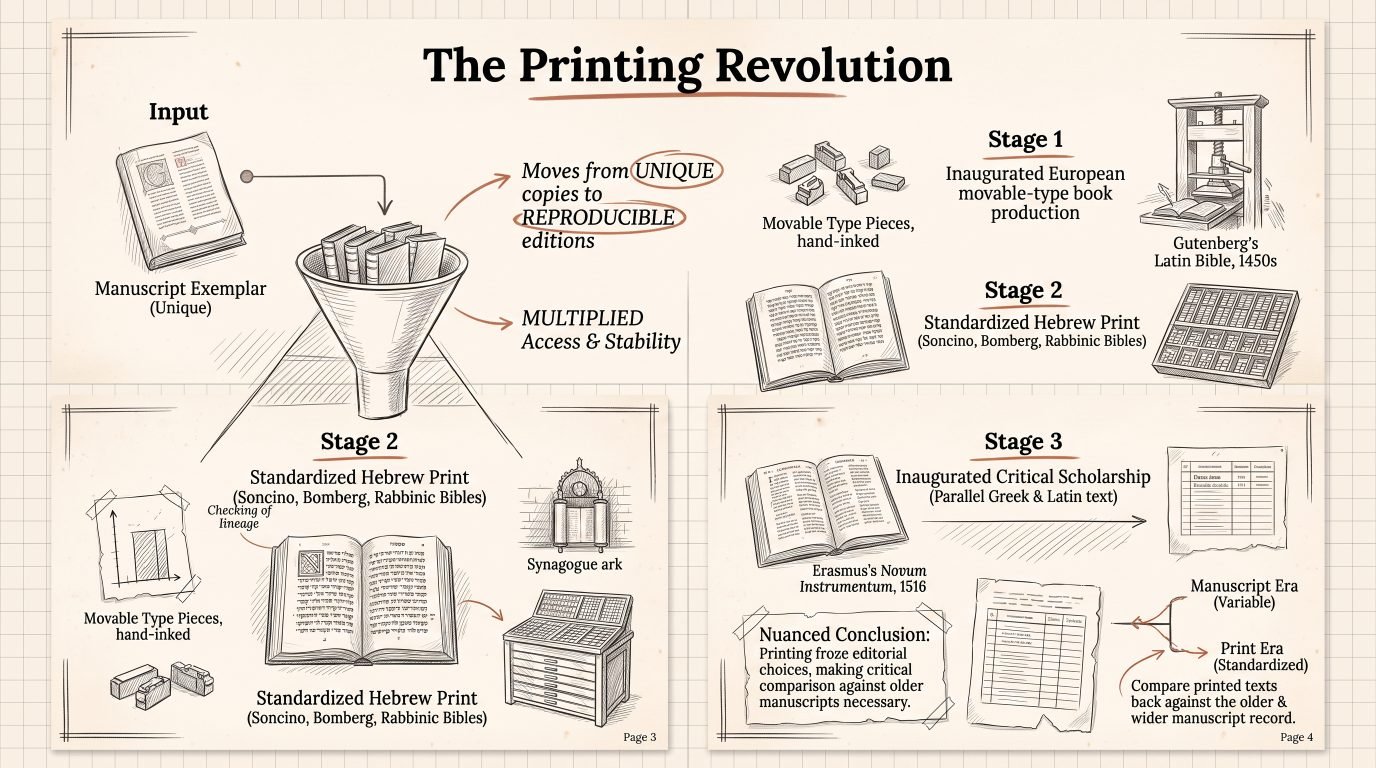
Browse all thirty presentation frames below (full slide visible in each tile). Click any tile to open the full image. For teaching or offline use, download the PowerPoint file above.
Selected Bibliography & Further Hub Reading
The Masoretes Project, The Preservation of the Holy Bible Since the Time of Jesus (30-slide presentation). Download from this page.
Bruce M. Metzger & Bart D. Ehrman, The Text of the New Testament, 4th ed. (Oxford: Oxford University Press, 2005).
Emanuel Tov, Textual Criticism of the Hebrew Bible, 3rd ed. (Minneapolis: Fortress, 2012).
Larry W. Hurtado, The Earliest Christian Artifacts (Grand Rapids: Eerdmans, 2006).
Michael J. Kruger, Christianity at the Crossroads (Downers Grove: IVP Academic, 2018).
Hub notes: Greek Preservation · DSS · Soferim · Nakdanim · Vaticanus · Sinaiticus · Textual Criticism · Ancient Versions.
Map links: Qumran / Jerusalem (DSS and Second Temple), Alexandria and Rome (codices and versions), Sinai (Sinaiticus), and eastern centers in the versional story, see the Scholarship Map.