Antiquity–21st c. CE
Morocco, Algeria, Tunisia, Libya
Hebrew, Judeo-Arabic, Berber-influenced dialects, French
Soferim, piyyut, humash pedagogy, Sephardi-type rites
I. Scope, Terms, and Historiography
Maghrebi Jews are the Jewish communities of the western Islamic world—primarily Morocco, Algeria, Tunisia, and Libya—whose continuous history spans late antiquity, the medieval Maghreb, Ottoman and sharifian centuries, colonial modernity, and mass mid-twentieth-century migration. The category overlaps with, but is not identical to, Mizrahi and Sephardi identities. Indigenous Maghrebi Jews (toshavim, “residents”) long predated Iberian refugees (megorashim, “expelled”) who arrived after 1391 and especially after 1492. In Israeli and French public discourse, “Maghrebi” often functions as an ethnic-cultural label for North African Jewish heritage; historians insist on local specificity—Fez is not Tunis; the M’zab is not Oran.
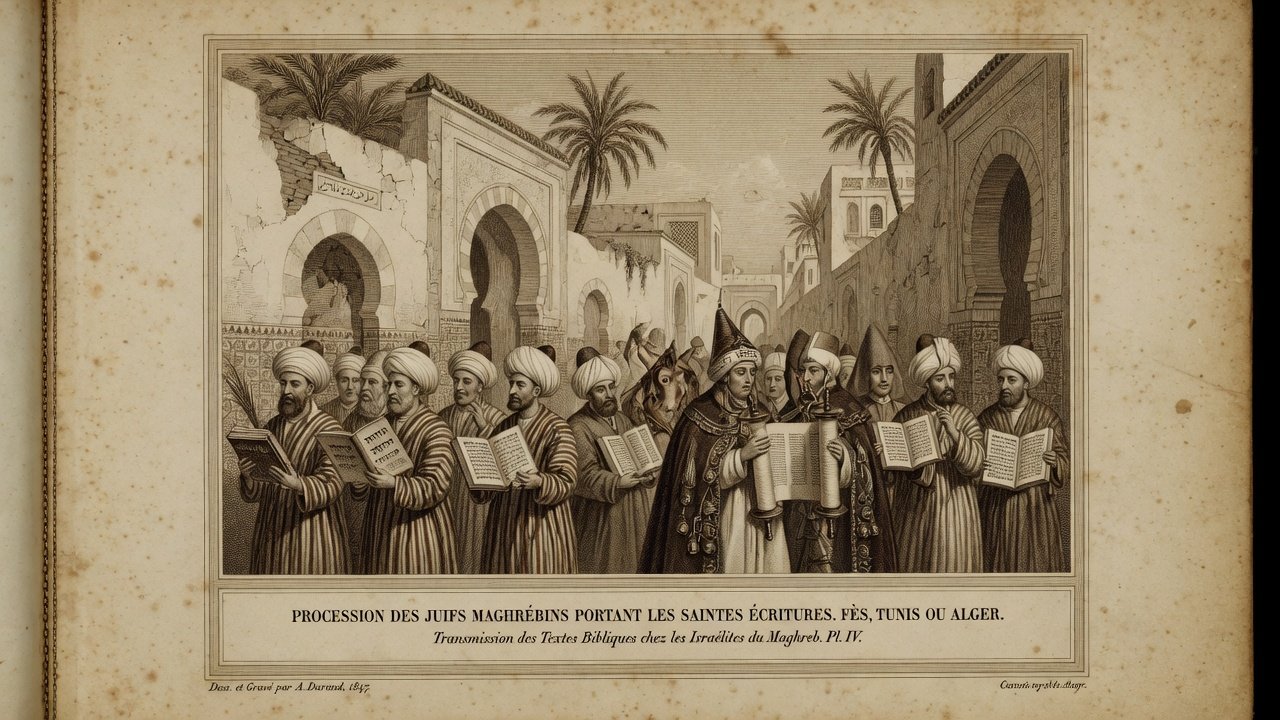
This encyclopedic note emphasises biblical and textual culture: how Maghrebi communities produced kosher scrolls, taught the vocalized humash, composed piyyut around the weekly portion, preserved Judeo-Arabic glosses of Scripture, and negotiated Sephardi grammars and printed Rabbinic Bibles. Companion studies include North Africa, city notes such as Tunis, Algiers, Oran, and Casablanca, and the panoramic Jews of the Arab Lands.
Scholarship has moved from colonial ethnography and apologetic “golden age” narratives toward archival work in rabbinic responsa, Alliance Israélite Universelle reports, notarial records, and oral-history projects after the exodus. Foundational modern syntheses treat Maghrebi Jewry as a Mediterranean civilization in its own right—not merely a periphery of Spanish or French history.
“In the Maghreb the Masoretic page was not an imported European schoolbook. It was the daily craft of soferim, melamedim, and paytanim who sang Scripture in Judeo-Arabic streets.”
II. Antiquity to the Early Islamic Maghreb
Jewish presence in Roman North Africa is attested by funerary inscriptions, synagogue remains, rabbinic references to African communities, and Christian polemic. Carthage and other coastal cities hosted Greek- and Latin-speaking Jews who also used Hebrew liturgy. Late antique North Africa was a dense landscape of Christian, Jewish, and later Vandal and Byzantine regimes before the Arab-Muslim conquests of the seventh and eighth centuries reorganized political space.
Under Umayyad and then Abbasid, Aghlabid, Fatimid, Almoravid, and Almohad rule, Maghrebi Jews became subjects of Islamic polities, generally under dhimmi status: protected yet subordinated non-Muslims with communal autonomy in family law and synagogue regulation—including public Torah reading from kosher scrolls. The severity of dhimmi enforcement varied by dynasty. The Almohad period (twelfth century) forced conversions and flight, scattering Maghrebi and Andalusian Jews toward Christian Iberia, Egypt, and elsewhere—famously shaping the biography of Maimonides.
Medieval Maghrebi communities maintained trade and scholarly links with al-Andalus, Sicily, Egypt, and the Levant. Letters in the Cairo Genizah preserve Maghrebi correspondents discussing commerce, marriage, and books. Those networks carried Tiberian-pointed codices, Judeo-Arabic Bible translations, and legal queries that kept Maghrebi readers inside the wider Masoretic world even when local oral pronunciation differed from Tiberias or Baghdad.
III. Toshavim, Megorashim, and the Layering of Rite
The demographic and cultural watershed of the late Middle Ages was the arrival of Iberian Jews. Pogroms of 1391, conversions under pressure, and the expulsions from Spain (1492) and Portugal (1496–97) sent megorashim into Fez, Tlemcen, Algiers, Tunis, and smaller towns. In many cities, Sephardi rite, Spanish-Portuguese family names, and Andalusian intellectual prestige reshaped communal leadership. Yet toshavim customs—older piyyut corpora, local cantillation habits, and Maghrebi legal traditions—survived, especially in the Moroccan interior, among certain Tunisian and Libyan communities, and in village settings less dominated by Iberian elites.
The result was not a simple replacement of “native” by “Spanish” Judaism, but a stratified society in which Bible pedagogy mixed local heder methods with Sephardi grammars, printed humashim, and eventually Ottoman and European print. Some communities retained dual synagogues or dual customs for generations. Historians therefore treat Maghrebi Jewry as a composite civilization in which the same Masoretic text was taught through multiple oral and commentarial channels.
| Layer | Origin / period | Biblical emphasis |
|---|---|---|
| Toshavim | Indigenous Maghreb (pre-1391/1492) | Local cantillation; older minhagim; Judeo-Arabic gloss; village soferim |
| Megorashim | Iberian exile after 1391/1492 | Sephardi rite; Andalusian grammatical heritage; prestige print culture |
| Livornese & Italian networks | Early modern ports | Mediterranean book trade; Italian-Sephardi print |
| Colonial modernity | French/Italian rule (19th–20th c.) | Alliance schools; French literacy; mass printed Bibles; modern Hebrew |
| Post-exodus reconstitution | Israel, France, Canada (mid-20th c.–) | Preserved melodies; heritage education; Israeli curriculum |
IV. Geography of Maghrebi Bible Culture
Morocco hosted the largest Maghrebi Jewish population into the modern period. Fez, Marrakesh, Meknes, and later Casablanca were centers of rabbinic courts, soferim, and Talmud Torahs. Inland communities often preserved older customs; Atlantic and Mediterranean ports absorbed more commercial and print influence. Algeria saw early French colonization (from 1830) and the Crémieux Decree (1870) that conferred citizenship on most Algerian Jews, accelerating Francophone education while traditional cheders continued. Tunisia balanced French protectorate structures with strong Tunis and Djerba communities—Djerba especially famous for continuous synagogue life and scribal reputation. Libya (Tripoli, Benghazi) linked Maghrebi and Italian Mediterranean worlds until mid-century departure.
Each zone taught the same Tiberian-pointed text with regional accents of melody and explanation. City notes on this site trace local soferim, schools, and manuscript habits in Tunis, Algiers, Oran, and Casablanca.
V. Languages around the Pointed Page
Sacred literacy used Hebrew (and Aramaic for Talmud and some liturgy). Everyday speech employed Judeo-Arabic dialects—often written in Hebrew script—with Berber-influenced Jewish speech in parts of the Moroccan and Algerian interior, and later French, Italian, or Spanish in colonial cities. Judeo-Arabic oral paraphrase of the weekly portion and of popular biblical stories mediated sense for women, artisans, and children not yet fluent in unpointed rabbinic Hebrew.
Pronunciation of Tiberian vowel signs in Maghrebi traditions differs from Ashkenazi and Yemenite systems. Those differences are not “errors”; they are authentic oral implementations of the same Masoretic inventory. Comparative cantillation research treats Maghrebi Torah and haftarah melodies as a major branch of Sephardi-related oral tradition, with local Tunisian, Moroccan, and Algerian substyles.
VI. Soferim, Schools, and the Classroom Humash
Maghrebi Bible culture rested on interlocking institutions:
- Soferim who wrote Torah scrolls, megillot, and sometimes tefillin and mezuzot under traditional halakhic rules—often family crafts transmitted across generations.
- Heder / kuttab-style schools that taught children the alphabet, pointing, and the weekly portion, typically with Rashi as the default companion once students advanced.
- Yeshivot and batei midrash for advanced Talmud and legal codes, still anchored in biblical literacy for liturgical and homiletical use.
- Piyyut that elaborates biblical narratives in synagogue performance—especially rich in Moroccan and Tunisian repertoires—so that Scripture entered public sound beyond the formal Torah reading.
- Print and Alliance Israélite Universelle schools from the nineteenth century that multiplied humashim, introduced European classroom methods, and taught French or other metropolitan languages alongside Hebrew.
Printed Mikraot Gedolot-type editions and separate humashim with Targum and classical commentators circulated through Livorno, Vienna, and later local presses. Maghrebi readers thus participated in the same commentarial canon—Rashi, ibn Ezra, Ramban, and others—that structured Sephardi and Ashkenazi classrooms, while retaining local melodies and Judeo-Arabic explanation.
VII. Manuscript, Print, and Mediterranean Book Routes
Before mass print, Maghrebi communities relied on imported and locally copied codices. Links to Egyptian and Levantine book markets, and to Andalusian and later Ottoman Sephardi printing, brought pointed Bibles into North African synagogues. Early modern Livorno and other Italian ports supplied Sephardi-type liturgical and biblical books to Maghrebi customers. In the nineteenth century, cheaper print and colonial postal systems made vocalized Scripture a household object for broader classes.
Genizah fragments, private collections, and synagogue genizot (where preserved) show Maghrebi hands copying biblical books, Targum, and liturgical poetry. Those materials remain understudied relative to Egyptian Genizah corpora but are essential for a non-Eurocentric history of Masoretic reception.
VIII. Colonial Modernity, Reform of Schooling, and Continuity
French and Italian colonial regimes restructured Maghrebi Jewish legal status and education. Alliance schools taught modern subjects and standardized Hebrew pedagogy; traditional rabbis sometimes resisted, sometimes adapted. Zionist and modern Hebrew movements added new textbooks and national ideologies without always displacing synagogue cantillation. Women gained new access to literacy through colonial and communal schools, expanding who could read the pointed prayerbook and humash at home.
By the early twentieth century, Maghrebi Bible culture was simultaneously traditional (sofer, piyyut, Judeo-Arabic explanation) and modern (print, French, Alliance, emerging Israeli Hebrew). That dual character still shapes heritage communities today.
IX. Exodus, Reconstitution, and Living Transmission
Between the 1940s and 1970s, the vast majority of Maghrebi Jews left for Israel, France, Canada, and elsewhere—under pressures that varied by country, including violence, political exclusion, and economic collapse of communal structures. They carried scrolls, humashim, wedding songs, and Torah melodies into new languages. In Israel, Maghrebi and broader Mizrahi cultural revivals have revalorized North African piyyut and cantillation; in France, large Maghrebi Jewish populations sustain synagogues whose weekly portion still sounds Maghrebi.
For the history of the Masoretic text, Maghrebi Jewry demonstrates that the Tiberian pointed page became a Mediterranean common good—implemented through Judeo-Arabic speech, Sephardi rite layers, colonial print, and post-exodus heritage education. Any account of biblical transmission that stops at Europe or the eastern Mashriq is incomplete without Fez, Tunis, Algiers, Djerba, and Casablanca.
X. Relation to Sephardi, Mizrahi, and Other Communities
Maghrebi Jewry is a hinge between Sepharad and the wider Mizrahi world. It also compares instructively with Teimani oral precision, Romaniote Greek-speaking Mediterranean Judaism, and Ashkenazi yeshiva culture. Cross-links on this site’s map and diaspora hub are meant to keep those comparisons visible without collapsing them into a single “non-Ashkenazi” essence.