Ancient/medieval roots–21st c.
Kerala (Cochin/Kochi); Israel
Malayalam, Hebrew, English
Synagogue scrolls; Paradesi & Malabari traditions
I. Malabar Jewish Society: Scope and Streams
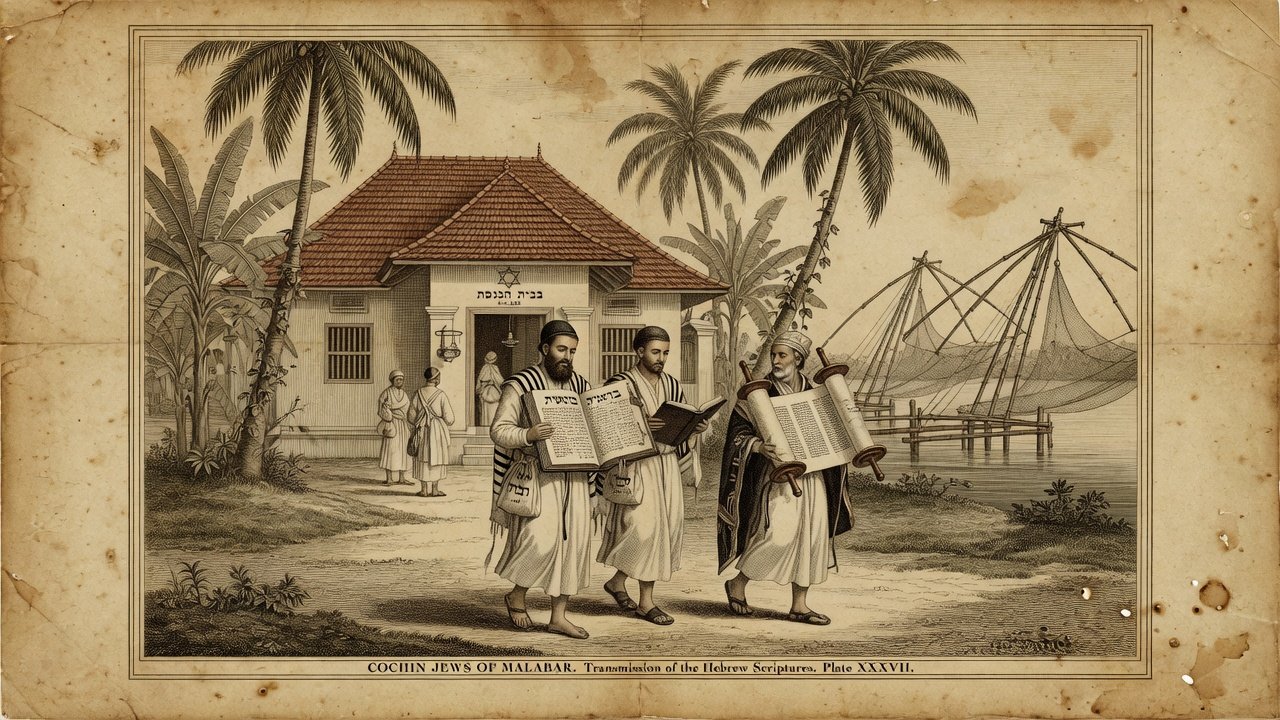
The Jews of Cochin (Kochi) on India’s Malabar Coast formed one of the Indian Ocean’s historic Jewish societies. Historians distinguish older Malabari communities from later Paradesi (“foreign”) Jews who arrived from the Middle East and Europe and clustered in distinctive synagogue spaces. Copper-plate traditions and royal privileges encode memory of status under Hindu rulers. This note emphasises synagogue Bible culture: scrolls, liturgy, education, and contact with global Jewish book networks.
“In Kerala the ark held the same five books—read under fans and monsoon light, guarded by families who measured continuity in scrolls and marriage contracts.”
II. Synagogues, Scrolls, and Sacred Space
The Paradesi Synagogue and other Kerala synagogues became symbols of Indian Jewish heritage—architecture, floor tiles, and ritual objects attracting travelers and scholars. Torah scrolls, whether locally maintained or imported, stood at the center of public religion. Soferim and ritual experts linked Cochin to Middle Eastern scribal standards when books and people moved along monsoon trade routes. Visitors from Yemen, Baghdad, and Europe noted both familiarity (Hebrew liturgy, kosher scroll) and difference (local custom, dress, social stratification between Jewish groups).
III. Education and the Pointed Page
Hebrew literacy for prayer and Torah reading was a communal priority for boys in traditional settings. The weekly portion structured time; festival megillot added seasonal readings. Malayalam served as vernacular; Hebrew as holy tongue. Printed Bibles and prayerbooks eventually supplemented manuscript culture. Contact with Bene Israel teachers and students, Baghdadi merchants, and later Zionist educators expanded modern pedagogy.
IV. Trade Routes and Book Supply
Malabar’s spice trade placed Cochin Jews within Indian Ocean networks linking Arabia, Persia, and Europe. Those networks could carry scrolls, printed sefarim, and travelers who reported on Jewish practice. Compared with inland Kaifeng, Cochin’s maritime position favored intermittent renewal of Hebrew book culture from the Middle East.
V. Modernity, Emigration, and Heritage
Twentieth-century emigration to Israel reduced Kerala’s Jewish population to a remnant, while Israeli Cochin communities and heritage tourism in Kochi preserve synagogue spaces and family histories. Recordings of melodies and oral histories document how the Masoretic portion was chanted on the Malabar Coast. Museums and scholarly monographs integrate Cochin into Indian Ocean Jewish studies.
VI. Comparative Notes
With Bene Israel and Baghdadi Indians, Cochin shows India’s plural Jewish map. With Yemenite and Maghrebi communities, it shares the pattern of Hebrew liturgy in a non-European vernacular environment. It is a necessary point on any global map of biblical transmission.
VII. Social Stratification and Shared Scripture
Historic distinctions among Malabari, Paradesi, and other Jewish groups in Kerala affected synagogue seating and marriage patterns, yet all streams oriented toward Hebrew liturgy and Torah reading. Shared Scripture did not automatically erase social hierarchy; encyclopedic honesty requires noting both the common Masoretic horizon and internal boundaries.
VIII. Colonial Observation and Scholarly Archives
European travelers, missionaries, and colonial officials described Cochin synagogues and rituals, producing sources now mined by historians. Jewish travelers compared Cochin practice with Middle Eastern norms. These outsider archives, read critically alongside communal memory, reconstruct how the weekly portion was performed on the Malabar Coast.
IX. Israeli Heritage and Tourism of Memory
In Israel, Cochin Jews maintain associations and synagogues that recall Kerala melodies. In Kochi, heritage tourism preserves synagogue space even as resident community numbers dwindled. The pointed scroll remains the symbol that links monsoon ports to the global Jewish library.
X. Cantillation, Malayalam, and the Heard Torah
Cochin Torah melodies, as remembered by elders in Israel and documented by ethnomusicologists, form an Indian Ocean branch of Jewish oral tradition. Malayalam-speaking households heard biblical stories in the vernacular while the formal reading remained Hebrew. That split between holy tongue and mother tongue is the structural parallel to Judeo-Arabic Maghreb or Yiddish Ashkenaz—each a complete ecology of Scripture. Loss of resident community in Kerala makes recordings and notation urgent primary sources.
Festival cycles—especially seasons rich in megillah reading—marked the year with additional texts. Children learned to recognize scroll ornaments, ark curtains, and the choreography of taking out the sefer Torah, long before they mastered full fluency. Sensory religion carried biblical culture as much as abstract literacy.
XI. Women, Family Bibles, and Domestic Teaching
Family humashim and prayerbooks, sometimes brought on aliyah, encode female as well as male ownership histories. Women taught blessings, festival foods tied to biblical calendar, and moral stories from Genesis and Exodus. Modern Indian and Israeli schooling expanded women’s direct access to Hebrew Tanakh study, adding a new chapter to Cochin biblical pedagogy without erasing older domestic channels.
XII. Why Cochin Matters for Masoretic Geography
If the Masoretic text is only mapped from Tiberias to Vilna, Cochin disappears. Restoring Cochin to the map shows monsoon trade as a vector of Jewish book culture and demonstrates that tropical synagogue architecture can house the same five books as a Rhineland stone shul. The encyclopedic claim is modest and strong: Kerala is a real coordinate of biblical transmission in the Common Era.