Leucorea reformers
German from Heb./Gk.
Humanist languages
Mass vernacular

I. Why Wittenberg Matters for Bible Scholarship
Wittenberg (German Wittenberg; older English sometimes Wittemberg) became the intellectual capital of the German Reformation. At its university, Martin Luther, Philip Melanchthon, and their circle made the Bible the public engine of reform, preached in German, argued from Hebrew and Greek, and printed for a mass audience. For this hub Wittenberg is where Renaissance original-language tools met vernacular national Scripture most explosively on German soil.
Pair this note with Mainz (print technology), Erasmus (Greek NT), and English paths from Tyndale to the Authorised Version.
II. University, Castle Church, and Reform
The University of Wittenberg (Leucorea) gave reformers a faculty platform. Theology, arts, and languages intertwined: Melanchthon’s humanism supplied Greek and educational reform; Luther’s lectures on Psalms, Romans, and Galatians modeled exegesis as university and pastoral work at once. The Castle Church and town pulpits made biblical argument a civic event.
Wittenberg’s importance is not only the 95 Theses legend but the sustained program of lecturing, translating, and printing Scripture as the rule of faith, using the best Hebrew and Greek tools the age could buy.
III. Luther’s German Bible
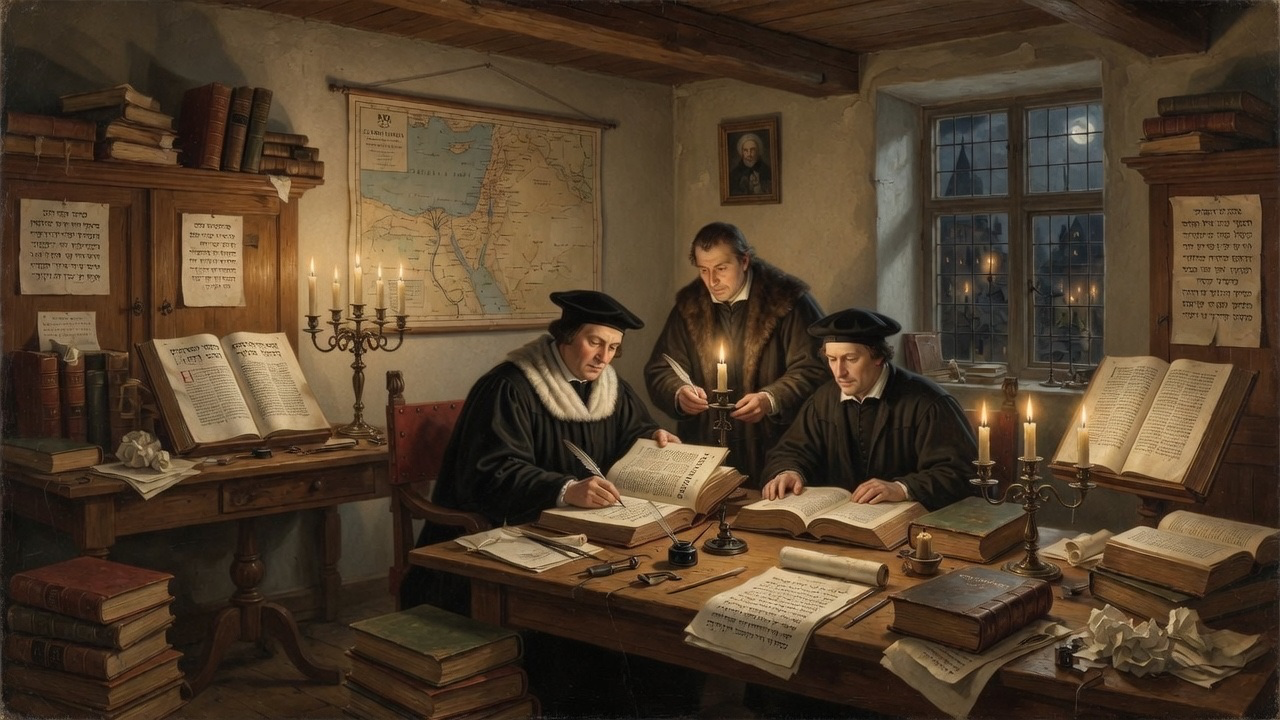
Luther’s German New Testament (1522, “September Testament”) and later complete Bible made Scripture a people’s book in Early New High German. He worked from Greek (in the Erasmian printed tradition related to our Textus Receptus story) and from Hebrew for the Old Testament, consulting the Latin Vulgate and earlier German attempts. The result was philology plus rhetoric: a translation meant to speak.
Collaborators in Wittenberg checked drafts; printers spread editions across German lands. For transmission history, Wittenberg shows how a university town could nationalize the Bible almost as thoroughly as London would later do for English, though with different politics and base-text arguments.
| Project | Wittenberg role |
|---|---|
| German NT (1522) | Greek-based vernacular breakthrough |
| German OT / full Bible | Hebrew + team revision culture |
| University lectures | Exegesis as public reform |
| Print distribution | Mass German Scripture market |
IV. Hebrew, Greek, and the Reformers’ Desk
Wittenberg reformers insisted that faith rest on the prophetic and apostolic Scriptures in their original languages as far as learning allowed. Hebrew grammars and Rabbinic tools, however mediated, and Greek New Testaments from Basel and elsewhere filled their shelves. The Tiberian Hebrew tradition and Renaissance Greek recovery thus entered German pulpits through Wittenberg desks.
At Wittenberg the Bible ceased to be only a Latin schoolbook; it became German speech grounded, so the reformers claimed, in Hebrew and Greek.
V. Networks: Rhine Presses and Europe
Wittenberg depended on the print and book culture of the Rhine and south Germany, see Mainz and Cologne. English readers later felt Luther’s shock waves through Tyndale and every Protestant vernacular. The map places Wittenberg on the German Bible circuit with Worms, Cologne, and Mainz.
- Worms, Diet of 1521; Rhineland Jewish learning
- Mainz, Gutenberg print revolution
- William Tyndale, English original-language path
- Erasmus, Greek NT tools
VI. Place on the Transmission Map
Wittenberg is the Reformation workshop of the German Bible: university exegesis, Hebrew–Greek claims, and vernacular print power. Continue to Mainz, Worms, and Cologne for the wider German-Rhenish story.
Sources & Further Reading
| Work | Author / Source | Relevance |
|---|---|---|
| Martin Luther | Biography | Reformer & Bible translator |
| Luther Bible | Reference | German Bible project |
| Philip Melanchthon | Biography | Humanist colleague |
| Wittenberg | Encyclopedic | City & university |
| Textus Receptus | Masoretes site | Printed Greek NT tradition |
| Erasmus | Masoretes site | Greek NT editions |
| Mainz | Masoretes site | Print revolution |
| Tyndale | Masoretes site | English parallel path |
| Worms | Masoretes site | Diet of 1521 |