c. 9th–21st c. CE
Rhineland, France, Poland–Lithuania, Central & Eastern Europe
Hebrew, Aramaic, Yiddish, local vernaculars
Rashi, tosafists, yeshiva & cheder pedagogy
I. Scope, Terms, and Historiography
Ashkenazi Jews (Hebrew Ashkenazim) are the communities whose medieval heartland lay in the German-speaking Rhineland and northern France—regions medieval Jews called Ashkenaz—and who later expanded eastward into Bohemia, Poland, Lithuania, and the wider Slavic and Habsburg worlds. In modern usage the term also covers their descendants in the Americas, Western Europe, South Africa, Australia, and Israel. Ashkenazi identity is not a single ethnicity sealed at one moment; it is a historical cluster of rites (minhag Ashkenaz), legal traditions, languages (especially Yiddish), and family memory, always in dialogue with local Christian polities and with other Jewish divisions.
This note emphasises biblical and textual culture: how Ashkenazi communities copied, pointed, chanted, commented, and printed the Hebrew Bible. Companion regional studies include Poland & Ashkenaz, Eastern Europe, the Pale of Settlement, and city notes from Worms and Mainz to Warsaw. Comparative overviews of the other major Common Era divisions appear in the sister notes on Sephardi Jews and Mizrahi Jews.
“Ashkenaz is not only a place-name remembered from Genesis 10. It is a portable civilization of the pointed page—built in the Rhine, rebuilt in Poland, and carried again across the Atlantic.”
II. Origins: From Late Antiquity to the Rhineland
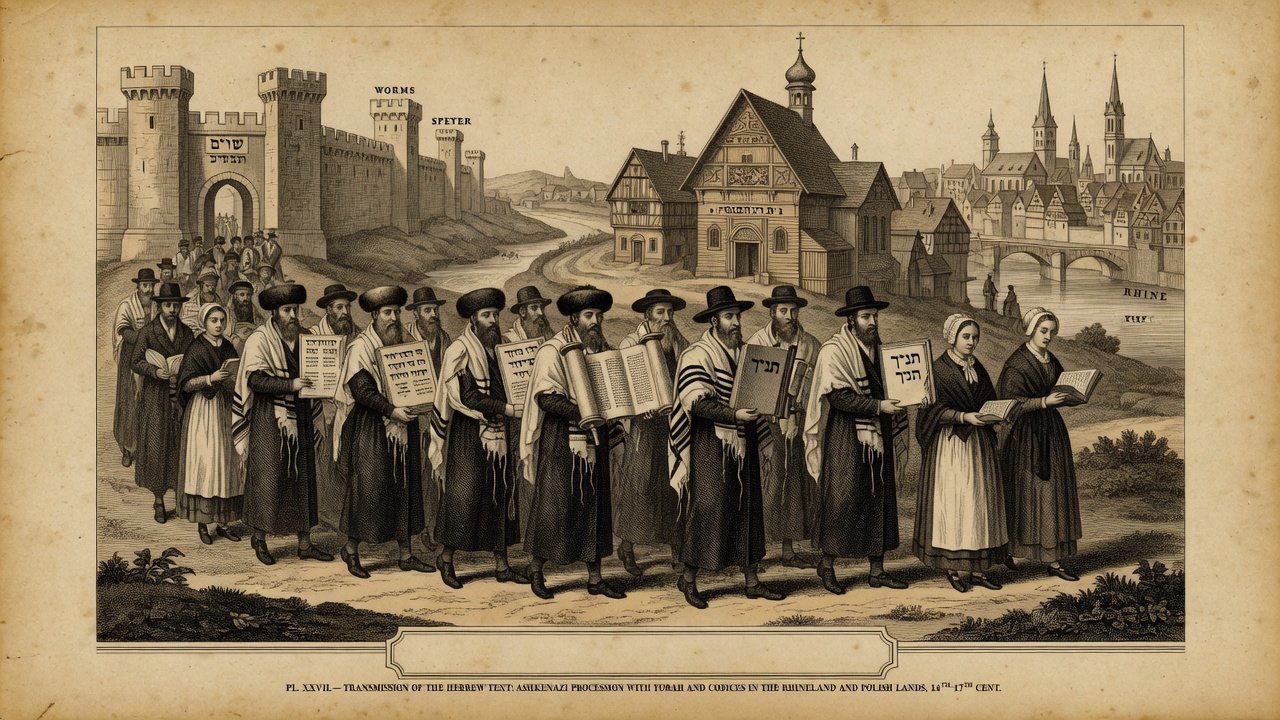
Jewish settlement in Roman and early medieval Gaul and the Rhineland is attested by archaeology, epitaphs, and Carolingian legislation long before the classic “Ashkenazi” profile of the high Middle Ages. By the tenth and eleventh centuries, communities in Mainz, Worms, and Speyer—the ShUM cities—had become centers of Talmudic learning and synagogue custom. Their ordinances, elegies, and responsa form the documentary core of early Ashkenaz.
Migration narratives differ. Some families came north from Italy and southern France; others linked memory to Palestine or Babylon through itinerant scholars. What crystallized was a rite and legal culture distinct from Iberian (Sephardi) and Middle Eastern patterns: a particular order of prayers, distinctive piyyutim, and a classroom method that treated the vocalized Bible and Rashi’s commentary as inseparable companions.
| Period | Geographic focus | Textual landmark |
|---|---|---|
| Late antique–Carolingian | Gaul, Rhine frontier | Early settlements; Latin-Christian legal frames |
| High Middle Ages (10th–13th c.) | ShUM cities; northern France | Rashi; tosafists; early Ashkenazi piyyut |
| Late medieval–early modern | Eastward migration to Poland–Lithuania | Yeshivot; Hebrew printing; community councils |
| Modern (18th–21st c.) | Pale, Central Europe, Americas, Israel | Hasidism; Haskalah; mass print & critical editions |
III. Rashi, Tosafists, and the Classroom Bible
No single figure shaped Ashkenazi Bible reading more than Rashi (Shlomo Yitzchaki of Troyes, 1040–1105). His phrase-by-phrase commentary on the Torah and much of the Tanakh made the peshat—the plain sense of the pointed text—available to students who already knew midrash. Printed later beside the biblical text in Rabbinic Bibles, Rashi became the default companion of the Masoretic page for centuries of Ashkenazi cheders and yeshivot.
The tosafists of twelfth- and thirteenth-century France and Germany extended dialectical study of the Talmud; their methods also trained readers to notice textual and legal tension in biblical verses cited in rabbinic literature. Bible study in Ashkenaz was rarely philology divorced from law and liturgy. It was an integrated curriculum: weekly Torah portion, prophetic haftarah, Psalms and festival readings, all chanted with inherited cantillation and explained through Rashi, midrash, and later supercommentaries.
Masoretic awareness in Ashkenaz often arrived through imported Sephardi and Italian codices, through printed editions (Bomberg and successors), and through local soferim who copied synagogue scrolls according to accepted rules. The Tiberian pointing system—stabilized by the Masoretes—became the normative vocalization of Ashkenazi liturgy even when local pronunciation of those signs differed from Sephardi or Yemenite practice.
IV. Crisis, Migration, and the Polish–Lithuanian Commonwealth
Crusader massacres (especially 1096), expulsions from England (1290) and France (multiple waves culminating in 1394), and later German hostilities pushed many Ashkenazi families eastward. By the sixteenth century, the Polish–Lithuanian Commonwealth hosted the largest Jewish population in Europe. Community councils regulated taxation, education, and printing privileges; yeshivot in cities such as Kraków, Lublin, and later Lithuanian centers trained elites in Talmud while cheders taught children to read the pointed humash.
Hebrew printing multiplied access to Bibles, mahzorim, and commentaries. Ashkenazi printers and booksellers in Prague, Kraków, Amsterdam (for export), and later Warsaw and Vilna made the vocalized page a mass object. The catastrophe of the mid-seventeenth-century wars and massacres devastated communities yet did not erase the educational infrastructure that re-formed in the eighteenth century.
V. Major Subdivisions of Ashkenazi Jewry
Ashkenaz is internally diverse. The following subdivisions are historical and cultural clusters, not airtight castes; families moved, intermarried, and adopted new rites.
| Subdivision | Core areas | Distinctive traits (summary) |
|---|---|---|
| Western Ashkenaz (“Yekke” / Rhineland) | Germany, Alsace, Netherlands, Central Europe | Older minhag Ashkenaz; later German culture; roots of Reform & Neo-Orthodoxy |
| Northern French / Tosafist zone | Champagne, Île-de-France (medieval) | Rashi–tosafist scholarship; absorbed into later Ashkenaz after expulsions |
| Polish–Lithuanian (Eastern Ashkenaz) | Poland, Lithuania, Belarus, Ukraine | Yeshiva culture; Yiddish heartland; ancestry of most modern Ashkenazim |
| Litvish (Lithuanian) | Vilna, Volozhin, Mir, related yeshivot | Mitnagdic Talmudism; elite analytical study; modern yeshiva model |
| Hasidic | Podolia, Galicia, Hungary, Poland; global courts | Dynastic rebbes; mystical ethos; distinctive dress, niggunim, schools |
| Galician | Austrian Galicia (Lviv region and environs) | Hasidic and non-Hasidic mix; Habsburg frame; printing & Haskalah |
| Hungarian (Oberlander / Unterlander) | Historic Hungary, Slovakia, Transylvania | Strong Orthodoxy; Pressburg yeshiva tradition |
| Bohemian–Moravian & Austrian | Prague, Vienna hinterlands | Early Hebrew printing; bridge to German culture |
| Anglo-American & colonial Ashkenaz | Britain, United States, South Africa, Australia | Mass migration 1880–1924; English vernacular; denominational spectrum |
These labels often overlap with rite (nusach Ashkenaz vs. the Hasidic nusach Sefard—a liturgical hybrid, not a claim of Sephardi ancestry) and with modern denominations that cut across older geographic clusters.
VI. Language: Hebrew, Aramaic, and Yiddish
Ashkenazi sacred literacy rested on Hebrew (Bible, prayer, legal codes) and Aramaic (Talmud, some liturgy). Day-to-day speech for centuries was Yiddish—a Germanic Jewish language with Hebrew–Aramaic and later Slavic elements—used for teaching, commerce, and folk literature. Yiddish translations and Taytsh glosses helped broader audiences follow the weekly portion; maskilic writers later used Yiddish and German to critique or renew tradition.
Pronunciation of Hebrew among Ashkenazim developed characteristic features that differ from Sephardi and Yemenite norms. When modern Israeli Hebrew adopted a largely Sephardi-influenced pronunciation standard, Ashkenazi liturgical and yeshiva pronunciations continued in diaspora and in many Orthodox settings—another reminder that the same Masoretic signs can sound different across Jewry.
VII. Hasidism, Mitnagdism, and Haskalah
From the mid-eighteenth century, Hasidism reshaped Eastern Ashkenazi life around charismatic courts and popular mysticism. Opponents—Mitnagdim, centered in the Lithuanian yeshiva world—defended analytical Talmud study as the spiritual core. Both camps still taught children the pointed Torah; both used the same Masoretic text.
The Haskalah promoted vernacular education, biblical grammar, and engagement with European scholarship. In the nineteenth century, Wissenschaft des Judentums and Christian Hebraism together professionalized Masoretic and textual study—work that later fed critical editions used worldwide, even as traditional yeshivot retained classical methods.
VIII. The Pale, Emancipation, and Mass Migration
Under the Russian Empire, most Jews were confined to the Pale of Settlement, where cities such as Warsaw, Odessa, and Berdychiv became hubs of print, politics, and piety. Emancipation in Western and Central Europe opened universities and professions but also new pressures of assimilation and antisemitism.
Between roughly 1881 and 1924, millions of Ashkenazim emigrated, especially to the United States. The Holocaust murdered the majority of European Jewry and destroyed the demographic heart of Eastern Ashkenaz; survivors and pre-war emigrants rebuilt communities in Israel, North America, and elsewhere. Post-1945 Ashkenazi life is therefore both a continuation of older rites and a reconstruction after catastrophe.
IX. Ashkenazim and the Transmission of Scripture
For this site’s purposes, Ashkenazi history is a chapter in the preservation and teaching of the biblical text:
- Synagogue scrolls written by soferim under traditional rules;
- Vocalized humashim and complete Tanakhs for study and school;
- Commentarial chains from Rashi through supercommentaries and printed Mikraot Gedolot;
- Cantillation traditions that perform the Masoretic accents in public reading;
- Modern academic and rabbinic work on Masorah, grammar, and editions.
Ashkenazi demography means that much of global Jewish and Christian encounter with “the Hebrew Bible” has been mediated through Ashkenazi teachers, printers, and institutions—even when the underlying text is the shared Tiberian Masoretic tradition also cherished by Sephardi and Mizrahi communities.
X. Relation to Sephardi and Mizrahi Jewry
Medieval Ashkenazim knew of Spanish and Babylonian Jews through travelers, books, and occasional migration. Early modern centuries brought closer contact through Sephardi printers in Amsterdam and Italy, Ottoman trade, and later shared modern ideologies. In Israel and diaspora federations, Ashkenazi, Sephardi, and Mizrahi identities remain socially meaningful even as intermarriage and shared Hebrew culture blur older boundaries.
Read alongside Sephardi Jews and Mizrahi Jews, this page completes the site’s triad of Common Era divisions of Jewry, always with an eye to how each preserved and taught Scripture.
XI. Print, Rabbinic Bibles, and the Mass Humash
The sixteenth-century Rabbinic Bibles printed under Daniel Bomberg in Venice—proofread and marketed with crucial Jewish participation—gave Ashkenazi classrooms a durable mise-en-page: Masoretic text surrounded by Targum and classical commentators. Later Amsterdam, Prague, Kraków, Sulzbach, Vilna, and Warsaw presses multiplied pointed humashim and complete Tanakhs. By the nineteenth century, cheap print made the vocalized weekly portion a household object across the Pale. Yiddish translations and bilingual editions extended access. The print revolution did not replace oral cantillation; it standardized the graphic page that cantillation performs.
Censorship, apostate proofreaders, and Christian Hebraist interest complicated production, yet the net effect was the democratization of Masoretic literacy among Ashkenazim on a scale unmatched before movable type.
XII. Women, Domestic Literacy, and Taytsh
While public Torah reading remained male in traditional law, Ashkenazi women participated in biblical culture through Yiddish Taytsh paraphrases, Tsene-rene–style vernacular Bibles, tkhines (supplicatory prayers), and domestic instruction of children. Maskilic and later modern schools expanded female Hebrew and vernacular literacy. Any encyclopedia of Ashkenazi Bible culture that ignores women’s reading undercounts how the pointed and paraphrased page entered family life.
XIII. Modern Critical Scholarship and Traditional Resistance
Nineteenth- and twentieth-century Wissenschaft des Judentums, Protestant biblical criticism, and Jewish academic Bible study professionalized historical-critical methods. Ashkenazi-born scholars staffed seminaries and universities worldwide. Traditional yeshivot often rejected higher criticism while intensifying classical humash-Rashi-Talmud curricula. Both streams—critical and traditional—remain Ashkenazi contributions to global biblical discourse, sometimes in open conflict, sometimes in creative tension within the same families.
XIV. Israel, America, and the Contemporary Ashkenazi Page
In the State of Israel, Ashkenazi pronunciation and yeshiva culture coexist with Sephardi-influenced standard Hebrew and with massive Mizrahi and other populations. In North America, denominational spectrums (Orthodox, Conservative, Reform, Reconstructionist, and others) teach the Hebrew Bible with varying commitments to traditional pointing, grammar, and theology. Digital editions of the Leningrad Codex and online Mikraot Gedolot extend Ashkenazi-originated print habits into new media. The classroom Bible of Troyes and Vilna still structures how millions first meet the Masoretic text.