From Second Temple's fall to Islamic campaigns
Foundations of rabbinic oral law and exegesis
Yerushalmi (Galilee) & Bavli (Sasanian Babylonia)
Consonantal stability & living oral pronunciation

This page concentrates on the period from the destruction of Jerusalem's Second Temple in 70 CE to the early seventh century, while looking back where older evidence is essential. The Islamic conquests did not take place at a single date. Muslim rule reached Syria and Palestine principally in the 630s, Egypt in the early 640s, and different parts of the Sasanian world over a longer sequence of campaigns. Arabian communities encountered the new movement earlier. Through these political transitions, many established languages, occupations and intellectual habits continued.
The central question is how Jewish communities sustained a distinctive life while participating in the societies around them—and how their varied practices became the foundations on which later Jewish scholarship, including the Masoretic tradition, would build.
1. A Diaspora Older Than the Roman Destruction
The Jewish diaspora did not begin when Roman soldiers destroyed the Temple in 70 CE. Deportation, migration, military service, trade and family movement had established communities beyond Judaea centuries earlier. The Babylonian destruction of Jerusalem in 587/586 BCE was one major turning point. Yet the history of those taken east cannot be reduced to a waiting room for return.
Cuneiform records associated with the settlement called Al-Yahudu, or “Judah-town,” document Judeans in the Babylonian countryside during the sixth and fifth centuries BCE. They entered transactions, worked land and dealt with administrative obligations. These records make visible the everyday work of building households under foreign government. They also show why the later importance of Babylonia rested on much more than the arrival of famous rabbis. A community could preserve connections with Judah while acquiring deep roots in Mesopotamia. See Laurie Pearce, Metropolitan Museum: Cyrus and the Judean diaspora.
Egypt offers another early perspective. A surviving Aramaic petition from Elephantine, dated to 407 BCE, asks a Persian official in Judaea for help rebuilding the community's temple. The document reveals correspondence across provincial boundaries and a religious institution that does not fit neatly into later assumptions about a single legitimate Jewish sanctuary. It belongs to its own Persian-period setting; it should not be treated as a description of Jewish worship a thousand years later. See Berlin collections: the Elephantine petition.
These early communities matter because they change the shape of the story. Jerusalem remained a powerful point of reference, but Jewish history already involved several local worlds. By late antiquity, a Babylonian Jew did not necessarily experience residence outside the ancestral land as temporary. A household could belong to its town, its imperial province and the people of Israel at the same time.
Scripture and Scholarship Before 70 CE
The Second Temple centuries had already made interpretation a field of vigorous Jewish activity. The Dead Sea Scrolls preserve biblical manuscripts alongside community rules, hymns, legal arguments, calendars and interpretations of prophecy. Some writings connect scriptural words with the community's own historical struggles; others organize daily obligations or imagine the end of the age. Scripture stood at the centre of an extensive literary culture. The surviving manuscripts also make its differences visible: Jewish groups could disagree sharply over priestly authority, sacred time and the conduct required of Israel. See Israel Antiquities Authority: the scrolls' historical setting.
The collection is equally revealing at the scale of ordinary practice. Tiny parchment passages used in tefillin and mezuzot show scriptural words becoming objects worn on the body or placed at a doorway. Aramaic and Greek translations sit alongside Hebrew compositions, while copies and interpretations preserve several ways of approaching inherited texts. These materials help explain how scholarship could involve copying a passage, debating its application, using it in worship or organizing a community around a particular reading. See Israel Antiquities Authority: manuscripts, interpretation and ritual objects.
Greek Jewish scholarship had roots in this earlier world too. The translation of the Hebrew scriptures into Greek developed over the last three centuries BCE; the resulting collection came to be known as the Septuagint. It provided generations of Jews with a language for teaching and worship, and subsequently became foundational for Christians as well. The translation tradition belongs to the history of Jewish intellectual creation, not only to the later history of the Church. See University of Cambridge: the Greek Bible of Byzantine Jews.
2. Reading a World Through Unequal Evidence
The surviving evidence is rich, but uneven. Rabbinic compilations preserve an extraordinary amount of legal reasoning, interpretation and storytelling. Synagogue remains reveal buildings that communities paid to construct. Inscriptions name donors and the dead. Papyri preserve contracts and disputes. Inscribed bowls record petitions for protection. Each kind of evidence answers different questions.
A legal rule tells us what its transmitters considered proper or debatable. It does not establish how frequently people complied. A story about a sage may preserve a memory, advance an argument, or do both. A dedication tells us that someone could finance a gift and wanted that contribution remembered; it does not supply the congregation's complete social composition. Historical interpretation becomes stronger when these different traces can be compared.
The imbalance is particularly marked between Palestine and Babylonia. The former has substantial excavated synagogue evidence. For Sasanian Babylonia, historians possess the immense Babylonian Talmud but much less securely contextualized synagogue archaeology. The disproportion can make the Babylonian past look more exclusively rabbinic than it necessarily was. See Geoffrey Herman, evidence for Babylonian Jewish diversity.
Literacy presents a similar problem. Someone might recognize familiar scriptural passages, dictate a contract, understand a public reading or sign a name without being able to compose an extended text. Reading, writing, memorizing and listening were related abilities, not one universal accomplishment. The costs of materials and training also mattered. A community organized around sacred texts need not have consisted entirely of independent readers. See Catherine Hezser, Jewish literacy in Roman Palestine.
The result should be a history of interacting forms of expertise. Rabbis deserve close attention because of the literature they produced. They do not exhaust the people whose knowledge helped Jewish life continue.
3. Judaea, Galilee and the Life That Continued
The destruction of the Temple ended its sacrificial service and shattered Jerusalem's political and religious life. The Bar Kokhba revolt of 132–135 brought another devastating Roman war, especially across Judaea. Death, enslavement, displacement and damaged settlement were fundamental realities. Archaeology nevertheless requires historians to distinguish the affected districts rather than assume an identical catastrophe everywhere. Even the interpretation of ancient casualty figures demands scrutiny. See Research on the demographic consequences of the Bar Kokhba war.
Jewish settlement continued in Galilee and elsewhere. In the middle and later second century, Galilean locations became increasingly prominent in rabbinic learning. Sepphoris and Tiberias were among the places associated with teachers, patrons and the transmission of traditions. This was a shift within the region's Jewish geography, not the disappearance of Jews from their ancestral country. See Martin Goodman, Galilean and Judaean Judaism.
The late antique synagogue at Huqoq makes continuity unusually tangible. Excavation has revealed a substantial building with elaborate mosaics, alongside evidence for the village's agricultural and water installations. Its biblical scenes required skilled labour and communal resources. Such a building invites questions about the people who cultivated the surrounding countryside, gathered funds and chose how a public Jewish interior should look. See Huqoq excavation report.
Under Christian imperial rule, synagogue communities continued to invest in buildings that differed in plan, ornament and liturgical arrangement. Legal restriction and local prosperity could coexist. Architectural evidence brings patronage, artistic ambition and collective effort into view alongside the political history of discrimination. See Lee I. Levine, diversity in Palestinian synagogues.
4. Babylonia Within the Sasanian World
Jewish Babylonia lay principally in the Mesopotamian lowlands of present-day Iraq. It was not identical with the ancient city of Babylon, and it should not be imagined as a province populated exclusively by Jews. The Sasanians, who established their empire in the third century CE, governed a region of canals, cultivated land, settlements and major urban concentrations. Jewish families belonged to this larger economic and social landscape.
Farming and crafts were substantial parts of Jewish life. Water management, access to fields, rents, taxes and the processing of crops could matter as much to a household as distant royal politics. Eastern Aramaic was central to Jewish speech and textual production, while Persian government and culture supplied another layer of vocabulary and experience. The Babylonian Talmud contains Iranian words and discussions shaped by the realities of its surroundings. See Encyclopaedia Iranica: Persian elements in the Talmud.
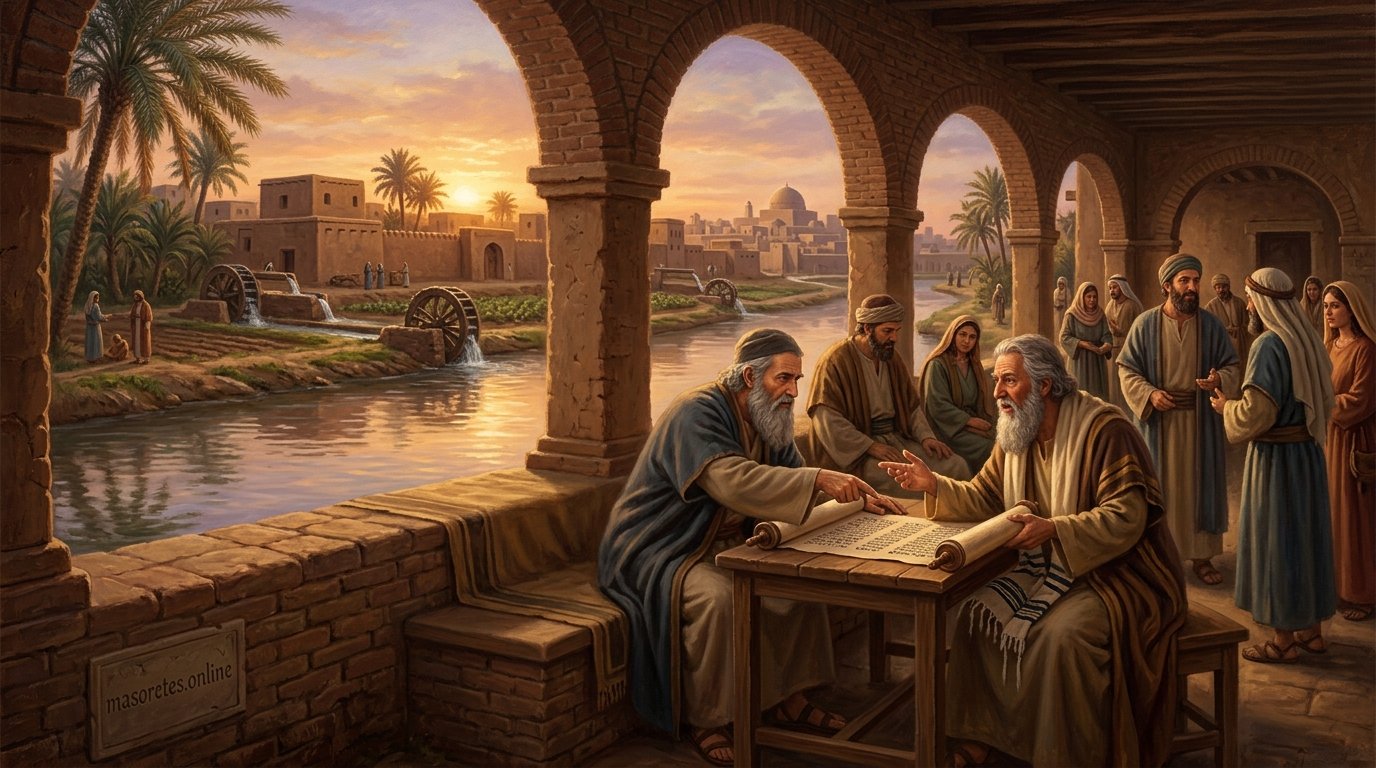
It is misleading, however, to picture a self-contained Jewish society behind an impermeable boundary. Sasanian administration, law, elite customs and religious institutions affected the circumstances within which Jews operated. Recent scholarship has challenged the familiar model of complete internal autonomy under a distant empire. It has also questioned overly tidy divisions between rulers, exilarchs, rabbis and ordinary people. See Simcha Gross, Babylonian Jews and Sasanian imperialism.
Zoroastrian traditions, Syriac Christianity and other religious communities formed part of the same environment. Similarities between Jewish and Iranian discussions can therefore be historically illuminating. They require care: a shared problem does not automatically prove direct borrowing, and surviving Persian works can have complicated transmission histories of their own. See Shai Secunda, rabbinic literature and Middle Persian texts.
Babylonia's scholarly achievement emerged from this setting. Its rabbis were imperial subjects, neighbours, householders and participants in a multilingual society; these relationships helped supply the questions their scholarship addressed.
The empire's Jewish geography extended beyond these lowlands. Evidence also points to communities in the wider Iranian sphere, including Media, although the record becomes much less detailed away from the centres illuminated by rabbinic literature. Babylonia, largely in modern Iraq, must therefore be distinguished from the Iranian plateau. The abundance of Babylonian texts should not make the less visible communities farther east disappear from the account, or encourage historians to fill the gaps with much later local traditions. See Encyclopaedia Iranica: Jewish communities under Parthian and Sasanian rule.
5. Syria and Egypt: Different Histories Under Roman Rule
Dura-Europos, on the Euphrates in present-day Syria, offers one of the most striking surviving views of ancient Jewish public culture. A house became a synagogue between approximately 165 and 200 CE; the building was enlarged and lavishly decorated in the third century. Its walls carried biblical scenes rendered through the visual language of its urban environment.
The synagogue stood in a city that also contained Christian and other religious buildings. Its paintings made extensive figural art part of scriptural commemoration: biblical memory met local artistic technique. Dura's synagogue was buried during preparations for the Sasanian siege that destroyed the city in 256. The buried walls preserved an exceptional view of this third-century congregation. See Yale University Art Gallery: the Dura-Europos synagogue.
In Antioch, the evidence often reaches us through Christian writers. The vehemence of John Chrysostom's late-fourth-century preaching against participation in Jewish observances reveals an effort to police boundaries that ordinary social relationships could blur. Polemic should be read as an intervention, not as a neutral report. Religious leaders might describe sharply divided communities precisely because some people's friendships, habits and attractions refused to follow those divisions. See Isabella Sandwell, religious identity in Antioch.
Egypt had a distinctive inheritance of Greek Jewish scholarship. Philo of Alexandria, active in the first century CE, interpreted Jewish scripture through a philosophical vocabulary shaped by the Greek intellectual world. His work reminds us that serious Jewish exegesis existed outside the literary forms later associated with the rabbis. Greek was not merely a foreign covering placed over Jewish ideas; for many Jews it was a language in which those ideas were encountered and developed. See Stanford Encyclopedia of Philosophy: Philo of Alexandria.
Yet Philo's Alexandria cannot simply be extended unchanged across late antiquity. The violence and suppression of the revolt in 115–117 devastated Egyptian Jewry. Later evidence is considerably thinner. The expulsion associated with Cyril of Alexandria in 415 forms another serious episode, although its scale and the subsequent pattern of Jewish residence require cautious reconstruction. A chapter on late antique Egypt must acknowledge both continuing Jewish presence and the limits imposed by a damaged, selective record. See Cambridge: Jews in late antique Egypt.
The comparison matters. A synagogue's destruction on one frontier, a preacher's hostility in another city and demographic catastrophe in Egypt belong to separate histories. None supplies a complete description of Jewish life throughout the Roman East.
6. Arabia and the Jewish Kingdom of Himyar
Arabia belonged to the history of Judaism before the rise of Islam. Jewish communities were associated with oasis settlements, including places later prominent in Islamic accounts such as Yathrib, subsequently Medina, and Khaybar. Their histories should not be collapsed into the better documented rabbinic centres farther north.
The evidence poses a particular challenge. Islamic biographies, histories and reports preserve extensive accounts of Arabian Jewish groups, their relationships and their conflicts. Much of this material was transmitted or written down after the events it describes. It is indispensable, but it is not a contemporary census. Details about origins, tribes, migration and local power need to be weighed against inscriptions and other independent evidence. See Christian Julien Robin, Judaism in pre-Islamic Arabia.
Epigraphy has made the pre-Islamic peninsula a much more concrete historical landscape. Inscriptions preserve names, languages, prayers and acts of commemoration. Their religious identification nevertheless depends on wording and context: a biblical name or a reference to one God does not, by itself, settle the writer's community. Resources such as Oxford's corpus of north and central Arabian inscriptions allow the evidence and alternative readings to be inspected directly. See Oxford: Online Corpus of the Inscriptions of Ancient North Arabia.
Himyar, in the southern Arabian region centred on present-day Yemen, presents a different picture. From approximately the late fourth century, its rulers embraced a form of monotheism closely associated with Judaism and Israel. Inscriptions are central to reconstructing this development. Christian Julien Robin argues that the evidence points toward priestly currents rather than straightforward subordination to rabbinic institutions. The public formulations are often restrained, and the exact religious life of the population remains difficult to recover. See Robin, the Judaism of ancient Himyar.
The reign of Yusuf As'ar Yath'ar, remembered as Dhu Nuwas, also requires attention to religious violence. His persecution of Christians at Najran around 523 was followed by Aksumite conquest around 525. These events belong to the interconnected politics of South Arabia and the Red Sea, where local conflicts were entangled with larger imperial rivalries. Christian accounts and royal inscriptions illuminate different aspects of this violent struggle for power. See Scholarly reference entry on Najran.
Himyar was neither all of Arabia nor a copy of Babylonia. Its inclusion reveals how incomplete Jewish history becomes when only communities that produced surviving rabbinic compilations are allowed to occupy the foreground.
7. Work, Households and Unequal Resources
Most people's days were organized around obtaining food, maintaining shelter, supporting dependants and meeting obligations. A field, an orchard, a workshop or a market stall could be the setting in which religious practice acquired its practical meaning. Questions about Sabbath rest, crop gifts, wages, loans and damaged property emerged from the same world in which people had to earn a living.
The Mishnah's discussion of hired workers provides a useful example. It asks about working hours and customary food, and about a labourer's entitlement to eat from the produce being handled. Grapes, figs, dates, wine and processed foods appear as the objects of work and disagreement. Questions about a meal or a handful of fruit could become questions about entitlement, custom and the obligations created when an employer hired another person's labour. See Mishnah Bava Metzia 7.
Communal life also included poverty. Mishnah Peah addresses assistance for travellers and the distribution of support, connecting membership in a community with obligations toward people who lacked sufficient resources. Its provisions concern quantities, eligibility, collection and distribution: the organizational work needed to turn an ethical commitment into food and shelter. See Mishnah Peah 8.
The household itself was hierarchical. Free workers, dependants and enslaved people did not share the same choices. Jews could be enslaved and could also own slaves; slavery was part of the wider ancient economy, not a practice from which Jewish society stood apart. Legal discussion might distinguish obligations and statuses, but it did not remove the coercion inherent in ownership. See Catherine Hezser, slavery and the Jews.
These material realities belong inside a history of scholarship. The person who could spend time studying needed access to food, social support and teaching. The benefactor who funded a synagogue had resources unavailable to a landless worker. Intellectual life depended on decisions about labour and distribution, even when a surviving text says little about who prepared the meal, cared for children or maintained the building.
8. Women, Family Property and the Documentary Record
Rabbinic literature often discusses women through the concerns of male legal experts: marriage, divorce, inheritance, household work and ritual obligation. These texts are essential evidence for the development of law and the expectations their authors promoted. They give a partial view of women's lives.
The archives of Babatha and Salome Komaise provide a different angle. Their documents, largely dating from the late first and early second centuries CE, concern Jewish women and their families in an area that passed from Nabataean to Roman rule. Jewish, Nabataean, Greek and Roman legal practices intersect in these records. The resulting world was one in which a person's affairs could require movement among several documentary languages and legal forms. See Oxford research on the Babatha and Salome Komaise archives.
Babatha's papers concern land, marriage, financial obligations and disputes over property and guardianship. Her decision to preserve them makes visible an individual engaged in protecting claims and navigating institutions. A land registration dated to 127 CE is one particularly concrete surviving example. These are documents of practical consequence: proof mattered because assets and family interests could be contested. See PBS / Israel Museum: Babatha's land registration.
Babatha's relative wealth helped make this legal activity possible. Other evidence brings women into public religious life: synagogue inscriptions commemorate significant female benefactors. Their contributions helped fund spaces used by the wider community, and the decision to name them preserved a public record of their agency. See Tal Ilan, women in Jewish life and law.
A comprehensive account must hold these observations together. Gender imposed real constraints, while wealth, kinship, marital position and local circumstances shaped the room available for action. Women's work and decisions helped sustain households, transmit practices and finance communal institutions, even where their individual names did not survive.
9. The Synagogue as a Communal Achievement
Synagogues existed before the destruction of the Temple. Their later importance developed through local histories rather than a single universal plan. A congregation needed somewhere to assemble, people able to perform public roles, objects for worship and arrangements for maintaining its space.
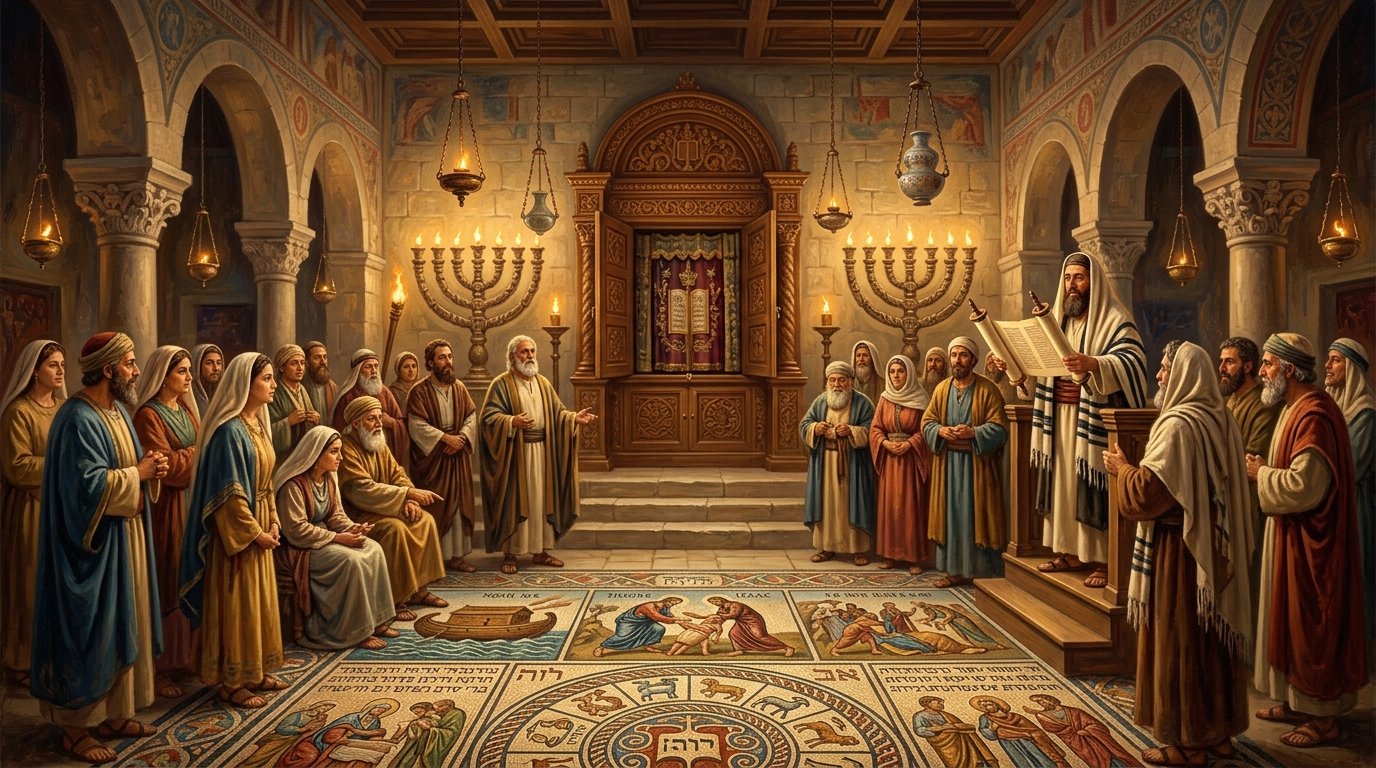
The art of late antiquity makes these communities visible. Menorahs, scriptural scenes and other Jewish symbols could be combined with decorative forms shared across the Mediterranean. Artists and patrons used familiar visual materials to create specifically Jewish settings. Variation is as significant as resemblance: different buildings offered different ways to remember scripture and articulate communal identity. See Metropolitan Museum: Jewish art in late antiquity.
At Rehov, a synagogue pavement carried a lengthy legal inscription concerning agricultural obligations and the status of produce from named places. Its parallels with rabbinic traditions are unusually direct. Here, law was not confined to a remembered discussion or a manuscript: it was made visible in a shared building. The inscription also reminds us that religious geography had consequences at the level of food grown, purchased and consumed. See The Rehov synagogue inscription.
Communal memory extended beyond worship into burial. The necropolis of Bet She'arim, associated with Judah ha-Nasi and later generations, attracted burials from a wider Jewish world. Its inscriptions and carved imagery preserve relationships among language, status, family and attachment to place. They show another way in which people far apart could orient themselves toward common centres without living under one uniform administration. See UNESCO: the necropolis of Bet She'arim.
These spaces were made by communities, not merely inhabited by them. Buildings, pavements and tombs record decisions about expenditure and remembrance. They also preserve people whose importance might be missed by a history arranged only around the succession of distinguished teachers.
10. A Multilingual Religious Life
Hebrew, Aramaic and Greek occupied overlapping places in Jewish life. Their uses varied by region, occasion and social setting. Hebrew served scripture, legal formulation and new literary creation. Aramaic encompassed distinct regional forms, including the Palestinian and Babylonian varieties encountered in rabbinic texts. Greek could be a language of contracts, commemoration, public culture and Jewish scriptural reading.
Translation was therefore an intellectual activity at the heart of communal religion. Mishnah Megillah describes a public reader working with a translator. Torah verses are to be delivered in small units so the translation can follow; the rules also distinguish practices for readings from the Prophets. The scene involves a scroll, a voice, another voice rendering meaning, and an audience listening. Access to scripture was mediated through performance as well as possession of a written copy. See Mishnah Megillah 4.
The relationship between language and authority could also attract imperial intervention. In 553, Justinian issued legislation on Jewish scriptural reading. It supported the use of Greek and other intelligible languages while attempting to direct interpretation toward Christian conclusions. The document reveals a ruler claiming a right to intervene inside Jewish religious life. It also confirms that disagreements over scriptural language were consequential. It was not simply an order abolishing Hebrew. See Justinian's Novella 146.
Multilingualism did not mean that everyone knew every language. A trained translator's skills differed from those of a merchant using routine spoken Greek or a worshipper who knew familiar Hebrew prayers by heart. The distinctions help explain the importance of specialists. A scribe, teacher or interpreter could connect people with a written culture in which their own participation was substantial but uneven.
For the history of the Masoretes, this is crucial background. The sound of Hebrew persisted through learned and devotional practice within societies where many Jews conducted ordinary conversation in another language.
Greek translation continued to develop after the Septuagint. Aquila's translation, conventionally dated to the second century CE, became an important point of reference in Jewish and Christian discussions. Its surviving fragments and the accounts of its reception show that Jews continued to work on Greek renderings of Hebrew Scripture; the exact relationship between the translator and rabbinic patrons remains debated. Aramaic renderings, known as targums, likewise belong to the wider relationship between public translation and written interpretation. The age of an oral practice and the date of a surviving literary recension are separate questions. See Jenny R. Labendz, Aquila's translation in late antiquity.
The companion study of Hebrew and Aramaic follows those intersecting linguistic histories. → Hebrew and Aramaic Languages
11. The Mishnah: Arranging a World of Obligations
The Mishnah, associated with Judah ha-Nasi around the beginning of the third century CE, became a foundational work of rabbinic learning. It gathered and arranged traditions rather than presenting a continuous biblical commentary. Its six orders encompass agriculture and blessings, appointed times, family law, civil and related matters, sacred offerings, and purity.
That range gives the work an unusual intellectual reach. It places the conduct of a household and the service of the Temple within a single ordered field of discussion. Practices no longer available after the destruction of the sanctuary could remain subjects of exacting study. The transmitted disagreements also meant that preservation did not always require reducing earlier voices to one undifferentiated answer. See David Kraemer, the Mishnah.
Its opening offers a compact demonstration. Instead of beginning with an abstract declaration, Mishnah Berakhot asks when the evening recitation of the Shema may take place. Different authorities propose boundaries within the night. A story about sons returning late from a wedding turns a question of sacred time into a recognizable problem of social life. The passage then relates its reasoning to other obligations. The movement between a rule, disagreement, narrative and comparison would remain characteristic of rabbinic learning. See Mishnah Berakhot 1.
A reader encounters law here as disciplined classification. What kind of act is this? When does an obligation begin? Which boundary is essential, and which protects against neglect? What changes when the circumstances change? Such questions made the Mishnah teachable and reusable across different settings.
Its later authority should not obscure the achievement involved in its formation. A collection had to be selected, organized, taught and recognized. The Mishnah became the common framework for the two Talmuds because subsequent generations made sustained interpretation of it a central scholarly undertaking.
12. Tosefta and Midrash: Supplementing and Interpreting
The Mishnah did not absorb every inherited teaching. The Tosefta preserves a related body of traditions, often following a similar organization while adding formulations, examples and material absent from the Mishnah. Its title is associated with supplementation, but its relationship to the Mishnah is more complex than that of a simple appendix.
Early rabbinic teachings circulated through remembered sayings and attributed opinions. Repetition helped preserve them, while additional explanation could generate further collections. The Tosefta gives access to this larger field of transmission and to alternatives that a reader of the Mishnah alone would miss. It also helps explain why a Talmudic discussion can appeal to a teaching outside the Mishnah as evidence in an argument. See The Tosefta in the Cambridge History of Judaism.
Midrash organized scholarship differently. Its point of departure was the biblical text: a verse, phrase, apparent repetition or difficulty could open a sequence of interpretation. Some collections concentrate on legal passages in Exodus through Deuteronomy. Their arrangement follows scripture rather than the topical architecture of the Mishnah. These works nevertheless share many concerns and traditions with other rabbinic literature. See The Cambridge Companion to the Talmud and Rabbinic Literature.
Other midrashic works employ narrative, comparison and homiletic argument to explore creation, ancestry, ethical conduct and Israel's relationship with God. A scriptural passage could become a meeting place for several biblical books, with one verse illuminating another. Learning therefore involved an ability to hear connections across a large remembered textual field.
Even Temple sacrifice could acquire renewed meaning through interpretation. Research on Leviticus Rabbah shows how its discussions place sacrifice alongside arguments about appetite, restraint and human purpose. A practice no longer performed could remain intellectually productive. See Study of sacrifice in Leviticus Rabbah.
The result was not one literary channel but several: topical law, supplemental tradition, verse-by-verse exposition and extended preaching. Together they made the inherited text available for new questions.
13. Two Talmuds and the Art of Sustained Argument
The Palestinian and Babylonian Talmuds grew from interpretation of the Mishnah, but they are distinct compositions. The Palestinian Talmud is also called the Jerusalem Talmud, or Yerushalmi. That familiar name should not locate its principal production in Jerusalem: Galilean scholarly settings were central to the traditions it preserves.
Its teaching belongs largely to the third and fourth centuries, with its compilation generally placed around the late fourth or early fifth century. It brings together mishnaic passages, related traditions and discussions attributed to generations of interpreters known as amoraim. Its legal reasoning can be compressed, and its terminology and Palestinian Aramaic differ from those of the Bavli. See Leib Moscovitz, formation of the Jerusalem Talmud.
The Babylonian Talmud, or Bavli, developed through a longer process. Named teachings from the amoraic centuries were arranged within discussions whose anonymous voices often perform much of the argumentative work. Questions connect passages; objections expose difficulties; distinctions allow apparently incompatible rulings to coexist. The received work reflects accumulated interpretation and editorial activity, not a stenographic record of one institution's debates. The dating of its final formation remains disputed, and some stages may extend across the transition to Islamic rule. See David Kraemer, the emergence of the Bavli.
The opening of Bava Metzia supplies a concrete entry into this method. Two people hold a garment and each claims ownership. What should happen when their claims are equal? What changes if one claims the whole garment and the other only half? Possession, assertion and oath become carefully distinguished elements of the case. A familiar object becomes an instrument for thinking about evidence and adjudication. See Babylonian Talmud, Bava Metzia 2.
A developed unit of discussion, often called a sugya, can bring such problems into contact with several earlier rulings. The reader learns not only a proposed outcome but how to test an analogy, identify a contradiction or decide that two cases differ in a legally relevant respect. The intellectual demand lies in keeping several possible relationships in view.
The two Talmuds also preserve different selections and treatments of material. Their coexistence records the regional growth of rabbinic learning; the Bavli's later pre-eminence should not be projected backwards as though Palestinian study had always been a preliminary stage on the way to it. See Lawrence H. Schiffman, the Talmuds and their formation.
14. Teachers, Patrons and the Reach of Authority
Study depended on relationships among teachers and students. A scholar's reputation, access to an influential household, or ability to assemble a circle of learners could shape the movement of traditions. Nehardea, Sura, Pumbedita and Mahoza appear in the history of Babylonian learning as places associated with teachers and intellectual activity.
Rav, also known as Abba Arikha, and Samuel stand near the beginning of the prominent Babylonian amoraic tradition in the third century. Rav is particularly associated with Sura and Samuel with Nehardea. In the fourth century, Abaye and Rava became central voices in the argumentative tradition preserved by the Bavli. Rav Ashi, active in the late fourth and early fifth centuries, belongs to a later generation associated with Mata Mehasya near Sura. Their names gave students ways to locate positions within remembered chains of teaching. See Schiffman, Babylonian teachers and centres.
Later tradition gave Rav Ashi and Ravina a decisive place in the Talmud's completion. That retrospective account, especially familiar through Sherira Gaon's tenth-century letter, is part of the history of the work's authority. It should be distinguished from the more extended process of composition that modern analysis identifies. See Research on Sherira's account of canonization.
These names can mislead a modern reader who imagines permanent university campuses with fixed departments and uninterrupted administrative succession. The strongly institutionalized academies familiar from the geonic period belong to a later phase. Historians distinguish those bodies from the more varied settings in which classical Talmudic learning developed. Baghdad, founded in 762, belongs entirely beyond the period discussed here. See The Place to Go: geonic contexts of learning.
Learning also moved across imperial frontiers. The Babylonian corpus preserves engagement with Palestinian traditions, while people and materials travelled through networks that wars could interrupt or redirect. Richard Kalmin has emphasized the importance of Palestinian connections in understanding Babylonian rabbinic culture. Cultural development did not take place in two perfectly sealed rooms marked “Roman” and “Persian.” See Richard Kalmin, Jewish Babylonia between Persia and Roman Palestine.
Public authority was not identical with scholarly standing. The Palestinian patriarchate, associated with prominent families and recognized within the Roman imperial environment, was an institution with its own political history. Its disappearance in the early fifth century did not end Jewish communal organization or learning. See Oxford Classical Dictionary: the Jewish patriarchate.
In Babylonia, the exilarch was another form of Jewish leadership. His title evoked the leadership of the exile; the relationship between that office, particular rabbis and imperial power varied. Recent work cautions against treating all Jews as members of one simple hierarchy whose orders necessarily reached every household. See Gross, introduction on Sasanian Jewish society.
Authority grew through recognition as well as claims. A text could become influential because teachers repeatedly taught it, courts found it useful, or communities accepted its interpreters. That process took time, and it left room for local leadership and other forms of religious expertise.
15. Prayer, Festivals and the Ordering of Time
Prayer translated inherited commitments into the rhythm of a day. The recitation of the Shema, blessings and forms of standing prayer supplied occasions for remembering God, asking for help and locating individual life within a community. Their history involves both recognizable continuities and changing formulations.
Mishnah Berakhot records disagreement about the daily prayer of eighteen blessings. One position requires the full sequence, another allows an abbreviated form, and a third distinguishes the fluent worshipper from someone less able to recite it. The discussion recognizes a practical fact: an obligation must be performed by people with different capacities. Religious order and accommodation could be considered together. See Mishnah Berakhot 4:3.
Festivals required a further kind of knowledge: deciding when the date had arrived. Lunar months had to be related to the seasonal year, and communities needed procedures for announcing or calculating them. Calendar reckoning brought observation, calculation, communication and authority into close relationship. A decision made in one place could matter to worshippers elsewhere.
The present Jewish calendar should not be assumed for every ancient community. Sacha Stern's research traces a gradual movement toward fixed calculation and increasing uniformity. Local differences persisted through late antiquity. The widespread story that the complete modern system was instituted at a stroke by Hillel II in 358/359 cannot serve as an uncomplicated historical account. See Stern, development of the rabbinic calendar.
Such questions show why scholarship mattered beyond specialist circles. A calendar decision affected when a household prepared a festival meal and when work stopped. A prayer tradition needed to be remembered and voiced. Religious learning connected cosmic and scriptural order with the ordinary coordination of people, food, travel and time.
The diversity of arrangements did not erase shared identity. It shows the work required to maintain it across distance. Communities could commemorate the same scriptural events while differing over precisely how inherited obligations should be implemented.
16. Poetry, Protection and Knowledge Beyond the Study Circle
A history of Jewish scholarship that ends with legal compilations misses important creative work. Liturgical poetry, or piyyut, interpreted scripture within worship. Its language could be dense with allusion, drawing listeners into remembered biblical scenes and themes. The poet's skill lay partly in making several passages resonate within a new composition.
Early Palestinian piyyut belongs to the public culture of the synagogue. Its audiences need not have been exclusively rabbinic, and its emphases can reveal forms of communal identity that differ from those most visible in legal argument. Poetry gave scriptural learning an artistic and performative life: it was heard within an occasion, voiced by a person and directed toward an assembled community. See Michael D. Swartz, society and the self in early piyyut.
Inscribed incantation bowls from Mesopotamia open another window. Written petitions name clients and families, seek protection, and address fears about harm, curses or disrupted relationships. Excavated examples were placed beneath domestic floors or in other strategic positions. These objects bring the historian close to the concerns of households whose members rarely appear in narrative histories.
Their scripts and dialects also reveal interaction. Bowls associated with Jewish Babylonian Aramaic stand alongside Syriac and Mandaic examples, and the religious vocabulary does not always remain within the boundaries a modern classification would expect. Researchers caution against dismissing them as merely the superstition of a poor or uneducated population. Their makers drew on varied forms of scribal and religious competence. See University of Pennsylvania: what the incantation bowls reveal.
Poets, interpreters, ritual practitioners and rabbis were not necessarily mutually exclusive classes. Ideas and forms could move between their activities. Rabbinic influence could grow while other kinds of knowledge remained significant; diversity did not have to disappear for rabbinization to occur. See Ra'anan Boustan, rabbinization and enduring diversity.
Recognizing this wider world also restores emotional depth to the period. Jewish people sought explanation and order, but also comfort, protection, beauty and ways to speak about uncertainty. Learning answered more than the need for a legal ruling.
17. Scripture Before the Mature Masoretic Systems
The Hebrew Bible's survival depended on people who copied, read, taught and remembered it. Before the great medieval codices, a written consonantal text and an inherited way of reading already worked together. The visible letters did not carry every feature a trained reader supplied through pronunciation, phrasing and familiarity.
The charred Leviticus scroll from En-Gedi provides a remarkable material witness. Modern imaging recovered text from a roll that could not be physically opened in the usual way. Its surviving passages closely agree with the consonantal form preserved in the later Masoretic tradition. The scroll is ancient—radiocarbon and palaeographic approaches have produced different proposed dates—and its importance lies in the actual passages available for comparison. A fragment can establish striking continuity without answering every question about the history of every biblical book. See Michael Segal and colleagues, the early Leviticus scroll from En-Gedi.
The mature Tiberian system of vowel and accent signs belongs to the early Islamic period. It should not be placed in the hands of a fifth-century scribe. The signs were a means of recording an existing reading tradition, not the invention of vowels for a language that previously lacked them. Geoffrey Khan's work emphasizes both the medieval setting of the notation and the ancient roots of what it represented. See Khan, the Tiberian pronunciation tradition.
Consonantal spelling and transmitted pronunciation also have related but distinguishable histories. A spelling may preserve an older linguistic stage while a reading reflects developments in spoken or learned usage. Aaron Hornkohl's research shows why the Tiberian tradition is best understood through this historical depth rather than as a mechanically uniform record. See Hornkohl, the historical depth of Tiberian Hebrew.
This is the central connection between pre-conquest scholarship and the Masoretes. Public reading created repeated occasions for transmitting sound. Scribes maintained written forms. Teachers cultivated attention to wording and distinction. Later Masoretic notation made aspects of that knowledge visible with extraordinary precision.
The bridge is therefore both continuous and creative. The Masoretes inherited a textual culture shaped over centuries, then developed tools for preserving it. Their achievement becomes more intelligible when set within the earlier communities that made careful reading a durable communal practice.
18. Imperial Pressure, War and the Threshold of a New Age
Jews lived under governments that could protect a community's property while restricting its standing. Later Roman legislation contains measures affecting public office, conversion, slaveholding and synagogue construction, alongside provisions protecting existing Jewish institutions. These are records of unequal power. Their variety also makes it necessary to distinguish particular laws and periods from a claim that one policy operated unchanged everywhere. See Selections from later Roman law concerning Jews.
The early seventh century brought exceptional upheaval. The long Roman–Sasanian war reached Jerusalem in 614 and transformed control over large areas of the eastern Mediterranean. After peace in 628, Persian withdrawal and Roman restoration followed. Heraclius's visit to Jerusalem, most probably in 630, became a heavily remembered event. The narratives surrounding warfare, Jewish participation and reprisals are often partisan and difficult to reconcile in detail. Their strongest common message is the disruption of the region's political order. See Robert Schick, the Byzantine recovery.
The Islamic conquests followed upon that exhausted imperial landscape. For this page, they mark the boundary of the main inquiry. They did not create the Jewish communities they encountered, nor did they bring their intellectual lives to an immediate stop.
What existed before them was already substantial: agricultural and urban communities, traditions of public worship, several learned languages, legal and exegetical compilations, poetry, scribal skills and regional networks. These were not uniform achievements distributed evenly among all Jews. They were accumulated resources built by many communities under differing conditions.
The later histories of the Geonim, Judeo-Arabic scholarship and the great Masoretic codices would unfold within new political and linguistic settings. Their foundations included the labour of earlier readers and teachers, but also the households, patrons and congregations that had made sustained learning possible.
Chronology at a Glance
Dates of compilation are approximate; political transitions did not happen everywhere at once.
| Date or Period | Development |
|---|---|
| 587/586 BCE and after | Jerusalem's destruction and Babylonian deportations; enduring Judean communities develop in Mesopotamia. |
| 407 BCE | The Elephantine petition documents a Jewish community in Persian-period Egypt. |
| First century CE | Philo exemplifies Greek Jewish scholarship in Alexandria. |
| 70 CE | Roman destruction of Jerusalem's Second Temple. |
| 115–117 | Revolt and suppression bring catastrophe to Egyptian and other diaspora communities. |
| 132–135 | The Bar Kokhba war devastates Judaea; Jewish settlement and learning continue elsewhere. |
| Around 200 | Principal formation of the Mishnah, associated with Judah ha-Nasi. |
| Third century | Sasanian rule begins; Babylonian rabbinic teaching becomes increasingly visible. |
| 244/245–256 | The decorated Dura synagogue's final phase, ending with the city's destruction. |
| Late 4th–early 5th c. | Approximate formation of the Palestinian Talmud (Yerushalmi). |
| Late 4th–early 6th c. | Jewish-associated royal monotheism in Himyar (South Arabia). |
| 5th–early 7th c. | Continued synagogue building, poetry, and formation of Babylonian Talmudic traditions. |
| Around 523; around 525 | Persecution of Christians at Najran under Yusuf/Dhu Nuwas; Aksumite conquest follows. |
| 553 | Justinian legislates about Jewish scriptural reading (Novella 146). |
| 614; 628–630 | Sasanian capture of Jerusalem; peace and Roman restoration under Heraclius. |
| 630s–640s | Muslim conquests transform rule in Syria, Palestine, Babylonia and Egypt at different dates. |
The chronology draws on the archaeological, documentary and scholarly sources linked throughout the article. Literary works generally formed over periods longer than a single date can convey.
Brief Glossary
Rabbinic interpreters whose teachings form a major component of the Palestinian and Babylonian Talmuds.
The Babylonian Talmud, developed in Jewish Babylonia through several generations of teaching and editorial activity.
A form of Jewish leadership in Babylonia; the title evokes leadership of the exile (Resh Galuta).
Legal teaching and discussion concerning religious obligations, jurisprudence, and daily conduct.
Traditions and scholarly practices concerned with preserving, vocalizing, and transmitting the biblical text.
Interpretation of scripture, and the classical collections in which such homiletical and legal interpretation is preserved.
The early rabbinic compilation associated with Judah ha-Nasi around 200 CE, organized in six topical orders.
Liturgical poetry, composed for vocal and communal performance within synagogue worship.
A sustained unit of Talmudic discussion, often combining traditions, questions, objections, analogies, and distinctions.
An Aramaic translation or interpretive rendering of scripture; also associated with traditions of oral synagogue recitation.
A rabbinic collection closely related to the Mishnah, preserving additional, parallel, and supplementary traditions.
The Palestinian Talmud, commonly called the Jerusalem Talmud, compiled in Galilean centers in the late 4th or early 5th century.