


The Biblioteca Universitaria di Bologna holds a scroll of the Torah, known in the library as Rotolo 2, which is at present regarded as the oldest complete Torah scroll known. For more than a century it was catalogued as a clumsy and incorrect copy of the seventeenth century, and its identity as one of the most celebrated Hebrew books in early modern Europe was forgotten. In 2013 Mauro Perani, professor of Hebrew at the University of Bologna, recognised its antiquity while preparing a new catalogue of the library’s Hebrew manuscripts, and two radiocarbon analyses placed the animal skin on which it is written between 1155 and 1225.12 This article describes the scroll, the reasons for its importance, the history of its reception as the “Bible of Ezra” in the Dominican convent of Bologna, the confusion by which it lost its identity in the nineteenth century, and the questions about its origin that remain open.
At a glance
- Shelfmark: Rotolo 2, Banc. I.A.Cass. 1.H.2, Biblioteca Universitaria di Bologna.
- Contents: the complete consonantal text of the five books of the Torah, written for liturgical use.
- Material: soft sheepskin, about 36 metres long and 64 centimetres high, made of 58 sewn sections carrying 198 columns of usually 48 lines.
- Date: between 1155 and 1225 according to two radiocarbon analyses, consistent with the palaeographic assessment.
- Origin: uncertain; the scroll has been placed in the East or southern Italy, and more recently in northern Iberia around 1200.
- History: given to the Dominican friar Aimerico Giliani in 1304, kept for five centuries in the convent of San Domenico, taken to Paris in the Napoleonic period, returned to Bologna, and misidentified in the nineteenth century.
The Rediscovery of 2013
The University of Bologna announced the discovery on 28 May 2013. The university’s report described the document as a scroll of soft sheepskin, thirty-six metres long and sixty-four centimetres high, containing the whole text of the Torah in Hebrew, and stated that it had previously been catalogued as probably dating from the seventeenth century.3 The identification was made by Mauro Perani, professor of Hebrew in the Department of Cultural Heritage of the University of Bologna at its Ravenna campus, in the course of compiling a new catalogue of the Hebrew manuscripts of the Biblioteca Universitaria together with Giacomo Corazzol.456 The catalogue was to be published in the third number of the library’s journal inBUB, edited by the library’s director Biancastella Antonino with the collaboration of Patrizia Moscatelli, and the university’s report expected it to appear at the end of June 2013.7
Perani’s own account of the discovery appeared in the journal TECA in September 2013. He emphasised that it would be more correct to speak of a rediscovery, since the scroll had not been found for the first time in a cave or a hidden store but had been kept for centuries in the library’s collections under an erroneous description.8 According to Perani, almost all of the thirty-six Hebrew manuscripts now in the library probably came from the archives and libraries of the religious congregations of Bologna that were suppressed by Napoleon in 1797, and in particular from the two convents of San Salvatore and San Domenico.910 The provenance of the scroll itself and the date at which it came to Bologna were, in his words of 2013, unknown, and the university’s report likewise stated that it was not known how and when Rotolo 2 had entered the library, though it suggested that this had probably happened before the Napoleonic suppressions.1112 As later sections show, Perani’s subsequent research changed this picture considerably.
The rediscovery depended on a plain act of re-examination. When Perani took the scroll in hand to compare it with the description in the earlier catalogue, he saw at once that it was written in a very fine ancient Oriental script and that the nineteenth-century description had to be set aside and rewritten entirely.13 He consulted leading specialists in Torah scrolls and Hebrew palaeography, and he reported that there was unanimous agreement on the scroll’s antiquity. The opinions expressed in this discussion ranged between the late eleventh and the thirteenth century, with some extending into the fourteenth. Jordan Penkower and Angelo Piattelli, according to Perani, inclined to a date between the eleventh and the twelfth century, and in any case not later than about 1220–1230, one generation after the death of Maimonides in 1204.1415
Scroll and Codex
Perani took care to explain what kind of object had been found, because the newspaper reports of 2013 had sometimes described it inaccurately. It is not a Hebrew Bible but only the Torah, the five books of Genesis, Exodus, Leviticus, Numbers and Deuteronomy, and it is not a codex but a scroll of thirty-six metres.1617 Older Hebrew Bibles and Pentateuchs written in codex form exist, and Perani gave as an example the manuscript of St Petersburg B19A, the Leningrad Codex, copied in 1008–1009.1819 The claim made for the Bologna scroll is therefore a precise one. It is the oldest complete Torah scroll for liturgical use known at present.2021
Perani described the scroll as the ancient form of the book, which was replaced for most purposes by the codex because a codex can be opened at any point without unrolling and rerolling many metres of skin. In his account the codex entered the Latin world in the first centuries of the common era, while in the Jewish world it was adopted in the seventh and eighth centuries.22 Because of the great sanctity attributed to the Torah scroll, however, it remained in the form of a scroll for the liturgical reading in the synagogue, together with the scroll of Esther, even after codices of the Torah began to be copied for study.2324
Perani also offered a historical interpretation of this sanctity. In his account, after the destruction of Jerusalem in the year 70 and the failure of the two wars against Rome, Judaism was rebuilt as a religion that could be practised without the Temple and the land, centred on the written and the oral Torah, and the Torah scroll came to be regarded as sacred not only for the text it carried but as an object in itself.25 Where previously the five books attributed to Moses had been written on separate scrolls, it now became obligatory to copy all five on a single scroll, which was therefore long and heavy and could no longer be held in the arms during the reading but had to be placed on a reading desk, the bemah.26 This is Perani’s synthesis rather than a matter on which the sources used here offer independent evidence, and it is presented here as his interpretation. He added that the biblical manuscripts found from 1947 in the caves of Qumran include texts of the books of the Torah copied between the second century before and the first century of the common era, but that these are scrolls of individual books rather than Torah scrolls containing all five.2728
The liturgical function of the scroll also determines its content. A Torah scroll for synagogue use must contain only the consonantal text, without the points and strokes that indicate vowels and accents, and without the Masoretic notes that accompany the text in codices.29 Perani described the Masorah, which in codices is divided into the Masorah parva and the Masorah magna, as a collection of philological observations, references to parallel passages, counts of words and corrections of the reading, which together form a critical apparatus in embryo.30 None of this appears in the Bologna scroll, whose value for the history of the text lies in its consonants, its layout and the graphic devices of its scribe. The rules that govern such scrolls are discussed on this site in the article on scribal safeguards of the Torah.31
The Physical Scroll
Perani’s description of 2013 gives the material features of the scroll in detail. It is made of sheepskin, 640 millimetres high and thirty-six metres long, composed of fifty-eight sections sewn together. Of these, thirty-seven sections carry three columns, eighteen carry four columns and only three, numbered 15, 54 and 55, carry five columns, giving a total of 198 columns. All the columns have forty-eight lines, with some exceptions of forty-seven.3233 The ruling is in drypoint, and the pricking in the outer margins of the sections is often double.34 The skin is so soft that Perani compared it to linen cloth.35 A caption in his article notes the sewing of two sections of skin with the sinews of a ritually clean animal, as the rules for Torah scrolls require.36
The scroll is complete, but it is no longer attached to its two original wooden rollers. Only one roller survives, the inner one at the end of Deuteronomy, and this is a recent stick without handles.37 Perani’s illustrations show other features of the layout, among them the space of four blank lines left between the end of Numbers and the beginning of Deuteronomy.38 The script is an elegant calligraphic Oriental square hand, with spacings, ornaments and crowns, the tagin, and with letters in curled forms according to the Oriental tradition of the Sefer Tagin.39
The figures given by the university’s report and by Perani agree on the essentials. Both describe a scroll of thirty-six metres by sixty-four centimetres containing the complete Torah.4041 Neither source gives the number of skins in terms of animals or the original length of the scroll before any trimming, and nothing more precise on these matters is offered here.
The Scribal Tradition of the Scroll
The importance of the scroll, in Perani’s judgment, lies not only in its age but in the scribal tradition it follows, which makes it what he called a graphic and scribal fossil.42 He explained that during the first millennium there were in the East two traditions regarding the copying of the Torah scroll, which he called the north-eastern or Babylonian tradition and the south-western tradition of the rabbinic academies of the Land of Israel. The second of these was canonised from the twelfth century onwards. Some of its elements are found already in the Mishnah, composed around the year 200, in the Babylonian Talmud and in the extra-canonical tractate Massekhet Soferim, the “Tractate of the Scribes”, which Perani dated to the seventh or eighth century.4344
The Babylonian tradition, according to Perani, followed different ideas about letters varied with curls of various kinds, about the crowns with which certain letters were adorned, and about the conditions of the liturgical validity of the scroll. This tradition crystallised around the eighth century in the Sefer Tagin, the “Book of Crowns”, which was known to Saadia Gaon, who cited it in his commentary on the Sefer Yetzirah.454647 Maimonides followed the Babylonian tradition in some matters, but in others he settled on the rabbinic tradition of the Land of Israel and gave it authority. In Perani’s formulation, the Bologna scroll does not observe the rules of the Palestinian tradition simply because it follows the Babylonian one.48
Perani compared this situation to the history of Hebrew vocalisation. There were at least two systems of pointing, a Palestinian system developed in Tiberias and the other centres of Galilee, with points placed mostly beneath the letters, and a Babylonian system that used signs mostly above the letters. With the acceptance of the Tiberian system, the Babylonian system disappeared.495051 The Babylonian pointing is described more fully on this site in the article on the Babylonian vocalisation system.52 The same process, in Perani’s view, took place in the scribal tradition of the Torah scroll, where the Babylonian practice disappeared from the twelfth century in favour of the Palestinian. The Bologna scroll is therefore at present the oldest witness not only to the complete Torah on a liturgical scroll but also to the Babylonian tradition in the scribal devices used by its copyist.53
Several of these devices are described in Perani’s article. The scribe placed graphic filling signs at the ends of lines in order to improve the justification of the left margin of a text written from right to left.54 He used the crowns on certain letters against the tradition that was to prevail soon after the scroll was copied. He wrote special letters with curls on nun, pe, kaf and even waw, which in Hebrew are called lefufot or meluppafot, letters bearing a curl within them. He also used an elongated final nun placed in the margins beside the spaces marking the beginning of sections, in order to indicate the existence of differing traditions regarding those sections.55 The university’s report states the matter more briefly, saying that the scroll displays graphic features that were absolutely prohibited to copyists after the codification of Maimonides.56
The rules to which these statements refer were set out by Maimonides in the treatise on the Torah scroll within his Mishneh Torah, which Perani described as the work in which Maimonides organised the whole body of talmudic religious law.5758 Perani wrote that Maimonides contributed to fixing the norms for copying the Torah scroll with this treatise, and the university’s report described him as having fixed definitively the rabbinic regulations for writing the Pentateuch.5960 His life and works are surveyed in this site’s article on Maimonides.61 For the dating of the scroll the significance of these rules is that a scroll which ignores them is more likely to have been written before they became authoritative, or in a community that did not yet accept them. The latter possibility means that the palaeographic argument alone cannot fix a date, which is why Perani sought scientific confirmation.
The Radiocarbon Dating
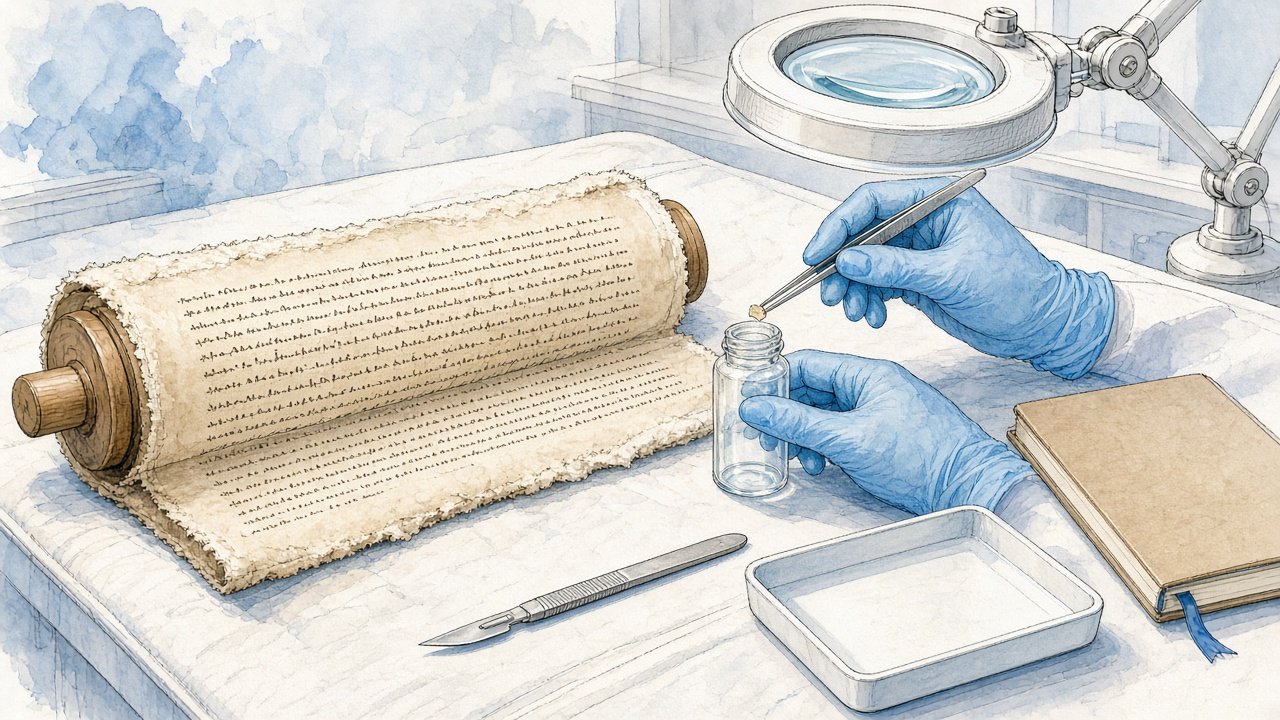
Once he had understood the importance of the scroll, Perani decided to have it tested by radiocarbon dating.6263 His colleague Giorgio Gruppioni, an anthropologist in the same department at the Ravenna campus, introduced him to the laboratory at Lecce that he himself used. The analysis was carried out under the direction of Lucio Calcagnile, director of the Centre for Dating and Diagnostics of the Department of Engineering for Innovation of the University of Salento at Lecce, and gave a date between the second half of the twelfth century and the first quarter of the thirteenth, that is, between 1155 and 1225.6465
A second radiocarbon analysis was carried out at the Radiocarbon Dating Laboratory of the Illinois State Geological Survey at the University of Illinois Urbana-Champaign, under its director Hong Wang, and it confirmed the dating obtained at Lecce.666768 The university’s report stated that the dating, already clear from graphic, textual and palaeographic examination, was confirmed by both analyses.69 Radiocarbon dating measures the age of the organic material, in this case the sheepskin, and not the moment of writing. The sources used here do not discuss the interval between the preparation of the skins and their use, and the range 1155–1225 is strictly a date for the skin, which the palaeographic judgment then extends to the writing.
The radiocarbon range agrees with the opinions of the palaeographers in placing the scroll before the middle of the thirteenth century, but it is somewhat later than the earliest dates suggested in the discussion Perani reported. Perani himself, in 2013, summarised the result as making the scroll the oldest complete Torah scroll known, and the university’s report presented it in the same way.7071 Before this rediscovery, according to Perani, the oldest complete scrolls known included a complete scroll of the end of the thirteenth century in Sephardic square script and Ashkenazi scrolls of the thirteenth and fourteenth centuries, while there were also fragments, single sheets or sections of skin, from older scrolls copied in the eleventh century or earlier.72
The Text and the Aleppo Codex
The textual character of the scroll is a further aspect of its importance. Perani reported that it follows very closely the text documented in the Aleppo Codex, both in its wording and in the layout of the two songs of Moses.7374 The Song of the Sea in Exodus 15 and the song Ha’azinu in Deuteronomy 32 are laid out exactly as in the Aleppo Codex, and so are the lines that precede each song, five and six lines respectively, and the lines that follow them, five lines in both cases.7576 The Brill volume of 2019 states in its description that the Hebrew text is very close to the Aleppo Codex.77
This agreement has a particular value because the Torah section of the Aleppo Codex itself is almost entirely lost. Perani recalled that almost the whole of the Pentateuch of the codex was burned when the codex was damaged in Aleppo in 1947.78 The history of the codex is told on this site in the article on the Aleppo Codex.79 Perani concluded that the Bologna scroll provides another witness of the same textual type and of considerable antiquity, which will allow philologists to collate its variants, both graphic and strictly textual.80 The rediscovery thus has a double interest. It preserves an archaic scribal tradition that was later abandoned, and it preserves a text close to the most authoritative Tiberian codex in precisely those books where that codex is now defective.
There is an apparent tension in this result. The scroll follows the Babylonian scribal tradition in its letter forms and crowns, while its text and the layout of its songs agree with a codex produced in the Tiberian tradition of the Land of Israel. Perani’s article of 2013 reports both findings side by side without discussing how they are related.81 It may be observed that the two belong to different levels of the scroll, since the scribal devices concern the form and ornament of the letters, whereas the agreement with the Aleppo Codex concerns the consonantal text and the layout of the songs. The later studies in the Brill volume, which treat the textual and para-textual devices of the scroll and its palaeography and scribal traditions in separate chapters, presumably address this relationship in more detail, but their contents could not be consulted for this article.82
The Ezra Scroll in the Dominican Convent
The most remarkable result of the rediscovery was the recovery of the scroll’s history. In an essay published by the Biblioteca Universitaria, Perani explained that the correct dating made it possible to reconstruct an exchange of two Torah scrolls that had taken place in the library in the nineteenth century, and he set out the stages of the scroll’s history.83 In 1304 the Dominican friar Aimerico Giliani of Piacenza was designated Master General of the Dominican Order, an office he held from 1304 to 1311, at a gathering of the order held in Provence. On that occasion he received from some Jews as a gift an ancient Hebrew Torah scroll, different from others, and on returning to Bologna he placed it in the library of the Dominicans.848586
The scroll was already known for its great antiquity at the beginning of the fourteenth century, because its graphic signs and ornaments differed entirely from those known in more recent Torah scrolls.87 Perani reported that Jews of the time exalted its antiquity and even attributed it to Ezra the Scribe, the leader of the return of the exiles from Babylon, who was supposed to have written it with his own hand.8889 The Brill volume describes the scroll as having been considered in the Middle Ages and the Renaissance the archetypal autograph written by Ezra.90 The tradition of the gift thus connects the scroll’s unusual appearance directly with the reputation it acquired. Its archaic letter forms, which caused Modona to judge it clumsy in the nineteenth century, were in the fourteenth century the very features that made it appear ancient.
The scroll remained in the Dominican convent for about five centuries.91 In the sixteenth century the naturalist Ulisse Aldrovandi mentioned it in his manuscript Biblologia of 1582, where he referred to the “Bibbia d’Esdra in S. Domenico di molti pelli insieme cociti”, the Bible of Ezra in San Domenico made of many skins sewn together.9293 Perani also stated that the Spanish orientalist Benito Arias Montano, the editor of the polyglot Bible, knew the scroll.94
The fullest early description was given by Bernard de Montfaucon. In his Diarium italicum, printed in Paris in 1702, Montfaucon described his journey in Italy in 1700 and recorded that he had seen at Bologna, in the Dominican convent, the famous roll of the Pentateuch. He reported its great antiquity and the gift made by the Jews to Friar Aimerico, and he copied a Latin inscription that was sewn on the back of the scroll about halfway along and that narrated its history.9596 The authenticity of Montfaucon’s copy has been confirmed by Rita De Tata, who found a second manuscript copy of the same inscription in the library of the Dominicans of Bologna, on folio 185r of the chronicle of Ludovico da Pralormo, guardian of the Arca di San Domenico from 1528, about a century and a half before Montfaucon.97
Scholars and Visitors
In the eighteenth century the scroll entered the literature of biblical scholarship. The biblical scholar Giuseppe Maria Bianchini repeated Montfaucon’s information in his Evangeliarium quadruplex latinae versionis antiquae seu veteris italicae, published in Rome in 1748–1749.98 Benjamin Kennicott, in his Dissertatio generalis in Vetus Testamentum Hebraicum, published at Oxford in 1780, dated the Bologna scroll to the end of the eleventh century, while the Hebraist Giovanni Bernardo De Rossi, a few years later, dated it in his Variae lectiones Veteris Testamenti to the beginning of the thirteenth century.99 The work of these two collators is discussed in the article on Kennicott, De Rossi and the eighteenth-century collations of Hebrew manuscripts.100 It is notable that De Rossi’s estimate, made more than two centuries before the radiocarbon tests, falls within the range those tests produced.
Perani wrote that all the most important biblical scholars of Europe knew the scroll, and that the king of France and Queen Christina of Sweden wished to see the famous Pentateuch of Ezra when they visited Bologna.101102 The source does not identify the king of France or give the dates of these visits, and they are therefore left unspecified here. What these notices establish is that for several centuries Christians as well as Jews venerated and visited the scroll. The Brill volume describes it in the same terms, as preserved for centuries among the treasures of the convent of San Domenico and, in the early modern period, an object of reverence and curiosity among Christians.103
The Emperor, the Pope and Leviticus 18
One episode in the scroll’s Christian history is especially striking. In 1530 the emperor Charles V came to Bologna to be reconciled with Pope Clement VII.104105106 According to Perani, on that occasion they also discussed the question of the divorce of Henry VIII of England from Catherine of Aragon, who had been the wife of Henry’s brother, and of the dispensation for that marriage granted by Pope Julius II.107108109110 Perani wrote that the pope and the emperor wished to go in person to the library of the Dominicans to see what the original exemplar of the Pentateuch said, and in particular the verse that forbids marriage with a brother’s wife, which is found in Leviticus 18.111112
In Rotolo 2 the verses Leviticus 18:16–20 have been erased by scraping with a blade, although traces of the letters remain legible.113 Perani credited Saverio Campanini with identifying the meeting of pope and emperor in 1530, and he reported Campanini’s explanation as probable: that someone belonging to the party of the pope and opposed to the divorce, which was to lead to the separation of the English church from Rome, erased the five verses containing the prohibition after this episode, almost as a gesture of anger.114 Perani himself remarked that, if so, it would have been a very strange way of taking revenge.115 The explanation therefore remains a hypothesis. The erasure itself is a physical fact visible in the scroll, while its connection with the meeting of 1530 is an inference from the coincidence of the subject of the erased verses with the question then under discussion.
The episode also shows the authority the scroll then possessed. If the account is correct, the pope and the emperor treated a Jewish liturgical scroll in a Dominican library as the original text of the Pentateuch, against which a question of canon law with consequences for the English succession could be tested. Campanini’s chapter in the Brill volume, entitled “The ‘Ezra Scroll’ of Bologna: Vicissitudes of an Archetype between Memory and Oblivion”, treats this history at greater length.116
Paris and the Return
The convent’s possession of the scroll ended in the Napoleonic period. When Napoleon extended his rule over Italy, the religious orders were suppressed and their manuscripts and printed books were deposited in public institutions, among them the book collections of the convents of San Salvatore and San Domenico, where the scroll had been kept for five centuries.117118 The famous scroll, together with many of the Hebrew manuscripts of the Dominicans, was then taken to the Bibliothèque nationale in Paris.119120121 With the restoration that followed the Congress of Vienna in 1815, almost all the manuscripts of the Biblioteca Universitaria returned to Bologna.122123 Perani noted in 2013 that many of the manuscripts still bear the stamp of the Paris library on their first or last leaves.124
According to the Brill volume, the scroll was almost entirely forgotten after its confiscation by the French revolutionary troops.125 The scroll returned from Paris complete, but the knowledge of which scroll it was did not survive the following decades.
The Exchange of the Two Scrolls
The Biblioteca Universitaria also possessed a second Torah scroll, which Perani’s library essay describes as a scroll of the sixteenth century lacking almost all of the first three books, Genesis, Exodus and Leviticus. It had been given to the library in the eighteenth century by the Bolognese pope Benedict XIV, Prospero Lorenzo Lambertini (1675–1758).126127 Perani’s article of 2013 gives a slightly different date for this second scroll. There he identifies it as Ms. 3569, also called Rotolo 1, and states that Modona dated it to the twelfth or thirteenth century whereas it should in fact be attributed to the fifteenth.128 The two accounts therefore differ by a century on the date of the second scroll, and the sources used here do not resolve the difference.
In the second half of the nineteenth century, after the ancient scroll had returned from Paris, the two scrolls were confused. As a result the ancient scroll, which had gone to Paris, was believed to have returned mutilated and was identified with the incomplete scroll given by Pope Lambertini, while the ancient scroll itself was taken to be a later copy.129 The first contribution to this confusion was made in 1872 by Vittore Ravà, a Bolognese Jew, in his study Gli ebrei in Bologna. Cenni storici, published at Vercelli in that year. Ravà believed that the Ezra scroll had been taken to Paris in 1797 and returned to Bologna without its first three books, which in his view had been retained by the Bibliothèque nationale before the scroll was sent back.130 He was mistaken, Perani wrote, because the scroll that went to Paris was the complete ancient scroll, and it returned intact.131
Seventeen years later, in 1889, Leonello Modona, a Jew of Cento who worked as a librarian at the Biblioteca Universitaria, compiled the first concise catalogue of the library’s small collection of some thirty Hebrew manuscripts.132133 Perani gave his dates as Cento, near Ferrara, 4 October 1841, to Parma, 13 August 1902, and cited his Catalogo dei codici ebraici della Biblioteca della R. Università di Bologna, published in 1889 in the fourth fascicle of the series of catalogues of Oriental manuscripts in Italian libraries printed at the expense of the Ministry of Public Instruction.134 Modona followed Ravà’s thesis. He gave the scroll donated by Lambertini the shelfmark Rotolo 1 and treated it as the ancient and famous scroll, and he described the other scroll as very poor, gave it the shelfmark Rotolo 2 and dated it to the seventeenth century with a question mark.135
Modona’s description of the ancient scroll has been quoted by Perani in full. It describes the script as “carattere di tipo italiano piuttosto goffo”, a rather clumsy Italian type of script, in which some letters, besides the usual crowns or tips, bear unusual and strange appendages, and it continues: “Sec. XVII (?). Contiene l’intero Pentateuco. È scorrettissimo e presenta non poche omissioni ed aggiunte in margine della stessa mano dello scriba del testo. Ne è ignota la provenienza.”136 In English, the scroll was assigned to the seventeenth century with a question mark, was said to contain the whole Pentateuch, to be extremely incorrect, and to show many omissions and additions in the margin in the hand of the scribe of the text, and its provenance was described as unknown. The features that Modona took as signs of incompetence, the curled letters and unusual crowns, were those that the Babylonian tradition required.
Perani suggested that the confusion probably arose because the ancient scroll no longer carried the note that Montfaucon had transcribed when it was still sewn on its back. Yet both Ravà and Modona knew the Diarium italicum, in which the inscription copied by Montfaucon speaks of different crowns and of curled and varied letters, features that to an expert eye would have been enough to show which of the two scrolls had the characteristics of antiquity.137 Perani described the exchange as remaining mysterious and incredible until 2013.138
Earlier Notices and the Limits of Nineteenth-Century Knowledge
One nineteenth-century scholar had come closer to the truth. While Perani awaited the result of the first radiocarbon test, Giacomo Corazzol, with whom he had divided the work of the catalogue, found that in 1875, before Modona, Abraham Berliner had noticed the Oriental origin of the scroll during a journey of study in Italy. Berliner described it as “eine Thora-Rolle, die aus dem Orient stammt”, a Torah scroll that comes from the East, and noted the resemblance of its script to certain Oriental codices because of the difficulty of distinguishing similar letters such as he and ḥet, but he proposed no date.139 His observation was evidently unknown to Modona and referred only to the type of the letters.140
Perani also defended his predecessor. He wrote that it was normal for Modona to be disoriented by the features of the scroll, because at the end of the nineteenth century Hebrew palaeography and codicology did not yet exist as sciences, and cataloguers relied on considerable empirical knowledge of manuscripts and scrolls.141 These disciplines, he continued, were born in the 1960s through the work of Colette Sirat and Malachi Beit-Arié, who led several pioneering projects that laid their scientific foundations.142 Modona had certainly seen many Torah scrolls in Cento and perhaps in the synagogue of Ferrara, but his knowledge had been built on scrolls standardised after the twelfth and thirteenth centuries, that is, on scrolls of the sixteenth to eighteenth centuries.143 He could have had little knowledge of Oriental scripts, of which few images circulated in his time.144
Perani added that the Cairo Geniza was discovered shortly before the publication of Modona’s catalogue, and that it would take several decades before scholarly publications began to study and publish images of leaves of biblical texts and sections of Torah scrolls written in the tenth and eleventh centuries.145146 Its contents and history are the subject of this site’s article on the Cairo Genizah.147 The materials needed to recognise the Bologna scroll for what it was became available only in the twentieth century, and in this sense the rediscovery of 2013 depended on a century of work on medieval Hebrew manuscripts.
The Question of Origin
The place where the scroll was written is the least settled aspect of its history. In 2013 Perani concluded that it was copied in Oriental script, probably in the East or in southern Italy, with Apulia suggested with a question mark, by a scribe of Babylonian origin, within the period indicated by the radiocarbon tests.148149 His library essay, written after further research, describes the scroll as written in proto-Sephardic square characters of the first centuries of the second millennium.150 The Brill volume of 2019 states that the scroll was probably copied in northern Iberia around 1200, and the title of Perani’s chapter in that volume refers to “the Ancient Proto-Sephardic Bologna Torah Scroll”.151152
The sources thus record a change of opinion between 2013 and 2019, from an Oriental or southern Italian origin to a northern Iberian one. The evidence for the later view is not set out in the publisher’s description, and the chapters themselves could not be consulted for this article. The question of how a scroll copied in northern Iberia came to be given to a Dominican friar at a gathering in Provence in 1304 is also not answered by the sources used here, though the geographical proximity of the two regions makes such a passage plausible. The attribution to northern Iberia should therefore be regarded as the most recent scholarly opinion rather than as a settled fact.
The Brill description adds a further element to the scroll’s context. It states that the scroll contains letters with special shapes and crowns that link its production with a Jewish milieu which associated the scribal tradition with mystical and esoteric meanings.153 This places the scroll in the world in which the special letter forms of the Sefer Tagin were understood as bearers of hidden meaning, a world that in medieval Iberia and Provence was also that of early Kabbalah.154 The sources used here do not make this connection explicitly, and it is offered only as a context in which the Brill description may be read.
The Brill Volume and Related Scrolls
The principal scholarly study of the scroll is the volume edited by Perani, The Ancient Sefer Torah of Bologna. Features and History, published by Brill in 2019 as the fourth volume of the series European Genizah Texts and Studies.155 Its first part, on the history and vicissitudes of the scroll, contains a chapter by Rita De Tata on “The Many Lives of the ‘Bible of Esdras’: Proposals for a Long-term Investigation” and Campanini’s chapter on the Ezra scroll. Its further chapters include Perani’s study of the textual and para-textual devices of the scroll, a chapter by Judith Olszowy-Schlanger on “The Making of the Bologna Scroll: Palaeography and Scribal Traditions”, and a chapter by Jordan S. Penkower on “The 12th–13th Century Torah Scroll in Bologna: How It Differs from Contemporary Scrolls”.156
The volume also places the Bologna scroll among other early Torah scrolls that have come to light in Europe. It contains a chapter by Amedeo Spagnoletto on the Sefer Torah of Biella, a chapter by Josef M. Oesch and co-authors on the criteria for dating the Sefer Torah Meran 1, associated with Merano, and its peculiar system of special letters, and a chapter by Justine Isserles and co-authors on a Torah scroll fragment from the parochial archives of Romont in Switzerland.157158159 The publisher’s description states that the volume studies the different halakhot, or norms for copying a Torah scroll, adopted in pre-Maimonidean scrolls.160 The Bologna scroll is therefore not an isolated curiosity but the most complete member of a group of early scrolls whose study is reshaping the understanding of Torah scroll copying before the rules of Maimonides became standard.
Perani’s library essay lists further studies. These include a booklet published by the Biblioteca Universitaria in 2015 by Biancastella Antonino, Rita De Tata and Perani, with Italian and English texts of De Tata’s brief history of the scroll and Perani’s study of it as the oldest complete Torah scroll, and Perani’s chapter on the codicological, textual and palaeographic features of the scroll in a volume on the Jews in Italy published by Academic Studies Press in 2019.161 They also include his long study of the graphic and scribal characteristics of the “Rotolo di Esdra” in a volume of studies in honour of Giuliano Tamani published in 2020.162

Bologna and the Torah
Both Perani and the university’s report connected the rediscovery with an earlier association between Bologna and the Torah. The first printed edition of the Hebrew Pentateuch appeared in Bologna in 1482, from the press of the Jewish printer Yosef ben Avraham Caravita, according to Perani’s article.163164 In 1546, according to the university’s report, the members of a Jewish charitable confraternity founded in that year paraphrased the verse of Isaiah 2:3, “For out of Zion shall go forth the Torah”, in article 50 of their statutes, writing instead “For out of Bologna shall go forth the Torah”, with reference to the first edition printed in their city sixty-two years earlier.165 Perani also recorded that the Jews of Bologna read the name of their city, with a dialect pronunciation, as Bo-lan-Yah, which in Hebrew means “in it the Lord dwells”.166167
The university’s report also placed the scroll among the other treasures of the library’s Hebrew collection, among them the celebrated manuscript of the Canon of Avicenna, Ms. 2197, whose miniatures it described as known throughout the world.168 It stated that the library’s Hebrew codices, like other rare documents in its collections, came from generous donors such as Ferdinando Marsili, founder of the Istituto delle Scienze, the naturalist Aldrovandi, Pope Benedict XIV and the polyglot Gaspare Mezzofanti.169 Rotolo 2 was not one of these gifts, since its route to the library passed through the Dominican convent and the Napoleonic suppressions.170
The Significance of the Scroll
The Bologna scroll is important for several distinct reasons, and it is helpful to keep them apart. As a material object it is, on present knowledge, the earliest complete liturgical Torah scroll, dated by two independent radiocarbon analyses to 1155–1225.171172 As a witness to scribal practice it preserves the letter forms, crowns and other devices of a tradition of copying Torah scrolls that later disappeared, and which Perani associated with Babylonia and with the Sefer Tagin.173 As a witness to the text it agrees closely with the Aleppo Codex, including the layout of the songs of Moses, and so supplies evidence for the type of text found in the lost Torah of that codex.174175
The scroll is also important for the history of how Christians in early modern Europe regarded Hebrew books. For five centuries it was kept in a Dominican convent as the Bible of Ezra, noticed by Aldrovandi and Montfaucon, dated by Kennicott and De Rossi, visited by royalty, and, if Campanini’s explanation is correct, consulted by a pope and an emperor on a question of marriage law.176 Its later fate, carried to Paris, returned and then confused with another scroll, shows how easily the identity of a famous object can be lost when the documentation attached to it disappears and when its distinguishing features can no longer be read.177
Several questions remain open. The place of copying has been placed in the East, southern Italy and northern Iberia by successive studies, and the most recent view rests on arguments that have not been reviewed here.178179 The sources differ on the date of the second scroll with which Rotolo 2 was confused.180181 The connection between the erasure of Leviticus 18:16–20 and the meeting of 1530 remains a hypothesis.182 The rediscovery of 2013 has nevertheless transformed the status of the object, from an incorrect seventeenth-century copy to one of the most important Hebrew manuscripts of the twelfth or early thirteenth century.
Further Study
The essential starting point is Perani’s article in TECA of 2013, which gives the physical description, the scribal features and the dating, together with the history of the discovery.183 The history of the scroll in the Dominican convent and the exchange of the two scrolls are set out in Perani’s essay on the website of the Biblioteca Universitaria di Bologna, which also lists the principal publications.184 The fullest treatment is the Brill volume of 2019.185 For the Torah scroll as a liturgical object and the rules for its writing, readers may consult the articles on the sofer and on Torah reading, as well as this site’s articles on scribal law and on the Aleppo Codex.186187188189
Notes
- Università di Bologna, “Scoperto alla BUB il più antico rotolo esistente del Pentateuco ebraico”, UniboMagazine, 28 May 2013. *
- Mauro Perani, “Il più antico rotolo del Pentateuco ebraico integro: una scoperta alla Biblioteca Universitaria di Bologna”, TECA 4 (September 2013), pp. 87–97. *
- Università di Bologna, “Scoperto alla BUB il più antico rotolo esistente del Pentateuco ebraico”, UniboMagazine, 28 May 2013. *
- Università di Bologna, “Scoperto alla BUB il più antico rotolo esistente del Pentateuco ebraico”, UniboMagazine, 28 May 2013. *
- “University of Bologna”. *
- “Ravenna”. *
- Università di Bologna, “Scoperto alla BUB il più antico rotolo esistente del Pentateuco ebraico”, UniboMagazine, 28 May 2013. *
- Mauro Perani, “Il più antico rotolo del Pentateuco ebraico integro: una scoperta alla Biblioteca Universitaria di Bologna”, TECA 4 (September 2013), pp. 87–97. *
- Mauro Perani, “Il più antico rotolo del Pentateuco ebraico integro: una scoperta alla Biblioteca Universitaria di Bologna”, TECA 4 (September 2013), pp. 87–97. *
- “Bologna”. *
- Mauro Perani, “Il più antico rotolo del Pentateuco ebraico integro: una scoperta alla Biblioteca Universitaria di Bologna”, TECA 4 (September 2013), pp. 87–97. *
- Università di Bologna, “Scoperto alla BUB il più antico rotolo esistente del Pentateuco ebraico”, UniboMagazine, 28 May 2013. *
- Mauro Perani, “Il più antico rotolo del Pentateuco ebraico integro: una scoperta alla Biblioteca Universitaria di Bologna”, TECA 4 (September 2013), pp. 87–97. *
- Mauro Perani, “Il più antico rotolo del Pentateuco ebraico integro: una scoperta alla Biblioteca Universitaria di Bologna”, TECA 4 (September 2013), pp. 87–97. *
- “Maimonides”. *
- Mauro Perani, “Il più antico rotolo del Pentateuco ebraico integro: una scoperta alla Biblioteca Universitaria di Bologna”, TECA 4 (September 2013), pp. 87–97. *
- “Scroll”. *
- Mauro Perani, “Il più antico rotolo del Pentateuco ebraico integro: una scoperta alla Biblioteca Universitaria di Bologna”, TECA 4 (September 2013), pp. 87–97. *
- “The Leningrad Codex”, Masoretes Online. *
- Mauro Perani, “Il più antico rotolo del Pentateuco ebraico integro: una scoperta alla Biblioteca Universitaria di Bologna”, TECA 4 (September 2013), pp. 87–97. *
- “Torah”. *
- Mauro Perani, “Il più antico rotolo del Pentateuco ebraico integro: una scoperta alla Biblioteca Universitaria di Bologna”, TECA 4 (September 2013), pp. 87–97. *
- Mauro Perani, “Il più antico rotolo del Pentateuco ebraico integro: una scoperta alla Biblioteca Universitaria di Bologna”, TECA 4 (September 2013), pp. 87–97. *
- “Torah reading”. *
- Mauro Perani, “Il più antico rotolo del Pentateuco ebraico integro: una scoperta alla Biblioteca Universitaria di Bologna”, TECA 4 (September 2013), pp. 87–97. *
- Mauro Perani, “Il più antico rotolo del Pentateuco ebraico integro: una scoperta alla Biblioteca Universitaria di Bologna”, TECA 4 (September 2013), pp. 87–97. *
- Mauro Perani, “Il più antico rotolo del Pentateuco ebraico integro: una scoperta alla Biblioteca Universitaria di Bologna”, TECA 4 (September 2013), pp. 87–97. *
- “Dead Sea Scrolls”. *
- Mauro Perani, “Il più antico rotolo del Pentateuco ebraico integro: una scoperta alla Biblioteca Universitaria di Bologna”, TECA 4 (September 2013), pp. 87–97. *
- Mauro Perani, “Il più antico rotolo del Pentateuco ebraico integro: una scoperta alla Biblioteca Universitaria di Bologna”, TECA 4 (September 2013), pp. 87–97. *
- “The Law of the Quill – Scribal Safeguards of the Torah”, Masoretes Online. *
- Mauro Perani, “Il più antico rotolo del Pentateuco ebraico integro: una scoperta alla Biblioteca Universitaria di Bologna”, TECA 4 (September 2013), pp. 87–97. *
- “Sheepskin”. *
- Mauro Perani, “Il più antico rotolo del Pentateuco ebraico integro: una scoperta alla Biblioteca Universitaria di Bologna”, TECA 4 (September 2013), pp. 87–97. *
- Mauro Perani, “Il più antico rotolo del Pentateuco ebraico integro: una scoperta alla Biblioteca Universitaria di Bologna”, TECA 4 (September 2013), pp. 87–97. *
- Mauro Perani, “Il più antico rotolo del Pentateuco ebraico integro: una scoperta alla Biblioteca Universitaria di Bologna”, TECA 4 (September 2013), pp. 87–97. *
- Mauro Perani, “Il più antico rotolo del Pentateuco ebraico integro: una scoperta alla Biblioteca Universitaria di Bologna”, TECA 4 (September 2013), pp. 87–97. *
- Mauro Perani, “Il più antico rotolo del Pentateuco ebraico integro: una scoperta alla Biblioteca Universitaria di Bologna”, TECA 4 (September 2013), pp. 87–97. *
- Mauro Perani, “Il più antico rotolo del Pentateuco ebraico integro: una scoperta alla Biblioteca Universitaria di Bologna”, TECA 4 (September 2013), pp. 87–97. *
- Università di Bologna, “Scoperto alla BUB il più antico rotolo esistente del Pentateuco ebraico”, UniboMagazine, 28 May 2013. *
- Mauro Perani, “Il più antico rotolo del Pentateuco ebraico integro: una scoperta alla Biblioteca Universitaria di Bologna”, TECA 4 (September 2013), pp. 87–97. *
- Mauro Perani, “Il più antico rotolo del Pentateuco ebraico integro: una scoperta alla Biblioteca Universitaria di Bologna”, TECA 4 (September 2013), pp. 87–97. *
- Mauro Perani, “Il più antico rotolo del Pentateuco ebraico integro: una scoperta alla Biblioteca Universitaria di Bologna”, TECA 4 (September 2013), pp. 87–97. *
- “Mishnah”. *
- Mauro Perani, “Il più antico rotolo del Pentateuco ebraico integro: una scoperta alla Biblioteca Universitaria di Bologna”, TECA 4 (September 2013), pp. 87–97. *
- “Saadia Gaon”. *
- “Sefer Yetzirah”. *
- Mauro Perani, “Il più antico rotolo del Pentateuco ebraico integro: una scoperta alla Biblioteca Universitaria di Bologna”, TECA 4 (September 2013), pp. 87–97. *
- Mauro Perani, “Il più antico rotolo del Pentateuco ebraico integro: una scoperta alla Biblioteca Universitaria di Bologna”, TECA 4 (September 2013), pp. 87–97. *
- “Tiberian vocalization”. *
- “Babylonian vocalization”. *
- “The Babylonian Vocalisation System”, Masoretes Online. *
- Mauro Perani, “Il più antico rotolo del Pentateuco ebraico integro: una scoperta alla Biblioteca Universitaria di Bologna”, TECA 4 (September 2013), pp. 87–97. *
- Mauro Perani, “Il più antico rotolo del Pentateuco ebraico integro: una scoperta alla Biblioteca Universitaria di Bologna”, TECA 4 (September 2013), pp. 87–97. *
- Mauro Perani, “Il più antico rotolo del Pentateuco ebraico integro: una scoperta alla Biblioteca Universitaria di Bologna”, TECA 4 (September 2013), pp. 87–97. *
- Università di Bologna, “Scoperto alla BUB il più antico rotolo esistente del Pentateuco ebraico”, UniboMagazine, 28 May 2013. *
- Mauro Perani, “Il più antico rotolo del Pentateuco ebraico integro: una scoperta alla Biblioteca Universitaria di Bologna”, TECA 4 (September 2013), pp. 87–97. *
- “Mishneh Torah”. *
- Mauro Perani, “Il più antico rotolo del Pentateuco ebraico integro: una scoperta alla Biblioteca Universitaria di Bologna”, TECA 4 (September 2013), pp. 87–97. *
- Università di Bologna, “Scoperto alla BUB il più antico rotolo esistente del Pentateuco ebraico”, UniboMagazine, 28 May 2013. *
- “Maimonides”, Masoretes Online. *
- Mauro Perani, “Il più antico rotolo del Pentateuco ebraico integro: una scoperta alla Biblioteca Universitaria di Bologna”, TECA 4 (September 2013), pp. 87–97. *
- “Radiocarbon dating”. *
- Mauro Perani, “Il più antico rotolo del Pentateuco ebraico integro: una scoperta alla Biblioteca Universitaria di Bologna”, TECA 4 (September 2013), pp. 87–97. *
- “Lecce”. *
- Mauro Perani, “Il più antico rotolo del Pentateuco ebraico integro: una scoperta alla Biblioteca Universitaria di Bologna”, TECA 4 (September 2013), pp. 87–97. *
- Università di Bologna, “Scoperto alla BUB il più antico rotolo esistente del Pentateuco ebraico”, UniboMagazine, 28 May 2013. *
- “University of Illinois Urbana-Champaign”. *
- Università di Bologna, “Scoperto alla BUB il più antico rotolo esistente del Pentateuco ebraico”, UniboMagazine, 28 May 2013. *
- Mauro Perani, “Il più antico rotolo del Pentateuco ebraico integro: una scoperta alla Biblioteca Universitaria di Bologna”, TECA 4 (September 2013), pp. 87–97. *
- Università di Bologna, “Scoperto alla BUB il più antico rotolo esistente del Pentateuco ebraico”, UniboMagazine, 28 May 2013. *
- Mauro Perani, “Il più antico rotolo del Pentateuco ebraico integro: una scoperta alla Biblioteca Universitaria di Bologna”, TECA 4 (September 2013), pp. 87–97. *
- Mauro Perani, “Il più antico rotolo del Pentateuco ebraico integro: una scoperta alla Biblioteca Universitaria di Bologna”, TECA 4 (September 2013), pp. 87–97. *
- “Aleppo Codex”. *
- Mauro Perani, “Il più antico rotolo del Pentateuco ebraico integro: una scoperta alla Biblioteca Universitaria di Bologna”, TECA 4 (September 2013), pp. 87–97. *
- “Song of the Sea”. *
- Mauro Perani (ed.), The Ancient Sefer Torah of Bologna. Features and History, European Genizah Texts and Studies 4 (Leiden and Boston: Brill, 2019), publisher’s description and table of contents. *
- Mauro Perani, “Il più antico rotolo del Pentateuco ebraico integro: una scoperta alla Biblioteca Universitaria di Bologna”, TECA 4 (September 2013), pp. 87–97. *
- “The Aleppo Codex”, Masoretes Online. *
- Mauro Perani, “Il più antico rotolo del Pentateuco ebraico integro: una scoperta alla Biblioteca Universitaria di Bologna”, TECA 4 (September 2013), pp. 87–97. *
- Mauro Perani, “Il più antico rotolo del Pentateuco ebraico integro: una scoperta alla Biblioteca Universitaria di Bologna”, TECA 4 (September 2013), pp. 87–97. *
- Mauro Perani (ed.), The Ancient Sefer Torah of Bologna. Features and History, European Genizah Texts and Studies 4 (Leiden and Boston: Brill, 2019), publisher’s description and table of contents. *
- Mauro Perani, “Il Sefer Torah, Rotolo 2 della Biblioteca Universitaria di Bologna”, Biblioteca Universitaria di Bologna, with bibliography. *
- Mauro Perani, “Il Sefer Torah, Rotolo 2 della Biblioteca Universitaria di Bologna”, Biblioteca Universitaria di Bologna, with bibliography. *
- “Dominican Order”. *
- “Provence”. *
- Mauro Perani, “Il Sefer Torah, Rotolo 2 della Biblioteca Universitaria di Bologna”, Biblioteca Universitaria di Bologna, with bibliography. *
- Mauro Perani, “Il Sefer Torah, Rotolo 2 della Biblioteca Universitaria di Bologna”, Biblioteca Universitaria di Bologna, with bibliography. *
- “Ezra”. *
- Mauro Perani (ed.), The Ancient Sefer Torah of Bologna. Features and History, European Genizah Texts and Studies 4 (Leiden and Boston: Brill, 2019), publisher’s description and table of contents. *
- Mauro Perani, “Il Sefer Torah, Rotolo 2 della Biblioteca Universitaria di Bologna”, Biblioteca Universitaria di Bologna, with bibliography. *
- Mauro Perani, “Il Sefer Torah, Rotolo 2 della Biblioteca Universitaria di Bologna”, Biblioteca Universitaria di Bologna, with bibliography. *
- “Ulisse Aldrovandi”. *
- Mauro Perani, “Il Sefer Torah, Rotolo 2 della Biblioteca Universitaria di Bologna”, Biblioteca Universitaria di Bologna, with bibliography. *
- Mauro Perani, “Il Sefer Torah, Rotolo 2 della Biblioteca Universitaria di Bologna”, Biblioteca Universitaria di Bologna, with bibliography. *
- “Bernard de Montfaucon”. *
- Mauro Perani, “Il Sefer Torah, Rotolo 2 della Biblioteca Universitaria di Bologna”, Biblioteca Universitaria di Bologna, with bibliography. *
- Mauro Perani, “Il Sefer Torah, Rotolo 2 della Biblioteca Universitaria di Bologna”, Biblioteca Universitaria di Bologna, with bibliography. *
- Mauro Perani, “Il Sefer Torah, Rotolo 2 della Biblioteca Universitaria di Bologna”, Biblioteca Universitaria di Bologna, with bibliography. *
- “Kennicott, De Rossi and the Eighteenth-Century Collations of Hebrew Manuscripts”, Masoretes Online. *
- Mauro Perani, “Il Sefer Torah, Rotolo 2 della Biblioteca Universitaria di Bologna”, Biblioteca Universitaria di Bologna, with bibliography. *
- “Christina, Queen of Sweden”. *
- Mauro Perani (ed.), The Ancient Sefer Torah of Bologna. Features and History, European Genizah Texts and Studies 4 (Leiden and Boston: Brill, 2019), publisher’s description and table of contents. *
- Mauro Perani, “Il Sefer Torah, Rotolo 2 della Biblioteca Universitaria di Bologna”, Biblioteca Universitaria di Bologna, with bibliography. *
- “Charles V, Holy Roman Emperor”. *
- “Pope Clement VII”. *
- Mauro Perani, “Il Sefer Torah, Rotolo 2 della Biblioteca Universitaria di Bologna”, Biblioteca Universitaria di Bologna, with bibliography. *
- “Henry VIII”. *
- “Catherine of Aragon”. *
- “Pope Julius II”. *
- Mauro Perani, “Il Sefer Torah, Rotolo 2 della Biblioteca Universitaria di Bologna”, Biblioteca Universitaria di Bologna, with bibliography. *
- “Book of Leviticus”. *
- Mauro Perani, “Il Sefer Torah, Rotolo 2 della Biblioteca Universitaria di Bologna”, Biblioteca Universitaria di Bologna, with bibliography. *
- Mauro Perani, “Il Sefer Torah, Rotolo 2 della Biblioteca Universitaria di Bologna”, Biblioteca Universitaria di Bologna, with bibliography. *
- Mauro Perani, “Il Sefer Torah, Rotolo 2 della Biblioteca Universitaria di Bologna”, Biblioteca Universitaria di Bologna, with bibliography. *
- Mauro Perani (ed.), The Ancient Sefer Torah of Bologna. Features and History, European Genizah Texts and Studies 4 (Leiden and Boston: Brill, 2019), publisher’s description and table of contents. *
- Mauro Perani, “Il Sefer Torah, Rotolo 2 della Biblioteca Universitaria di Bologna”, Biblioteca Universitaria di Bologna, with bibliography. *
- “Napoleon”. *
- Mauro Perani, “Il Sefer Torah, Rotolo 2 della Biblioteca Universitaria di Bologna”, Biblioteca Universitaria di Bologna, with bibliography. *
- Mauro Perani, “Il più antico rotolo del Pentateuco ebraico integro: una scoperta alla Biblioteca Universitaria di Bologna”, TECA 4 (September 2013), pp. 87–97. *
- “Bibliothèque nationale de France”. *
- Mauro Perani, “Il Sefer Torah, Rotolo 2 della Biblioteca Universitaria di Bologna”, Biblioteca Universitaria di Bologna, with bibliography. *
- “Congress of Vienna”. *
- Mauro Perani, “Il più antico rotolo del Pentateuco ebraico integro: una scoperta alla Biblioteca Universitaria di Bologna”, TECA 4 (September 2013), pp. 87–97. *
- Mauro Perani (ed.), The Ancient Sefer Torah of Bologna. Features and History, European Genizah Texts and Studies 4 (Leiden and Boston: Brill, 2019), publisher’s description and table of contents. *
- Mauro Perani, “Il Sefer Torah, Rotolo 2 della Biblioteca Universitaria di Bologna”, Biblioteca Universitaria di Bologna, with bibliography. *
- “Pope Benedict XIV”. *
- Mauro Perani, “Il più antico rotolo del Pentateuco ebraico integro: una scoperta alla Biblioteca Universitaria di Bologna”, TECA 4 (September 2013), pp. 87–97. *
- Mauro Perani, “Il Sefer Torah, Rotolo 2 della Biblioteca Universitaria di Bologna”, Biblioteca Universitaria di Bologna, with bibliography. *
- Mauro Perani, “Il Sefer Torah, Rotolo 2 della Biblioteca Universitaria di Bologna”, Biblioteca Universitaria di Bologna, with bibliography. *
- Mauro Perani, “Il Sefer Torah, Rotolo 2 della Biblioteca Universitaria di Bologna”, Biblioteca Universitaria di Bologna, with bibliography. *
- Mauro Perani, “Il Sefer Torah, Rotolo 2 della Biblioteca Universitaria di Bologna”, Biblioteca Universitaria di Bologna, with bibliography. *
- “Cento”. *
- Mauro Perani, “Il più antico rotolo del Pentateuco ebraico integro: una scoperta alla Biblioteca Universitaria di Bologna”, TECA 4 (September 2013), pp. 87–97. *
- Mauro Perani, “Il Sefer Torah, Rotolo 2 della Biblioteca Universitaria di Bologna”, Biblioteca Universitaria di Bologna, with bibliography. *
- Mauro Perani, “Il Sefer Torah, Rotolo 2 della Biblioteca Universitaria di Bologna”, Biblioteca Universitaria di Bologna, with bibliography. *
- Mauro Perani, “Il più antico rotolo del Pentateuco ebraico integro: una scoperta alla Biblioteca Universitaria di Bologna”, TECA 4 (September 2013), pp. 87–97. *
- Mauro Perani, “Il più antico rotolo del Pentateuco ebraico integro: una scoperta alla Biblioteca Universitaria di Bologna”, TECA 4 (September 2013), pp. 87–97. *
- Mauro Perani, “Il più antico rotolo del Pentateuco ebraico integro: una scoperta alla Biblioteca Universitaria di Bologna”, TECA 4 (September 2013), pp. 87–97. *
- Mauro Perani, “Il più antico rotolo del Pentateuco ebraico integro: una scoperta alla Biblioteca Universitaria di Bologna”, TECA 4 (September 2013), pp. 87–97. *
- Mauro Perani, “Il più antico rotolo del Pentateuco ebraico integro: una scoperta alla Biblioteca Universitaria di Bologna”, TECA 4 (September 2013), pp. 87–97. *
- Mauro Perani, “Il più antico rotolo del Pentateuco ebraico integro: una scoperta alla Biblioteca Universitaria di Bologna”, TECA 4 (September 2013), pp. 87–97. *
- Mauro Perani, “Il più antico rotolo del Pentateuco ebraico integro: una scoperta alla Biblioteca Universitaria di Bologna”, TECA 4 (September 2013), pp. 87–97. *
- “Cairo Geniza”. *
- “The Cairo Genizah – The Sacred Chamber of Ben Ezra”, Masoretes Online. *
- Mauro Perani, “Il più antico rotolo del Pentateuco ebraico integro: una scoperta alla Biblioteca Universitaria di Bologna”, TECA 4 (September 2013), pp. 87–97. *
- “Apulia”. *
- Mauro Perani, “Il Sefer Torah, Rotolo 2 della Biblioteca Universitaria di Bologna”, Biblioteca Universitaria di Bologna, with bibliography. *
- Mauro Perani (ed.), The Ancient Sefer Torah of Bologna. Features and History, European Genizah Texts and Studies 4 (Leiden and Boston: Brill, 2019), publisher’s description and table of contents. *
- “Iberian Peninsula”. *
- Mauro Perani (ed.), The Ancient Sefer Torah of Bologna. Features and History, European Genizah Texts and Studies 4 (Leiden and Boston: Brill, 2019), publisher’s description and table of contents. *
- “Kabbalah”. *
- Mauro Perani (ed.), The Ancient Sefer Torah of Bologna. Features and History, European Genizah Texts and Studies 4 (Leiden and Boston: Brill, 2019), publisher’s description and table of contents. *
- Mauro Perani (ed.), The Ancient Sefer Torah of Bologna. Features and History, European Genizah Texts and Studies 4 (Leiden and Boston: Brill, 2019), publisher’s description and table of contents. *
- Mauro Perani (ed.), The Ancient Sefer Torah of Bologna. Features and History, European Genizah Texts and Studies 4 (Leiden and Boston: Brill, 2019), publisher’s description and table of contents. *
- “Biella”. *
- “Merano”. *
- Mauro Perani (ed.), The Ancient Sefer Torah of Bologna. Features and History, European Genizah Texts and Studies 4 (Leiden and Boston: Brill, 2019), publisher’s description and table of contents. *
- Mauro Perani, “Il Sefer Torah, Rotolo 2 della Biblioteca Universitaria di Bologna”, Biblioteca Universitaria di Bologna, with bibliography. *
- Mauro Perani, “Il Sefer Torah, Rotolo 2 della Biblioteca Universitaria di Bologna”, Biblioteca Universitaria di Bologna, with bibliography. *
- Mauro Perani, “Il più antico rotolo del Pentateuco ebraico integro: una scoperta alla Biblioteca Universitaria di Bologna”, TECA 4 (September 2013), pp. 87–97. *
- Università di Bologna, “Scoperto alla BUB il più antico rotolo esistente del Pentateuco ebraico”, UniboMagazine, 28 May 2013. *
- Università di Bologna, “Scoperto alla BUB il più antico rotolo esistente del Pentateuco ebraico”, UniboMagazine, 28 May 2013. *
- Università di Bologna, “Scoperto alla BUB il più antico rotolo esistente del Pentateuco ebraico”, UniboMagazine, 28 May 2013. *
- Mauro Perani, “Il Sefer Torah, Rotolo 2 della Biblioteca Universitaria di Bologna”, Biblioteca Universitaria di Bologna, with bibliography. *
- Mauro Perani, “Il più antico rotolo del Pentateuco ebraico integro: una scoperta alla Biblioteca Universitaria di Bologna”, TECA 4 (September 2013), pp. 87–97. *
- Università di Bologna, “Scoperto alla BUB il più antico rotolo esistente del Pentateuco ebraico”, UniboMagazine, 28 May 2013. *
- Mauro Perani, “Il più antico rotolo del Pentateuco ebraico integro: una scoperta alla Biblioteca Universitaria di Bologna”, TECA 4 (September 2013), pp. 87–97. *
- Mauro Perani, “Il più antico rotolo del Pentateuco ebraico integro: una scoperta alla Biblioteca Universitaria di Bologna”, TECA 4 (September 2013), pp. 87–97. *
- Mauro Perani (ed.), The Ancient Sefer Torah of Bologna. Features and History, European Genizah Texts and Studies 4 (Leiden and Boston: Brill, 2019), publisher’s description and table of contents. *
- Mauro Perani, “Il Sefer Torah, Rotolo 2 della Biblioteca Universitaria di Bologna”, Biblioteca Universitaria di Bologna, with bibliography. *
- Mauro Perani, “Il Sefer Torah, Rotolo 2 della Biblioteca Universitaria di Bologna”, Biblioteca Universitaria di Bologna, with bibliography. *
- Mauro Perani, “Il più antico rotolo del Pentateuco ebraico integro: una scoperta alla Biblioteca Universitaria di Bologna”, TECA 4 (September 2013), pp. 87–97. *
- Mauro Perani (ed.), The Ancient Sefer Torah of Bologna. Features and History, European Genizah Texts and Studies 4 (Leiden and Boston: Brill, 2019), publisher’s description and table of contents. *
- Mauro Perani, “Il Sefer Torah, Rotolo 2 della Biblioteca Universitaria di Bologna”, Biblioteca Universitaria di Bologna, with bibliography. *
- Mauro Perani, “Il più antico rotolo del Pentateuco ebraico integro: una scoperta alla Biblioteca Universitaria di Bologna”, TECA 4 (September 2013), pp. 87–97. *
- Mauro Perani, “Il Sefer Torah, Rotolo 2 della Biblioteca Universitaria di Bologna”, Biblioteca Universitaria di Bologna, with bibliography. *
- Mauro Perani (ed.), The Ancient Sefer Torah of Bologna. Features and History, European Genizah Texts and Studies 4 (Leiden and Boston: Brill, 2019), publisher’s description and table of contents. *
- “Sofer”. *
- “Torah reading”. *
- “The Law of the Quill – Scribal Safeguards of the Torah”, Masoretes Online. *
- “The Aleppo Codex”, Masoretes Online. *