

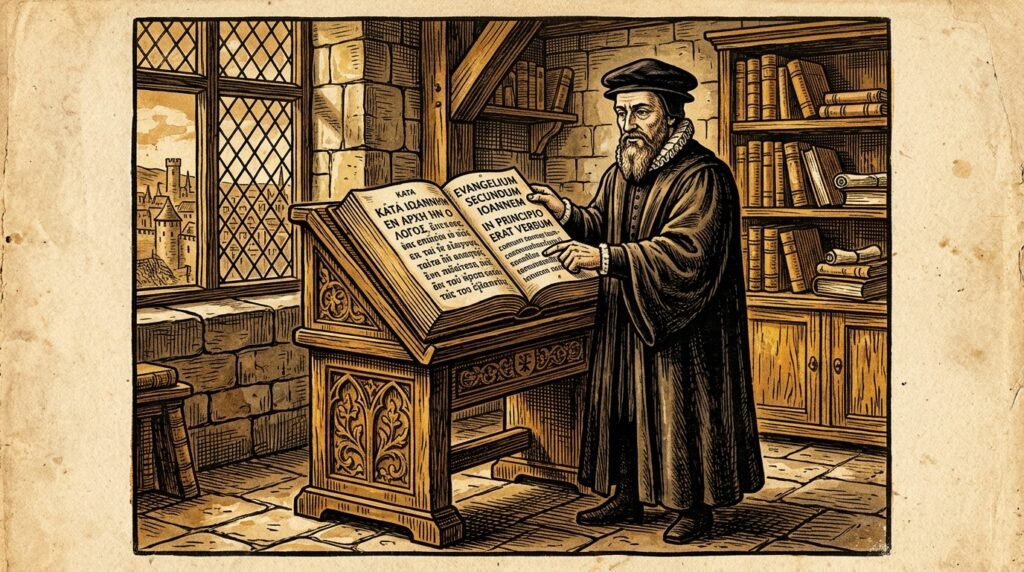
1. Introduction: The Most Perplexing Manuscript of Antiquity
Among the uncial codices preserving the Greek and Latin scriptures of late antiquity, none has inspired such persistent fascination, bewilderment, and philological debate as the bilingual manuscript catalogued in Cambridge University Library under shelfmark MS Nn.2.41. Designated universally in New Testament textual criticism as Codex Bezae Cantabrigiensis (bearing the Gregory-Aland siglum D or 05 for Greek, and d or 5 in the Beuron register for Old Latin), this fifth-century parchment codex represents the primary surviving monument of what nineteenth-century scholarship categorized as the “Western” text-type. Within its surviving 406 folios, the codex presents a textual landscape so divergent from the Alexandrian and Byzantine recensions that textual critics have long treated it as a fascinating anomaly.
In his landmark 1864 critical edition, Frederick Henry Ambrose Scrivener famously characterized Codex Bezae as “the most eccentric copy of the sacred text which has survived to modern times,” remarking upon its pervasive readiness to interpolate, paraphrase, and reorder canonical phrases. In their 1881 introduction to The New Testament in the Original Greek, Brooke Foss Westcott and Fenton John Anthony Hort observed that the “Western” text, of which Codex Bezae is the preeminent Greek representative, was distinguished by a “boldness of paraphrase” and a “readiness to adopt inventions, substitutions, and harmonisations.” Where Alexandrian codices—such as Codex Vaticanus (B, 03) and Codex Sinaiticus (&alef;, 01)—present a disciplined, compressed text, Codex Bezae confronts the reader with a living, unstandardized, and vigorously dramatic narrative.
The codex is arranged as a bilingual diglot on facing pages: the Greek text occupies the position of honor on the left-hand page (verso), while the parallel Latin translation faces it on the right-hand page (recto). Within this bilingual framework, the manuscript preserves the four Gospels according to the ancient Western canonical sequence—Matthew, John, Luke, and Mark—followed by a single surviving leaf of the Catholic Epistles (3 John 11–15 in Latin) and the Acts of the Apostles. In the Gospel of Luke and, above all, in Acts, the radical deviations of Codex Bezae reach their zenith. In Acts, its text is approximately 8.5 percent longer than the standard Alexandrian text found in modern critical editions, introducing circumstantial narratives, topographical details, psychological motives for apostolic actions, dramatic crowd reactions, and unexpected ethical reconfigurations of apostolic decrees.
For more than four centuries, scholars have grappled with the fundamental mysteries posed by this codex. Was Codex Bezae the reckless creation of an incompetent provincial scribe, as Scrivener believed, or was it the product of a highly sophisticated scribal program, as David C. Parker has demonstrated? Does its expansive text of Acts preserve an authentic second edition penned by Luke himself, as Friedrich Blass famously hypothesized, or does it embody an early second-century expansion designed to counter Marcionite and Gnostic challenges? Furthermore, what does its bilingual, colometric format—written not in continuous blocks of prose, but in rhythmic sense-lines (per cola et commata)—reveal about the liturgical performance of scripture in late antiquity? This monograph provides a comprehensive codicological, textual, and historical analysis of Codex Bezae Cantabrigiensis, tracing its physical production, its journey from Lyon to Cambridge, its celebrated textual anomalies, and its enduring role as a witness to the fluid state of early Christian scripture.
2. Physical Codicology: The Bilingual Facing Pages (Greek Left, Latin Right) and Sense-Lines (Colometry)
The physical composition and codicological layout of Codex Bezae reflect a specialized scribal architecture tailored for bilingual comprehension and liturgical lection. Surviving today in 406 parchment folios, the manuscript originally comprised between 510 and 534 leaves, gathered predominantly into quaterniones (quires of four bifolia). The surviving leaves measure approximately 260 by 215 millimeters, presenting a substantial, nearly square format. The vellum displays visible contrasts between the rougher hair side and the smoother flesh side, complete with original follicle markings and pre-inking repairs.
The visual signature of Codex Bezae lies in its facing-page diglot structure. Across each opening, a single column of thirty-three lines appears on each page. The Greek text occupies the left-hand page (verso), while the Latin translation occupies the facing right-hand page (recto). In late antique bilingual codices, the left-hand page represented the place of honor and signified the authoritative source language (textus principalis), while the right-hand page served as an auxiliary translation (interpretatio) for Western readers. Each page exhibits dry-point ruling on the flesh side with vertical bounding margins.
Colometry: Writing Per Cola et Commata
Unlike the continuous scriptio continua of Codex Sinaiticus or Codex Vaticanus, Codex Bezae is arranged throughout in colometric sense-lines (κατὰ κῶλα καὶ κόμματα). Each line represents a discrete syntactical, rhetorical, or breath unit designed for public oral recitation. Lines range in length from two or three words to sixteen or more syllables, depending upon the logical cadence of the clause. Overflow lines are indented, creating a hanging indention that guided the lector’s voice.
Colometry functioned as an ancient form of punctuation and exegesis, instructing the reader where to pause and how to group clauses. Crucially, the Bezan layout required strict line-for-line correspondence between Greek and Latin. Every line of Greek on the verso matches the parallel Latin line on the facing recto. When Latin required more syllables or different syntax, the copyist adjusted script size, used abbreviations, or altered Latin word order to ensure that both pages turned together at the exact same point in the text.
Palaeography and the Single-Scribe Paradigm
The palaeography of Codex Bezae synthesizes Greek and Latin uncial traditions. The Greek text is written in an upright, square Biblical majuscule, featuring broad, rounded characters (epsilon, theta, omicron, sigma) characteristic of the late fourth and early fifth centuries. The Latin text is executed in a stately Latin uncial that is thoroughly Hellenized: the Latin characters mimic the proportions, pen angle, and ductus of the facing Greek letters, forming a distinct “Graeco-Latin uncial.”
Nineteenth-century critics posited that two separate scribes worked collaboratively on the manuscript. However, the codicological investigation of David C. Parker (Codex Bezae, 1992) conclusively demonstrated that a single bilingual scribe copied both the Greek and the Latin columns. Analyzing pen strokes, ink changes, and ruling alignments, Parker proved that the copyist worked line by line across each opening, alternating between Greek and Latin. This shattered the myth of an ignorant Latin copyist mechanically tracing Greek words, revealing instead a disciplined bilingual artisan executing a coordinated liturgical tool.
The Strata of Correctors
Codex Bezae was actively used and emended for over seven centuries across four primary chronological strata:
- Strata I (5th–6th Centuries): The original scribe (corrector s) made immediate corrections by scraping or writing omitted lines in margins. In the sixth century, correctors A and B checked the text against different exemplars, emending orthography and grammar in both languages.
- Strata II (7th Century): Corrector C (the “liturgical hand”) added extensive apparatus: Ammonian sections, Eusebian canon numbers, and lectionary rubrics (arche and telos) in Greek and Latin, while emending portions of Matthew toward a proto-Byzantine standard.
- Strata III (9th Century): In Lyon, Carolingian scholars—most notably the circle of Florus, Deacon of Lyon (d. 860 CE)—annotated the codex, checking the Latin against the Vulgate and adding liturgical cues.
- Strata IV (11th–12th Centuries): Medieval readers added sporadic vernacular-influenced Latin glosses and chapter numbers before the manuscript left the monastery of Saint-Irenaeus.
3. Historical Provenance: From Lyon (Monastery of St. Irenaeus) to Theodore Beza and Cambridge (MS Nn.2.41)
The geographic origins of Codex Bezae remain a classic problem of palaeography. Five primary locales have been proposed across two centuries of inquiry:
- Southern Gaul (The Rhone Valley / Lyon or Arles): A vibrant bilingual Greco-Roman region since the second century, when Saint Irenaeus of Lyon (c. 130–202 CE), a native of Smyrna, wrote in Greek while presiding over a Latin-speaking community. The unbroken medieval documentation of the manuscript in Lyon strongly supports local production.
- North Africa (Carthage): Proposed due to affinities between the Latin column (d) and the Old Latin citations of Tertullian and Cyprian, though North Africa lacked an established tradition of Greek-Latin uncial diglot production.
- Southern Italy or Sicily: A thoroughly bilingual cultural sphere where Greek monasticism coexisted with Latin ecclesial structures, providing ideal conditions for a bilingual scriptorium.
- Berytus (Beirut): Proposed in 1891 by J. Rendel Harris, who suggested that the Roman Law School at Berytus, with its bilingual scholasticism, produced the codex. While brilliant, this hypothesis fails to explain the Western dialectal features of the Latin column.
- Egypt (Alexandria): While Alexandria was the primary Greek scribal capital, Egyptian bilingual manuscripts consistently treat Latin as a secondary tongue, whereas Codex Bezae exhibits an authentic Western Old Latin text.
The consensus of modern scholarship, formulated by Parker, dates Codex Bezae to approximately 400 CE and places its production in the Western Mediterranean—most plausibly in Southern Gaul or Southern Italy.
The Monastic Haven of Saint-Irenaeus in Lyon
By the early ninth century, the codex was securely housed in the library of the Abbey of Saint-Irenaeus in Lyon. Paleographical analysis has identified marginal annotations written by Florus, Deacon of Lyon (d. 860 CE), the renowned Carolingian theologian and canonist. Florus cited the Latin text of Codex Bezae in his liturgical works, and the martyrologist Ado of Vienne (d. 875 CE) utilized its text of Acts. For centuries, the manuscript remained in Lyon as an ancient treasure, largely insulated from Vulgate standardization.
The Sack of Lyon (1562) and Theodore Beza
In 1562, during the first French War of Religion, Huguenot troops under François de Beaumont, Baron des Adrets, captured Lyon. Protestant forces plundered the Abbey of Saint-Irenaeus. Amid the destruction of the cloister library, Codex Bezae was rescued by a sympathetic scholar and transmitted to Theodore Beza (1519–1605), John Calvin’s successor in Geneva.
Beza recognized the codex’s antiquity and cited its variants in his editions of the Greek New Testament (1565, 1582, 1589, 1598). However, Beza was deeply disturbed by its radical divergences from the newly established Textus Receptus. Committed to sola scriptura, Beza feared that publishing such an erratic text would undermine scriptural authority and furnish Catholic polemicists with arguments against biblical stability. He explicitly cautioned that the codex should be kept from general circulation, regarding it as a historical curiosity rather than an authoritative standard.
The Cambridge Donation of 1581 (MS Nn.2.41)
Seeking a secure academic repository, Beza presented the codex to the University of Cambridge in 1581. In his Latin dedication letter of 8 December 1581, Beza entrusted the manuscript to the university to ensure its perpetual preservation (ut in hac praesertim Academia… asservaretur). Deposited in Cambridge University Library under shelfmark MS Nn.2.41, it quickly attracted English textual critics, including Patrick Young, Brian Walton (1657 London Polyglot), John Mill (1707), and Richard Bentley.
Thomas Kipling published the editio princeps facsimile in 1793 in specially cast uncial type. In 1864, Frederick H.A. Scrivener published his definitive critical edition with an exhaustive introduction and analysis of correctors, laying the foundation for modern Bezan research.
4. The Order of the Gospels: The Western Canonical Order (Matthew, John, Luke, Mark) and Missing Sections
A striking structural feature of Codex Bezae is its arrangement of the four Gospels. While modern Bibles and the Alexandrian recension follow the sequence Matthew, Mark, Luke, John, Codex Bezae preserves the ancient “Western” canonical order:
The Logic of Apostolic Priority
The Western order was rooted in early ecclesiological views regarding apostolic authority. Early Christian communities distinguished between two classes of evangelists:
- The Apostles: Matthew and John were personal disciples and eyewitness companions of Jesus Christ, numbered among the Twelve. As direct apostolic eyewitnesses, their Gospels were placed first.
- The Apostolic Men: Luke and Mark were companions of the apostles (Luke the traveling associate of Paul, Mark the interpreter of Peter). Their Gospels were placed in the secondary position.
This sequence paired the two eyewitness Apostles at the front, followed by the two Apostolic Companions. It was widely adopted throughout the early West, appearing in Codex Washingtonianus (W, 032), the Codex Claromontanus list, the Gothic Bible of Wulfila, the Apostolic Constitutions, and Old Latin manuscripts such as a, b, d, e, ff2, and q, before being replaced by the Vulgate order.
Folio 415 and the Lost Catholic Epistles
Codicological evidence reveals that in Codex Bezae, an entire corpus of writings originally stood between Mark and Acts. This discovery centers upon the surviving Folio 415.
On folio 415 recto, Mark terminates abruptly at Mark 16:15 due to lost leaves. Turning to folio 415 verso, the reader encounters not Acts, but the concluding verses of the Third Epistle of John in Latin (3 John 11–15, witness d), ending with the subscriptio: EPISTULAE IOHANNIS III AMEN • EXPLICIT • INCIPIT ACTUS APOSTOLORUM (“The Third Epistle of John, Amen. It ends. The Acts of the Apostles begins”). The facing Greek text of 3 John is lost, but the Latin text reads:
…noli imitari malum sed quod bonum est. Qui benefacit ex Deo est; qui malefacit non vidit Deum. Demetrio testimonium perhibetur ab omnibus et ab ipsa veritate… Salutant te amici. Saluta amicos per nomen.
(“…do not imitate evil but what is good. Whoever does good is from God; whoever does evil has not seen God. Demetrius has received a good testimony from everyone and from the truth itself… The friends greet you. Greet the friends by name.”)
This leaf proves that the Catholic Epistles originally stood between Mark and Acts. Codicological calculations indicate that at least sixty-four leaves are missing at this point, which originally contained the complete Johannine Epistles and likely Peter, James, and Jude. These quires were lost in the early Middle Ages, leaving only the final leaf of 3 John adhering to Acts.
Survey of Major Lacunae
Of its original ~510–534 folios, 406 survive. The principal lacunae include:
- Matthew: Greek and Latin lost for Matt 1:1–20; Latin lost for Matt 3:7–16 and Matt 6:20–9:2; Greek lost for Matt 27:2–12.
- John: Greek lost for John 1:16–3:26 and John 18:14–20:13 (Latin survives on facing pages, enabling Greek colometric reconstruction).
- Mark: Text breaks off at Mark 16:15; Mark 16:16–20 lost in Greek and Latin, though quire measurements show the longer ending was originally present.
- Catholic Epistles: All lost except 3 John 11–15 in Latin on folio 415v.
- Acts: Greek lost for Acts 8:29–10:14, Acts 21:2–10, Acts 21:16–18, and Acts 22:10–20. Both Greek and Latin terminate at Acts 22:29; the final quire(s), containing Acts 22:30 through Acts 28:31, was lost in antiquity.
5. The “Western” Text-Type Debate: Definition, Characteristics, and Radical Deviations
In New Testament textual criticism, no subject has provoked more debate than the origin of the “Western” text. Identified by Johann Salomo Semler (1767) and Johann Jakob Griesbach (1777), the term was canonized by Westcott and Hort in 1881, who placed Codex Bezae at the center of the Western stream.
The Geographic Paradox: An Early Mediterranean Phenomenon
The fundamental paradox of the “Western” text is that it is not exclusively Western. Nineteenth-century scholars coined the label because its primary witnesses were Western European and North African: Codex Bezae (D), Codex Claromontanus (DP), the Old Latin versions, and citations in Tertullian and Cyprian.
However, twentieth-century papyrological discoveries in Egypt shattered this geographic assumption. Papyri from the third century—such as &P;38 (c. 300 CE, Acts 18–19), &P;48 (c. 250 CE, Acts 23), &P;29 (3rd c., Acts 26), and portions of &P;45 (Chester Beatty I, c. 250 CE)—exhibit unmistakable Western readings deep within Egypt. Furthermore, second-century Eastern witnesses—including Tatian’s Diatessaron (c. 170 CE), the Old Syriac versions (Sinaiticus and Curetonian), Justin Martyr, Irenaeus, and Clement of Alexandria—consistently attest to this textual profile. Kurt and Barbara Aland rightly argued that “Western” is a misnomer, designating it instead as the “D-Text” or the “free, uncontrolled text” of early Christianity. Codex Bezae represents the primary uncial monument of a widespread textual stream that predated fourth-century recensional standardization.
Defining Textual Characteristics
Modern textual criticism identifies four core scribal traits in Codex Bezae:
- Paraphrastic Smoothing: Obscure idioms are replaced with familiar terms, pronouns are clarified with explicit nouns, complex participles are resolved into coordinate clauses, and awkward transitions are smoothed.
- Harmonization: Parallel synoptic passages are systematically assimilated (e.g., conforming Luke’s Sermon on the Plain to Matthew’s Sermon on the Mount), and Old Testament quotations are conformed to the Septuagint.
- Circumstantial Additions: In narrative sections, especially Acts, the text adds precise temporal markers, topographical details, and psychological motivations.
- Theological Clarification: Passages susceptible to adoptionist or subordinationist readings are softened to emphasize Christ’s divine dignity.
Theoretical Models of Origin
Four major hypotheses have attempted to explain the genesis of the Western text:
1. Semitic / Aramaic Vorlage: Charles Cutler Torrey, Matthew Black, and A.J. Wensinck proposed that Western variants represent independent Greek translations of an underlying Aramaic original. While Black demonstrated authentic Semitisms in Bezae, modern scholarship views most variants as Hellenistic stylistic adaptations.
2. Friedrich Blass’s Dual-Edition Hypothesis (1895–1897): The German philologist argued that Luke himself produced two authentic editions of his two-volume work: a rougher, longer draft for Theophilus or Rome (the Western text in Bezae), and a polished, shorter edition for Eastern distribution (the Alexandrian text). While brilliant, Blass’s hypothesis failed to explain why the same Western paraphrastic tendencies appear in Matthew, Mark, and John.
3. The Creative Redactor Hypothesis: James Hardy Ropes (1926) and Sir Frederic Kenyon posited that a single gifted Christian editor in the early second century undertook a comprehensive, systematic revision of the New Testament to improve style and incorporate oral traditions.
4. The Living Text Paradigm: Championed by David C. Parker (The Living Text of the Gospels, 1997), Eldon Jay Epp, Bart D. Ehrman, and William A. Strange, this model recognizes that before the stabilization of a closed canon and central ecclesiastical authority, scripture was a “living text.” Early scribes saw themselves as active preservers of apostolic tradition, freely incorporating oral memory, liturgical expansions, and catechetical glosses. Codex Bezae is not a corrupted failure, but a monumental window into this dynamic, pre-canonical stage of transmission.
6. Celebrated Variants in the Gospels: The Sabbath Worker Logion (Luke 6:5b), the Genealogy of Jesus, and the Lord’s Prayer
The textual deviations of Codex Bezae in the Gospels represent bold narrative interventions, structural reorganizations, and the preservation of otherwise unknown Jesus-sayings (agrapha).
The Sabbath Worker Agraphon (Luke 6:5b)
The most famous variant in the entire manuscript occurs in Luke 6. In canonical Luke 6:1–5, Jesus defends his disciples plucking grain on the Sabbath by citing David eating the showbread, concluding in verse 5: “The Son of Man is Lord of the Sabbath.” In standard texts, verse 6 immediately follows with the healing of the withered hand.
In Codex Bezae, on Folio 188 verso (Greek) and Folio 189 recto (Latin), the scribe removes verse 5 and transfers it to after verse 10. In its place, after verse 4, Codex Bezae alone inserts an extraordinary, unique logion:
Greek Text (Folio 188v):
Τῇ αὐτῇ ἡμέρᾳ θεασάμενός τινα ἐργαζόμενον τῷ σαββάτῳ εἶπεν αὐτῷ· Ἄνθρωπε, εἰ μὲν οἶδας τί ποιεῖς, μακάριος εἶ· εἰ δὲ μὴ οἶδας, ἐπικατάρατος καὶ παραβάτης εἶ τοῦ νόμου.
Latin Text (Folio 189r):
Eodem die videns quendam operantem sabbato et dixit illi: Homo, si quidem scis quod facis, beatus es; si autem nescis, maledictus et trabaricator [praevaricator] legis.
English Translation:
“On the same day, beholding someone working on the Sabbath, he said to him: ‘Man, if indeed you know what you are doing, blessed are you; but if you do not know, you are accursed and a transgressor of the law.'”
Joachim Jeremias (Unknown Sayings of Jesus) and Richard Bauckham regard this as one of the few agrapha with strong claims to authentic historical memory. The logion establishes a profound dialectic between conscious spiritual intentionality (knowing what one does) and ignorant disobedience. If the worker labors with spiritual illumination—recognizing that the Sabbath was made for human liberation and is fulfilled in Christ—he is pronounced makarios (blessed). If he works out of secular indifference or greed, he remains a common moral transgressor under the curse of the Mosaic Law (epikataratos kai parabates tou nomou). This directly parallels Paul’s theology of conscience in Romans 14:22–23: “whatever does not proceed from faith is sin.”
The Reconstruction of the Genealogy (Luke 3:23–38)
In standard Luke, Jesus’ genealogy ascends from Joseph through David’s son Nathan to Adam and God, conflicting directly with Matthew 1, which descends from Abraham through David’s royal heir Solomon. Codex Bezae executes a radical harmonistic intervention: it systematically replaces Luke’s post-Davidic ancestors with the royal Solomonic line from Matthew! When D reaches David, it inserts Solomon, Rehoboam, Abijah, Asa, and the successive Judean kings from Matthew 1. Yet the editor preserves Luke’s ascending order and maintains the exact count of seventy-seven generations back to Adam and God, resolving a notorious synoptic discrepancy.
Harmonization in the Lord’s Prayer (Luke 11:2–4)
In Luke 11:2–4, earliest Alexandrian witnesses (&P;75, Vaticanus, Sinaiticus) preserve a concise five-petition prayer. Codex Bezae assimilates the text to the liturgical Matthean version (Matt 6:9–13):
- Expands the address to “Our Father who art in heaven” (Πάτερ ἡμῶν ὁ ἐν τοῖς οὐρανοῖς; Pater noster qui es in caelis).
- Inserts Matthew’s petition: “Thy will be done, as in heaven, so also upon earth” (γενηθήτω τὸ θέλημά σου ὡς ἐν οὐρανῷ καὶ ἐπὶ γῆς).
- Appends Matthew’s conclusion: “deliver us from the evil one” (ῥῦσαι ἡμᾶς ἀπὸ τοῦ πονηροῦ; libera nos a malo).
The Pericope Adulterae (John 7:53–8:11)
Codex Bezae is the oldest extant Greek manuscript containing the Woman Caught in Adultery (John 7:53–8:11). Completely absent from early papyri (&P;66, &P;75) and fourth-century codices (Vaticanus, Sinaiticus), the story appears in Bezae on Folios 121v–122v with unique Western phrasing (e.g., Jesus writing “with his finger,” τῷ δακτύλῳ). This proves that the narrative circulated in Western Greek and Latin streams centuries before entering the Byzantine text.
Matthew 20:28 and the “Western Non-Interpolations”
In Matthew 20:28, following the ransom saying, Codex Bezae, Old Latin manuscripts, and Curetonian Syriac insert an extensive parabolic expansion: “Seek ye to increase from that which is small, and from that which is greater to become less…” (adapted from Luke 14:8–10).
Conversely, in Luke 24, Westcott and Hort identified famous “Western Non-Interpolations” where Codex Bezae and the Old Latin omit phrases found in Alexandrian texts: Luke 24:12 (Peter at the tomb); 24:36b (“Peace be unto you”); 24:40 (showing hands and feet); 24:51b (“and was carried up into heaven”); and 24:52a (“worshipped him”). Westcott and Hort argued that here Bezae preserved the unexpanded apostolic original.
7. The Expansive Text of Acts: The 8.5% Longer Narrative, Peter’s Speeches, and Decree Variants
In the Acts of the Apostles, Codex Bezae diverges from the canonical Alexandrian text more radically than anywhere else in the New Testament. Its text of Acts is approximately 8.5 percent longer than standard critical editions, enriched with vivid circumstantial details, dramatic dialogues, and clear theological tendencies.
Vivid Topographical and Circumstantial Additions
Throughout Acts, Codex Bezae incorporates remarkable circumstantial notices:
- The Seven Steps of the Prison (Acts 12:10): In Peter’s escape from prison, where standard texts state they passed the gate into the street, Codex Bezae adds that they “descended the seven steps” (κατέβησαν τοὺς ἑπτὰ βαθμούς; descenderunt septem gradus). Excavations at the Antonia Fortress in Jerusalem confirm that seven stone steps led from the courtyard to the street—an exact architectural detail known to an eyewitness of pre-70 Jerusalem.
- The Hours of Tyrannus’s Lecture Hall (Acts 19:9): While standard texts state Paul lectured daily in the hall of Tyrannus in Ephesus, Codex Bezae specifies the exact daily hours: “from the fifth hour unto the tenth” (ἀπὸ ὥρας πέμπτης ἕως δεκάτης; a quinta hora usque ad decimam)—11:00 AM to 4:00 PM. During the midday heat, public activity ceased; Paul, who worked as a tentmaker in the cool early morning, rented the vacant lecture hall during the afternoon siesta.
- The Early “We-Passage” in Antioch (Acts 11:28): Where standard Acts introduces the first-person plural (“we”) at Troas (Acts 16:10), Codex Bezae reads at Acts 11:28: “And there was much rejoicing; and when WE were gathered together, one of them named Agabus spoke…” (συνεστραμμένων δὲ ἡμῶν; consequentibus autem nobis), anchoring the author Luke in the church of Antioch in the early 40s CE.
- The Healing at the Beautiful Gate (Acts 3:6–11): Peter’s healing of the lame man is heightened with psychological realism: Peter gazes intently, grasps his right hand, and the crowd is seized with paralyzed awe.
Peter’s Speeches and Prophetic Denunciations
The speeches of the Apostle Peter in Codex Bezae display systematic rhetorical and theological expansions. In Peter’s Pentecost sermon (Acts 2:14–40), D amplifies the emotional impact of the address: at Acts 2:37, when the hearers are pierced to the heart, D adds their desperate cry to Peter and the apostles: “Show us what we must do!” (ὑποδείξατε ἡμῖν τί ποιήσομεν; ostendite nobis quid faciemus). In Solomon’s Portico (Acts 3:12–26), Peter’s indictment of the Jerusalem hierarchy is sharpened, highlighting their obstinacy. In speeches to Cornelius (Acts 10:34–43) and at Jerusalem (Acts 15:7–11), D adds references to the Holy Spirit and underscores Peter’s pastoral authority in legitimizing the Gentile mission.
The Transformation of the Apostolic Decree (Acts 15:20, 29; 21:25)
In the standard Alexandrian text of Acts 15:29, the Jerusalem Council prescribes four ritual prohibitions derived from the Levitical Holiness Code (Lev 17–18): abstaining from things sacrificed to idols, blood (kosher slaughter), things strangled (πνικτοῦ), and sexual immorality.
Codex Bezae transforms this decree by:
- Omitting “and from things strangled” (καὶ πνικτοῦ) in Acts 15:20, 15:29, and 21:25.
- Appending the negative Golden Rule: “and whatsoever ye would not have done to yourselves, do not ye to others” (καὶ ὅσα μὴ θέλουσιν ἑαυτοῖς γίνεσθαι ἑτέροις μὴ ποιεῖν; et quaecumque non vultis vobis fieri aliis ne faciatis).
This modification transforms a ceremonial food-purity decree into a universal ethical charter. By removing strangled meat and adding the Golden Rule, “blood” is reinterpreted not as dietary blood, but as the moral sin of bloodshed/murder, creating three universal moral prohibitions: Idolatry, Murder, and Sexual Immorality.
Theological Tendencies: Anti-Judaism and Gender Modulations
In The Theological Tendency of Codex Bezae Cantabrigiensis in Acts (1966), Eldon Jay Epp demonstrated that variants in Acts reflect consistent ideological agendas:
- Heightened Anti-Judaism: The Bezan text systematically sharpens Jewish hostility toward the apostles, emphasizing bitterness and obstinacy, while intensifying prophetic rebukes.
- Mitigation of Roman Guilt: Roman magistrates (Pilate, Gallio, Philippian magistrates) are depicted favorably as fair guardians of order manipulated by Jewish accusers, serving second-century apologetic needs.
- Diminution of Prominent Women: As analyzed by Bart D. Ehrman (The Orthodox Corruption of Scripture), D subtly suppresses female leadership: in Acts 17:12, the prominent women of Berea are subordinated in word order; in Acts 17:34, Damaris is omitted from the Latin; and in Acts 18:26, Priscilla and Aquila are inverted to the patriarchal order “Aquila and Priscilla.”
8. The Interlinear and Bilingual Relationship: Harmonization, Latinization, and Scribe Theories (Scrivener vs. Parker)
The linguistic relationship between the Greek text (D) on the left and the Old Latin translation (d) on the right has stood at the center of Bezan studies for centuries.
The “Latinization” Controversy: Wetstein vs. Modern Philology
In the eighteenth century, Johann Jakob Wetstein (1751) and Johann David Michaelis argued that the Greek text of Codex Bezae was a back-translation corrupted by the Latin (Latinizatio). They claimed that Western scribes, ignorant of Greek, had systematically altered the Greek text to conform to their vulgar Latin translations.
Scrivener (1864) resisted crude Latinization but viewed the scribe as an illiterate copyist whose Greek was corrupted by Latin idiom. However, Francis Crawford Burkitt (1896) and David C. Parker (1992) decisively dismantled this thesis. Comparative linguistics and papyrology have proved that the Greek of Codex Bezae is authentic, living Koine Greek. Crucially, textual critics proved that the direction of harmonization was the reverse: the Latin column (d) was continually conformed to the Greek column (D)!
Colometric Alignment Mechanics
The Latin text of Codex Bezae is an archaic Old Latin (Vetus Latina) witness related to Cyprian and Novatian, but it has been heavily revised line by line to correspond to the facing Greek. Because the codex was copied in sense-lines, the scribe faced the formidable challenge of maintaining strict thirty-three-line alignment across two languages with divergent grammar:
- Word-Order Accommodation: The Latin repeatedly abandons natural Latin syntax to mirror the Greek word sequence.
- Lexical Calques: Where Greek contains compound verbs or unique variants, the Latin coins literal calques to match the Greek stem.
- Pleonastic Fillers: Where a Latin line was too short to match the Greek, the scribe inserted pleonastic pronouns (ille, ipse, eius) to preserve visual balance.
Scribe Profiles: Scrivener vs. Parker
Scrivener viewed the Bezan scribe through a Victorian classical lens, lamenting in 1864 that he was an “illiterate bungler” who “nodded over his desk” and produced “monstrous blunders.” In stark contrast, David C. Parker’s 1992 codicological investigation established that the copyist was a highly skilled, disciplined professional artisan. Managing line-breaks, margins, and script across two languages on over 400 folios was a masterwork of late antique craftsmanship, producing a sophisticated liturgical instrument for a bilingual community.
9. Modern Critical Assessment: Historical Value, Oral Tradition Echoes, and Digital Transcription
In the twenty-first century, New Testament textual criticism has moved beyond the nineteenth-century “restorationist” obsession with reconstructing an isolated apostolic autograph. Scholars now recognize that the history of the text is the history of early Christianity.
From “Corruption” to “The Living Text”
Codex Bezae is celebrated today as our primary uncial window into the second-century Christian Mediterranean. Papyrological and patristic citations demonstrate that its textual profile was already flourishing throughout the Roman Empire between 150 and 200 CE. When reading Codex Bezae, one encounters the New Testament in the fluid form read and preached by Justin Martyr, Tatian, and Irenaeus. Its variants preserve authentic echoes of living oral tradition, primitive apostolic memory, and early community adaptations.
Digital Humanities and the Editio Critica Maior
Two major digital milestones have transformed modern Bezan studies:
- The Cambridge Digital Library: Cambridge University Library has published an ultra-high-resolution multispectral scan of all 406 folios of MS Nn.2.41, enabling scholars worldwide to examine ink strokes, erasures, and palimpsest layers in forensic detail.
- The Birmingham Codex Bezae Project (ITSEE): Under David C. Parker and Christian-B. Amphoux, the Institute for Textual Scholarship and Electronic Editing produced a full XML-encoded TEI transcription of both Greek and Latin pages.
Integrated into the ongoing Editio Critica Maior (ECM) by the Institut für Neutestamentliche Textforschung (INTF) in Münster, Codex Bezae’s readings are now evaluated via the Coherence-Based Genealogical Method (CBGM), illuminating the earliest branches of textual transmission. Four centuries after Theodore Beza hesitated to circulate it, Codex Bezae Cantabrigiensis stands vindicated as one of the most vital monuments of the early Christian church.
10. Exhaustive Bibliography, Sigla Concordance, and Primary Source Citations
Sigla Concordance Table
| Classification System | Siglum / Designation | Scope & Description |
|---|---|---|
| Gregory-Aland | D or 05 | Greek text of Gospels and Acts (left/verso). |
| Beuron Vetus Latina | d or 5 (VL 5) | Old Latin text facing Greek (right/recto). |
| Von Soden | δ 5 | Diglot uncial (Gospels, Catholic Epistles, Acts). |
| Cambridge Shelfmark | MS Nn.2.41 | Cambridge University Library primary holding. |
| Dating & Origin | c. 400 CE | Late 4th / early 5th c.; Southern Gaul or Southern Italy. |
| Physical Structure | Parchment (Vellum) | 406 folios; 26 × 21.5 cm; 1 col; 33 lines/page; colometric. |
| Canonical Order | Western Order | Matt, John, Luke, Mark, [Catholic Epistles], Acts. |
Primary Facsimiles, Transcriptions, and Critical Editions
- Beza, Théodore de. Novum Testamentum Graece et Latine. Geneva: Henri Estienne, 1565 (2nd ed., 1582; 3rd ed., 1589; 4th ed., 1598).
- Kipling, Thomas, ed. Codex Theodori Bezae Cantabrigiensis, Evangelia et Apostolorum Acta complectens, quadratis literis, Graeco-Latinus. 2 vols. Cambridge: Cambridge University Press, 1793.
- Scrivener, Frederick Henry Ambrose, ed. Bezae Codex Cantabrigiensis: Being an Exact Copy, in Ordinary Type, of the Celebrated Uncial Graeco-Latin Manuscript of the Four Gospels and Acts of the Apostles. Cambridge: Deighton, Bell, and Co., 1864.
- Cambridge University Press. Codex Bezae Cantabrigiensis: Phototypice repraesentatus. 2 vols. Cambridge: Cambridge University Press, 1899.
- Parker, David C., and Christian-B. Amphoux, eds. Codex Bezae: Studies from the Lunel Colloquium, June 1994. New Testament Tools and Studies 22. Leiden: E. J. Brill, 1996.
- Institute for Textual Scholarship and Electronic Editing (ITSEE). The Codex Bezae Project: An Electronic Edition of the Greek and Latin Text. University of Birmingham, 2012.
Foundational Monographic and Critical Literature
- Aland, Kurt, and Barbara Aland. The Text of the New Testament. Translated by Erroll F. Rhodes. 2nd ed. Grand Rapids: Eerdmans, 1989.
- Bauckham, Richard. Jesus and the Eyewitnesses. Grand Rapids: Eerdmans, 2006.
- Black, Matthew. An Aramaic Approach to the Gospels and Acts. 3rd ed. Oxford: Clarendon Press, 1967.
- Blass, Friedrich. Acta Apostolorum sive Lucae ad Theophilum liber alter, secundum formam quae videtur Romanam. Leipzig: Teubner, 1895.
- Blass, Friedrich. Philology of the Gospels. London: Macmillan, 1898.
- Boismard, Marie-Émile, and Arnaud Lamouille. Le texte occidental des Actes des Apôtres: Reconstitution et réhabilitation. 2 vols. Paris: Éditions Recherche sur les Civilisations, 1984.
- Burkitt, Francis Crawford. “The Date of Codex Bezae.” The Classical Review 10, no. 8 (1896): 383–384.
- Chase, Frederic Henry. The Old Syriac Element in the Text of Codex Bezae. London: Macmillan, 1893.
- Clark, Albert Curtis. The Primitive Text of the Gospels and Acts. Oxford: Clarendon Press, 1914.
- Clark, Albert Curtis. The Acts of the Apostles: A Critical Edition. Oxford: Clarendon Press, 1933.
- Ehrman, Bart D. The Orthodox Corruption of Scripture. Oxford: Oxford University Press, 1993.
- Epp, Eldon Jay. The Theological Tendency of Codex Bezae Cantabrigiensis in Acts. SNTSMS 3. Cambridge: Cambridge University Press, 1966.
- Harris, James Rendel. A Study of Codex Bezae. Texts and Studies 2.1. Cambridge: Cambridge University Press, 1891.
- Jeremias, Joachim. Unknown Sayings of Jesus. Translated by Reginald H. Fuller. London: SPCK, 1957.
- Metzger, Bruce M., and Bart D. Ehrman. The Text of the New Testament. 4th ed. Oxford: Oxford University Press, 2005.
- Parker, David C. Codex Bezae: An Early Christian Manuscript and Its Text. Cambridge: Cambridge University Press, 1992.
- Parker, David C. The Living Text of the Gospels. Cambridge: Cambridge University Press, 1997.
- Ropes, James Hardy. The Text of Acts. Vol. 3 of The Beginnings of Christianity. London: Macmillan, 1926.
- Strange, William A. The Problem of the Western Text of Acts. SNTSMS 71. Cambridge: Cambridge University Press, 1992.
- Torrey, Charles Cutler. The Composition and Date of Acts. Cambridge, MA: Harvard University Press, 1916.
- Westcott, Brooke Foss, and Fenton John Anthony Hort. The New Testament in the Original Greek: Introduction and Appendix. Cambridge: Macmillan, 1881.