

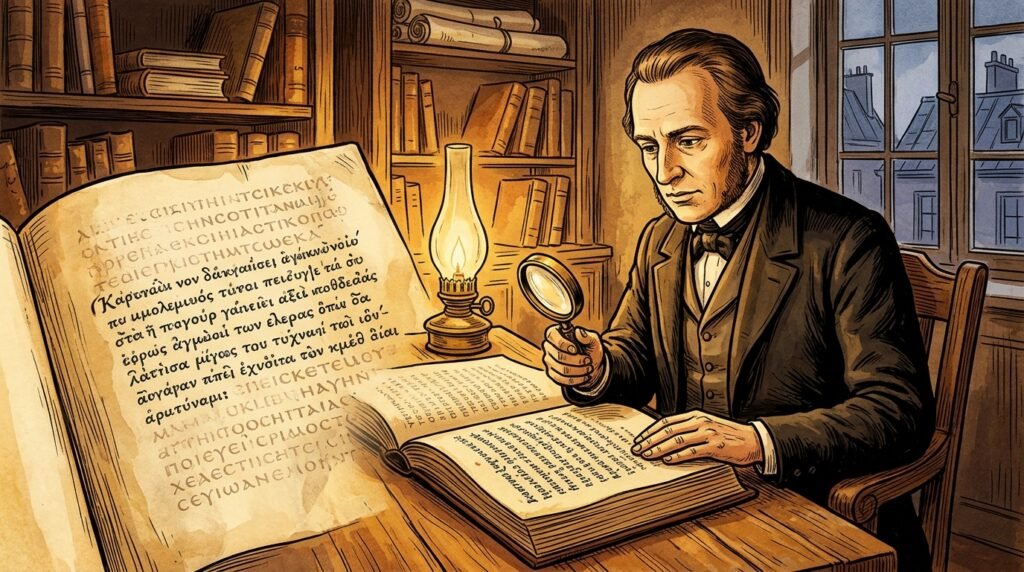
1. Introduction: The Anatomy of a Great Uncial and the Palimpsest Mystery
Within the annals of New Testament textual criticism and late antique codicology, four monumental Greek manuscripts form the sovereign tetrad of Great Uncials: the fourth-century Codex Vaticanus (B / 03), the fourth-century Codex Sinaiticus (א / 01), the early fifth-century Codex Alexandrinus (A / 02), and the fifth-century Codex Ephraemi Rescriptus (C / 04, Paris, Bibliothèque nationale de France, Grec 9). Yet, among this preeminent quartet, Codex Ephraemi Rescriptus occupies a tragic and unique position. Whereas its three companions survived late antiquity and the Byzantine Middle Ages with their parchment intact and their text accessible, Codex C was condemned in the twelfth century to physical obliteration. In a Byzantine monastic scriptorium, its fifth-century biblical leaves were unstitched, washed with chemical detergents, scraped with pumice stone, cut down, folded in half, and overwritten with the Greek translations of thirty-eight ascetic treatises of St. Ephrem the Syrian.
The manuscript thus entered the modern era as a palimpsest (from the Greek palímpsēstos, παλίμψηστος, derived from pálin, “again,” and psáō, “I scrape”). For centuries, the sacred biblical text lay hidden as a ghost beneath the dense minuscule script of the Syrian father. What was once an imperial single-volume pandect of the Greek Scriptures—encompassing both the Septuagint and the complete New Testament—was fractured into an enigmatic codicological puzzle. Only through early modern collations, nineteenth-century chemical reactivations, the paleographical labors of Konstantin von Tischendorf, and twenty-first-century multispectral imaging has this fifth-century witness been recovered for modern critical scholarship.
Preserved today under the shelfmark Bibliothèque nationale de France, Département des Manuscrits, Grec 9 (BnF Gr. 9), the manuscript comprises 209 surviving folios. Of these, 64 leaves preserve fragments of the Old Testament poetical and sapiential books, while 145 leaves preserve approximately two-thirds of the Greek New Testament. In the critical apparatus of modern editions, such as Nestle-Aland’s Novum Testamentum Graece (NA28) and the United Bible Societies’ Greek New Testament (UBS5), the siglum C (or 04 in the Gregory-Aland register; δ 3 in Hermann von Soden’s notation) designates an indispensable witness of the highest rank, preserving an Alexandrian textual baseline interpenetrated with early Western variants and nascent Byzantine readings.
2. Codicology and Origin: The Fifth-Century Parchment and Fifth-Century Script
To reconstruct the primitive architecture of Codex Ephraemi before its medieval recycling is to encounter an uncial monument of extraordinary craftsmanship, produced around the middle of the fifth century (c. 450 CE). Chronologically, it stands alongside or slightly posterior to Codex Alexandrinus and roughly half a century after Sinaiticus and Vaticanus.
Parchment Quality and Original Dimensions
The codex was executed on exceptionally fine, thin vellum prepared from high-grade calfskin. Codicological analysis demonstrates that the original untrimmed leaves measured approximately 33 cm in height by 27 cm in width. When twelfth-century monastic scribes prepared the vellum for overwriting, the original quires were dismantled, each bifolium was separated along the fold, rotated ninety degrees, trimmed, and folded down the center to yield smaller leaves measuring today between 30 and 31.5 cm in height by 24 to 25.5 cm in width.
Stichometric calculations and text-block projections reveal that the original complete pandect comprised approximately 468 to 500 folios. The Old Testament portion, containing the complete Septuagint, spanned roughly 230 to 250 leaves, while the New Testament occupied approximately 238 leaves. Only 209 leaves survive today—64 from the Old Testament and 145 from the New Testament—the remainder having been lost or discarded during the twelfth-century rebinding.
Page Architecture and Columnar Format
In its layout, Codex Ephraemi departs strikingly from its great uncial predecessors. While Codex Sinaiticus deployed four narrow columns per page and Codex Vaticanus deployed three columns, Codex C was written in a single, broad column per page (long-line format). In this layout, it mirrors luxury late antique Latin codices and anticipates the single-column format of later uncials. Each page contained between 40 and 46 lines of script (with 40 or 41 lines representing the regular norm), guided by delicate dry-point ruling incised on the hair-side of the vellum.
Paleography of the Scriptio Inferior: Biblical Majuscule
The primary text (scriptio inferior) is executed in monumental Biblical Majuscule. The script is upright, square, rigid, and severe, displaying an absence of ornamentation or cursive flourishes. The round characters (epsilon, theta, omicron, sigma) exhibit strict geometric curvature, while the broad letters (mu, nu, omega, pi) span square proportions. The horizontal crossbars of theta (Θ) and epsilon (Ε) are situated precisely at the median character height.
The text is written in scriptio continua (unbroken script without word division), devoid of breathings and accents in the original hand. Punctuation in the primary hand ($C^*$) consists solely of a single elevated dot or middle point (stigmē) placed at the close of a grammatical clause. Enlarged initial letters (litterae notabiliores) appear at the head of major sections; these characters stand slightly into the left margin (ecthesis), being approximately double the size of standard text characters, aligning Codex C with Codex Alexandrinus.
Scribal Hands and Historical Correctors
Tischendorf demonstrated that the original manuscript was transcribed by two collaborating scribes: Scribe A, responsible for the Old Testament and portions of the Gospels (characterized by heavier strokes and broader spacing), and Scribe B, responsible for the majority of the New Testament (exhibiting a lighter ductus and narrower margins). The text is further defined by three successive layers of historical correctors:
- $C^*$ and $C^1$ (Fifth Century): The original scribes and contemporary diorthōtēs making immediate corrections in scribendo or during initial collation via dots, erasure, or marginal uncial additions.
- Corrector $C^2$ or $C^b$ (Sixth Century): An active hand in Palestine, Syria, or Egypt who systematically added liturgical rubrics, church readings, accents, breathings, and textual corrections conforming to the Eastern ecclesiastical standard.
- Corrector $C^3$ or $C^c$ (Ninth Century): A Byzantine hand in Constantinople who added modern punctuation and altered archaic Alexandrian variants to match the Byzantine Koine.
Paratextual Apparatus, Nomina Sacra, and Provenance
In the Gospel margins, the Ammonian Sections appear with Eusebian Canon numbers inscribed beneath. In the Epistles, remnants of the Euthalian Apparatus survive (kephalaia, titloi, and stichometric counts). The Nomina Sacra are systematically contracted under a horizontal stroke: ΘΣ (Θεός), ΚΣ (Κύριος), ΙΣ (Ἰησοῦς), ΧΣ (Χριστός), ΠΝΑ (Πνεῦμα), ΥΣ (Υἱός), ΔΑΔ (Δαυίδ), ΙΗΛ (Ἰσραήλ), ΑΝΟΣ (ἄνθρωπος), and ΟΥΝΟΣ (Οὐρανός).
Most paleographers assign Codex C to Alexandria or Lower Egypt based on its Alexandrian textual affinity, paleographical kinship to Egyptian documentary uncials, and distinctive Greco-Coptic orthography, though Caesarea and Constantinople remain possible alternative origins.
3. The Twelfth-Century Erasure and Overwriting: The Treatises of Ephrem the Syrian
By the twelfth century, the cultural and liturgical landscape of the Byzantine Empire had undergone an epochal transformation. The monumental uncial script of late antiquity had long been abandoned in book production, replaced since the ninth-century Studite reforms by the swift, compact minuscule script. Late antique uncial manuscripts without word division, accents, or contemporary lectionary markings were viewed by Byzantine monks as obsolete and cumbersome.
The Economics of Vellum and the Recycling Process
During the Comnenian era (1081–1185 CE), high-grade calfskin vellum was an exceptionally scarce and expensive commodity. Monastic scriptoria faced an acute shortage of parchment to copy patristic and liturgical works demanded by expanding foundations such as the Monastery of the Theotokos Evergetis or the monastic houses of Mount Athos. When an ancient manuscript was deemed defective, incomplete, or archaic, it was targeted for recycling. Codex Ephraemi, already missing quires, presented an ideal quarry of durable fifth-century vellum.
In a Byzantine scriptorium—almost certainly in Constantinople or Mount Athos—the codex was dismantled and transformed into a palimpsest through an arduous craft:
- Dismemberment: Gathering threads were severed, separating each quire (quaternio) into loose bifolia.
- Chemical and Mechanical Ablation: Leaves were immersed in water mixed with milk, lime, or plant-based acidic washes to soften the medieval iron-gall ink. Scribes then abraded the surface with pumice stones, cuttlefish bone, and curved scraping knives (novacula). Where the iron-gall ink had bitten deeply into the parchment collagen, washing removed only superficial pigment, leaving latent iron residues embedded in the dermal fibers.
- Reformatting and Trimming: Scribes rotated the folios ninety degrees, folded each in half to produce two smaller leaves, and trimmed the margins, destroying original line-ends and marginal apparatus.
- Disordering the Quires: The recyclers bound leaves with complete indifference to biblical order, placing Matthew against Revelation or the Pauline Epistles.
The Overtext (Scriptio Superior): Ephrem the Syrian in Greek
A twelfth-century scribe inscribed the upper text in fluid Byzantine minuscule with full ligatures, breathings, and accents. The text copied was a collection of thirty-eight ascetical treatises, homilies, and sermons of St. Ephrem the Syrian (c. 306–373 CE) in Greek translation (along with several pseudo-Ephremic homilies). Revered across Eastern Christendom as the “Harp of the Spirit,” Ephrem’s works on repentance, monastic asceticism, and the Last Judgment were staples of Byzantine monastic reading, including Sermo de virtutibus et vitiis, De compunctione cordis, De patientia et consummatione saeculi, De iudicio et resurrectione, and Sermo de secundo adventu Domini.
Remarkably, this overwriting secured the manuscript’s physical survival: had the parchment not housed a revered patristic text actively read and protected in monastic libraries, the bare uncial leaves would almost certainly have been lost during the cataclysms of late Byzantium.
4. From Constantinople to Florence and Paris: Catherine de’ Medici and the Royal Library (BnF Gr. 9)
The survival of Codex Ephraemi Rescriptus through the collapse of the Byzantine Empire and its passage into Western Europe form a notable chapter in Renaissance bibliophilia, diplomatic intrigue, and royal collecting.
The Fall of Constantinople and Italian Humanism
Throughout the fourteenth and early fifteenth centuries, the palimpsest was preserved in a monastic library in Constantinople. As the Ottoman Turks inexorably tightened their encirclement around the Byzantine capital, Italian humanists, merchant princes, and papal emissaries visited the Eastern Mediterranean to salvage the literary patrimony of classical antiquity and early Christianity before the final catastrophe. The volume was brought to Italy shortly before or immediately following the Fall of Constantinople to Sultan Mehmed II on May 29, 1453.
By the early sixteenth century, the manuscript was firmly established in Florence in the collection of Cardinal Niccolò Ridolfi (1501–1550). Ridolfi, a wealthy patrician, nephew of Pope Leo X and grandson of Lorenzo the Magnificent, was among the most voracious book collectors of the High Renaissance. Assisted by prominent Greek scholars, including Janus Lascaris and Matthaios Devaris, Ridolfi amassed a celebrated library of Greek manuscripts. In Ridolfi’s catalogues, the Ephrem palimpsest occupied an honored place, though catalogued simply under the patristic treatises of St. Ephrem.
Piero Strozzi and Catherine de’ Medici
Upon Cardinal Ridolfi’s death in Rome in 1550, his magnificent library was acquired by Piero Strozzi (1510–1558), Marshal of France and cousin of Catherine de’ Medici, Queen Consort of France (wife of King Henri II). Following Strozzi’s death at the siege of Thionville in 1558, Catherine acquired the entire manuscript collection, merging it into her glittering royal library at Fontainebleau and Paris. Catherine was an ardent patron of learning, amassing nearly 800 Greek codices. Following her death in January 1589, her collection was seized by the French Crown to satisfy outstanding debts. Under King Henri IV, the Medici treasures were formally integrated into the Bibliothèque du Roi.
The Royal Library and BnF Grec 9
In the Royal Library, the manuscript was catalogued successively as *Codex Regius 1905*, *Codex Regius 9*, and finally, following the French Revolution, as Grec 9 in the Bibliothèque nationale de France. For over a century in Paris, however, it was regarded purely as a medieval copy of Ephrem the Syrian, its fifth-century biblical undertext completely overlooked by royal librarians.
5. Early Decipherment Attempts: Pierre Allix, Jean Boivin, and J.J. Wettstein
The rediscovery and gradual recovery of the fifth-century undertext of Codex C developed across more than a century of painstaking paleographical inquiry, marking the emergence of scientific textual criticism in Western Europe.
Pierre Allix: The Discovery of the Undertext
The first scholar to detect the ancient scriptio inferior was the learned French Protestant divine Pierre Allix (1641–1717). A native of Alençon and pastor of the Reformed temple at Charenton near Paris, Allix was one of the foremost patristic scholars of seventeenth-century France. In the late 1670s or early 1680s, while examining Greek patristic manuscripts in the Bibliothèque du Roi, Allix observed faint majuscule characters running perpendicular to the twelfth-century minuscule text of Grec 9. Examining the faint letters, he recognized archaic Greek biblical uncials preserving fragments of the New Testament.
Following the Revocation of the Edict of Nantes by Louis XIV in 1685, Allix was forced into exile in England, where he became Canon of Salisbury. Though he did not publish a systematic transcription, Allix communicated his sensational discovery to scholars in Paris, Oxford, and Cambridge, alerting the academic world that the Royal Library harbored a biblical witness comparable in antiquity to the celebrated Codex Alexandrinus.
Jean Boivin’s Collation for Ludolph Küster
Around 1708–1710, Jean Boivin (1663–1726), sub-librarian of the Bibliothèque du Roi and member of the Académie des Inscriptions et Belles-Lettres, undertook the first partial transcription of the palimpsest. Working without optical magnification and relying entirely on natural daylight angled through the tall windows of the library, Boivin painstakingly transcribed selected readings from the Gospels, Acts, and Epistles.
Boivin communicated his collations to the German classicist Ludolph Küster, who incorporated them into the preface and critical apparatus of his landmark 1710 Amsterdam edition of John Mill’s Greek New Testament (*Novum Testamentum Graecum cum lectionibus variantibus*). For the first time, biblical critics were confronted with concrete textual variants extracted from the Parisian palimpsest, demonstrating that its text diverged sharply from the received Textus Receptus and exhibited striking affinities with ancient uncial readings.
Johann Jakob Wettstein’s Two-Year Campaign (1716)
The first systematic, comprehensive collation of Codex C was executed by the Swiss philologist Johann Jakob Wettstein (1693–1754). In 1715, the English classical scholar and Master of Trinity College, Cambridge, Richard Bentley, was actively preparing his projected monumental critical edition of the Greek New Testament. Bentley’s revolutionary principle was to restore the exact text of the New Testament as it existed in the fourth and fifth centuries by collating the oldest Greek uncials against the oldest manuscripts of Jerome’s Latin Vulgate. Recognizing the immense value of Codex Ephraemi, Bentley commissioned the twenty-two-year-old Wettstein to travel to Paris and collate BnF Grec 9.
Wettstein arrived in Paris in the spring of 1716 and devoted nearly two years of grueling labor to the codex. The physical and intellectual toll was severe. The ancient majuscules were faint, faded to a pale-yellow or translucent tan, frequently intersected by the heavy black ink of the twelfth-century minuscule script, and complicated by the bleed-through of ink from the reverse sides of the vellum. To read a single line often required hours of adjustment, waiting for the shifting sun to strike the parchment at precise grazing angles.
Despite these monumental obstacles, Wettstein successfully transcribed substantial portions of the New Testament. Although Bentley’s projected New Testament was never published, Wettstein preserved his collations with meticulous care. In his landmark two-volume Greek New Testament (Novum Testamentum Graecum, Amsterdam, 1751–1752), Wettstein assigned to Codex Ephraemi Rescriptus the capital letter C, establishing the permanent siglum by which the manuscript has been known to biblical textual criticism ever since. Wettstein’s collation proved beyond dispute that Codex C was one of the supreme primary witnesses to the early text.
6. The Chemical Tragedy and Triumph: Gioachino Trecourt, the “Tinctura Giobertina”, and Parchment Staining
By the 1830s, more than eighty years after Wettstein’s publication, the incomplete knowledge of Codex C grew intolerable to European scholars. Karl Lachmann’s landmark 1831 edition had decisively broken with the Textus Receptus, demonstrating that the New Testament text could be reconstructed solely on the basis of early uncial and patristic witnesses. Textual critics urgently demanded a complete, unabridged transcription of Codex C.
The Emergence of Chemical Reagents in Paleography
In the early nineteenth century, European manuscript repositories turned to chemical reagents to revive faded iron-gall inks. Ancient and medieval inks were composed of iron gallotannate—a coordination complex formed by combining oak gall extracts (tannic and gallic acids) with iron(II) sulfate (green vitriol). While washing and mechanical scraping removed surface pigment, latent iron ions remained embedded in the collagen fibers of the vellum. To reactivate these invisible iron residues, chemists developed solutions designed to precipitate intensely colored inorganic compounds.
The most famous formulation was the Tinctura Giobertina (Giobertine Tincture), invented in Turin around 1800 by the Italian chemist Giovanni Antonio Giobert (1761–1834). The reagent consisted of an acidified solution of potassium ferrocyanide (yellow prussiate of potash, $\text{K}_4[\text{Fe}(\text{CN})_6]$) dissolved in ethanol and acidified with dilute hydrochloric acid ($\text{HCl}$). When swabbed onto parchment, ferrocyanide ions react with residual ferric ions ($\text{Fe}^{3+}$) to precipitate ferric ferrocyanide, the vivid pigment known as Prussian blue:
Chemical Precipitation of Prussian Blue:
$$4\,\text{Fe}^{3+} + 3\,[\text{Fe}(\text{CN})_6]^{4-} \longrightarrow \text{Fe}_4[\text{Fe}(\text{CN})_6]_3 \quad (\text{Prussian Blue})$$
Gioachino Trecourt’s Intervention (1834–1835)
In 1834, the authorities of the Bibliothèque Royale in Paris formally commissioned an Italian manuscript restorer and chemist, Gioachino (Gioacchino) Trecourt, to treat the leaves of Codex Ephraemi with the Giobertine tincture. The immediate effect was spectacular: hidden fifth-century letters flared into view in bright Prussian blue and black, enabling transcribers to read lines that had been invisible for centuries. Transcribers marveled as forgotten verses of Paul, Luke, and John emerged from the vellum as if freshly penned.
The Chemical Disaster: Acid Hydrolysis and Oxidation
The triumph, however, was short-lived, inaugurating a physical tragedy for the manuscript. Within months of application, secondary chemical reactions began to destroy the delicate balance of the parchment:
- Severe Acid Hydrolysis: Dilute hydrochloric acid in the tincture attacked the peptide bonds of the parchment collagen, causing irreversible acid hydrolysis. The supple fifth-century vellum became brittle, dry, and rigid, curling at the margins and cracking along folds.
- Uncontrolled Oxidation and Discoloration: Excess potassium ferrocyanide, reacting with ambient atmospheric moisture and sulfurous urban pollutants, oxidized across the page surface. Vast areas of vellum were transformed into dark brown, mossy green, dirty purple, and pitch-black stains.
- Bleed-Through and Obliteration: On dozens of folios, the chemical wash penetrated entirely through the parchment, causing the ink of the recto and verso to bleed into one another. The chemical blackening permanently obliterated both the twelfth-century Ephrem text and the underlying fifth-century majuscules, sealing valuable verses in perpetual darkness.
When scholars entered the Bibliothèque Royale in the late 1830s, they were greeted by a devastating spectacle: where once lay ivory-toned vellum with faint uncial script, there now sat folios disfigured by chemical splotches, brittle margins, and deep blue-black stains. The French authorities abruptly banned all further use of chemical reagents on the manuscript. It appeared that Codex C had been ruined by the very science that sought to resurrect it.
7. Konstantin von Tischendorf’s Decipherment (1840–1843): Methods, Transcriptions, and the Breakthrough
It was into this desolate landscape of chemical devastation that a young German scholar stepped in the autumn of 1840, achieving one of the most astonishing paleographical triumphs in the history of scholarship: Lobegott Friedrich Konstantin von Tischendorf (1815–1874).
Tischendorf’s Arrival in Paris
In October 1840, Tischendorf—a twenty-five-year-old privatdozent from the University of Leipzig, possessing almost no financial resources but animated by an consuming passion for recovering the earliest text of the Greek New Testament—arrived in Paris. European philologists had largely written off Codex Ephraemi as an intractable puzzle. The English textual critic Samuel Prideaux Tregelles and various German scholars believed that no human eye could ever systematically disentangle the complete biblical text from the combined confusion of Ephrem’s minuscule, the bleed-through of opposite pages, and Trecourt’s chemical stains.
Armed with letters of recommendation from his Leipzig mentor David Schulz, Tischendorf gained admittance to the manuscript department of the Bibliothèque Royale. For the next two and a half years—from October 1840 until the spring of 1843—Tischendorf lived within the folios of BnF Grec 9. His work on Codex C was the crucible that forged the legend of modern biblical paleography.
Paleographical Methods and Physical Endurance
Tischendorf’s success rested on rigorous physical, optical, and codicological discipline:
- Exploitation of Natural Grazing Light: Rejecting artificial lamps that created blinding glare on the chemical stains, Tischendorf worked exclusively by natural daylight. Seated directly adjacent to the large south-facing windows of the library, he tilted each folio at precise angles relative to incoming solar rays (raking light), using microscopic pen indentations made by the reed pen (calamus) to trace letterforms where chemical pigment had vanished.
- High-Power Optical Magnification: Using specialized magnifying lenses and custom monoculars with varying focal lengths, he distinguished between superficial black carbon particles of the twelfth-century minuscule and deep-seated, oxidized iron traces of the fifth-century majuscules.
- Codicological Calculation: He calculated average letters per line and lines per page, mathematically verifying whether disputed readings fit within lacunae.
- Unyielding Tenacity: Working eight to ten hours daily, he endured chronic eyestrain and headaches until every recoverable stroke was transcribed.
The Landmark Publications (1843 and 1845)
By late 1842, Tischendorf had transcribed virtually the entire recoverable undertext, discovering portions of every New Testament book except 2 Thessalonians and 2 John (lost in missing quires). In 1843, he published the New Testament undertext with Bernhard Tauchnitz in Leipzig:
Codex Ephraemi Syri Rescriptus, sive Fragmenta Novi Testamenti, e codice Graeco Parisiensi celeberrimo quinti ut videtur post Christum seculi eruit atque edidit Constantinus Tischendorf (Lipsiae: B. Tauchnitz, 1843).
In 1845, he followed with the Septuagint fragments: Codex Ephraemi Syri Rescriptus, sive Fragmenta Veteris Testamenti. Printed in custom uncial type replicating the manuscript’s layout, accompanied by extensive Latin prolegomena, the edition won international acclaim. The achievement earned Tischendorf royal patronage from Saxony and Russia, financing the journeys to Mount Sinai where he discovered Codex Sinaiticus in 1844 and 1859.
8. Textual Character and Affiliations: Alexandrian Baseline with Mixed Secondary Readings
In New Testament textual criticism, Codex Ephraemi Rescriptus occupies a significant transitional position. Unlike Codex Vaticanus, which preserves an unadulterated Alexandrian text (what Westcott and Hort termed the “Neutral” text), Codex C is a classic early mixed text, combining an ancient Alexandrian core with Western variants and emerging Byzantine harmonizations.
The Aland Categorization
Kurt and Barbara Aland classified Codex C into two distinct categories based on its textual affinities:
- Category II in the Gospels: In Matthew, Mark, Luke, and John, Codex C reflects an exemplar that had absorbed significant Byzantine harmonization and secondary readings, though retaining a high proportion of ancient Alexandrian forms.
- Category I in the Remainder of the NT: In Acts, the Catholic Epistles, the Pauline Epistles, and Revelation, Codex C preserves an exceptionally pure Alexandrian text, standing alongside Sinaiticus, Vaticanus, and Alexandrinus as a premier primary witness.
The Crown Jewel: The Book of Revelation
Codex C’s greatest critical value lies in the Book of Revelation. Because Codex Vaticanus breaks off at Hebrews 9:14 and lacks Revelation entirely, and Codex Sinaiticus exhibits an erratic text, modern critical editions rely primarily on two early uncial witnesses: Codex Alexandrinus (A) and Codex Ephraemi Rescriptus (C). Together, A and C form the firmest foundation for establishing the original text of the Apocalypse.
Analysis of Notable Textual Variants
1. The Number of the Beast (Revelation 13:18): Reading 616
While the Byzantine majority and standard tradition read 666 ($\chi\xi\varsigma^\prime$), Codex C explicitly reads 616:
Codex C in Revelation 13:18:
$$\dot{\alpha}\rho\iota\theta\mu\dot{o}\varsigma\,\gamma\dot{\alpha}\rho\,\dot{\alpha}\nu\theta\rho\dot{\omega}\pi\mathrm{ov}\,\dot{\epsilon}\sigma\tau\iota\nu\cdot\,\kappa\alpha\dot{\iota}\,\dot{o}\,\dot{\alpha}\rho\iota\theta\mu\dot{o}\varsigma\,\alpha\dot{\upsilon}\tau\mathrm{o}\tilde{\upsilon}\,\boldsymbol{\chi\iota\boldsymbol{\varsigma}^\prime}\quad (\mathbf{616})$$
Written as $\chi\iota\varsigma^\prime$ (600 + 10 + 6 = hexakosiai deka hex), this variant was noted and contested in the second century by Irenaeus of Lyons (*Adv. Haer.* 5.30.1). In 1999, the third-century papyrus $\mathfrak{P}^{115}$ was published, confirming that 616 was an authentic early reading reflecting the gematria of the Latin form *Nero Caesar* ($50 + 200 + 6 + 100 + 60 + 200 = 616$, versus Greek *Neron Caesar* = 666).
2. The Christological Crux of 1 Timothy 3:16: ὅς versus θεός
In 1 Timothy 3:16, late Byzantine manuscripts read “God was manifest in the flesh” (Θεὸς ἐφανερώθη ἐν σαρκί / ΘΣ), whereas ancient Alexandrian witnesses read the relative pronoun “He who was revealed in the flesh” (ὅς ἐφανερώθη ἐν σαρκί). In Codex C, the fifth-century hand ($C^*$) wrote ΟΣ (ὅς). In the ninth century, Byzantine corrector $C^3$ drew a crossbar through the omicron to make theta (Θ) and added a contraction stroke, creating ΘΣ. Tischendorf’s microscopic analysis proved that the primitive reading was unequivocally ὅς, exactly mirroring the correction in Codex Alexandrinus.
3. The Pericope Adulterae (John 7:53–8:11)
Although the leaves spanning John 6:53 to 8:12 are lost in a lacuna, stichometric calculations demonstrate that Codex C omitted the Pericope Adulterae. Scribe B’s line and letter counts show that the missing folios accommodated only the text without John 7:53–8:11; including the twelve verses would have required an additional leaf that never existed in the quire.
4. The Ending of Mark (Mark 16:9–20)
Codex C preserves the Longer Ending of Mark through verse 14 (where the folio ends, verses 15–20 being lost to a lacuna). This confirms that Codex C aligned with Codex Alexandrinus and ecclesiastical tradition in accepting verses 9–20, diverging from the abrupt ending at 16:8 in Vaticanus and Sinaiticus.
9. Modern Multispectral Imaging, Hyperspectral Analysis, and Ongoing Preservation
Throughout the twentieth century, paleographers periodically examined obscured folios of Codex C using basic optical aids—such as Wood’s lamps (ultraviolet light, ~365 nm) and infrared film photography. While these analog techniques yielded modest improvements in contrast on lightly scraped folios, they remained fundamentally incapable of penetrating Trecourt’s deep, opaque Prussian blue stains.
The Digital Paleographical Revolution: Multispectral Imaging (MSI)
In the twenty-first century, the study of historical palimpsests was transformed by Multispectral Imaging (MSI) and Hyperspectral Analysis. Collaborative international initiatives—involving the Center for the Study of New Testament Manuscripts (CSNTM), the Lazarus Project, and the Département des Manuscrits of the Bibliothèque nationale de France—developed advanced optical protocols capable of virtually unmixing multiple writing layers without touching the delicate parchment.
Multispectral imaging operates upon fundamental physical principles of light absorption, reflectance, and fluorescence across distinct regions of the electromagnetic spectrum:
- Narrow-Band LED Illumination: The manuscript leaf is placed in an environmentally controlled copy stand and illuminated sequentially by narrow-band light emitting diodes (LEDs) spanning from the near-ultraviolet (365 nm), through sixteen discrete visible spectral bands (including 450 nm blue, 530 nm green, and 600 nm amber), into the near-infrared (735 nm, 850 nm, and 940 nm).
- Ultraviolet Fluorescence Quenching: When irradiated by short-wave ultraviolet light, collagen molecules within the parchment naturally fluoresce, emitting a diffuse greenish-blue visible light. Where the original fifth-century iron-gall ink bit into the vellum, the residual ferric ions quench this fluorescence, causing the ancient undertext to appear as razor-sharp dark silhouettes floating against a luminous background.
- Infrared Differential Absorption: Under near-infrared illumination, organic iron-gall stains and degraded chemical reagents become virtually transparent, whereas the carbon-based ink of the twelfth-century minuscule continues to absorb infrared light, allowing mathematical algorithms to isolate the upper text independently of the lower text.
Statistical Unmixing: PCA and ICA
Once a high-resolution multispectral image cube is captured, advanced mathematical image-processing algorithms are deployed:
- Principal Component Analysis (PCA): A linear algebraic transformation that diagonalizes the covariance matrix of spectral bands, segregating correlated variance (such as uniform parchment background and broad chemical stains) from uncorrelated variance (such as the sharp stroke-edges of ink layers). In a successful PCA rendering, the fifth-century uncial undertext is mapped into a single, high-contrast false-color channel, while the twelfth-century minuscule and blue stains are mathematically suppressed.
- Independent Component Analysis (ICA): A higher-order statistical method that treats captured images as mixtures of independent source signals (Parchment, Iron-Gall Ink, Carbon Ink, Reagent Stain), executing blind source separation to produce legible transcriptions of previously impenetrable leaves.
Current Status and Ongoing Preservation at the BnF
Today, BnF Grec 9 is preserved under rigorous conservation standards in the Département des Manuscrits of the Bibliothèque nationale de France in Paris. The manuscript is stored in an archival, climate-controlled vault maintained at an unvarying temperature of 18°C ($\pm 1^\circ\text{C}$) and 50% relative humidity ($\pm 5\%$), protected from all exposure to ultraviolet radiation. The entire manuscript has been digitized in high resolution and made accessible to global scholarship via the BnF’s digital library platform, Gallica.
Modern re-examinations have confirmed the astonishing precision of Tischendorf’s 1843 transcription—demonstrating that his error rate was less than one percent across hundreds of thousands of characters—while resolving dozens of disputed minor readings, clarifying punctuation marks, and recovering marginal numbers that had been buried beneath Prussian blue stains for nearly two centuries. Codex Ephraemi Rescriptus stands today as a triumphant testament to the enduring resilience of ancient texts and the transformative power of modern scientific recovery.
10. Scholarly Bibliography and Critical Edition Concordance
Primary Editions and Facsimiles
- Tischendorf, Konstantin von. Codex Ephraemi Syri Rescriptus, sive Fragmenta Novi Testamenti, e codice Graeco Parisiensi celeberrimo quinti ut videtur post Christum seculi eruit atque edidit Constantinus Tischendorf. Lipsiae: Bernhard Tauchnitz, 1843. [The editio princeps of the New Testament undertext].
- Tischendorf, Konstantin von. Codex Ephraemi Syri Rescriptus, sive Fragmenta Veteris Testamenti, e codice Graeco Parisiensi celeberrimo quinti ut videtur post Christum seculi eruit atque edidit Constantinus Tischendorf. Lipsiae: Bernhard Tauchnitz, 1845. [The editio princeps of the Septuagint undertext].
- Wettstein, Johann Jakob. Novum Testamentum Graecum editionis receptae cum lectionibus variantibus codicum MSS., editionum aliarum, versionum et patrum. 2 vols. Amstelaedami: Ex Officina Dommeriana, 1751–1752. [First systematic use of the siglum ‘C’ for Codex Ephraemi].
- Bibliothèque nationale de France. Département des Manuscrits, Grec 9: Éphrem le Syrien, Traités ascétiques et théologiques (Palimpseste: Bible grecque, Ve siècle). High-resolution digital facsimile hosted on Gallica (BnF).
Key Critical Studies
- Aland, Kurt, and Barbara Aland. The Text of the New Testament. Translated by Erroll F. Rhodes. 2nd ed. Grand Rapids: Eerdmans, 1989. (Discussion of Codex C as Category II in Gospels, Category I elsewhere, pp. 109–110).
- Cavallo, Guglielmo, and Herwig Maehler. Greek Bookhands of the Early Byzantine Period: A.D. 300–800. London: Institute of Classical Studies, Bulletin Supplement 47, 1987.
- Elliott, J. Keith. “The Distinctive Textual Features of Codex Ephraemi Rescriptus (C 04).” In New Testament Textual Criticism and Exegesis: Festschrift J. Delobel, edited by A. Denaux, 143–158. Leuven: Peeters, 2002.
- Hatch, William Henry Paine. The Principal Uncial Manuscripts of the New Testament. Chicago: University of Chicago Press, 1939.
- Kenyon, Frederic G. Handbook to the Textual Criticism of the New Testament. 2nd ed. London: Macmillan, 1912.
- Metzger, Bruce M., and Bart D. Ehrman. The Text of the New Testament: Its Transmission, Corruption, and Restoration. 4th ed. Oxford: Oxford University Press, 2005. (Detailed analysis of the palimpsest and Tischendorf’s decipherment, pp. 69–71).
- Nestle, Eberhard, et al., eds. Novum Testamentum Graece. 28th rev. ed. (NA28). Stuttgart: Deutsche Bibelgesellschaft, 2012.
- Parker, David C. An Introduction to the New Testament Manuscripts and Their Texts. Cambridge: Cambridge University Press, 2008.
- Scrivener, Frederick Henry Ambrose. A Plain Introduction to the Criticism of the New Testament. 4th ed. 2 vols. London: George Bell and Sons, 1894. (Vol. 1, pp. 120–124).
- Tregelles, Samuel Prideaux. An Account of the Printed Text of the Greek New Testament. London: Bagster, 1854.
- Westcott, Brooke Foss, and Fenton John Anthony Hort. The New Testament in the Original Greek: Introduction and Appendix. Cambridge: Macmillan, 1881.
Concordance of Extant Biblical Folios in BnF Grec 9
The following tables provide an authoritative critical concordance of the surviving leaves of the fifth-century undertext of Codex Ephraemi Rescriptus (BnF Gr. 9), recording the precise biblical books, surviving chapters, and major lacunae.
Part A: Extant Old Testament (Septuagint) Portions (64 Folios Surviving)
| Biblical Book | Extant Surviving Chapters & Verses | Major Lacunae & Deficiencies |
|---|---|---|
| Book of Job | Job 2:12–42:17 (fragments across 19 folios) | Lacks Job 1:1–2:11; intermediate lacunae in chapters 15–20. |
| Book of Proverbs | Proverbs 1:1–31:31 (fragments across 15 folios) | Approximately 40% of the text lost to medieval trimming. |
| Ecclesiastes | Ecclesiastes 1:1–12:14 (portions across 8 folios) | Sporadic line erasures from heavy twelfth-century scraping. |
| Song of Songs | Song of Songs 1:1–8:14 (across 5 folios) | Nearly complete; word-endings trimmed in lateral margins. |
| Wisdom of Solomon | Wisdom 1:1–19:22 (fragments across 7 folios) | Lacks major portions of chapters 5–8 and 12–14. |
| Sirach (Ecclesiasticus) | Sirach 1:1–51:30 (fragments across 10 folios) | Lacks roughly half the book; chapters 11–18 largely missing. |
Part B: Extant New Testament Portions (145 Folios Surviving)
| Corpus / Book | Extant Surviving Chapters & Verses | Major Lacunae & Missing Leaves |
|---|---|---|
| Gospel of Matthew | Matt 1:2–5:15; 7:5–17:26; 18:28–22:20; 23:17–24:10; 24:46–25:30; 26:22–27:11; 27:47–28:20 | Lacks Matt 5:16–7:4; 17:27–18:27; 22:21–23:16; 24:11–45; 25:31–26:21; 27:12–46. |
| Gospel of Mark | Mark 1:17–6:31; 8:5–12:29; 13:34–16:14 | Lacks Mark 1:1–16; 6:32–8:4; 12:30–13:33; 16:15–20 (ending lost in lacuna). |
| Gospel of Luke | Luke 1:1–2; 1:30–2:5; 3:21–4:25; 6:4–7:16; 7:47–8:2; 8:18–50; 9:27–10:21; 10:39–11:27; 12:4–13:19; 14:19–16:25; 17:1–18:8; 18:34–19:41; 20:1–21:11; 22:1–23:10; 24:7–45 | Extensive quire losses; approximately 35% of the Gospel is missing. |
| Gospel of John | John 1:1–41; 3:33–5:16; 6:38–7:3; 8:34–9:11; 11:8–46; 13:8–14:7; 16:21–18:36; 20:26–21:25 | Lacks John 1:42–3:32; 5:17–6:37; 7:4–8:33 (including Pericope Adulterae); 9:12–11:7; 11:47–13:7; 14:8–16:20; 18:37–20:25. |
| Acts of the Apostles | Acts 1:2–4:3; 5:35–10:42; 13:1–16:36; 20:10–21:30; 22:21–23:19; 24:15–26:19; 27:16–28:4 | Substantial gaps; lacks Acts 4:4–5:34; 10:43–12:25; 16:37–20:9; 21:31–22:20; 23:20–24:14; 26:20–27:15; 28:5–31. |
| Catholic Epistles | James 1:1–5:20 (nearly complete); 1 Pet 1:2–4:5; 2 Pet 1:1–3:18; 1 John 1:1–2:8; 4:2–5:19; 3 John 1:1–15; Jude 1:1–25 | 2 John is entirely missing; 1 Pet 4:6–5:14 missing; 1 John 2:9–4:1 missing. |
| Pauline Epistles | Romans 1:1–2:5; 3:21–9:6; 10:15–11:31; 13:10–16:27; 1 Cor 1:1–7:18; 9:6–13:8; 15:40–16:24; 2 Cor 1:1–10:8; Gal 1:20–6:18; Eph 2:18–6:24; Phil 1:22–4:23; Col 1:1–4:18; 1 Thess 1:1–2:8; 2:14–5:28; 1 Tim 1:1–5:19; 6:2–21; 2 Tim 1:1–4:22; Titus 1:1–3:15; Phlm 1:1–25; Heb 1:1–2:4; 7:26–9:15; 10:24–12:15 | 2 Thessalonians is entirely missing; Hebrews lacks 2:5–7:25; 9:16–10:23; 12:16–13:25. |
| Book of Revelation | Rev 1:2–3:19; 5:14–7:14; 8:5–9:16; 10:10–11:3; 16:13–17:1; 18:2–19:5 | Survives across 10 leaves; missing Rev 3:20–5:13; 7:15–8:4; 9:17–10:9; 11:4–16:12; 17:2–18:1; 19:6–22:21. |
Through this concordance of surviving leaves, Codex Ephraemi Rescriptus endures as an indispensable monument of early Christian textual history. Scraped, overwritten, chemically altered, and dispersed across centuries, the ancient uncial voice of Codex C continues to provide a vital window into the transmission of the Greek Scriptures.