

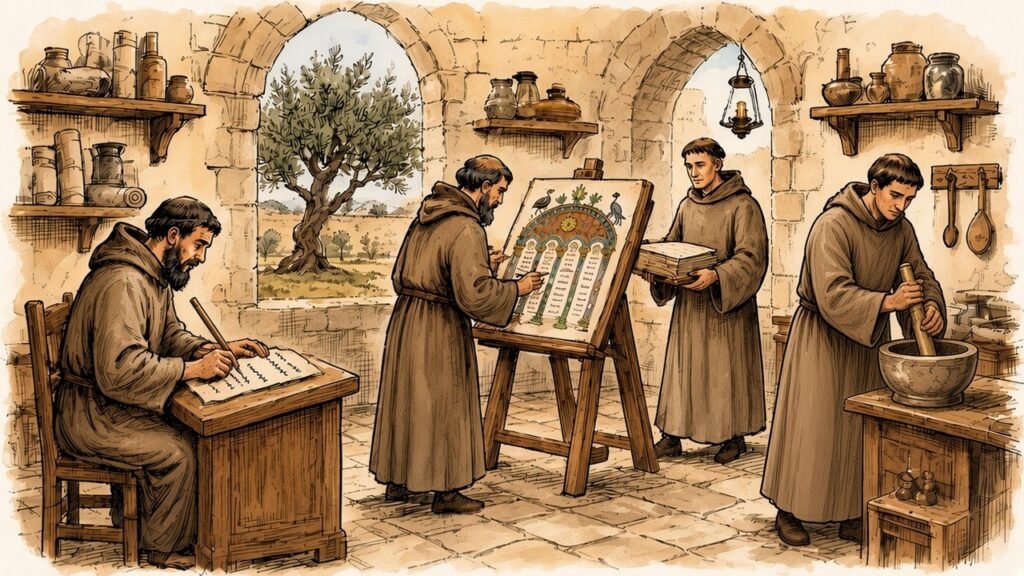
The Rabbula Gospels is a Syriac manuscript of the four Gospels completed in 586 at a monastery in northern Syria or Mesopotamia and now kept in the Biblioteca Medicea Laurenziana in Florence under the shelfmark Plut. 1.56.12 It takes its name from the scribe who wrote it, a monk named Rabbula, who recorded in a colophon the year of its completion and the place in which he worked. Its text is the Peshitta, the standard Syriac version of the Gospels, and it is one of the earliest dated manuscripts of that version.34 The Rabbula Gospels is best known, however, for its decoration. Its Eusebian canon tables are framed by painted architecture and accompanied by small scenes from the life of Christ and figures of prophets, and it contains a series of full-page miniatures, among them one of the earliest surviving depictions of the Crucifixion in a manuscript and a celebrated image of the Ascension.56 This article describes the manuscript, its colophon, its text, its decoration and its later history, and considers the debate over whether the miniatures belong to the original book.
At a glance
- Shelfmark: Florence, Biblioteca Medicea Laurenziana, Plut. 1.56.
- Date: Completed in 586 CE, according to the scribe’s colophon, dated in the Seleucid era.
- Place: The monastery of St John at Beth Zagba, probably in the Jebel Riha north of Apamea in Syria, though the site is not certain.
- Scribe: A monk named Rabbula, after whom the book is called; he is not the fifth-century bishop of Edessa of the same name.
- Text: The four Gospels in the Syriac Peshitta version, in Estrangela script.
- Decoration: Illuminated Eusebian canon tables with marginal scenes, and full-page miniatures including the Crucifixion, the Ascension and Pentecost.
- Later history: Kept in Maronite monasteries of Lebanon; in the Laurentian Library at Florence since the sixteenth century.
The Syriac Gospels
Syriac, the Aramaic dialect of Edessa in northern Mesopotamia, became from the second century onwards the literary language of a large part of the Christian population of the Near East. The Gospels were first known in Syriac in two forms, the Diatessaron, a harmony of the four Gospels attributed to Tatian, and the separate Gospels in the Old Syriac version, which survives in two manuscripts. In the fifth century these older forms were replaced by the Peshitta, a revision of the Old Syriac towards the Greek text, which became the standard version of all the Syriac-speaking churches.789
The Peshitta Old Testament, translated from Hebrew, is discussed in a separate article on this site.10 The Peshitta Gospels survive in a large number of manuscripts from the fifth and sixth centuries, many of them dated, which makes the Syriac Gospels one of the best-documented textual traditions of late antiquity. The Rabbula Gospels is among the most famous of these early dated manuscripts.1112
The colophon
At the end of the manuscript the scribe Rabbula added a colophon recording that he completed the book in the year 897 of the Seleucid era, which corresponds to 586 of the common era, at the monastery of St John of Beth Zagba. The colophon names other monks who assisted or were associated with the work. The location of Beth Zagba is not certain. It has been placed in northern Syria, in the region between Antioch and the Euphrates, or in Mesopotamia, and several sites have been proposed. In a study of 1983 Marlia Mundell Mango argued that the monastery lay in the Jebel Riha, some fifty kilometres north of Apamea in Syria, and this location is now the one most widely cited.1314151617
The scribe should not be confused with Rabbula, the bishop of Edessa from 411 to 435, an important figure in the history of the Syriac church who was once credited, probably wrongly, with the authorship of the Peshitta revision. The scribe of 586 was a monk of the same name and nothing further is known about him.1819
The monastery at Beth Zagba appears to have belonged to the communities which rejected the Council of Chalcedon of 451, often described today as Miaphysite and later organised as the Syriac Orthodox Church. The manuscript’s later history, however, connects it with the Maronite communities of Lebanon.2021
The manuscript
The Rabbula Gospels is a large codex on parchment. Its text is written in two columns in the Estrangela script, the formal Syriac script of late antiquity, which was used for biblical and liturgical manuscripts. The text is divided according to the system of sections and canons devised by Eusebius of Caesarea, and the book opens with the canon tables that give the key to this system.2223
The canon tables were invented by Eusebius in the fourth century to allow readers to find parallel passages in the four Gospels. Each Gospel was divided into numbered sections, and ten tables listed the sections that were shared by all four Gospels, by three, by two, or found in one alone. In Greek, Latin, Syriac, Armenian and other manuscripts, the canon tables were often set within painted arcades of columns and arches, and they became one of the principal fields for decoration in Gospel books.2425
The canon tables
In the Rabbula Gospels the canon tables occupy a sequence of pages. Each table is set within an architectural frame of columns and arches, painted in bright colours and decorated with patterns of foliage, birds and geometric ornament. In the margins beside the arches, the painter placed small figures and scenes. Prophets of the Old Testament stand on either side of the arcades holding scrolls, and scenes from the Gospels are set at the foot or the top of the pages. These include the Annunciation, the Nativity, the Massacre of the Innocents, the Baptism, miracles of healing, the Wedding at Cana and scenes from the Passion.262728
The pairing of prophets with Gospel scenes reflects the Christian understanding of the Old Testament as foretelling the events of the life of Christ. Carl Nordenfalk, in his study of late antique canon tables, regarded those of the Rabbula Gospels as among the most elaborate of their kind, and they have been compared with similar decorative programmes in Greek and Armenian Gospel books.29
The full-page miniatures
The manuscript opens with a quire of fourteen leaves containing the illuminations. The first three pages carry full-page miniatures: the election of Matthias to replace Judas among the apostles, as described in the Acts of the Apostles; the Virgin standing with the Christ child on her arm, of the type later known as the Hodegetria; and standing figures of Eusebius of Caesarea and Ammonius of Alexandria, the two scholars associated with the system of the canon tables. The text of Eusebius’s Letter to Carpianus follows within decorated frames, and then the canon tables themselves. After the tables come four further full-page miniatures: the Crucifixion with the women at the tomb, the Ascension, Christ enthroned and approached by four men, two of whom hold books, and Pentecost. The text of the Gospels which follows contains no further illuminations. Two of these pages carry the most celebrated images in the book.303132
The first of these shows the Crucifixion in the upper register and the women at the empty tomb in the lower. Christ is shown on the cross, wearing a long sleeveless robe known as the colobium, between the two thieves, who wear loincloths. A soldier on one side pierces Christ’s side with a lance, and another on the other side raises a sponge on a reed. The soldier with the lance is labelled with his name, Longinus. At the foot of the cross soldiers cast lots for Christ’s garments. The Virgin and John stand on one side, and the women on the other. The sun and moon appear in the sky above. The lower register shows the angel at the tomb and the risen Christ appearing to the women.3334
The Crucifixion of the Rabbula Gospels is one of the earliest surviving examples of a detailed narrative depiction of the scene in a manuscript. Representations of the Crucifixion in early Christian art before the sixth century are rare, and the Rabbula image has been central to discussions of how the scene came to be depicted.35
The second celebrated page shows the Ascension. Christ stands in a mandorla supported by angels and by a winged chariot with the four living creatures of Ezekiel’s vision. Below, the Virgin stands in the centre, flanked by apostles and angels. The composition combines the account of the Ascension in Acts with the imagery of the visions of the prophets, and it closely parallels images of the Ascension on objects from the Holy Land, such as pilgrim flasks of the sixth century. A further page shows the descent of the Holy Spirit at Pentecost.363738
Were the miniatures original?
For much of the twentieth century scholars debated whether the illuminated quire belonged to the manuscript of 586 or had been joined to it from another book. The illuminations occupy a separate gathering at the beginning, and the colophon at the end of the book, which names the scribe and those who assisted him, does not mention the paintings or name the painters. In 1973 David H. Wright, after examining the manuscript in person, concluded that the illuminations had been part of the codex from the time of its making, and his view was widely accepted.39404142
The study edited by Massimo Bernabò in 2008 reopened the question. In it Pier Giorgio Borbone and Alessandro Mengozzi drew attention to a note in Garshuni, that is, Arabic written in Syriac script, on one of the canon pages, which records a substantial donation made by two priests to the monastery of Qannubin in 1460 or 1461. The object of the gift is described as the great dast. Stefano Evodio Assemani, who first catalogued the manuscript in 1742, took the word to mean a copper vessel, but Borbone and Mengozzi argued that it meant a fascicle or quire and referred to the gathering of illuminations itself, which on this view was joined to the Gospel text only in the fifteenth century. Other contributors to the same volume, notably Marlia Mundell Mango, did not accept this interpretation, and it has not won general support. Even on Borbone and Mengozzi’s view, however, the illuminations are not late: their style and the Syriac script of their captions point to the sixth century, so that the question concerns whether the quire was made for this book or for another of the same period.4344
Later history
The Rabbula Gospels did not remain in the monastery where it was written. Notes added in its margins and blank pages over the centuries record its presence in other places. By the later Middle Ages it was in Lebanon, in the possession of the Maronite church, and was kept for a time at the monastery of Qannubin in the Qadisha valley, the seat of the Maronite patriarchs.4546
The manuscript reached Florence in the sixteenth century, and it is generally held to have come from the Maronite patriarchate in the context of the contacts between the Maronite church and Rome in that period. The precise date and circumstances of its arrival have been discussed in the Bernabò volume and elsewhere. It has been in the Laurentian Library, founded by the Medici and housed in the building designed by Michelangelo, ever since.474849
A facsimile of the miniatures, with an introduction and commentary, was published in 1959 by Carlo Cecchelli, Giuseppe Furlani and Mario Salmi. The whole manuscript can now be consulted in digital images through the Laurentian Library’s online collections.5051
Place in the history of art
The Rabbula Gospels holds a central place in the history of early Christian art. It is one of the few illuminated manuscripts of the sixth century to survive with a dated colophon, and its miniatures are among the earliest witnesses to compositions that would later become standard in Byzantine and medieval art. Kurt Weitzmann and others have used it as a key point of reference for the reconstruction of the art of the Syrian and Palestinian regions in late antiquity, a period from which very little painting survives.5253
Its relation to other illustrated books of the period has been much discussed. It has been compared with the Greek purple codices of the sixth century, the Rossano Gospels and the Sinope Gospels, and with the Latin Ashburnham Pentateuch, which is discussed in another article on this site.54 These manuscripts share a taste for narrative illustration and for vivid colour, but each has its own character, and the Rabbula Gospels is distinguished above all by the integration of its scenes into the frame of the canon tables.55
The physical book
The Rabbula Gospels is a parchment codex of 292 folios. Its leaves now measure about 336 by 266 millimetres, but they are not of their original size. Successive bookbinders trimmed the margins at the top and at both sides, so that the dimensions of the book as it left the monastery in 586 can no longer be stated exactly. The folios are numbered in modern Arabic numerals in the outer upper corner.5657
The Gospel text is written in two columns to the page. The number of lines in a column is not constant, because at the foot of many columns the scribe added notes in red ink referring to the sections and canons of the Eusebian system. Where these notes occupy several lines, the column of text above them is correspondingly shorter. The arrangement shows that the apparatus of sections and canons was planned together with the text and was not added as an afterthought.58
The illuminated quire occupies folios 1 to 14, and the Gospels themselves run from folio 20 to folio 291. The colophon stands at the end of the book. Some readings written on paper were added to the codex in a later period, and the book also carries a series of notes in Syriac, Garshuni and other scripts recording its owners and the places where it was kept.5960
The Letter to Carpianus and the canon system
The canon tables at the front of the Rabbula Gospels are the Syriac form of a system devised in the early fourth century by Eusebius of Caesarea. In a short letter to a certain Carpianus, Eusebius explained that Ammonius of Alexandria had earlier produced a work in which the parallel passages of the other three Gospels were set beside the text of Matthew. This arrangement preserved the sequence of Matthew alone and broke up the continuous text of the others. Eusebius proposed instead to leave each Gospel intact and to number its sections, and then to compile ten tables listing which sections correspond across the Gospels.6162
The first canon lists passages common to all four Gospels, the following canons passages shared by three or by two of them, and the tenth passages found in only one. A reader who came upon a section number in the margin, with its canon number beneath it, could turn to the appropriate table and find the parallel passages in the other Gospels. The system was adopted in Greek, Latin, Syriac, Armenian, Coptic and other traditions, and the decorated arcades in which the tables were set became one of the most widespread forms of book decoration in Late Antiquity and the Middle Ages.6364
The Rabbula Gospels presents the letter itself on two facing pages, written within ornamental frames, and depicts both Eusebius and Ammonius in a full-page miniature at the opening of the book. The decision to portray the two scholars shows how closely the producers of the manuscript associated the apparatus of the Gospel book with the work of its originators.65
The prophets and scenes of the canon pages
The architectural frames of the canon tables follow a common type, with columns carrying arches, but in the Rabbula Gospels they are elaborated with figures and scenes. In the upper register, beside the arches of folios 3v to 9r, stand figures from the Hebrew Bible, each with a name in Estrangela script. They include Aaron, Moses, Joshua, Samuel, David and Solomon; the prophets of the Twelve, among them Hosea, Joel, Amos, Obadiah, Jonah, Micah, Nahum, Zephaniah, Habakkuk, Haggai, Zechariah and Malachi; the major prophets Isaiah, Jeremiah, Ezekiel and Daniel; and Job and Elisha.66
Beside the outer columns, in a middle register, are small scenes from the Gospel narrative, and the lower corners are mostly filled with animals and plants. Birds and plants also appear above the arches. The pairing of figures from the Hebrew Bible above with Gospel scenes below expresses visually the conviction that the prophecies were fulfilled in the events narrated in the Gospels.6768
Some of these scenes reflect a distinctively Syriac context. The Baptism of Christ shows fire coming out of the water of the Jordan, a motif that has been compared with the hymns of Ephrem the Syrian and other Syriac writings in which the baptismal water is associated with fire. The Nativity and other scenes have likewise been read against the background of Syriac literature. These details are among the reasons why the manuscript is regarded as a product of a Syriac monastic culture and not simply as a Syriac copy of a Greek model.69
The Crucifixion and the Ascension in context
The Crucifixion page of the Rabbula Gospels shows Christ wearing a long purple tunic without sleeves, the colobium, rather than the loincloth that became usual in later art. This form of the image appears in other works of the early Byzantine and early medieval periods, and it is one of the reasons why the Rabbula Crucifixion is cited in studies of the development of the subject. In the register below, the scene of the women at the tomb shows Christ appearing to the two Marys.7071
The Ascension page has been compared with images of the same subject on the small pilgrim flasks, or ampullae, from the Holy Land, which are preserved at Monza and Bobbio in Italy and which are generally dated to about the same period. The comparison suggests that the painters drew on compositions that were in circulation in the eastern Mediterranean, some of them perhaps associated with the holy sites themselves. The Rabbula Gospels is valuable here because it is dated, while most comparable works are not.7273
Repainting and restoration
The illuminations as they now appear are not entirely as they were painted in the sixth century. A group of scholars associated with the Bernabò project has studied extensive later repainting in the miniatures. The repainting does not seem to have been a simple restoration of damaged areas. It appears instead to have altered features that seemed unusual to a later eye, bringing them closer to familiar conventions.7475
On the Crucifixion page, for example, the face of Christ was originally painted in the same type as on the dedication page and in the scene of Christ before Pilate, with curly red hair. In the scene of the women at the tomb, the angel now sits on a sarcophagus, which is a later replacement; originally he was seated on a rock, which suited the representation of the tomb as a round building with its doors open. Such findings mean that the miniatures must be studied with attention to the history of the book as an object, and not only as works of the sixth century.76
The codex was rebound after its arrival in Florence, and at least part of the repainting may date from that period, though this cannot be settled from the surface of the paintings alone. The earlier trimming of the margins, mentioned above, also belongs to the long history of handling and rebinding that the manuscript has undergone.7778
The notes of later owners
The notes added to the manuscript allow its history to be traced in outline. One relatively early note records that after the death of Romanus, a priest and visitor from Antioch, the book was given to a church of Saint George. A later note mentions the monastery of Mayfuq in Lebanon and a Maronite patriarch named Peter. A note of 1361 places the codex at Qannubin, and other notes of the fifteenth century show that it was still kept there. The Garshuni note of 1460 or 1461, discussed above in connection with the illuminated quire, belongs to this period.798081
The manuscript was thus in all likelihood written in a Syriac Orthodox environment and later passed into the possession of the Maronite church. It remained in Maronite hands for at least two centuries before its transfer to Florence. Its first full description was published in 1742 by Stefano Evodio Assemani in his catalogue of the oriental manuscripts of the Laurentian and Palatine libraries.8283
The scribe and his colleagues
The colophon, written by Rabbula in a smaller hand but in the same Estrangela script as the Gospel text, binds his dated signature securely to the book. It gives the year 586 and the place of writing, and it names others who took part in the making of the manuscript. The artists of the illuminations, however, are not named, and it is not known whether Rabbula himself had any part in the painting.8485
Nothing more is known of the scribe than what the colophon records. He is to be distinguished from Rabbula, bishop of Edessa in the early fifth century, whose name the manuscript shares only by coincidence. The modern name of the book derives from the scribe and not from the bishop.8687
Estrangela and the Syriac book
The Gospel text is written in Estrangela, the formal script of early Syriac manuscripts. In the period of the Rabbula Gospels it was the common book hand of Syriac scribes in both the eastern and western parts of the Syriac-speaking world, and the later East Syriac and West Syriac scripts developed from it. Its name is usually explained from a Greek word for rounded writing, though the derivation has been discussed. Like the other Semitic scripts, Syriac is written from right to left, and the book accordingly opens from what a reader of Greek or Latin would regard as the back.8889
The use of Estrangela for the captions of the illuminations, as well as for the text, is one of the reasons for dating the illuminated quire to the sixth century, whatever view is taken of its original connection with the Gospel text.90
The Peshitta Gospels
The text of the Rabbula Gospels is the Peshitta, the standard Syriac version of the Gospels. By the end of the sixth century the Peshitta had displaced in ordinary use both the Diatessaron, the Gospel harmony associated with Tatian, and the older separate Gospels of the Old Syriac version, which survives only in two manuscripts. The Rabbula Gospels belongs to the group of early Peshitta manuscripts that preserve the version in its settled form, and it ranks among the earliest dated manuscripts of the four Gospels in any language.9192
Its date gives it particular value. Many early Syriac manuscripts are dated by their colophons, and the Syriac tradition is for this reason unusually rich in fixed points for the history of scripts and of book production. Among illuminated Gospel books of the sixth century in any language, however, the Rabbula Gospels is exceptional in carrying a precise date and place of writing, and it has accordingly served as a point of reference for dating other works.9394
The illuminations in modern sacred art
The images of the Rabbula Gospels have not remained objects of study alone. In recent decades they have served as a source of inspiration for modern religious art, especially wall paintings in Maronite, Syriac Orthodox and Syriac Catholic churches. A study of Maronite liturgical iconography by Abdo Badwi, published in 2006, documents many examples of this use. The manuscript thus continues to shape the visual culture of the churches in whose monasteries it was made and kept.9596
The opening miniatures
The first miniature of the book illustrates the account in the first chapter of the Acts of the Apostles of how the apostles chose a successor to Judas. Two candidates were put forward, Joseph called Barsabbas and Matthias, and after prayer the apostles cast lots, and the lot fell on Matthias. The choice of this subject for the opening of a Gospel book is unusual. It has been interpreted as an image of the completion of the apostolic company and of the transmission of authority within the community, themes that suit a book produced and used in a monastery, but the reasons for its selection are not stated in the manuscript.9798
The second miniature shows the Virgin standing and holding the Christ child on her arm. The type, in which the Virgin carries the child and presents him to the viewer, is the one later associated with the famous icon called the Hodegetria at Constantinople, and the Rabbula page is one of the early dated examples of it. The third shows Eusebius and Ammonius standing, each set within an architectural frame, and leads directly to the letter in which Eusebius describes Ammonius’s work.99
The closing miniatures
After the canon tables come the four full-page miniatures already mentioned. The Crucifixion and the Ascension have been discussed above. The third of the group shows Christ enthroned, approached by four men: two of them each hold a book, and the two others follow behind and support them. The scene has been read as a presentation of books, perhaps a representation of the offering of the Gospel book itself, but the figures are not named and the identification is uncertain.100101
The last of the series is Pentecost, the descent of the Holy Spirit upon the apostles described in the second chapter of Acts. The Holy Spirit appears in the form of a dove, and tongues of fire rest upon the figures below. With the election of Matthias at the beginning and Pentecost at the end, the illuminated quire is framed by two events from the Acts of the Apostles, while the Gospel narrative itself is represented by the scenes beside the canon tables and by the Crucifixion and Ascension.102103
Significance
The Rabbula Gospels matters to several fields at once. For the history of the Syriac Bible, it is an early dated witness to the Peshitta Gospels, written with the full Eusebian apparatus and with notes for the reading of the lessons. For the history of the book, it documents the planning of a large and costly Gospel codex in a sixth-century monastery, from the layout of its columns to the arrangement of its notes. For the history of art, it is one of the very few illuminated manuscripts of its period whose date and place of writing are recorded, even if the relation of its illuminated quire to the text remains under discussion.104105
Its later history is equally instructive. The notes written in it show how a book made in a Syriac Orthodox monastery in Syria passed into Maronite hands in Lebanon, was valued and protected there for centuries, and finally reached a European library. The repainting of its miniatures and the trimming of its leaves show how such a book was altered in the course of use and care. Each of these layers is part of the evidence that the manuscript offers, and modern study, from Assemani’s catalogue of 1742 to the Bernabò volume of 2008, has gradually brought them to light.106107
What the manuscript can and cannot tell us
The study of the Rabbula Gospels shows the limits as well as the strengths of the evidence that a single manuscript provides. The colophon fixes the date and place of the Gospel text, but it does not by itself fix those of the illuminated quire. The style of the paintings and the script of their captions place them in the sixth century, but they cannot show whether the quire was made for this book or for another. The notes of later owners trace the movements of the codex, but they are brief and sometimes ambiguous, as the debate over the meaning of a single Garshuni word shows. And the paintings themselves, as they now appear, carry later interventions that must be distinguished from the original work before they can be used as evidence for the art of the sixth century.108109
For these reasons scholars have increasingly treated the manuscript as an object with a history of its own, examining its parchment, gatherings, pigments, bindings and notes alongside its text and images. This approach, exemplified by the Bernabò volume, does not resolve every question, but it makes clear which conclusions rest on the evidence of the book itself and which on comparison and inference.110
Related material on this site
The Syriac Peshitta, of which the Rabbula Gospels is a witness, is described in the article on the Peshitta and its Hebrew Vorlage, and the history of the Syriac New Testament in its own article.111112 Later Syriac biblical scholarship is represented by the articles on Jacob of Edessa and on Paul of Tella and the Syro-Hexapla.113114 Illustrated biblical manuscripts of late antiquity in the Latin West are treated in the article on the Ashburnham Pentateuch.115
Conclusion
The Rabbula Gospels, completed in 586 by a monk of that name at the monastery of St John of Beth Zagba, is both an important witness to the Syriac Peshitta and one of the most significant illuminated manuscripts of late antiquity. Its canon tables, framed in painted architecture and peopled with prophets and Gospel scenes, and its full-page miniatures, including the Crucifixion and the Ascension, record the visual culture of Syriac Christianity at a time when little else survives. Preserved by the Maronite church of Lebanon and later in the Laurentian Library at Florence, it remains a primary source for the history of both the Syriac Bible and Christian art.116117118
Notes
- Grokipedia, “Rabbula Gospels”. ↩
- Grokipedia, “Laurentian Library”. ↩
- Sebastian P. Brock, The Bible in the Syriac Tradition, 2nd ed. (Piscataway: Gorgias Press, 2006). ↩
- Grokipedia, “Peshitta”. ↩
- Carlo Cecchelli, Giuseppe Furlani and Mario Salmi, eds., The Rabbula Gospels: Facsimile Edition of the Miniatures of the Syriac Manuscript Plut. I, 56 in the Medicaean-Laurentian Library (Olten: Urs Graf, 1959). ↩
- Kurt Weitzmann, Late Antique and Early Christian Book Illumination (New York: George Braziller, 1977). ↩
- Sebastian P. Brock, The Bible in the Syriac Tradition, 2nd ed. (Piscataway: Gorgias Press, 2006). ↩
- Bruce M. Metzger, The Early Versions of the New Testament (Oxford: Clarendon Press, 1977). ↩
- See also “The Syriac New Testament” on this site. ↩
- See also “The Peshitta and Its Hebrew Vorlage” on this site. ↩
- Sebastian P. Brock, The Bible in the Syriac Tradition, 2nd ed. (Piscataway: Gorgias Press, 2006). ↩
- Grokipedia, “Peshitta”. ↩
- Marlia Mundell Mango, “Where Was Beth Zagba?” Harvard Ukrainian Studies 7 (1983): 405–430. ↩
- Sebastian P. Brock et al., eds., Gorgias Encyclopedic Dictionary of the Syriac Heritage, electronic edition, “Rabbula Gospels”. ↩
- Carlo Cecchelli, Giuseppe Furlani and Mario Salmi, eds., The Rabbula Gospels: Facsimile Edition of the Miniatures of the Syriac Manuscript Plut. I, 56 in the Medicaean-Laurentian Library (Olten: Urs Graf, 1959). ↩
- Massimo Bernabò, ed., Il Tetravangelo di Rabbula: Firenze, Biblioteca Medicea Laurenziana, Plut. 1.56. L’illustrazione del Nuovo Testamento nella Siria del VI secolo (Rome: Edizioni di Storia e Letteratura, 2008). ↩
- Jules Leroy, Les manuscrits syriaques à peintures conservés dans les bibliothèques d’Europe et d’Orient, 2 vols. (Paris: Geuthner, 1964). ↩
- Sebastian P. Brock, The Bible in the Syriac Tradition, 2nd ed. (Piscataway: Gorgias Press, 2006). ↩
- Grokipedia, “Rabbula Gospels”. ↩
- Grokipedia, “Syriac Christianity”. ↩
- Grokipedia, “Miaphysitism”. ↩
- Grokipedia, “Eusebian Canons”. ↩
- Grokipedia, “Syriac alphabet”. ↩
- Carl Nordenfalk, Die spätantiken Kanontafeln (Göteborg: Oscar Isacsons, 1938). ↩
- Grokipedia, “Eusebian Canons”. ↩
- Carlo Cecchelli, Giuseppe Furlani and Mario Salmi, eds., The Rabbula Gospels: Facsimile Edition of the Miniatures of the Syriac Manuscript Plut. I, 56 in the Medicaean-Laurentian Library (Olten: Urs Graf, 1959). ↩
- Massimo Bernabò, ed., Il Tetravangelo di Rabbula: Firenze, Biblioteca Medicea Laurenziana, Plut. 1.56. L’illustrazione del Nuovo Testamento nella Siria del VI secolo (Rome: Edizioni di Storia e Letteratura, 2008). ↩
- Carl Nordenfalk, Die spätantiken Kanontafeln (Göteborg: Oscar Isacsons, 1938). ↩
- Carl Nordenfalk, Die spätantiken Kanontafeln (Göteborg: Oscar Isacsons, 1938). ↩
- Sebastian P. Brock et al., eds., Gorgias Encyclopedic Dictionary of the Syriac Heritage, electronic edition, “Rabbula Gospels”. ↩
- Carlo Cecchelli, Giuseppe Furlani and Mario Salmi, eds., The Rabbula Gospels: Facsimile Edition of the Miniatures of the Syriac Manuscript Plut. I, 56 in the Medicaean-Laurentian Library (Olten: Urs Graf, 1959). ↩
- Kurt Weitzmann, Late Antique and Early Christian Book Illumination (New York: George Braziller, 1977). ↩
- Kurt Weitzmann, Late Antique and Early Christian Book Illumination (New York: George Braziller, 1977). ↩
- Carlo Cecchelli, Giuseppe Furlani and Mario Salmi, eds., The Rabbula Gospels: Facsimile Edition of the Miniatures of the Syriac Manuscript Plut. I, 56 in the Medicaean-Laurentian Library (Olten: Urs Graf, 1959). ↩
- Kurt Weitzmann, Late Antique and Early Christian Book Illumination (New York: George Braziller, 1977). ↩
- Grokipedia, “Ascension of Jesus”. ↩
- David H. Wright, “The Date and Arrangement of the Illustrations in the Rabbula Gospels,” Dumbarton Oaks Papers 27 (1973): 197–208. ↩
- Sebastian P. Brock et al., eds., Gorgias Encyclopedic Dictionary of the Syriac Heritage, electronic edition, “Rabbula Gospels”. ↩
- Jules Leroy, Les manuscrits syriaques à peintures conservés dans les bibliothèques d’Europe et d’Orient, 2 vols. (Paris: Geuthner, 1964). ↩
- Kurt Weitzmann, Late Antique and Early Christian Book Illumination (New York: George Braziller, 1977). ↩
- Massimo Bernabò, ed., Il Tetravangelo di Rabbula: Firenze, Biblioteca Medicea Laurenziana, Plut. 1.56. L’illustrazione del Nuovo Testamento nella Siria del VI secolo (Rome: Edizioni di Storia e Letteratura, 2008). ↩
- Sebastian P. Brock et al., eds., Gorgias Encyclopedic Dictionary of the Syriac Heritage, electronic edition, “Rabbula Gospels”. ↩
- Massimo Bernabò, ed., Il Tetravangelo di Rabbula: Firenze, Biblioteca Medicea Laurenziana, Plut. 1.56. L’illustrazione del Nuovo Testamento nella Siria del VI secolo (Rome: Edizioni di Storia e Letteratura, 2008). ↩
- Grokipedia, “Maronite Church”. ↩
- Massimo Bernabò, ed., Il Tetravangelo di Rabbula: Firenze, Biblioteca Medicea Laurenziana, Plut. 1.56. L’illustrazione del Nuovo Testamento nella Siria del VI secolo (Rome: Edizioni di Storia e Letteratura, 2008). ↩
- Sebastian P. Brock et al., eds., Gorgias Encyclopedic Dictionary of the Syriac Heritage, electronic edition, “Rabbula Gospels”. ↩
- Grokipedia, “Laurentian Library”. ↩
- Carlo Cecchelli, Giuseppe Furlani and Mario Salmi, eds., The Rabbula Gospels: Facsimile Edition of the Miniatures of the Syriac Manuscript Plut. I, 56 in the Medicaean-Laurentian Library (Olten: Urs Graf, 1959). ↩
- Biblioteca Medicea Laurenziana, Florence, digital collections (Teca Digitale), Plut. 1.56. ↩
- Kurt Weitzmann, Late Antique and Early Christian Book Illumination (New York: George Braziller, 1977). ↩
- Grokipedia, “Illuminated manuscript”. ↩
- See also “The Ashburnham Pentateuch and Early Illustrated Latin Bibles” on this site. ↩
- Kurt Weitzmann, Late Antique and Early Christian Book Illumination (New York: George Braziller, 1977). ↩
- Carlo Cecchelli, Giuseppe Furlani and Mario Salmi, eds., The Rabbula Gospels: Facsimile Edition of the Miniatures of the Syriac Manuscript Plut. I, 56 in the Medicaean-Laurentian Library (Olten: Urs Graf, 1959). ↩
- Carlo Cecchelli, Giuseppe Furlani and Mario Salmi, The Rabbula Gospels (Olten: Urs Graf, 1959), description of the manuscript. ↩
- Carlo Cecchelli, Giuseppe Furlani and Mario Salmi, The Rabbula Gospels (Olten: Urs Graf, 1959), description of the manuscript. ↩
- Sebastian P. Brock et al., eds., Gorgias Encyclopedic Dictionary of the Syriac Heritage, electronic edition, “Rabbula Gospels”. ↩
- Carlo Cecchelli, Giuseppe Furlani and Mario Salmi, eds., The Rabbula Gospels: Facsimile Edition of the Miniatures of the Syriac Manuscript Plut. I, 56 in the Medicaean-Laurentian Library (Olten: Urs Graf, 1959). ↩
- Grokipedia, “Eusebian Canons”. ↩
- Grokipedia, “Peshitta”. ↩
- Grokipedia, “Eusebian Canons”. ↩
- Grokipedia, “Peshitta”. ↩
- Sebastian P. Brock et al., eds., Gorgias Encyclopedic Dictionary of the Syriac Heritage, electronic edition, “Rabbula Gospels”. ↩
- Sebastian P. Brock et al., eds., Gorgias Encyclopedic Dictionary of the Syriac Heritage, electronic edition, “Rabbula Gospels”. ↩
- Sebastian P. Brock et al., eds., Gorgias Encyclopedic Dictionary of the Syriac Heritage, electronic edition, “Rabbula Gospels”. ↩
- Kurt Weitzmann, Late Antique and Early Christian Book Illumination (New York: George Braziller, 1977). ↩
- Sebastian P. Brock et al., eds., Gorgias Encyclopedic Dictionary of the Syriac Heritage, electronic edition, “Rabbula Gospels”. ↩
- Sebastian P. Brock et al., eds., Gorgias Encyclopedic Dictionary of the Syriac Heritage, electronic edition, “Rabbula Gospels”. ↩
- Kurt Weitzmann, Late Antique and Early Christian Book Illumination (New York: George Braziller, 1977). ↩
- Kurt Weitzmann, Late Antique and Early Christian Book Illumination (New York: George Braziller, 1977). ↩
- Jules Leroy, Les manuscrits syriaques à peintures conservés dans les bibliothèques d’Europe et d’Orient, 2 vols. (Paris: Geuthner, 1964). ↩
- National Museum of Asian Art, Smithsonian Institution, “The Rabbula Gospels,” online research essay. ↩
- Massimo Bernabò, ed., Il Tetravangelo di Rabbula: Firenze, Biblioteca Medicea Laurenziana, Plut. 1.56. L’illustrazione del Nuovo Testamento nella Siria del VI secolo (Rome: Edizioni di Storia e Letteratura, 2008). ↩
- Carlo Cecchelli, Giuseppe Furlani and Mario Salmi, The Rabbula Gospels (Olten: Urs Graf, 1959), description of the manuscript. ↩
- Carlo Cecchelli, Giuseppe Furlani and Mario Salmi, The Rabbula Gospels (Olten: Urs Graf, 1959), description of the manuscript. ↩
- Sebastian P. Brock et al., eds., Gorgias Encyclopedic Dictionary of the Syriac Heritage, electronic edition, “Rabbula Gospels”. ↩
- Massimo Bernabò, ed., Il Tetravangelo di Rabbula: Firenze, Biblioteca Medicea Laurenziana, Plut. 1.56. L’illustrazione del Nuovo Testamento nella Siria del VI secolo (Rome: Edizioni di Storia e Letteratura, 2008). ↩
- Sebastian P. Brock et al., eds., Gorgias Encyclopedic Dictionary of the Syriac Heritage, electronic edition, “Rabbula Gospels”. ↩
- Stefano Evodio Assemani, Bibliothecae Mediceae Laurentianae et Palatinae codicum manuscriptorum orientalium catalogus (Florence, 1742). ↩
- Sebastian P. Brock et al., eds., Gorgias Encyclopedic Dictionary of the Syriac Heritage, electronic edition, “Rabbula Gospels”. ↩
- Carlo Cecchelli, Giuseppe Furlani and Mario Salmi, eds., The Rabbula Gospels: Facsimile Edition of the Miniatures of the Syriac Manuscript Plut. I, 56 in the Medicaean-Laurentian Library (Olten: Urs Graf, 1959). ↩
- Carlo Cecchelli, Giuseppe Furlani and Mario Salmi, eds., The Rabbula Gospels: Facsimile Edition of the Miniatures of the Syriac Manuscript Plut. I, 56 in the Medicaean-Laurentian Library (Olten: Urs Graf, 1959). ↩
- Sebastian P. Brock et al., eds., Gorgias Encyclopedic Dictionary of the Syriac Heritage, electronic edition, “Rabbula Gospels”. ↩
- Kurt Weitzmann, Late Antique and Early Christian Book Illumination (New York: George Braziller, 1977). ↩
- Grokipedia, “Ascension of Jesus”. ↩
- Sebastian P. Brock et al., eds., Gorgias Encyclopedic Dictionary of the Syriac Heritage, electronic edition, “Rabbula Gospels”. ↩
- Sebastian P. Brock et al., eds., Gorgias Encyclopedic Dictionary of the Syriac Heritage, electronic edition, “Rabbula Gospels”. ↩
- Grokipedia, “Ascension of Jesus”. ↩
- Kurt Weitzmann, Late Antique and Early Christian Book Illumination (New York: George Braziller, 1977). ↩
- Jules Leroy, Les manuscrits syriaques à peintures conservés dans les bibliothèques d’Europe et d’Orient, 2 vols. (Paris: Geuthner, 1964). ↩
- Sebastian P. Brock et al., eds., Gorgias Encyclopedic Dictionary of the Syriac Heritage, electronic edition, “Rabbula Gospels”. ↩
- Abdo Badwi, The Liturgical Year Iconography of the Syro-Maronite Church (2006). ↩
- Kurt Weitzmann, Late Antique and Early Christian Book Illumination (New York: George Braziller, 1977). ↩
- Sebastian P. Brock et al., eds., Gorgias Encyclopedic Dictionary of the Syriac Heritage, electronic edition, “Rabbula Gospels”. ↩
- Sebastian P. Brock et al., eds., Gorgias Encyclopedic Dictionary of the Syriac Heritage, electronic edition, “Rabbula Gospels”. ↩
- Sebastian P. Brock et al., eds., Gorgias Encyclopedic Dictionary of the Syriac Heritage, electronic edition, “Rabbula Gospels”. ↩
- Kurt Weitzmann, Late Antique and Early Christian Book Illumination (New York: George Braziller, 1977). ↩
- Kurt Weitzmann, Late Antique and Early Christian Book Illumination (New York: George Braziller, 1977). ↩
- Sebastian P. Brock et al., eds., Gorgias Encyclopedic Dictionary of the Syriac Heritage, electronic edition, “Rabbula Gospels”. ↩
- Sebastian P. Brock et al., eds., Gorgias Encyclopedic Dictionary of the Syriac Heritage, electronic edition, “Rabbula Gospels”. ↩
- Massimo Bernabò, ed., Il Tetravangelo di Rabbula: Firenze, Biblioteca Medicea Laurenziana, Plut. 1.56. L’illustrazione del Nuovo Testamento nella Siria del VI secolo (Rome: Edizioni di Storia e Letteratura, 2008). ↩
- Stefano Evodio Assemani, Bibliothecae Mediceae Laurentianae et Palatinae codicum manuscriptorum orientalium catalogus (Florence, 1742). ↩
- Massimo Bernabò, ed., Il Tetravangelo di Rabbula: Firenze, Biblioteca Medicea Laurenziana, Plut. 1.56. L’illustrazione del Nuovo Testamento nella Siria del VI secolo (Rome: Edizioni di Storia e Letteratura, 2008). ↩
- Sebastian P. Brock et al., eds., Gorgias Encyclopedic Dictionary of the Syriac Heritage, electronic edition, “Rabbula Gospels”. ↩
- National Museum of Asian Art, Smithsonian Institution, “The Rabbula Gospels,” online research essay. ↩
- Massimo Bernabò, ed., Il Tetravangelo di Rabbula: Firenze, Biblioteca Medicea Laurenziana, Plut. 1.56. L’illustrazione del Nuovo Testamento nella Siria del VI secolo (Rome: Edizioni di Storia e Letteratura, 2008). ↩
- See also “The Peshitta and Its Hebrew Vorlage” on this site. ↩
- See also “The Syriac New Testament” on this site. ↩
- See also “Jacob of Edessa” on this site. ↩
- See also “Paul of Tella and the Syro-Hexapla” on this site. ↩
- See also “The Ashburnham Pentateuch and Early Illustrated Latin Bibles” on this site. ↩
- Carlo Cecchelli, Giuseppe Furlani and Mario Salmi, eds., The Rabbula Gospels: Facsimile Edition of the Miniatures of the Syriac Manuscript Plut. I, 56 in the Medicaean-Laurentian Library (Olten: Urs Graf, 1959). ↩
- Massimo Bernabò, ed., Il Tetravangelo di Rabbula: Firenze, Biblioteca Medicea Laurenziana, Plut. 1.56. L’illustrazione del Nuovo Testamento nella Siria del VI secolo (Rome: Edizioni di Storia e Letteratura, 2008). ↩
- Kurt Weitzmann, Late Antique and Early Christian Book Illumination (New York: George Braziller, 1977). ↩