

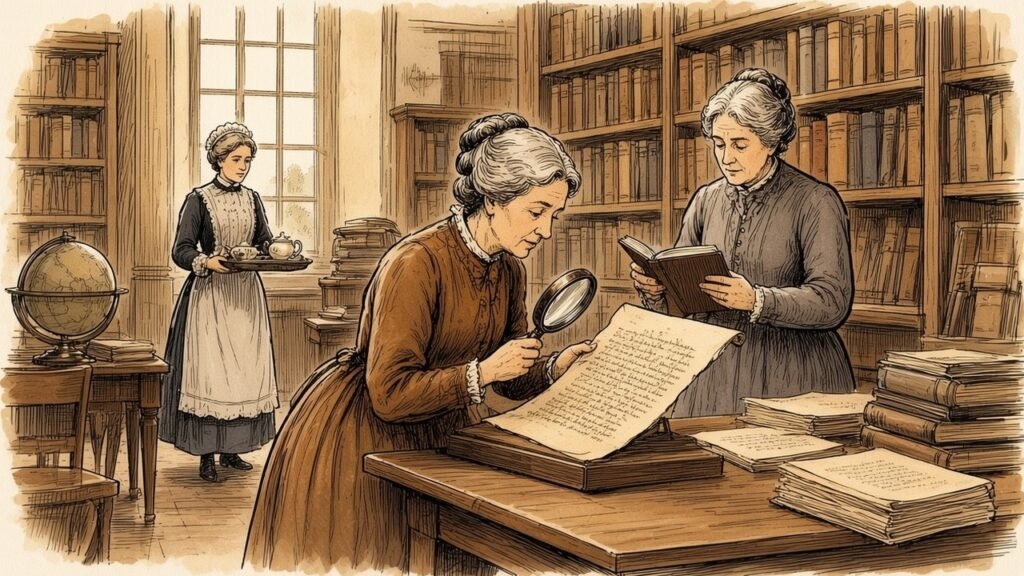
Codex Climaci Rescriptus is a palimpsest, a manuscript whose original writing was scraped away so that the parchment could be used again. Its upper and later text, written in Syriac around the ninth or tenth century, contains translations of two works by John Climacus, the seventh-century abbot of the monastery at Mount Sinai, the Ladder of Divine Ascent and the Discourse to the Shepherd. It is from Climacus that the manuscript takes its name.123 Beneath the Syriac lie several older manuscripts that were dismembered to supply the parchment. The most important of them contain portions of the Old and New Testaments in Christian Palestinian Aramaic, the dialect of the Aramaic-speaking Christians of Palestine and Transjordan, written in the sixth century. Others contain the Gospels in Greek, and in recent years multispectral imaging has revealed beneath the Syriac fragments of Greek astronomical texts, among them part of the lost star catalogue of the Hellenistic astronomer Hipparchus.45 The manuscript, divided since the late nineteenth century between Sinai and the West, illustrates both the history of a little-known biblical version and the ways in which modern technology has transformed the study of palimpsests. A companion study on this site describes the most famous of all biblical palimpsests, Codex Ephraemi Rescriptus in Paris.6
At a glance
- Type: A palimpsest: biblical and other texts of the sixth to eighth centuries scraped and overwritten in Syriac around the ninth or tenth century.
- Upper text: Syriac translations of the Ladder of Divine Ascent and the Discourse to the Shepherd by John Climacus, abbot of Sinai.
- Lower texts: Christian Palestinian Aramaic portions of the Old and New Testaments; Greek Gospel leaves (Gregory–Aland 0250); and fragments of Greek astronomical works.
- Discovery: Leaves bought in Cairo by Agnes Smith Lewis in 1895 and 1906; published by her in 1909.
- Location: Most leaves at the Museum of the Bible, Washington, since 2010 (formerly Westminster College, Cambridge); others at St Catherine’s Monastery, Sinai.
- Recent work: Multispectral imaging since the 2010s revealed new Greek texts, including in 2022 a portion of the star catalogue of Hipparchus.
- Significance: A key witness to the Bible of the Aramaic-speaking Christians of Palestine.
Palimpsests and their recovery
In late antiquity and the Middle Ages parchment was expensive, and old manuscripts that were damaged, obsolete or written in a language no longer understood were often reused. The scribe would wash or scrape the surface to remove the ink and then write a new text over it, frequently turning the leaves sideways and folding them to a new size. The earlier writing, however, was seldom removed completely. Traces of ink, or chemical changes in the parchment caused by the ink, remained beneath the new text and could sometimes be read by an attentive eye, especially under raking light.7
From the eighteenth century onwards scholars attempted to recover such lower texts, at first by applying chemical reagents that darkened the faded ink but often damaged the parchment, and later by ultraviolet photography. In the early twenty-first century multispectral imaging, in which a manuscript is photographed under light of many different wavelengths and the images are processed by computer, made it possible to recover texts that had been invisible to earlier readers. The Codex Climaci Rescriptus has been one of the beneficiaries of this development.89
The upper text
John Climacus, also known as John of the Ladder, was a monk of Sinai who became abbot of the monastery now known as St Catherine’s in the seventh century. His Ladder of Divine Ascent, a guide to the spiritual life in thirty steps, became one of the most widely read works of Eastern Christian monastic literature. It was translated into many languages, including Syriac, Arabic, Georgian, Armenian and Slavonic. The Discourse to the Shepherd, a shorter work addressed to the superior of a monastery, was often copied with it.1011
The Syriac copy of these works that forms the upper text of Codex Climaci Rescriptus was written in an Estrangela or early Serto hand, which on palaeographic grounds is dated to the ninth or tenth century. The scribe who wrote it worked with parchment drawn from at least eight earlier manuscripts, some Greek and some in Christian Palestinian Aramaic. The leaves were reused without regard to their original order, so that a single quire of the upper text may contain leaves from several different lower manuscripts.1213
The manuscript was almost certainly produced in or near the monastery of St Catherine at Sinai, where Syriac-speaking and Aramaic-speaking monks lived alongside Greek and Arabic speakers. The library of the monastery contained manuscripts in many languages, and the reuse of older books there was common. The monastery’s collection includes several other palimpsests whose lower texts are in Christian Palestinian Aramaic, Greek, Georgian and Caucasian Albanian.14
Agnes Smith Lewis and the Cambridge leaves
The modern history of the codex begins with Agnes Smith Lewis, a Scottish scholar who, with her twin sister Margaret Dunlop Gibson, made a series of journeys to Sinai and the Near East from 1892 onwards. On their first visit to St Catherine’s the sisters photographed the palimpsest now known as the Sinaitic Syriac, which contains one of the oldest copies of the Gospels in Syriac. Their discoveries made them well known, and they continued to acquire and publish manuscripts for many years.15
Between 1895 and 1906 Agnes Smith Lewis acquired, in Egypt and through a scholar in Berlin, leaves of a Syriac palimpsest whose lower text she recognised as Christian Palestinian Aramaic, which was then usually called Palestinian Syriac. The leaves had evidently been removed from Sinai at some earlier date. She studied them over several years and in 1909 published an edition of the lower biblical texts under the title Codex Climaci Rescriptus, as the eighth volume of the series Horae Semiticae. Her edition presented portions of the Gospels, Acts and the Pauline Epistles in Christian Palestinian Aramaic.1617
The leaves passed with the sisters’ other manuscripts to Westminster College, Cambridge, the Presbyterian theological college which they had supported. They remained there for a century. In 2010 the college sold them to the Green collection in the United States, and they are now held by the Museum of the Bible in Washington. Other leaves of the same Syriac manuscript remained at Sinai, where some came to light among the so-called new finds discovered in a sealed room in 1975.1819
Christian Palestinian Aramaic
Christian Palestinian Aramaic was a western Aramaic dialect used by Christian communities in Palestine, Transjordan and Sinai from about the fifth to the thirteenth century. It is closely related to Jewish Palestinian Aramaic, the language of the Jerusalem Talmud and of the Palestinian targums, and to Samaritan Aramaic. It was written in a script derived from the Syriac Estrangela, which is why it was formerly called Palestinian Syriac, although the language itself is quite distinct from Syriac.2021
The Christian Palestinian Aramaic literature consists mainly of translations from Greek, particularly of biblical texts, lectionaries and liturgical and hagiographic works. The biblical texts were translated from the Greek Septuagint and the Greek New Testament. They survive mostly in fragmentary form, and many of the most important witnesses are palimpsests in which the Christian Palestinian Aramaic text was later overwritten in Greek, Syriac, Georgian or Arabic. The communities that used the language were Melkites, Christians in communion with the church of Constantinople, and after the Arab conquests they gradually adopted Arabic.2223
The lower texts of Codex Climaci Rescriptus are among the most substantial witnesses to Christian Palestinian Aramaic. They come from several original manuscripts, including continuous texts of the Gospels, Acts and Pauline Epistles, and portions of the Old Testament. Christa Müller-Kessler and Michael Sokoloff, who re-edited the entire corpus of Christian Palestinian Aramaic texts in the 1990s, included the Codex Climaci material in their edition, correcting and supplementing Lewis’s readings.24
The Christian Palestinian Aramaic biblical texts are of interest for several reasons. They show how the Greek Bible was rendered into an Aramaic dialect closely related to the language spoken by Jesus and his first followers. They provide evidence for the Greek text of the Septuagint and the New Testament current in Palestine in the late antique period. And they preserve a vocabulary and a style of translation distinct from those of the Syriac Peshitta, the Bible of the Syriac-speaking churches further north and east.252627
The Greek lower texts
Some leaves of Codex Climaci Rescriptus contain lower texts in Greek. The most significant of these, from the biblical point of view, are leaves of a Greek Gospel manuscript in majuscule script, registered in the Gregory–Aland list of New Testament manuscripts as 0250 and generally dated to the eighth century.28
Other Greek lower texts proved to be non-biblical. In the 2010s and early 2020s, multispectral imaging of the leaves at the Museum of the Bible revealed that some contained passages from the Phaenomena of Aratus, a Hellenistic poem on the constellations, and from related astronomical writings. In 2022 Victor Gysembergh, Peter J. Williams and Emanuel Zingg published a study showing that one leaf contained a passage which they identified as a portion of the star catalogue of Hipparchus, the second-century BCE astronomer whose work had been known previously only through later sources, chiefly through the Almagest of Ptolemy. The passage gives coordinates for the stars of the constellation Corona Borealis and is the first direct evidence for the catalogue in Hipparchus’s own terms.293031
This discovery attracted wide attention and illustrated the potential of the palimpsest for disciplines far beyond biblical studies. It also showed that the Sinai monks who reused the parchment had at their disposal books of very different kinds, including works of Greek science that had otherwise been lost.32
The biblical texts in detail
Lewis’s edition of 1909 presented the Christian Palestinian Aramaic texts of the Gospels, Acts and Epistles. The Gospel portions include passages from Matthew, Mark, Luke and John. The Acts and Epistles material is especially valuable because Christian Palestinian Aramaic witnesses to these books are relatively rare. The Old Testament material includes portions of several books, which later scholars have identified and edited.3334
In its textual character the Christian Palestinian Aramaic New Testament reflects a Greek text of the type current in Palestine and the eastern Mediterranean in the sixth century. Its readings have been cited in critical editions of the Greek New Testament, though less frequently than those of the Syriac, Latin and Coptic versions, partly because the Christian Palestinian Aramaic witnesses are so fragmentary.35
Imaging and digital reunification
Because the leaves of Codex Climaci Rescriptus are divided between Washington and Sinai, the codex can only be studied as a whole through images. The Sinai Palimpsests Project, a collaboration between St Catherine’s Monastery and the Early Manuscripts Electronic Library and the University of California, Los Angeles, imaged the monastery’s palimpsests between 2011 and 2017 and made the results available to scholars. The leaves held in Washington were imaged separately. Together these images allow the codex to be reconstructed virtually and its lower texts studied more fully than ever before.3637
How the leaves were gathered
The leaves that make up Codex Climaci Rescriptus did not reach Cambridge in a single purchase. According to the account reconstructed by the team now editing the manuscript, Agnes Smith Lewis bought a single folio in Cairo in 1895. In October 1905 she received a further eighty-eight folios from a scholar in Berlin whose name she did not record, and in April 1906 she bought forty-eight more at Port Tewfik, the harbour at the southern end of the Suez Canal.3839 The leaves had evidently been taken from the monastery of St Catherine at some earlier date and dispersed through the antiquities trade, as happened to many Sinai manuscripts in the nineteenth century.
Lewis was not able to recover the whole book. A single leaf was acquired in the 1920s by Alphonse Mingana, the Iraqi-born scholar who travelled in the Middle East collecting Syriac and Arabic manuscripts for the Cadbury family, and it is now in the Mingana Collection of the University of Birmingham as Mingana Syr. 637. A further quire of eight leaves remained at Sinai. It was among the manuscripts found in 1975 in a sealed room beneath the monastery’s chapel of St George, the discovery known as the New Finds, and it is now catalogued as Sinai Syriac NF M38N.4041
When all the parts are counted, Codex Climaci Rescriptus consists of 146 leaves arranged in eighteen quires, sixteen of them quaternions of eight leaves and two of them quinions of ten. The first seventeen quires are, apart from the Birmingham leaf, in Washington, and the eighteenth is at Sinai. Two leaves from the beginning of the codex are lost.42 The manuscript is thus an example of a type of book that is familiar to students of Sinai palimpsests, in which the remains of a codex have been scattered among several collections and can only be studied as a whole with the help of photographs and catalogues.
Eleven books in one
The most striking result of recent work on the codex has been the reconstruction of the older manuscripts from which its parchment was taken. A scribe who wished to produce a new book on recycled parchment would take apart one or more old books, wash or scrape the writing from their leaves, and refold the sheets to form new quires. In the process the original order of the leaves was lost, and leaves from different books were mixed together. The present editors have concluded that the 146 leaves of Codex Climaci Rescriptus derive from eleven earlier codices. Seven of these contained texts in Christian Palestinian Aramaic and four contained texts in Greek. Of the 146 leaves, 109 have Aramaic writing beneath the Syriac, and the remainder, all in the Washington portion, have Greek undertext, though one leaf appears to have none.4344
The eleven underlying books are referred to by Roman numerals, CCR I to CCR XI, a system that allows each to be described and edited separately. They differ in date, format and contents. Some were continuous biblical manuscripts containing whole books in their canonical order, while others were selections of readings arranged for use in worship or in preaching. The Museum of the Bible’s catalogue entry notes that the biblical passages in both languages include both continuous texts and excerpts for lectionaries or homilies.45 The editors date the Aramaic manuscripts to the fifth and sixth centuries, and the Greek manuscripts are generally placed somewhat later, in the seventh or eighth century.46
Separate studies have now been devoted to individual underlying manuscripts. In 2025 Kim Phillips published, in an open-access volume, a new edition and study of two of the Aramaic manuscripts, CCR II and CCR XI, both biblical books of the early Byzantine period, prepared with the help of the multispectral images.47 The publication shows the extent to which earlier editions, made by eye, can be corrected and extended now that the erased ink can be made visible more fully.
From Cambridge to Washington
After the death of the sisters the manuscript passed, together with much of their collection, to Westminster College, Cambridge, the theological college of the Presbyterian Church of England, which the sisters had helped to found and endow. It remained there for about a century. During that time it was examined by several scholars. In the 1950s Ian Moir studied the Greek undertexts with the aid of ultraviolet and infrared light and published the first attempts at a full edition of them, and towards the end of the twentieth century Christa Müller-Kessler re-edited all the Aramaic undertexts by direct examination of the leaves, using an ultraviolet lamp. Her transcriptions, much improved over those of Lewis, were published in the first volumes of the Corpus of Christian Palestinian Aramaic, which she prepared with Michael Sokoloff.4849
In 2009 Westminster College offered the manuscript for sale at Sotheby’s in London. It did not sell at auction, but in 2010 it was bought by the Green Collection, the collection of biblical artefacts assembled by the family that owns the Hobby Lobby company, and in 2012 it was donated to the newly founded Museum of the Bible in Washington, D.C., where it bears the shelfmark MS.000149.505152 The new owners then invited a Cambridge institution to take charge of its publication.
The Tyndale House project
In 2012 the Museum of the Bible asked Tyndale House, a research library for biblical studies in Cambridge, to undertake new editions of the Greek and Aramaic undertexts, and encouraged the involvement of students in the work. Between 2012 and 2017 undergraduates worked on the multispectral images during university vacations under the direction of scholars at Tyndale House. In July 2012 one of them, Jamie Klair, then a Cambridge undergraduate, read on folio 48 a sequence of Greek words which he was able to identify, through the Thesaurus Linguae Graecae, as part of an ancient commentary on the Phaenomena of Aratus.53 This was the first indication that the Greek undertexts included astronomical material, and it led over the following years to the identification of further passages.
New spectral images were taken in March and July 2017 by the Early Manuscripts Electronic Library and the Lazarus Project of the University of Rochester. In May 2018 textual scholars and imaging scientists from these organisations and from the Rochester Institute of Technology met for a week of joint work at Tyndale House. The textual scholars indicated the places where text was suspected, and the image processors developed algorithms suited to the recovery of erased ink on particular parts of particular pages. This collaboration produced further breakthroughs in the reading of both text and drawings.54
In 2022 the results for the astronomical leaves were published in The Classical Quarterly by Peter J. Williams, Patrick James, Jamie Klair, Peter Malik and Sarah Zaman. Their article presented an initial edition of texts associated with Aratus and with Eratosthenes, the third-century BCE scholar to whom a collection of myths about the constellations was attributed. These texts extend across nine folios, numbered 47 to 54 and 64, and were the last of the groups of undertext in the codex to be deciphered. The editors refer to the book from which they came as CCR X and date its writing to the fifth or sixth century.5556 Some of the leaves preserved traces of illustrations of the constellations, which make this one of the very few surviving illustrated astronomical books of late antiquity.
The star catalogue fragment discussed above came from the same group of leaves. Its identification as Hipparchan rests on the form of the coordinates, which are expressed in a way that differs from the coordinates of Ptolemy’s later catalogue, and on the positions themselves, which correspond to the sky of the second century BCE when the slow shift of the stars known as precession is taken into account.5758 The fragment therefore offers direct evidence for a work that had been known only indirectly, and it confirms that Hipparchus compiled a catalogue with numerical coordinates, a point on which historians of astronomy had disagreed.
Reading erased writing
The methods used to read palimpsests have changed greatly since the leaves of Codex Climaci Rescriptus were first studied. In the early nineteenth century scholars who wished to recover erased writing sometimes applied chemical reagents to the parchment, which could darken the traces of the old ink for a time but often stained and damaged the leaves permanently. Several famous palimpsests, among them Codex Ephraemi Rescriptus in Paris, still bear the marks of such treatment.59 Later scholars relied instead on daylight, magnifying glasses and, from the twentieth century, ultraviolet lamps, under which the residues of iron-gall ink can show more clearly against the parchment. Lewis worked largely by eye, and Moir and Müller-Kessler used ultraviolet light.60
Multispectral imaging takes this principle much further. The leaf is photographed many times under narrow bands of light, from the ultraviolet through the visible spectrum to the infrared, and sometimes with light falling at a low angle or passing through the parchment from behind. Because the erased ink, the later ink and the parchment respond differently to each band, the separate images can be combined by statistical processing to produce pictures in which the erased writing stands out from the upper text. The method does not restore what has been lost, and in places the lower writing remains illegible, but it has allowed texts to be read which could not be seen at all by earlier methods. The astronomical leaves of Codex Climaci Rescriptus are a clear example, since they resisted decipherment until the images of 2017 and their processing in 2018.6162
Multispectral images also have a practical advantage for a dispersed manuscript. Once the leaves in Washington, Birmingham and Sinai have been imaged to comparable standards, the editors can work from the images without moving or handling the leaves themselves, and the original order of each underlying book can be reconstructed by matching the lines, columns and ruling of the erased writing across leaves now held in different places.63
Why the parchment was reused
The history of Codex Climaci Rescriptus illustrates the economy of the book at Sinai. Parchment was costly, and a monastery in a remote desert could not easily obtain new skins. Old books that had fallen out of use were therefore a valuable source of writing material. By the ninth or tenth century the Aramaic-speaking Christian communities of Palestine had largely adopted Arabic and, for worship, Greek or Syriac, and manuscripts written in their dialect were no longer read. Greek manuscripts of classical astronomy and of the Gospels in an older format were likewise expendable. The Syriac-speaking monks who copied the works of John Climacus needed parchment, and the old books provided it.64
Sinai holds an unusually large number of palimpsests, because its library was never destroyed and because its monks drew on a mixed collection of books in many languages. The Sinai Palimpsests Project, which imaged the monastery’s palimpsests, has revealed lower texts in Greek, Latin, Syriac, Christian Palestinian Aramaic, Georgian, Armenian, Arabic and Caucasian Albanian, among others. Codex Climaci Rescriptus belongs to the same world, even though most of its leaves left the monastery more than a century ago.65
The works of John Climacus in Syriac
The upper text that gives the manuscript its name is itself a document of the spiritual culture of Sinai. John Climacus was abbot of the monastery at Sinai in the seventh century, and his Ladder of Divine Ascent, a guide to the monastic life arranged in thirty steps, became one of the most widely read works of Eastern Christian spirituality. It was copied in Greek in very large numbers and translated into Syriac, Arabic, Georgian, Slavonic and other languages. A shorter work, the Discourse to the Shepherd, addressed to the abbot of another monastery, was often copied with it.66
That a Syriac translation of these works should have been copied at or near Sinai on recycled parchment reflects the presence of Syriac-speaking monks among the multilingual community of the monastery. The editors place the copying of the Syriac upper text in the ninth or tenth century.6768 By then the Christian Palestinian Aramaic books which supplied much of its parchment were no longer in use. The choice of these books for reuse does not imply hostility to their contents, but rather that the language in which they were written had ceased to be read by the monks of the time.
The Aramaic Bible of the Melkites
The Christian Palestinian Aramaic version was the Bible of a community whose existence is known chiefly through its manuscripts. Its members were Christians of the Chalcedonian tradition, later called Melkites, living in Palestine and Transjordan. They used Greek as the language of the imperial church but translated Scripture and liturgical texts into their own Western Aramaic dialect, which they wrote in a form of the Syriac script. The version was made from Greek, not from Hebrew or Syriac, and its Old Testament books therefore follow the Septuagint.697071
The surviving evidence falls into two groups. The earlier consists of fragments, nearly all of them palimpsests, from the fifth to the eighth centuries, which include continuous biblical manuscripts as well as lectionaries. The later consists of a small number of complete lectionaries and liturgical books from the eleventh to the thirteenth centuries, by which time the dialect was probably no longer spoken and was maintained only in worship. The best known of these is the Gospel lectionary in the Vatican Library, Vat. sir. 19, copied in 1030, which was the first Christian Palestinian Aramaic book to be published in the nineteenth century. Agnes Smith Lewis and Margaret Dunlop Gibson themselves published in 1899 an edition of the Palestinian Syriac Gospel lectionary based on manuscripts at Sinai.7273
Within this small corpus Codex Climaci Rescriptus is of exceptional importance, because its Aramaic leaves belong to the earlier period and include continuous texts. They preserve portions of the Old Testament, the Gospels, Acts and the Epistles, which allow the version to be studied apart from the lectionary system. For the New Testament the version is a witness to the Greek text current in Palestine in late antiquity, and its readings are cited, with those of the other versions, in the critical apparatus of editions of the Greek New Testament.7475
A companion palimpsest
Codex Climaci Rescriptus invites comparison with the most famous palimpsest associated with the same two scholars. In 1892, on their first visit to St Catherine’s, Agnes Smith Lewis and Margaret Dunlop Gibson photographed a Syriac manuscript whose upper text contained lives of women saints and whose lower text proved to be the Gospels in the Old Syriac version, the translation that preceded the Peshitta. The upper writing carries a colophon dated to the year 1090 of the Seleucid era, corresponding to 778 or 779 of the common era. The manuscript, known as the Sinaitic Syriac or Syriacus Sinaiticus, remains at Sinai, and it is one of the two surviving witnesses to the separate Old Syriac Gospels.7677
The two palimpsests illustrate the same processes at work. In each case a biblical book in a version that had passed out of use was dismantled to supply parchment for a later book of devotional literature in Syriac, and in each case the lower text has proved more significant for modern scholarship than the upper. The difference is that the Sinaitic Syriac is a single underlying manuscript, while Codex Climaci Rescriptus combines the remains of eleven. The discovery of the Sinaitic Syriac made the reputation of the sisters as scholars, and it was in the years that followed that Lewis began to acquire and study the leaves which became Codex Climaci Rescriptus.78
Significance for textual criticism
For the biblical text the importance of Codex Climaci Rescriptus lies in three areas. First, it preserves early evidence of the Christian Palestinian Aramaic version, which is otherwise known mainly from fragments and later lectionaries. Second, its Greek Gospel leaves, registered as 0250, add a further majuscule witness to the Greek Gospels. Third, its Aramaic Old Testament leaves provide evidence for the Greek Old Testament used in the churches of Palestine, since the translation was made from that Greek text.7980
Like any versional evidence, the Aramaic readings must be used with care. A translation cannot reproduce every feature of its source, and differences of language mean that many Greek variants cannot be detected through Aramaic at all. But where the translators rendered a word or phrase that is otherwise attested only in some Greek manuscripts, their testimony shows that the reading was current in Palestine at the date of the translation. The new editions made with multispectral images make it possible to cite such readings with a confidence that was not possible when the leaves could only be read by eye.81
Aratus and the star catalogue tradition
The Phaenomena of Aratus of Soli, composed in the third century BCE, is a didactic poem in Greek hexameters describing the constellations and the signs of the weather. It was among the most widely read poems of antiquity, was translated into Latin more than once, and attracted a substantial body of commentary. The Catasterisms, a work transmitted under the name of Eratosthenes, gathers the myths explaining how figures and objects were placed among the stars and lists the stars belonging to each constellation.8283
Illustrated copies of these texts formed part of a long tradition in which each constellation was shown as a figure with its stars marked. The leaves recovered from Codex Climaci Rescriptus belong to that tradition in an early form. Their value lies not only in the text they preserve but in the evidence they give for how astronomical knowledge was presented in the books of Late Antiquity, before the better-known illustrated manuscripts of the Carolingian and Byzantine periods. That such material was erased and overwritten with Syriac monastic literature at Sinai shows how varied the books were whose parchment the monastery’s scribes reused.8485
Related material on this site
The most famous biblical palimpsest, Codex Ephraemi Rescriptus, in which a Greek Bible of the fifth century was overwritten in the twelfth century with Greek translations of treatises by Ephrem the Syrian, is described in a study on the static pages of this site.86 Sinai’s best-known manuscript, the Codex Sinaiticus, is also the subject of a study.87 The Syriac New Testament and the Peshitta, the Bibles of the Syriac-speaking churches, are discussed in separate articles.8889
Conclusion
Codex Climaci Rescriptus, a Syriac manuscript of the ninth or tenth century containing works of John Climacus, conceals beneath its text portions of several older manuscripts, the most important of which preserve the Bible in Christian Palestinian Aramaic. Recovered and published by Agnes Smith Lewis in 1909, and now studied with the help of multispectral imaging, the palimpsest has yielded not only biblical texts in a little-known Aramaic dialect but also a lost portion of Hipparchus’s star catalogue. It stands as an example of how a single reused manuscript can preserve the traces of several vanished books and of the communities that read them.909192
Notes
- Agnes Smith Lewis, Codex Climaci Rescriptus: Fragments of Sixth Century Palestinian Syriac Texts of the Gospels, of the Acts of the Apostles and of St. Paul’s Epistles, Horae Semiticae 8 (Cambridge: Cambridge University Press, 1909). ↩
- Grokipedia, “Palimpsest”. ↩
- Grokipedia, “John Climacus”. ↩
- Christa Müller-Kessler and Michael Sokoloff, A Corpus of Christian Palestinian Aramaic, vols. 1–5 (Groningen: Styx, 1996–1999). ↩
- Victor Gysembergh, Peter J. Williams and Emanuel Zingg, “New Evidence for Hipparchus’ Star Catalogue Revealed by Multispectral Imaging,” Journal for the History of Astronomy 53, no. 4 (2022): 383–393, doi:10.1177/00218286221128289. ↩
- See also the study “Codex Ephraemi Rescriptus” on this site. ↩
- Grokipedia, “Palimpsest”. ↩
- Victor Gysembergh, Peter J. Williams and Emanuel Zingg, “New Evidence for Hipparchus’ Star Catalogue Revealed by Multispectral Imaging,” Journal for the History of Astronomy 53, no. 4 (2022): 383–393, doi:10.1177/00218286221128289. ↩
- Grokipedia, “Palimpsest”. ↩
- Grokipedia, “John Climacus”. ↩
- Grokipedia, “Saint Catherine’s Monastery”. ↩
- Agnes Smith Lewis, Codex Climaci Rescriptus: Fragments of Sixth Century Palestinian Syriac Texts of the Gospels, of the Acts of the Apostles and of St. Paul’s Epistles, Horae Semiticae 8 (Cambridge: Cambridge University Press, 1909). ↩
- Christa Müller-Kessler and Michael Sokoloff, A Corpus of Christian Palestinian Aramaic, vols. 1–5 (Groningen: Styx, 1996–1999). ↩
- Grokipedia, “Saint Catherine’s Monastery”. ↩
- Janet Soskice, Sisters of Sinai: How Two Lady Adventurers Found the Hidden Gospels (London: Chatto & Windus, 2009). ↩
- Agnes Smith Lewis, Codex Climaci Rescriptus: Fragments of Sixth Century Palestinian Syriac Texts of the Gospels, of the Acts of the Apostles and of St. Paul’s Epistles, Horae Semiticae 8 (Cambridge: Cambridge University Press, 1909). ↩
- Janet Soskice, Sisters of Sinai: How Two Lady Adventurers Found the Hidden Gospels (London: Chatto & Windus, 2009). ↩
- Museum of the Bible, Washington, D.C., museumofthebible.org, which holds the leaves formerly at Westminster College, Cambridge. ↩
- Grokipedia, “Museum of the Bible”. ↩
- Christa Müller-Kessler, Grammatik des Christlich-Palästinisch-Aramäischen (Hildesheim: Olms, 1991). ↩
- Grokipedia, “Christian Palestinian Aramaic”. ↩
- Christa Müller-Kessler, Grammatik des Christlich-Palästinisch-Aramäischen (Hildesheim: Olms, 1991). ↩
- Bruce M. Metzger, The Early Versions of the New Testament (Oxford: Clarendon Press, 1977), chapter on the Palestinian Syriac version. ↩
- Christa Müller-Kessler and Michael Sokoloff, A Corpus of Christian Palestinian Aramaic, vols. 1–5 (Groningen: Styx, 1996–1999). ↩
- Bruce M. Metzger, The Early Versions of the New Testament (Oxford: Clarendon Press, 1977), chapter on the Palestinian Syriac version. ↩
- See also “The Syriac New Testament” on this site. ↩
- See also “The Peshitta and Its Hebrew Vorlage” on this site. ↩
- Kurt Aland et al., Kurzgefasste Liste der griechischen Handschriften des Neuen Testaments, 2nd ed. (Berlin: De Gruyter, 1994), entry for 0250. ↩
- Victor Gysembergh, Peter J. Williams and Emanuel Zingg, “New Evidence for Hipparchus’ Star Catalogue Revealed by Multispectral Imaging,” Journal for the History of Astronomy 53, no. 4 (2022): 383–393, doi:10.1177/00218286221128289. ↩
- Grokipedia, “Hipparchus”. ↩
- Grokipedia, “Star catalogue”. ↩
- Victor Gysembergh, Peter J. Williams and Emanuel Zingg, “New Evidence for Hipparchus’ Star Catalogue Revealed by Multispectral Imaging,” Journal for the History of Astronomy 53, no. 4 (2022): 383–393, doi:10.1177/00218286221128289. ↩
- Agnes Smith Lewis, Codex Climaci Rescriptus: Fragments of Sixth Century Palestinian Syriac Texts of the Gospels, of the Acts of the Apostles and of St. Paul’s Epistles, Horae Semiticae 8 (Cambridge: Cambridge University Press, 1909). ↩
- Christa Müller-Kessler and Michael Sokoloff, A Corpus of Christian Palestinian Aramaic, vols. 1–5 (Groningen: Styx, 1996–1999). ↩
- Bruce M. Metzger, The Early Versions of the New Testament (Oxford: Clarendon Press, 1977), chapter on the Palestinian Syriac version. ↩
- Victor Gysembergh, Peter J. Williams and Emanuel Zingg, “New Evidence for Hipparchus’ Star Catalogue Revealed by Multispectral Imaging,” Journal for the History of Astronomy 53, no. 4 (2022): 383–393, doi:10.1177/00218286221128289. ↩
- Grokipedia, “Saint Catherine’s Monastery”. ↩
- Peter J. Williams, Patrick James, Jamie Klair, Peter Malik and Sarah Zaman, “Newly Discovered Illustrated Texts of Aratus and Eratosthenes within Codex Climaci Rescriptus,” The Classical Quarterly 72.2 (2022): 504–531, doi:10.1017/s0009838822000726. ↩
- Kim Phillips, Two Early Byzantine Bible Manuscripts in Christian Palestinian Aramaic: Codex Climaci Rescriptus II & XI (Cambridge: Open Book Publishers, 2025), doi:10.11647/obp.0455. ↩
- Kim Phillips, Two Early Byzantine Bible Manuscripts in Christian Palestinian Aramaic: Codex Climaci Rescriptus II & XI (Cambridge: Open Book Publishers, 2025), doi:10.11647/obp.0455. ↩
- Grokipedia, “Saint Catherine’s Monastery”. ↩
- Kim Phillips, Two Early Byzantine Bible Manuscripts in Christian Palestinian Aramaic: Codex Climaci Rescriptus II & XI (Cambridge: Open Book Publishers, 2025), doi:10.11647/obp.0455. ↩
- Kim Phillips, Two Early Byzantine Bible Manuscripts in Christian Palestinian Aramaic: Codex Climaci Rescriptus II & XI (Cambridge: Open Book Publishers, 2025), doi:10.11647/obp.0455. ↩
- Peter J. Williams, Patrick James, Jamie Klair, Peter Malik and Sarah Zaman, “Newly Discovered Illustrated Texts of Aratus and Eratosthenes within Codex Climaci Rescriptus,” The Classical Quarterly 72.2 (2022): 504–531, doi:10.1017/s0009838822000726. ↩
- Museum of the Bible, collection record for Codex Climaci Rescriptus. ↩
- Museum of the Bible, collection record for Codex Climaci Rescriptus. ↩
- Kim Phillips, Two Early Byzantine Bible Manuscripts in Christian Palestinian Aramaic: Codex Climaci Rescriptus II & XI (Cambridge: Open Book Publishers, 2025), doi:10.11647/obp.0455. ↩
- Kim Phillips, Two Early Byzantine Bible Manuscripts in Christian Palestinian Aramaic: Codex Climaci Rescriptus II & XI (Cambridge: Open Book Publishers, 2025), doi:10.11647/obp.0455. ↩
- Christa Müller-Kessler and Michael Sokoloff, A Corpus of Christian Palestinian Aramaic, vols. 1–5 (Groningen: Styx, 1996–1999). ↩
- Peter J. Williams, Patrick James, Jamie Klair, Peter Malik and Sarah Zaman, “Newly Discovered Illustrated Texts of Aratus and Eratosthenes within Codex Climaci Rescriptus,” The Classical Quarterly 72.2 (2022): 504–531, doi:10.1017/s0009838822000726. ↩
- Museum of the Bible, collection record for Codex Climaci Rescriptus. ↩
- Grokipedia, “Museum of the Bible”. ↩
- Peter J. Williams, Patrick James, Jamie Klair, Peter Malik and Sarah Zaman, “Newly Discovered Illustrated Texts of Aratus and Eratosthenes within Codex Climaci Rescriptus,” The Classical Quarterly 72.2 (2022): 504–531, doi:10.1017/s0009838822000726. ↩
- Peter J. Williams, Patrick James, Jamie Klair, Peter Malik and Sarah Zaman, “Newly Discovered Illustrated Texts of Aratus and Eratosthenes within Codex Climaci Rescriptus,” The Classical Quarterly 72.2 (2022): 504–531, doi:10.1017/s0009838822000726. ↩
- Peter J. Williams, Patrick James, Jamie Klair, Peter Malik and Sarah Zaman, “Newly Discovered Illustrated Texts of Aratus and Eratosthenes within Codex Climaci Rescriptus,” The Classical Quarterly 72.2 (2022): 504–531, doi:10.1017/s0009838822000726. ↩
- Grokipedia, “Hipparchus”. ↩
- Victor Gysembergh, Peter J. Williams and Emanuel Zingg, “New Evidence for Hipparchus’ Star Catalogue Revealed by Multispectral Imaging,” Journal for the History of Astronomy 53, no. 4 (2022): 383–393, doi:10.1177/00218286221128289. ↩
- Grokipedia, “Star catalogue”. ↩
- See also the study “Codex Ephraemi Rescriptus” on this site. ↩
- Kim Phillips, Two Early Byzantine Bible Manuscripts in Christian Palestinian Aramaic: Codex Climaci Rescriptus II & XI (Cambridge: Open Book Publishers, 2025), doi:10.11647/obp.0455. ↩
- Peter J. Williams, Patrick James, Jamie Klair, Peter Malik and Sarah Zaman, “Newly Discovered Illustrated Texts of Aratus and Eratosthenes within Codex Climaci Rescriptus,” The Classical Quarterly 72.2 (2022): 504–531, doi:10.1017/s0009838822000726. ↩
- Sinai Palimpsests Project, St Catherine’s Monastery, EMEL and UCLA Library. ↩
- Kim Phillips, Two Early Byzantine Bible Manuscripts in Christian Palestinian Aramaic: Codex Climaci Rescriptus II & XI (Cambridge: Open Book Publishers, 2025), doi:10.11647/obp.0455. ↩
- Grokipedia, “Palimpsest”. ↩
- Sinai Palimpsests Project, St Catherine’s Monastery, EMEL and UCLA Library. ↩
- Grokipedia, “John Climacus”. ↩
- Kim Phillips, Two Early Byzantine Bible Manuscripts in Christian Palestinian Aramaic: Codex Climaci Rescriptus II & XI (Cambridge: Open Book Publishers, 2025), doi:10.11647/obp.0455. ↩
- Museum of the Bible, collection record for Codex Climaci Rescriptus. ↩
- Grokipedia, “Christian Palestinian Aramaic”. ↩
- Bruce M. Metzger, The Early Versions of the New Testament (Oxford: Clarendon Press, 1977), chapter on the Palestinian Syriac version. ↩
- Christa Müller-Kessler, Grammatik des Christlich-Palästinisch-Aramäischen (Hildesheim: Olms, 1991). ↩
- Bruce M. Metzger, The Early Versions of the New Testament (Oxford: Clarendon Press, 1977), chapter on the Palestinian Syriac version. ↩
- Janet Soskice, Sisters of Sinai: How Two Lady Adventurers Found the Hidden Gospels (London: Chatto & Windus, 2009). ↩
- Bruce M. Metzger, The Early Versions of the New Testament (Oxford: Clarendon Press, 1977), chapter on the Palestinian Syriac version. ↩
- Kurt Aland et al., Kurzgefasste Liste der griechischen Handschriften des Neuen Testaments, 2nd ed. (Berlin: De Gruyter, 1994), entry for 0250. ↩
- Janet Soskice, Sisters of Sinai: How Two Lady Adventurers Found the Hidden Gospels (London: Chatto & Windus, 2009). ↩
- See also “The Syriac New Testament” on this site. ↩
- Janet Soskice, Sisters of Sinai: How Two Lady Adventurers Found the Hidden Gospels (London: Chatto & Windus, 2009). ↩
- Kurt Aland et al., Kurzgefasste Liste der griechischen Handschriften des Neuen Testaments, 2nd ed. (Berlin: De Gruyter, 1994), entry for 0250. ↩
- Bruce M. Metzger, The Early Versions of the New Testament (Oxford: Clarendon Press, 1977), chapter on the Palestinian Syriac version. ↩
- Kim Phillips, Two Early Byzantine Bible Manuscripts in Christian Palestinian Aramaic: Codex Climaci Rescriptus II & XI (Cambridge: Open Book Publishers, 2025), doi:10.11647/obp.0455. ↩
- Peter J. Williams, Patrick James, Jamie Klair, Peter Malik and Sarah Zaman, “Newly Discovered Illustrated Texts of Aratus and Eratosthenes within Codex Climaci Rescriptus,” The Classical Quarterly 72.2 (2022): 504–531, doi:10.1017/s0009838822000726. ↩
- Grokipedia, “Hipparchus”. ↩
- Peter J. Williams, Patrick James, Jamie Klair, Peter Malik and Sarah Zaman, “Newly Discovered Illustrated Texts of Aratus and Eratosthenes within Codex Climaci Rescriptus,” The Classical Quarterly 72.2 (2022): 504–531, doi:10.1017/s0009838822000726. ↩
- Christa Müller-Kessler and Michael Sokoloff, A Corpus of Christian Palestinian Aramaic, vols. 1–5 (Groningen: Styx, 1996–1999). ↩
- See also the study “Codex Ephraemi Rescriptus” on this site. ↩
- See also “Codex Sinaiticus” on this site. ↩
- See also “The Syriac New Testament” on this site. ↩
- See also “The Peshitta and Its Hebrew Vorlage” on this site. ↩
- Agnes Smith Lewis, Codex Climaci Rescriptus: Fragments of Sixth Century Palestinian Syriac Texts of the Gospels, of the Acts of the Apostles and of St. Paul’s Epistles, Horae Semiticae 8 (Cambridge: Cambridge University Press, 1909). ↩
- Christa Müller-Kessler and Michael Sokoloff, A Corpus of Christian Palestinian Aramaic, vols. 1–5 (Groningen: Styx, 1996–1999). ↩
- Victor Gysembergh, Peter J. Williams and Emanuel Zingg, “New Evidence for Hipparchus’ Star Catalogue Revealed by Multispectral Imaging,” Journal for the History of Astronomy 53, no. 4 (2022): 383–393, doi:10.1177/00218286221128289. ↩