

Codex Sinaiticus is, in the modern inventory of biblical manuscripts, one of the four corner-stones of Greek New Testament textual criticism. Together with Codex Vaticanus, Codex Alexandrinus, and Codex Ephraemi Rescriptus, it supplies the textual critic with the oldest near-complete witness to the Christian Bible in its original language, and it sits at the head of the textual tradition that the 19th and 20th centuries identified as the most reliable textual line for the New Testament text. The manuscript also stands at the head of the Septuagint tradition for substantial portions of the Old Testament, and it is the only one of the four great codices to come out of a working Christian community rather than out of an imperial or monastic library in the main currents of late-antique Mediterranean culture.
The manuscript is a quarto codex of roughly 730 leaves, originally written on the best vellum of the 4th century. It contains, in its surviving form, the full text of the Septuagint in roughly the order Genesis through 2 Chronicles (with substantial lacunae in Genesis 23-24, in 1 Samuel, and in 2 Samuel at the beginning), most of the poetical and prophetic books (with notable loss in the Psalter and major loss in the prophets), the New Testament in full, the Epistle of Barnabas in full, and substantially all of the Shepherd of Hermas. The original codex was, on the binding and the page-count evidence of the surviving leaves, a single coherent manuscript written by at least four scribes within a relatively short period. The four scribes made consistent use of a system of column-numerals that permits the textual critic to identify each scribe’s contribution to the manuscript and to compare them with each other in the textual decisions that each made.
The history of the manuscript from the 4th century to its rediscovery in the 19th is, in many respects, the history of the Christian monastic community of the Sinai Peninsula and of the political vicissitudes of the eastern Mediterranean world. The manuscript was, on the best evidence, produced in a scriptorium associated either with Caesarea or with the Sinai community itself, and it was, on the textual evidence, in continuous liturgical use within the Sinai monastic community from the 4th century through the 9th or 10th century at the latest. By the 11th or 12th century it had, on the codicological evidence of its preservation condition, been moved out of liturgical use and into a storage location inside the monastery of Saint Catherine at the foot of Mount Sinai. It was there, in a record-room of the monastery, that a 19th-century German biblical scholar named Konstantin von Tischendorf found it in 1844, and from that finding the long, contested, and ultimately successful effort to bring the manuscript into the modern world of biblical scholarship began.
The essay traces the Codex Sinaiticus through five threads. The first is the scriptorium story: who wrote it, when, where, and under what commission. The second is the textual-history story: how the manuscript relates to the other great codices, what it tells us about the state of the text in the 4th century, and what role it has played in the textual criticism that culminated in the Nestle-Aland and the United Bible Societies text-editions of the New Testament. The third is the discovery story: the three Tischendorf visits of 1844, 1853, and 1859, the Greek rebellion at the monastery, and the eventual transfer of the manuscript to the Russian Imperial Library. The fourth is the Soviet-Anglo transfer story: how the manuscript moved from Saint Petersburg to London in 1933, and what that transfer did to the codicological and curatorial history of the manuscript. The fifth is the modern-digital story: how the British Library, the Leipzig University Library, Saint Catherine’s Monastery, and the National Library of Russia joined in a 2008 reunification project that brought together all of the surviving leaves and fragments of the manuscript into a single digitized corpus that is now freely available to researchers and to the public.
The scriptorium and the scribes of Sinaiticus
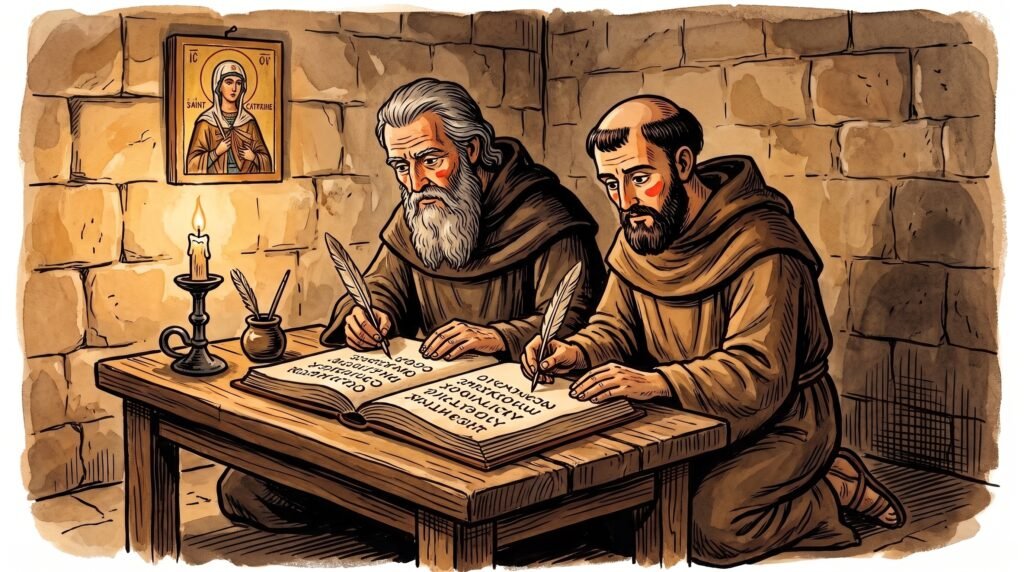
The scribes of Codex Sinaiticus are, on the codicological evidence, four in number, and they worked in a single scriptorium within a relatively short time-span. The principal scribe, conventionally designated as scribe A, wrote the bulk of the manuscript and is identified on paleographic grounds as a senior hand in the great uncial tradition of the 4th century. The principal scribe’s hand is, in the descriptive system of the early-2010s Sinaiticus Project, the model against which the other three scribes were calibrated, and it is the scribe whose training and whose textual decisions dominate the textual profile of the manuscript. The second scribe, scribe B, is responsible for substantially the whole of the Psalter and for portions of the New Testament: the four Gospels, the Acts of the Apostles, and substantially all of the Catholic Epistles. The third scribe, scribe C, worked on a small but distinct block of leaves in the New Testament. The fourth scribe, scribe D, worked on a single substantial block of leaves in the Prophets. The distribution of the work across the four hands is, on the codicological evidence, broadly even: each of the four scribes contributed a significant portion of the surviving manuscript.
The scriptorium’s location is, on the textual and codicological evidence, most plausibly Caesarea. The strongest evidence is the presence, on the manuscript, of a substantial number of corrections that match text-types attested in the Caesarean tradition that Origen’s library at Caesarea Maritima is best known for. The Caesarean evidence is, on the analysis of the Sinaiticus Project’s editors, particularly clear in the Gospel of John, where the manuscript’s readings cluster with the Caesarean witnesses rather than with the Alexandrian or the Western witnesses. The Caesarean attribution is not unanimous in modern scholarship, and the alternative attribution that the manuscript was produced in the Egyptian tradition, principally at Alexandria, has substantial support. The principal counter-evidence to the Caesarean attribution is, however, the manuscript’s striking textual agreement with Codex Vaticanus, which is, on the well-established textual evidence, an Alexandrian witness. The argument from this latter evidence is that the manuscript was produced at the same scriptorium as Vaticanus, and the standard date and place for that scriptorium is mid-4th-century Caesarea or Alexandria.
The date of the manuscript is, on the paleographic evidence, set by the second quarter of the 4th century. The principal evidence is the form of the letters: the Biblical uncials of the 4th century show a distinct progressive development of letter forms away from the older 3rd-century forms, and Sinaiticus is, on the comparison with dated papyri of the 4th century, a clear stage within the mid-4th-century uncial tradition. The 4th-century date is, on the textual evidence, also the most natural: the manuscript’s text is, on the standard critical apparatus, a representation of the 4th-century state of the manuscript tradition, with all of the principal textual streams of the 2nd and 3rd centuries already partly conflated.
Sinaiticus in New Testament textual criticism
The role of Codex Sinaiticus in the textual criticism of the New Testament is, in modern scholarship, principal and in some respects dominant. The manuscript sits, in the standard critical apparatus of the Nestle-Aland Novum Testamentum Graece and of the United Bible Societies Greek New Testament, at the head of the textual tradition that supports what the 19th-century textual critics labelled the Alexandrian text-type. The Alexandrian text-type is, in the 19th- and 20th-century classifications, the older, shorter, and, on a substantial portion of the textual variation, the more reliable text-type for the New Testament. Sinaiticus’s principal rival in the representation of the Alexandrian text-type is Codex Vaticanus, and the agreement between the two manuscripts on a substantial fraction of the text is the principal basis for the claim that the Alexandrian text-type is a real and identifiable textual stream.
The Sinaiticus text differs from Vaticanus in a number of important places, however, and these differences have been the focus of substantial modern editorial work. The most famous of the differences is the pericope adulterae, the story of the woman caught in adultery that appears in the Gospel of John after John 7:52 in the majority of Greek manuscripts. The pericope is, in Sinaiticus, marked with an obelus in the margin and added in a later hand at the foot of the page, indicating that the scribe who copied the manuscript was aware that this passage was not in the oldest stratum of the manuscript tradition and that he was, in effect, indicating the textual critic’s caution about its inclusion. The pericope is, in Vaticanus, not present at all. The editorial handling of the pericope in the modern critical editions reflects the Sinaiticus evidence as much as the Vaticanus evidence: the pericope is bracketed and footnoted in the critical editions, and the textual critic’s reading of the pericope’s status in the 4th century is drawn from both manuscripts together.
Sinaiticus also contains a substantial number of unique readings, readings that are not attested elsewhere in the Greek manuscript tradition and that the textual critic has to evaluate on a case-by-case basis. Some of the unique readings are, on internal evidence, scribal errors and are accordingly marked in the apparatus as probable typos. Some are, on the contrary, the most-attractive readings in the textual tradition: readings that resolve a difficulty in the more standard text, that agree with the most ancient of the patristic citations, and that are, on the basis of transcriptional probability, more likely to be the original than to be the secondary. The unique readings of Sinaiticus have been, since the Sinaiticus Project’s complete digital edition in 2008, an important source of new evidence for the textual critic.
The Sinaiticus text contains also a substantial number of correctors’ marks: marks made by later hands in the manuscript that differ from the scribes’ original readings. The correctors are, on the codicological evidence, at least four in number, and they worked at intervals over at least four centuries, from the 4th century itself down to the 12th or 13th. The correctors’ marks add to the textual evidence that the manuscript carries, and the standard critical apparatus distinguishes carefully between the original scribes’ hands and the later correctors’ hands. The correctors’ reading-tradition is, on the textual evidence, principally aligned with the later Byzantine text-type, and the correctors’ marks are, accordingly, evidence of how the manuscript’s text was, in liturgical use, gradually brought into line with the wider church text.
The Tischendorf find and the 1844 discovery
The discovery of Codex Sinaiticus by Konstantin von Tischendorf in 1844 is the modern starting-point of the manuscript’s curatorial history. Tischendorf was, at the time of his first visit to Saint Catherine’s Monastery, a 29-year-old German theological student working on a project to collect all the variants of the Septuagint text from manuscripts of the 7th century and older. The project was a German academic initiative, supported by the Saxon government and led, on the scholarly side, by Tischendorf’s doctoral advisor at Leipzig. The first visit to Saint Catherine’s was, on Tischendorf’s own account of the journey, an opportunistic detour from his main Egyptological itinerary, and it was on the third day of his stay at the monastery that a discussion with the monastery’s steward led him to the record-room of the monastery, where he found a substantial pile of parchment leaves about to be burned.
The leaves that Tischendorf found at the monastery in 1844 included the greater part of 1 Chronicles, the whole of Esdras and Nehemiah, small portions of Genesis and Numbers, substantial portions of the Psalms, a small portion of Isaiah and Jeremiah, and substantially all of the New Testament. Tischendorf was permitted, on the intervention of the steward, to take 43 leaves with him on the steamer that left the Sinai coast a few days after his visit. The 43 leaves were carried back to Leipzig, where they were deposited in the Leipzig University Library and identified, after some further work, as coming from a single 4th-century manuscript. The original identification was that the leaves belonged to a manuscript that had once been at Constantinople, and the manuscript itself was, in the early identification, thought to be a manuscript of Constantine’s commission from Eusebius of Caesarea. That attribution is, on the modern codicological evidence, almost certainly incorrect, but it supplied the manuscript’s modern name, Sinaiticus, from its discovery at the Sinai monastery.
The second visit, in 1853, recovered a smaller set of fragments. Tischendorf obtained the leaves by negotiating with the community for the exchange of the manuscript leaves for a gift of some hundreds of printed copies of the Greek Septuagint. The negotiation was a delicate one, and the leaves that Tischendorf obtained on the 1853 visit were a much smaller quantity than the 43 leaves of the 1844 visit. The 1853 visit was, on the historical record, the last time that Tischendorf was able to negotiate the transfer of manuscript material out of the Sinai monastery without the monastery’s later-felt sense of having been cheated of a national and a religious treasure. The full text of the manuscript was, however, on the basis of the 1844 leaves alone, an object of intense textual-critical work in the 1850s.
The third visit, in 1859, recovered the remainder of the manuscript. The visit was, by this time, sponsored by Tsar Alexander II of Russia, who had, on the political logic of the 19th-century Russian patronage of Orthodox Christianity in the eastern Mediterranean, an interest in supporting the Sinai monastery. Tischendorf obtained on the third visit the remaining 347 leaves of the manuscript, which became, on the trip back to Saint Petersburg, the most famous manuscript acquisition of the Russian Imperial Library. The transfer of the manuscript to Russia was, on the Russian side, an act of imperial-religious patronage; on the Sinai monastery’s side, it was a transaction that the monastery community has, since the 20th century, regarded with regret and has sought to undo or to rebalance. The monastery’s regret is the principal rationale for the post-1991 negotiations between the monastery, the Russian Federation, the British Library, and other parties for the partial redress of the original transfer.
The Soviet sale and the 1933 transfer to London
The transfer of Codex Sinaiticus from the Russian Imperial Library in Saint Petersburg to the British Museum in 1933 is, in the curatorial history of the manuscript, the second major event of the 20th century, and its context is the financial distress of the early Soviet state. The Soviet government, in the late 1920s, embarked on a substantial disposal of state cultural assets to raise hard-currency reserves. The Soviet disposal program was implemented principally through Antikvariat, the Soviet state antiquities trading organization, and the program involved the offering of major cultural objects to American and British dealers, collectors, and museums.
The British acquisition of Codex Sinaiticus was, on the historical record, primarily driven by the British Museum’s interest in the manuscript, and the price paid, of 100,000 pounds, was substantial for the period. The Soviet side was, on the historical record, eager to dispose of the manuscript because of its considerable 1930s cash value and because of the political value of having the manuscript in a non-German collection (the British Museum was an attractive counter-example to the rumored German interest in the manuscript). The British Museum’s acquisition was facilitated by a substantial donation from the Friends of the British Museum. The manuscript arrived at the British Museum in December 1933 and was, for the next 75 years, catalogued as Additional MS 43725. The British Library was separated from the British Museum as a separate entity in 1973, and the manuscript became, on the library’s records, the property of the British Library.
The Sinai monastery has, since the late 1960s, raised the question of the original transfer. The monastery’s modern position is that the transfer was the result of an unfair transaction in which the monastery did not have full information about the manuscript’s contents or its market value, and the monastery’s preferred remedy has been the return of the manuscript to the Sinai community. The British Library’s position has been that the transfer was, on the legal evidence, completed in 1859, that the British Library is the legitimate owner of the leaves it acquired in 1933, and that the monastery’s claim would, if upheld, have a destabilising effect on the international museum and library market. The dispute has not, as of the 2020s, been resolved in law.
The dispute has, however, been substantially resolved in practice. The 2008 Sinaiticus Project, a joint initiative of the British Library, the Leipzig University Library, Saint Catherine’s Monastery, and the National Library of Russia, brought together all of the surviving leaves of the manuscript into a single digitally reunited edition that is freely available to researchers and to the public. The reunification has substantially reduced the practical effect of the monastery’s claim, since the monastery’s residual fragment is now as accessible, digitised, as the British Library’s larger collection of leaves. The co-operation between the four institutions that participated in the project has, on the assessment of most modern commentators, done more for the manuscript than any further legal action would have been likely to do.
The modern digital edition and the continuing significance of Sinaiticus
The 2008 Sinaiticus Project was one of the largest single collaborative digital-edition projects ever undertaken for a biblical manuscript. The project digitised the 347 leaves in the British Library’s collection at high resolution, the 43 leaves in the Leipzig University Library’s collection at the same resolution, the residual fragments at Saint Catherine’s Monastery, and the additional fragments identified at the National Library of Russia over the four years of the project’s life. The total number of leaves and fragments digitised was approximately 730, which is the full original count of the manuscript. The digitisation was done at a resolution that allows the smallest letter-form details to be examined by remote scholars, and the edition is freely available on the British Library’s website.
The digital edition has substantially expanded the use of Sinaiticus in scholarly textual criticism. The traditional use of the manuscript required either travel to the British Library or the use of the older, less reliable editions that circulated in the 19th and 20th centuries. The digital edition has made it possible for a textual critic working in any country in the world to consult the manuscript directly at full resolution, and the consequences for the rate and depth of modern work on the manuscript have been substantial. The Sinaiticus Project’s editors estimate that the rate of publication of new textual-critical work based on Sinaiticus has roughly tripled since the digital edition became freely available.
The continuing significance of Sinaiticus for the textual criticism of the New Testament is also, in the long view, a substantial marker of the state of the manuscript tradition. Sinaiticus and Vaticanus together supply the textual critic with the oldest near-complete witness to the New Testament text, and the agreement between the two manuscripts on a large fraction of the text is the strongest single piece of evidence for the existence of a stable textual tradition in the 4th century. The disagreement between the two manuscripts on a small fraction of the text is, in turn, the principal evidence for the existence of multiple text-types within that 4th-century tradition, and the textual critic’s reading of the later tradition depends substantially on how the Sinaiticus/Vaticanus disagreement is read.
Sinaiticus’s significance for the textual criticism of the Septuagint is, similarly, principal. The manuscript is, together with Vaticanus and with the uncial fragments from the Cairo Geniza, the oldest substantial witness to the pre-Hexaplaric state of the Septuagint text. The Hexapla of Origen is the principal document for the textual history of the Septuagint in the 3rd century, but the surviving uncial witnesses such as Sinaiticus supply the evidence for the textual history of the 4th and 5th centuries, and the textual critic’s reconstruction of the 1st- and 2nd-century Septuagint text depends substantially on the evidence that Sinaiticus supplies.
The long-term interpretation of Sinaiticus is going to be substantially shaped by the digital edition and by the ongoing cooperation between the four institutions that participated in the original project. The digital edition is, in the 2020s, the principal route by which the manuscript enters the textual criticism of the next generation of scholars, and the institutions’ cooperation is the principal route by which the manuscript’s curatorial history is being unfolded for the scholarly and the public. The manuscript’s role as a principal witness to the textual state of the 4th century is, on the evidence, durable and stable, and the manuscript’s role in the formation of the textual criticism of the New Testament is, on the modern evidence, principal and ongoing.
References
- Codex Sinaiticus — British Library, Add MS 43725.
- Codex Sinaiticus Project — University of the Arts London and others, 2008-2011.
- Codex Sinaiticus — Grokipedia, 2026.
- Codex Sinaiticus — Encyclopaedia Britannica, 2026.
- The Bible That Time Forgot — Daily Beast, 2026.
- Sinaiticus at the British Library — British Library Learning, 2026.
- Kirschner’s Codex Sinaiticus: History and Interpretation — Brill, 2015.
- Parker, D. C., Codex Sinaiticus: The Story of the World’s Oldest Bible — British Library, 2010.
- Saint Catherine’s Monastery on Mount Sinai — Monastery official site.