

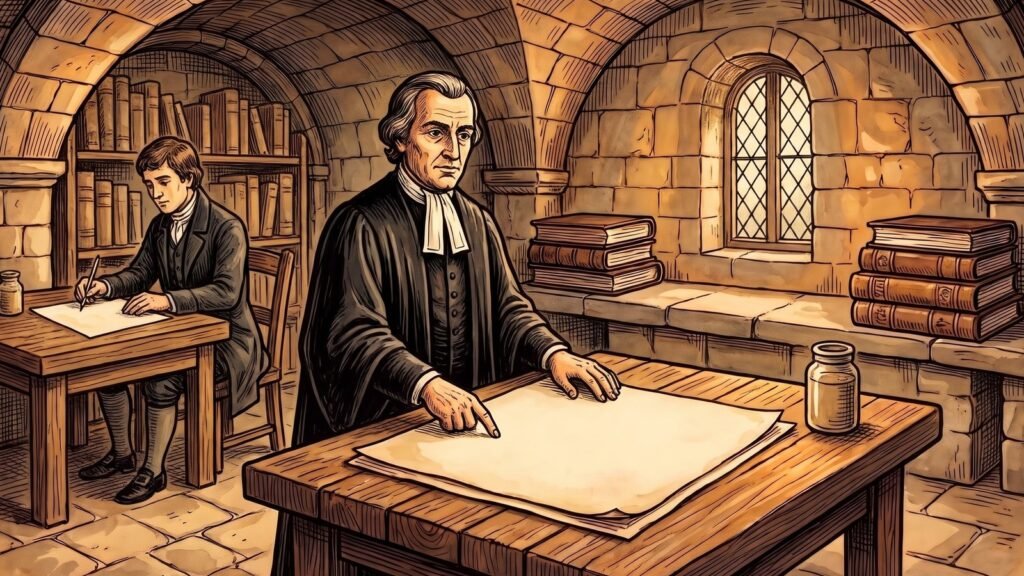
In the autumn of 1720 Richard Bentley, Master of Trinity College, Cambridge, and the most celebrated classical scholar in Europe, issued a short printed paper announcing a new edition of the Greek New Testament together with the Latin translation of Saint Jerome. The paper, known as the Proposals, set out in a few pages a method that was a century ahead of its time. Bentley proposed to set aside the printed Greek text that had been reproduced, with small variations, since the sixteenth century, and to rebuild the text from the oldest Greek manuscripts and the oldest manuscripts of the Latin Vulgate, using the agreement of the two as a test of antiquity. He claimed that by this means he could restore the text as it had stood in the fourth century, at the time of the Council of Nicaea, and that the thirty thousand variant readings which had alarmed the readers of John Mill’s recent edition would shrink to a handful. The edition was never published. The project was attacked, delayed, entangled in the bitter quarrels of Bentley’s college, and finally abandoned, leaving behind a mass of collations and notes now preserved at Trinity. Its principles were nevertheless taken up by later editors, above all by Karl Lachmann, who made Bentley’s plan the explicit programme of his own Greek New Testament of 1831. This article describes Bentley’s career up to the Proposals, the state of the New Testament text in his time, the origin of the plan in his correspondence with Archbishop Wake, the contents of the Proposals and their specimen, the collations gathered for the work, the controversy with Conyers Middleton, the reasons for the failure of the edition, and its later influence.123
At a glance
- Subject: Richard Bentley’s plan for a critical edition of the Greek New Testament and the Latin Vulgate, announced in printed Proposals of 1720 and never completed.
- Editor: Richard Bentley (1662–1742), classical scholar, Master of Trinity College, Cambridge, from 1700.
- Origin: A letter to Archbishop William Wake of 15 April 1716 setting out the plan.
- Principle: Agreement of the oldest Greek manuscripts with the oldest manuscripts of Jerome’s Latin would recover the text current about the time of the Council of Nicaea.
- Specimen: The Proposals printed the last chapter of Revelation in Greek and Latin as a sample.
- Opposition: Attacked by Conyers Middleton in Remarks, Paragraph by Paragraph (1721).
- Fate: Abandoned in the later 1720s; the papers remain at Trinity College and were partly published by A. A. Ellis in 1862.
- Legacy: Karl Lachmann adopted the plan as the programme of his own New Testament of 1831.
Bentley Before the New Testament
Richard Bentley was born on 27 January 1662 at Oulton, near Wakefield in Yorkshire, into a family of yeoman farmers. He learned the elements of Latin from his mother, attended the grammar school at Wakefield, and in 1676, at the age of fourteen, entered St John’s College, Cambridge, as a subsizar, a poor student who paid for his education in part by service. He took his degree in 1680. In 1683 he became tutor to the son of Edward Stillingfleet, then Dean of Saint Paul’s and later Bishop of Worcester, and the years in Stillingfleet’s household, with the use of one of the finest private libraries in England, gave him the leisure and the books on which his learning was built. He read through the Greek and Latin authors with a thoroughness that became legendary, and he compiled for his own use indexes of the poets and lexicographers that later enabled him to recall parallels at will.456
His first publication, in 1691, was a Latin letter to the scholar John Mill appended to an edition of the chronicle of John Malalas, in which he displayed, in a few dozen pages, a command of Greek literature, metre and lexicography that astonished the learned world. In 1692 he was chosen as the first lecturer under the bequest of Robert Boyle, delivering a series of sermons against atheism in which he drew on the new physics of Isaac Newton, with whom he corresponded on the subject. In 1694 he became keeper of the royal libraries, an office that placed in his charge the collection at Saint James’s Palace, which included the Codex Alexandrinus, the great fifth-century manuscript of the Greek Bible presented to Charles I in 1627. The manuscript was to play a central part in his later plans for the New Testament.78910
Bentley’s reputation was made by the controversy over the Epistles of Phalaris, a collection of letters attributed to a Sicilian tyrant of the sixth century before Christ. Sir William Temple had praised the letters as among the finest remains of antiquity, and a group of young scholars at Christ Church, Oxford, published an edition of them in 1695 under the name of Charles Boyle. Bentley argued, first in a short dissertation of 1697 and then in a greatly enlarged treatise of 1699, that the letters were a forgery of a much later age. He showed that they mentioned cities that did not exist in Phalaris’s time, used coins and measures of later periods, quoted authors who lived after him, and were written not in the Doric dialect of Sicily but in the Attic Greek of a later sophist. The treatise demolished the authenticity of the letters so completely that no scholar has since defended it, and it is regarded as one of the founding works of historical criticism. The controversy also made Bentley a figure of fun among the wits of the age, and Jonathan Swift caricatured him in The Battle of the Books.11121314
In 1700 Bentley was appointed Master of Trinity College, Cambridge, the richest and most prestigious college in the university. His mastership lasted forty-two years and was one of the most turbulent in the history of any academic institution. He began with ambitious improvements, restoring the chapel, building an observatory and a chemical laboratory, encouraging the study of science and raising the standards of the college’s elections and examinations. But he also treated the fellows with contempt, spent college money on his own lodge without consent, and appropriated revenues to himself in ways the fellows regarded as illegal. From 1709 the fellows appealed against him to the Bishop of Ely as visitor of the college, and the resulting litigation, interrupted by the deaths of bishops and by legal technicalities, continued for decades. A sentence of deprivation was eventually passed against him in 1734, but it was never executed, and he remained in possession of the lodge until his death on 14 July 1742.151617
Throughout these battles Bentley continued to work on the classics. His edition of Horace, published in 1711, proposed some seven hundred changes to the received text, many of them based on conjecture rather than on manuscript evidence, and defended them in notes of combative brilliance. He later produced editions of Terence and Phaedrus in 1726 and of the astronomical poet Manilius in 1739, and in 1732 an edition of Milton’s Paradise Lost in which he argued that the printed text had been corrupted by an editor and proposed hundreds of emendations. The Milton edition was widely ridiculed and has damaged his reputation ever since, but the Manilius is still regarded as one of the masterpieces of classical scholarship. Alexander Pope satirised him in The Dunciad as a pedant who flattened poetry under his corrections.1819202122
It is important to understand that Bentley’s approach to classical texts combined two elements which can seem contradictory. On the one hand, he was the greatest master of conjectural emendation of his age, willing to alter the text where sense, metre or style demanded it, even against the unanimous testimony of the manuscripts; his famous dictum in the Horace was that reason and the matter itself were worth more to him than a hundred manuscripts. On the other hand, he understood better than his contemporaries that the value of manuscripts depended on their age and relationships, and that the oldest witnesses should be weighed rather than counted. In his work on the New Testament he deliberately confined the first element and gave free rein to the second, for he held that in a sacred text the editor’s business was to recover what the manuscripts attested, not to improve it.232425
The New Testament Text in Bentley's Time
The Greek New Testament that every scholar of Bentley’s day read was descended from the editions of the sixteenth century. Erasmus had published the first edition of the Greek text at Basel in 1516, basing it on a handful of late medieval manuscripts that happened to be available to him. His text had been revised by the Paris printer Robert Estienne, whose third edition of 1550 included variant readings from a number of manuscripts, and by the Genevan reformer Theodore Beza, whose editions appeared between 1565 and 1604. In 1633 the Elzevir printers of Leiden issued an edition whose preface declared that the reader now had the text received by all, and from this phrase the traditional printed text came to be known as the Textus Receptus. In England the edition of Estienne of 1550 served much the same function. Neither form of the text rested on the oldest manuscripts, which had been either unknown or unused by the sixteenth-century editors.26272829
During the seventeenth century the materials for criticising this text accumulated. The Codex Alexandrinus arrived in England in 1627, and its readings were printed in the London Polyglot edited by Brian Walton in 1655–57, whose sixth volume contained a collection of variant readings drawn from it and from other sources. The Oxford scholar John Fell published a Greek New Testament with variants in 1675, and he encouraged his younger colleague John Mill to undertake a fuller collection. Mill laboured on it for some thirty years, and his edition appeared at Oxford in 1707, only a fortnight before his death. It printed the text of Estienne unchanged, but its apparatus recorded readings from about a hundred manuscripts, from the early versions and from the quotations of the church fathers, and its long prolegomena discussed the history of the text with unprecedented learning. The number of variants recorded was commonly estimated at about thirty thousand.30313233
Mill’s edition caused alarm. Some readers felt that by displaying so many variants it had undermined the certainty of the text on which Protestant doctrine rested, and the Roman Catholic controversialists had long argued that the variability of the text showed the need for the authority of the church. The free-thinker Anthony Collins, in his Discourse of Free-Thinking of 1713, cited Mill’s thirty thousand variants as evidence that the text of the New Testament was uncertain, and that the clergy who claimed to rest everything on Scripture were relying on a foundation they could not establish. Bentley answered Collins in the same year in a pamphlet published under the pseudonym Phileleutherus Lipsiensis, a lover of freedom from Leipzig, purporting to come from a German scholar. In it he argued that the variants were the natural result of copying over many centuries, that the same was true of every classical author, and that far from weakening the text they made it more secure, because the greater the number of manuscripts, the greater the chance that the true reading was preserved in one of them.343536
The reply to Collins contained, in embryo, the argument of Bentley’s later plan. If the variants were simply the accumulation of errors over time, then the oldest manuscripts should contain fewer of them, and an editor who confined himself to the oldest witnesses could recover a text close to the original. Bentley also pointed out that most variants were trivial, affecting spelling, word order or small particles, and that no article of faith depended on them. In a famous passage he insisted that the real text of the sacred writers was competently exact even in the worst manuscript, and that the choice among variants, however numerous, did not alter the substance of the faith. The pamphlet was enormously successful, running through several editions, and it established Bentley as the champion of the established church against the deists on the ground of textual criticism.373839
The Letter to Archbishop Wake
The plan for an edition of the New Testament was first set out in a letter that Bentley wrote on 15 April 1716 to William Wake, Archbishop of Canterbury, who had shown interest in the state of the text. The letter is preserved in Bentley’s correspondence and is one of the classic documents in the history of New Testament scholarship. Bentley wrote that he had been led, by his work on the Latin manuscripts, to a discovery about the relation of the oldest Greek and Latin texts. Jerome, at the end of the fourth century, had revised the Latin version of the Gospels by comparison with the best Greek manuscripts available to him. If, therefore, the oldest manuscripts of Jerome’s Latin agreed with the oldest Greek manuscripts in a reading, that reading must have stood in the Greek copies of the fourth century, since the two traditions had been independent ever since Jerome’s revision.404142
Bentley explained to Wake that he had compared the Codex Alexandrinus with the oldest Latin manuscripts he could find and had been surprised by the closeness of their agreement, not only in readings but in the very order of the words, in which the later Greek manuscripts and the printed editions frequently departed from both. He declared that he was able, as some had thought impossible, to give an edition of the Greek Testament exactly as it was in the best copies at the time of the Council of Nicaea, so that there should not be twenty words, nor even particles, of difference. The Latin he proposed to restore at the same time to the form in which Jerome left it, purging it of the corruptions introduced in the Middle Ages. The two texts would then stand side by side, each confirming the other, and the mass of variants accumulated by Mill would be reduced to a small and manageable number.434445
The confidence of this claim has often been noted, and it was, in a sense, the source of the later difficulties of the project. Bentley was promising something no editor could deliver, for the oldest Greek and Latin manuscripts do not agree as closely as he supposed, and the text of the fourth century was itself already diverse. But the principle he stated was sound and new. It rested on three ideas. The first was that the value of a witness depended on its age, so that a few old manuscripts outweighed many late ones. The second was that independent traditions could be used to control each other, since agreement between them could not be the result of copying. The third was that the editor should aim at a definite historical stage of the text, not at an ideal original, and should establish that stage from documentary evidence rather than from the authority of the printed editions. Each of these ideas was taken up by later critics, and the third in particular became the guiding principle of Lachmann.464748
Wake encouraged the plan. Bentley began collecting materials, and the project became widely known among scholars at home and abroad. In 1717 he was elected Regius Professor of Divinity at Cambridge, a position that gave him a theological standing to match his classical fame, and his inaugural lecture in that year is reported to have dealt with the disputed verse of the three heavenly witnesses in the First Epistle of John, which is absent from the Greek manuscripts and the oldest Latin ones. The text of the lecture has not survived, and its precise conclusions are therefore uncertain, but the choice of subject indicates that the questions of the New Testament text were at the centre of his attention at the time.495051
The Collations
Bentley’s plan required collations of the oldest Greek and Latin manuscripts, many of which were in foreign libraries. He himself collated the Codex Alexandrinus, which was in his own custody as keeper of the royal library, and he gathered collations of the Latin manuscripts in English libraries, including several old manuscripts of the Vulgate in the libraries of the universities and cathedrals. For the manuscripts abroad he employed agents. The most important of them in the early years was a young Swiss scholar from Basel, Johann Jakob Wettstein, who visited England in 1715 and 1716 and was engaged by Bentley to collate manuscripts in Paris. Among them was the Codex Ephraemi Rescriptus, a fifth-century manuscript of the Greek Bible whose biblical text had been erased in the twelfth century and overwritten with treatises of Ephrem the Syrian. Reading the faded underlying script was laborious, and Wettstein’s collation for Bentley was one of the first serious attempts to recover the biblical text of the palimpsest.52535455
Bentley also employed John Walker, a fellow of Trinity, who spent long periods in Paris collating Latin manuscripts of the Vulgate and Greek manuscripts in the royal library there and in the libraries of religious houses. Walker’s work continued for years, and he became Bentley’s principal collaborator on the project; he was named in the Proposals as associate in the edition. Bentley’s nephew Thomas Bentley also collated manuscripts on the continent. The most important manuscript of all, the Codex Vaticanus in the Vatican Library at Rome, was beyond Bentley’s reach in person, but he procured a collation of it through an Italian agent, the Abbé Mico, about 1720, and later sought further readings through other correspondents. The Vaticanus was then little known and its importance not yet recognised, and Bentley’s interest in it shows how far he was ahead of his contemporaries in judging the value of the oldest witnesses.56575859
The collations accumulated over more than a decade. Bentley’s correspondence shows him writing to scholars and librarians across Europe, asking for readings, arranging for copies and paying for the labour of collators. The materials included collations of Greek manuscripts of the Gospels, Acts and Epistles, of numerous manuscripts of the Vulgate, of the quotations in the Latin fathers, and of the Coptic and Syriac versions so far as they were accessible. Bentley also annotated a printed copy of the Greek New Testament with readings and proposed corrections, and these annotations, together with the collations, passed after his death into the library of Trinity College. In the nineteenth century the scholar Arthur Ayres Ellis, a fellow of Trinity, extracted from them the notes on the text which Bentley had made, and published them in 1862 under the title Bentleii Critica Sacra.606162
The Latin side of the project was in some respects the more original. No one before Bentley had attempted to recover the text of Jerome’s Vulgate from its oldest manuscripts. The Latin Bible in use in the Roman Catholic Church was the Clementine edition of 1592, produced under papal authority after the abortive Sixtine edition of 1590, and it was based on relatively late manuscripts. Bentley recognised that the oldest manuscripts of the Vulgate, written in the sixth to the ninth centuries, preserved a purer form of Jerome’s text, and he gathered collations of a number of them, including manuscripts written in England and Ireland in the early Middle Ages. The great Codex Amiatinus, written at Wearmouth-Jarrow in Northumbria about 700 and now in Florence, had not yet been identified as English and was not among his sources, but his principle of seeking the oldest Latin witnesses anticipated the method by which the critical editions of the Vulgate were made in the nineteenth and twentieth centuries.63646566
The Proposals of 1720
In 1720 Bentley felt ready to announce the edition publicly and to raise subscriptions for it. The Proposals for Printing a New Edition of the Greek Testament and Saint Hierom’s Latin Version were printed in London and circulated in the autumn of that year. The document was short, consisting of a few pages of text followed by a specimen of the proposed edition, and it was issued in English and in Latin for the benefit of foreign scholars. It set out the plan of the work, the principles on which the text would be established, the materials to be used and the terms of subscription.676869
The Proposals began by observing that the printed text of the Greek Testament had been settled more than a century and a half earlier by editors who had only late manuscripts at their disposal, and that it had been reprinted ever since with superstitious reverence, as if it were itself inspired. Bentley announced that he would give the text, not from any printed edition, but from the oldest manuscripts of the Greek original and of the Latin version, both of more than a thousand years’ antiquity. He would use the agreement of these two sets of witnesses, which he described as the surest guides, to establish the text, and he would set out in the notes the evidence for every reading so that the reader could judge for himself. He expressed the hope that by this means the text would be restored to the condition in which it was current in the time of the Council of Nicaea, and that the thirty thousand variants would be reduced to fewer than two hundred that were of any consequence.707172
The edition was to be in two volumes in folio, with the Greek and Latin texts in parallel columns and the evidence in the notes below. It was to include, Bentley promised, all the variants of the oldest manuscripts, so that nothing would be concealed; the reader would see the authority for each choice. Readings found only in late manuscripts would not be recorded, since they had no claim to represent the ancient text. Bentley also announced that he would add the evidence of the early versions and of the fathers of the first four centuries, so far as they bore on the text. The edition was to be printed at Cambridge on fine paper, and subscriptions were invited, payable half on subscribing and half on delivery, at a higher rate for copies on large paper.7374
The specimen attached to the Proposals consisted of the last chapter of the Book of Revelation, printed in Greek and Latin in the proposed form, with notes giving the authorities for the readings adopted. The choice of the chapter was deliberate. Erasmus, who had had only one incomplete manuscript of Revelation, had supplied the last six verses of the book by translating them back into Greek from the Latin Vulgate, and his retroversion had passed into the printed text with all its peculiarities. Bentley’s specimen therefore showed, in a passage where the corruption of the received text could be demonstrated beyond dispute, what a text based on ancient manuscripts would look like. It departed from the received text in many places, and it showed the readers of 1720 for the first time a portion of the New Testament printed entirely from the ancient evidence.75767778
The Proposals were received with great interest and, in many quarters, with enthusiasm. Subscriptions came in from England and abroad, and Bentley is reported to have received a considerable sum. Learned journals on the continent reported the plan, and the Dutch scholar Jean Leclerc, who edited the leading review of the republic of letters, gave it a favourable notice. For a moment it seemed that Bentley would accomplish, within a few years, the revolution in the New Testament text that in fact took another century to achieve.798081
The Controversy with Conyers Middleton
The Proposals were immediately attacked by Conyers Middleton, a fellow of Trinity and one of Bentley’s bitterest opponents in the college disputes. Middleton had clashed with Bentley over fees demanded for degrees, and he had a personal as well as a scholarly motive for attacking him. In 1721 he published anonymously a pamphlet entitled Remarks, Paragraph by Paragraph, upon the Proposals Lately Published by Richard Bentley, in which he subjected each sentence of the Proposals to hostile criticism. He argued that Bentley’s claims were boastful and unfounded, that the agreement of the Greek and Latin manuscripts was far less close than he asserted, that the oldest manuscripts were not necessarily the best, that the edition would unsettle the faith of ordinary readers by altering the received text, and that Bentley was raising money from subscribers for a work he had no intention or ability of completing.828384
Middleton also criticised the specimen, pointing out readings in which Bentley appeared to have departed from his own principles, adopting a reading on the authority of a single witness or on conjecture. Some of these criticisms were fair. Bentley had not confined himself strictly to the agreement of the oldest witnesses, and in a few places he had followed his instinct as a critic. More generally, Middleton touched a real weakness of the plan, which was that the oldest manuscripts did not always agree, so that the editor would be forced to choose between them by his own judgement. The promise that the variants would be reduced to a few hundred could only be kept if the editor was willing to decide between rival ancient readings, and such decisions would be open to the same criticism as the conjectures of the classical editor.858687
Bentley’s response was characteristic. He believed, wrongly, that the pamphlet was the work of another fellow, and a reply appeared under his auspices, though not in his name, which attacked the supposed author with violent abuse. When Middleton acknowledged his authorship, he published a further pamphlet answering the reply and renewing his criticisms. The quarrel became entangled in the college disputes and in legal proceedings, and Middleton was for a time prosecuted for libel at Bentley’s instigation. The episode did Bentley great harm. It made the project appear an extension of his personal quarrels, it discouraged subscribers, and it gave his enemies a ready weapon. The objections to altering the received text, which Middleton had expressed in the language of piety, also found an echo among clergy who feared that a new text would disturb the faith of the people.888990
The Failure of the Edition
After 1721 the project continued for some years, but its progress slowed. The collations went on accumulating, Walker continued his work in Paris, and Bentley’s correspondence shows him still engaged with the materials in the later 1720s. But the edition was never sent to press. The reasons for its failure have been much discussed. The simplest is that Bentley was a man of many projects and immense energy who was continually distracted by new undertakings and by the endless litigation of his college. In the years after the Proposals he published his editions of Terence and Phaedrus and prepared his Manilius and his Milton, and the defence of his position at Trinity consumed much of his time and temper. A further practical obstacle is reported by his biographer Monk: Bentley sought from the government an exemption from the duty on the paper to be used for the edition, as had been granted for some other learned works, and his request was refused, which he took as a slight.919293
A deeper reason was the nature of the evidence itself. As the collations accumulated, it became clear that the oldest manuscripts did not agree with each other as closely as Bentley had hoped, and that the oldest Latin manuscripts were themselves divided. The Codex Vaticanus, when its readings became known, differed from the Alexandrinus in many places, and the Latin manuscripts preserved not only Jerome’s text but traces of the older Latin versions that Jerome had revised. The simple test of agreement between Greek and Latin, which had seemed so powerful in the letter to Wake, proved insufficient to settle the text, and the editor would have had to make a vast number of individual decisions. Bentley, who had promised a text with scarcely twenty words of uncertainty, may have recognised that he could not deliver it, and preferred to leave the work unfinished rather than produce something that fell short of his claims.949596
The relationship with Wettstein also broke down. Wettstein, who had collated manuscripts for Bentley, developed views of his own on the text and began preparing his own edition. He was accused of heterodoxy in Basel, deposed from his ministry in 1730, and moved to Amsterdam, where he taught at the Remonstrant seminary and eventually published his Greek New Testament in two volumes in 1751 and 1752. His edition printed the received text but recorded a vast apparatus of variants and introduced the system of designating manuscripts by letters and numbers that, in modified form, is still in use. Wettstein’s own critical views were in several respects more conservative than Bentley’s, for he came to distrust the oldest manuscripts, believing that they had been corrupted by assimilation to the Latin. The parting of the two scholars meant that Bentley lost his ablest collaborator on the Greek side of the project.979899
By about 1729 the project had in effect been abandoned, though Bentley never formally announced its end, and he is said to have returned the money of subscribers who asked for it. When he died in 1742, the materials passed to his nephew and eventually to Trinity College, where they remain. The failure was a loss to scholarship. Had the edition been published in the 1720s, the critical study of the New Testament text might have advanced by a century, for the principles Bentley stated were those that later scholars had to rediscover slowly and against much resistance. As it was, the Greek New Testament continued to be printed in the received text, with variants in the notes, until Lachmann broke with it in 1831.100101102
Bentley's Method in Context
Bentley’s plan must be seen against the background of the critical methods of his time. The classical editors of the seventeenth century had generally worked by taking a printed text, the vulgate of the author, and correcting it here and there from manuscripts or by conjecture. They did not as a rule attempt to classify the manuscripts or to establish their relationships, and they rarely asked which of them preserved the oldest form of the text. Bentley himself worked in this way in his classical editions, though with an exceptional sense of the relative value of witnesses. His New Testament plan was different in kind. It proposed to discard the printed text entirely and to build the edition from documentary evidence selected according to an explicit criterion. In this respect it anticipated the method that later came to be associated with Lachmann.103104105
The principle that the oldest witnesses should be preferred was not entirely new. Scholars such as Richard Simon in France had argued that the text should be examined historically, and Mill had discussed the antiquity of different witnesses in his prolegomena. But no one before Bentley had proposed to construct a complete text on that principle, or had seen how the Latin version could be used as an independent control on the Greek. The insight that Jerome’s revision fixed a stage of the Greek text in the late fourth century, and that the agreement of the oldest Latin and Greek manuscripts therefore attested readings of that period, was Bentley’s own, and it remains valid within limits. Modern scholars would add that the Latin tradition was influenced by the Old Latin versions and that Greek manuscripts were sometimes corrected from the Latin, but the general argument is still recognised as an important contribution.106107108
Bentley’s aim of restoring the text of the time of Nicaea, rather than the autographs of the apostles, was also significant. It recognised that the evidence available could at best take the editor back to a particular historical stage of the text, and that a text of the fourth century was a realistic goal. This modest aim, which Lachmann expressly adopted, distinguished the critical method from the ambition of the dogmatic theologians who regarded the received text as identical with the original. It also distinguished it from the method of conjecture, for Bentley proposed to restore what the ancient church had read, not what the apostles must have written. The distinction between these two aims remains basic to textual criticism.109110111
There was a tension in Bentley’s own thinking between this documentary method and his habits as a classical critic. In the specimen of Revelation, and in some of the notes preserved by Ellis, he allowed himself conjectures and choices that went beyond the evidence of the oldest manuscripts. His critics seized on these as evidence of inconsistency. But the tension was inherent in the task. Even an editor who confined himself to ancient witnesses would have to choose between them where they disagreed, and the choice would require judgement. Bentley’s Proposals did not explain how such choices were to be made, and this gap was filled only in the nineteenth century, when scholars developed systematic methods for evaluating the relationships of witnesses and the probabilities of readings.112113114
The Later Influence of the Plan
Although the edition was never published, the Proposals were reprinted in the eighteenth and nineteenth centuries and became well known to students of the New Testament text. The German scholar Johann Albrecht Bengel, whose Greek New Testament appeared in 1734, was aware of Bentley’s plan and shared his conviction that witnesses should be weighed rather than counted, though he did not adopt the principle of the agreement of Greek and Latin. Bengel divided the manuscripts into families, distinguishing an older African group from a later Asiatic group, and this classification was developed by Johann Salomo Semler and Johann Jakob Griesbach in the later eighteenth century. These scholars moved towards the method that Bentley had proposed, but none of them broke completely with the received text.115116117
The decisive application of Bentley’s principles came with Karl Lachmann. In 1830, in an article explaining the edition of the Greek New Testament that he was about to publish, Lachmann declared that he had undertaken to carry out the plan that Bentley had proposed more than a century before. He intended to give the text of the fourth century, as it could be established from the oldest Greek manuscripts and the oldest manuscripts of the Latin version, without reference to the received text. His small edition of 1831 printed a text based on these principles, and his larger edition of 1842–50, prepared with Philipp Buttmann, set out the Greek and Latin texts together in a form close to the one Bentley had envisaged. Lachmann acknowledged Bentley as his predecessor and model, and the debt was recognised by his contemporaries.118119120121
Lachmann’s editions were followed by those of Constantin von Tischendorf, Samuel Prideaux Tregelles and the Cambridge scholars Brooke Foss Westcott and Fenton John Anthony Hort, whose Greek New Testament of 1881 established a text based primarily on the Codex Vaticanus and the Codex Sinaiticus. Tregelles, in his account of the printed text of the Greek New Testament published in 1854, gave a full description of Bentley’s plan and argued that it had pointed the way to the true method of criticism. In this sense the modern critical text of the New Testament, from Lachmann to the editions used today, carries out the programme that Bentley announced in 1720, though by methods far more elaborate than he imagined and with results that confirm his judgement of the value of the oldest witnesses.122123124
The Latin side of the plan had a parallel history. The recovery of Jerome’s text from the oldest manuscripts of the Vulgate was undertaken in the nineteenth century by scholars such as John Wordsworth, Bishop of Salisbury, and Henry Julian White, whose critical edition of the Vulgate New Testament was published at Oxford between 1889 and 1954, and by the Benedictine commission for the revision of the Vulgate in Rome. These editions relied heavily on the Codex Amiatinus and other early manuscripts written in England and Italy, and they confirmed Bentley’s view that the oldest Latin manuscripts preserved a text very different from that of the printed Clementine edition. Wordsworth and White were well aware of Bentley’s pioneering work on the Latin manuscripts, and his collations at Trinity were among the materials they consulted.125126127
The Bentley Papers at Trinity
The materials Bentley collected for his edition are preserved in the library of Trinity College, Cambridge, in the building designed by Christopher Wren and completed in 1695, five years before Bentley became Master. They include collations of Greek and Latin manuscripts made by Bentley, Walker, Wettstein and other assistants, Bentley’s annotated copies of printed editions, and correspondence relating to the project. Several of the collations are the only record of readings in manuscripts that have since been damaged or lost, and they have been used by later editors for that reason. They also document the working methods of eighteenth-century collators, who had to record readings by hand against a printed text, often in poor light and under restrictions imposed by librarians.128129130
Arthur Ayres Ellis’s publication of 1862 made a selection of the notes accessible. Ellis printed Bentley’s annotations on the Greek and Latin text, together with the Proposals and related documents, and in his introduction he described the history of the project and the contents of the papers. The publication showed that Bentley had progressed further than had been supposed, for the annotations covered much of the New Testament, and many of the readings he favoured were the same as those adopted by Lachmann and Tischendorf. It also showed the limits of his work, for the notes were uneven and in some books sparse. The full collations have never been published, and they remain a resource for historians of scholarship.131132
The twentieth-century study of the project was advanced by Adam Fox, whose book on John Mill and Richard Bentley of 1954 examined the textual criticism of the New Testament between 1675 and 1729. Fox traced the development of Bentley’s ideas from the reply to Collins through the letter to Wake and the Proposals, analysed the collations, and assessed the reasons for the failure of the edition. He emphasised the continuity between Mill and Bentley, showing how Bentley’s plan grew out of the materials Mill had assembled and the problems they had raised. More recent studies of Bentley, such as that of Kristine Haugen, have placed the New Testament project in the context of his classical scholarship and his combative personality, showing how the same qualities that made him a great critic also made it difficult for him to complete large undertakings.133134
Assessment
Bentley’s Proposals occupy a curious place in the history of the Bible. They announced an edition that never appeared, and yet they are among the most important documents in the history of the New Testament text. Their importance lies in the clarity with which they stated principles that later scholars adopted: that the printed text had no authority of its own, that the oldest witnesses should be preferred, that independent traditions could be used to control each other, and that the editor should aim at a definite historical stage of the text and display the evidence for each reading. These principles were not entirely original, but no one before Bentley had combined them in a single plan or applied them with such confidence.135136137
The failure of the edition was partly the result of Bentley’s character. His arrogance provoked the opposition of Middleton, his quarrels with his college consumed his energy, and his tendency to overstate his claims raised expectations that the evidence could not satisfy. But it was also the result of the difficulty of the task. The materials available in the 1720s were incomplete, the oldest manuscripts were only partly known, and the methods needed to evaluate their relationships had not yet been developed. Even Lachmann, a century later, could produce only a provisional text, and the debate about the relative value of the oldest witnesses continued throughout the nineteenth century. It is unlikely that Bentley’s edition, had it appeared, would have satisfied his own claims, but it would have shown the scholarly world how a critical text of the New Testament could be built.138139140
For the history of the Bible in English, the Proposals also have a particular significance. They were the first public challenge in England to the authority of the received Greek text, which underlay the Authorised Version of 1611, and they raised questions that were not finally settled until the Revised Version of 1881 adopted a Greek text based on the oldest manuscripts. The resistance that Bentley met, expressed in Middleton’s appeal to the faith of ordinary readers, was a foretaste of the controversy that greeted the Revised Version, when critics again argued that a new text would undermine confidence in Scripture. Bentley’s answer, that the variants did not affect the substance of the faith and that a text based on ancient evidence would be more secure, remains the answer of textual critics today.141142143
The Proposals are also a reminder of the international character of biblical scholarship in the early eighteenth century. Bentley’s collaborators included a Swiss scholar in Paris, an English fellow working in French libraries, an Italian agent in Rome, and correspondents across Protestant and Catholic Europe. The manuscripts they consulted were scattered among royal, papal and monastic libraries, and access to them depended on patronage and diplomacy. The project thus belongs to the same world of learned collaboration that produced the great polyglot Bibles of the sixteenth and seventeenth centuries and the collations of Hebrew manuscripts by Benjamin Kennicott later in the eighteenth century, a world in which the text of the Bible was studied as a historical document by scholars of many nations.144145146
Bentley himself never wrote a full account of his method, and what we know of it comes from the letter to Wake, the Proposals, the reply to Collins and the notes published by Ellis. These documents are brief, but they are written with the force and clarity that marked all his work, and they convey the excitement of a scholar who believed he had found the key to an ancient problem. His claim to restore the text of the fourth century with scarcely twenty words of uncertainty was too bold, but the confidence behind it was justified in a deeper sense. The method he proposed was the right one, and the editors who followed it have given the modern world a text of the New Testament far closer to the ancient copies than the text that Bentley set out to replace.147148149150
Notes
- Grokipedia, “Richard Bentley”. ↩
- R. C. Jebb, Bentley, English Men of Letters (London: Macmillan, 1882). ↩
- Adam Fox, John Mill and Richard Bentley: A Study of the Textual Criticism of the New Testament, 1675–1729 (Oxford: Basil Blackwell, 1954). ↩
- Grokipedia, “Richard Bentley”. ↩
- James Henry Monk, The Life of Richard Bentley, D.D., 2nd ed., 2 vols. (London: J. G. & F. Rivington, 1833). ↩
- R. C. Jebb, Bentley, English Men of Letters (London: Macmillan, 1882). ↩
- Grokipedia, “Richard Bentley”. ↩
- Grokipedia, “Isaac Newton”. ↩
- Grokipedia, “Codex Alexandrinus”. ↩
- See also “Codex Alexandrinus” on this site. ↩
- Grokipedia, “Phalaris”. ↩
- Joseph M. Levine, The Battle of the Books: History and Literature in the Augustan Age (Ithaca: Cornell University Press, 1991). ↩
- Grokipedia, “Jonathan Swift”. ↩
- R. C. Jebb, Bentley, English Men of Letters (London: Macmillan, 1882). ↩
- Grokipedia, “Trinity College, Cambridge”. ↩
- James Henry Monk, The Life of Richard Bentley, D.D., 2nd ed., 2 vols. (London: J. G. & F. Rivington, 1833). ↩
- R. C. Jebb, Bentley, English Men of Letters (London: Macmillan, 1882). ↩
- Grokipedia, “Horace”. ↩
- Grokipedia, “Paradise Lost”. ↩
- Grokipedia, “Alexander Pope”. ↩
- Kristine Louise Haugen, Richard Bentley: Poetry and Enlightenment (Cambridge, MA: Harvard University Press, 2011). ↩
- C. O. Brink, English Classical Scholarship: Historical Reflections on Bentley, Porson, and Housman (Cambridge: James Clarke, 1986). ↩
- R. C. Jebb, Bentley, English Men of Letters (London: Macmillan, 1882). ↩
- L. D. Reynolds and N. G. Wilson, Scribes and Scholars: A Guide to the Transmission of Greek and Latin Literature, 4th ed. (Oxford: Oxford University Press, 2013). ↩
- C. O. Brink, English Classical Scholarship: Historical Reflections on Bentley, Porson, and Housman (Cambridge: James Clarke, 1986). ↩
- Grokipedia, “Textus Receptus”. ↩
- Grokipedia, “Erasmus”. ↩
- Bruce M. Metzger and Bart D. Ehrman, The Text of the New Testament: Its Transmission, Corruption, and Restoration, 4th ed. (New York: Oxford University Press, 2005). ↩
- See also “The Complutensian Polyglot” on this site. ↩
- Grokipedia, “John Mill (theologian)”. ↩
- Adam Fox, John Mill and Richard Bentley: A Study of the Textual Criticism of the New Testament, 1675–1729 (Oxford: Basil Blackwell, 1954). ↩
- See also “The Antwerp, Paris and London Polyglots” on this site. ↩
- Bruce M. Metzger and Bart D. Ehrman, The Text of the New Testament: Its Transmission, Corruption, and Restoration, 4th ed. (New York: Oxford University Press, 2005). ↩
- Grokipedia, “Anthony Collins”. ↩
- Phileleutherus Lipsiensis [Richard Bentley], Remarks upon a Late Discourse of Free-Thinking (London, 1713). ↩
- Adam Fox, John Mill and Richard Bentley: A Study of the Textual Criticism of the New Testament, 1675–1729 (Oxford: Basil Blackwell, 1954). ↩
- Phileleutherus Lipsiensis [Richard Bentley], Remarks upon a Late Discourse of Free-Thinking (London, 1713). ↩
- R. C. Jebb, Bentley, English Men of Letters (London: Macmillan, 1882). ↩
- Adam Fox, John Mill and Richard Bentley: A Study of the Textual Criticism of the New Testament, 1675–1729 (Oxford: Basil Blackwell, 1954). ↩
- Christopher Wordsworth, ed., The Correspondence of Richard Bentley, D.D., 2 vols. (London: John Murray, 1842). ↩
- Adam Fox, John Mill and Richard Bentley: A Study of the Textual Criticism of the New Testament, 1675–1729 (Oxford: Basil Blackwell, 1954). ↩
- See also “The Latin Vulgate and Jerome’s Translation of the Bible” on this site. ↩
- Christopher Wordsworth, ed., The Correspondence of Richard Bentley, D.D., 2 vols. (London: John Murray, 1842). ↩
- R. C. Jebb, Bentley, English Men of Letters (London: Macmillan, 1882). ↩
- Adam Fox, John Mill and Richard Bentley: A Study of the Textual Criticism of the New Testament, 1675–1729 (Oxford: Basil Blackwell, 1954). ↩
- Adam Fox, John Mill and Richard Bentley: A Study of the Textual Criticism of the New Testament, 1675–1729 (Oxford: Basil Blackwell, 1954). ↩
- Sebastiano Timpanaro, The Genesis of Lachmann’s Method, ed. and trans. Glenn W. Most (Chicago: University of Chicago Press, 2005). ↩
- See also “Karl Lachmann” on this site. ↩
- James Henry Monk, The Life of Richard Bentley, D.D., 2nd ed., 2 vols. (London: J. G. & F. Rivington, 1833). ↩
- R. C. Jebb, Bentley, English Men of Letters (London: Macmillan, 1882). ↩
- Adam Fox, John Mill and Richard Bentley: A Study of the Textual Criticism of the New Testament, 1675–1729 (Oxford: Basil Blackwell, 1954). ↩
- Adam Fox, John Mill and Richard Bentley: A Study of the Textual Criticism of the New Testament, 1675–1729 (Oxford: Basil Blackwell, 1954). ↩
- Grokipedia, “Codex Ephraemi Rescriptus”. ↩
- Grokipedia, “Codex Alexandrinus”. ↩
- Christopher Wordsworth, ed., The Correspondence of Richard Bentley, D.D., 2 vols. (London: John Murray, 1842). ↩
- Adam Fox, John Mill and Richard Bentley: A Study of the Textual Criticism of the New Testament, 1675–1729 (Oxford: Basil Blackwell, 1954). ↩
- Grokipedia, “Codex Vaticanus”. ↩
- See also “Codex Vaticanus and the Oldest Large Bible” on this site. ↩
- Arthur Ayres Ellis, ed., Bentleii Critica Sacra: Notes on the Greek and Latin Text of the New Testament, Extracted from the Bentley MSS. in Trinity College Library (Cambridge: Deighton, Bell, 1862). ↩
- Arthur Ayres Ellis, ed., Bentleii Critica Sacra: Notes on the Greek and Latin Text of the New Testament, Extracted from the Bentley MSS. in Trinity College Library (Cambridge: Deighton, Bell, 1862). ↩
- Christopher Wordsworth, ed., The Correspondence of Richard Bentley, D.D., 2 vols. (London: John Murray, 1842). ↩
- Grokipedia, “Trinity College, Cambridge”. ↩
- Grokipedia, “Vulgate”. ↩
- See also “The Sixtine and Clementine Vulgates” on this site. ↩
- See also “The Codex Amiatinus” on this site. ↩
- See also “The Latin Vulgate and Jerome’s Translation of the Bible” on this site. ↩
- Richard Bentley, Dr. Bentley’s Proposals for Printing a New Edition of the Greek Testament, and St. Hierom’s Latin Version (London, 1720). ↩
- James Henry Monk, The Life of Richard Bentley, D.D., 2nd ed., 2 vols. (London: J. G. & F. Rivington, 1833). ↩
- Adam Fox, John Mill and Richard Bentley: A Study of the Textual Criticism of the New Testament, 1675–1729 (Oxford: Basil Blackwell, 1954). ↩
- Richard Bentley, Dr. Bentley’s Proposals for Printing a New Edition of the Greek Testament, and St. Hierom’s Latin Version (London, 1720). ↩
- Adam Fox, John Mill and Richard Bentley: A Study of the Textual Criticism of the New Testament, 1675–1729 (Oxford: Basil Blackwell, 1954). ↩
- R. C. Jebb, Bentley, English Men of Letters (London: Macmillan, 1882). ↩
- Richard Bentley, Dr. Bentley’s Proposals for Printing a New Edition of the Greek Testament, and St. Hierom’s Latin Version (London, 1720). ↩
- James Henry Monk, The Life of Richard Bentley, D.D., 2nd ed., 2 vols. (London: J. G. & F. Rivington, 1833). ↩
- Richard Bentley, Dr. Bentley’s Proposals for Printing a New Edition of the Greek Testament, and St. Hierom’s Latin Version (London, 1720). ↩
- Grokipedia, “Erasmus”. ↩
- Grokipedia, “Textus Receptus”. ↩
- Adam Fox, John Mill and Richard Bentley: A Study of the Textual Criticism of the New Testament, 1675–1729 (Oxford: Basil Blackwell, 1954). ↩
- Grokipedia, “Jean Leclerc”. ↩
- James Henry Monk, The Life of Richard Bentley, D.D., 2nd ed., 2 vols. (London: J. G. & F. Rivington, 1833). ↩
- R. C. Jebb, Bentley, English Men of Letters (London: Macmillan, 1882). ↩
- Conyers Middleton, Remarks, Paragraph by Paragraph, upon the Proposals Lately Publish’d by Richard Bentley, for a New Edition of the Greek Testament and Latin Version (London, 1721). ↩
- Adam Fox, John Mill and Richard Bentley: A Study of the Textual Criticism of the New Testament, 1675–1729 (Oxford: Basil Blackwell, 1954). ↩
- Sebastiano Timpanaro, The Genesis of Lachmann’s Method, ed. and trans. Glenn W. Most (Chicago: University of Chicago Press, 2005). ↩
- Conyers Middleton, Remarks, Paragraph by Paragraph, upon the Proposals Lately Publish’d by Richard Bentley, for a New Edition of the Greek Testament and Latin Version (London, 1721). ↩
- James Henry Monk, The Life of Richard Bentley, D.D., 2nd ed., 2 vols. (London: J. G. & F. Rivington, 1833). ↩
- R. C. Jebb, Bentley, English Men of Letters (London: Macmillan, 1882). ↩
- James Henry Monk, The Life of Richard Bentley, D.D., 2nd ed., 2 vols. (London: J. G. & F. Rivington, 1833). ↩
- Adam Fox, John Mill and Richard Bentley: A Study of the Textual Criticism of the New Testament, 1675–1729 (Oxford: Basil Blackwell, 1954). ↩
- R. C. Jebb, Bentley, English Men of Letters (London: Macmillan, 1882). ↩
- Adam Fox, John Mill and Richard Bentley: A Study of the Textual Criticism of the New Testament, 1675–1729 (Oxford: Basil Blackwell, 1954). ↩
- Sebastiano Timpanaro, The Genesis of Lachmann’s Method, ed. and trans. Glenn W. Most (Chicago: University of Chicago Press, 2005). ↩
- Bruce M. Metzger and Bart D. Ehrman, The Text of the New Testament: Its Transmission, Corruption, and Restoration, 4th ed. (New York: Oxford University Press, 2005). ↩
- Bruce M. Metzger and Bart D. Ehrman, The Text of the New Testament: Its Transmission, Corruption, and Restoration, 4th ed. (New York: Oxford University Press, 2005). ↩
- Adam Fox, John Mill and Richard Bentley: A Study of the Textual Criticism of the New Testament, 1675–1729 (Oxford: Basil Blackwell, 1954). ↩
- Samuel Prideaux Tregelles, An Account of the Printed Text of the Greek New Testament (London: Samuel Bagster, 1854). ↩
- James Henry Monk, The Life of Richard Bentley, D.D., 2nd ed., 2 vols. (London: J. G. & F. Rivington, 1833). ↩
- Arthur Ayres Ellis, ed., Bentleii Critica Sacra: Notes on the Greek and Latin Text of the New Testament, Extracted from the Bentley MSS. in Trinity College Library (Cambridge: Deighton, Bell, 1862). ↩
- Adam Fox, John Mill and Richard Bentley: A Study of the Textual Criticism of the New Testament, 1675–1729 (Oxford: Basil Blackwell, 1954). ↩
- L. D. Reynolds and N. G. Wilson, Scribes and Scholars: A Guide to the Transmission of Greek and Latin Literature, 4th ed. (Oxford: Oxford University Press, 2013). ↩
- Sebastiano Timpanaro, The Genesis of Lachmann’s Method, ed. and trans. Glenn W. Most (Chicago: University of Chicago Press, 2005). ↩
- C. O. Brink, English Classical Scholarship: Historical Reflections on Bentley, Porson, and Housman (Cambridge: James Clarke, 1986). ↩
- Adam Fox, John Mill and Richard Bentley: A Study of the Textual Criticism of the New Testament, 1675–1729 (Oxford: Basil Blackwell, 1954). ↩
- Bruce M. Metzger and Bart D. Ehrman, The Text of the New Testament: Its Transmission, Corruption, and Restoration, 4th ed. (New York: Oxford University Press, 2005). ↩
- See also “The Codex Amiatinus” on this site. ↩
- Sebastiano Timpanaro, The Genesis of Lachmann’s Method, ed. and trans. Glenn W. Most (Chicago: University of Chicago Press, 2005). ↩
- Adam Fox, John Mill and Richard Bentley: A Study of the Textual Criticism of the New Testament, 1675–1729 (Oxford: Basil Blackwell, 1954). ↩
- See also “Karl Lachmann” on this site. ↩
- Arthur Ayres Ellis, ed., Bentleii Critica Sacra: Notes on the Greek and Latin Text of the New Testament, Extracted from the Bentley MSS. in Trinity College Library (Cambridge: Deighton, Bell, 1862). ↩
- Conyers Middleton, Remarks, Paragraph by Paragraph, upon the Proposals Lately Publish’d by Richard Bentley, for a New Edition of the Greek Testament and Latin Version (London, 1721). ↩
- L. D. Reynolds and N. G. Wilson, Scribes and Scholars: A Guide to the Transmission of Greek and Latin Literature, 4th ed. (Oxford: Oxford University Press, 2013). ↩
- Bruce M. Metzger and Bart D. Ehrman, The Text of the New Testament: Its Transmission, Corruption, and Restoration, 4th ed. (New York: Oxford University Press, 2005). ↩
- Samuel Prideaux Tregelles, An Account of the Printed Text of the Greek New Testament (London: Samuel Bagster, 1854). ↩
- Sebastiano Timpanaro, The Genesis of Lachmann’s Method, ed. and trans. Glenn W. Most (Chicago: University of Chicago Press, 2005). ↩
- Grokipedia, “Karl Lachmann”. ↩
- See also “Karl Lachmann” on this site. ↩
- Sebastiano Timpanaro, The Genesis of Lachmann’s Method, ed. and trans. Glenn W. Most (Chicago: University of Chicago Press, 2005). ↩
- Samuel Prideaux Tregelles, An Account of the Printed Text of the Greek New Testament (London: Samuel Bagster, 1854). ↩
- Samuel Prideaux Tregelles, An Account of the Printed Text of the Greek New Testament (London: Samuel Bagster, 1854). ↩
- Bruce M. Metzger and Bart D. Ehrman, The Text of the New Testament: Its Transmission, Corruption, and Restoration, 4th ed. (New York: Oxford University Press, 2005). ↩
- See also “Codex Vaticanus and the Oldest Large Bible” on this site. ↩
- See also “The Latin Vulgate and Jerome’s Translation of the Bible” on this site. ↩
- See also “The Codex Amiatinus” on this site. ↩
- Grokipedia, “Vulgate”. ↩
- Grokipedia, “Trinity College, Cambridge”. ↩
- Arthur Ayres Ellis, ed., Bentleii Critica Sacra: Notes on the Greek and Latin Text of the New Testament, Extracted from the Bentley MSS. in Trinity College Library (Cambridge: Deighton, Bell, 1862). ↩
- Adam Fox, John Mill and Richard Bentley: A Study of the Textual Criticism of the New Testament, 1675–1729 (Oxford: Basil Blackwell, 1954). ↩
- Adam Fox, John Mill and Richard Bentley: A Study of the Textual Criticism of the New Testament, 1675–1729 (Oxford: Basil Blackwell, 1954). ↩
- Kristine Louise Haugen, Richard Bentley: Poetry and Enlightenment (Cambridge, MA: Harvard University Press, 2011). ↩
- Adam Fox, John Mill and Richard Bentley: A Study of the Textual Criticism of the New Testament, 1675–1729 (Oxford: Basil Blackwell, 1954). ↩
- Bruce M. Metzger and Bart D. Ehrman, The Text of the New Testament: Its Transmission, Corruption, and Restoration, 4th ed. (New York: Oxford University Press, 2005). ↩
- Sebastiano Timpanaro, The Genesis of Lachmann’s Method, ed. and trans. Glenn W. Most (Chicago: University of Chicago Press, 2005). ↩
- R. C. Jebb, Bentley, English Men of Letters (London: Macmillan, 1882). ↩
- James Henry Monk, The Life of Richard Bentley, D.D., 2nd ed., 2 vols. (London: J. G. & F. Rivington, 1833). ↩
- Sebastiano Timpanaro, The Genesis of Lachmann’s Method, ed. and trans. Glenn W. Most (Chicago: University of Chicago Press, 2005). ↩
- See also “The English Bibles between Tyndale and 1611” on this site. ↩
- Phileleutherus Lipsiensis [Richard Bentley], Remarks upon a Late Discourse of Free-Thinking (London, 1713). ↩
- Bruce M. Metzger and Bart D. Ehrman, The Text of the New Testament: Its Transmission, Corruption, and Restoration, 4th ed. (New York: Oxford University Press, 2005). ↩
- See also “The Antwerp, Paris and London Polyglots” on this site. ↩
- See also “Kennicott, de Rossi and the Eighteenth-Century Collations of Hebrew Manuscripts” on this site. ↩
- Adam Fox, John Mill and Richard Bentley: A Study of the Textual Criticism of the New Testament, 1675–1729 (Oxford: Basil Blackwell, 1954). ↩
- Christopher Wordsworth, ed., The Correspondence of Richard Bentley, D.D., 2 vols. (London: John Murray, 1842). ↩
- Richard Bentley, Dr. Bentley’s Proposals for Printing a New Edition of the Greek Testament, and St. Hierom’s Latin Version (London, 1720). ↩
- Arthur Ayres Ellis, ed., Bentleii Critica Sacra: Notes on the Greek and Latin Text of the New Testament, Extracted from the Bentley MSS. in Trinity College Library (Cambridge: Deighton, Bell, 1862). ↩
- Grokipedia, “Richard Bentley”. ↩