

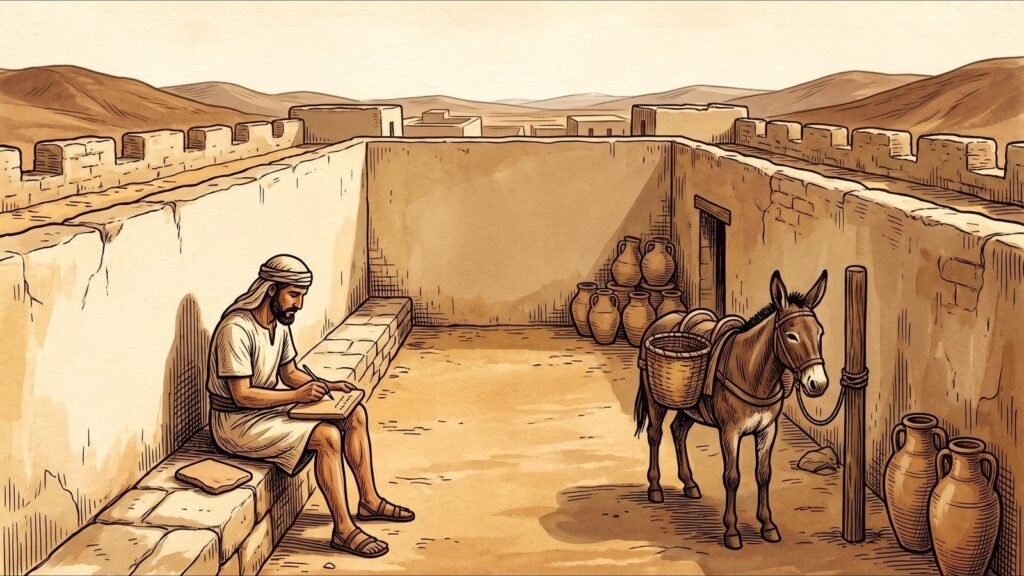
In the northern Negev, on a low hill at the eastern end of the Beersheba Valley, stand the remains of a small fortress that guarded the southern frontier of the kingdom of Judah. Excavations there in the 1960s recovered the largest group of Hebrew inscriptions known from the period of the monarchy: more than one hundred ostraca, potsherds written in ink, most of them dating from the last years of the kingdom around 600 BCE. They include letters and orders sent to the commander and the quartermaster of the fortress, lists of names, records of supplies and fragments of administrative accounts. Known collectively as the Arad ostraca, they offer a direct view of the daily working of a Judahite royal outpost on the eve of the Babylonian conquest.123
The ostraca matter to the history of the Hebrew Bible for several reasons. They are written in the Hebrew language and script of the late monarchy, the same period to which many scholars assign the composition or editing of important parts of the biblical books. They mention persons, places and institutions known from the Bible, including the king of Judah and the house of YHWH. They show how writing was used in the administration of the kingdom, and recent studies of their handwriting have made them a central piece of evidence in the debate about how widely literacy had spread in Judah before the exile.456
This article describes the site and its excavation, the principal groups of texts and their contents, the script and language in which they are written, the sanctuary found within the fortress, and the place of the Arad ostraca in the study of ancient Hebrew writing and of the biblical text.
At a glance
- Site: Tel Arad, a small royal fortress in the eastern Beersheba Valley of the northern Negev, on Judah’s southern frontier.
- 1962–1967: Excavations by Yohanan Aharoni for the Hebrew University and the Israel Exploration Society.
- Corpus: More than 100 Hebrew ostraca from the Iron Age, with later Aramaic, Greek and Arabic texts from the same mound.
- c. 600 BCE: The Eliashib archive: orders to the fortress quartermaster to issue wine, bread, flour and oil, including rations for the Kittim.
- Key texts: Ostracon 18 mentions the house of YHWH; Ostracon 24 orders troops to Ramat-negeb lest Edom come; Ostracon 40 reports trouble from Edom.
- Shrine: A small Judahite sanctuary in the fortress with two altars and a standing stone, now dated to the eighth century BCE.
- 2016–2020: Handwriting studies identify several writers in a small garrison, evidence for literacy in late monarchic Judah.
- Today: Most of the inscriptions are held in the Israel Museum, Jerusalem.
The site of Tel Arad
Tel Arad consists of two distinct parts. The lower city, a large walled town of the Early Bronze Age, was abandoned in the early third millennium BCE and not reoccupied in the biblical period. On a hill at its north-eastern edge, the Iron Age settlers built a series of fortresses, rebuilt several times between the tenth or ninth century and the early sixth century BCE, and later reused in the Persian, Hellenistic, Roman and early Islamic periods. The Iron Age fortress was small, roughly fifty metres square, enclosed by solid or casemate walls, with a gate, storerooms, living quarters and a water system fed from a cistern.78
The fortress lay on a route leading from the Judaean hills towards the Arabah and the land of Edom to the south-east. Together with a chain of other forts in the Beersheba Valley and the eastern Negev, it served to protect the southern border of Judah, to control traffic along the desert roads and to supply royal troops and travellers. Its garrison was small; on the basis of the size of the fortress, recent estimates place it at no more than twenty to thirty soldiers. The biblical name Arad is mentioned in the accounts of the Israelite approach to Canaan and in the list of the towns of Judah, and the identification of the site is not in doubt, since the name appears in the ostraca themselves.91011
Excavation and publication
The site was excavated between 1962 and 1967 by an expedition of the Hebrew University of Jerusalem and the Israel Exploration Society. Ruth Amiran directed the work in the Early Bronze Age city, and Yohanan Aharoni excavated the fortress mound. Aharoni distinguished a sequence of Iron Age strata, numbered from XII at the bottom to VI at the top, and attributed the fortresses to the kings of Judah from Solomon to the end of the monarchy. The ostraca were found in many parts of the mound, in storerooms, rooms of the inner fortress and fill, with the largest and best preserved group coming from the final Judahite stratum.1213
Aharoni published preliminary reports during the excavations and a full edition of the inscriptions in Hebrew in 1975, followed by an English edition prepared with the epigrapher Joseph Naveh in 1981, after Aharoni’s death. The numbering of the ostraca in that edition remains the standard reference. Later editions and handbooks, including those of Dennis Pardee, Johannes Renz and Wolfgang Röllig, F. W. Dobbs-Allsopp and colleagues, and Shmuel Ahituv, have revised many readings and interpretations.1415161718
Aharoni’s stratigraphy was itself revised. In 2002 Ze’ev Herzog, who had taken part in the original excavation, published a reassessment of the fortress mound. He lowered the dates of several strata, argued that the earliest fortress was built in the ninth rather than the tenth century, and redated the sanctuary. These revisions affect the dating of some of the earlier ostraca, but the bulk of the inscriptions, and in particular the archive of Eliashib, remain securely placed in the last phase of the Judahite fortress, around 600 BCE.19
The corpus
The Hebrew inscriptions from Arad number more than one hundred items. Most are ostraca written in black carbon ink with a reed pen on pieces of broken pottery, the cheapest and most readily available writing material in a fortress full of storage jars. A few are incised on whole vessels, including short labels and names. The size of the ostraca varies from small fragments with a few letters to sherds of more than ten centimetres with a dozen or more lines of text, sometimes written on both sides.202122
In addition to the Hebrew texts, the mound produced a substantial group of Aramaic ostraca from the Persian period, dating to the fifth and fourth centuries BCE, which record supplies for men and animals passing through the post, together with a few Greek and Arabic inscriptions from later occupations. These later texts are important for the history of the region, but the Iron Age Hebrew corpus is the main reason for the fame of the site.2324
The state of preservation of the ostraca is uneven. Carbon ink adheres well to pottery but fades with exposure to light and air, and many texts were already difficult to read when they were excavated. Since the 2010s the use of multispectral imaging has improved the reading of several inscriptions. In 2017 a team from Tel Aviv University announced that the reverse of Ostracon 16, long thought to be blank, carried a previously unknown text of several lines, which became visible only under multispectral photography.2526
The archive of Eliashib
The best known group of ostraca is a set of letters addressed to a man named Eliashib son of Eshiyahu, found in a room of the last Judahite fortress. Three seals bearing his name and patronymic were found in the same stratum, which confirms that he was an official of the fortress. The letters are short administrative orders. Most begin with the formula To Eliashib, followed by the transition word and now, and an instruction to issue a stated quantity of supplies to a named person or group. The commodities include wine, measured in baths and jars, flour, measured by the kor and its subdivisions, bread, and oil. The orders often specify the date, or instruct Eliashib to write down the date of issue.272829
The tone and content of the letters suggest that Eliashib was the quartermaster of the fortress, responsible for its stores. The orders came from superiors elsewhere, perhaps at a regional centre, and some from colleagues at neighbouring forts. The same names recur in several letters, and the handwriting studies discussed below suggest that the archive covers a short span of time, perhaps about a month of expenses. Taken together, the letters give a rare picture of the logistics of a small royal garrison: how supplies were received, stored and issued, and how the movement of men and goods was recorded in writing.3031
Many of the orders concern supplies for the Kittim. The term is used in the Bible for the inhabitants of Cyprus and, more broadly, for peoples of the western Mediterranean islands and coasts. At Arad it probably designates a unit of mercenaries of Greek or Cypriot origin serving in the Judahite army, comparable to the Greek mercenaries known to have served the kings of Egypt in the same period. The presence of East Greek pottery at several sites in the Negev and the coastal plain has been cited in support of this view. The Kittim at Arad received regular rations of wine, bread and flour, recorded in the same terms as those of other troops.323334
Ostracon 18 and the house of YHWH
One of the most discussed letters of the Eliashib archive is Ostracon 18. It is addressed to my lord Eliashib, and opens with a greeting invoking the welfare of the recipient in the name of YHWH. The writer then asks Eliashib to issue supplies to a named person and reports on a matter about which Eliashib had given him instructions, ending with a statement that a certain man is staying, or has been placed, in the house of YHWH. The phrase is the same as the biblical expression for the Temple in Jerusalem, and most scholars understand it here in that sense.353637
Some earlier interpreters suggested that the house of YHWH in Ostracon 18 might refer to the sanctuary found at Arad itself. Herzog’s redating of the shrine to the eighth century, long before the archive of Eliashib, makes that interpretation unlikely, since the Arad sanctuary had already gone out of use by the time the letter was written. The reference therefore appears to be to the Temple in Jerusalem, mentioned in an ordinary administrative letter of the late monarchy.383940
Military correspondence and the threat from Edom
Other ostraca concern military matters. The most dramatic is Ostracon 24, a letter written on both sides of a sherd. It orders that men be sent from Arad and from Kinah, another site in the Negev, to Ramat-negeb, under the command of a man named Malkiyahu son of Qerabur, and warns that this must be done lest Edom should come there. The text refers to the king’s command and implies an urgent threat to the southern frontier. Most scholars date it to the last years of the kingdom, when Edom took advantage of the weakness of Judah to press into the Negev, an episode reflected in the hostility to Edom expressed in several prophetic books.414243
Ostracon 40, which Aharoni assigned to an earlier stratum, is a letter from two officials to their superior, Malkiyahu, which also mentions Edom and the king of Judah. Its fragmentary text appears to report on a crisis involving Edomite activity and on the dispatch of messages. The name Malkiyahu recurs in Ostraca 24 and 40, and he is generally understood to have been a commander of the fortress or of the district. The dating of Ostracon 40 and its relation to the archive of Eliashib depend partly on the revised stratigraphy and remain debated.444546
Ostracon 88 is a small, fragmentary text that begins with a statement in the first person, usually read as I have become king, or I have reigned, followed by words that may be read in all. Aharoni suggested that it was a copy of an announcement of the accession of a new king of Judah, perhaps Jehoahaz in 609 BCE. Other scholars have proposed different readings or a different context, and the text is too fragmentary to permit certainty.474849
Lists, names and accounts
Alongside the letters, many Arad ostraca are lists of personal names or accounts of goods. Name lists may record soldiers, workers or recipients of rations, and some include patronymics or family names. The personal names of the Arad ostraca are overwhelmingly Yahwistic, compounded with the divine name in the form yahu, as in Malkiyahu, Gemaryahu, Nehemyahu and Eshiyahu, which is typical of Judah in the late monarchy and matches the onomastic picture of the biblical books of Kings and Jeremiah.505152
Several ostraca bear names that also appear in the Bible, such as the priestly families of Meremoth and Pashhur, and a bowl inscription has been read as referring to the sons of Korah, the guild of Temple singers to whom several psalms are attributed. These identifications show that the same families and groups known from biblical texts were present in the administration of the frontier, though in most cases they do not prove that the persons mentioned are the same individuals as those in the Bible.535455
Accounts on the ostraca record quantities by means of numerals derived from Egyptian hieratic, a cursive form of hieroglyphic writing. Hieratic numerals and measure signs were used throughout the kingdoms of Israel and Judah for administrative purposes, and the Arad ostraca are among the richest sources for their use. The scribes combined Hebrew words for measures, such as bath and kor, with hieratic numerals for quantities, a practice that points to a long tradition of scribal training going back to contacts with Egypt.5657
Script and language
The Arad ostraca are written in the Hebrew script of the late monarchy, a development of the alphabet that the Israelites shared with the Phoenicians and their other neighbours. It is a script of twenty-two consonant letters with no vowel signs, sometimes called Paleo-Hebrew to distinguish it from the square Aramaic-derived script that the Jews adopted after the exile. The Arad hands are cursive and fluent, written quickly with a reed pen, and they show the developed forms of letters characteristic of Judah around 600 BCE, closely matching those of the Lachish letters.585960
The language of the ostraca is Judahite Hebrew of the late monarchy. Its vocabulary, grammar and epistolary formulas are close to those of the prose books of the Bible written or edited in the same period. Greeting formulas invoking YHWH, the use of the word and now to introduce the business of a letter, and the address of a superior as my lord and of oneself as your servant are all paralleled in biblical letters and in the Lachish ostraca. The spelling makes use of matres lectionis, consonants used to indicate vowels, mainly at the ends of words, in a manner consistent with other inscriptions of the period.616263
For the history of the biblical text, these features are important. The Masoretic Text preserves the Hebrew of the biblical books in a form that has passed through many centuries of transmission and in a script that was not used in the period of the monarchy. Inscriptions such as those from Arad allow scholars to compare the language and orthography of the biblical books with texts written in Judah during the period to which many of them refer, and to see which features of the Masoretic spelling reflect older conventions and which are later developments.646566
Literacy in Judah
The Arad ostraca have become central to the debate about literacy in ancient Judah. If writing was confined to a small group of professional scribes in Jerusalem, the composition of extensive literary works such as the historical books of the Bible would have been the work of a few specialists, and its timing would depend on when such a class existed. If, on the other hand, the ability to read and write was widespread among officials and soldiers, a broader base for literary activity can be assumed.6768
In 2016 a team from Tel Aviv University, combining archaeologists, mathematicians and physicists, published an algorithmic analysis of the handwriting of sixteen Arad ostraca. Using computerised methods to compare the shapes of letters, they concluded that the texts were written by at least four to seven different writers. In 2020 the same group published a further study of eighteen texts, combining the algorithms with the independent examination of a professional forensic document examiner. The forensic examination identified a high probability of at least twelve different writers in the sample.6970
Given that the fortress housed only a small garrison and that the archive appears to cover a short span of time, the authors argued that literacy extended through the military and administrative hierarchy of Judah, from the commander down to the quartermaster and his subordinates. They suggested that the existence of such a literate administration made the composition of substantial texts in late monarchic Judah more plausible. Other scholars have questioned the methods or the conclusions, pointing out that letters could be dictated, that officials of different ranks might have employed scribes, and that the sample is small. The debate continues, but the Arad corpus remains its principal data set.717273
The sanctuary at Arad
One of the most remarkable discoveries at Arad was a small sanctuary within the fortress. It consisted of a courtyard with an altar for burnt offerings built of earth and unhewn stones, a broad room and a small raised niche at the back, approached by steps. In the niche stood a standing stone, a massebah, and on the steps leading to it were two limestone altars of different sizes. Aharoni regarded the building as a temple of YHWH in continuous use from the tenth century to the reforms of Hezekiah or Josiah, and saw in it evidence for the existence of local sanctuaries in Judah before the centralisation of worship in Jerusalem.747576
Herzog’s reassessment narrowed the life of the sanctuary to the eighth century BCE and suggested that it was dismantled and buried in the late eighth century, perhaps in connection with the reform attributed to Hezekiah in the books of Kings and Chronicles. The two altars had been laid on their sides and covered with earth, which preserved them and the residues on their surfaces. In 2020 an analysis of those residues identified cannabis on the smaller altar and frankincense on the larger, the first direct evidence for the burning of these substances in a Judahite cult.777879
The sanctuary and the ostraca together illustrate the religious life of a royal outpost. The garrison worshipped YHWH, bore names compounded with his name and greeted one another in letters with blessings in his name. Whether the sanctuary was still in use when the archive of Eliashib was written, and how the frontier cult related to the Temple in Jerusalem, are questions on which the evidence of the ostraca and the stratigraphy must be weighed together.8081
The end of the fortress
The last Judahite fortress at Arad was destroyed in the early sixth century BCE. The destruction is associated with the campaigns of the Babylonian king Nebuchadnezzar II against Judah, which culminated in the capture of Jerusalem in 597 and its destruction in 586 BCE, or with Edomite incursions into the Negev in the same period. Ostracon 24, with its warning lest Edom come, is often read in the light of these events. The fortress was later rebuilt in the Persian period, when the Aramaic ostraca were written, by which time the land of Judah had become a province of a foreign empire and the Negev was largely in Edomite hands.828384
The ostraca thus capture the kingdom of Judah in its final years. Their routine orders for wine and flour, their name lists and their brief reports from the frontier were written at the moment when, according to the biblical account, the prophets Jeremiah and Ezekiel were warning of the coming catastrophe. The Lachish letters, written at another Judahite fortress in the same period, provide a parallel view from the Shephelah, and the two corpora are usually studied together.8586
The Arad ostraca and the Hebrew epigraphic record
The Arad ostraca belong to a body of Hebrew inscriptions from the period of the monarchy that has grown steadily since the nineteenth century. Earlier finds include the Siloam inscription from the reign of Hezekiah and the Samaria ostraca from the northern kingdom; later discoveries include the silver amulets of Ketef Hinnom, with their version of the priestly blessing, and the early inscriptions from Khirbet Qeiyafa. Within this corpus, Arad is distinguished by the number of its texts, by their concentration in a single site and period, and by the variety of their genres.878889
For epigraphers the Arad ostraca provide a dated sequence of letter forms, a range of administrative formulas and a body of personal names that can be compared with the other inscriptions and with the Bible. For historians they offer evidence of the organisation of the royal army and its supply system. For students of religion they document the names, greetings and sanctuary of a Judahite garrison. And for the history of the biblical text they illustrate the Hebrew language and script in which the earliest written forms of many biblical books were set down.909192
Assessment
The Arad ostraca are not literary texts. They contain no prophecies, psalms or narratives, and their value lies precisely in their ordinariness. They show writing as a working tool of the Judahite state: used to order supplies, record names, report on threats and keep accounts. They reveal a garrison in which reading and writing were familiar skills, in which the name of YHWH was invoked in daily correspondence, and in which the house of YHWH in Jerusalem was a point of reference even on a remote frontier.939495
For the study of the Masoretic tradition, the ostraca offer something that later manuscripts cannot: Hebrew as it was actually written in Judah in the generation before the exile. Between these potsherds and the great codices of the Masoretes lie more than fifteen centuries, a change of script, the addition of vowel signs and accents, and a long history of copying. The Arad ostraca allow scholars to measure that distance and to see how much of the language and spelling of the biblical text the Masoretes preserved from the age of the kings.9697
Notes
- Yohanan Aharoni, in cooperation with Joseph Naveh, Arad Inscriptions (Jerusalem: Israel Exploration Society, 1981; Hebrew edition 1975). ↩
- F. W. Dobbs-Allsopp, J. J. M. Roberts, C. L. Seow and R. E. Whitaker, Hebrew Inscriptions: Texts from the Biblical Period of the Monarchy with Concordance (New Haven: Yale University Press, 2005). ↩
- Grokipedia, “Arad ostraca”; Grokipedia, “Tel Arad”. ↩
- F. W. Dobbs-Allsopp, J. J. M. Roberts, C. L. Seow and R. E. Whitaker, Hebrew Inscriptions: Texts from the Biblical Period of the Monarchy with Concordance (New Haven: Yale University Press, 2005). ↩
- Arie Shaus et al., “Forensic Document Examination and Algorithmic Handwriting Analysis of Judahite Biblical Period Inscriptions Reveal Significant Literacy Level”, PLOS ONE 15/9 (2020), e0237962. ↩
- Shira Faigenbaum-Golovin et al., “Algorithmic Handwriting Analysis of Judah’s Military Correspondence Sheds Light on Composition of Biblical Texts”, Proceedings of the National Academy of Sciences 113 (2016), 4664–4669. ↩
- Ze’ev Herzog, “The Fortress Mound at Tel Arad: An Interim Report”, Tel Aviv 29 (2002), 3–109. ↩
- Grokipedia, “Arad ostraca”; Grokipedia, “Tel Arad”. ↩
- Ze’ev Herzog, “The Fortress Mound at Tel Arad: An Interim Report”, Tel Aviv 29 (2002), 3–109. ↩
- Arie Shaus et al., “Forensic Document Examination and Algorithmic Handwriting Analysis of Judahite Biblical Period Inscriptions Reveal Significant Literacy Level”, PLOS ONE 15/9 (2020), e0237962. ↩
- Grokipedia, “Edom”; Grokipedia, “Negev”. ↩
- Yohanan Aharoni, in cooperation with Joseph Naveh, Arad Inscriptions (Jerusalem: Israel Exploration Society, 1981; Hebrew edition 1975). ↩
- Ze’ev Herzog, “The Fortress Mound at Tel Arad: An Interim Report”, Tel Aviv 29 (2002), 3–109. ↩
- Yohanan Aharoni, in cooperation with Joseph Naveh, Arad Inscriptions (Jerusalem: Israel Exploration Society, 1981; Hebrew edition 1975). ↩
- F. W. Dobbs-Allsopp, J. J. M. Roberts, C. L. Seow and R. E. Whitaker, Hebrew Inscriptions: Texts from the Biblical Period of the Monarchy with Concordance (New Haven: Yale University Press, 2005). ↩
- Shmuel Ahituv, Echoes from the Past: Hebrew and Cognate Inscriptions from the Biblical Period (Jerusalem: Carta, 2008). ↩
- Dennis Pardee, Handbook of Ancient Hebrew Letters (Chico, CA: Scholars Press, 1982). ↩
- Johannes Renz and Wolfgang Röllig, Handbuch der althebräischen Epigraphik, vol. 1 (Darmstadt: Wissenschaftliche Buchgesellschaft, 1995). ↩
- Ze’ev Herzog, “The Fortress Mound at Tel Arad: An Interim Report”, Tel Aviv 29 (2002), 3–109. ↩
- Yohanan Aharoni, in cooperation with Joseph Naveh, Arad Inscriptions (Jerusalem: Israel Exploration Society, 1981; Hebrew edition 1975). ↩
- Arie Shaus et al., “Forensic Document Examination and Algorithmic Handwriting Analysis of Judahite Biblical Period Inscriptions Reveal Significant Literacy Level”, PLOS ONE 15/9 (2020), e0237962. ↩
- Grokipedia, “Arad ostraca”; Grokipedia, “Tel Arad”. ↩
- Yohanan Aharoni, in cooperation with Joseph Naveh, Arad Inscriptions (Jerusalem: Israel Exploration Society, 1981; Hebrew edition 1975). ↩
- Grokipedia, “Arad ostraca”; Grokipedia, “Tel Arad”. ↩
- Arie Shaus et al., “Forensic Document Examination and Algorithmic Handwriting Analysis of Judahite Biblical Period Inscriptions Reveal Significant Literacy Level”, PLOS ONE 15/9 (2020), e0237962. ↩
- Anat Mendel-Geberovich et al., “A Brand New Old Inscription: Arad Ostracon 16 Rediscovered via Multispectral Imaging”, Bulletin of the American Schools of Oriental Research 378 (2017). ↩
- Yohanan Aharoni, in cooperation with Joseph Naveh, Arad Inscriptions (Jerusalem: Israel Exploration Society, 1981; Hebrew edition 1975). ↩
- F. W. Dobbs-Allsopp, J. J. M. Roberts, C. L. Seow and R. E. Whitaker, Hebrew Inscriptions: Texts from the Biblical Period of the Monarchy with Concordance (New Haven: Yale University Press, 2005). ↩
- Dennis Pardee, Handbook of Ancient Hebrew Letters (Chico, CA: Scholars Press, 1982). ↩
- Dennis Pardee, Handbook of Ancient Hebrew Letters (Chico, CA: Scholars Press, 1982). ↩
- Arie Shaus et al., “Forensic Document Examination and Algorithmic Handwriting Analysis of Judahite Biblical Period Inscriptions Reveal Significant Literacy Level”, PLOS ONE 15/9 (2020), e0237962. ↩
- F. W. Dobbs-Allsopp, J. J. M. Roberts, C. L. Seow and R. E. Whitaker, Hebrew Inscriptions: Texts from the Biblical Period of the Monarchy with Concordance (New Haven: Yale University Press, 2005). ↩
- Dennis Pardee, Handbook of Ancient Hebrew Letters (Chico, CA: Scholars Press, 1982). ↩
- Grokipedia, “Kittim”. ↩
- Yohanan Aharoni, in cooperation with Joseph Naveh, Arad Inscriptions (Jerusalem: Israel Exploration Society, 1981; Hebrew edition 1975). ↩
- F. W. Dobbs-Allsopp, J. J. M. Roberts, C. L. Seow and R. E. Whitaker, Hebrew Inscriptions: Texts from the Biblical Period of the Monarchy with Concordance (New Haven: Yale University Press, 2005). ↩
- Dennis Pardee, Handbook of Ancient Hebrew Letters (Chico, CA: Scholars Press, 1982). ↩
- Ze’ev Herzog, “The Fortress Mound at Tel Arad: An Interim Report”, Tel Aviv 29 (2002), 3–109. ↩
- Eran Arie, Baruch Rosen and Dvory Namdar, “Cannabis and Frankincense at the Judahite Shrine of Arad”, Tel Aviv 47 (2020), 5–28. ↩
- The Masoretes, “The Ketef Hinnom Scrolls”; Grokipedia, “Yahweh”. ↩
- Yohanan Aharoni, in cooperation with Joseph Naveh, Arad Inscriptions (Jerusalem: Israel Exploration Society, 1981; Hebrew edition 1975). ↩
- F. W. Dobbs-Allsopp, J. J. M. Roberts, C. L. Seow and R. E. Whitaker, Hebrew Inscriptions: Texts from the Biblical Period of the Monarchy with Concordance (New Haven: Yale University Press, 2005). ↩
- Grokipedia, “Edom”; Grokipedia, “Negev”. ↩
- Yohanan Aharoni, in cooperation with Joseph Naveh, Arad Inscriptions (Jerusalem: Israel Exploration Society, 1981; Hebrew edition 1975). ↩
- Ze’ev Herzog, “The Fortress Mound at Tel Arad: An Interim Report”, Tel Aviv 29 (2002), 3–109. ↩
- Arie Shaus et al., “Forensic Document Examination and Algorithmic Handwriting Analysis of Judahite Biblical Period Inscriptions Reveal Significant Literacy Level”, PLOS ONE 15/9 (2020), e0237962. ↩
- Yohanan Aharoni, in cooperation with Joseph Naveh, Arad Inscriptions (Jerusalem: Israel Exploration Society, 1981; Hebrew edition 1975). ↩
- F. W. Dobbs-Allsopp, J. J. M. Roberts, C. L. Seow and R. E. Whitaker, Hebrew Inscriptions: Texts from the Biblical Period of the Monarchy with Concordance (New Haven: Yale University Press, 2005). ↩
- Grokipedia, “Kingdom of Judah”; Grokipedia, “Josiah”; Grokipedia, “Hezekiah”. ↩
- F. W. Dobbs-Allsopp, J. J. M. Roberts, C. L. Seow and R. E. Whitaker, Hebrew Inscriptions: Texts from the Biblical Period of the Monarchy with Concordance (New Haven: Yale University Press, 2005). ↩
- Shmuel Ahituv, Echoes from the Past: Hebrew and Cognate Inscriptions from the Biblical Period (Jerusalem: Carta, 2008). ↩
- The Masoretes, “The Ketef Hinnom Scrolls”; Grokipedia, “Yahweh”. ↩
- Yohanan Aharoni, in cooperation with Joseph Naveh, Arad Inscriptions (Jerusalem: Israel Exploration Society, 1981; Hebrew edition 1975). ↩
- F. W. Dobbs-Allsopp, J. J. M. Roberts, C. L. Seow and R. E. Whitaker, Hebrew Inscriptions: Texts from the Biblical Period of the Monarchy with Concordance (New Haven: Yale University Press, 2005). ↩
- Shmuel Ahituv, Echoes from the Past: Hebrew and Cognate Inscriptions from the Biblical Period (Jerusalem: Carta, 2008). ↩
- F. W. Dobbs-Allsopp, J. J. M. Roberts, C. L. Seow and R. E. Whitaker, Hebrew Inscriptions: Texts from the Biblical Period of the Monarchy with Concordance (New Haven: Yale University Press, 2005). ↩
- Grokipedia, “Paleo-Hebrew alphabet”; Grokipedia, “Hieratic”. ↩
- Grokipedia, “Paleo-Hebrew alphabet”; Grokipedia, “Hieratic”. ↩
- Grokipedia, “Lachish letters”; The Masoretes, “The Lachish Letters and the Last Days of Judah”. ↩
- The Masoretes, “Hebrew and Aramaic”; The Masoretes, “The Alphabet”. ↩
- F. W. Dobbs-Allsopp, J. J. M. Roberts, C. L. Seow and R. E. Whitaker, Hebrew Inscriptions: Texts from the Biblical Period of the Monarchy with Concordance (New Haven: Yale University Press, 2005). ↩
- Dennis Pardee, Handbook of Ancient Hebrew Letters (Chico, CA: Scholars Press, 1982). ↩
- Grokipedia, “Lachish letters”; The Masoretes, “The Lachish Letters and the Last Days of Judah”. ↩
- F. W. Dobbs-Allsopp, J. J. M. Roberts, C. L. Seow and R. E. Whitaker, Hebrew Inscriptions: Texts from the Biblical Period of the Monarchy with Concordance (New Haven: Yale University Press, 2005). ↩
- The Masoretes, “The Khirbet Qeiyafa Ostracon, the Gezer Calendar and the Earliest Hebrew Writing”; The Masoretes, “The Siloam Inscription and Hezekiah’s Tunnel”. ↩
- The Masoretes, “Hebrew and Aramaic”; The Masoretes, “The Alphabet”. ↩
- Arie Shaus et al., “Forensic Document Examination and Algorithmic Handwriting Analysis of Judahite Biblical Period Inscriptions Reveal Significant Literacy Level”, PLOS ONE 15/9 (2020), e0237962. ↩
- Shira Faigenbaum-Golovin et al., “Algorithmic Handwriting Analysis of Judah’s Military Correspondence Sheds Light on Composition of Biblical Texts”, Proceedings of the National Academy of Sciences 113 (2016), 4664–4669. ↩
- The Masoretes, “The Ketef Hinnom Scrolls”; Grokipedia, “Yahweh”. ↩
- Yohanan Aharoni, in cooperation with Joseph Naveh, Arad Inscriptions (Jerusalem: Israel Exploration Society, 1981; Hebrew edition 1975). ↩
- Ze’ev Herzog, “The Fortress Mound at Tel Arad: An Interim Report”, Tel Aviv 29 (2002), 3–109. ↩
- Grokipedia, “Kingdom of Judah”; Grokipedia, “Josiah”; Grokipedia, “Hezekiah”. ↩
- Ze’ev Herzog, “The Fortress Mound at Tel Arad: An Interim Report”, Tel Aviv 29 (2002), 3–109. ↩
- Eran Arie, Baruch Rosen and Dvory Namdar, “Cannabis and Frankincense at the Judahite Shrine of Arad”, Tel Aviv 47 (2020), 5–28. ↩
- Grokipedia, “Kingdom of Judah”; Grokipedia, “Josiah”; Grokipedia, “Hezekiah”. ↩
- Ze’ev Herzog, “The Fortress Mound at Tel Arad: An Interim Report”, Tel Aviv 29 (2002), 3–109. ↩
- The Masoretes, “The Ketef Hinnom Scrolls”; Grokipedia, “Yahweh”. ↩
- Yohanan Aharoni, in cooperation with Joseph Naveh, Arad Inscriptions (Jerusalem: Israel Exploration Society, 1981; Hebrew edition 1975). ↩
- Grokipedia, “Edom”; Grokipedia, “Negev”. ↩
- Grokipedia, “Nebuchadnezzar II”; Grokipedia, “Babylonian captivity”. ↩
- Grokipedia, “Lachish letters”; The Masoretes, “The Lachish Letters and the Last Days of Judah”. ↩
- Grokipedia, “Nebuchadnezzar II”; Grokipedia, “Babylonian captivity”. ↩
- The Masoretes, “The Khirbet Qeiyafa Ostracon, the Gezer Calendar and the Earliest Hebrew Writing”; The Masoretes, “The Siloam Inscription and Hezekiah’s Tunnel”. ↩
- The Masoretes, “The Ketef Hinnom Scrolls”; Grokipedia, “Yahweh”. ↩
- Johannes Renz and Wolfgang Röllig, Handbuch der althebräischen Epigraphik, vol. 1 (Darmstadt: Wissenschaftliche Buchgesellschaft, 1995). ↩
- F. W. Dobbs-Allsopp, J. J. M. Roberts, C. L. Seow and R. E. Whitaker, Hebrew Inscriptions: Texts from the Biblical Period of the Monarchy with Concordance (New Haven: Yale University Press, 2005). ↩
- Shmuel Ahituv, Echoes from the Past: Hebrew and Cognate Inscriptions from the Biblical Period (Jerusalem: Carta, 2008). ↩
- Grokipedia, “Paleo-Hebrew alphabet”; Grokipedia, “Hieratic”. ↩
- F. W. Dobbs-Allsopp, J. J. M. Roberts, C. L. Seow and R. E. Whitaker, Hebrew Inscriptions: Texts from the Biblical Period of the Monarchy with Concordance (New Haven: Yale University Press, 2005). ↩
- Arie Shaus et al., “Forensic Document Examination and Algorithmic Handwriting Analysis of Judahite Biblical Period Inscriptions Reveal Significant Literacy Level”, PLOS ONE 15/9 (2020), e0237962. ↩
- The Masoretes, “The Ketef Hinnom Scrolls”; Grokipedia, “Yahweh”. ↩
- The Masoretes, “The Khirbet Qeiyafa Ostracon, the Gezer Calendar and the Earliest Hebrew Writing”; The Masoretes, “The Siloam Inscription and Hezekiah’s Tunnel”. ↩
- The Masoretes, “Hebrew and Aramaic”; The Masoretes, “The Alphabet”. ↩