

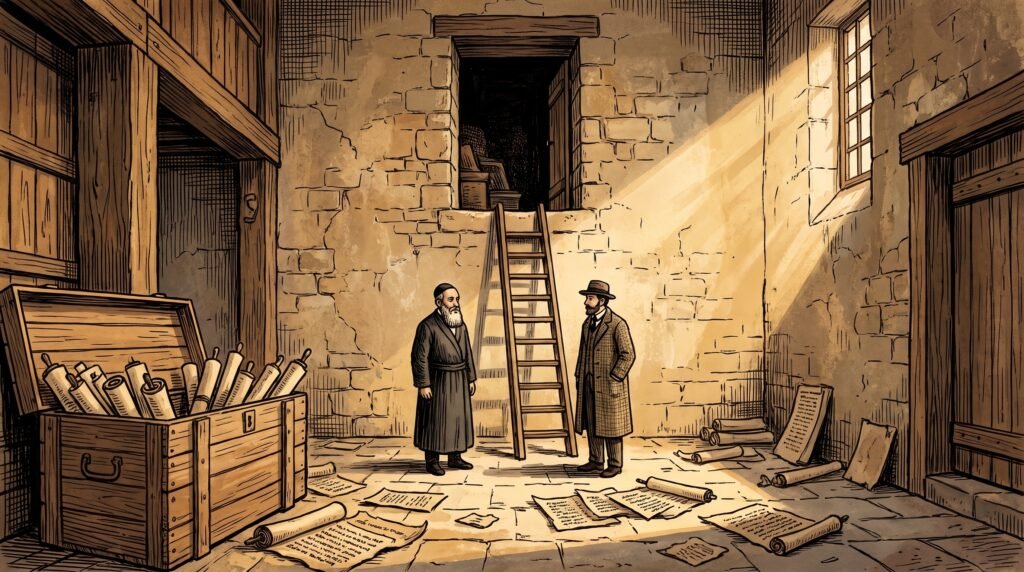
On a January morning in 1897, in the Jewish quarter of Fustat — Old Cairo — a rabbi and a Cambridge scholar climbed a wooden ladder to a small opening in the upper wall of the Ben Ezra Synagogue. The scholar was Solomon Schechter, Reader in Talmudic Studies at the University of Cambridge; the rabbi was Aaron Raphael Ben-Shim’on, the Chief Rabbi of the community. The opening, high in the wall, gave access to a small chamber that had been used, since at least the eleventh century, as a sacred storeroom — a genizah — for the deposit of worn-out Hebrew, Aramaic, Arabic, and Judaeo-Arabic manuscripts. Schechter climbed the ladder first; he jumped down into the chamber; and the manuscripts, centuries of accumulation, were at his feet. The chamber and its contents were, by the end of the year, in Cambridge; the discovery is one of the great finds of nineteenth-century scholarship, comparable in significance to the Dead Sea Scrolls a half-century later, and the scholarship it produced is still, in the early twenty-first century, the central archive of medieval Jewish life in the Arabic-speaking world. This essay is about the genizah, the chamber, the community that filled it, and the long nineteenth-century search that led to its unsealing.
At a glance
- From early 11th c.: The Rabbanite Jewish community of Fustat (Old Cairo) deposits worn religious texts, secular documents, and everyday papers into the genizah chamber of the Ben Ezra Synagogue.
- 15th–19th c.: Continued deposition, including printed books and newspapers into the late 19th century.
- 1864 onwards: Late-Ottoman Cairo: the genizah continues to receive texts through the 19th century.
- 1895–96: The Scottish twin sisters Agnes Smith Lewis and Margaret Dunlop Gibson purchase manuscript leaves from a Cairo bookseller and bring them back to Cambridge.
- 13 May 1896: Solomon Schechter identifies a fragment among their purchases as the long-lost Hebrew original of the Book of Ben Sira (Ecclesiasticus, Sirach).
- 1896 (late): Schechter sets off for Cairo with funding from Charles Taylor, Master of St John’s College, Cambridge.
- January 1897: Schechter’s first visit to the Ben Ezra Synagogue and the genizah chamber.
- February–June 1897: Negotiations with Chief Rabbi Aaron Raphael Ben-Shim’on.
- 3 August 1897: Schechter’s account “A Hoard of Hebrew Mss” published in The Times.
- 1897–1899: Some 193,000 manuscript fragments are shipped from Cairo to Cambridge.
- 1901: The Taylor-Schechter Collection opens at Cambridge University Library.
- 1954: The Moses Gaster collection (11,000 fragments) is purchased by the John Rylands Library, Manchester.
- 2006: The Jacques Mosseri Genizah Collection (7,000 fragments) arrives in Cambridge on a 20-year loan.
- 2014: Cambridge and the Bodleian Library jointly purchase the Lewis-Gibson Collection (1,700 fragments).
- 2015 onward: Cambridge Digital Library begins mass digitisation; tens of thousands of fragments are now viewable.
What a genizah is
A genizah in the older sense is a sacred storeroom — a chamber set aside in a synagogue for the deposit of worn religious texts whose content includes the name of God. The rule is, in substance, that a parchment scroll, a codex, or a loose leaf on which the name of God is written must be stored when it is no longer usable, not thrown out with the household refuse. The community keeps the document in the genizah until such time as the chamber is full and the contents are buried; the documents are, in the meantime, kept in a sacred space that protects them from the indignity of disposal. The custom is, in origin, an extension of the prohibition against destroying objects on which the name of God is written, and the genizah is, in essence, the practical mechanism by which a community handles a manuscript that is no longer usable but that cannot, on religious grounds, be destroyed.
The Ben Ezra Synagogue of Fustat is one of the oldest synagogues in the world. The present building is a nineteenth-century reconstruction of a much older structure; the original synagogue is, on the standard account, a fourth-century foundation that may have been built on the site of an earlier Coptic church. The synagogue was the principal Rabbanite place of worship in Fustat, the old Rabbanite Jewish quarter of Cairo, which was, by the eleventh century, the largest and most prosperous Jewish community in the Mediterranean world. The Rabbanite community of Fustat — a community that included merchants, scholars, physicians, scribes, and rabbinical judges — was, by the eleventh century, a community that produced a substantial body of written records, and the genizah of the Ben Ezra Synagogue was, in the centuries that followed, the principal repository for the community’s worn-out written records.1
The remarkable fact about the Ben Ezra genizah is not, in itself, its existence — almost every synagogue had a genizah, and the practice was standard throughout the Jewish world — but its survival into the late nineteenth century. Most medieval genizot were emptied and buried after a generation or two; the Ben Ezra chamber, for reasons that the historical record does not fully explain, was allowed to accumulate for the better part of a thousand years. By the time Schechter arrived in 1897, the chamber contained the manuscript equivalent of a thousand years of dust, and the contents were, in many cases, already partially destroyed by moisture and vermin. The Cambridge scholars who catalogued the fragments in the years after 1897 would estimate that the chamber had, at the time of its opening, contained upwards of two hundred thousand individual fragments — leaves, quires, codices, loose papers, and a much smaller number of substantial codices.2
Fustat and the Jewish community
Fustat — the old Cairo — was founded in 641 CE as the Arab capital of Egypt. The Jewish community of Fustat was, by the eleventh century, one of the most important Jewish communities in the world; the community included substantial numbers of merchants, scholars, and artisans, and the community’s synagogue, the Ben Ezra, was the principal place of worship. The Rabbanite community of Fustat — the mainstream Jewish community under the authority of the geonic academies of Iraq — was, by the eleventh century, in a long-running dispute with the Palestinian and Karaite communities of Egypt, and the disputes were partly theological and partly about the boundaries of the synagogue and its records. The Ben Ezra genizah is, in part, a record of those disputes, and the documents in the genizah include legal opinions, rabbinical court records, leases, title-deeds, endowment contracts, debt acknowledgments, marriage contracts, and private letters. The genizah is, in substance, the archive of the Rabbanite community of Fustat, preserved not because anyone meant to preserve it but because no one could bring themselves to destroy it.3
The community of Fustat was, in the centuries that followed, displaced and diminished. The city of Cairo, founded in 969 to the north of Fustat, became the new capital; the Rabbanite community gradually moved north, and the old Ben Ezra synagogue fell into partial disuse. By the fifteenth century the synagogue was, in part, a ruin; the genizah chamber continued to receive deposits from the diminished Rabbanite community of Cairo, but the volume of new deposits was, by the early modern period, small. The synagogue was, in the nineteenth century, rebuilt by the Egyptian Jewish community with the support of the British and French Jewish communities, and the rebuilt synagogue was, in the 1890s, the focus of the Cairo Jewish community’s most important religious life.4
The remarkable range of the genizah’s contents reflects the range of the community that filled it. The genizah contained, in addition to the expected religious texts — Bibles, prayer books, compendia of Jewish law, and the like — a vast body of secular documents: business letters, marriage contracts, divorce deeds, school exercises, magical amulets, shopping lists, pages from Arabic fables, works of Sufi and Shi’ite philosophy, medical books, and hundreds of private letters in Judaeo-Arabic. The genizah also contained, in much smaller numbers, substantial codices that had been placed in the chamber as a whole — for example, a complete Talmudic tractate, or a Bible codex, that was no longer usable but that could not, on religious grounds, be disposed of by any other means. The Zadokite Fragment, the most consequential single document found in the genizah, was a substantial portion of a longer work — the Damascus Document — that had been placed in the chamber as a worn codex.5
The late-Ottoman genizah
The genizah continued to receive deposits into the nineteenth century, long after the great age of the medieval Jewish community of Fustat had passed. The Cambridge Digital Library’s Genizah Research Unit has, in recent years, established that the last securely dated fragment placed in the chamber before Schechter’s arrival is a piece of an Arabic newspaper from summer 1895 — T-S NS 297.284. The fact that the chamber was still receiving newspaper fragments in the 1890s is, in itself, a striking testimony to the persistence of the genizah custom; the modern reader of the genizah catalogues will find, alongside the medieval legal documents and the Maimonides autographs, a steady stream of nineteenth-century letters, printed sheets, and newspaper fragments that show the community of Cairo continuing to deposit in the chamber as a matter of habit and religious observance.6
The late-Ottoman genizah is, in its own right, a substantial historical resource. The nineteenth-century fragments include documents directly related to the marriage and divorce customs of the Cairo Jewish community, the history of Middle Eastern printing, Jewish migration patterns, the book trade between Europe and Egypt, and the lives of prominent members of the Egyptian Jewish community. The recent work of Amir Ashur and the Cambridge Genizah Research Unit has shown that the late-Ottoman deposits are a more substantial historical resource than the older scholarship had assumed, and the catalogue of late fragments is now a major strand of the Genizah Research Unit’s work.7
The nineteenth-century genizah also raises questions about the relationship between the older deposits and the newer ones. The early-twentieth-century assumption, following the work of Schechter himself, was that the chamber had received its principal contents before the fourteenth century and that the later deposits were a thin veneer on top. The recent work of the Genizah Research Unit has shown that the later deposits are more substantial than had been assumed, and that the chamber was, in the seventeenth, eighteenth, and nineteenth centuries, a working genizah that continued to receive documents from the Cairo community. The Cambridge catalogue now distinguishes, by date, the earlier from the later fragments, and the historical work on the community of Cairo is, accordingly, more nuanced than the older scholarship allowed.8
Lewis and Gibson
Agnes Smith Lewis (1843-1926) and Margaret Dunlop Gibson (1843-1920) were identical twin sisters, daughters of a Scottish shipping agent, who between them learned twelve languages — including Hebrew, Arabic, Syriac, Ethiopic, and Coptic. The sisters travelled repeatedly to the Middle East, often in the company of their husbands, and on each trip acquired manuscript leaves from local dealers. The manuscripts that they brought back to Cambridge in 1895-96 were, on the sisters’ own account, purchased from a Cairo bookseller — a dealer who had acquired them, directly or indirectly, from the Ben Ezra synagogue. The Cambridge scholar Solomon Schechter, who was then Reader in Talmudic Studies at the University of Cambridge, was shown the manuscripts by the sisters on or about 13 May 1896, and the moment of recognition was the moment at which the genizah became known to the modern scholarly world.9
What Schechter saw, on 13 May 1896, was a fragment of the long-lost Hebrew original of the Book of Ben Sira — Ecclesiasticus, Sirach — a deuterocanonical wisdom text composed in Hebrew in the second century BCE and previously known only in Greek, Syriac, and Latin translations. The recognition of a substantial Hebrew portion of Ben Sira was a sensation in 1896; it was the most consequential single manuscript discovery of the late nineteenth century. The sisters’ manuscript, in the event, contained only a small portion of the Hebrew Ben Sira (xxxix.15 to xl.7), but the existence of the Hebrew original was confirmed in the months that followed, and the discovery was the spark that sent Schechter to Cairo in late 1896.10
The role of the sisters in the discovery has been, in the years since, somewhat obscured by the focus on Schechter. The standard scholarly account credits Schechter with the identification of the Hebrew Ben Sira and with the expedition to Cairo; the standard account gives the sisters the role of donors and travel companions. The Cambridge University Library’s own account of the discovery, in its online Genizah Research Unit pages, has been at pains in recent years to restore the sisters’ role, and the modern visitor to the Library will find the sisters’ manuscript cases and the sisters’ published accounts of their travels presented as the centre of the narrative. The sisters’ own writings — Agnes Lewis’s translations of the Palestinian Syriac lectionaries, Margaret Gibson’s accounts of their travels — are, in the Cambridge presentation, the entry points into the larger story.11
Schechter in Cairo
Solomon Schechter arrived in Cairo in late 1896, with the financial support of Charles Taylor, Master of St John’s College, Cambridge. The funds were substantial — Taylor is reported to have committed some £500 of his own money to the expedition, a sum equivalent to perhaps £50,000 in early-twenty-first-century terms — and they were necessary because the Cairo Jewish community was, in the late 1890s, suspicious of European scholarly interest in the genizah. The suspicion was well-founded: the earlier scholarly visitors to the chamber had, in some cases, removed fragments without permission, and the community had, by the 1890s, become cautious about further visits. Schechter’s first task, on his arrival, was to negotiate access with the community’s Chief Rabbi, Aaron Raphael Ben-Shim’on.12
The negotiations took several months. Schechter’s first visit to the chamber, in January 1897, was by personal favour from Ben-Shim’on rather than by formal agreement; the formal agreement to remove the bulk of the chamber’s contents to Cambridge was concluded in the spring of 1897. The agreement was, in substance, a sale rather than a donation — the community was paid for the contents, and the money was used, in part, to defray the community’s debts and, in part, to fund the reconstruction of the Ben Ezra Synagogue. The arrangement was, by the standards of the time, generous; the modern reader of the Cambridge archives will find that Schechter himself was uneasy about the commercial aspect of the arrangement, and his letters to Taylor in the spring of 1897 express a recurring worry about the appearance of exploitation.13
The chamber itself, when Schechter first saw it, was a small room with an opening high in the end wall. The opening was, by his own account, “a rickety ladder which had its rungs widely-spaced.” Schechter climbed the ladder and jumped down into the chamber, landing on centuries of fragments; the description of the jump is one of the most quoted passages in the literature of the genizah discovery. The fragments were, by his account, “a confused heap” covering the floor of the chamber to a depth of several feet; the chamber was, in substance, full. The contents were, on the day of Schechter’s first visit, roughly the same as on the day of his formal agreement with Ben-Shim’on; the community did not, in the months between January and June, make any systematic attempt to sort or catalog the contents before Schechter’s return.14
The packing cases
Between February and June 1897, Schechter and a team of local workers packed the contents of the chamber into some twenty-two wooden cases and shipped them, by sea, from Alexandria to Cambridge. The packing was not, by the standards of modern manuscript conservation, particularly careful; many of the fragments were packed in loose heaps, with little protection against moisture, and the voyage from Alexandria to Cambridge was, by the standards of the time, slow. The cases were received in Cambridge in the autumn of 1897 and opened at the University Library under Schechter’s supervision; the opening of the cases was, in its own right, a substantial scholarly event, with Schechter working through the contents in a long series of sessions that continued for several months.15
The total number of fragments brought to Cambridge is, in the modern catalogues, given as roughly 193,000 — a figure that the Cambridge University Library’s Genizah Research Unit treats as approximate, because many of the fragments were, by the time they reached Cambridge, broken or partially destroyed, and the count is, in part, a count of identifiable fragments rather than of individual leaves. The total number of individual leaves is estimated to be roughly a quarter of a million — substantially more than the number of fragments, because many fragments consist of several leaves bound together or compressed into a single object. The discrepancy between the figure of 193,000 fragments and the higher figure of a quarter of a million leaves is, in the older literature, a source of confusion; the modern Cambridge account treats both figures as approximate.16
The contents of the cases were, in the years after their arrival in Cambridge, the subject of a long and methodical cataloguing effort. Schechter himself worked through a substantial portion of the fragments in the years 1898-1902, with the help of a small team of cataloguers and the support of the Taylor family (the funds being the same Charles Taylor who had funded the Cairo expedition). The first published catalogue — the so-called “Schechter catalogue” — appeared in 1903 as Saadyana, a volume of texts from the genizah with Schechter’s introductions. The Cambridge University Library’s full catalogue of the Taylor-Schechter Collection is still, in the early twenty-first century, a work in progress; the digitisation programme of 2015 onward has, in the years since 2015, transformed the accessibility of the collection, and the Genizah Research Unit’s online catalogue now includes a substantial proportion of the surviving fragments.17
The dispersal
The Taylor-Schechter Collection was, from the start, only one of several repositories of the Cairo genizah. The Cambridge expedition of 1897-99 removed the bulk of the chamber’s contents, but substantial quantities of fragments remained in Cairo, were sold to other dealers, or were acquired by other collectors. The Cambridge collection is, by the modern count, roughly 60 per cent of the surviving fragments; the remainder is dispersed across more than a dozen libraries and private collections. The principal other collections are, in alphabetical order, the Bodleian Library, Oxford; the British Library; the John Rylands Library, Manchester; the Jewish Theological Seminary of America, New York; the Library of the Jewish Theological Seminary of Breslau (now partly recovered); the National Library of France; and the National Library of Russia. Smaller collections are held by the Schocken Institute in Jerusalem, the Alliance Israélite Universelle in Paris, and a number of American and European university libraries.18
The dispersal is, in part, the result of a deliberate policy of the late nineteenth and early twentieth centuries. Schechter and his Cambridge colleagues were aware, from the early days of the collection, that the Cairo expedition could not remove the entire chamber; the chamber was, by the time of the formal agreement, partially inaccessible, and the community had, in the years before Schechter’s arrival, sold substantial quantities of fragments to local dealers. The dealers had, in turn, sold fragments to European collectors; the brothers Wertheimer, in particular, had shipped quantities of Cairo fragments to Jerusalem and to various European libraries before Schechter’s arrival, and the early-twentieth-century catalogues of the Bodleian Library and the Jewish Theological Seminary include substantial numbers of fragments acquired from the Wertheimer stock.19
The dispersal is also, in part, the result of later acquisitions. The Jacques Mosseri Collection, assembled by the Cairo businessman Jacques Mosseri in the early twentieth century, was purchased in 2004 by a consortium of Cambridge institutions and is now on a 20-year loan to Cambridge University Library. The Lewis-Gibson Collection — the fragments that the sisters themselves had purchased in 1895-96 and a number of subsequent acquisitions — was purchased jointly by Cambridge and the Bodleian in 2014, and the 1,700 fragments in the collection are now divided between the two libraries. The Cambridge Genizah Research Unit, established in 2004, is the international centre for the study of the genizah, and the unit’s work includes the integration of the various dispersed collections into a single digital catalogue.20
The Zadokite Fragment
The Zadokite Fragment, identified by Schechter among the first fragments he examined in 1896-97, is one of the most consequential single documents in the genizah. The fragment is a substantial portion of a longer work — the Damascus Document, or Serekh ha-Yahad — that had been placed in the chamber as a worn codex. The fragment was, in 1896, the first substantial piece of a previously unknown Jewish sectarian text; the text itself was, on Schechter’s reading, the work of a Jewish sect that had existed in the Second Temple period and that had preserved a distinctive set of halakhic and theological positions. Schechter named the text the “Zadokite Fragment” because of its claim to be the work of the Zadokite priestly line.21
The significance of the Zadokite Fragment became apparent fifty years after Schechter’s identification, when the discovery of the Dead Sea Scrolls at Qumran in 1947-56 produced a substantial corpus of texts from a Jewish sect that, on the standard interpretation, was the community that had produced the Damascus Document. The Qumran scrolls include several substantial copies of the Damascus Document, and the relationship between the genizah fragment and the Qumran copies is, in substance, the relationship between a single witness that had been preserved by the Cairo community and a larger body of manuscripts that had been preserved, in the wilderness, by the community that had produced them. The identification of the genizah fragment as a text of the Qumran sect was, in 1947-56, one of the central discoveries of the Dead Sea Scrolls scholarship, and the genizah fragment has, since 1956, been treated as a Qumran text.22
The Zadokite Fragment is, in substance, the bridge between the genizah and the Dead Sea Scrolls. The fragment was, when Schechter found it, a wholly new text, but the text was, by 1956, recognisable as a text of the Qumran sect. The relationship between the genizah and the scrolls has, in the years since 1956, been a central strand of the Genizah Research Unit’s work; the modern catalogues of the Taylor-Schechter Collection include several hundred fragments that have been reidentified, in the post-Qumran scholarship, as fragments of texts preserved more fully in the Qumran corpus. The Ben Sira fragments, in particular, have been augmented by the post-Qumran discoveries of additional Hebrew Ben Sira manuscripts at Masada and elsewhere, and the modern critical edition of Ben Sira uses both the genizah and the Qumran-era Dead Sea Scrolls evidence.23
Strengths and limits
What the Cairo Genizah has done for the modern study of medieval Jewish life is, in summary, three things. It has provided an archive — the largest single archive of medieval Jewish manuscripts in existence — that documents the everyday life of a Jewish community in the Arabic-speaking world over the better part of a thousand years. It has provided the textual basis for the modern critical editions of several important texts — most notably the Hebrew Ben Sira, the Zadokite Fragment, and a substantial body of liturgical and legal texts. It has provided the documentary basis for a social history of medieval Jewish life — S. D. Goitein’s A Mediterranean Society — that is, in its scope and its detail, one of the great works of twentieth-century social history. The genizah is, in substance, the single most important single resource for the modern study of medieval Jewish life.
The limits of the genizah are also real. The chamber was, in substance, the archive of a single community — the Rabbanite community of Fustat — and the documents in it are, accordingly, documents of a single perspective on medieval Jewish life. The Karaite community of Cairo had its own genizah, and the Karaite fragments have been dispersed across a different set of collections; the genizah of the Ben Ezra Synagogue does not, in itself, give access to the Karaite materials. The Christian-Persian tradition of Cairo, and the Muslim majority of Cairo, are, by the same token, documented in other archives that the genizah does not speak for. The reader of the genizah catalogues will find, in addition, that the chamber’s contents are not, by modern standards, evenly preserved: the most precious documents — the Maimonides autographs, for example — were the first to be recognised by the dealers, and the community’s least important documents are, in the genizah, the most numerous.
The genizah is, in short, a find that has transformed the modern study of medieval Jewish life, and the digital resources that the Cambridge Genizah Research Unit has, since 2015, made available are now the entry point for any serious scholarly work on the period. The chamber’s contents are not, however, the entirety of the medieval Jewish archive; they are the archive of one community in one city in one corner of the medieval Arabic-speaking world. The reader who wants the full story will need to combine the genizah with the documentary papyri from the Cairo synagogue records, with the Cairo Genizah’s parallel Karaite materials, and with the substantial body of medieval Jewish documents that have been found elsewhere in Egypt and in the wider Mediterranean world. The Cairo Genizah is the centre of the picture, but it is not the whole of it.
Examples of practically every kind of written text produced by the Jewish communities of the Near East can now be found in the Genizah Collection, and it presents an unparalleled insight into the medieval Jewish world.
Cambridge University Library, “The Taylor-Schechter Cairo Genizah Collection: A Priceless Collection,” https://www.lib.cam.ac.uk/collections/departments/taylor-schechter-genizah-research-unit/taylor-schechter-genizah-priceless (accessed 9 October 2026).
Related on The Masoretes
- From the resource hub: The Cairo Genizah
- From the resource hub: The Ben Ezra Synagogue of Fustat
- From the resource hub: Solomon Schechter (1847–1915)
- From the resource hub: The Taylor-Schechter Collection
- From the journal: The Leningrad Codex (B19a), the Oldest Complete Hebrew Bible (St Petersburg, 1008)
- From the journal: The Tiberias Masoretes: The Ben Asher and Ben Naphtali Schools (Tiberias, 8th–9th c.)
- From the journal: Christian David Ginsburg: A Christian Scholar’s Life on the Masorah (London, 1831–1914)
Notes
- On the genizah custom and the prohibition against destroying objects on which the name of God is written, see the standard account in the Jewish Encyclopedia (1906), s.v. “Genizah,” and the fuller discussion in S. C. Reif, The Cambridge Genizah Collections: Their Contents and Significance (Cambridge: Cambridge University Press, 2002), ch. 1.
- On the survival of the Ben Ezra genizah into the late nineteenth century, see S. C. Reif, “A Glimpse of the Cairo Genizah,” in Journal of Jewish Studies 53 (2002), 1-24, and the standard accounts in the Cambridge Genizah Research Unit’s online presentation.
- On the community of Fustat, see S. D. Goitein, A Mediterranean Society: The Jewish Communities of the Arab World as Portrayed in the Documents of the Cairo Geniza, 6 vols. (Berkeley: University of California Press, 1967-93), vol. 1, and the shorter account in M. R. Cohen, Under Crescent and Cross: The Jews in the Middle Ages (Princeton: Princeton University Press, 1994).
- On the history of the Ben Ezra Synagogue, see the entry in the Encyclopaedia Judaica, 2nd ed., and the recent architectural history in A. El-Hassan and S. C. Reif, “The Ben Ezra Synagogue of Cairo: Architectural and Religious History,” in Journal of Jewish Art 30 (2004).
- On the range of the genizah’s contents, see S. C. Reif, The Cambridge Genizah Collections, ch. 2, and the standard introductory chapter in the Cambridge Digital Library’s online presentation.
- On the late-Ottoman genizah and the last dated fragment, see A. Ashur, “Searching for the Last Genizah Fragment in Late Ottoman Cairo,” in International Journal of Middle East Studies 54 (2022), 211-232.
- On the late-Ottoman deposits as a historical resource, see the standard accounts in the Cambridge Genizah Research Unit’s online catalogue, https://www.lib.cam.ac.uk/genizah-fragments.
- On the relative weight of the late deposits, see the discussion in S. C. Reif, The Cambridge Genizah Collections, ch. 3, and the more recent reassessments in the Genizah Research Unit’s publications.
- On Lewis and Gibson, see their own published accounts — A. S. Lewis, Some Pages of the Four Gospels Retranscribed from the Sinaitic Palimpsest (London, 1896), and the biographical account by J. E. M. Llewelyn, The Sisters of Sinai (London, 1955, repr. 2014).
- On the 13 May 1896 identification of the Hebrew Ben Sira, see S. Schechter’s own account in “A Hoard of Hebrew Mss,” The Times, 3 August 1897, and the longer discussion in the standard biographies.
- On the role of the sisters, see the recent reassessment in the Cambridge University Library’s Genizah Research Unit pages, https://www.lib.cam.ac.uk/genizah-fragments/solomon-schechter.
- On the negotiations with Ben-Shim’on, see S. Schechter’s letters to C. Taylor, in the Cambridge University Library’s Schechter archive (CUL MS Add. 8182), and the account in the standard biographies.
- On the financial arrangements, see the correspondence in the Taylor archive at St John’s College, Cambridge, summarised in S. C. Reif, The Cambridge Genizah Collections, ch. 4.
- S. Schechter, “A Hoard of Hebrew Mss,” The Times, 3 August 1897. The description of the ladder and the jump is in this article; the passage has been widely quoted since.
- On the packing and shipping, see the Cambridge University Library’s Genizah Research Unit pages, https://www.lib.cam.ac.uk/genizah-fragments.
- On the 193,000 figure, see the Cambridge University Library’s Taylor-Schechter Cairo Genizah Collection page (9 October 2026).
- On the Schechter catalogue, see S. Schechter, Saadyana (Cambridge, 1903), and the modern account in S. C. Reif, The Cambridge Genizah Collections, ch. 5.
- On the dispersal, see the standard accounts in the Jewish Virtual Library (https://www.jewishvirtuallibrary.org/genizah-cairo) and in S. C. Reif, The Cambridge Genizah Collections, ch. 6.
- On the Wertheimer sales and the pre-Schechter dispersal, see the standard account in S. C. Reif, “The Wertheimer Fragments and the Cambridge Genizah,” in Jewish Quarterly Review 92 (2001), 131-150.
- On the Mosseri and Lewis-Gibbon acquisitions, see the Cambridge University Library press releases of 2004 and 2014.
- On the Zadokite Fragment, see S. Schechter, “Fragments of a Zadokite Work,” in Jewish Quarterly Review 12 (1910), 415-456, and the standard account in the modern Qumran scholarship.
- On the Qumran identification of the Zadokite Fragment, see M. Burrows, The Dead Sea Scrolls (New York: Viking, 1955), and the standard modern accounts in J. C. VanderKam, The Dead Sea Scrolls Today, 2nd ed. (London: SPCK, 2010).
- On the Ben Sira fragments and the Qumran-era evidence, see P. C. Beentjes, The Book of Ben Sira in Hebrew (Atlanta: Scholars Press, 1997), and the modern critical edition by B. G. Wright, Jesus Ben Sira of Jerusalem: A Biblical Guide to Living Wisely (Indianapolis: Indiana University Press, 2020).
Sources & Further Reading
Primary sources
- The Taylor-Schechter Collection at Cambridge University Library, with tens of thousands of fragments digitised on Cambridge Digital Library, https://cudl.lib.cam.ac.uk/collections/genizah.
- Solomon Schechter, “A Hoard of Hebrew Mss,” The Times, 3 August 1897.
- Solomon Schechter, Saadyana (Cambridge, 1903) — the first major published study using genizah sources.
- Adolf Neubauer and A. E. Cowley, The Original Hebrew of a Portion of Ecclesiasticus (xxxix.14–xlix.11) (Oxford, 1897).
- The Schechter-Taylor correspondence, Cambridge University Library, MS Add. 8182.
- The Cambridge Genizah Research Unit’s online catalogue and the Cambridge Digital Library Genizah Series.
Modern studies
- Stefan C. Reif, The Cambridge Genizah Collections: Their Contents and Significance (Cambridge: Cambridge University Press, 2002).
- S. D. Goitein, A Mediterranean Society: The Jewish Communities of the Arab World as Portrayed in the Documents of the Cairo Geniza, 6 vols. (Berkeley: University of California Press, 1967-93).
- Mark R. Cohen, Under Crescent and Cross: The Jews in the Middle Ages (Princeton: Princeton University Press, 1994).
- Amir Ashur, “Searching for the Last Genizah Fragment in Late Ottoman Cairo,” in International Journal of Middle East Studies 54 (2022), 211-232.
- Philip F. Kennedy, the Cambridge Genizah blog series, https://www.lib.cam.ac.uk/genizah-fragments.
- The Jewish Virtual Library entry, “Genizah, Cairo,” https://www.jewishvirtuallibrary.org/genizah-cairo.
- Geoffrey Khan, The Early Karaite Tradition of Hebrew Grammatical Thought (Leiden: Brill, 2000).
- The Encyclopaedia Judaica, 2nd ed., s.v. “Genizah” and “Cairo.”
By dan · Reading time: about 24 minutes · Filed in Discovery & Recovery · Tagged: Cairo Genizah, Ben Ezra Synagogue, Solomon Schechter, Agnes Lewis, Margaret Gibson, Charles Taylor, Aaron Raphael Ben-Shim’on, Taylor-Schechter Collection, Zadokite Fragment, Ben Sira, S. D. Goitein.