

A City on the Lake
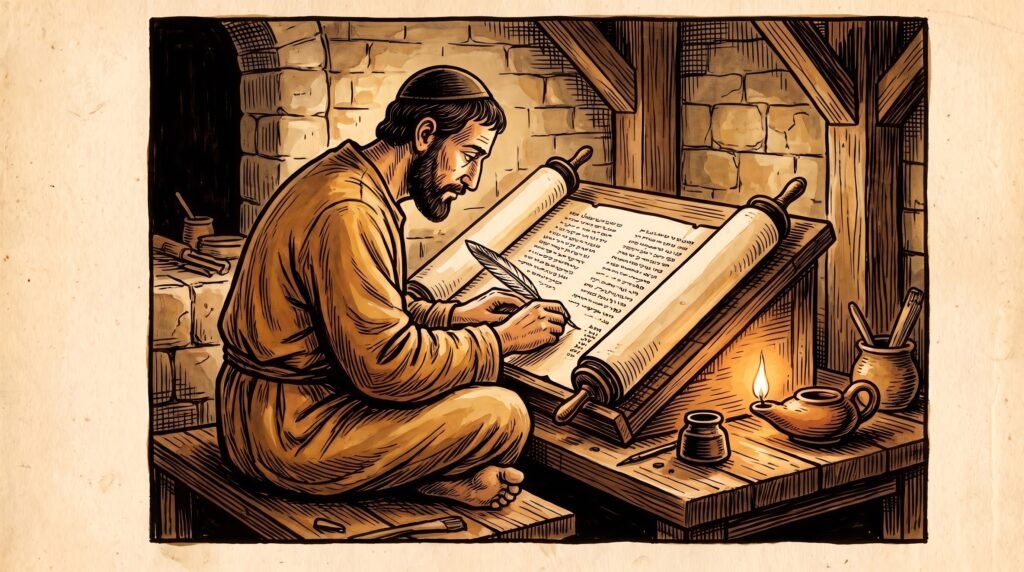
The lowest town on the western shore of the Sea of Galilee, Tiberias, was, by the late seventh century of the Common Era, the only place in the world where the Hebrew Bible was still being copied with any care. The temple in Jerusalem had not stood for almost six centuries; the southern centre of rabbinic learning at Caesarea had been sacked in the Persian invasion of 614; the Babylonian academies at Sura and Pumbedita, though still active, worked from a different textual lineage. In the little Galilean town the scribes who had inherited the older Judaean and Galilean traditions sat over their parchment and tried to preserve, letter by letter and accent by accent, the reading of the Torah and the Prophets and the Writings that they had been taught.
This was the soil from which the Tiberian Masorah grew. The Masorah itself is the apparatus of marginal notes, interlinear vocalisation, accentuation and cross references that the Tiberian scribes attached to the consonantal text of the Hebrew Bible. Without it the Bible would still be readable in synagogue, but only by an initiate; with it, even a child can parse the verse aloud and arrive at something close to the traditional reading. The Masorah is not a translation, and not a paraphrase. It is, more than anything else, a set of careful instructions, written by hand into the margin of the page, that locks the consonantal text of the Hebrew Bible to a single tradition of recitation.
For roughly four centuries, from about the seventh to the eleventh century, three competing Masoretic traditions could still be found in the eastern Mediterranean world. The Babylonian, the Palestinian, and the Tiberian. The Babylonian Masorah attached a different system of vowels and accents to the consonantal text, the system that survives in the printed Yemenite Bible; the Palestinian Masorah preserved an even older system of superlinear vowel points, of which only a handful of manuscripts and fragments remain. By the tenth century the Tiberian tradition had begun to crowd its two rivals aside. Two scribal families did most of the work: the family of Ben Asher on one side, and the family of Ben Naphtali on the other. Their disagreements, recorded in a careful set of marginal notes that modern editors call the Differences, give us a window onto the closing centuries of the Masoretic age.
The Family of Ben Asher
The Ben Asher family served the Tiberian synagogue and study house for at least five generations, beginning with a scribe whom early sources call simply Asher the Elder. His grandson, Moses ben Asher, is the first member of the line who can be located with confidence. Around the middle of the ninth century Moses prepared a manuscript of the entire Bible and wrote, in an appended colophon, the famous claim that he had written the work carefully from ancient codices, that he had divided the verses, and that he had pointed the text vowel by vowel. This colophon is preserved in a single fragment now held at the Leningrad Public Library, and its style of writing is one of the diagnostic features that scholars use to identify texts in the Ben Asher manner.
Moses’s son and grandson, Asher ben Moses ben Asher and finally Aaron ben Moses ben Asher, brought the family and the Tiberian school to its highest point. Aaron ben Moses ben Asher, who is customarily dated to the late tenth and early eleventh century, copied the Aleppo Codex in Tiberias around the year 920 CE. The exact year is uncertain, and the colophon has been lost with the Codex itself, but the consensus of recent scholarship places the copy in the first decades of the tenth century. Aaron’s own commentary on the Masorah, sometimes printed under the title Diqduqei ha-Te’amim, or Treatise on the Accents, was the most rigorous examination of the Tiberian accent system produced in his generation; in it he defends the choices he made in pointing the Aleppo Codex, and explains the constraints under which he worked.
The precision that Aaron brought to his work is extraordinary even by the standards of tenth-century scribalism. He counted verses, words and letters; he cross-referenced the consonantal text of every quotation back to its source; he eliminated, by deliberate choice, marginal readings that he judged to be later accretions. The Aleppo Codex, as it has come down to us, is the earliest known manuscript of the Hebrew Bible that contains all three parts (Torah, Prophets and Writings) with full Tiberian vocalisation and full Masoretic annotation. For the section that survives today, it is the single most reliable witness to the Ben Asher tradition.
Aaron ben Moses ben Asher did not claim that his text was inspired or that his work was without error. The colophon to the Aleppo Codex, in the lines that survive in medieval quotations, declares simply that the text was prepared carefully, that the work had been tested by comparison with older books, and that anyone who found a divergence should consult the original source rather than the copy. This pragmatic and empirical statement is one of the things that distinguishes Ben Asher practice from the more confident claims of the rival family.
The Family of Ben Naphtali
If Aaron ben Moses ben Asher is the single most representative Tiberian Masorite, his near contemporary Moses ben Naphtali is his closest counterpart on the other side of a careful but resolvable disagreement. Moses ben Naphtali himself cannot be located by name in any extant manuscript, but the text-form that medieval catalogues attribute to him is recognisably different in nearly three hundred places from the Ben Asher text. These differences, catalogued since the eleventh century in writings known as the Lists of Differences between Ben Asher and Ben Naphtali, are the working data of Masoretic criticism.
Ben Naphtali practice appears to have been centred in Tiberias itself in the tenth and eleventh centuries, in the same synagogue and study-house complex where the Ben Asher scribes worked. Some medieval sources treat them as rival teams within the same scholarly community; others treat them as branch families with distinct lineages. The truth is uncertain and has been the subject of much contention in twentieth-century Masoretic studies. What is empirically evident is that the disagreements are consistent and are passed down from generation to generation within each family, so that any given Tiberian manuscript from the tenth century onward can usually be assigned to one or other camp by its spellings, vocalisations and accent placements.
The Ben Naphtali differences are not confined to any one section of the Bible. The corpus of variations includes changes in orthography, in the placing of certain accent signs, in the use of mater lectionis letters for long vowels, and in the pointed reading of several dozen words. The disagreements almost never touch the consonantal text itself, which both families transmit in essentially the same form; the doctrines of Tiberian Masorah are designed precisely to specify the pronunciation, the cantillation and the syntactic phrasing without altering the consonantal skeleton.
Moses ben Naphtali himself wrote or is credited with a treatise in defence of his family’s readings, parts of which were preserved and quoted in later medieval works. An interesting aside: the Jewish communities of northern Europe and the Iberian peninsula almost always sided with Ben Naphtali in their printed Bibles until the late Middle Ages, while the communities of the Islamic east, including Babylon and Egypt, sided with Ben Asher. This east-versus-west split is one of the first divides that an editor of the printed Mikraot Gedolot notices when collating editions of the fifteenth and sixteenth centuries.
The Lists of Differences
The catalogue of differences between the two Tiberian schools is one of the great labour-saving inventions of the medieval Masoretes. Beginning at least as early as the eleventh century, scribes and scholars began to compile parallel lists that recorded, in a standardised format, every word or phrase in which the two traditions disagreed. Some lists ran to two or three hundred entries; others ran much longer. The most important single such list, sometimes called the Long List, includes between eight hundred and nine hundred distinct differences, depending on how one counts multiple entries for the same phrase.
The Lists of Differences are critical to the modern critical apparatus of the Hebrew Bible for an obvious reason. The apparatus must distinguish readings supported by one Tiberian tradition from readings supported by the other, since otherwise the reader would be unable to evaluate any subsequent manuscript. In most cases the two families agreed, and the apparatus simply records that the verse is uncontradicted in the Tiberian tradition; in cases of disagreement the apparatus must record the Ben Asher reading and the Ben Naphtali reading side by side and indicate which subsequent manuscripts or printed editions follow which side.
The correspondence between the printed Lists and the surviving manuscripts is generally very close, but not perfect. There are several places in which medieval manuscripts of the Aleppo form disagree with the reading that the Lists attribute to Ben Asher, and vice versa. The most plausible explanation, although it cannot be proven, is that the Lists are slightly later than the earliest manuscripts that they describe and may also contain occasional copying errors of their own. Modern critical editions therefore do not assign a reading to Ben Asher or Ben Naphtali solely on the basis of the Lists; the attestation in the actual manuscripts is also weighed.
The Lists are also useful for textual criticism in other ways. Several entries in the Long List refer to spellings or vocalisations that are attested only in one side, and the apparatus notes wherever a reading preserved in the Vaticanus, the Alexandrinus or the great uncial codices of the Septuagint agrees with Ben Naphtali rather than Ben Asher. This is a way of tracking the antiquity of a reading: if an early Greek witness supports Ben Naphtali, then the Ben Naphtali reading may be older than the Ben Asher reading. Conversely, when a reading is attested only in Ben Asher manuscripts of the tenth century, the editor tends to be more cautious about its antiquity.
The Aleppo Codex and the Leningrad Codex
The Codex that Aaron ben Moses ben Asher signed in Tiberias around 920 CE has not been read as a single object in living memory. The Aleppo Codex, or Keter Aram Tsova, was in the central synagogue of Aleppo for many centuries. When it was smuggled out of the city after the anti-Jewish riot of 1947, more than half of the manuscript was lost. The surviving portion, now in the Shrine of the Book in Jerusalem, covers most of the Torah, most of the Prophets, and a portion of the Writings, with its vocalisation and Masoretic notes substantially intact. The section lost in 1947 included the Torah portion from Genesis through Deuteronomy, so for the Five Books of Moses the editor must work from photographs of the manuscript taken in the early twentieth century and from the edited transcription made by Umberto Cassuto in 1937.
The Leningrad Codex, signed by a Masorete working in the Ben Asher tradition and completed around the year 1010 CE, survives as a single physical object and contains the entire Hebrew Bible in Tiberian vocalisation with full Masorah. It is therefore the earliest complete copy of the Hebrew Bible in its Tiberian form. The manuscript was held in Cairo for several centuries, was acquired by Abraham Firkovich in the nineteenth century, and was deposited in the Imperial Public Library in Saint Petersburg, where it remains. The codex is the single most important complete manuscript of the Hebrew Bible for the modern printed editions.
The bibliographic history of the two codices is intertwined. Until the early twentieth century, when the Aleppo Codex was photographed and the Cairo manuscripts began to be catalogued more systematically, scholars relied almost entirely on the Leningrad Codex for the printed base text. The Hebrew University Bible Project, established in the late 1950s, was originally conceived as a critical edition based on the Aleppo Codex, but with the loss of the Aleppo manuscript in 1947, the project had to retrofit, leaning heavily on the Leningrad Codex for the Torah portion that had been lost. The Biblia Hebraica Stuttgartensia, published in 1977 and revised several times since, uses the Leningrad Codex as its base text and provides a critical apparatus on the lower page. The Leningrad Codex therefore serves, in practice, as the printed edition’s underlying text for the whole Hebrew Bible, while the Aleppo remains the gold standard for those sections where it survives.
A corollary of this state of affairs is that any passage for which the Aleppo and Leningrad manuscripts differ is treated with particular care in the apparatus. There are several hundred such passages. The two manuscripts agree on the consonantal text in all such passages, by definition; they may differ on the vocalisation, on the accent placement, or on the reading of a particular word. Modern editors usually follow the Aleppo reading wherever it survives, because Aaron ben Moses ben Asher’s work is dated to about 920 CE and is presumed to be closer to the early Tiberian tradition than the Leningrad text of about 1010. Where the Aleppo is silent, the Leningrad reading is used by default. The apparatus flags every such decision.
The Masorah in the Print Age
When Daniel Bomberg printed the first Rabbinic Bible in Venice in 1516, the apparatus that he set in the margins of the page was the printed Masorah. He took the consonantal text from a Ben Naphtali manuscript in his shop, layered the Masoretic notes from various sources on top of it, and gave the whole apparatus the title Mikraot Gedolot. The Mikraot Gedolot form of the Bible became the standard printed reference work for Jewish study for the next four centuries. Bomberg’s editions were emended and reissued repeatedly, but the basic layout of the consonantal text, the vocalisation, and the marginal Masorah was not substantially changed until the late nineteenth century.
The critical editions of the twentieth century are heirs to Bomberg’s editorial programme, but execute it on different principles. The Biblia Hebraica edited by Rudolf Kittel and his successors used as its base text a single complete manuscript, the Leningrad Codex, and printed underneath the consonantal text a critical apparatus consisting of textual variants from the versions. The apparatus referred back into the apparatus Masoretic notes in an upper level, drawing selectively from the Mikraot Gedolot. The Stuttgart edition that succeeded Kittel’s work added further manuscripts to the comparison, including the Aleppo Codex for those portions where it survives, and made the apparatus more inclusive of the Septuagint and Vulgate traditions.
The twentieth century also saw the rise of two important modern translations that depended on the Tiberian Masoretic text for their base. The New Jewish Publication Society Version, completed in 1985, draws its Hebrew text from the 1955 Mikraot Gedolot and renders it into modern American English. The 1917 JPS translation, while earlier, was prepared with the same general orientation. The German Buber-Rosenzweig translation of the Bible, completed in the years 1925 to 1961, was produced from the Buber family’s close attention to the Tiberian accentuation and rests on a similar base text. These translations, in their different languages, all depend on the Tiberian Masorah for the reading of any given verse; if the German or English translation differs from a strict reading of the consonantal text, it is because the translation has accepted a Tiberian vocalisation that clarifies the meaning of the consonantal skeleton.
The modern research programme for the Tiberian Masorah is dominated by two related enterprises: the publication of new photographic facsimile editions of the principal manuscripts, and the systematic collection of manuscript evidence for both the Ben Asher and Ben Naphtali traditions. The Hebrew University Bible Project has produced an Aleppo facsimile that has been in use since the 1970s; the Leningrad Codex has been reproduced in facsimile at full size, and additional manuscripts from the Ben Naphtali corpus have been identified and catalogued. The composite picture, at the time of writing, is that the corpus of Tiberian manuscripts is larger than the nineteenth century believed and that the Ben Naphtali side of the tradition is much more fully represented in the surviving library than was once assumed.
What the Tiberian Masorah Did
The Tiberian Masorah solved three distinct problems, and solved them in such a way that each subsequent generation of scribes has been willing to pass on its apparatus without major revision. The first problem was pronunciation: the consonantal text, written in a square script that began to displace the older Hebrew palaeo-Hebrew hand in the third or fourth century BCE, no longer contained its vowels as a part of the letters themselves. The Tiberian Masorah restored the vowels, in their final Tiberian form, by placing a system of dots and dashes above and below the consonantal text, in such a way that any careful reader could reconstruct the original spoken reading.
The second problem was cantillation. The cantillation marks of the Tiberian Masorah are a separate apparatus from the vowels, although they share the page with them. The marks are written as small symbols placed above or below the line; the cantillation marks are not for reading aloud in the modern phonetic sense, but for chanting the verse in the synagogue liturgy and for marking the syntactic structure of the phrase. The Tiberian system was the most elaborate cantillation system ever developed for any Biblical language, and modern Yiddish and other Hebrew liturgical traditions still use a close relative of it in synagogue reading.
The third problem was preservation of the consonantal text from unintentional alteration. The Masoretic notes that are set in the margins of the page do not substitute for the consonantal text, but cross-check it. A note in the margin tells the reader how many times a particular word occurs in the Bible; another tells the reader where the middle word of the Five Books lies; another notes whether a particular verse is open or closed in the parchment. By writing such notes into the margin, the Tiberian scribes ensured that any scribal deviation from the received text would be picked up by the next copyist and could be checked against the catalogue.
The combined effect of these three innovations is to lock the Hebrew Bible into a single textual tradition with extraordinary rigour. A reader of the BHS in the twenty-first century reads a vowel-pointed, accentuated, parcelled consonantal text that is in its essentials identical to the consonantal text that Moses ben Asher read in the ninth century. The vowels that the BHS prints are not exactly the vowels that the ancient Hebrew writers wrote into their parchment, but they are the vowels that Aaron ben Moses ben Asher’s tradition declared them to be, and they have been preserved across centuries by an unusually careful set of marginal records. The Tiberian Masorah is the largest-scale editorial undertaking of the medieval period in any of the Mediterranean cultures, and it is still doing its job.
What It Did Not Do
It is worth pausing over what the Tiberian Masorah did not do. It did not transmit the consonantal text of the Hebrew Bible unchanged from the time of composition. By the tenth century the Tiberian scribes had inherited a consonantal text that was already heavily standardised by comparison with the second-century Greek translations of the Septuagint, and the Tiberian tradition includes many spellings and forms that reflect post-exilic development. The Tiberian scribes themselves did not claim to be reproducing a strictly primitive text. They claimed to be reproducing the tradition of their own school accurately, and they succeeded at that task.
Nor did the Tiberian Masorah single-handedly define the Jewish canon of scripture. The list of books that the Tiberian scribes attached to the end of the Leningrad Codex is essentially the standard Jewish list, but the canonical list had been fixed by earlier rabbinic authorities in the centuries before the Tiberian Masorah was written down. The Tiberian scribes accepted the list they had received. Their contribution was to fix the wording of the canon, not the membership of the canon. The same observation holds for the order of the books within the threefold division: the order of the Minor Prophets, the relative positioning of Lamentations after Jeremiah, the order of the Psalms and of the Hebrew Wisdom corpus; these were inherited decisions, not Tiberian innovations.
And finally the Tiberian Masorah did not produce a single uniform standard that everyone accepted. The Ben Naphtali tradition was preserved in printed Bibles well into the modern period, and individual Ben Naphtali readings continue to be cited by scholars as plausible alternatives to the Ben Asher text in many verses. The apparatus of the BHS expects the editor to know which tradition a manuscript belongs to, and to flag the difference when both are attested. There is no single Muslim consensus equivalent here. The Tiberian Masorah is preserved as a careful discipline of presenting two related but distinct textual traditions, not as a single text with a single set of readings.
The Living Tradition
The Tiberian Masorah is still doing its job in the synagogues and yeshivot of the world today. The Torah scrolls used in Orthodox and Conservative Judaism are written without vowel points or accents, but the reader who chants the scroll uses a Tiberian reading tradition, transmitted by oral means, that has been maintained in unbroken continuity since the close of the Masoretic period. The trope marks that the cantor uses to sing the Torah are recognisably the Tiberian trope marks, and the grammatical reading that the cantor gives to the consonantal text is recognisably the same grammatical reading that Aaron ben Moses ben Asher sealed into the Aleppo Codex.
In the academic world, the Tiberian Masorah is preserved in two parallel ways. On the one hand, the great codices have been edited, photographed and reproduced, and the scholarly tools for working with them (manuscript catalogues, comparison software, digital facsimiles) have reached a level of refinement that the nineteenth-century founders of the field would have found surprising. On the other, the classical Masoretic literature that accompanied the codices has been re-edited, translated into modern languages and made available to readers who would not have had access to the printed Mikraot Gedolot in earlier decades. The two parallel paths, the textual and the literary, sustain each other.
The unsurprising result is that any modern critical edition of the Hebrew Bible still leans on the Tiberian Masorah, and that any serious student of the Masoretic text needs to know the Tiberian tradition from the inside as well as from the printed page. The Tiberian Masorah has done for the Hebrew Bible something close to what the Alexandrian critical tradition has done for classical Greek texts and the early modern critical tradition has done for the Latin Vulgate. It has given the text a fixed form that has lasted through the centuries and that has organised the work of every editor who has tried to understand how the Bible came to be in the form in which it is now read.
The story of the Tiberian Masorah is, finally, a story about the laboratory work of an ancient craft. The four hundred years in which it matured are not the most prominent years of Jewish intellectual history; the great names of the same period are the philosophers, the early kabbalists, the great halakhic codifiers. But the slow, careful, letter-by-letter labour of the Tiberian scribes produced one of the most enduringly accurate textual traditions of the ancient world. The Aleppo and Leningrad codices are not books that have been replaced by newer technologies or better manuscripts. They are still the basis on which any later Hebrew Bible is built.
The Working Apparatus of a Modern Critical Edition
The first task of a modern critical edition is to specify the text that is being printed. The second task is to provide an apparatus of the readings against which the printed text is being compared. The Tiberian Masorah is the single most important tool for the second task in the modern Hebrew Bible tradition. The apparatus records, in the lower page of the printed edition, the readings of the relevant Versions (the Septuagint, the Vulgate, the Peshitta, the Targums); but it also records, in the upper apparatus, the readings of the principal Masoretic codices, the readings of the early printed editions, and the Ben Asher / Ben Naphtali differences where the two traditions disagree. The combination of the lower and upper apparatus is what makes the apparatus usable.
For passages in the Torah, the apparatus must rely almost entirely on the description of the Aleppo Codex, because the relevant pages of the Aleppo are not in Jerusalem. Cassuto’s 1937 transcription of the Aleppo text for Genesis through Deuteronomy is the single working source. Cassuto prepared the transcription by collating the Aleppo folio-by-folio against the photographs published in the early twentieth century; modern editors have since checked his transcription against the photographs and against the various Leningrad readings that cross the same verses. The result is a working text for the Five Books of Moses that is very close to the Aleppo, and where the Aleppo is silent, the Leningrad is used by default. Some critical editions allow variants from the Firkovich manuscripts and from the Ben Naphtali corpus to influence the lower apparatus where they are supported in the documentary evidence.
For passages in the Prophets and the Writings, the apparatus is even more comprehensive, because the surviving portion of the Aleppo covers most of these books. The Hebrew University Bible Project has been working on the apparatus since the 1950s, and the project has developed a working method of comparing the Aleppo text with the Leningrad, with the secondary Ben Asher and Ben Naphtali codices, with the early printed Bibles, and with the relevant Versional readings. The project has been published in instalments, of which the Isaiah, Jeremiah and Ezekiel volumes are the most thoroughly prepared. Each volume prints the consonantal text with full vocalisation and indicates in the apparatus the source of every variant where the principal codices disagree.
A particular difficulty for the modern editor is the treatment of the Tiberian accents. The accents are present in the printed BHS as in every modern printed Bible, but they are not strictly part of the Bible text on the page. They are a Tiberian reading tradition, and modern critical editions print them with the understanding that the editor is preserving the Tiberian reading while leaving the option open to use a different cantillation in the synagogue. The accents are therefore treated as a separate appendix to the underlying consonantal text, and modern editions have begun to flag, in the apparatus, places where the printed accents do not match the Leningrad accents exactly. This was first done in the appendix volume of BHS for the disputed cases.
Bibliography and Digital Humanities
The twentieth and twenty-first centuries have seen a slow consolidation of the bibliographical tools for studying the Tiberian Masorah. Yeivin’s editions of the Masorah Magna, the small Masorah, and the final Masorah prepared the way for the systematic study of the marginal notes that accompany the Tiberian text. The codex catalogue of the Hebrew University Bible Project has logged thousands of manuscripts and printed editions in Tiberian vocalisation. The micropalaeographic library maintained by the Department of Manuscripts at the Hebrew University has been reproducing, in facsimile, every significant Tiberian manuscript that is in the public domain. The Kennicott and de Rossi collations of the late eighteenth century, which were the first scholarly attempts to map the consonantal variants of the Hebrew Bible manuscript tradition, have been digitalised and made available as searchable databases.
The digital humanities transformation of the last two decades has given Masoretic studies a new set of working tools. The digital editions of the BHS and of the Hebrew University Bible Project are now searchable by verse and by consonant cluster, and the searches can be limited to particular Tiberian traditions by a click on the manuscript collation boxes. The interlinear gloss databases of the Mikraot Gedolot have been cross-linked to the apparatus of the BHS so that any given reading of any given verse in the printed Mikraot Gedolot can be traced to the manuscript or printed source on which it draws. The cumulative result is that a scholar or serious reader can, in the time it took a single nineteenth-century scholar to look up one verse, now check that verse against a thousand different recensions of the printed Mikraot.
This methodological consolidation has, in turn, changed the kinds of textual questions that are now sensibly asked. The Tiberian Masorah is no longer treated as a single undifferentiated tradition with the Leningrad Codex as the principal witness; it is treated as a network of related but distinct traditions, each of which has its own coherence and its own development. The bigger Ben Asher codices share a common ancestor in their consonantal text and most of their vocalisation, but differ in their marginal Masorah. The Ben Naphtali codices share another common ancestor, in which the consonantal text is essentially the same but the vocalisation and accentuation are differentiated. The seventy or so extant printed Mikraot Gedolot of the sixteenth to eighteenth centuries each have their own local peculiarities, and many are now traceable to particular manuscript exemplars. The corpus, in other words, has become much more legible than it was a generation ago.
There is one further sense in which the Tiberian Masorah remains alive: in the synagogue and in the yeshiva, the Tiberian reading is still performed each week. The cantor who chants the Torah scroll on a Saturday morning is using a Tiberian reading tradition, with Tiberian vowels and accents, that has been transmitted by oral means and that is recognisably the same reading tradition Aaron ben Moses ben Asher sealed into the Aleppo Codex. The academic and devotional traditions of the Tiberian Masorah are, in the twenty-first century, looking after each other rather than competing with each other. The careful scribalism of the Massoretes has been integrated into a much larger community of readers than the Tiberian school ever imagined.
References
- Aleppo Codex — Grokipedia, retrieved October 2026.
- Ben Asher family — Grokipedia, retrieved October 2026.
- Ben Naphtali masoretic tradition — Grokipedia, retrieved October 2026.
- Breuer, Mordechai. The Aleppo Codex and the Accepted Text of the Hebrew Bible — Magnes Press, 2016.
- Biblia Hebraica Stuttgartensia — Deutsche Bibelgesellschaft, 5th edition, 1997.
- Leningrad Codex — Grokipedia, retrieved October 2026.
- Masoretic notes in medieval codices — Grokipedia, retrieved October 2026.
- Dotan, Aron. Masorah ha-Gedolah: The Great Masorah — Hebrew University of Jerusalem, 2003.
- Kelley, Page H.; Mynatt, Daniel S.; Crawford, Timothy G. The Masorah of Biblia Hebraica Stuttgartensia — Eerdmans, 1998.
- Mikraot Gedolot — Grokipedia, retrieved October 2026.
- Shrine of the Book, Israel Museum, Jerusalem — holding institution for the Aleppo Codex, retrieved October 2026.
- Russian National Library (formerly Leningrad Public Library) — holding institution for the Leningrad Codex, Evr. II B 19a, retrieved October 2026.