

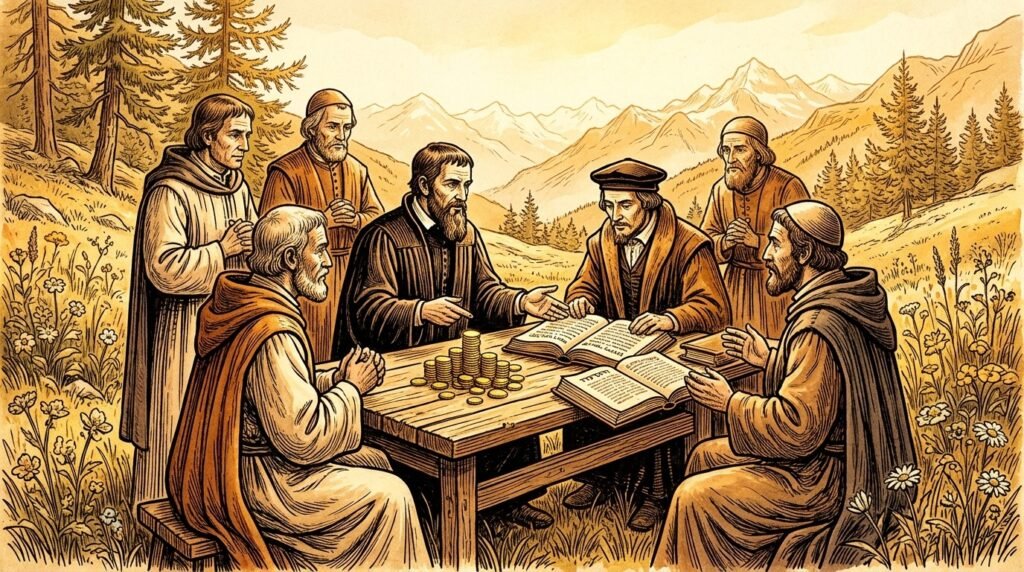
In the autumn of 1532, deep in the rugged Angrogna valley of the Cottian Alps, a historic convocation took place that would forever alter the course of European biblical history. Subsistence alpine farmers and hunted pastors known as the barbes, who had preserved the Holy Scriptures in handwritten manuscripts through centuries of papal inquisitions, gathered their meager life savings to perform an act of breathtaking spiritual devotion: presenting five hundred gold crowns to finance the translation and printing of the Holy Bible into the common French tongue directly from the original Hebrew and Greek.
The Church of the Valleys and the Guardians of the Vaudois Scriptures
Centuries before Martin Luther nailed his ninety-five theses to the door of the Wittenberg Castle church, a vibrant, underground biblical movement flourished in the high, isolated valleys of Piedmont. Known as the Waldensians (or Vaudois), their origins traced back to Peter Waldo (Valdes), a wealthy Lyon merchant who in the late 12th century experienced a profound spiritual awakening. Waldo divested himself of his vast estates, distributed his wealth to the poor, and commissioned scholars to translate portions of the New Testament into the Franco-Provençal (Occitan) vernacular.
The Roman Catholic hierarchy quickly condemned the Waldensians as heretics, unleashing ferocious Inquisitorial campaigns across southeastern France and northern Italy. Driven into the remote, snowbound valleys of Angrogna, Pellice, and Germanasca, the Waldensians survived as an underground community of faith. Their traveling pastors, known affectionately as barbes (“uncles”), traveled in pairs disguised as traveling merchants, carrying tiny handwritten copies of the Gospels and Epistles stitched inside their garments.
Waldensian youths were trained from childhood to memorize complete books of Scripture. In stone cottages and alpine caves, young men and women copied the Latin and Occitan biblical texts onto parchment by the dim light of tallow candles. If an Inquisitor discovered a manuscript, the scribe faced the stake; yet the copying never ceased. The Waldensians rejected papal supremacy, the doctrine of purgatory, the veneration of relics, and human ecclesiastical traditions, asserting that the canonical Holy Scripture alone possessed absolute and divine authority over faith and practice.
The Synod of Chanforan, September 12–18, 1532
When news of the Protestant Reformation began filtering into the Piedmont valleys in the 1520s, the Waldensian barbes were overjoyed to discover that across Switzerland and Germany, scholars were proclaiming the same biblical truths for which their ancestors had bled for three hundred years. In 1530, the barbes dispatched two delegates, Georges Morel and Pierre Masson, to consult with the leading Swiss Reformers, including Guillaume Farel in Neuchâtel and Johannes Oecolampadius in Basel.
The Swiss Reformers urged the Waldensians to emerge from centuries of secrecy and align openly with the evangelical Reformation. To formalize this historic union, a general synod was convened from September 12 to 18, 1532, at Chanforan, a natural amphitheater in the Angrogna valley. Hundreds of Waldensian elders, barbes, and alpine peasants gathered under the open autumn sky, joined by Guillaume Farel and Antoine Saunier who had traveled across mountain passes from Switzerland.
During the intense theological discussions, Farel challenged the Waldensians: While the Roman Church kept the people in darkness by locking the Scriptures in Latin and burning vernacular translations, the true Church must provide the people of God with an open, faithfully translated Bible in the language they spoke every day. But translating and printing thousands of folio Bibles required immense financial capital—capital that the impoverished Swiss reformers did not possess.
The 500 Gold Crowns as the Widow’s Mite of the Alps
At that historic moment, the Waldensian barbes made a monumental decision. Drawing upon secret reserves accumulated through generations of alpine toil—coins saved penny by penny from the sale of wool, cheese, and timber, hidden in stone walls and alpine crevices against times of disaster—the barbes laid a staggering sum upon the table: 500 gold crowns (écus au soleil).
For a community of impoverished mountain farmers who walked barefoot through the snow and lived on rye bread and chestnuts, five hundred gold crowns represented an almost unimaginable fortune. It was the sacrificial widow’s mite multiplied a thousandfold. The Waldensians did not use their gold to purchase weapons to defend their alpine redoubts, nor did they use it to bribe the Duke of Savoy’s inquisitors. They invested their entire collective wealth in a single weapon: the printed Word of God.
Pierre Robert Olivétan and the 1535 Masterpiece
To execute the monumental task of translation, the synod commissioned Pierre Robert, known as Olivétan (derived from his devotion to burning the midnight oil in study). A brilliant young scholar from Noyon and a cousin of John Calvin, Olivétan possessed mastery of both classical biblical languages: Hebrew and Greek.
Retreating to an isolated cabin in the Alpine valleys, Olivétan labored tirelessly for over eighteen months, translating directly from the original Hebrew Masoretic text for the Old Testament and Erasmus’s Greek text for the New Testament. Refusing to rely merely upon the Latin Vulgate, Olivétan produced a work of unmatched philological rigor and literary grace.
On June 4, 1535, the completed masterwork emerged from the printing press of Pierre de Wingle in Neuchâtel: a magnificent folio edition of over 800 pages, printed in sharp Gothic type. In his humble preface addressed to the poor believers of France, Olivétan dedicated the volume to the despised alpine flock who had financed its birth:
“To the poor, despised church, driven into mountain caves and desolate wildernesses, who have preserved the heavenly treasure in earthen vessels… to you is this Word of life restored.”
The Supremacy of Scripture Over Human Traditions
The Olivétan Bible of 1535 became the foundational mother text for all subsequent French Protestant translations, including the Geneva Bible and the revisions of Theodore Beza and John Calvin. It demonstrated decisively that the preservation and revival of the biblical canon was not dependent upon the patronage of kings, the wealth of imperial cities, or the decrees of ecclesiastical synods.
While human religious authorities elevated post-biblical dogmas, papal decretals, and ecclesiastical councils to equality with or supremacy over the Word of God, the humble alpine remnant at Chanforan staked their lives and their earthly fortunes upon the single, unalterable authority of the canonical Scriptures. Their 500 gold crowns purchased no indulgences and erected no monuments; instead, they ignited an unquenchable flame of biblical truth that illuminated France, Switzerland, and the world.
The Barbes and the Preservation of the Itala Text
The historical significance of the Waldensian biblical tradition extends far beyond their 1532 financial contribution at Chanforan. For centuries prior to the Reformation, the Waldensians had maintained a manuscript transmission tradition that textual scholars trace back to the Itala (the Old Latin version that preceded Jerome’s Vulgate). While the official Latin Church increasingly restricted vernacular reading and aligned its text with scholastic dogma, the Waldensian barbes copied the Gospels into Franco-Provençal (Romaunt) dialects.
Surviving Waldensian New Testament manuscripts—such as the 14th-century Dublin MS 269 (Trinity College Dublin), Cambridge University MS Dd.xv.34, and the Carpentras Codex—demonstrate an extraordinary degree of scribal discipline. Copied in tiny, cramped cursive hands on pocket-sized vellum leaves designed to be concealed inside merchant packs, these manuscripts contain the complete New Testament with virtually no dogmatic alterations or medieval theological interpolations.
The Rigors of Olivétan’s Translation
Pierre Robert Olivétan’s eighteen-month translation campaign was a masterpiece of Christian humanism and linguistic devotion. In his remote alpine retreat, Olivétan consulted the finest available linguistic authorities: for the Hebrew Old Testament, he utilized the Second Rabbinic Bible printed by Daniel Bomberg in Venice (1524–1525) edited by Jacob ben Chayyim; for the New Testament, he used the third edition of Erasmus’s Greek text (1522). Olivétan also consulted the Septuagint and the medieval commentaries of Rashi and David Kimchi to illuminate obscure Hebrew idioms.
Where the medieval Latin Vulgate had obscured biblical theology with ecclesiastical terminology—translating the Greek ekklesia as “clergy” or “church” in an institutional sense, presbyteros as “priest,” and metanoeite as “do penance”—Olivétan restored the apostolic meaning: translating congrégation for church, ancien for elder, and se repentir for repentance. This linguistic purification tore down the monopoly of the priesthood and restored the believer’s direct access to the throne of grace through Jesus Christ alone.
Canonical Supremacy Over Papal Decretals
The sacrifice at Chanforan presents a vivid contrast between the divine authority of the Biblical Canon and the accumulated weight of human religious tradition. The Council of Toulouse (1229) and the Council of Tarragona (1234) had explicitly forbidden laypeople from possessing the books of the Old or New Testament in the vernacular, asserting that the common people would fall into error without the guidance of the Latin clergy.
The humble alpine farmers of Angrogna understood that the exact opposite was true: it was the suppression of the vernacular Bible that had allowed human superstitions, purgatorial dogmas, and papal absolutism to corrupt the church. By giving their life savings to print the Olivétan Bible, the Waldensians placed the infallible, inspired Scriptures in the hands of the French-speaking world, proving that the Word of God is not the exclusive property of an elite hierarchy, but the living inheritance of all who seek salvation in Christ.
The Alpine Sanctuary of the Waldensian Remnant and the Pre-Reformation Word
For more than three centuries before Martin Luther nailed his Ninety-Five Theses to the door of the Castle Church in Wittenberg, an impoverished, persecuted people known as the Waldensians (Vaudois) preserved the light of the gospel in the rugged, inaccessible Alpine valleys of the Cottian Alps, straddling the border of modern-day Piedmont in northern Italy and the Dauphiné in southeastern France. Founded in the late twelfth century by Peter Waldo, a wealthy merchant of Lyon who renounced his riches to preach apostolic poverty and vernacular scripture, the Waldensians survived relentless inquisitorial persecutions, papal crusades, and military pogroms launched by the Dukes of Savoy and the Kings of France.
The defining hallmark of the Waldensian faith was their supreme, unyielding devotion to the authority of the Holy Scriptures. In an era when the Roman Catholic Church strictly forbade the laity from possessing or reading vernacular translations of the Bible under penalty of heresy, Waldensian pastors (known affectionately as Barbes, meaning “uncles”) painstakingly hand-copied portions of the New Testament into the local Franco-Provençal Romance dialect (Occitan). These itinerant barbes traveled as humble peddlers across Europe, carrying concealed manuscript portions of Matthew, John, and the Pauline Epistles sewn into the linings of their woolen garments.
Before an apprentice barbe was ordained to the ministry, he was required to memorize entire books of the Bible—frequently all four Gospels, the Epistles of Paul, and the Psalms—so that even if inquisitors discovered and burned his physical manuscripts, the living Word of God would remain indelibly inscribed upon the tablets of his heart. They memorized and recited the Scriptures in rocky Alpine caverns, remote cowherds’ huts, and snowbound mountain passes. While the theological academies of Paris and Rome were consumed by scholastic debates and canon law, the Waldensians held fast to the simple, pure, and infallible Word of God.
The Synod of Chanforan (1532) and the Alpine Meeting of Two Streams
In the late 1520s, rumors reached the high Alpine valleys of Pragelato, Val Pellice, and Val Germanasca that a great spiritual awakening had erupted in Germany and Switzerland. The Waldensian barbes learned that scholars in Zurich, Strasbourg, and Basel were proclaiming the very truths for which their ancestors had bled for centuries: the supreme authority of the Bible (Sola Scriptura), justification by grace through faith alone (Sola Fide), and the rejection of purgatory, papal indulgences, and the veneration of relics.
Determined to establish direct communion with the Swiss Reformers, the Waldensian barbes sent two senior delegates, Georges Morel of Freissinières and Pierre Masson of Burgundy, across the Alps in 1530 to consult with Guillaume Farel in Neuchâtel, Johannes Oecolampadius in Basel, and Martin Bucer in Strasbourg. Morel presented the Reformers with a detailed confession of Waldensian faith and practice, asking for biblical counsel on ecclesiastical organization, the sacraments, and theological education. The Reformers were astonished to discover this ancient community of believers that had preserved the gospel through centuries of darkness.
In response to this historic contact, the Waldensian elders convened a general synod from September 12 to 18, 1532, at Chanforan, a natural amphitheater in the hamlet of Angrogna, surrounded by towering Alpine peaks. Hundreds of Waldensian barbes, elders, and delegates from the valleys of Piedmont, Calabria, and southern France gathered under the open sky. Riding across the mountain passes to join them were Guillaume Farel, the fiery evangelist of French Switzerland, and Antoine Saunier. For six days, the assembly debated theological doctrines, formally aligning the ancient Waldensian movement with the emerging Reformed churches.
The Gold of Chanforan and the 1,500 Gold Écus for the French Bible
The crowning achievement of the Synod of Chanforan was a breathtaking act of sacrificial generosity that would forever alter the course of European history. During the deliberations, Guillaume Farel passionately urged the assembly that the French-speaking world desperately needed a complete, accurate translation of the entire Bible translated directly from the original Hebrew and Greek tongues, rather than from the corrupt Latin Vulgate. The existing French translations, such as the 1530 version of Jacques Lefèvre d’Étaples, were based heavily on the Vulgate and lacked the linguistic rigor required for true biblical reform.
Translating and printing a massive folio Bible in the original languages was an immense financial undertaking, far beyond the means of the impoverished Protestant refugees in Switzerland. Hearing this plea, the Waldensian elders—impoverished mountain farmers, shepherds, and weavers who lived in stone huts and subsisted on rye bread and goat’s milk—unanimously resolved to finance the entire project. Reaching deep into their collective savings, families produced ancient gold coins that had been hidden away for generations in hollow floorboards, stone walls, and iron pots to protect them from predatory tax collectors and inquisitorial pillagers.
The synod collected the staggering sum of 1,500 gold écus (crowns of the sun)—a fortune in sixteenth-century currency, equivalent to millions of dollars in modern purchasing power. This golden treasure, gathered from the calloused hands of Alpine peasants, was entrusted to Farel and Saunier to commission the printing of the first French Protestant Bible. It was the purest gold in Europe: the gold of humble faith, consecrated not for the construction of gilded cathedral altars, but for the dissemination of the living Word of God in the mother tongue of the common people.
Pierre Robert Olivétan, the Scholar of Noyon and His Monumental Translation
With the gold of Chanforan secured, Farel turned to his cousin, Pierre Robert Olivétan (c. 1506–1538), a brilliant young humanist scholar from Noyon, France, and a close relative of John Calvin. Olivétan was a master of classical languages, having studied Greek and Hebrew under the finest Renaissance scholars in Orléans and Paris. Living in exile in Neuchâtel and Geneva, Olivétan possessed the exact linguistic genius, spiritual humility, and textual discipline required for the monumental task.
Retreating to a modest cabin in the village of Cortaillod on the shores of Lake Neuchâtel, Olivétan labored in isolation for more than two years. Unlike previous translators who merely polished the medieval Latin text, Olivétan translated the Old Testament directly from the Hebrew Masoretic text (utilizing the 1494 Brescia Hebrew Bible and the Bomberg Rabbinic Bibles) and the New Testament directly from the Greek text edited by Desiderius Erasmus. He worked with agonizing diligence, comparing ancient rabbinic grammatical commentaries (such as David Kimchi and Rashi), the Septuagint, and the Chaldee Targums to ensure that every Hebrew idiom was accurately rendered into idiomatic French.
In his famous preface, addressed “To the Poor Church,” Olivétan poignantly expressed his theological vision. While other translators dedicated their works to kings, princes, and wealthy prelates, Olivétan dedicated the French Bible to the persecuted, impoverished believers of Christ: “It is to thee alone, poor little Church, that this royal treasure is presented and offered… God hath chosen the poor of this world to be rich in faith.”
Pierre de Wingle and the Printing Press of Serrières (1535)
The printing of Olivétan’s translation was entrusted to Pierre de Wingle (known by the pseudonym Pirot Picard), a master printer from Lyon who had been forced to flee France due to his evangelical beliefs and had established a printing shop in the village of Serrières, near Neuchâtel. With the 1,500 gold écus from Chanforan, de Wingle purchased premium rag paper, ordered newly cast blackletter and roman types, and operated several wooden screw presses around the clock.
On June 4, 1535, the magnificent folio volume was completed. It was a massive work of typography, comprising over 800 large folio pages printed in double columns, adorned with woodcut initials, marginal references, and an extensive textual apparatus. To protect the identities of the sponsors, Olivétan included a Latin preface and an ingenious ten-line rhyming acrostic at the end of the volume, whose first letters spelled out the hidden dedication: “Les Vaudois, qui ont tout temps chéri l’Évangile, ont payé cette œuvre” (“The Waldensians, who have always cherished the Gospel, have paid for this work”).
Olivétan’s Bible of 1535 became the foundational text of the French Reformation. It was repeatedly revised by John Calvin, Olivétan’s young cousin, who penned two profound Latin and French prefaces for the volume, including his celebrated treatise on the divinity of Christ. The Olivétan translation served as the base text for the Geneva Bible (French), the revision of Theodore Beza, and the classic Louis Segond Bible of the nineteenth century. Every French-speaking Christian today who reads the Scriptures in their native tongue traces their spiritual lineage directly back to the sacrificial gold of Chanforan.
Theological Significance of Canonical Purity Versus Papal Tradition
The Waldensian investment in the Olivétan Bible represents a watershed moment in the theological defense of the Biblical Canon. For centuries, the medieval church had insulated itself from scriptural critique by maintaining the Latin Vulgate as an unchallengeable linguistic monopoly, claiming that only the ecclesiastical magisterium could interpret its mysteries. Human traditions—such as transubstantiation, the sacrifice of the Mass, clerical celibacy, and the treasury of merits—were elevated to equal or superior authority over the written Word of God.
By bypassing the Latin Vulgate and returning directly to the fontes—the inspired Hebrew of Moses and the Prophets, and the inspired Greek of the Apostles—Olivétan and the Waldensians shattered the theological foundations of human ecclesiastical tyranny. In his translation, Olivétan deliberately replaced scholastic ecclesiastical terms with their true biblical equivalents: Greek metanoia was translated as “repentance” rather than the scholastic “do penance”; presbyteros was translated as “elder” rather than “priest”; and ekklesia was translated as “assembly” or “congregation” rather than “the institutional Roman church.”
This return to canonical purity affirmed that the Bible is self-interpreting (Scriptura sacra sui ipsius interpres) and possesses supreme authority over all earthly councils, popes, and human traditions. The Waldensians recognized that while empires, inquisitions, and theological dynasties pass away, the canonical Scriptures remain the only infallible rule of faith and life. Their sacrificial offering at Chanforan stands as an eternal monument to the supremacy of the inspired Word of God.
Chronological Timeline of the Waldensians and the Olivétan Bible
| Year | Historical Milestone | Key Figures | Significance for Biblical Preservation |
|---|---|---|---|
| c. 1173 CE | Conversion of Peter Waldo in Lyon; commissions vernacular Gospels. | Peter Waldo, Bernard Ydros, Stephen of Anse | First medieval initiative to provide vernacular Scriptures to the common people. |
| 1184 CE | Papal bull Ad Abolendam by Pope Lucius III excommunicates Waldensians. | Pope Lucius III, Emperor Frederick Barbarossa | Waldensians retreat into the high valleys of the Cottian Alps to survive. |
| 1200–1530 CE | The Age of the Barbes: Manuscript transmission in Alpine caverns. | Itinerant Barbes (pastors) | Memorization and hand-copying of Occitan New Testament manuscripts across centuries. |
| 1530 CE | Waldensian delegation sent to Swiss Reformers in Basel, Strasbourg, Neuchâtel. | Georges Morel, Pierre Masson, Johannes Oecolampadius, Martin Bucer | Historic discovery of shared theological convictions between Waldensians and Reformers. |
| Sept 12–18, 1532 | Synod of Chanforan in Val d’Angrogna, Piedmont. | Guillaume Farel, Antoine Saunier, hundreds of Barbes | Waldensians donate 1,500 gold écus to finance the first French Protestant Bible. |
| 1533–1535 CE | Pierre Robert Olivétan translates the Bible from Hebrew and Greek in Neuchâtel. | Pierre Robert Olivétan, John Calvin | First direct translation of the entire Christian Canon into French from original biblical languages. |
| June 4, 1535 | Publication of the Olivétan Folio Bible in Serrières by Pierre de Wingle. | Pierre de Wingle, Olivétan, Farel | Magnificent 800-page printing completed; acrostic reveals Waldensian sponsorship. |
| 1545–1686 CE | Inquisitorial massacres (Mérindol 1545, Piedmontese Easter 1655). | Duke of Savoy, Joshua Janavel, Oliver Cromwell | Waldensians endure slaughter; Cromwell intervenes; Milton writes “Avenge, O Lord, thy slaughtered saints.” |
The Material Craft of the Olivétan Bible in Typographic and Papermaking Analysis
The production of the 1535 Olivétan Bible in the rustic workshop of Pierre de Wingle in Serrières remains one of the greatest technical triumphs in early modern printing. Financed by the 1,500 gold écus of the Waldensian peasants, de Wingle spared no expense in securing materials of extraordinary durability. Modern bibliographical analysis of surviving copies—such as those preserved in the Bibliothèque publique et universitaire de Neuchâtel and the British Library—reveals that the paper used was manufactured from pure linen rag fiber, pulped in watermills powered by Alpine mountain streams.
The sheets display clear wire lines and chain lines from the wire mesh papermaking moulds, bearing distinctive sixteenth-century watermarks including the Swiss cross, the grapes of Neuchâtel, and the hand of providence. Unlike nineteenth-century wood-pulp paper that degrades into brittle yellow powder due to acid hydrolysis within decades, the pure rag paper of the Olivétan Bible has remained bright, supple, and acid-free for nearly five hundred years. The printing ink was compounded from boiled linseed oil and high-grade carbon lampblack, producing a rich, velvety black impression that has never faded or oxidized.
De Wingle set the text using a newly cut French Bastarda (blackletter) typeface for the body of the scriptures, with elegant roman capitals for running headers and Hebrew/Greek types for philological marginal notes. The volume was laid out in a grand folio format (measuring approximately 36 by 24 centimeters), collating in regular gatherings of six leaves (ternions), totaling over 400 leaves (800 pages). It was a monument of artisanal typography, demonstrating that the despised “heretics” of the Alps possessed standards of literary and aesthetic excellence that far surpassed the shoddy commercial output of Paris and Lyon.
The Philological Revolution of Hebrew Idioms in the French Tongue
Pierre Robert Olivétan’s greatest contribution to biblical scholarship was his uncompromising fidelity to the syntactical structure and concrete idiom of the original Hebrew Masoretic text. Where previous translators had relied upon the Latin Vulgate—often smoothing out Hebrew idioms to fit classical Latin rhetorical conventions—Olivétan insisted that the Holy Spirit had chosen Hebrew for the Old Testament for divine reasons, and that its distinctive conceptual world must be preserved in the vernacular.
For example, in translating the divine covenant Name of God—the Tetragrammaton (YHWH)—Olivétan refused to use the traditional Catholic title Le Seigneur (“The Lord”), which obscured the unique personal identity of the Almighty. Instead, drawing upon the etymology of the Hebrew root havah (“to be”), Olivétan coined the brilliant French title L’Éternel (“The Eternal”). This rendering capture the timeless, self-existent nature of God revealed to Moses at the burning bush (“I AM THAT I AM”), and it remains the standard designation for the Lord across all French Protestant translations to this day.
Similarly, Olivétan meticulously rendered Hebrew absolute infinitives (which emphasize certainty by repeating the verbal root) with literal French equivalents, preserved the parallelisms of Hebrew poetry in the Psalms and Job, and translated the Hebrew sacrificial and Levitical terminology with rigorous legal precision. In the New Testament, working directly from Erasmus’s Greek text, he restored the apostolic clarity of the gospel, translating charis as “grace” (the unmerited favor of God) rather than ecclesiastical “merit,” and dikaiosyne as “justification” (the imputation of Christ’s righteousness) rather than legalistic human virtue.
The Martyrdom of Pierre Robert Olivétan (1538)
Olivétan’s tireless labors on behalf of the Word of God were cut tragically short. In 1537, following the publication of his Bible, Olivétan traveled south to Italy, undertaking an undercover mission to visit the Waldensian congregations in the Kingdom of Naples and Calabria, who were suffering under ferocious inquisitorial repression. He carried with him copies of his French Bible and translated portions into Italian, seeking to strengthen the faith of the scattered brethren.
In the spring of 1538, while in Rome or traveling north through Ferrara, Olivétan suddenly fell violently ill. Contemporary chroniclers and his close friend Guillaume Farel recorded that he was poisoned by papal agents who had tracked his movements. At the young age of approximately thirty-two, Pierre Robert Olivétan died a martyr’s death, his physical body buried in an unmarked Italian grave. Yet his legacy was indestructible. The Bible he translated lived on, carrying the light of the gospel across France, Switzerland, the Low Countries, and into the wilderness of the New World. The seed planted by the gold of Chanforan and watered by the tears of Olivétan produced a spiritual harvest that no inquisition could ever eradicate.
Canonical Supremacy and the Word Above All Human Traditions
The historic drama of Chanforan highlights the irreconcilable divide between the self-authenticating Canonical Scriptures and the shifting, contradictory traditions of human religion. The Roman hierarchy had claimed that Scripture was a “nose of wax” that could be twisted in any direction without the authoritative guidance of the Magisterium and papal decrees. Yet the simple Alpine peasants of Piedmont proved that when an uneducated ploughman or shepherd reads the canonical Bible in his own tongue, the Holy Spirit speaks directly to his conscience with undeniable clarity and divine authority.
This reality also dismantles the claims of post-biblical compilations like the Talmud and the Koran. In the rabbinic Talmud, the written Torah of Moses is frequently subordinated to the “Oral Law,” with rabbis claiming in famous Talmudic passages (such as Bava Metzia 59b, the Oven of Akhnai) that even when a heavenly voice declares the truth, the majority vote of the rabbis overrules heaven! In Islam, the Koran claims to confirm previous scriptures while simultaneously asserting that the biblical text was hopelessly corrupted by Jews and Christians, demanding blind submission to the unilateral dictations of a seventh-century conqueror.
The Bible of Chanforan stands in absolute contradiction to both systems. The Christian Canon contains no secret esoteric oral traditions and no despotic political impositions. It is the open, transparent, and harmonious revelation of God’s redemptive love in Jesus Christ, verified across thousands of years of historical fulfillment, preserved by the blood of martyrs, and accessible to the humblest child. The Waldensian peasants understood what the greatest scholars of their age had forgotten: that man shall not live by bread alone, but by every word that proceedeth out of the mouth of God.
The Continuing Legacy from Chanforan to Global Vernacular Translation
The financial and spiritual sacrifice made by the Waldensians at Chanforan in 1532 ignited a movement that continues to bear fruit across the globe today. By establishing the principle that every Christian has an inalienable right to read the complete Scriptures translated directly from the original Hebrew and Greek into their mother tongue, the Synod of Chanforan laid the foundation for the global missionary translation movement of the modern era.
The Olivétan Bible served as the linguistic engine of the French Protestant Reformation. It provided the biblical vocabulary for the monumental sermons and biblical commentaries of John Calvin, the passionate theology of Theodore Beza, and the fiery martyrdoms recorded in Jean Crespin’s Book of Martyrs. For two centuries, French Huguenots faced death, the galleys, and the dragonnades clutching copies or memories of the text translated by Olivétan. When Huguenot refugees fled across the oceans following the Revocation of the Edict of Nantes, they carried Olivétan Bibles to England, the Netherlands, South Africa, and the American colonies, where their descendants helped shape the religious and political foundations of modern free societies.
Furthermore, the Waldensian conviction that the humble laity can understand the Scriptures without the mediation of a sacerdotal hierarchy directly influenced the modern Bible society movement. When the British and Foreign Bible Society was established in 1804 to produce “Scripture without note or comment” for every tribe and nation, they were walking in the exact footsteps of the Waldensian barbes. Today, organizations like Wycliffe Bible Translators and SIL continue that identical mission, working to translate the inspired biblical canon into the remaining thousands of minor languages across the earth. The golden stream that began with 1,500 gold coins poured out on an Alpine meadow at Chanforan has expanded into an unstoppable global river of vernacular truth.
The Canonical Word Versus Rabbinic and Medieval Additions
The historic witness of Chanforan forever settles the question of canonical sufficiency. In their debates with Rome, the Waldensians consistently refused to accept any doctrine or practice that could not be proved by the clear, express testimony of Holy Scripture. They rejected the Apocryphal books as non-canonical, following the ancient Hebrew canon recognized by Jesus Christ and the Apostles, because those intertestamental books lacked prophetic inspiration and contained historical, geographical, and theological errors (such as prayers for the dead and salvation through almsgiving).
Similarly, the Waldensian approach exposes the fatal flaw of post-biblical compilations like the Talmud and the Koran. In the Talmud, divine revelation is submerged beneath a mountain of rabbinic argumentation, casuistry, and conflicting opinions, creating an impenetrable legal maze that obscures the simple grace of God. In Islam, the Koran demands uncritical submission to a single book while denying the foundational historical facts of the Christian faith: the death, burial, and bodily resurrection of Jesus Christ on the cross. The Waldensian Bible at Chanforan stood as a pure fountain of living water, calling humanity back to the uncorrupted, infallible revelation of the One True God. Their sacrifice proves that when men stand upon the Word of God alone, they are more than conquerors through Him that loved them.
A Theological Collation of the Waldensian Barbes and the Purity of the Canon
The extraordinary sacrifice of the Waldensian believers at Chanforan in 1532 was rooted in their unwavering commitment to the absolute purity and sufficiency of the biblical text. For centuries, the medieval Roman Church had accumulated layers of non-canonical traditions, apocryphal legends, and scholastic disputations that obscured the clear light of the gospel. The Waldensian barbes, living in the stark simplicity of the Alpine peaks, recognized that human additions to divine revelation are not merely unnecessary; they are spiritually toxic.
When the barbes copied the Scriptures in their hidden caverns, they strictly distinguished between the sixty-six books of the inspired Canon and the uninspired apocryphal or human writings. Unlike the medieval scriptoria that frequently mingled apocryphal books among the prophetic writings of the Old Testament, the Waldensians held to the ancient Hebrew canon recognized by Jesus Christ and His apostles. They understood that the thirty-nine books of the Old Testament and the twenty-seven books of the New Testament constitute the complete, closed, and sufficient rule of faith. In their early confessions of faith, preserved in ancient Romance manuscripts in Cambridge and Geneva, the Waldensians explicitly rejected prayers for the dead, the existence of purgatory, and the intercession of saints, demonstrating from the biblical text alone that Christ’s finished sacrifice on the cross is all-sufficient for salvation.
This unwavering focus on canonical purity directly influenced Pierre Robert Olivétan as he translated the Scriptures into French. In his marginal notes and prefaces, Olivétan clearly marked the Apocrypha as non-canonical, establishing a precedent that was followed by the Geneva Bible, the King James Bible, and the entire Protestant tradition. The gold of Chanforan was thus spent not merely to print a book, but to establish a monument of textual fidelity that separated the infallible Word of God from the traditions of men. Their sacrifice remains an unshakeable testimony that when believers anchor their souls upon the pure, unadulterated Canon of Scripture, no persecution, poverty, or imperial power can ever prevail against them.
The Theological Distinctives of the Waldensian Confession of Faith
The historic Synod of Chanforan in 1532 was not merely a financial milestone; it was a profound theological alignment between the ancient Waldensian Church and the Protestant Reformation. In the official confession of faith adopted at Chanforan, the Waldensian barbes and elders explicitly affirmed the fundamental doctrines that distinguish biblical Christianity from human religious systems:
- The Divine Inspiration and Sufficiency of Scripture: The confession declared that all doctrine necessary for salvation is fully contained within the canonical books of the Old and New Testaments, rejecting all human traditions, papal decrees, and conciliar canons that contradict the written Word.
- Justification by Faith Alone: The Waldensians affirmed that man is justified before God solely by the imputed righteousness of Jesus Christ received through faith, entirely apart from human works, sacramental penance, or monastic merits.
- The Sole Mediatorship of Jesus Christ: The synod firmly rejected the intercession of the Virgin Mary and the saints, declaring that Jesus Christ is the only Mediator between God and man, our eternal High Priest who ever liveth to make intercession for us.
- The Nature of the Sacraments: They recognized only two sacraments ordained by Christ—Baptism and the Lord’s Supper—as visible signs and seals of divine grace, rejecting the Roman dogmas of transubstantiation and the sacrifice of the Mass.
This unwavering adherence to the canonical Scriptures sustained the Waldensian community through three more centuries of ferocious persecution. When the troops of Charles Emmanuel II, Duke of Savoy, launched the infamous “Piedmontese Easter” massacre in April 1655, slaughtering hundreds of Waldensian families in cold blood, the survivors fled to the high mountain peaks, singing the Psalms of David and defending their families with heroic courage. Their suffering moved the English poet John Milton to pen his immortal sonnet:
“Avenge, O Lord, thy slaughtered saints, whose bones
Lie scattered on the Alpine mountains cold;
Even them who kept thy truth so pure of old,
When all our fathers worshiped stocks and stones…”
The Waldensians kept the truth pure because they possessed the pure Word of God. The gold of Chanforan was their greatest legacy to the world—a legacy of sacrificial devotion to the eternal Scriptures that continues to inspire believers across the globe to this very day.
Summary of the Eternal Fruit of the Alpine Sacrifice
The extraordinary gathering of Waldensian believers at Chanforan in September 1532 stands as one of the most heroic demonstrations of biblical stewardship in church history. In an age when the powerful and wealthy hoarded their gold to construct opulent monuments to human vanity, these impoverished mountain peasants poured out their ancestral treasure to place the living Word of God into the hands of the common people. Their 1,500 gold écus did not buy physical land or earthly titles; they bought the spiritual liberation of the French-speaking world.
Through the linguistic genius and sacrificial life of Pierre Robert Olivétan, the Hebrew and Greek canonical Scriptures were faithfully translated into the French tongue, providing the spiritual fuel that ignited the Reformation across Europe. Despite centuries of horrific massacres, inquisitorial crusades, and military exile, the Waldensians held fast to their sacred motto: “Lux Lucet in Tenebris” (“The Light Shineth in Darkness”). Today, their legacy lives on in every French Bible open on pulpit and kitchen table, testifying that no earthly power can extinguish the divine light of Holy Scripture. The gold of Chanforan remains forever precious in the eyes of heaven, an everlasting testament to the sovereign majesty of God’s holy Word.
The faith of the Waldensians at Chanforan reminds us that the true treasure of the Church is not earthly silver or gold, but the uncorrupted Word of God. Their sacrificial gift produced a harvest of eternal life that continues to flourish around the world today, proving that God’s truth is invincible and eternal.
Centuries after the alpine synod, the testimony of the Waldensian believers remains an immovable fortress of faith. By elevating the pure Canonical Scriptures above every human decree, they lit a torch of vernacular truth that can never be extinguished, proving that the Word of God shall stand supreme forever and ever.