

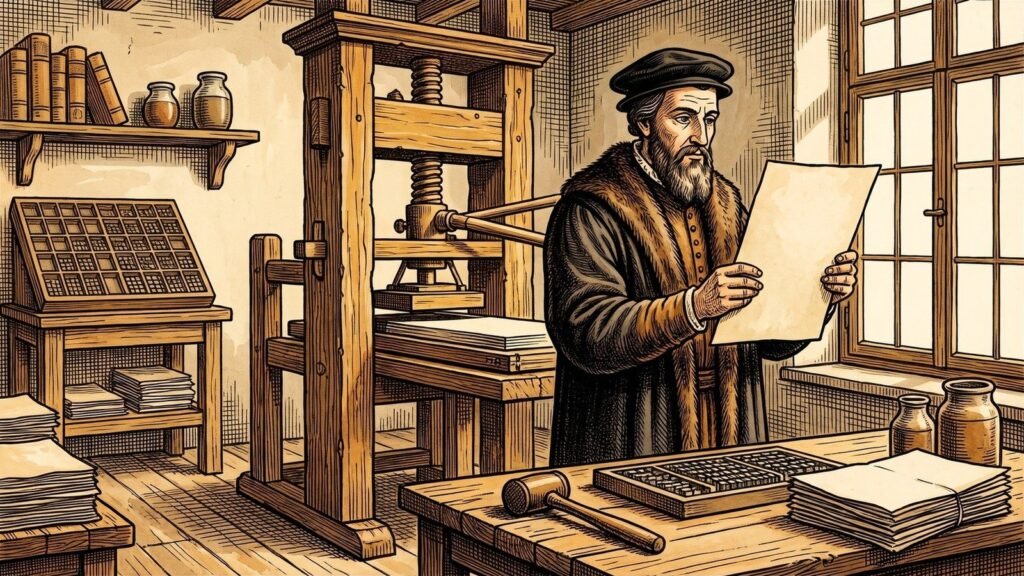
In September 1569 a quarto volume of more than twelve hundred pages came from the press at Basel under the title La Biblia, que es, los sacros libros del Viejo y Nuevo Testamento, “the Bible, that is, the sacred books of the Old and New Testament”. It was the first complete Bible printed in the Spanish language. Its translator, Casiodoro de Reina, was a former monk from a monastery outside Seville who had fled Spain twelve years earlier and had since been condemned by the Inquisition. The book carried no name of translator or printer on its title page, but it bore a woodcut of a bear reaching up to a honeycomb in a tree, and from that device it has always been known as the Biblia del Oso, the Bear Bible. Revised by Reina’s fellow exile Cipriano de Valera and published again at Amsterdam in 1602, it became the Reina–Valera Bible, which in its successive revisions has been the principal Bible of Spanish-speaking Protestants for more than four centuries. This article describes the Spanish background, the life of the translator, the making of the translation and its sources, the book of 1569, Valera’s revision and the later history of the text.123
At a glance
- c. 1520: Casiodoro de Reina is born, probably at Montemolín in Extremadura; he later enters the Hieronymite monastery of San Isidoro del Campo near Seville.
- 1543: Francisco de Enzinas publishes a Spanish New Testament from the Greek at Antwerp.
- 1553: The Ferrara Bible, a Spanish Old Testament for Sephardic Jews, is printed in Ferrara.
- 1557: Reina and about eleven other monks leave San Isidoro to escape the Inquisition.
- 1559: The Valdés Index forbids Bibles in the vernacular in Spain; Seville holds the first of its great autos-da-fé against the evangelical circle.
- 1562: Reina is burned in effigy at Seville.
- September 1569: The Biblia del Oso, the first complete Bible printed in Spanish, appears at Basel.
- 1594: Reina dies at Frankfurt as a pastor of the Lutheran church.
- 1602: Cipriano de Valera publishes his revision at Amsterdam, the foundation of the Reina–Valera tradition.
The Spanish Background
The Bible in Medieval Spain
The Iberian peninsula had a long tradition of vernacular scripture before the Reformation. In the thirteenth century translations of the Old Testament into Castilian were made directly from the Hebrew, and several of them survive in manuscripts now in the library of the Escorial. The historical compilations made under Alfonso X incorporated large portions of biblical narrative in Castilian. In the fifteenth century the most celebrated of these translations was the Bible prepared between 1422 and 1433 by Rabbi Moses Arragel of Guadalajara for Don Luis de Guzmán, master of the Order of Calatrava, known as the Alba Bible from the ducal family that later owned it. These versions were the work of Jewish scholars or were made with their help, and they rendered the Hebrew text with a literalness that would reappear in the Ferrara Bible of the following century.45
In Catalan a complete Bible was printed at Valencia in 1478, translated in the previous century and revised by Jaume Borrell, but the edition was destroyed by the Inquisition and only a single leaf is known to survive. After the expulsion of the Jews from Spain in 1492 and the establishment of the Spanish Inquisition, the official attitude towards vernacular scripture hardened. Translations were associated with Judaizing on the one hand and with heresy on the other, and the church in Spain came to regard the Latin Vulgate, explained by the clergy, as the proper form in which the laity should receive the Bible. Spain was nevertheless the home of one of the great scholarly achievements of the age, the Complutensian Polyglot, printed at Alcalá between 1514 and 1517 under the patronage of Cardinal Francisco Jiménez de Cisneros, which presented the Hebrew, Greek and Latin texts side by side. Learning in the original languages and suspicion of the vernacular thus existed together in the same country.678
Erasmus and the Spanish Evangelicals
In the 1520s the writings of Erasmus were read widely and with enthusiasm in Spain, among clergy, university men and members of the court. Erasmus had argued that the scriptures should be translated into every language so that the farmer at his plough and the weaver at his loom might know them, and his Spanish admirers took up this programme. Juan de Valdés, who left Spain for Italy in the early 1530s, translated the Psalms from the Hebrew and Romans, First Corinthians and the Gospel of Matthew from the Greek, with commentaries; his translations circulated in manuscript and some were printed after his death. His circle in Naples combined an inward and devotional religion with a reading of scripture that went beyond the limits of Catholic orthodoxy as it was soon to be defined.910
The first Spanish New Testament translated from the Greek was published at Antwerp in 1543 by Francisco de Enzinas, a young scholar from Burgos who had studied at Louvain and at Wittenberg under Philip Melanchthon. Enzinas presented a copy to the emperor Charles V in Brussels, and was arrested and imprisoned shortly afterwards; he escaped in 1545 and spent the rest of his short life among the Protestants of Germany, Switzerland and England. In 1556 Juan Pérez de Pineda, a former official of the Spanish embassy in Rome who had fled from Seville, published at Geneva a revision of Enzinas’s New Testament, with a false imprint naming Venice, and in the following year a translation of the Psalms. These books were intended for readers in Spain, and some of them were carried there secretly.111213
The Seville Circle and the Inquisition
In the 1540s and 1550s Seville was the centre of an evangelical movement unusual in Spain for its size and its social range. Its leading figures were preachers attached to the cathedral, among them Juan Gil, known as Doctor Egidio, and Constantino Ponce de la Fuente, a celebrated preacher and author of devotional works. Their teaching laid stress on justification by faith and on the reading of scripture, and it reached members of noble families, merchants, artisans and the religious houses of the city. Among those houses was the Hieronymite monastery of San Isidoro del Campo at Santiponce, a few miles north-west of Seville, where in the course of the 1550s the community set aside prayers for the dead, the veneration of images and the traditional ascetic practices, and read the scriptures and Protestant books in their place.141516
Books printed abroad, including Pérez de Pineda’s New Testament, were brought into Seville in barrels and bales by Julián Hernández, a small man who had worked as a corrector in Geneva and who acted as the movement’s courier. His arrest in 1557 led the Inquisition to the network. In that year about twelve of the monks of San Isidoro left the monastery and made their way out of Spain, Reina among them, together with the prior. Those who remained or were caught were tried in the following years. The first great auto-da-fé against the Seville Protestants was held on 24 September 1559 and a second on 22 December 1560; further sentences followed, and by the early 1560s the movement had ceased to exist as an organised body. In the same year 1559 the Index of prohibited books issued by the inquisitor general Fernando de Valdés forbade Bibles in the vernacular, whether complete or in part. Reina, tried in his absence, was burned in effigy at Seville in 1562.17181920
Casiodoro de Reina
Origins and Exile
Casiodoro de Reina was born about 1520. The records of the Seville tribunal have been read as making him a native of Montemolín in Extremadura, although he signed himself a Sevillian. Little is known of his early life, but he appears to have studied at a university, probably Seville, before he entered San Isidoro del Campo, and he had a good knowledge of Latin, Hebrew and Greek. After his flight in 1557 he went first to Geneva, where he found the strict discipline of Calvin’s church uncongenial, and in 1558 to Frankfurt. In 1559, after the accession of Elizabeth I, he crossed to England, and from late in that year he was in London, where he gathered a congregation of Spanish Protestants and sought to establish a church for them apart from the existing congregations of foreign Protestants.212223
In London Reina drew up a confession of faith for his congregation, presented in March 1560, and received the support of Edmund Grindal, bishop of London. His position was nevertheless insecure. From 1561 he was the subject of grave accusations of moral misconduct and of unsound doctrine on the Trinity, brought by rivals among the foreign churches and pursued with interest by the Spanish embassy, which wished to see him returned to Spain. In 1563 he left England secretly and went to Antwerp and then to Frankfurt, where he was supported by members of the French Reformed church, and to Strasbourg. Throughout these years he continued to work on his translation of the Bible, which he had begun, by his own account, about the time of his flight from Spain.242526
The Years at Basel
In 1567 Reina came to Basel to see the translation through the press. Basel was one of the great printing centres of Europe and a city with a tradition of tolerance towards scholars of independent views. Reina signed a contract with the printer Johannes Oporinus, but Oporinus died in 1568 with the work unfinished, and the printing was completed by Thomas Guarin, a printer of French origin established in the city. The woodcut of the bear and the honeycomb on the title page was the device of the Bern printer Samuel Apiarius, whose name means “beekeeper”, and the use of his device has been taken to indicate his part in the production. Reina had to find the money for the edition largely by his own efforts, and he received help from friends in Basel and Strasbourg and from Spanish exiles. The edition was completed in 1569, and about 2,600 copies were printed.272829
After the publication Reina settled in Frankfurt and became a citizen there. In 1578 he went to Antwerp as pastor of the French-speaking Lutheran congregation of the city, a post he held until the fall of Antwerp to the Spanish army under Alexander Farnese in 1585 forced him to leave. He returned to Frankfurt, and in 1593 he was appointed a minister of the French-speaking Lutheran church there. He died in Frankfurt in March 1594. His career thus carried him from a Spanish monastery through the Reformed churches of Geneva and London to the Lutheran churches of Antwerp and Frankfurt, and his theology has been described as irenic, seeking common ground between the Protestant confessions rather than adhering strictly to any one of them.303132
The Translation
Sources for the Old Testament
In the preface to his Bible, the Amonestación del intérprete or “admonition of the translator”, Reina gave an account of the texts he had used. For the Old Testament he worked from the Hebrew, and he consulted the Latin translation of the Dominican scholar Santes Pagnini, published at Lyon in 1528, which followed the Hebrew closely and was widely used by Protestant and Catholic translators alike. He also used the Ferrara Bible, the Spanish version of the Hebrew scriptures printed by Abraham Usque and Yom Tob Atias in 1553 for the Sephardic communities of the diaspora. Reina acknowledged his debt to the Ferrara translation openly, while noting that its extreme literalness made it difficult to read and that its rendering of some passages reflected Jewish rather than Christian interpretation.333435
The relationship between the two books is of particular interest. The Ferrara Bible had preserved the vocabulary and syntax of the medieval Jewish tradition of translation from Hebrew into Castilian, following the Hebrew word by word and using a distinctive set of Spanish equivalents for Hebrew terms. Reina took from it much of its vocabulary and many of its renderings, but he recast them in the ordinary Castilian prose of the sixteenth century, and in passages traditionally read as prophecies of Christ he followed the Christian tradition of interpretation. Through Reina, therefore, an element of the old Jewish translation tradition of Spain entered the Bible of Spanish Protestantism.3637
Sources for the New Testament
For the New Testament Reina used the printed Greek text in the tradition of Erasmus, the text that was later called the Textus Receptus, and he consulted the Latin and vernacular versions available to him. He knew the earlier Spanish New Testaments of Enzinas and Pérez de Pineda, and he was able to draw on the work of the Reformed scholars of Geneva, including the Latin translation and annotations of Theodore Beza. He also made use of the Syriac New Testament, which had been printed at Vienna in 1555, and Reina is reported to have consulted it for some readings, although its place among his sources was secondary. His Greek text was not a critical edition in the modern sense, but it was the best available text of the Greek New Testament in his time.383940
Principles of Translation
In his preface Reina explained that he had sought to render the original faithfully, adding nothing and leaving nothing out, and that where he had found it necessary to supply words for the sense he had marked them with a different type so that the reader could distinguish them from the text. He had translated proper names according to Hebrew forms rather than their Latin equivalents in some cases, and he had chosen to use the word Jehová to render the divine name, explaining his reasons at length. He discussed the difficulty of finding Spanish equivalents for certain Hebrew and Greek terms and the decisions he had made, and he asked readers who found errors to point them out so that they might be corrected in later editions.4142
Reina also explained his treatment of the deuterocanonical books, which he called the Apocrypha. Following the order of the Latin Bible, he placed them among the books of the Old Testament rather than gathering them into a separate section, but he made clear in the preface that he regarded them as of lesser authority than the books of the Hebrew canon. Valera’s revision of 1602 moved them into a separate section between the Old and New Testaments, in accordance with the practice of the Reformed Bibles, and later editions published by the Bible societies omitted them altogether. The volume of 1569 also included summaries at the head of each chapter, marginal notes giving alternative renderings and cross-references, and the verse divisions introduced by Robert Estienne in his Greek New Testament of 1551 and his Latin Bible of 1555.434445
Language and Style
The Spanish of the Bear Bible is the literary Castilian of the mid-sixteenth century, the language of the generation of Garcilaso de la Vega and of the great religious prose writers of Spain. Reina wrote it as a native speaker who had been trained in the schools of Seville, and later readers have found in it a dignity and fluency that place it among the classic works of Spanish prose of its century. It is more idiomatic than the Ferrara Bible and less dependent on the Latin than the older Catholic versions, and it achieves in Spanish something of what Luther had achieved in German and Tyndale in English. Its literary quality was recognised even by scholars who rejected its theology; Marcelino Menéndez Pelayo, the historian of Spanish heterodoxy, who had no sympathy for its translator’s religion, nevertheless praised its language.464748
The Book of 1569
Title Page and Device
The title page of the Bear Bible gives the title, a quotation from the book of Isaiah in Spanish declaring that the word of God endures for ever, and the date in Roman numerals. It names neither translator nor printer. The preface is signed with the initials C. R. The decision to omit names was a precaution, since the book was intended in part for readers in Spain and in the Spanish dominions, where possession of it was a grave offence, and since its translator had already been condemned by the Inquisition. The woodcut in the centre of the page shows a bear standing on its hind legs and reaching for a honeycomb in a tree, with bees around it, a hammer hanging from a branch and a book lying at the foot of the tree. The device was a pun on the name of Apiarius and has no theological meaning of its own, but it gave the book the name by which it has been known ever since.4950
Contents and Format
The volume is a quarto of about twenty-five centimetres in height. It opens with a Latin preface addressed to the princes of Europe, in which Reina defended the right of the Spanish people to read the scriptures in their own language, followed by the Spanish admonition to the reader in which he explained his methods. The text follows, with the Apocrypha among the books of the Old Testament, and then the New Testament, printed in a single column with chapter summaries and marginal notes. The typography is plain, without illustrations other than the title-page device and a few ornamental initials, and the book was designed for reading and study rather than display.515253
Distribution and Survival
Copies of the Bear Bible were distributed among the Spanish Protestant communities in exile, in London, Antwerp, Frankfurt and elsewhere, and some were sent to Spain by the clandestine routes that had carried the earlier books of the Seville circle. The Inquisition placed the work on its Index and confiscated copies wherever they were found, and many were destroyed. Copies also travelled to Spanish America and to the Spanish Netherlands, where the authorities were equally vigilant. Despite the size of the edition, the number of surviving copies is limited, and they are held chiefly in the great libraries of Europe and North America. The edition has been reproduced in facsimile, and its quatercentenary in 1969 and its four hundred and fiftieth anniversary in 2019 were marked by exhibitions and conferences in Spain and elsewhere.545556
Cipriano de Valera and the Revision of 1602
Valera's Life
Cipriano de Valera was born about 1531 or 1532, probably in Seville. He studied at the university of Seville and then entered San Isidoro del Campo, where he was a member of the community at the time of the evangelical movement. He left with the other monks in 1557 and went to Geneva, and after 1558 to England. In England he studied and taught at Cambridge, married and settled in London, where he spent most of the remainder of his life. He was a vigorous writer of controversial works against the papacy and the mass, and he translated Calvin’s Institutes of the Christian Religion into Spanish, publishing it in London in 1597. He died early in the seventeenth century, the date being uncertain.575859
The Revision
Valera spent many years revising Reina’s translation. He published a revised New Testament in London in 1596, and in 1602 his revised Bible was printed in Amsterdam. On its title page he named the translator: La Biblia que es, los sacros libros del Viejo y Nuevo Testamento. Revista y conferida con los textos hebreos y griegos y con diversas traducciones, por Cypriano de Valera, “revised and compared with the Hebrew and Greek texts and with various translations by Cipriano de Valera”. In his preface he paid tribute to Reina’s work and explained that he had corrected errors and improved renderings by comparison with the original languages and with other translations, while preserving the substance of the text. The edition of 1602 is sometimes called the Biblia del Cántaro, the Pitcher Bible, from the device on its title page, which shows a figure watering a young plant, an image drawn from Paul’s words that one plants and another waters.606162
Valera’s changes were mostly matters of detail: the correction of misprints, the revision of individual words and phrases, the adjustment of the text in some places to the Greek of the Textus Receptus and the Hebrew of the rabbinic Bibles, and the addition of some marginal notes. The most visible change was the transfer of the Apocrypha to a separate section between the Testaments. The text of 1602 remained essentially Reina’s, and it is for this reason that the version has borne the names of both men since the nineteenth century. Valera’s edition was the form in which the Spanish Protestant Bible was transmitted to later generations, and it was the basis of all subsequent revisions.6364
Later History
Two Centuries of Neglect
In the seventeenth and eighteenth centuries the Reina–Valera Bible was little printed. Spanish Protestantism had been suppressed in Spain, and the exile communities that had supported Reina and Valera dwindled and were absorbed into the churches of their host countries. The Bible remained a forbidden book in Spain, and in 1790 the Catholic church in Spain authorised its own translation from the Vulgate by Felipe Scío de San Miguel, which was followed early in the nineteenth century by the version of Félix Torres Amat. These versions, made from the Latin and accompanied by notes, were the Bibles permitted to Spanish Catholics until the twentieth century.656667
The Bible Societies
The revival of the Reina–Valera Bible began with the work of the British and Foreign Bible Society and the American Bible Society in the nineteenth century. These societies, seeking to provide scripture in the languages of the world without notes or comment, printed Spanish Bibles for distribution in Spain and Latin America, at first using the Catholic version of Scío and later returning to the Protestant text of Reina and Valera. An edition with modernised spelling and grammar appeared in 1862, and a more thorough revision was published in 1909. These editions, without the Apocrypha and without notes, were distributed widely in Spain, Mexico, Central and South America and the Caribbean, and the Reina–Valera became the Bible of the Protestant churches that grew up in those countries in the nineteenth and twentieth centuries.6869
In 1960 the United Bible Societies published a further revision, carried out by a committee of translators from Latin America and Spain, which modernised the language while retaining the character of the older text. The Reina–Valera of 1960 became the most widely used Spanish Protestant Bible of the twentieth century, and it remains in use in many churches. Later revisions appeared in 1977, 1995 and in the early twenty-first century, some of them taking account of modern critical editions of the Hebrew and Greek texts. The question of how far the text should be brought into line with modern critical scholarship has been debated among Spanish-speaking Protestants, and some churches continue to prefer the editions of 1909 or 1602 because of their adherence to the Textus Receptus.7071
A Place in the History of the Bible
The Reina–Valera Bible belongs to the family of Reformation vernacular Bibles that includes Luther’s German Bible, the English Bibles of Tyndale and his successors, the French Bible of Olivétan and the Czech Bible of Kralice. Like them it was translated from the Hebrew and Greek rather than from the Latin, it was printed for the use of ordinary readers, and it had a lasting influence on the religious life of those who used it. It differs from them in that it was made by exiles for a people whose own government and church forbade it, and in that it had no settled community of readers in its homeland for most of its history. Its survival and eventual success owed much to the persistence of its translator and reviser and to the work of the Bible societies three centuries later.727374
The Bear Bible also has a place in the history of the Hebrew text and its transmission. Through its use of the Ferrara Bible, it preserved something of the medieval Jewish tradition of translation into Castilian, and through its use of the rabbinic Bibles and Pagnini’s Latin it reflected the Masoretic text as it had been fixed by the printers of Venice. In this respect it stands at a point where the scholarship of the Sephardic Jews and that of the Protestant Reformers met, in a Spanish book printed in a Swiss city by a Spanish exile, for readers in Spain and the Spanish world who were forbidden to read it.757677
Notes
- A. Gordon Kinder, Casiodoro de Reina: Spanish Reformer of the Sixteenth Century (London: Tamesis, 1975). ↩
- Grokipedia, “Reina Valera”. ↩
- Grokipedia, “Bear Bible”. ↩
- Margherita Morreale, “Vernacular Scriptures in Spain”, in G. W. H. Lampe, ed., The Cambridge History of the Bible, vol. 2: The West from the Fathers to the Reformation (Cambridge: Cambridge University Press, 1969). ↩
- See also “The Ferrara Bible of 1553” on this site. ↩
- Margherita Morreale, “Vernacular Scriptures in Spain”, in G. W. H. Lampe, ed., The Cambridge History of the Bible, vol. 2: The West from the Fathers to the Reformation (Cambridge: Cambridge University Press, 1969). ↩
- Henry Kamen, The Spanish Inquisition: A Historical Revision (New Haven: Yale University Press, 1998). ↩
- See also “The Complutensian Polyglot” on this site. ↩
- A. Gordon Kinder, Casiodoro de Reina: Spanish Reformer of the Sixteenth Century (London: Tamesis, 1975). ↩
- Edward Boehmer, Bibliotheca Wiffeniana: Spanish Reformers of Two Centuries from 1520, 3 vols (Strasbourg and London, 1874–1904). ↩
- Edward Boehmer, Bibliotheca Wiffeniana: Spanish Reformers of Two Centuries from 1520, 3 vols (Strasbourg and London, 1874–1904). ↩
- Euan Cameron, ed., The New Cambridge History of the Bible, vol. 3: From 1450 to 1750 (Cambridge: Cambridge University Press, 2016). ↩
- Grokipedia, “Geneva”. ↩
- Grokipedia, “Bear Bible”. ↩
- Grokipedia, “Seville”. ↩
- Marcelino Menéndez Pelayo, Historia de los heterodoxos españoles, 3 vols (Madrid, 1880–1882). ↩
- Grokipedia, “Spanish Inquisition”. ↩
- Henry Kamen, The Spanish Inquisition: A Historical Revision (New Haven: Yale University Press, 1998). ↩
- Marcelino Menéndez Pelayo, Historia de los heterodoxos españoles, 3 vols (Madrid, 1880–1882). ↩
- Grokipedia, “Bear Bible”. ↩
- A. Gordon Kinder, Casiodoro de Reina: Spanish Reformer of the Sixteenth Century (London: Tamesis, 1975). ↩
- Grokipedia, “Bear Bible”. ↩
- Grokipedia, “Frankfurt”. ↩
- A. Gordon Kinder, Casiodoro de Reina: Spanish Reformer of the Sixteenth Century (London: Tamesis, 1975). ↩
- Edward Boehmer, Bibliotheca Wiffeniana: Spanish Reformers of Two Centuries from 1520, 3 vols (Strasbourg and London, 1874–1904). ↩
- Grokipedia, “Antwerp”. ↩
- Grokipedia, “Bear Bible”. ↩
- Grokipedia, “Basel”. ↩
- A. Gordon Kinder, Casiodoro de Reina: Spanish Reformer of the Sixteenth Century (London: Tamesis, 1975). ↩
- A. Gordon Kinder, Casiodoro de Reina: Spanish Reformer of the Sixteenth Century (London: Tamesis, 1975). ↩
- Grokipedia, “Antwerp”. ↩
- Grokipedia, “Frankfurt”. ↩
- A. Gordon Kinder, Casiodoro de Reina: Spanish Reformer of the Sixteenth Century (London: Tamesis, 1975). ↩
- Grokipedia, “Bear Bible”. ↩
- See also “The Ferrara Bible of 1553” on this site. ↩
- See also “The Ferrara Bible of 1553” on this site. ↩
- Margherita Morreale, “Vernacular Scriptures in Spain”, in G. W. H. Lampe, ed., The Cambridge History of the Bible, vol. 2: The West from the Fathers to the Reformation (Cambridge: Cambridge University Press, 1969). ↩
- Grokipedia, “Bear Bible”. ↩
- Grokipedia, “Reina Valera”. ↩
- See also “The Antwerp, Paris and London Polyglots” on this site. ↩
- A. Gordon Kinder, Casiodoro de Reina: Spanish Reformer of the Sixteenth Century (London: Tamesis, 1975). ↩
- Grokipedia, “Bear Bible”. ↩
- Grokipedia, “Reina Valera”. ↩
- See also “Chapter and Verse: Langton, Estienne and Isaac Nathan’s Concordance” on this site. ↩
- T. H. Darlow and H. F. Moule, Historical Catalogue of the Printed Editions of Holy Scripture in the Library of the British and Foreign Bible Society, vol. 2 (London: Bible House, 1911). ↩
- Marcelino Menéndez Pelayo, Historia de los heterodoxos españoles, 3 vols (Madrid, 1880–1882). ↩
- See also “Luther’s German Bible of 1534” on this site. ↩
- See also “The English Bibles between Tyndale and 1611” on this site. ↩
- Grokipedia, “Bear Bible”. ↩
- T. H. Darlow and H. F. Moule, Historical Catalogue of the Printed Editions of Holy Scripture in the Library of the British and Foreign Bible Society, vol. 2 (London: Bible House, 1911). ↩
- Grokipedia, “Bear Bible”. ↩
- T. H. Darlow and H. F. Moule, Historical Catalogue of the Printed Editions of Holy Scripture in the Library of the British and Foreign Bible Society, vol. 2 (London: Bible House, 1911). ↩
- A. Gordon Kinder, Casiodoro de Reina: Spanish Reformer of the Sixteenth Century (London: Tamesis, 1975). ↩
- Grokipedia, “Bear Bible”. ↩
- Grokipedia, “Spanish Inquisition”. ↩
- Euan Cameron, ed., The New Cambridge History of the Bible, vol. 3: From 1450 to 1750 (Cambridge: Cambridge University Press, 2016). ↩
- Edward Boehmer, Bibliotheca Wiffeniana: Spanish Reformers of Two Centuries from 1520, 3 vols (Strasbourg and London, 1874–1904). ↩
- Grokipedia, “Reina Valera”. ↩
- Grokipedia, “Bear Bible”. ↩
- Grokipedia, “Reina Valera”. ↩
- Edward Boehmer, Bibliotheca Wiffeniana: Spanish Reformers of Two Centuries from 1520, 3 vols (Strasbourg and London, 1874–1904). ↩
- Grokipedia, “Bear Bible”. ↩
- Grokipedia, “Reina Valera”. ↩
- A. Gordon Kinder, Casiodoro de Reina: Spanish Reformer of the Sixteenth Century (London: Tamesis, 1975). ↩
- Margherita Morreale, “Vernacular Scriptures in Spain”, in G. W. H. Lampe, ed., The Cambridge History of the Bible, vol. 2: The West from the Fathers to the Reformation (Cambridge: Cambridge University Press, 1969). ↩
- Euan Cameron, ed., The New Cambridge History of the Bible, vol. 3: From 1450 to 1750 (Cambridge: Cambridge University Press, 2016). ↩
- See also “The Sixtine and Clementine Vulgates” on this site. ↩
- Grokipedia, “Reina Valera”. ↩
- T. H. Darlow and H. F. Moule, Historical Catalogue of the Printed Editions of Holy Scripture in the Library of the British and Foreign Bible Society, vol. 2 (London: Bible House, 1911). ↩
- Grokipedia, “Reina Valera”. ↩
- Euan Cameron, ed., The New Cambridge History of the Bible, vol. 3: From 1450 to 1750 (Cambridge: Cambridge University Press, 2016). ↩
- Grokipedia, “Protestant Reformation”. ↩
- See also “Luther’s German Bible of 1534” on this site. ↩
- See also “The English Bibles between Tyndale and 1611” on this site. ↩
- See also “The Ferrara Bible of 1553” on this site. ↩
- A. Gordon Kinder, Casiodoro de Reina: Spanish Reformer of the Sixteenth Century (London: Tamesis, 1975). ↩
- Margherita Morreale, “Vernacular Scriptures in Spain”, in G. W. H. Lampe, ed., The Cambridge History of the Bible, vol. 2: The West from the Fathers to the Reformation (Cambridge: Cambridge University Press, 1969). ↩