

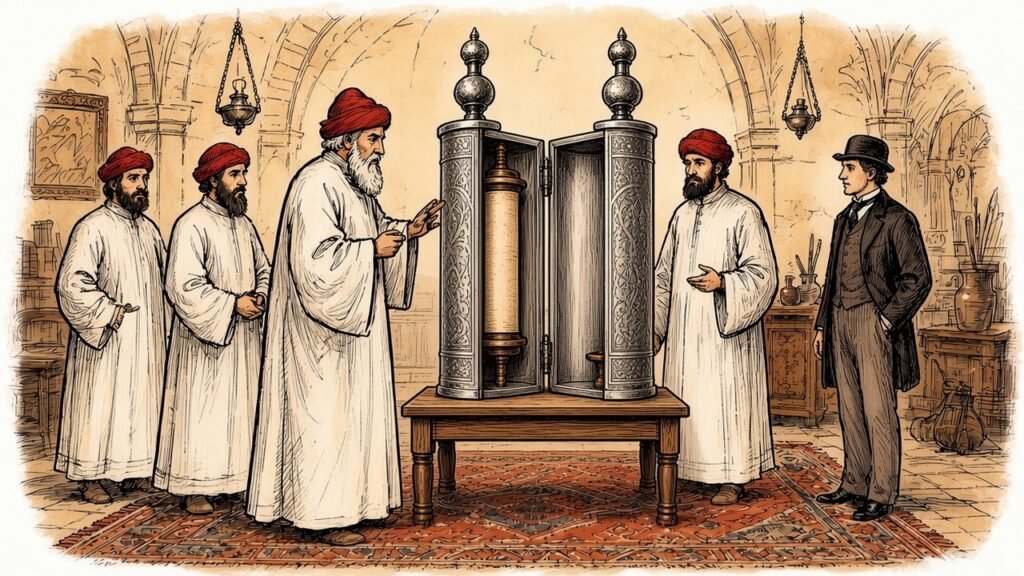
The Samaritans, a small community living at Nablus and on Mount Gerizim in the central hills of the land of Israel, possess a number of ancient Torah scrolls written in their own form of the old Hebrew alphabet. One of these is held in particular veneration. It is known as the Abisha Scroll, after a cryptographic inscription woven into its text which names its scribe as Abisha, great-grandson of Aaron the priest, and states that he wrote it at the door of the Tent of Meeting on Mount Gerizim in the thirteenth year after Israel entered Canaan.12 For the Samaritans the scroll is the oldest copy of the Law in the world, written within a generation of Moses. For modern scholars it is a composite manuscript of the Middle Ages, made of pieces of different ages, whose oldest part was probably written in the eleventh or twelfth century of the common era.34 The two views have coexisted since European travellers first sought to see the scroll in the sixteenth and seventeenth centuries. This article describes the Samaritan community and its Torah, the physical character of the scroll, the inscription that gives it its name, the history of its study by outsiders, the scholarly debate over its date and the place it holds in the religious life of the Samaritans.
At a glance
- Object: A Torah scroll of the Samaritan community, written in Samaritan script on parchment, revered as the oldest copy of the Law in existence.
- Location: Held by the Samaritan high priesthood, formerly in the synagogue of Nablus and now associated with the community on Mount Gerizim.
- Tradition: A cryptogram in the text names Abisha, son of Phinehas, son of Eleazar, son of Aaron, as the scribe, in the thirteenth year of Israel’s settlement in Canaan.
- Composition: Several pieces of different ages sewn together; the oldest part, beginning in Numbers, is generally dated to the eleventh or twelfth century CE.
- Edition: Federico Pérez Castro published the old portion from photographs in 1959.
- Debate: Alan D. Crown argued that the scroll was assembled and promoted in the fourteenth century, when a Samaritan chronicle records its recovery.
- Significance: A central relic of Samaritan religious identity and a witness to the medieval transmission of the Samaritan Pentateuch.
The Samaritans and their Torah
The Samaritans regard themselves as the descendants of the Israelite tribes of Ephraim and Manasseh and of priests of the line of Aaron who remained in the land after the fall of the northern kingdom. Their name for themselves, Shamerim, is understood within the community to mean keepers, that is, those who keep the Law. Their sacred centre is Mount Gerizim, above the city of Shechem, which they believe to be the place chosen by God for his worship, rather than Jerusalem. The historical origins of the community, and of its separation from the Jews who worshipped at Jerusalem, remain disputed, but archaeological excavation on Mount Gerizim has shown that a temple stood there from the fifth century BCE until its destruction by the Hasmonaean ruler John Hyrcanus at the end of the second century BCE.567
The Samaritan Bible consists of the five books of Moses alone. The Samaritans do not accept the Prophets and the Writings of the Jewish canon as Scripture, though they have their own chronicles and liturgical and theological literature. Their Torah, known to scholars as the Samaritan Pentateuch, is written in the Samaritan script, a descendant of the palaeo-Hebrew alphabet used in Israel before the adoption of the square Aramaic letters by the Jews. It differs from the Masoretic Text in some six thousand places, most of them minor matters of spelling and grammar, but a number of them significant. The best known is the inclusion, after the Ten Commandments in both Exodus and Deuteronomy, of a commandment to build an altar on Mount Gerizim. Many other differences are harmonisations, in which parallel passages are brought into agreement, a feature shared with some of the biblical manuscripts found at Qumran.891011
The textual character of the Samaritan Pentateuch is treated in detail in a separate article on this site.12 The present article concerns one scroll and the traditions surrounding it. It should be noted, however, that the Abisha Scroll is not, as its fame might suggest, the basis of the scholarly editions of the Samaritan Pentateuch. Those editions have rested mainly on codices brought to Europe from the seventeenth century onwards and on the manuscripts held by the community, and the Abisha Scroll has been used chiefly as one witness among many.1314
The community at Nablus and Mount Gerizim
For most of the medieval and modern periods the Samaritan community was concentrated at Nablus, the city built by the Romans as Flavia Neapolis close to ancient Shechem. Earlier there had been Samaritan communities in many places, including Damascus, Gaza, Cairo and Caesarea, but by the nineteenth century the community had shrunk to fewer than two hundred people living in a quarter of Nablus, where they maintained a synagogue and kept their sacred scrolls. In the twentieth century part of the community moved to Holon near Tel Aviv, and from the 1990s most of the Nablus Samaritans settled in the village of Kiryat Luza on the slopes of Mount Gerizim.151617
The community is led by a high priest of the line of Aaron, who presides over its worship and its annual sacrifice of the Passover lambs on Mount Gerizim. The high priest and his family have custody of the community’s most precious scrolls. The Abisha Scroll is not a scroll for ordinary reading. It is kept in a silver case and brought out on particular occasions, notably on festivals, when it is displayed to the congregation and carried in procession. Visitors have occasionally been shown it, but it has more often been shown at a distance, and other scrolls have frequently been shown in its place.1819
The physical scroll
The Abisha Scroll is a parchment roll of considerable length containing the whole of the Pentateuch. It is written in a single column format typical of Samaritan Torah scrolls, with the text divided into sections by spaces and marks, and in the Samaritan majuscule script used for liturgical manuscripts. The parchment is old and worn, and large parts of the scroll have been repaired or replaced over the centuries. Photographs taken in the late nineteenth and twentieth centuries show that the surface of some sheets is heavily darkened and damaged, while others are much better preserved.2021
Examination of photographs by modern scholars has made clear that the scroll is not the work of a single scribe. It consists of several pieces sewn together, written by different hands at different times. Federico Pérez Castro, who prepared an edition of the scroll from photographs in the 1950s, distinguished an older portion running from the later chapters of Numbers through the end of Deuteronomy, and later portions making up the rest. The older portion is the one that contains the cryptogram naming Abisha. Pérez Castro published this portion in 1959, with the photographs and a transcription, under the title Sefer Abisha.22
The later portions have been dated variously, but they are generally regarded as considerably more recent than the older part, perhaps from the fourteenth century or later. Some sheets may have been replaced as recently as the early modern period. Such composite scrolls are not unusual in Jewish or Samaritan practice, where a damaged sheet in a valued scroll is replaced rather than the whole scroll being discarded.2324
The cryptogram
The name of the scroll comes from a feature known in Samaritan scribal practice as a tashqil. A tashqil is an inscription formed by isolating letters of the biblical text in a column. The scribe arranges the text so that certain letters fall in a vertical channel separated from the rest of the line, and when these letters are read from top to bottom they spell out a message, usually naming the scribe, the place and the date of writing. The device allowed a scribe to record a colophon within the sacred text without adding any words to it. It is found in many Samaritan Torah scrolls and some codices.2526
The tashqil of the Abisha Scroll is located in the book of Deuteronomy. It reads, in the usual translation, that the writer is Abisha, son of Phinehas, son of Eleazar, son of Aaron the priest, and that he wrote the scroll at the door of the Tent of Meeting on Mount Gerizim in the thirteenth year of the dominion of the children of Israel over the land of Canaan. Phinehas the son of Eleazar is a figure of the book of Numbers, renowned for his zeal, and Abisha, also spelled Abishua, appears in the priestly genealogies of Chronicles and Ezra as the son of Phinehas.2728
Within the Samaritan community the tashqil is accepted as recording the true origin of the scroll. It places the scroll within the lifetime of the generation that entered Canaan under Joshua, and it makes it the work of the high priestly family itself, written at the sanctuary on Mount Gerizim. The scroll therefore serves not only as a copy of the Law but as a witness to the Samaritan claim that their priesthood and their holy mountain represent the authentic continuation of the worship established by Moses.2930
European interest
European scholars became interested in the Samaritans and their Pentateuch at the end of the sixteenth century, when Joseph Justus Scaliger corresponded with Samaritan communities in Cairo and Nablus. The first copy of the Samaritan Pentateuch to reach Europe was purchased in Damascus in 1616 by the Italian traveller Pietro Della Valle. Its text was printed in the Paris Polyglot of 1645 and the London Polyglot of 1657, and it became the subject of intense debate, since some Protestant and Catholic scholars used its differences from the Masoretic Text to argue about the authority of the Hebrew text received from the Jews.313233
Travellers to Nablus in the following centuries often asked to see the ancient scroll of which they had heard. The accounts they left are inconsistent. Some reported being shown a scroll of evident antiquity, others suspected that a less precious scroll had been substituted, and several mentioned the claim that it had been written by Abisha. The American biblical geographer Edward Robinson, who visited Nablus in 1838, recorded the Samaritans’ claims about their ancient scroll. By the later nineteenth century photographers had begun to work in Nablus, and pictures of the Samaritan high priest holding an open scroll became familiar images, although it is not always clear which scroll is shown.3435
Moses Gaster, the Romanian-born scholar who became Haham of the Sephardi congregations in London and a leading collector of Samaritan manuscripts, discussed the Abisha Scroll in his Schweich Lectures of 1923. Gaster was sympathetic to the antiquity of Samaritan traditions and inclined to give their claims more weight than most scholars, but he also recognised the composite nature of the scroll. In the twentieth century the community allowed the scroll to be photographed more fully, and it was from such photographs that Pérez Castro prepared his edition.3637
The question of date
No scholar outside the Samaritan community accepts the date stated in the tashqil. The Samaritan script itself developed from the palaeo-Hebrew script in the centuries around the turn of the era, and its majuscule form as seen in the scroll belongs to the medieval period. The writing material, the format and the scribal conventions all point to a much later date. The question is therefore not whether the scroll is as old as it claims, but when its oldest part was written and how the tashqil came to stand in it.3839
Pérez Castro dated the older portion on palaeographic grounds to around the eleventh or twelfth century. This date has generally been accepted, though with the caution that Samaritan palaeography is less well established than Hebrew or Greek palaeography and that dated Samaritan manuscripts from the early Middle Ages are few. The later portions, as noted, are more recent.4041
A more radical account was proposed by the Australian scholar Alan D. Crown in a study published in 1975. Crown drew attention to the Samaritan chronicle of Abu al-Fath, written in Arabic in 1355 at the request of the Samaritan high priest of the time, which contains a narrative concerning the recovery of an ancient scroll. In Crown’s reading, the fourteenth-century high priesthood, at a time when the community sought to strengthen its religious authority, assembled the scroll from older and newer pieces and promoted it as the work of Abisha. He also argued that the tashqil may have been copied into the scroll from another manuscript, or composed at that time on the model of genuine scribal colophons.4243
Crown’s thesis has been widely discussed. Some scholars have found its reconstruction of the fourteenth-century context persuasive, while others have regarded the evidence of the chronicle as too indirect to bear the weight placed on it. There is general agreement that the scroll as it now exists took shape in the medieval period, that it combines parts of different ages and that the attribution to Abisha cannot be historical. The precise date of the oldest portion and the exact circumstances in which the scroll acquired its reputation remain open questions.4445
The text of the scroll
The text of the Abisha Scroll is a Samaritan text in the full sense. It contains the characteristic Samaritan readings, including the commandment concerning Mount Gerizim and the use of the past tense in Deuteronomy for the place that God has chosen, rather than the future tense of the Masoretic Text, which implies that the place was already chosen in the time of Moses and points to Shechem and Gerizim. In this respect the scroll does not differ from the main manuscript tradition of the Samaritan Pentateuch.4647
Within the Samaritan tradition, manuscripts differ from one another in small details of spelling and division, and the Abisha Scroll has its own readings. Pérez Castro noted these in his edition. For the textual criticism of the Samaritan Pentateuch the scroll is a useful witness, but it does not hold the decisive authority that its reputation might suggest. The critical edition of the Samaritan Pentateuch now in progress under the direction of Stefan Schorch draws on a broad range of manuscripts, with codices of the twelfth and thirteenth centuries playing a central part.4849
The Samaritans’ own reading tradition is also relevant. They pronounce the Hebrew of their Torah according to an oral tradition which differs considerably from the Tiberian pronunciation preserved by the Masoretes. The manuscripts do not record this pronunciation in the way that Masoretic codices record vowels and accents. The Samaritan scribes used a limited set of signs, and the reading of the text depended on the oral tradition handed down in the priestly families. The Abisha Scroll, like other Samaritan liturgical scrolls, therefore records the consonants of the text, and its use in worship depends on readers trained in the tradition.50
The scroll in Samaritan religious life
For the Samaritan community the scroll’s significance lies above all in its role as a sacred object. It is brought out on the major festivals, particularly at Passover, Shavuot and the Feast of Tabernacles, and displayed to the community on Mount Gerizim. The high priest raises it before the congregation, and members of the community approach to kiss its case. Its presence links the living community to the priestly ancestors from whom the high priests trace their descent and to the founding events of Israel’s history.5152
The scroll has also served as a focus of identity in the community’s dealings with outsiders. In the nineteenth and twentieth centuries, when the Samaritans were few and poor, the fame of their ancient scroll brought visitors and patrons, and it gave the community a standing out of proportion to its numbers. Accounts of visitors who sought to buy the scroll, or who suspected the Samaritans of concealing it, form part of the long history of European curiosity about the community.5354
It should be noted that the community did not, in general, permit the scroll to leave its custody, even for study. The edition of Pérez Castro was made from photographs, and later scholars have mostly relied on those photographs and on others taken since. The scroll has never been subjected to scientific dating by radiocarbon or other methods, and any such analysis would depend on the consent of the community, for whom the question of its age is answered by the tashqil.5556
Samaritan scribal culture
The Abisha Scroll belongs to a long tradition of Samaritan scribal work. Samaritan scribes copied the Torah both in scrolls for liturgical use and in codices for study, and they developed a distinctive set of conventions. The text is divided into sections called qissim, marked by spacing and by special signs. The ends of books are marked by colophons, and the tashqil device allowed scribes to record their names and the circumstances of their work within the text itself. Many Samaritan codices from the twelfth century onwards survive, often with dated tashqils that allow the development of the script to be followed.5758
The use of the tashqil in a scroll attributed to Abisha is therefore not in itself unusual. What distinguishes it is the claim of the inscription. Other tashqils name medieval scribes and give dates in the era of the Muslim calendar or in years since the entry into Canaan. The Abisha tashqil gives a date that places it within the biblical narrative, and so it removes the scroll from the ordinary history of manuscript production. The scholarly debate is in large part an attempt to restore the scroll to that ordinary history while respecting the meaning it carries for those who preserve it.5960
Comparisons with Jewish traditions
The veneration of the Abisha Scroll has parallels in Jewish tradition. Medieval Jewish communities also preserved scrolls and codices to which they attributed great antiquity or special authority. The Aleppo Codex, written in Tiberias in the tenth century, was revered by the community of Aleppo as the model codex consulted by Maimonides, and it was surrounded by legends and protected by curses against anyone who removed it. Some Jewish communities claimed to possess scrolls written by Ezra the scribe. In each case, the attribution reflects the value placed on continuity with the founding generation of the tradition and on the fidelity of transmission.61
The comparison should not be pressed too far. The Samaritan and Jewish traditions developed separately and with different structures of authority. But the history of the Abisha Scroll illustrates a general feature of religious communities that preserve sacred texts: the most important manuscripts are not simply copies of a text but objects that embody the community’s relation to its origins. Their histories as physical objects, which can be reconstructed by scholars, and their meanings within the community, which are expressed in tradition and ritual, are two aspects of the same reality.62
Editions of the Samaritan Pentateuch
The modern study of the Samaritan Pentateuch has depended on a series of editions, and the place of the Abisha Scroll in each of them reflects the changing judgement of scholars about its value. The first critical edition was that of August von Gall, published at Giessen between 1914 and 1918. Von Gall collated a large number of manuscripts and printed an eclectic text, that is, a text reconstructed from the readings he judged best rather than the text of a single manuscript. His edition was later criticised for regularising the spelling of the text in ways that the manuscripts do not support.636465
A different approach was adopted by Abraham Tal, whose edition of 1994 reproduced the text of a single manuscript, MS 6 of the synagogue of the Samaritan community at Shechem, a codex dated to 1204 CE. A diplomatic edition of this kind records exactly what one manuscript contains, with its own spellings and divisions, and so preserves the character of a real Samaritan copy. In 2010 Tal and Moshe Florentin published an edition that sets the Samaritan text beside the Masoretic Text, allowing the differences between the two traditions to be seen at a glance.666768
The critical editio maior directed by Stefan Schorch aims to provide a full record of the manuscript evidence for the Samaritan Pentateuch, with a text based on the early codices and an apparatus of their variants. Its volumes have appeared since 2018. In this edition, as in Tal’s, the authority given to particular manuscripts rests on their date and quality as established by scholarly study, and not on their reputation within the community. The Abisha Scroll is accordingly one witness among others, and the old codices dated by their colophons carry more weight.69
Word division and section marks
Samaritan manuscripts, including the Abisha Scroll, separate words with a dot placed between them, a practice inherited from the palaeo-Hebrew writing of the biblical period, in which inscriptions often use dots or short strokes as word dividers. Jewish scribes writing in the square script came instead to separate words by spaces. The Samaritan practice is thus one of several features in which the Samaritan scribal tradition preserves conventions older than those of the Jewish book.7071
The text of the Samaritan Torah is also divided into sections, called qiṣṣot, which are marked in the manuscripts by combinations of dots and dashes and by the arrangement of the line. These divisions do not correspond exactly to the open and closed sections of the Masoretic Text, though the two systems often coincide. In the Abisha Scroll, as in other Samaritan scrolls, the section marks and the layout of the columns are part of what the scribe was expected to reproduce, and differences in their placement are among the small variations that distinguish one Samaritan manuscript from another.7273
The scroll and the codices
The Samaritan manuscript tradition includes both scrolls and codices. Scrolls such as the Abisha Scroll are used in worship, while codices, which are easier to consult, have long served for study and private reading. Many of the oldest dated Samaritan manuscripts of the Torah are codices of the twelfth and thirteenth centuries, and their colophons record the names of the scribes, the dates of writing and often the owners. These dated codices provide the fixed points against which Samaritan scripts are compared and undated manuscripts, including the oldest part of the Abisha Scroll, are assigned to their periods.7475
The relationship between scroll and codex in the Samaritan tradition resembles that in the Jewish tradition, where the Torah scroll remained the form required for public reading while the codex became the vehicle of the Masoretic notes and of study. In both communities the scroll retained a ritual status that the codex did not acquire, and the most venerated objects of each tradition have included scrolls whose authority rested on their claimed antiquity.7677
The oral tradition and its study
The pronunciation of the Samaritan Torah was documented systematically by Zeʾev Ben-Hayyim, whose multi-volume work on the literary and oral tradition of Hebrew and Aramaic among the Samaritans appeared between 1957 and 1977. Ben-Hayyim recorded the reading of the Torah by members of the community and transcribed it, showing that the Samaritan reading tradition is an independent and ancient form of Hebrew pronunciation, distinct from the Tiberian tradition preserved by the Masoretes. His later grammar of Samaritan Hebrew, published in English in 2000, set out the results of this work in systematic form.7879
This research has a bearing on the Abisha Scroll. Because Samaritan manuscripts record the consonants without full vocalisation, the reading of the scroll in worship depends on the oral tradition that Ben-Hayyim studied. The scroll and the reading tradition thus form two complementary parts of a single transmission, one written and the other spoken, in much the same way that the consonantal text and the vocalisation stood side by side in the Jewish tradition before the Masoretes committed the latter to writing.80
The Samaritan Targum and the Arabic version
Like the Jews, the Samaritans translated their Torah into Aramaic when Hebrew ceased to be their everyday language. The Samaritan Targum survives in manuscripts that differ considerably from one another, reflecting a long process of revision rather than a single fixed translation. Abraham Tal published a critical edition of the Samaritan Targum in three volumes between 1980 and 1983. The Targum is an important source for Samaritan Aramaic and for the interpretation of the Torah in the community, though its value as a witness to the Hebrew text is limited by its history of revision.8182
After the Arab conquest Arabic gradually replaced Aramaic as the spoken language of the Samaritans, and the Torah was translated into Arabic. The best known version is associated with Abu Saʿid, a Samaritan scholar of the thirteenth century working in Egypt. Haseeb Shehadeh published a critical edition of the Arabic translation of the Samaritan Pentateuch. Bilingual and trilingual manuscripts, in which Hebrew, Aramaic and Arabic stand in parallel columns, show how the community continued to read its Hebrew Torah while explaining it in the languages it spoke.8384
The scroll and the Qumran evidence
The discovery of the Qumran scrolls changed the way in which the Samaritan Pentateuch as a whole is understood, and with it the context in which the Abisha Scroll is studied. Among the biblical manuscripts from Qumran are several which share many of the characteristic features of the Samaritan text, notably its harmonising expansions, but lack the specifically Samaritan readings concerning Mount Gerizim. Scholars have called these texts pre-Samaritan, and they show that the Samaritan Pentateuch was based on a form of the Hebrew text that was current among Jews in the late Second Temple period, to which a small number of sectarian changes were added.8586
This conclusion places the Abisha Scroll, like the other Samaritan manuscripts, in the line of a very old textual tradition, even though the scroll itself is medieval. Its claim to antiquity is thus true in an unexpected sense: not as a copy written by the great-grandson of Aaron, but as a late representative of a text whose roots reach back to the period of the Qumran scrolls. The wider question of the Samaritan text and its relation to the Masoretic and Septuagint traditions is treated in the article on the Samaritan Pentateuch on this site.8788
The festival year
The Samaritans observe the festivals prescribed in the Torah: Passover and the Feast of Unleavened Bread, Shavuot, the festival of the seventh month, the Day of Atonement, the Feast of Tabernacles and the Eighth Day of Assembly. Three times a year, at Unleavened Bread, Shavuot and Tabernacles, the community goes up in pilgrimage to the summit of Mount Gerizim, in accordance with the commandment that all males appear before God three times a year. Their calendar is calculated by the priests and differs at times from the Jewish calendar. It is on these occasions that the Abisha Scroll, together with other ancient scrolls of the community, is brought out and shown, so that the scroll’s ritual life follows the rhythm of the year laid down in the text it contains.8990
Model scrolls in the Jewish tradition
The Jewish tradition also knew scrolls and codices that served as models for copyists and to which special authority was attributed. Medieval sources refer to such model manuscripts, and the Aleppo Codex, discussed above, became the best known of them. Their authority rested partly on the care with which they had been written and corrected and partly on their association with famous scholars. The difference from the Abisha Scroll is that the Jewish model codices were valued above all as guides to the correct text, while the Abisha Scroll is valued primarily as a relic of the priestly founder of the community.9192
In both traditions, however, such objects served to anchor the transmission of the text in a recognised authority. A community that possessed a model or a relic could appeal to it to settle questions of correctness and to affirm its own continuity with the past. The Abisha Scroll, kept by the high priests on Mount Gerizim, has fulfilled this role for the Samaritans for at least six centuries, and its study by outsiders, from Della Valle to the editors of the present day, forms part of the history of how that role has been understood.9394
Related material on this site
The text of the Samaritan Pentateuch, its relation to the Masoretic Text and its significance for the history of the Hebrew Bible are described in the article on the Samaritan Pentateuch.95 The harmonising readings that the Samaritan text shares with some of the Qumran manuscripts, including several phylactery slips, are discussed in the article on the tefillin and mezuzot from Qumran.96 Readers interested in ancient copies of the priestly blessing and other early biblical inscriptions may consult the article on the Silver Scroll.97
Conclusion
The Abisha Scroll is at once a medieval manuscript and a sacred relic. Its oldest part was probably written in the eleventh or twelfth century, and it was later combined with newer sections to form the complete scroll now kept by the Samaritan high priesthood. Its cryptographic inscription, naming the great-grandson of Aaron as its scribe, cannot be accepted as historical, and it may have been introduced or promoted in the fourteenth century, when a Samaritan chronicle records the recovery of an ancient scroll. For the Samaritans the scroll remains the oldest copy of the Law and a tangible link with the priesthood of the time of Joshua. For the historian it is a witness to the continuity of Samaritan scribal culture and to the ways in which a small community, through centuries of decline and survival, has preserved and honoured the text on which its identity rests.9899100
Notes
- Grokipedia, “Samaritans”. ↩
- Grokipedia, “Samaritan Pentateuch”. ↩
- Federico Pérez Castro, Sēfer Abiša: Edición del fragmento antiguo del rollo sagrado del Pentateuco hebreo samaritano de Nablus, Textos y Estudios del Seminario Filológico Cardenal Cisneros 2 (Madrid: Consejo Superior de Investigaciones Científicas, 1959). ↩
- Alan D. Crown, “The Abisha Scroll of the Samaritans,” Bulletin of the John Rylands University Library of Manchester 58 (1975): 36–65. ↩
- Reinhard Pummer, The Samaritans: A Profile (Grand Rapids: Eerdmans, 2016). ↩
- Grokipedia, “Mount Gerizim”. ↩
- Grokipedia, “Shechem”. ↩
- Robert T. Anderson and Terry Giles, The Samaritan Pentateuch: An Introduction to Its Origin, History, and Significance for Biblical Studies (Atlanta: Society of Biblical Literature, 2012). ↩
- Emanuel Tov, Textual Criticism of the Hebrew Bible, 3rd ed. (Minneapolis: Fortress Press, 2012). ↩
- Grokipedia, “Samaritan Pentateuch”. ↩
- See also “The Samaritan Pentateuch” on this site. ↩
- See also “The Samaritan Pentateuch” on this site. ↩
- Robert T. Anderson and Terry Giles, The Samaritan Pentateuch: An Introduction to Its Origin, History, and Significance for Biblical Studies (Atlanta: Society of Biblical Literature, 2012). ↩
- Stefan Schorch, ed., The Samaritan Pentateuch: A Critical Editio Maior (Berlin: De Gruyter, 2018–). ↩
- Reinhard Pummer, The Samaritans: A Profile (Grand Rapids: Eerdmans, 2016). ↩
- Grokipedia, “Nablus”. ↩
- Grokipedia, “Kiryat Luza”. ↩
- Reinhard Pummer, The Samaritans: A Profile (Grand Rapids: Eerdmans, 2016). ↩
- Moses Gaster, The Samaritans: Their History, Doctrines and Literature, Schweich Lectures 1923 (London: Oxford University Press, 1925). ↩
- Federico Pérez Castro, Sēfer Abiša: Edición del fragmento antiguo del rollo sagrado del Pentateuco hebreo samaritano de Nablus, Textos y Estudios del Seminario Filológico Cardenal Cisneros 2 (Madrid: Consejo Superior de Investigaciones Científicas, 1959). ↩
- Alan D. Crown, ed., The Samaritans (Tübingen: Mohr Siebeck, 1989). ↩
- Federico Pérez Castro, Sēfer Abiša: Edición del fragmento antiguo del rollo sagrado del Pentateuco hebreo samaritano de Nablus, Textos y Estudios del Seminario Filológico Cardenal Cisneros 2 (Madrid: Consejo Superior de Investigaciones Científicas, 1959). ↩
- Alan D. Crown, “The Abisha Scroll of the Samaritans,” Bulletin of the John Rylands University Library of Manchester 58 (1975): 36–65. ↩
- Alan D. Crown, ed., The Samaritans (Tübingen: Mohr Siebeck, 1989). ↩
- Alan D. Crown, ed., The Samaritans (Tübingen: Mohr Siebeck, 1989). ↩
- Alan D. Crown, Reinhard Pummer and Abraham Tal, eds., A Companion to Samaritan Studies (Tübingen: Mohr Siebeck, 1993). ↩
- Federico Pérez Castro, Sēfer Abiša: Edición del fragmento antiguo del rollo sagrado del Pentateuco hebreo samaritano de Nablus, Textos y Estudios del Seminario Filológico Cardenal Cisneros 2 (Madrid: Consejo Superior de Investigaciones Científicas, 1959). ↩
- Grokipedia, “Phinehas”. ↩
- Reinhard Pummer, The Samaritans: A Profile (Grand Rapids: Eerdmans, 2016). ↩
- Grokipedia, “Samaritans”. ↩
- Robert T. Anderson and Terry Giles, The Samaritan Pentateuch: An Introduction to Its Origin, History, and Significance for Biblical Studies (Atlanta: Society of Biblical Literature, 2012). ↩
- Grokipedia, “Samaritan Pentateuch”. ↩
- Grokipedia, “Pietro Della Valle”. ↩
- Reinhard Pummer, The Samaritans: A Profile (Grand Rapids: Eerdmans, 2016). ↩
- Moses Gaster, The Samaritans: Their History, Doctrines and Literature, Schweich Lectures 1923 (London: Oxford University Press, 1925). ↩
- Federico Pérez Castro, Sēfer Abiša: Edición del fragmento antiguo del rollo sagrado del Pentateuco hebreo samaritano de Nablus, Textos y Estudios del Seminario Filológico Cardenal Cisneros 2 (Madrid: Consejo Superior de Investigaciones Científicas, 1959). ↩
- Moses Gaster, The Samaritans: Their History, Doctrines and Literature, Schweich Lectures 1923 (London: Oxford University Press, 1925). ↩
- Alan D. Crown, “The Abisha Scroll of the Samaritans,” Bulletin of the John Rylands University Library of Manchester 58 (1975): 36–65. ↩
- Grokipedia, “Samaritan script”. ↩
- Federico Pérez Castro, Sēfer Abiša: Edición del fragmento antiguo del rollo sagrado del Pentateuco hebreo samaritano de Nablus, Textos y Estudios del Seminario Filológico Cardenal Cisneros 2 (Madrid: Consejo Superior de Investigaciones Científicas, 1959). ↩
- Alan D. Crown, Reinhard Pummer and Abraham Tal, eds., A Companion to Samaritan Studies (Tübingen: Mohr Siebeck, 1993). ↩
- Alan D. Crown, “The Abisha Scroll of the Samaritans,” Bulletin of the John Rylands University Library of Manchester 58 (1975): 36–65. ↩
- Paul Stenhouse, trans., The Kitāb al-Tarīkh of Abū ’l-Fatḥ (Sydney: Mandelbaum Trust, University of Sydney, 1985). ↩
- Alan D. Crown, ed., The Samaritans (Tübingen: Mohr Siebeck, 1989). ↩
- Reinhard Pummer, The Samaritans: A Profile (Grand Rapids: Eerdmans, 2016). ↩
- Robert T. Anderson and Terry Giles, The Samaritan Pentateuch: An Introduction to Its Origin, History, and Significance for Biblical Studies (Atlanta: Society of Biblical Literature, 2012). ↩
- Grokipedia, “Samaritan Pentateuch”. ↩
- Federico Pérez Castro, Sēfer Abiša: Edición del fragmento antiguo del rollo sagrado del Pentateuco hebreo samaritano de Nablus, Textos y Estudios del Seminario Filológico Cardenal Cisneros 2 (Madrid: Consejo Superior de Investigaciones Científicas, 1959). ↩
- Stefan Schorch, ed., The Samaritan Pentateuch: A Critical Editio Maior (Berlin: De Gruyter, 2018–). ↩
- Grokipedia, “Samaritan Hebrew”. ↩
- Reinhard Pummer, The Samaritans: A Profile (Grand Rapids: Eerdmans, 2016). ↩
- Grokipedia, “Samaritans”. ↩
- Reinhard Pummer, The Samaritans: A Profile (Grand Rapids: Eerdmans, 2016). ↩
- Moses Gaster, The Samaritans: Their History, Doctrines and Literature, Schweich Lectures 1923 (London: Oxford University Press, 1925). ↩
- Federico Pérez Castro, Sēfer Abiša: Edición del fragmento antiguo del rollo sagrado del Pentateuco hebreo samaritano de Nablus, Textos y Estudios del Seminario Filológico Cardenal Cisneros 2 (Madrid: Consejo Superior de Investigaciones Científicas, 1959). ↩
- Reinhard Pummer, The Samaritans: A Profile (Grand Rapids: Eerdmans, 2016). ↩
- Alan D. Crown, ed., The Samaritans (Tübingen: Mohr Siebeck, 1989). ↩
- Alan D. Crown, Reinhard Pummer and Abraham Tal, eds., A Companion to Samaritan Studies (Tübingen: Mohr Siebeck, 1993). ↩
- Alan D. Crown, “The Abisha Scroll of the Samaritans,” Bulletin of the John Rylands University Library of Manchester 58 (1975): 36–65. ↩
- Alan D. Crown, Reinhard Pummer and Abraham Tal, eds., A Companion to Samaritan Studies (Tübingen: Mohr Siebeck, 1993). ↩
- Emanuel Tov, Textual Criticism of the Hebrew Bible, 3rd ed. (Minneapolis: Fortress Press, 2012). ↩
- Reinhard Pummer, The Samaritans: A Profile (Grand Rapids: Eerdmans, 2016). ↩
- August Freiherr von Gall, Der hebräische Pentateuch der Samaritaner, 5 vols. (Giessen: Töpelmann, 1914–1918). ↩
- Robert T. Anderson and Terry Giles, The Samaritan Pentateuch: An Introduction to Its Origin, History, and Significance for Biblical Studies (Atlanta: Society of Biblical Literature, 2012). ↩
- Emanuel Tov, Textual Criticism of the Hebrew Bible, 3rd ed. (Minneapolis: Fortress Press, 2012). ↩
- Abraham Tal, The Samaritan Pentateuch, Edited According to MS 6 (C) of the Shekhem Synagogue (Tel Aviv: Tel Aviv University, 1994). ↩
- Abraham Tal and Moshe Florentin, The Pentateuch: The Samaritan Version and the Masoretic Version (Tel Aviv: Haim Rubin Tel Aviv University Press, 2010). ↩
- Robert T. Anderson and Terry Giles, The Samaritan Pentateuch: An Introduction to Its Origin, History, and Significance for Biblical Studies (Atlanta: Society of Biblical Literature, 2012). ↩
- Stefan Schorch, ed., The Samaritan Pentateuch: A Critical Editio Maior (Berlin: De Gruyter, 2018–). ↩
- Grokipedia, “Samaritan script”. ↩
- Alan D. Crown, Reinhard Pummer and Abraham Tal, eds., A Companion to Samaritan Studies (Tübingen: Mohr Siebeck, 1993). ↩
- Alan D. Crown, Reinhard Pummer and Abraham Tal, eds., A Companion to Samaritan Studies (Tübingen: Mohr Siebeck, 1993). ↩
- Robert T. Anderson and Terry Giles, The Samaritan Pentateuch: An Introduction to Its Origin, History, and Significance for Biblical Studies (Atlanta: Society of Biblical Literature, 2012). ↩
- Alan D. Crown, Reinhard Pummer and Abraham Tal, eds., A Companion to Samaritan Studies (Tübingen: Mohr Siebeck, 1993). ↩
- Stefan Schorch, ed., The Samaritan Pentateuch: A Critical Editio Maior (Berlin: De Gruyter, 2018–). ↩
- Alan D. Crown, Reinhard Pummer and Abraham Tal, eds., A Companion to Samaritan Studies (Tübingen: Mohr Siebeck, 1993). ↩
- Emanuel Tov, Textual Criticism of the Hebrew Bible, 3rd ed. (Minneapolis: Fortress Press, 2012). ↩
- Zeʾev Ben-Hayyim, A Grammar of Samaritan Hebrew (Jerusalem: Magnes Press; Winona Lake, IN: Eisenbrauns, 2000). ↩
- Grokipedia, “Samaritan Hebrew”. ↩
- Grokipedia, “Samaritan Hebrew”. ↩
- Abraham Tal, The Samaritan Targum of the Pentateuch: A Critical Edition, 3 vols. (Tel Aviv: Tel Aviv University, 1980–1983). ↩
- Alan D. Crown, Reinhard Pummer and Abraham Tal, eds., A Companion to Samaritan Studies (Tübingen: Mohr Siebeck, 1993). ↩
- Haseeb Shehadeh, The Arabic Translation of the Samaritan Pentateuch, 2 vols. (Jerusalem: Israel Academy of Sciences and Humanities, 1989–2002). ↩
- Alan D. Crown, Reinhard Pummer and Abraham Tal, eds., A Companion to Samaritan Studies (Tübingen: Mohr Siebeck, 1993). ↩
- Emanuel Tov, Textual Criticism of the Hebrew Bible, 3rd ed. (Minneapolis: Fortress Press, 2012). ↩
- See also “The Samaritan Pentateuch” on this site. ↩
- Emanuel Tov, Textual Criticism of the Hebrew Bible, 3rd ed. (Minneapolis: Fortress Press, 2012). ↩
- See also “The Samaritan Pentateuch” on this site. ↩
- Reinhard Pummer, The Samaritans: A Profile (Grand Rapids: Eerdmans, 2016). ↩
- Grokipedia, “Mount Gerizim”. ↩
- Emanuel Tov, Textual Criticism of the Hebrew Bible, 3rd ed. (Minneapolis: Fortress Press, 2012). ↩
- Alan D. Crown, Reinhard Pummer and Abraham Tal, eds., A Companion to Samaritan Studies (Tübingen: Mohr Siebeck, 1993). ↩
- Reinhard Pummer, The Samaritans: A Profile (Grand Rapids: Eerdmans, 2016). ↩
- Alan D. Crown, “The Abisha Scroll of the Samaritans,” Bulletin of the John Rylands University Library of Manchester 58 (1975): 36–65. ↩
- See also “The Samaritan Pentateuch” on this site. ↩
- See also “The Tefillin and Mezuzot from Qumran” on this site. ↩
- See also “The Silver Scroll” on this site. ↩
- Federico Pérez Castro, Sēfer Abiša: Edición del fragmento antiguo del rollo sagrado del Pentateuco hebreo samaritano de Nablus, Textos y Estudios del Seminario Filológico Cardenal Cisneros 2 (Madrid: Consejo Superior de Investigaciones Científicas, 1959). ↩
- Alan D. Crown, “The Abisha Scroll of the Samaritans,” Bulletin of the John Rylands University Library of Manchester 58 (1975): 36–65. ↩
- Reinhard Pummer, The Samaritans: A Profile (Grand Rapids: Eerdmans, 2016). ↩