

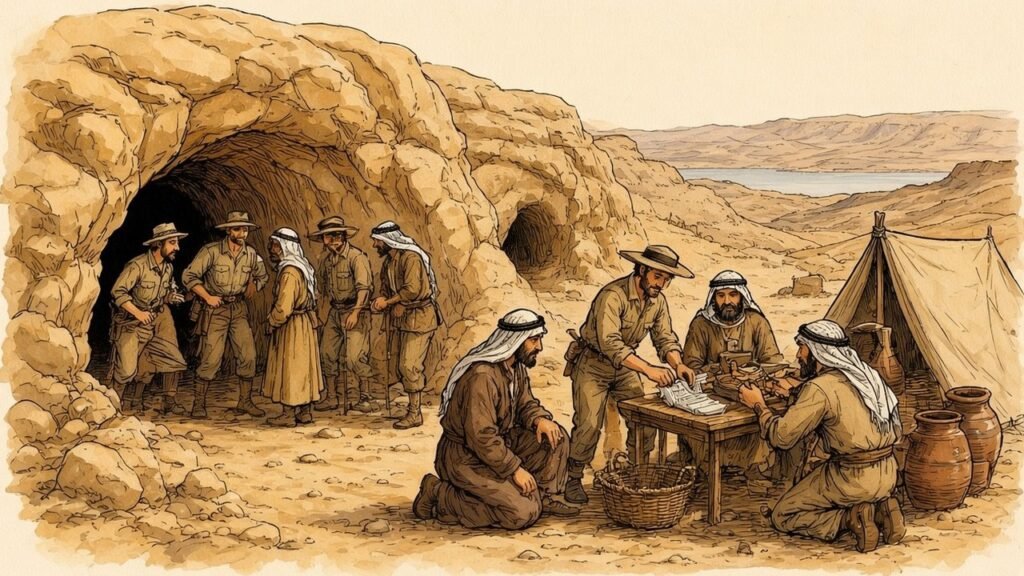
Among the many thousands of fragments recovered from the caves near Khirbet Qumran on the north-western shore of the Dead Sea are some of the smallest written objects to survive from ancient Judaism. They are slips of very thin parchment, a few centimetres across, covered on one or both sides with minute Hebrew script and once folded tightly into tiny leather cases. These are tefillin, the boxes containing passages of the Torah which Jewish men bind on the arm and the head during prayer, and mezuzot, the parchments fixed to the doorposts of houses. Found mostly in Cave 4 in the 1950s, with further pieces from other caves, they are the oldest physical examples of either practice known anywhere.123 Their texts show that by the late Second Temple period the commandments of Deuteronomy to bind the words of God as a sign upon the hand and to write them on the doorposts were already being carried out literally, but that the choice of passages, their arrangement and their spelling had not yet been fixed in the way later rabbinic law would require.4 This article describes the discovery and publication of these objects, their physical form, their contents, the relation of their texts to the Masoretic tradition and to rabbinic rules, and the questions they raise about the communities that used them.
At a glance
- Objects: Small parchment slips once folded into leather capsules worn on the head and arm (tefillin), and slightly larger slips fixed to doorposts (mezuzot).
- Find-places: Chiefly Qumran Cave 4, with further pieces from Caves 1, 5 and 8 and a capsule of uncertain cave acquired in 1968.
- Number: About thirty tefillin slips and some eight mezuzot are generally counted among the Qumran finds, together with several empty capsules.
- Date: Mostly from the first century BCE and the first century CE, on palaeographic grounds.
- Editions: K. G. Kuhn (1957), Y. Yadin (1969) and J. T. Milik in Discoveries in the Judaean Desert 6 (1977).
- Contents: The four passages later fixed by rabbinic law, often together with the Decalogue and other extracts from Exodus and Deuteronomy.
- Significance: The earliest physical evidence for tefillin and mezuzot, showing a practice still flexible in its choice of texts and in its spelling.
The commandments and their interpretation
The practice of tefillin and mezuzah rests on four passages of the Pentateuch. In Exodus 13:9 and 13:16, after the laws of the Passover and of the firstborn, Israel is told that these things shall be a sign upon the hand and a memorial, or frontlets, between the eyes. In Deuteronomy 6:8–9, immediately after the Shema, the command is given to bind the words as a sign upon the hand, to let them be frontlets between the eyes, and to write them on the doorposts of the house and on the gates. Deuteronomy 11:18–20 repeats the same commands in nearly the same words. Whether these expressions were first meant literally or figuratively has long been discussed. Proverbs uses similar language of binding teachings about the neck and writing them on the tablet of the heart, which suggests that a metaphorical reading was possible in ancient Israel. By the Hellenistic period, however, at least some Jews were plainly understanding the commands as instructions to make physical objects.5
The earliest literary witnesses confirm this. The Letter of Aristeas, a Greek work probably of the second century BCE, refers to the words written on gates and doors and to a sign bound upon the hands. Josephus, writing at the end of the first century CE, describes the custom of inscribing the greatest benefits of God on the doors and of displaying them on the head and the arm. The Gospel of Matthew speaks of those who make their phylacteries broad, using the Greek word phylakterion, meaning a safeguard or amulet, which became the usual name for tefillin in Greek and later in European languages.6 These references show that by the time of the Qumran settlement the practice was established and visible, but they say nothing about which passages were written inside the cases or how they were arranged. For that the evidence of the caves is unique.
Rabbinic law, as set out in the Mishnah and the Talmuds, later fixed the content precisely. Both the head tefillin and the arm tefillin were to contain the same four passages, Exodus 13:1–10, Exodus 13:11–16, Deuteronomy 6:4–9 and Deuteronomy 11:13–21. The head case was to be divided into four compartments, each holding one passage on a separate slip, while the arm case had a single compartment holding all four passages written on one slip. A mezuzah was to contain only the two passages from Deuteronomy, 6:4–9 and 11:13–21. The rules extended to the writing itself, which had to follow a fixed text, to the preparation of the parchment and to the shape of the cases. These regulations were developed over several centuries, and the question that the Qumran finds allow scholars to ask is how far, and how early, the later norms were already in force.78
Discovery and publication
The first phylactery fragments came to light among the material from Cave 1, discovered in 1947 and excavated by Roland de Vaux and G. Lankester Harding in 1949. The great harvest, however, came from Cave 4, found by Taamireh Bedouin in the late summer of 1952 in the marl terrace immediately opposite the ruins of Khirbet Qumran. Cave 4 yielded fragments of some five hundred manuscripts, and among them were dozens of tiny slips and several leather capsules, some still holding folded parchment.910 Further pieces came from Caves 5 and 8, the latter a small cave in which archaeologists also found leather thongs and capsule fragments. Because the material from Cave 4 reached the Palestine Archaeological Museum in Jerusalem in a confused state, partly by purchase from the Bedouin and partly from excavation, the attribution of individual slips to particular caves is not always certain.11
The first substantial publication was by the German scholar Karl Georg Kuhn, who in 1957 issued a short study of four phylactery slips from Cave 4 which he had been allowed to unfold and photograph.12 Kuhn showed that the slips contained not only the four passages required by rabbinic law but also the Ten Commandments, a discovery that immediately attracted attention, since the Decalogue was known to have been recited in the Temple service and later deliberately excluded from the daily liturgy. The full edition of the Cave 4 tefillin and mezuzot fell to the Polish scholar Józef Tadeusz Milik, a member of the original team of editors. His volume, published in 1977 as the sixth in the series Discoveries in the Judaean Desert, presented twenty-one phylactery slips and eight mezuzot from Cave 4, designated 4QPhyl A–U and 4QMez A–H, with photographs, transcriptions and a commentary in French.13
Between the two came the most spectacular single object. In 1968, after the Six-Day War, Yigael Yadin acquired through an intermediary a small leather capsule of the head type, about two centimetres long, with four compartments. Three of the compartments still held their tightly folded slips, and a fourth slip was recovered separately. Yadin, who was then also working on the Temple Scroll, had the slips opened in the laboratories of the Israel Museum and published them in 1969 as Tefillin from Qumran, XQ Phyl 1–4.14 The letters X and Q indicate that the cave of origin was not known, although Yadin regarded Cave 4 as the most likely source. The publication was the first to show a complete head capsule with its contents in their original arrangement, and it demonstrated that the four-compartment form required by rabbinic law was already in use, even though the texts inside did not conform to the rabbinic selection.
Since Milik’s edition, the Qumran tefillin have continued to be studied. Several unopened capsules remained in the collections of the Israel Antiquities Authority, and the opening of some of them in the twenty-first century, with modern imaging, added further slips to the corpus. The images of many fragments are now accessible through the Leon Levy Dead Sea Scrolls Digital Library, which allows the minute writing to be read at high magnification.15 The total count therefore varies slightly from one survey to another, but a figure of about thirty phylactery slips and about eight mezuzot is commonly given.16
The physical objects
A tefillin case from Qumran is a small object made from a single piece of leather. The leather was folded around a mould while damp and stitched, so that when it dried it kept the form of one or more compartments. A head case had four compartments arranged in a row, while an arm case had one. The cases found at Qumran are rectangular or somewhat rounded and are generally much smaller than modern tefillin, measuring between one and three centimetres in length. Some retain traces of the thongs by which they were fastened, made of thin strips of leather. The modern square black boxes, with their precise dimensions and blackened surfaces, are the result of later developments in rabbinic regulation, and nothing so standardised appears in the caves.17
The slips themselves were cut from very fine parchment, in some cases so thin that the writing on one side shows through to the other. They were written in a minute hand, sometimes with letters little more than a millimetre high, and many are written on both sides, a feature that later rabbinic law did not permit for tefillin. Once written, a slip was folded repeatedly, first lengthwise and then crosswise, into a small packet that could be inserted into a compartment and tied with a thread or a strand of hair. The folding has left the slips damaged along the creases, and the reading of them depends on careful reconstruction of the order in which the panels were folded.1819
Mezuzot from Qumran are similar in material but rather larger, and they were not designed to be folded so tightly. They were evidently intended to be placed in a container attached to the doorpost or in a hollow in the post itself, although no such containers were found in the caves. The texts on the mezuzot are written in a hand that is sometimes larger and more carefully laid out than that of the tefillin.20
The scripts belong to the late Hasmonaean and Herodian types familiar from other Qumran manuscripts, and on this basis the slips are dated mainly between the first century BCE and the destruction of the settlement in 68 CE. Some are written with great skill, others clumsily, and there is no reason to think that they were all produced by a single scribe or workshop. Emanuel Tov has observed that the writing of tefillin demanded particular techniques because of the small surface, and that several of the slips show abbreviations, crowded lines and corrections of a kind seldom found in literary scrolls.21
What the slips contain
The most striking feature of the Qumran tefillin is the variety of their contents. The four passages of later rabbinic law appear frequently, but they are often accompanied by other passages and are not always all present. Many slips include the Decalogue in its Deuteronomic form, Deuteronomy 5:1–21, followed by the continuation of that chapter and the opening of chapter 6 with the Shema. Others include Deuteronomy 10:12–11:21, a longer section of which the rabbinic passage 11:13–21 is only the end. Several contain Exodus 12:43–13:16, beginning with the laws of the Passover before the passages about the firstborn and the sign on the hand. One slip, designated 4QPhyl N, contains part of the Song of Moses in Deuteronomy 32, a text that has no connection with the commands about tefillin.2223
Scholars have sought to explain the selection. Yehudah Cohn, in a study of the ancient evidence, notes that the passages chosen tend to be those that lie close to the verses commanding tefillin, and that the Qumran scribes seem to have understood the phrase these words in Deuteronomy 6:6 and 11:18 as referring to a wider block of text than the rabbis later allowed.24 On this view the inclusion of Deuteronomy 5, which immediately precedes the Shema, follows naturally from reading the command in its context. The inclusion of the Decalogue also reflects its prominence in the worship of the period. The Mishnah records that the priests in the Temple recited the Ten Commandments before the Shema each morning, and the Talmuds explain that the Decalogue was later excluded from the daily prayers because of the claims of heretics, who maintained that only the Ten Commandments had been given at Sinai.25 The same association of Decalogue and Shema appears in the Nash Papyrus, a single sheet from Egypt of the second or first century BCE, which some scholars have described as a liturgical or devotional text, and which shares several readings with the Qumran tefillin.26
The slips do not always follow the order of the biblical text. In some, passages from Exodus are written after passages from Deuteronomy, or a slip begins in the middle of a chapter and continues on the reverse with another passage. The XQ head capsule acquired by Yadin illustrates the pattern well. Its four slips contain passages from Exodus 12 and 13 and from Deuteronomy 5, 6, 10 and 11, distributed among the compartments in an order which approximates, but does not match, the later rabbinic arrangement.27 The four-compartment structure is therefore older than the rabbinic rules about which passage goes in which compartment.
The mezuzot show a similar range. Some contain only Deuteronomy 6:4–9 and 11:13–21, as rabbinic law would require, while others include the Decalogue or longer portions of Deuteronomy 10 and 11. One Qumran mezuzah contains the Decalogue in a form that seems to combine readings from Exodus 20 and Deuteronomy 5, a feature also found in some tefillin and in the Nash Papyrus.2829
The text and its spelling
Beyond the choice of passages, the Qumran tefillin are important witnesses to the text of the Torah. Their readings were compared closely with the Masoretic Text, the Samaritan Pentateuch and the Septuagint in Milik’s edition and in later studies. Many slips contain readings that differ from the Masoretic Text and agree with the Samaritan Pentateuch or the Greek, especially harmonising readings, in which a passage is brought into line with a parallel passage elsewhere. The Decalogue in particular invites such harmonisation, because its two versions in Exodus and Deuteronomy differ in a number of details, notably in the commandment about the Sabbath, which Exodus grounds in the creation and Deuteronomy in the exodus from Egypt. Several slips mix the two.303132
Emanuel Tov has drawn attention to the division of the Qumran tefillin into two groups. One group is written in what he calls the Qumran scribal practice, a manner of writing found in many of the scrolls copied or used at Qumran, with full spelling that uses the letters waw and yod generously to indicate vowels, with longer forms of certain pronouns and suffixes, and with particular habits of correction. The other group is written in a defective spelling close to that of the Masoretic Text and contains only, or mainly, the passages later required by rabbinic law.33 The tefillin of the first group are the ones that include the Decalogue and the longer passages. Tov therefore suggested that the two groups reflect two different traditions, one associated with the community whose writings were found at Qumran and the other with the wider Jewish practice from which rabbinic law later developed.
The suggestion is supported by tefillin found elsewhere in the Judaean Desert. At Wadi Murabbaʿat, south of Qumran, a phylactery slip and a mezuzah from the period of the Bar Kokhba revolt, 132–135 CE, were found in caves used by refugees. These contain only the four rabbinic passages, written in a text virtually identical with the Masoretic, and are arranged in the manner later prescribed.343536 Further slips from Nahal Seʾelim and the Cave of Letters at Nahal Hever, also of the second century, conform in the same way.37 The contrast with the Qumran material suggests that between the first century BCE and the second century CE the variety visible at Qumran gave way, at least among the groups who fled to the desert with Bar Kokhba, to the stricter standard that rabbinic law would codify.
Practice, community and identity
The Qumran finds raise a question that has been much discussed. If the community associated with the scrolls held distinctive views on many points of law, were its tefillin also distinctive, and were the rabbinic-type tefillin from the caves brought by outsiders? The answer is not straightforward. The two groups identified by Tov are not perfectly separated, and the caves contained manuscripts of many origins, some evidently brought from elsewhere. It is possible that the variety of the tefillin reflects not a sectarian distinction but the absence, in the first century BCE, of any agreed standard among Jews in general. The rabbinic tradition itself records disputes about the contents and arrangement of tefillin which continued long after the destruction of the Temple, and the medieval dispute between the opinions associated with Rashi and with his grandson Rabbenu Tam about the order of the passages in the head tefillin shows that complete uniformity was never achieved.3839
What the Qumran slips do show clearly is that the wearing of tefillin and the fixing of mezuzot were taken seriously by those who used the caves. The slips were written with care, in some cases with considerable skill, and they were kept in their cases rather than discarded. The presence of tefillin among the manuscripts of a community devoted to the study and copying of Scripture is not surprising, but it confirms that the practices described in later rabbinic literature had roots in the Second Temple period, in a form that was already close to the later one in its physical design if not in its texts.4041
The tefillin should also be seen against the wider background of Jewish and non-Jewish use of written amulets in antiquity. The Greek name phylakterion suggests protection, and in the Hellenistic world small inscribed objects were widely carried for that purpose. The silver amulets found at Ketef Hinnom in Jerusalem, dating probably from the late seventh or early sixth century BCE, carry a version of the priestly blessing of Numbers 6, and they show that short biblical texts were being worn on the body centuries before Qumran. The Qumran tefillin differ from these in that they contain long passages of law and are tied to a specific commandment, but they belong to the same general world in which written words were believed to carry power and were kept close to the person.42
Reading the slips
The work of reading the Qumran tefillin is unusually demanding. The slips are small, the script minute and the parchment often darkened. The folding has broken many slips into panels that must be fitted together. Milik’s transcriptions remain the basis of study, but they were made from photographs and examination of the originals with the instruments available in the 1950s and 1960s, and in a number of places later readers have proposed corrections. Multispectral imaging of the fragments, carried out by the Israel Antiquities Authority as part of its digitisation of the scrolls, has made some passages legible for the first time and has allowed better reconstruction of the folding.43
The process of opening a closed capsule is itself delicate. The leather must be relaxed, the stitching cut and the folded parchment eased out without breaking, after which it must be humidified so that it can be flattened. When Yadin had the XQ slips opened in 1968 and 1969, the work was carried out by conservators of the Israel Museum, and the results were photographed at every stage.44 Several capsules found by the archaeologists in the 1950s were long left unopened because of the risk, and some of these were examined only in recent decades. The care taken in such work reflects the fact that the slips are irreplaceable, and that each new one adds a little more to the understanding of a practice that is otherwise known only from texts.
Contribution to the history of the biblical text
For the textual history of the Hebrew Bible, the Qumran tefillin and mezuzot have a particular value. They are copies of a limited range of passages, but they exist in many exemplars from roughly the same period, so that the variation among them can be compared directly. They show that within the same caves, perhaps within the same generation, passages of the Torah could be written in a text close to the Masoretic and in a text full of harmonisations and fuller spellings. This variety matches what is known from the biblical scrolls of Qumran as a whole, which include proto-Masoretic texts, texts close to the Hebrew source of the Septuagint, texts resembling the Samaritan Pentateuch and texts that belong to no group.45464748
At the same time, the later tefillin from Murabbaʿat and Nahal Hever, which conform to the Masoretic Text, illustrate the gradual triumph of a single textual tradition among the Jews of Judaea. The same development appears in the biblical scrolls from those sites, including the Minor Prophets scroll from Murabbaʿat, which differs from the medieval Masoretic Text only in small details. In this sense the tefillin form a small but clear index of a much larger change, from the plurality of texts in the Second Temple period to the dominance of the text which the Masoretes would later preserve, vocalise and annotate.4950
The tefillin also reveal something of how Scripture was used rather than simply copied. A literary scroll was meant to be read, studied or recited. A phylactery slip, folded into a sealed case, was not meant to be read at all once it was made. Its value lay in the act of writing and in the presence of the written words upon the body. That such objects were nonetheless written with careful attention to the text, and that scribes sometimes corrected their own errors on surfaces no one would see, says much about the reverence attached to the words themselves.51
The mezuzot and the domestic sphere
The Qumran mezuzot have received less attention than the tefillin, partly because they are fewer and partly because they are less dramatic as objects. They are nonetheless the oldest mezuzot known. Their presence in the caves raises the question of whose doorposts they were intended for. If they were placed on the doorways of the settlement at Khirbet Qumran, they were removed and stored in the caves, perhaps when the settlement was threatened in 68 CE. If they were brought by people who used the caves for other purposes, they may have come from houses elsewhere. The archaeology does not settle the question.5253
The contents of the mezuzot, like those of the tefillin, range from the strict rabbinic pair of passages to longer selections including the Decalogue. Their variety suggests that the same uncertainty about which words were meant by the command applied to the doorpost as to the head and arm. Later rabbinic law also excluded the Decalogue from the mezuzah, and the medieval mezuzah contains only Deuteronomy 6:4–9 and 11:13–21, written in twenty-two lines according to a fixed layout that the Masoretic scribal tradition preserved with great care.54
From Qumran to rabbinic regulation
The rabbinic sources that govern tefillin were compiled long after the Qumran slips were written, but they preserve traditions which in some cases reach back into the Second Temple period. The Mishnah, edited around 200 CE, assumes the existence of tefillin and mezuzot throughout and discusses them in several tractates, for instance in connection with the obligations of prayer, the rules of the Sabbath and the question of which objects convey impurity. It does not lay out the four passages as a single rule, but the later discussions in the Talmuds take the fourfold selection for granted and treat any departure from it as invalid.5556
The Talmudic literature also contains a body of rules known as halakhah le-Mosheh mi-Sinai, laws held to have been given orally to Moses without explicit basis in the written text. Among these are the requirement that tefillin be square, that their straps be black and that the head tefillin bear on its outer surface the letter shin. The Qumran capsules, which are neither uniformly square nor marked with a shin, predate these specifications or at least show that they were not observed by everyone. The rabbinic attribution of such rules to Sinai expresses their authority within the tradition. It does not by itself establish their antiquity in the historical sense, and the Qumran evidence allows historians to see a stage before they had become general.57
The rabbinic tradition gave close attention to the writing of the slips. They were to be written in the square Hebrew script on parchment prepared from the skin of a ritually clean animal, with ink of a particular composition, and each letter was to be fully formed and separate from its neighbours. A slip with a missing or malformed letter was invalid. The rules for the spelling of words in tefillin and mezuzot follow the Masoretic text exactly, so that the presence or absence of a single vowel letter could determine whether a slip was fit for use. The medieval scribal manuals, which drew on the same Masoretic learning that governed the copying of Torah scrolls, list the exact spellings required. The Qumran slips, with their fuller spellings and variant readings, would fail almost every one of these tests.5859
For historians the contrast is not a judgement on the Qumran scribes but a measure of change. Between the first century BCE and the early Middle Ages, a practice that had allowed considerable freedom was brought within the same system of textual precision that governed the copying of Scripture itself. The tefillin found in the refugee caves of the second century show that the change was well under way within a century of the destruction of the Temple, and the later rabbinic sources describe its completion.6061
Excerpted texts of Deuteronomy
The tefillin and mezuzot are not the only Qumran manuscripts that contain selections of biblical passages rather than continuous books. Emanuel Tov has drawn attention to a group of excerpted texts, scrolls which reproduce chosen sections of one or more books. Several of them contain passages from Deuteronomy, and some overlap with the passages found in the phylactery slips.6263
The scroll known as 4QDeutn, for example, contains a passage from Deuteronomy 8 followed by the Decalogue of Deuteronomy 5, and its text of the sabbath commandment includes the reason drawn from the creation account, as given in the parallel commandment of Exodus 20, alongside the reason given in Deuteronomy. The same kind of harmonisation between the two forms of the Decalogue appears in some of the tefillin. Another scroll, 4QDeutq, seems to have contained only the Song of Moses in Deuteronomy 32, and 4QDeutj combines passages of Deuteronomy with a section of Exodus that is also among the texts of the phylacteries. These manuscripts were published in 1995 in the fourteenth volume of Discoveries in the Judaean Desert, devoted to the Cave 4 manuscripts of Deuteronomy, Joshua, Judges and Kings, and their classification as excerpted texts has since been discussed in the light of their unusual selection and arrangement of passages.646566
Tov and others have suggested that some of these excerpted texts served liturgical or devotional purposes, and their contents invite comparison both with the tefillin and with the Nash Papyrus, which likewise combines the Decalogue with the Shema. Taken together, these manuscripts show that the selection and combination of key passages of the Torah was an established practice in the late Second Temple period, and that the tefillin and mezuzot belong to a wider culture of excerpting in which scribes adapted the biblical text to the needs of prayer and study, both in Judaea and, as the Nash Papyrus shows, in Egypt.6768
Related material on this site
The Qumran tefillin belong to a group of related witnesses discussed elsewhere on this site. The Nash Papyrus, with its combination of the Decalogue and the Shema, is the nearest parallel outside the Judaean Desert and long held the distinction of being the oldest known Hebrew biblical manuscript before the discovery of the scrolls.69 The Samaritan Pentateuch, which shares many harmonising readings with the expanded tefillin, is treated in its own article.70 The tefillin and mezuzot found with the refugees of the Bar Kokhba revolt are described in connection with the biblical scrolls of Wadi Murabbaʿat and with the letters from the Cave of Letters.7172 For the distinctive writings of the community associated with Qumran, readers may consult the articles on the War Scroll and on the Thanksgiving Scroll.7374
Conclusion
The tefillin and mezuzot from Qumran are slight objects, but they carry a considerable weight of evidence. They show that the commandments of Exodus and Deuteronomy were already being observed literally by Jews in the late Second Temple period, and that the physical form of the tefillin, with four compartments for the head and one for the arm, was already established. They show also that the texts placed within the cases had not yet been fixed, that the Decalogue was frequently included and that the scribes who wrote them drew on more than one textual tradition. The later finds from the refugee caves of the Bar Kokhba revolt indicate that within two centuries the variety had given way to the uniformity familiar from rabbinic law and from the Masoretic Text. In this way the smallest manuscripts from the Judaean Desert record in miniature one of the central developments in the history of the Hebrew Bible.7576
Notes
- J. T. Milik, Qumrân grotte 4.II: I. Archéologie; II. Tefillin, Mezuzot et Targums (4Q128–4Q157), Discoveries in the Judaean Desert 6 (Oxford: Clarendon Press, 1977). ↩
- Grokipedia, “Tefillin”. ↩
- Grokipedia, “Mezuzah”. ↩
- Yehudah B. Cohn, Tangled Up in Text: Tefillin and the Ancient World, Brown Judaic Studies 351 (Providence: Brown Judaic Studies, 2008). ↩
- Emanuel Tov, Textual Criticism of the Hebrew Bible, 3rd ed. (Minneapolis: Fortress Press, 2012). ↩
- Josephus, Jewish Antiquities 4.213; Letter of Aristeas 158–159; Matthew 23:5. ↩
- Yehudah B. Cohn, Tangled Up in Text: Tefillin and the Ancient World, Brown Judaic Studies 351 (Providence: Brown Judaic Studies, 2008). ↩
- Grokipedia, “Tefillin”. ↩
- Grokipedia, “Qumran”. ↩
- Grokipedia, “Dead Sea Scrolls”. ↩
- J. T. Milik, Qumrân grotte 4.II: I. Archéologie; II. Tefillin, Mezuzot et Targums (4Q128–4Q157), Discoveries in the Judaean Desert 6 (Oxford: Clarendon Press, 1977). ↩
- Karl Georg Kuhn, Phylakterien aus Höhle 4 von Qumran (Heidelberg: Carl Winter, 1957). ↩
- J. T. Milik, Qumrân grotte 4.II: I. Archéologie; II. Tefillin, Mezuzot et Targums (4Q128–4Q157), Discoveries in the Judaean Desert 6 (Oxford: Clarendon Press, 1977). ↩
- Yigael Yadin, Tefillin from Qumran (XQ Phyl 1–4) (Jerusalem: Israel Exploration Society and the Shrine of the Book, 1969). ↩
- Israel Antiquities Authority, The Leon Levy Dead Sea Scrolls Digital Library, which presents images of many of the phylactery and mezuzah fragments. ↩
- Lawrence H. Schiffman and James C. VanderKam, eds., Encyclopedia of the Dead Sea Scrolls, 2 vols. (New York: Oxford University Press, 2000). ↩
- Yehudah B. Cohn, Tangled Up in Text: Tefillin and the Ancient World, Brown Judaic Studies 351 (Providence: Brown Judaic Studies, 2008). ↩
- J. T. Milik, Qumrân grotte 4.II: I. Archéologie; II. Tefillin, Mezuzot et Targums (4Q128–4Q157), Discoveries in the Judaean Desert 6 (Oxford: Clarendon Press, 1977). ↩
- Emanuel Tov, Scribal Practices and Approaches Reflected in the Texts Found in the Judean Desert (Leiden: Brill, 2004). ↩
- J. T. Milik, Qumrân grotte 4.II: I. Archéologie; II. Tefillin, Mezuzot et Targums (4Q128–4Q157), Discoveries in the Judaean Desert 6 (Oxford: Clarendon Press, 1977). ↩
- Emanuel Tov, Scribal Practices and Approaches Reflected in the Texts Found in the Judean Desert (Leiden: Brill, 2004). ↩
- J. T. Milik, Qumrân grotte 4.II: I. Archéologie; II. Tefillin, Mezuzot et Targums (4Q128–4Q157), Discoveries in the Judaean Desert 6 (Oxford: Clarendon Press, 1977). ↩
- Yehudah B. Cohn, Tangled Up in Text: Tefillin and the Ancient World, Brown Judaic Studies 351 (Providence: Brown Judaic Studies, 2008). ↩
- Yehudah B. Cohn, Tangled Up in Text: Tefillin and the Ancient World, Brown Judaic Studies 351 (Providence: Brown Judaic Studies, 2008). ↩
- Mishnah, tractate Tamid 5:1; Babylonian Talmud, Berakhot 12a; Jerusalem Talmud, Berakhot 1:5 (3c). ↩
- See also “The Nash Papyrus” on this site. ↩
- Yigael Yadin, Tefillin from Qumran (XQ Phyl 1–4) (Jerusalem: Israel Exploration Society and the Shrine of the Book, 1969). ↩
- J. T. Milik, Qumrân grotte 4.II: I. Archéologie; II. Tefillin, Mezuzot et Targums (4Q128–4Q157), Discoveries in the Judaean Desert 6 (Oxford: Clarendon Press, 1977). ↩
- See also “The Nash Papyrus” on this site. ↩
- J. T. Milik, Qumrân grotte 4.II: I. Archéologie; II. Tefillin, Mezuzot et Targums (4Q128–4Q157), Discoveries in the Judaean Desert 6 (Oxford: Clarendon Press, 1977). ↩
- Emanuel Tov, Textual Criticism of the Hebrew Bible, 3rd ed. (Minneapolis: Fortress Press, 2012). ↩
- See also “The Samaritan Pentateuch” on this site. ↩
- Emanuel Tov, Scribal Practices and Approaches Reflected in the Texts Found in the Judean Desert (Leiden: Brill, 2004). ↩
- P. Benoit, J. T. Milik and R. de Vaux, Les grottes de Murabbaʿât, Discoveries in the Judaean Desert 2 (Oxford: Clarendon Press, 1961). ↩
- Grokipedia, “Wadi Murabbaʿat”. ↩
- See also “The Wadi Murabbaat Biblical Scrolls” on this site. ↩
- See also “The Bar Kokhba Letters and the Cave of Letters” on this site. ↩
- Yehudah B. Cohn, Tangled Up in Text: Tefillin and the Ancient World, Brown Judaic Studies 351 (Providence: Brown Judaic Studies, 2008). ↩
- Grokipedia, “Tefillin”. ↩
- Lawrence H. Schiffman and James C. VanderKam, eds., Encyclopedia of the Dead Sea Scrolls, 2 vols. (New York: Oxford University Press, 2000). ↩
- Grokipedia, “Qumran”. ↩
- Yehudah B. Cohn, Tangled Up in Text: Tefillin and the Ancient World, Brown Judaic Studies 351 (Providence: Brown Judaic Studies, 2008). ↩
- Israel Antiquities Authority, The Leon Levy Dead Sea Scrolls Digital Library, which presents images of many of the phylactery and mezuzah fragments. ↩
- Yigael Yadin, Tefillin from Qumran (XQ Phyl 1–4) (Jerusalem: Israel Exploration Society and the Shrine of the Book, 1969). ↩
- Emanuel Tov, Textual Criticism of the Hebrew Bible, 3rd ed. (Minneapolis: Fortress Press, 2012). ↩
- Grokipedia, “Dead Sea Scrolls”. ↩
- Grokipedia, “Masoretic Text”. ↩
- Grokipedia, “Septuagint”. ↩
- P. Benoit, J. T. Milik and R. de Vaux, Les grottes de Murabbaʿât, Discoveries in the Judaean Desert 2 (Oxford: Clarendon Press, 1961). ↩
- See also “The Wadi Murabbaat Biblical Scrolls” on this site. ↩
- Emanuel Tov, Scribal Practices and Approaches Reflected in the Texts Found in the Judean Desert (Leiden: Brill, 2004). ↩
- J. T. Milik, Qumrân grotte 4.II: I. Archéologie; II. Tefillin, Mezuzot et Targums (4Q128–4Q157), Discoveries in the Judaean Desert 6 (Oxford: Clarendon Press, 1977). ↩
- Grokipedia, “Qumran”. ↩
- Grokipedia, “Mezuzah”. ↩
- Mishnah, tractate Tamid 5:1; Babylonian Talmud, Berakhot 12a; Jerusalem Talmud, Berakhot 1:5 (3c). ↩
- Grokipedia, “Tefillin”. ↩
- Yehudah B. Cohn, Tangled Up in Text: Tefillin and the Ancient World, Brown Judaic Studies 351 (Providence: Brown Judaic Studies, 2008). ↩
- Emanuel Tov, Scribal Practices and Approaches Reflected in the Texts Found in the Judean Desert (Leiden: Brill, 2004). ↩
- Grokipedia, “Masoretic Text”. ↩
- P. Benoit, J. T. Milik and R. de Vaux, Les grottes de Murabbaʿât, Discoveries in the Judaean Desert 2 (Oxford: Clarendon Press, 1961). ↩
- See also “The Wadi Murabbaat Biblical Scrolls” on this site. ↩
- Emanuel Tov, “Excerpted and Abbreviated Biblical Texts from Qumran,” Revue de Qumrân 16 (1995): 581–600. ↩
- Emanuel Tov, Scribal Practices and Approaches Reflected in the Texts Found in the Judean Desert (Leiden: Brill, 2004). ↩
- Emanuel Tov, “Excerpted and Abbreviated Biblical Texts from Qumran,” Revue de Qumrân 16 (1995): 581–600. ↩
- Eugene Ulrich, Frank Moore Cross et al., Qumran Cave 4.IX: Deuteronomy, Joshua, Judges, Kings, Discoveries in the Judaean Desert 14 (Oxford: Clarendon Press, 1995). ↩
- Emanuel Tov, Textual Criticism of the Hebrew Bible, 3rd ed. (Minneapolis: Fortress Press, 2012). ↩
- Emanuel Tov, “Excerpted and Abbreviated Biblical Texts from Qumran,” Revue de Qumrân 16 (1995): 581–600. ↩
- See also “The Nash Papyrus” on this site. ↩
- See also “The Nash Papyrus” on this site. ↩
- See also “The Samaritan Pentateuch” on this site. ↩
- See also “The Wadi Murabbaat Biblical Scrolls” on this site. ↩
- See also “The Bar Kokhba Letters and the Cave of Letters” on this site. ↩
- See also “The War Scroll from Qumran” on this site. ↩
- See also “The Thanksgiving Scroll and the Qumran Hymns” on this site. ↩
- Yehudah B. Cohn, Tangled Up in Text: Tefillin and the Ancient World, Brown Judaic Studies 351 (Providence: Brown Judaic Studies, 2008). ↩
- Emanuel Tov, Textual Criticism of the Hebrew Bible, 3rd ed. (Minneapolis: Fortress Press, 2012). ↩