

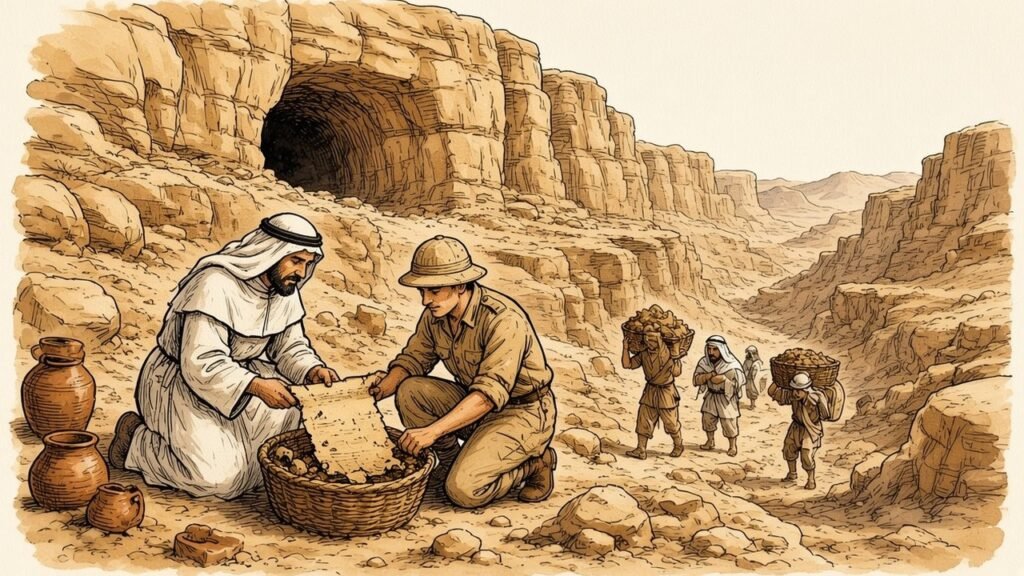
About eighteen kilometres south of Qumran, a steep gorge known in Arabic as Wadi Murabbaʿat and in Hebrew as Nahal Darga cuts through the Judaean Desert towards the Dead Sea. In the cliffs on its northern side are several large natural caves. In 1951 Bedouin of the Taamireh tribe, searching for further manuscripts after the success of the discoveries at Qumran, found written material in these caves, and in early 1952 an expedition led by Roland de Vaux and G. Lankester Harding excavated them.123 The finds included documents from the revolt led by Simeon bar Kosiba, known as Bar Kokhba, against Rome in 132–135 CE, among them letters bearing his name. They also included fragments of biblical books, and in 1955 a further cave nearby yielded a substantial portion of a scroll of the Twelve Minor Prophets. These biblical manuscripts, brought to the caves by refugees of the revolt, have a particular significance. Unlike the biblical scrolls of Qumran, which display a considerable variety of text, they agree almost entirely with the consonantal text later preserved by the Masoretes.45 This article describes the discovery, the circumstances in which the manuscripts reached the caves, the individual biblical texts and their importance for the history of the Hebrew Bible.
At a glance
- Site: Caves in the cliffs of Wadi Murabbaʿat (Nahal Darga), about eighteen kilometres south of Qumran in the Judaean Desert.
- Discovery: Found by Taamireh Bedouin in 1951; excavated by Roland de Vaux and G. Lankester Harding in January and March 1952.
- Biblical finds: Fragments of Genesis, Exodus, Numbers, Deuteronomy and Isaiah, a phylactery and a mezuzah, and a scroll of the Twelve Minor Prophets found in a nearby cave in 1955.
- Date: Brought to the caves by refugees of the Bar Kokhba revolt, 132–135 CE; the manuscripts were copied in the late first or early second century.
- Edition: Benoit, Milik and de Vaux, Discoveries in the Judaean Desert 2 (1961).
- Text: Virtually identical with the consonantal Masoretic Text, in contrast to the variety found at Qumran.
- Significance: Key evidence for the stabilisation of the Hebrew biblical text by the early second century.
The discovery
The discovery of the first Qumran scrolls in 1947 set off a search through the caves of the Judaean Desert by the Bedouin, who quickly understood the value placed on ancient manuscripts by scholars and museums. In the autumn of 1951 fragments reached Jerusalem which did not come from Qumran. Their source was traced to the caves of Wadi Murabbaʿat, then in territory under Jordanian administration. In January 1952 de Vaux, director of the École biblique et archéologique française in Jerusalem, and Harding, director of the Department of Antiquities of Jordan, began excavations there, continuing in March of the same year.67
Four caves were excavated. They had been occupied at many periods, from the Chalcolithic and the Middle Bronze Age through the Iron Age and the Roman period to Arab times. The written material, however, came mainly from the period of the Bar Kokhba revolt, when the caves served as a refuge for people who fled from the advancing Roman army. The excavators found remains of food, textiles, pottery, weapons and coins struck by the rebels, as well as the documents. Among these was a palimpsest on papyrus of the Iron Age, one of the oldest Hebrew documents known, together with Greek, Hebrew, Aramaic, Latin and later Arabic texts.89
The biblical fragments from the caves themselves were few and badly damaged, as was much of the documentary material, which had been torn and scattered by animals and earlier searchers. In 1955, however, Bedouin found in another cave in the same wadi a much more substantial biblical manuscript, a scroll of the Twelve Minor Prophets, which had evidently been hidden or buried. This manuscript, designated Mur 88 or MurXII, was acquired by the Palestine Archaeological Museum and published with the other material.10
The full publication appeared in 1961 as the second volume of Discoveries in the Judaean Desert, with the documentary texts edited by Pierre Benoit and Józef Milik and the archaeological report by de Vaux. The biblical fragments were edited by Milik.11
Refugees of the revolt
The Bar Kokhba revolt broke out in 132 CE, in the reign of the emperor Hadrian, and was crushed after more than three years of fighting. Its leader, Simeon bar Kosiba, took the title of prince of Israel and issued coins proclaiming the freedom of Jerusalem and the redemption of Israel. The rebels controlled much of Judaea for a time, but the Roman response was massive, and the final stages of the war saw the destruction of the rebel stronghold of Betar and the flight of many Jews to the caves of the desert.1213
The documents from Wadi Murabbaʿat include letters addressed by Simeon bar Kosiba to one of his commanders, Yeshua ben Galgula, who seems to have been in charge of the district. One letter threatens punishment for those who harbour Galileans, and another concerns the requisition of supplies. There are also contracts of sale, marriage contracts and deeds written in the years of the revolt and dated by the era of the freedom of Israel. Such documents show that the refugees brought with them their legal records as well as their religious books.1415
The same pattern appears in the caves of Nahal Hever, further south, where Yigael Yadin excavated in 1960 and 1961 and found the archive of Babatha and letters of Bar Kokhba in the Cave of Letters. The finds at Murabbaʿat and Nahal Hever together form the principal documentary evidence for the revolt and for the Jews who took part in it.1617
The biblical manuscripts
The biblical texts found in the Murabbaʿat caves in 1952 were small fragments. Milik identified pieces of Genesis, Exodus and Numbers which he thought might come from a single scroll of the Pentateuch, designated Mur 1. A fragment of Deuteronomy was designated Mur 2, and a fragment of Isaiah Mur 3. There was also a phylactery slip, Mur 4, and a mezuzah, Mur 5. The fragments are written in the formal Herodian or post-Herodian book hand of the late first or early second century.1819
The Minor Prophets scroll found in 1955 was a much more important manuscript. It preserves, in varying states, parts of ten of the twelve books, from Joel through Zechariah, and originally contained all twelve in a single scroll, as was the regular Jewish practice. The surviving portions extend over some twenty columns. The order of the books, where it can be determined, agrees with that of the Masoretic Text, which differs from the order of the Septuagint in the first six books.202122
The scroll is written in an elegant and regular hand. Its layout, with wide columns and careful spacing, corresponds to the standards of a formal scroll intended for public reading. Milik dated it to the early second century, and later palaeographers have generally agreed with a date in the late first or early second century CE.2324
A text close to the Masoretes
The significance of the Murabbaʿat biblical manuscripts lies in their text. When Milik compared the fragments and the Minor Prophets scroll with the Masoretic Text, he found that they agreed almost entirely. The differences were few and minor, consisting chiefly of matters of spelling, small variations in the use of vowel letters and occasional differences in individual words. The scroll did not show the harmonisations, expansions and variant readings that characterise many of the Qumran biblical scrolls. In the terms used by textual critics, the Murabbaʿat manuscripts are proto-Masoretic, or simply Masoretic in their consonantal text.2526
Emanuel Tov, in his survey of the textual history of the Hebrew Bible, has drawn attention to the contrast between the texts from Qumran and those from the other Judaean Desert sites. At Qumran, the biblical manuscripts include texts close to the Masoretic tradition, texts close to the Hebrew source of the Septuagint, texts resembling the Samaritan Pentateuch and texts that belong to no single group. At Masada, which fell in 73 or 74 CE, and at the refugee caves of the Bar Kokhba revolt, the biblical texts belong almost without exception to the proto-Masoretic tradition, and in many cases agree with the medieval Masoretic Text even in small details.27
The phylactery and mezuzah from Murabbaʿat illustrate the same development. Unlike many of the slips from Qumran, which include the Decalogue and other passages and are written with fuller spellings, the Murabbaʿat slip contains only the four passages later required by rabbinic law, written in a text that agrees with the Masoretic.282930
Explaining the contrast
The contrast between Qumran and the refugee caves has been explained in more than one way. The most widely held view is that it reflects a historical development. In the last centuries of the Second Temple period several forms of the biblical text circulated, and the community associated with Qumran preserved a variety of them. In the course of the first century CE, and especially after the destruction of the Temple in 70 CE, the proto-Masoretic text became dominant among Jews in Judaea, in part because it was the text of the Temple circles and the emerging rabbinic leadership. By the time of the Bar Kokhba revolt, the scrolls carried by refugees were copies of this text, and the variety visible at Qumran had largely disappeared from use.3132
Another view holds that the contrast is less a matter of chronology than of social setting. On this account, the proto-Masoretic text was already the dominant text among the groups centred on the Temple in Jerusalem before 70, and the variety found at Qumran reflects the particular character of the Qumran collection rather than the general situation. Ian Young, for example, has argued that the evidence of Masada and the other sites suggests that the proto-Masoretic text may have been dominant in some circles earlier than the conventional picture assumes, and that the variety at Qumran is not representative of all Judaism of the period.33
Both explanations agree on the central point that the Murabbaʿat manuscripts are among the earliest witnesses to a stable consonantal text identical in substance with that later vocalised and annotated by the Masoretes of Tiberias. A scroll of the Minor Prophets copied around 100 CE and differing only in minor details from manuscripts of the tenth century demonstrates the care with which the text was transmitted over nearly a millennium.3435
The Greek Minor Prophets of Nahal Hever
A further dimension is added by the Greek scroll of the Minor Prophets found in the Cave of Horror at Nahal Hever in the early 1950s, published by Dominique Barthélemy in 1963 and later by Emanuel Tov. This scroll contains a revision of the Septuagint designed to bring the Greek text closer to the Hebrew. Barthélemy identified the revision as part of a wider movement which he called the kaige recension, after its characteristic rendering of a Hebrew particle. The Hebrew text towards which the revision was made appears to have been close to the proto-Masoretic text attested at Murabbaʿat.3637
The two scrolls thus complement each other. The Hebrew Minor Prophets from Murabbaʿat shows what the Hebrew text of the refugees looked like, and the Greek Minor Prophets from Nahal Hever shows Greek-speaking Jews revising their translation to conform to that same Hebrew text. Together they illustrate the convergence of Jewish biblical tradition around a single text in the century before and after the destruction of the Temple.3839
The manuscripts as objects
The circumstances in which the Murabbaʿat manuscripts were found give them an additional interest. They were not the products of a scribal centre or a library, but the possessions of people who fled for their lives and took with them what they valued most. The presence of biblical scrolls, phylacteries and a mezuzah among the possessions of the refugees shows the place that these objects held in their lives. The Minor Prophets scroll, in particular, seems to have been deliberately hidden, perhaps when its owners realised that they could not escape.4041
The condition of the manuscripts reflects their history. The fragments from the caves themselves were torn and damaged, partly perhaps by the Roman soldiers who are thought to have found some of the refugees, and partly by the animals and human visitors who used the caves in later centuries. The Minor Prophets scroll, though damaged, was better preserved because of the place in which it was concealed. Its survival allows scholars to see a complete scroll of the Twelve in the form used by Judaean Jews of the early second century.42
Later study
Since the publication of 1961, the Murabbaʿat biblical texts have been re-examined in the light of the full publication of the Qumran scrolls and of the other Judaean Desert discoveries. Their readings are recorded in the apparatus of modern critical editions of the Hebrew Bible, including the Biblia Hebraica Quinta and the Hebrew University Bible, and in the comprehensive transcriptions of biblical texts from the Judaean Desert. The palaeographic dates proposed by Milik have been broadly confirmed.4344
The manuscripts are now held by the Israel Antiquities Authority in Jerusalem and are included in its digital library of the Dead Sea Scrolls, where images of high quality allow the details of the script and the text to be studied closely. The documentary texts from Murabbaʿat continue to be of interest to historians of the Bar Kokhba revolt, of Jewish law and of the languages used in Judaea in the second century.4546
The oldest document from the caves
The earliest written object recovered at Wadi Murabbaʿat is far older than the revolt. It is a small papyrus, published as Mur 17, written in the palaeo-Hebrew script and dated on palaeographic grounds to the eighth or seventh century BCE. The papyrus is a palimpsest. Its upper text is a list of personal names, and beneath it lies an earlier text, largely obliterated, which seems to have been a letter, since traces of the formulas used to open letters survive.4748
Mur 17 is one of the very few Hebrew papyri to survive from the period of the kingdom of Judah. Most written evidence from that time consists of inscriptions on stone and of ostraca, texts written in ink on potsherds, and the papyrus documents which these sometimes mention have almost entirely perished. The survival of a single papyrus in the dry conditions of a desert cave shows what has been lost elsewhere, and its reuse shows that writing material was valuable enough to be scraped and written again even in the Iron Age. The find also confirms that the caves were visited and used long before the second century CE, as the archaeological evidence of occupation from the Chalcolithic period onward already indicated.4950
Languages of the documents
The documentary texts from Murabbaʿat are written in Hebrew, Aramaic, Greek and Latin, and the publication of 1961 also included Arabic papyri of a much later date, which reflect the use of the caves in the early Islamic period. The range of languages is itself evidence for the society of Judaea in the Roman period, in which legal documents might be drawn up in Aramaic or Greek, and in which the Roman administration used Greek and occasionally Latin.5152
Hannah Cotton, in a study of the languages of the legal and administrative documents from the Judaean Desert, has examined how the choice of language related to the type of document and to the parties involved. Among the documents from the years of the revolt, a notable proportion are written in Hebrew, a language that had largely given way to Aramaic in daily legal practice. Several scholars have connected this use of Hebrew with the national aims of the revolt, though the evidence is limited and other explanations have been offered.5354
The biblical manuscripts stand apart from this variety. They are in Hebrew, in the square script, and follow the scribal conventions of the formal Jewish book. In the same caves, therefore, the documents of everyday life were written in several languages, while the scriptures were copied in the one language and script that tradition required.5556
The revolt in the ancient sources
Apart from the documents from the Judaean Desert, the principal ancient narrative of the Bar Kokhba revolt is a short account in the Roman History of Cassius Dio, preserved in an abridgement made in the Byzantine period. Dio names as the cause of the war the foundation by Hadrian of a Roman colony, Aelia Capitolina, on the site of Jerusalem, and the building of a temple to Jupiter where the Temple of the Jews had stood. Other ancient sources give different reasons, including a prohibition of circumcision, and the relation between these accounts has been much discussed.575859
According to Dio, the rebels at first avoided open battle and occupied advantageous positions, fortifying them with underground passages. Hadrian sent his best generals against them, among them Julius Severus, who had been governor of Britain, and the Romans wore the rebels down by cutting off their supplies rather than meeting them in the field. Dio states that fifty of their strongest outposts and nine hundred and eighty-five of their most important villages were destroyed, and that five hundred and eighty thousand men were killed in the raids and battles, besides those who died of hunger, disease and fire. He adds that the Roman losses were also heavy, so that Hadrian, writing to the senate, omitted the customary opening that he and the legions were in good health.60
Dio’s figures cannot be checked, and historians treat them with caution. The documents from the caves add a different kind of evidence: letters, contracts and lists that show the revolt from within, its administration, its control of land and supplies, and the lives of those who supported it. The final stronghold of the rebels was Bethar, south-west of Jerusalem, whose fall brought the revolt to an end in 135 CE. The flight of families to the caves of the Judaean Desert belongs to the last phase of the war.616263
The biblical scrolls of Masada
The biblical manuscripts from Murabbaʿat are often considered together with those from Masada, the fortress above the Dead Sea which fell to the Romans at the end of the First Jewish Revolt, about 73 or 74 CE. Yigael Yadin’s excavations of 1963 to 1965 recovered fragments of seven biblical scrolls: one of Genesis, two of Leviticus, one of Deuteronomy, one of Ezekiel and two of Psalms. With them were found a Hebrew scroll of Ben Sira, a copy of the Songs of the Sabbath Sacrifice also known from Qumran, and other non-biblical texts.6465
Two of the biblical scrolls were found beneath the floor of a room of the building identified as the synagogue of the fortress, in what appears to have been a deliberate burial of worn or damaged sacred books. One was a scroll of Deuteronomy and the other a scroll of Ezekiel, whose surviving columns cover the end of chapter 35 to chapter 38, including the vision of the valley of dry bones in chapter 37. Apart from small differences in spelling and in the division of the text into sections, the Ezekiel fragments agree with the Masoretic Text.6667
The full edition of the Hebrew fragments from Masada was prepared by Shemaryahu Talmon and published in 1999. Talmon concluded that all the biblical fragments from the site belong to the textual tradition of the Masoretic Text, and that, except for the Ben Sira scroll, they are written in Herodian scripts. Because Masada fell about sixty years before the Bar Kokhba revolt, its scrolls carry the evidence for a uniform text back into the period before the destruction of the Temple in 70 CE. This is one of the reasons why some scholars, including Ian Young, have argued that the contrast between Qumran and the other sites reflects social setting rather than chronology.6869
Other Hebrew scrolls of the revolt
Murabbaʿat is not the only site in the Judaean Desert to have yielded biblical manuscripts from the time of the Bar Kokhba revolt. Fragments of Genesis were found at Wadi Sdeir, and the caves of Nahal Hever produced fragments of Hebrew scrolls of Numbers and of Psalms, as well as phylacteries. Some of these fragments were acquired from Bedouin and only later attributed to particular sites, so that their provenance is not always certain.7071
Emanuel Tov’s lists of the texts from the Judaean Desert group these manuscripts with those of Murabbaʿat and Masada. Taken together, they show that the biblical scrolls carried or used by Jews outside the Qumran community in the late first and early second centuries agree closely with the consonantal text later transmitted by the Masoretes. Armin Lange’s handbook of the biblical manuscripts from the Dead Sea, published in 2009, provides a systematic description of these texts and of their textual character, book by book.727374
The Minor Prophets scroll in the critical editions
The Murabbaʿat Minor Prophets scroll is cited as a witness in the volume of the Biblia Hebraica Quinta devoted to the Twelve Minor Prophets, edited by Anthony Gelston and published in 2010. In that edition the Leningrad Codex provides the base text, and the evidence of the ancient manuscripts and versions is recorded in an apparatus beneath it. Because the Murabbaʿat scroll preserves substantial parts of ten books, it is one of the most important Hebrew witnesses to the Twelve before the medieval codices, together with the fragmentary manuscripts of the Twelve from Qumran.7576
The editors of such volumes must decide in each case whether a difference between the scroll and the Leningrad Codex reflects a genuine textual variant or merely a difference of spelling, and whether a damaged reading can be reconstructed with confidence. The general agreement of the scroll with the Masoretic Text means that its readings rarely change the text that the editors print, but where the medieval manuscripts differ among themselves, or where the ancient versions suggest a different Hebrew, the evidence of a scroll copied about a thousand years before the Leningrad Codex carries particular weight.7778
Qumran and Murabbaʿat compared
The Qumran Minor Prophets manuscripts provide a useful comparison. The fragments of the Twelve found in Qumran Cave 4 include copies that differ in places from the Masoretic Text, and one of them has been thought to place Jonah after Malachi rather than in its usual position. The Murabbaʿat scroll, by contrast, shows the order and text known from the later tradition. The comparison illustrates in a single book the broader contrast discussed above between the textual variety of the Qumran collection and the uniformity of the texts from the refugee caves.798081
The physical form of the scrolls also deserves notice. The Twelve Minor Prophets were treated in Jewish tradition as a single book, written on one scroll, and both the Qumran and the Murabbaʿat evidence agree with this practice. The rabbinic regulations on the copying of scrolls, which prescribe, for instance, the space to be left between books of the Pentateuch, also provide for a space between the individual prophets within the scroll of the Twelve, and the surviving transitions between books in the Murabbaʿat scroll allow the practice of its scribe to be compared with these later rules.8283
The caves after the revolt
The caves of Wadi Murabbaʿat did not cease to be used after 135 CE. The archaeological evidence and the Arabic papyri show that people returned to them in the early Islamic period, and later visitors, including the Bedouin who rediscovered the written material in 1951, continued to frequent them. This long history of use helps explain the damaged state of much of the material from the caves, which had been disturbed many times before the excavators arrived.8485
The same history makes the archaeological context of the finds important. Documents dated by the years of the revolt, together with the other finds in the same layers, allowed the excavators to associate the main body of written material with the years around 132 to 135 CE, even though the caves had been used both earlier and later. Without that context, the date of the biblical fragments would rest on palaeography alone.8687
Excavated and purchased manuscripts
A distinction that matters for all the Judaean Desert finds is that between manuscripts recovered by archaeologists in controlled excavation and those found by Bedouin and later sold. The fragments from the four caves excavated in 1952 have a known archaeological context, while the Minor Prophets scroll was found by Bedouin in 1955 in another cave in the wadi and brought to the scholars afterwards. Its attribution to Murabbaʿat rests on the information given by the finders and on the character of the scroll, which fits well with the other material from the site. It was nonetheless published with the excavated finds, as Mur 88, in the volume of 1961.8889
For the Minor Prophets scroll the uncertainty is small, but for some other fragments attributed to Judaean Desert sites in the same period it is greater, and Tov’s lists record where the provenance of a manuscript is doubtful. The careful separation of excavated from purchased material is one of the methodological lessons of the Murabbaʿat finds, and it has become more pressing as fragments of uncertain origin have continued to appear on the antiquities market.90
Spelling and scribal practice
One of the ways in which the Qumran scrolls differ from the Murabbaʿat manuscripts is in their spelling. Many Qumran texts use the consonants waw, yod and he as vowel letters far more often than the Masoretic Text does, and they also show distinctive forms of certain pronouns and verbal suffixes. Emanuel Tov has described these features as characteristic of a Qumran scribal practice, found in a large group of manuscripts copied, or at least preserved, by the community.91
The Murabbaʿat manuscripts do not show this practice. Their spelling is close to that of the Masoretic Text, and where it differs it does so in single words rather than as a system. The difference matters for the interpretation of the evidence: it shows that the agreement of the Murabbaʿat texts with the later tradition extends to small features of orthography that a scribe could easily have altered, and not only to the wording of the text.9293
Before the Masoretes
The text preserved in the Murabbaʿat scroll is a consonantal text. It has no vowel signs, no accents and no marginal notes. Those features were added by the Masoretes of the early medieval period, who recorded in writing the vocalisation and cantillation of the text as it was read aloud, and who surrounded the text with notes recording the number of occurrences of words and the forms of unusual spellings, in order to protect it from change.9495
The value of the Murabbaʿat scroll for the history of the Masoretic tradition lies precisely in this difference. It shows that the consonantal framework within which the Masoretes worked was already in place, in almost every detail, some eight centuries before them. The Masoretes did not create the text that they annotated; they inherited it, and their notes were designed to ensure that it would be transmitted with the same fidelity that the scrolls from the Judaean Desert already display.9697
Limits of the evidence
The importance of the Murabbaʿat manuscripts should not obscure the limits of what they can show. Apart from the Minor Prophets scroll, the biblical material from the site consists of small fragments, so that for the Pentateuch and Isaiah only a few verses survive, while the phylactery and the mezuzah contain only the passages prescribed for objects of their kind. The conclusions drawn from them depend heavily on a single well-preserved manuscript of one book, and on the support given to it by the other finds from Masada and the Bar Kokhba caves.9899
Nor can the finds show by themselves how the uniform text came to prevail. They show that the refugees of the revolt, like the defenders of Masada two generations earlier, used scrolls of the proto-Masoretic type, but they do not reveal whether other forms of the text had disappeared altogether or had merely ceased to be used in the circles from which these people came. For that question the scrolls from the desert must be weighed alongside the evidence of the Septuagint, the Samaritan Pentateuch and the rabbinic sources, as the debate between the chronological and the social explanations illustrates.100101102
Related material on this site
The letters of Bar Kokhba and the archives found by Yadin in the Cave of Letters are described in a separate article on this site.103 The Greek Minor Prophets scroll from Nahal Hever and the kaige recension are treated in their own article.104 For the variety of phylactery texts at Qumran, in contrast with the Masoretic phylactery from Murabbaʿat, readers may consult the article on the tefillin and mezuzot from Qumran.105 The distinctive literature of the Qumran community is represented on this site by the article on the War Scroll.106
Conclusion
The biblical scrolls from Wadi Murabbaʿat are few, and most of them are small fragments. Yet the Minor Prophets scroll and the smaller pieces found with it are among the most important witnesses to the history of the Hebrew Bible. Carried into the desert by refugees of the last Jewish revolt against Rome, they show that by the early second century the consonantal text later known as Masoretic had become the standard text among Jews in Judaea. The contrast with the variety of Qumran marks the end of one period in the history of the biblical text and the beginning of another, in which the task of the scribe was to preserve a single text with ever greater precision, a task which the Masoretes of the early Middle Ages would carry to its completion.107108
Notes
- P. Benoit, J. T. Milik and R. de Vaux, Les grottes de Murabbaʿât, Discoveries in the Judaean Desert 2 (Oxford: Clarendon Press, 1961). ↩
- Roland de Vaux, “Les grottes de Murabbaʿât et leurs documents,” Revue biblique 60 (1953): 245–267. ↩
- Grokipedia, “Wadi Murabbaʿat”. ↩
- Emanuel Tov, Textual Criticism of the Hebrew Bible, 3rd ed. (Minneapolis: Fortress Press, 2012). ↩
- Grokipedia, “Masoretic Text”. ↩
- P. Benoit, J. T. Milik and R. de Vaux, Les grottes de Murabbaʿât, Discoveries in the Judaean Desert 2 (Oxford: Clarendon Press, 1961). ↩
- Roland de Vaux, “Les grottes de Murabbaʿât et leurs documents,” Revue biblique 60 (1953): 245–267. ↩
- P. Benoit, J. T. Milik and R. de Vaux, Les grottes de Murabbaʿât, Discoveries in the Judaean Desert 2 (Oxford: Clarendon Press, 1961). ↩
- Lawrence H. Schiffman and James C. VanderKam, eds., Encyclopedia of the Dead Sea Scrolls, 2 vols. (New York: Oxford University Press, 2000). ↩
- P. Benoit, J. T. Milik and R. de Vaux, Les grottes de Murabbaʿât, Discoveries in the Judaean Desert 2 (Oxford: Clarendon Press, 1961). ↩
- P. Benoit, J. T. Milik and R. de Vaux, Les grottes de Murabbaʿât, Discoveries in the Judaean Desert 2 (Oxford: Clarendon Press, 1961). ↩
- Peter Schäfer, ed., The Bar Kokhba War Reconsidered (Tübingen: Mohr Siebeck, 2003). ↩
- Grokipedia, “Bar Kokhba revolt”. ↩
- P. Benoit, J. T. Milik and R. de Vaux, Les grottes de Murabbaʿât, Discoveries in the Judaean Desert 2 (Oxford: Clarendon Press, 1961). ↩
- Yigael Yadin, Bar-Kokhba: The Rediscovery of the Legendary Hero of the Last Jewish Revolt against Imperial Rome (London: Weidenfeld and Nicolson, 1971). ↩
- Yigael Yadin, Bar-Kokhba: The Rediscovery of the Legendary Hero of the Last Jewish Revolt against Imperial Rome (London: Weidenfeld and Nicolson, 1971). ↩
- See also “The Bar Kokhba Letters and the Cave of Letters” on this site. ↩
- P. Benoit, J. T. Milik and R. de Vaux, Les grottes de Murabbaʿât, Discoveries in the Judaean Desert 2 (Oxford: Clarendon Press, 1961). ↩
- Emanuel Tov, Revised Lists of the Texts from the Judaean Desert (Leiden: Brill, 2010). ↩
- P. Benoit, J. T. Milik and R. de Vaux, Les grottes de Murabbaʿât, Discoveries in the Judaean Desert 2 (Oxford: Clarendon Press, 1961). ↩
- Emanuel Tov, Textual Criticism of the Hebrew Bible, 3rd ed. (Minneapolis: Fortress Press, 2012). ↩
- Grokipedia, “Septuagint”. ↩
- P. Benoit, J. T. Milik and R. de Vaux, Les grottes de Murabbaʿât, Discoveries in the Judaean Desert 2 (Oxford: Clarendon Press, 1961). ↩
- Lawrence H. Schiffman and James C. VanderKam, eds., Encyclopedia of the Dead Sea Scrolls, 2 vols. (New York: Oxford University Press, 2000). ↩
- P. Benoit, J. T. Milik and R. de Vaux, Les grottes de Murabbaʿât, Discoveries in the Judaean Desert 2 (Oxford: Clarendon Press, 1961). ↩
- Emanuel Tov, Textual Criticism of the Hebrew Bible, 3rd ed. (Minneapolis: Fortress Press, 2012). ↩
- Emanuel Tov, Textual Criticism of the Hebrew Bible, 3rd ed. (Minneapolis: Fortress Press, 2012). ↩
- P. Benoit, J. T. Milik and R. de Vaux, Les grottes de Murabbaʿât, Discoveries in the Judaean Desert 2 (Oxford: Clarendon Press, 1961). ↩
- Grokipedia, “Tefillin”. ↩
- See also “The Tefillin and Mezuzot from Qumran” on this site. ↩
- Emanuel Tov, Textual Criticism of the Hebrew Bible, 3rd ed. (Minneapolis: Fortress Press, 2012). ↩
- Grokipedia, “Masoretic Text”. ↩
- Ian Young, “The Stabilization of the Biblical Text in the Light of Qumran and Masada: A Challenge for Conventional Qumran Chronology?” Dead Sea Discoveries 9 (2002): 364–390. ↩
- Emanuel Tov, Textual Criticism of the Hebrew Bible, 3rd ed. (Minneapolis: Fortress Press, 2012). ↩
- Grokipedia, “Masoretic Text”. ↩
- See also “The Nahal Hever Greek Minor Prophets Scroll and the Kaige Recension” on this site. ↩
- Grokipedia, “Septuagint”. ↩
- Emanuel Tov, Textual Criticism of the Hebrew Bible, 3rd ed. (Minneapolis: Fortress Press, 2012). ↩
- See also “The Nahal Hever Greek Minor Prophets Scroll and the Kaige Recension” on this site. ↩
- P. Benoit, J. T. Milik and R. de Vaux, Les grottes de Murabbaʿât, Discoveries in the Judaean Desert 2 (Oxford: Clarendon Press, 1961). ↩
- Lawrence H. Schiffman and James C. VanderKam, eds., Encyclopedia of the Dead Sea Scrolls, 2 vols. (New York: Oxford University Press, 2000). ↩
- P. Benoit, J. T. Milik and R. de Vaux, Les grottes de Murabbaʿât, Discoveries in the Judaean Desert 2 (Oxford: Clarendon Press, 1961). ↩
- Emanuel Tov, Textual Criticism of the Hebrew Bible, 3rd ed. (Minneapolis: Fortress Press, 2012). ↩
- Emanuel Tov, Revised Lists of the Texts from the Judaean Desert (Leiden: Brill, 2010). ↩
- Lawrence H. Schiffman and James C. VanderKam, eds., Encyclopedia of the Dead Sea Scrolls, 2 vols. (New York: Oxford University Press, 2000). ↩
- Grokipedia, “Dead Sea Scrolls”. ↩
- Israel Antiquities Authority, Leon Levy Dead Sea Scrolls Digital Library, Mur 17, list of personal names. ↩
- Hannah M. Cotton, “The Languages of the Legal and Administrative Documents from the Judaean Desert,” Zeitschrift für Papyrologie und Epigraphik 125 (1999): 219–231, PDF. ↩
- P. Benoit, J. T. Milik and R. de Vaux, Les grottes de Murabbaʿât, Discoveries in the Judaean Desert 2 (Oxford: Clarendon Press, 1961). ↩
- Israel Antiquities Authority, Leon Levy Dead Sea Scrolls Digital Library, Mur 17, list of personal names. ↩
- P. Benoit, J. T. Milik and R. de Vaux, Les grottes de Murabbaʿât, Discoveries in the Judaean Desert 2 (Oxford: Clarendon Press, 1961). ↩
- Hannah M. Cotton, “The Languages of the Legal and Administrative Documents from the Judaean Desert,” Zeitschrift für Papyrologie und Epigraphik 125 (1999): 219–231, PDF. ↩
- Hannah M. Cotton, “The Languages of the Legal and Administrative Documents from the Judaean Desert,” Zeitschrift für Papyrologie und Epigraphik 125 (1999): 219–231, PDF. ↩
- Peter Schäfer, ed., The Bar Kokhba War Reconsidered (Tübingen: Mohr Siebeck, 2003). ↩
- P. Benoit, J. T. Milik and R. de Vaux, Les grottes de Murabbaʿât, Discoveries in the Judaean Desert 2 (Oxford: Clarendon Press, 1961). ↩
- Emanuel Tov, Textual Criticism of the Hebrew Bible, 3rd ed. (Minneapolis: Fortress Press, 2012). ↩
- Cassius Dio, Roman History 69.12–14, trans. Earnest Cary, Loeb Classical Library (Cambridge, MA: Harvard University Press, 1925). ↩
- Grokipedia, “Aelia Capitolina”. ↩
- Peter Schäfer, ed., The Bar Kokhba War Reconsidered (Tübingen: Mohr Siebeck, 2003). ↩
- Cassius Dio, Roman History 69.12–14, trans. Earnest Cary, Loeb Classical Library (Cambridge, MA: Harvard University Press, 1925). ↩
- Peter Schäfer, ed., The Bar Kokhba War Reconsidered (Tübingen: Mohr Siebeck, 2003). ↩
- Grokipedia, “Bar Kokhba revolt”. ↩
- Yigael Yadin, Bar-Kokhba: The Rediscovery of the Legendary Hero of the Last Jewish Revolt against Imperial Rome (London: Weidenfeld and Nicolson, 1971). ↩
- Grokipedia, “Masada”. ↩
- Shemaryahu Talmon and Yigael Yadin, Masada VI: Yigael Yadin Excavations 1963–1965, Final Reports: Hebrew Fragments from Masada; The Ben Sira Scroll from Masada (Jerusalem: Israel Exploration Society, 1999). ↩
- Shemaryahu Talmon and Yigael Yadin, Masada VI: Yigael Yadin Excavations 1963–1965, Final Reports: Hebrew Fragments from Masada; The Ben Sira Scroll from Masada (Jerusalem: Israel Exploration Society, 1999). ↩
- Grokipedia, “Masada”. ↩
- Shemaryahu Talmon and Yigael Yadin, Masada VI: Yigael Yadin Excavations 1963–1965, Final Reports: Hebrew Fragments from Masada; The Ben Sira Scroll from Masada (Jerusalem: Israel Exploration Society, 1999). ↩
- Ian Young, “The Stabilization of the Biblical Text in the Light of Qumran and Masada: A Challenge for Conventional Qumran Chronology?” Dead Sea Discoveries 9 (2002): 364–390. ↩
- Emanuel Tov, Revised Lists of the Texts from the Judaean Desert (Leiden: Brill, 2010). ↩
- Emanuel Tov, Textual Criticism of the Hebrew Bible, 3rd ed. (Minneapolis: Fortress Press, 2012). ↩
- Emanuel Tov, Revised Lists of the Texts from the Judaean Desert (Leiden: Brill, 2010). ↩
- Emanuel Tov, Textual Criticism of the Hebrew Bible, 3rd ed. (Minneapolis: Fortress Press, 2012). ↩
- Armin Lange, Handbuch der Textfunde vom Toten Meer, vol. 1, Die Handschriften biblischer Bücher von Qumran und den anderen Fundorten (Tübingen: Mohr Siebeck, 2009). ↩
- Anthony Gelston, ed., Biblia Hebraica Quinta, fasc. 13, The Twelve Minor Prophets (Stuttgart: Deutsche Bibelgesellschaft, 2010). ↩
- Emanuel Tov, Textual Criticism of the Hebrew Bible, 3rd ed. (Minneapolis: Fortress Press, 2012). ↩
- Anthony Gelston, ed., Biblia Hebraica Quinta, fasc. 13, The Twelve Minor Prophets (Stuttgart: Deutsche Bibelgesellschaft, 2010). ↩
- Emanuel Tov, Textual Criticism of the Hebrew Bible, 3rd ed. (Minneapolis: Fortress Press, 2012). ↩
- Emanuel Tov, Textual Criticism of the Hebrew Bible, 3rd ed. (Minneapolis: Fortress Press, 2012). ↩
- Armin Lange, Handbuch der Textfunde vom Toten Meer, vol. 1, Die Handschriften biblischer Bücher von Qumran und den anderen Fundorten (Tübingen: Mohr Siebeck, 2009). ↩
- Grokipedia, “Qumran”. ↩
- Emanuel Tov, Textual Criticism of the Hebrew Bible, 3rd ed. (Minneapolis: Fortress Press, 2012). ↩
- P. Benoit, J. T. Milik and R. de Vaux, Les grottes de Murabbaʿât, Discoveries in the Judaean Desert 2 (Oxford: Clarendon Press, 1961). ↩
- P. Benoit, J. T. Milik and R. de Vaux, Les grottes de Murabbaʿât, Discoveries in the Judaean Desert 2 (Oxford: Clarendon Press, 1961). ↩
- Grokipedia, “Wadi Murabbaʿat”. ↩
- P. Benoit, J. T. Milik and R. de Vaux, Les grottes de Murabbaʿât, Discoveries in the Judaean Desert 2 (Oxford: Clarendon Press, 1961). ↩
- Roland de Vaux, “Les grottes de Murabbaʿât et leurs documents,” Revue biblique 60 (1953): 245–267. ↩
- P. Benoit, J. T. Milik and R. de Vaux, Les grottes de Murabbaʿât, Discoveries in the Judaean Desert 2 (Oxford: Clarendon Press, 1961). ↩
- Emanuel Tov, Revised Lists of the Texts from the Judaean Desert (Leiden: Brill, 2010). ↩
- Emanuel Tov, Revised Lists of the Texts from the Judaean Desert (Leiden: Brill, 2010). ↩
- Emanuel Tov, Textual Criticism of the Hebrew Bible, 3rd ed. (Minneapolis: Fortress Press, 2012). ↩
- Emanuel Tov, Textual Criticism of the Hebrew Bible, 3rd ed. (Minneapolis: Fortress Press, 2012). ↩
- P. Benoit, J. T. Milik and R. de Vaux, Les grottes de Murabbaʿât, Discoveries in the Judaean Desert 2 (Oxford: Clarendon Press, 1961). ↩
- Grokipedia, “Masoretic Text”. ↩
- Emanuel Tov, Textual Criticism of the Hebrew Bible, 3rd ed. (Minneapolis: Fortress Press, 2012). ↩
- Grokipedia, “Masoretic Text”. ↩
- Emanuel Tov, Textual Criticism of the Hebrew Bible, 3rd ed. (Minneapolis: Fortress Press, 2012). ↩
- Emanuel Tov, Revised Lists of the Texts from the Judaean Desert (Leiden: Brill, 2010). ↩
- Emanuel Tov, Textual Criticism of the Hebrew Bible, 3rd ed. (Minneapolis: Fortress Press, 2012). ↩
- Emanuel Tov, Textual Criticism of the Hebrew Bible, 3rd ed. (Minneapolis: Fortress Press, 2012). ↩
- Ian Young, “The Stabilization of the Biblical Text in the Light of Qumran and Masada: A Challenge for Conventional Qumran Chronology?” Dead Sea Discoveries 9 (2002): 364–390. ↩
- Grokipedia, “Septuagint”. ↩
- See also “The Bar Kokhba Letters and the Cave of Letters” on this site. ↩
- See also “The Nahal Hever Greek Minor Prophets Scroll and the Kaige Recension” on this site. ↩
- See also “The Tefillin and Mezuzot from Qumran” on this site. ↩
- See also “The War Scroll from Qumran” on this site. ↩
- P. Benoit, J. T. Milik and R. de Vaux, Les grottes de Murabbaʿât, Discoveries in the Judaean Desert 2 (Oxford: Clarendon Press, 1961). ↩
- Emanuel Tov, Textual Criticism of the Hebrew Bible, 3rd ed. (Minneapolis: Fortress Press, 2012). ↩