


Part of the subject hub The Aleppo Codex, where the reference notes and essays on this subject are gathered in one place
The Jerusalem Crown, in Hebrew Keter Yerushalayim, is an edition of the Hebrew Bible published in Jerusalem at the turn of the twenty-first century under the aegis of the Hebrew University of Jerusalem. Its full description, as recorded in the research portal of Bar-Ilan University, presents it as the Torah, Prophets and Writings according to the text and the Masorah of the Aleppo Codex and related manuscripts, following the method of Rabbi Mordechai Breuer, with Yosef Ofer bearing scholarly responsibility for the edition.1 The book is thus the product of two distinct enterprises. One was a long scholarly and halakhic inquiry into the exact wording, spelling, vocalisation and accentuation of the Masoretic Text, carried out by Breuer over more than four decades. The other was a printing project, conceived by the Jerusalem printer Nahum Ben-Zvi, which sought to give that text a physical form modelled on the great Tiberian codices themselves.2
This article describes both. It begins with the problem that Breuer inherited from the medieval and early modern authorities on the text of the Bible, follows the development of his method from his first corrected edition in 1958 to the editions of the 1970s, 1980s and 1990s, and then turns to the design, publication and reception of the Jerusalem Crown and the volumes that accompany it. The history of the Aleppo Codex itself, its loss and its arrival in Israel, has been told elsewhere in this journal, in The Crown in the Flames, and is mentioned here only where it bears on the making of the edition.
At a glance
- Title: Keter Yerushalayim, the Jerusalem Crown, the Bible of the Hebrew University of Jerusalem.
- Text: the whole Hebrew Bible, edited from the Aleppo Codex and the manuscripts related to it by the method that Breuer developed.
- Scholarly responsibility: Yosef Ofer of Bar-Ilan University; the Bar-Ilan record gives the place and date as Jerusalem, 2000, and the length as 874 pages.
- Publisher and design: N. Ben-Zvi Printing Enterprises; the text set in three columns to the page in a new typeface, Jerusalem Crown, designed by Zvi Narkiss.
- Accompanying volumes: a Companion Volume edited by Mordechai Glatzer, and Breuer’s word-by-word documentation of the text (2003).
- Status: adopted by the Hebrew University and the Knesset as their official Bible; used when Israeli presidents take the oath of office.
The Problem of the Received Text
By the end of the Masoretic period, in the tenth and eleventh centuries, the Tiberian Masoretes had established a text whose consonants, vowels and accents were recorded in model codices and safeguarded by tens of thousands of Masoretic notes. Amnon Bazak, in a lesson on the accuracy of the biblical text written for the Torat Har Etzion programme of Yeshivat Har Etzion, summarises the result: the version of Ben Asher came to be regarded as authoritative, and the Bibles printed today are almost identical with it apart from a few minor details.3 The difficulty lies in the words “almost” and “minor”. The model codices were few, and after the Masoretic period the text was transmitted by generations of scribes who copied from one another, introduced small errors, corrected some of them, and left their successors with a great number of manuscripts that differed in small points of spelling, vocalisation and accentuation.
The medieval authorities were well aware of the problem. Yosef Ofer, in an essay published in the newspaper Makor Rishon shortly after Breuer’s death, quotes the introduction of Rabbi Meir ha-Levi Abulafia, known as the Ramah, who lived in Spain in the thirteenth century and devoted his book Masoret Seyag la-Torah, “The Masorah, a Fence for the Torah”, to establishing the spelling of the Pentateuch. Ofer observes that this work influenced the text of the Torah scrolls of the Sephardi and Ashkenazi communities more than any other. In his introduction the Ramah describes the state in which he found the matter: if one sought to rely on the corrected books then in use, many disagreements were found in them also, and were it not for the Masoretic notes that had been made a fence for the Torah, a man would scarcely find his way among the disputes; anyone who wished to write a Torah scroll according to its law would stumble over the defective and full spellings and grope like a blind man in the darkness of the disagreements.4
The Ramah also set out the principle by which he proposed to resolve the difficulty. In Ofer’s quotation, he resolved to seek out the corrected and precise books and the precise Masoretic notes, to establish where they disagreed, to abandon new books lately come, to follow the old and trustworthy ones, and to incline among them after the majority, as the Torah commands.5 The principle combines two kinds of authority. The preference for old and accurate manuscripts is a philological one, while the decision by majority is drawn from the procedures of Jewish law. The tension between these two kinds of authority runs through the whole later history of the question, and it was the tension that Breuer’s method was designed to resolve.
Ofer’s essay names two of the Ramah’s best-known successors. Rabbi Yedidyah Shelomo Norzi, the author of Minḥat Shai, worked in Italy in the seventeenth century, and Rabbi Wolf Heidenheim worked in Germany in the nineteenth. Each of them, in his own generation, tried to establish the exact text of the Bible from the manuscripts and Masoretic sources available to him, and each worked with manuscripts that were, in time and place, far removed from the Masoretes of Tiberias.6 The manuscripts that have become known over the last century, Ofer argues, are of a different order. They were written in the period close to that of the Masoretes, and their text generally agrees with the notes of the Tiberian Masorah. Such manuscripts deserve to be regarded as the “corrected and precise books” of which the Ramah spoke, and the text of the Bible should be determined according to them and to the Masoretic notes written in them.7
Breuer’s First Edition
The first edition of the Bible that Breuer corrected appeared as early as 5718 (1957–58), under the title Tanakh Yisrael, published in Jerusalem and Tel Aviv by M. Newman. It was a photographic reprint of the well-known Letteris Bible, into which Breuer introduced corrections in accordance with the Masorah. Ofer records that the volume carried the approbations of the Chief Rabbi of Israel, Yitzhak HaLevi Herzog, and of Rabbi Zvi Yehuda Meltzer, head of the Yeshivat ha-Darom, and that Meltzer testified of Breuer that all his decisions in matters of vocalisation, spelling and accents had been made according to the methods of halakhah, on the basis of the opinion of the great and trustworthy Masoretic authorities.8
The testimony is significant for what it reveals about the setting in which Breuer worked. His audience was not only, or even chiefly, the academic world. It was the community of rabbis, scribes and readers who used the Bible in the synagogue and who required that its text be determined by recognised halakhic procedures. A correction of a printed Bible could be accepted in that community only if it could be shown to follow the accepted authorities. This requirement remained with Breuer throughout his work, and it explains why he presented his later and far more radical editions not as critical reconstructions but as a return to the text that the Masoretes themselves had fixed.
A New and Difficult Path
About ten years after the appearance of Tanakh Yisrael, Breuer was invited by Mossad Harav Kook to edit the text of the Bible according to the Masorah for the Daʿat Miqra series of commentaries. Ofer describes the decision that Breuer then took as the choice of a new path, long and difficult. Instead of correcting an existing printed text, he sought to make use of the ancient manuscripts that had come to light and of the advances in the study of the biblical text, and at the same time to decide each question according to the ways of halakhah accepted in Israel for generations. Ofer remarks that the success of such an approach was by no means assured in advance.9
The obstacles were of two kinds. Scholars might object that a text determined from many manuscripts would be a new and eclectic text, the fruit of artificial theoretical speculation; and they might ask whether the Masoretes of Tiberias had in fact succeeded in fixing a single text that was reflected in their notes, or whether the proper response to the many disagreements among the manuscripts was rather to follow a single manuscript regarded as the best of all. Halakhic authorities, from the opposite direction, might object that a received text had been fixed in Israel for generations, and that one should not deviate from it to the right or the left even if ancient manuscripts with other readings were discovered.10 Breuer’s method had to answer both objections at once.
Ofer describes how the work proceeded. Wherever Breuer found a disagreement in spelling among the manuscripts, he searched widely for a Masoretic note that would decide between the two readings. The labour was slow and exhausting, because there were no indexes or other aids for locating the Masoretic notes. The notes have no fixed place in the manuscript, and in each manuscript one may have to search in dozens of possible places to find the relevant one.11 Gradually lists of disagreements accumulated, and for most of them a clear way of deciding according to the Masorah was found. The examination showed that the Masoretic notes in the different manuscripts almost always pointed to a single text.
The result, however, presented a difficulty of its own. Breuer was convinced that he had uncovered the text fixed by the Tiberian Masoretes a thousand years earlier, but he had no proof that would command general assent, since none of the manuscripts on which he relied agreed in its text with the one he had established. His text was supported now by these manuscripts and now by others.12 To a sceptical scholar this was exactly the kind of eclectic result that the first objection had anticipated. What was needed was a single witness, independent of Breuer’s reasoning, whose text coincided with the one he had reconstructed.
The Test of the Aleppo Codex
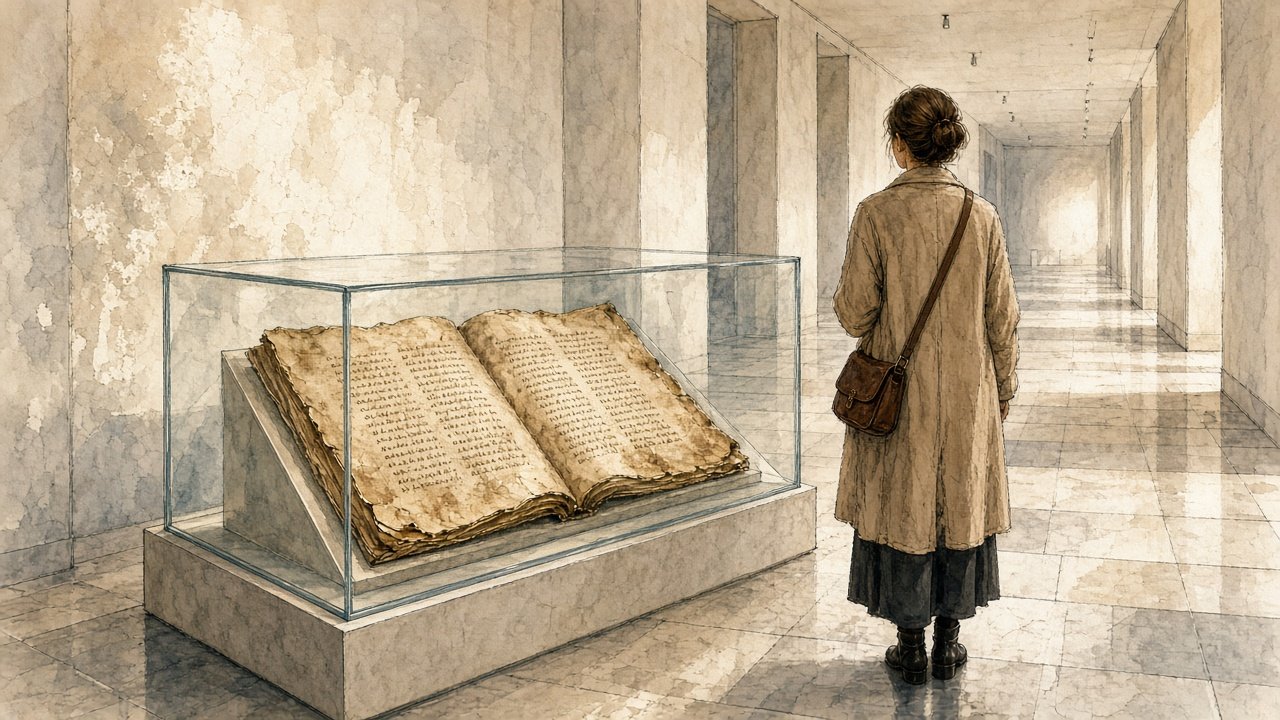
That witness was the Aleppo Codex. Ofer recalls that the codex is attributed to the Masorete Aaron ben Moses ben Asher of Tiberias, that according to tradition Maimonides relied on it when he fixed the list of the sections of the Torah, and that after it reached Israel in 5718 it was placed in the care of the Hebrew University’s Bible Project. In 5720 (1959–60) photographs of a few of its leaves were published with three articles on its character, but access to the codex itself or to a photograph of it was denied to most scholars, and a facsimile edition appeared only in 5736 (1975–76). All Breuer’s attempts to obtain a photograph of the codex and to base his work upon it failed.13
The circumstances in which Breuer eventually gained access to the codex remain obscure. Ofer reports that Breuer once said that, in despair, he had asked a librarian whether a photograph of any further manuscript was available, and that she handed him for examination a photograph of a manuscript whose nature she did not know; on another occasion he said that he was not permitted to reveal the name of the person who had supplied him with a photograph of the codex. In the end he examined its text minutely and also consulted the original. Everywhere, Ofer writes, the text of the codex agreed with the text that had emerged from Breuer’s earlier inquiry, carried out without it. It became clear that the spelling of the codex was the very text that the Masoretes had fixed and that was reflected in the body of Masoretic notes in the manuscripts, and the proof that could convince scholars had been found.14
The codex carried a further authority of a different kind. It had not been found in a forgotten geniza or in the store-rooms of a European library, but had been preserved by an important Jewish community, which bore witness to its character and to its expert Masorete, and which held a tradition that Maimonides had used it and praised its accuracy. Ofer notes that this standing gave the codex a halakhic significance as well.15 It allowed Breuer to answer the second objection as well as the first: the text that he had reconstructed was not a modern innovation but the text of the manuscript on which the most authoritative codifier of Jewish law had relied.
The Torah and the Communities of Israel
Breuer then compared the spelling of the Torah that emerged from the ancient manuscripts and the Masoretic notes with the text accepted among the different communities of Israel. Ofer describes the result as surprising. In all the places where the communities agreed on the spelling of the Torah, not a single instance was found in which the accepted text contradicted a clear decision of the Masorah. In nine words of the Torah there was a disagreement between the communities, in which the text of the Yemenite community stood against that of the Sephardi and Ashkenazi communities. In six of these the text that emerged from the manuscripts agreed with the Yemenite text, and in the remaining three the manuscripts were themselves divided on the same question. In the text of the Torah, therefore, an almost complete agreement was found between the ancient manuscripts and the received text.16 The close relationship between the Yemenite tradition and the Aleppo Codex has been discussed in this journal in The Yemenite Taj and the Tiberian Text in Yemen.
Breuer set out his method in his book Keter Aram Tsova ve-ha-nusaḥ ha-mequbbal shel ha-miqra, “The Aleppo Codex and the Accepted Text of the Bible”, published in 5737 (1976–77). In its introduction he offered for the consideration and decision of the Torah authorities the possibility that a new settlement, which as yet had no fixed custom and whose members came from different communities, might do well to seek out a Torah scroll written according to the custom of the Yemenite community. Ofer adds that the text of the Torah to which the communities of Israel adhere had been fixed centuries earlier, and that the chances of anyone following the suggestion were slight.17 The proposal is nonetheless revealing. It shows that Breuer regarded the agreement of the Yemenite tradition with the Masorah as a matter not merely of historical interest but of potential practical consequence.
The Prophets and the Writings
In the Torah the received text left Breuer little to change. The Prophets and the Writings were different. Ofer explains that in these books no clear and firm halakhic ruling had been established in recent generations, and that Breuer decided all the disputed readings in them according to the principles he had formulated. He adds that most of those who write scrolls of the Prophets for public reading appear today to follow his decisions.18 On the basis of the Aleppo Codex and the manuscripts closest to it, Breuer also settled the remaining particulars, namely the division into open and closed sections, the layout of the songs in the Prophets and Writings, and the many particulars of the systems of vocalisation, accents and gaʿyot.19
The edition of Mossad Harav Kook was completed in 5742 (1981–82). Geoffrey Khan, in his survey of the manuscripts and editions of the Tiberian tradition, dates Breuer’s edition to 1977–1982 and notes that it was re-edited in 1996–1998 with new information on the division into sections.20 That new information concerned the books in which the Aleppo Codex is now defective. The list of open and closed sections of the Torah that Maimonides codified had been taken from the codex, and Breuer followed the codex for the sections of the Prophets and Writings also; where the codex was lost, however, its sections could not be recovered with confidence from other manuscripts, each of which has its own tradition in the matter, and Breuer was obliged to rely on the Leningrad Codex. The rediscovery in 1987 of a nineteenth-century printed Bible in which the sections of the codex had been recorded supplied the missing information, and Breuer used it in the edition published by Horev in 5756 (1995–96).21 The story of that rediscovery belongs to the history of the open and closed sections and is not repeated here.
The Making of the Jerusalem Crown
The Jerusalem Crown was the next and, in its physical form, the most ambitious stage. According to the publisher’s account, the idea of publishing it was conceived by Nahum Ben-Zvi, who prepared the text of the Aleppo Codex for the press in a layout of three columns to the page.22 Such a layout had been used in many of the most important Jewish manuscripts, and the publisher describes the Jerusalem Crown as the first publication to return to it since the invention of the printing press, a return made possible by the availability of computerised typesetting.23 Ofer, writing of Breuer’s part in the project, records that Breuer took part in advising and guiding the preparation of this edition, which was designed in three columns to the page in the manner of the Aleppo Codex.24
Particular attention was paid to the poetic passages. The songs of the Pentateuch and the Prophets were printed in the traditional layout of half-bricks set over whole bricks, and the Song of the Sea (Exodus 15) was presented as a single unit on a separate page.25 The books of Job, Proverbs and Psalms, which form the group of the poetic books with their own system of accentuation, were set as poetry.26 Ofer notes that Breuer took a special interest in the design of the Psalms, and that he wrote that for the first time he had succeeded in setting them out in a form that suited both the Masorah and the division of the verses by the accents.27 The accentual system of these books, and its relation to the layout of the verse, is described in this journal in Taʿame Emet.
The letters themselves were newly designed. A typeface called Jerusalem Crown was created for the edition by the type designer Zvi Narkiss and modelled, according to the publisher, on the original letter of the Aleppo Codex, with considerable attention to clarity and legibility.28 The book was issued in several formats. The publisher’s catalogue lists a large edition measuring 30 by 37 centimetres, a medium-sized edition of 23.5 by 18.5 centimetres, and a small edition of 18.5 by 14.5 centimetres, the larger formats offered with the Companion Volume in a slipcase and in bindings of cloth, silk or leather.29 The Bar-Ilan record gives the length of the edition as 874 pages.30 The publisher states that the undertaking, which it describes as complex and costly, was made possible by a contribution from the Karger Family Fund of Basel.31
The date of publication is given differently in different sources. The Bar-Ilan record and the abstract of Ofer’s article in Hebrew Studies both give Jerusalem, 2000, and Bazak cites the edition by the Hebrew year 5760.323334 The publisher’s photograph album shows the first edition on display at the opening of the celebrations of the seventy-fifth anniversary of the Hebrew University in May 2000, while another page of the same website states that the edition was published in the spring of 2001.3536 The likeliest explanation is that a first copy was completed for the anniversary in 2000 and that the various editions were issued over the following period, but the sources consulted for this article do not settle the matter.
The Companion Volume and the Documentation of the Text
After the various editions had been completed, a Companion Volume edited by Mordechai Glatzer was published. The publisher lists its contents: a personal note by the sponsor, Thomas J. Karger; an essay by Menahem Ben-Sasson on the Bible and the Hebrew University; an account by Nahum Ben-Zvi of the making of the book; two essays by Ofer, on the history and authority of the Aleppo Codex and on the Jerusalem Crown and its editorial principles; and an essay by Glatzer on the passage of the book from scroll to codex and into print, followed by an epilogue, a glossary and a list of illustrations. The articles were published both in Hebrew and in English translation.37 Ofer’s essay on the codex, to judge from the headings the publisher lists, covered Tiberias and the Masoretes, the history of the codex up to the present, its uniqueness, the Masorete Ben Asher, the codex and Maimonides, the study of the codex and the reconstruction of its missing portions, and the relation between Masorah and halakhah.38
The Companion Volume was addressed to the general reader. For the specialist, Breuer prepared a full documentation of the text. The publisher describes this book, The Biblical Text in the Jerusalem Crown Edition and Its Sources in the Masora and Manuscripts, as a record of the considerations that governed the spelling of each word in the edition.39 Ofer dates it to 5763 (2002–03) and explains that it was based on notes that Breuer had prepared thirty years earlier and had checked and brought up to date throughout his years of work.40 He regards such documentation as one of Breuer’s principal achievements: besides the editions themselves, Breuer took care to explain and justify his methods of principle and, beyond that, to set out the evidence on which he had decided every verse of the Bible, in the introductions to his editions, in articles on the text and in books on the Masorah.41
Ofer also published an account of the preparation of the edition in English. His article “The Preparation of the Jerusalem Crown Edition of the Bible Text”, which appeared in Hebrew Studies in 2003, reviews, according to its abstract, the principles by which the biblical text was determined, the comparisons made with other readings, and the decisions that were taken. The abstract states that such documentation is an essential part of any modern scientific edition of the Bible.42 The emphasis is consistent with the whole of Breuer’s approach. A text that claimed to restore the decisions of the Masoretes had to show, case by case, the evidence for each decision, so that both scholars and halakhic authorities could examine it.
Status and Use
The publisher states that the Jerusalem Crown was recognised as the official Bible of the Hebrew University of Jerusalem and of the Israeli parliament, the Knesset, and that since its publication it has been used to administer the oath of office to new presidents of the State of Israel.43 The photograph album on the same website shows President Moshe Katsav taking the oath of allegiance on a copy of the edition.44 The book thus came to occupy a ceremonial place in the life of the state as well as a place in the study of the text.
The edition’s place in the scholarly world is a separate question. Khan lists the editions of the Hebrew Bible that are based on the early Tiberian manuscripts. They include the Biblia Hebraica from its third edition onwards, the Hebrew University Bible, the editions of Aron Dotan and of Breuer, and the modern Rabbinic Bible edited by Menachem Cohen under the name Ha-Keter.45 Bazak, writing for students rather than specialists, names the Breuer edition, Cohen’s Miqraot Gedolot Ha-Keter and the edition of the Bible Project of the Hebrew University as the principal editions based on the Aleppo Codex.46 The Jerusalem Crown belongs with the Breuer editions. It is not a critical edition with an apparatus of variants on the page, like the Hebrew University Bible or the Biblia Hebraica, but a text edition whose apparatus was published separately in Breuer’s documentation.
Ofer’s essay indicates how widely Breuer’s decisions were adopted. In recent years, he writes, many editions of the Bible have been printed, and nearly all of them have adopted Breuer’s decisions to a greater or lesser degree. Even the Bar-Ilan edition of Miqraot Gedolot Ha-Keter, whose editor Menachem Cohen argued at length with Breuer about how certain questions of vocalisation and gaʿyot should be decided, is very close to Breuer’s edition in its spelling, its sections, its vocalisation and its accents.47 The disagreements between the two editors therefore concerned matters of fine detail rather than the basic principle, which both accepted, that the text should be determined from the Aleppo Codex and its nearest relatives among the early manuscripts.
Breuer’s Legacy
Mordechai Breuer died in Jerusalem on the Sabbath of the weekly portion Terumah, 6 Adar 5767 (February 2007). Ofer, who had studied under him and served him for many years, describes him as one of the great Torah scholars of the generation and a laureate of the Israel Prize, who worked in many fields and was known especially for his distinctive approach to the interpretation of the Bible, and who was the foremost authority of his generation in determining its text.48 The publisher of the Jerusalem Crown, presenting the edition, describes him as the recipient of the Israel Prize in Bible scholarship for 1999.49
Ofer’s assessment of Breuer’s work rests on the point at which this article began. Over many centuries, his essay observes, the sages of Israel had tried to establish the text of the Bible, and Breuer succeeded in bringing it closer to the text that the early Masoretes had fixed.50 The Ramah had proposed to follow the old and precise books; Breuer applied that principle to manuscripts far older and closer to the Masoretes than any the Ramah had seen, and found that the Masoretic notes in those manuscripts pointed to a single text, which the Aleppo Codex confirmed. Ofer closes his essay with the judgement that Breuer will be remembered as an expert Masorete who paved the way for uncovering the text of the Bible fixed by the early Masoretes and for establishing it in the editions of the present day.51
The Jerusalem Crown is the most visible of those editions. Its three columns, its new letter and its setting of the poetic books recall the form of the codices from which its text derives, while its accompanying volumes record the evidence on which that text rests. In both respects the edition reflects the conviction that runs through Breuer’s work: that the Tiberian Masoretes’ text can still be recovered, and that the recovery must be argued openly from the manuscripts and the Masorah, so that its results can be accepted both in the study and in the synagogue.
Notes
- Bar-Ilan University research portal, record for Y. Ofer, Jerusalem Crown: The Bible of the Hebrew University of Jerusalem (Jerusalem, 2000). *
- N. Ben-Zvi Printing Enterprises, “Jerusalem Crown”, publisher’s website, archived 2011. *
- Amnon Bazak, “Nusach Ha-mikra: Accuracy of the Biblical Text (3)”, Fundamental Issues in the Study of Tanakh, lesson 31, trans. Kaeren Fish (Torat Har Etzion, 2014). *
- Yosef Ofer, “Ha-Rav Mordekhai Breuer: makhriʿa nusaḥ ha-miqra” (in Hebrew), Makor Rishon, 26 Adar 5767 (2007). *
- Ofer, “Makhriʿa nusaḥ ha-miqra”. *
- Ofer, “Makhriʿa nusaḥ ha-miqra”. *
- Ofer, “Makhriʿa nusaḥ ha-miqra”. *
- Ofer, “Makhriʿa nusaḥ ha-miqra”. *
- Ofer, “Makhriʿa nusaḥ ha-miqra”. *
- Ofer, “Makhriʿa nusaḥ ha-miqra”. *
- Ofer, “Makhriʿa nusaḥ ha-miqra”. *
- Ofer, “Makhriʿa nusaḥ ha-miqra”. *
- Ofer, “Makhriʿa nusaḥ ha-miqra”. *
- Ofer, “Makhriʿa nusaḥ ha-miqra”. *
- Ofer, “Makhriʿa nusaḥ ha-miqra”. *
- Ofer, “Makhriʿa nusaḥ ha-miqra”. *
- Ofer, “Makhriʿa nusaḥ ha-miqra”. *
- Ofer, “Makhriʿa nusaḥ ha-miqra”. *
- Ofer, “Makhriʿa nusaḥ ha-miqra”. *
- Geoffrey Khan, The Tiberian Pronunciation Tradition of Biblical Hebrew, vol. 1 (Cambridge: Open Book Publishers, 2020), pp. 17, 25. *
- Ofer, “Makhriʿa nusaḥ ha-miqra”. *
- Ben-Zvi, “Jerusalem Crown”, home page. *
- N. Ben-Zvi Printing Enterprises, “Three Columns”, publisher’s website, archived 2011. *
- Ofer, “Makhriʿa nusaḥ ha-miqra”. *
- N. Ben-Zvi Printing Enterprises, “The Songs”, publisher’s website, archived 2012. *
- Ben-Zvi, “Jerusalem Crown”, home page. *
- Ofer, “Makhriʿa nusaḥ ha-miqra”. *
- N. Ben-Zvi Printing Enterprises, “The Font”, publisher’s website, archived 2012. *
- N. Ben-Zvi Printing Enterprises, “Buy now”, publisher’s catalogue page, archived 2012. *
- Bar-Ilan record for Jerusalem Crown. *
- Ben-Zvi, “Jerusalem Crown”, home page. *
- Bar-Ilan record for Jerusalem Crown. *
- Yosef Ofer, “The Preparation of the Jerusalem Crown Edition of the Bible Text”, Hebrew Studies 44 (2003), pp. 87–117, abstract at the Bar-Ilan University research portal. *
- Bazak, “Nusach Ha-mikra (3)”, n. 6. *
- N. Ben-Zvi Printing Enterprises, “Photo Album”, publisher’s website, archived 2011. *
- N. Ben-Zvi Printing Enterprises, “The Jerusalem Crown”, publisher’s website, archived 2011. *
- N. Ben-Zvi Printing Enterprises, “Companion Volume”, publisher’s website, archived 2012. *
- Ben-Zvi, “Companion Volume”. *
- N. Ben-Zvi Printing Enterprises, “The Masora”, publisher’s website, archived 2012. *
- Ofer, “Makhriʿa nusaḥ ha-miqra”. *
- Ofer, “Makhriʿa nusaḥ ha-miqra”. *
- Ofer, “Preparation of the Jerusalem Crown Edition”. *
- Ben-Zvi, “The Jerusalem Crown”. *
- Ben-Zvi, “Photo Album”. *
- Khan, Tiberian Pronunciation Tradition, p. 17. *
- Bazak, “Nusach Ha-mikra (3)”. *
- Ofer, “Makhriʿa nusaḥ ha-miqra”. *
- Ofer, “Makhriʿa nusaḥ ha-miqra”. *
- Ben-Zvi, “Jerusalem Crown”, home page. *
- Ofer, “Makhriʿa nusaḥ ha-miqra”. *
- Ofer, “Makhriʿa nusaḥ ha-miqra”. *