


The Masoretes of Tiberias did not form a single undivided school. By the tenth century the Tiberian tradition of vocalising and accenting the Hebrew Bible had developed into several closely related branches, of which two were regarded as the most authoritative: that of Aaron ben Moses ben Asher and that of Moses ben David ben Naftali. The differences between them are known almost entirely from a single treatise, written in Arabic by a scholar named Mishael ben Uzziel and known as the Kitāb al-Khilaf, “The Book of Differences”. Aron Dotan describes the work as a collection of the points of controversy and agreement between the two masters of the Masorah, and as the only source for the readings and the method of Ben Naftali, from whose own works nothing survives except perhaps a few fragments that reflect his way of vocalising.1
The Book of Differences is a technical work, and much of it is concerned with signs so small that they are invisible to a reader who does not know where to look. Its importance lies in what it reveals about the final stage of the Masoretic period: the degree of uniformity that the Tiberian tradition had reached, the details on which its leading authorities still disagreed, and the way in which later generations used the list to judge between manuscripts. This essay describes the author and his setting, the structure and contents of the work, its relation to the surviving codices, its later reception, and the light that a recently published Geniza booklet has shed on the identity of Ben Naftali.
At a glance
- Title: Kitāb al-Khilaf, the Book of Differences between the two masters Ben Asher and Ben Naftali, in Arabic.
- Author: Mishael ben Uzziel, a Karaite scholar active in Jerusalem in the late tenth or early eleventh century.
- Contents: 867 places of disagreement between Ben Asher and Ben Naftali and 406 places where they agree against another authority, together with general rules in the introduction.
- Subject matter: mostly the minor gaʿya and the gaʿya on shewa; a few differences of spelling, word division, maqqef and vocalisation.
- Value: the Aleppo Codex agrees with Ben Asher in 94 per cent of recorded differences and the Leningrad Codex in 90 per cent; the Cairo Codex of the Prophets agrees with Ben Naftali in 64 per cent.
- Modern edition: Lazar Lipschütz, Jerusalem 1965, after his study in Textus 4 (1964).
The Author and His Setting
Very little is known about Mishael ben Uzziel beyond his work. Dotan, writing for the Encyclopaedia Judaica, considered that the author’s date had not been established precisely, and placed him not before the first half of the eleventh century and not after the twelfth.2 More recent research has narrowed the range. Geoffrey Khan, in his study of the Tiberian pronunciation tradition, describes Mishael as active in Jerusalem at the end of the tenth or early in the eleventh century, and he notes that Mishael, like many scholars of the Jerusalem community of that time, was a Karaite.3 Khan observes that Karaite scholars in Jerusalem in the eleventh century were in many respects the heirs of the Masoretic school, and that it was there, in the early eleventh century, that Mishael composed the Book of Differences.4
The identification rests in part on an inscription in a Torah manuscript preserved in the Karaite synagogue in Cairo and known as C3. Khan quotes it in translation: “I, Mishael ben Uzziel ben Joseph ben Hillel, checked this holy Torah in the enclosure of ben Bakhtavaih, may God have mercy on him.” Following Israel Penkower, Khan regards this as likely to be the Mishael who wrote the Book of Differences. The enclosure of ben Bakhtavaih, he explains, was a scholarly institution founded in Jerusalem at the end of the tenth century by Yūsuf ibn Bakhtavaih, also known as Yūsuf ibn Nūḥ, and it was the hub of Karaite scholarship in the city in the first half of the eleventh century.5 Yosef Ofer adds a further indication of date. Mishael refers to Ben Naftali with the blessing used for the dead, so that Ben Naftali must have died before Mishael wrote, which according to the study by Penkower cited by Ofer was at the end of the tenth or the beginning of the eleventh century.6
The setting matters for understanding the work. By the time Mishael wrote, the two Masoretes whose differences he recorded were no longer alive, and the tradition of Tiberian reading was being cultivated in Jerusalem rather than in Tiberias. Khan points out that grammarians outside Palestine at this period could no longer gain direct access to the oral tradition of Tiberian reading. Jonah ibn Janah, an Andalusian grammarian of the early eleventh century, lamented that he could not verify the length of certain vowels because his country lacked readers and teachers of the tradition.7 A work that recorded the differences between the two leading authorities in writing was therefore of value well beyond the circle in which it was composed.
The Two Masters
Before turning to the work itself it is worth recalling what is known of the two Masoretes whose differences it records. Ofer summarises the evidence. Both lived in the first half of the tenth century. Aaron ben Moses ben Asher is the better known: he vocalised the Aleppo Codex and wrote its Masoretic notes, and several Masoretic treatises are attributed to him, chief among them the Diqduqe ha-Teʿamim. His period of activity can be placed around 930, because the scribe of the Aleppo Codex, Shlomo ben Buyaʿa, is known from another manuscript that he wrote in 929, and the colophon of the Cairo Codex of the Prophets, which attributes that manuscript to Aaron’s father Moses ben Asher and dates it to 895, is consistent with such a date for the son.8 Dotan records that Aaron was the first Masorete who, in addition to biblical manuscripts and readings attributed to him, left a well-defined work of Masorah and grammar, the Diqduqe ha-Teʿamim, which is the first such collection known by the name of its author and the first compiled with a grammatical aim.9
Of Ben Naftali much less is known. Ofer notes that a Karaite commentary on Genesis 49:21, perhaps by the Karaite scholar Sahl ben Maṣliaḥ, connects both Ben Asher and Ben Naftali with the territory of the tribe of Naphtali and with the city of Tiberias, and that it is reasonable to suppose that Moses ben Naftali was a contemporary of Aaron ben Asher and discussed with him the questions on which they disagreed.10 The later tradition was confused about his name. A Bible manuscript copied at Avignon in 1419, now at Trinity College, Cambridge and formerly in the private collection of Christian David Ginsburg, opens with rules for the letters bgdkpt headed as the teaching of “Jacob ben Naftali the chief scribe”, and contrasts his practice with that of Moses ben Asher. Elia Levita called the Masorete Jacob ben Naftali in the third introduction to his Masoret ha-Masoret, and the Italian scholar Gedaliah ibn Yaḥya, in his Shalshelet ha-Qabbalah (Venice, 1586), spoke of two great sages after the generation of Saadia Gaon, Aaron ben Moses of the tribe of Asher and Moses ben David of the tribe of Naphtali, interpreting their names as tribal designations.11 Ofer suggests that Levita may have taken the name Jacob from the rules for bgdkpt rather than from the Book of Differences.12
The Work and Its Title
Dotan gives the full title of the work as Kitāb al-Khulf alladhī bayn al-Muʿallimayn ben Asher wa-ben Naftali, “The Book of the Differences between the Two Masters, Ben Asher and Ben Naftali”.13 Ofer quotes the opening words of the work from Lipschütz’s edition, in which Mishael addresses an unnamed patron: “You asked, may God strengthen you, that I set down for you the differences over which the two masters Abū Saʿīd Aaron ben Moses ben Asher and Moses ben David ben Naftali, may God have mercy on them, disagreed.” Ofer also cites an early Hebrew translation of the same sentence preserved in a compilation known as ʿAdat Devorim, in a manuscript now in the National Library of Russia.14 The opening establishes both the purpose of the work, which was written on request, and the names of the two authorities in the form that Mishael knew.
Dotan describes the method of compilation. The points of controversy and agreement were gathered, after the death of the two masters, from manuscripts that they had vocalised. Some differences are stated as rules or differences of principle, while the majority are lists of individual details.15 Ofer suggests a different possibility for the origin of the differences themselves: since Ben Asher and Ben Naftali appear to have been active at the same time, it is reasonable to suppose that their disagreements were first recorded following direct discussion between the two, rather than by later comparison of vocalised manuscripts.16 The two views are not necessarily incompatible, since Mishael could have worked from written records of disputes that had first arisen in conversation, but the question cannot be settled from the evidence now available.
The Contents
Khan summarises the scale of the work. It lists disagreements between Ben Asher and Ben Naftali in 867 specific places, and agreements of the two against another authority, usually unnamed, in 406 places. Most of these concern very small details. The majority of the disagreements relate to the minor gaʿya, that is, a gaʿya on a short vowel in a closed syllable, and to the gaʿya written on shewa. A few relate to spelling, to the division of words and to vocalisation.17 Ofer, using a round figure, speaks of nearly a thousand disputes between the two Masoretes set out in the Book of Differences, concerning vocalisation, the joining of words by maqqef, the accents and above all the marking of gaʿyot.18
Several general differences are set out in the introduction rather than in the lists. Khan gives examples. Ben Asher vocalised the prepositions le- or be- with shewa when they were followed by yod with ḥireq, as in לְיִשְׂרָאֵל (“for Israel”), whereas Ben Naftali vocalised the first letter with ḥireq and left the yod without a vowel, לִישְׂרָאֵל. The name Issachar was vocalised differently by Ben Asher and by Ben Naftali, and another Masorete, Moshe Moḥe, is reported to have had a third practice. Ben Asher vocalised the kaf of forms of the verb “to eat” before segol with ḥaṭef pataḥ, as in the form meaning “you will eat it” in Ezekiel 4:12, reflecting a reading of the shewa as vocal, whereas Ben Naftali read the shewa in all such cases as silent.19
Other entries illustrate the kinds of detail at issue. In a number of cases Ben Naftali read a word with a conjunctive accent where Ben Asher joined it to the following word with maqqef, as in the phrase meaning “when he blasphemes the Name” in Leviticus 24:16.20 Ben Naftali placed a dagesh in the first nun of the name Nun in the combination “son of Nun”, a measure that Khan interprets as intended to prevent two identical letters from coalescing across the word boundary, and he marked a dagesh in the qof of the verb meaning “he supplants” in Jeremiah 9:3, which ensured a clear division of syllables and distinguished the form from the more frequent name Jacob.21 At Exodus 6:27 Ben Asher is reported to have read the word for “those who spoke” without minor gaʿya, while Ben Naftali read it with one.22
Khan’s analysis of the Tiberian reading draws on many further entries, which show how the differences cluster around a small number of phonetic questions. The two other examples he gives of a conjunctive accent in Ben Naftali where Ben Asher has maqqef are the phrase “beautiful in form” in Genesis 39:6 and the words “with whom is not?” in Job 12:3.23 At Exodus 6:27, he notes, the Leningrad Codex agrees with the reading of Ben Naftali rather than with that of Ben Asher, and in the word for “the spies” in Joshua 6:22 and 6:23 Ben Asher read the shewa on the mem as vocal, whereas Ben Naftali regularly read it as silent.24 A related group of entries concerns the conjunction vav followed by shewa. In the phrases “and in every beast of” in Genesis 9:10 and “and when Aaron set up” in Exodus 30:8 the difference appears to lie in the presence or absence of the musical minor gaʿya; in the word “and my incense” in Ezekiel 16:18 Ben Naftali read the vav with a phonetic gaʿya and the following shewa as vocal, where Ben Asher read the vav without gaʿya and the shewa as silent; and in “and full of trouble” in Job 14:1 Ben Asher appears to have read the vav with minor gaʿya and the shewa as silent, while Ben Naftali read it with phonetic gaʿya and vocal shewa.25 A similar difference over phonetic gaʿya and the reading of shewa is recorded in the phrase “like a false divination” in Ezekiel 21:28.26
Some entries concern whole classes of forms rather than single passages. Ben Asher read the shewa as vocal in a single form of the root meaning “to drive out”, in Psalm 34:1, where the Leningrad and Aleppo codices mark it with ḥaṭef pataḥ, whereas Ben Naftali read the shewa as silent in all forms of that root. The same distinction applied to the verb “to eat”, where Ben Asher read the shewa as vocal in forms with segol before a suffix with geminate nun, of which Khan counts twenty-four in the Hebrew Bible.27 The Book of Differences also records differences in the lengthening of short vowels before two identical consonants, as in the word “your curse” in Genesis 27:13.28 Taken together, these examples confirm Khan’s general conclusion. The disagreements turn on the precise duration of vowels and on whether a shewa was pronounced, matters which the gaʿya was designed to record, and they presuppose agreement on everything else.
The work also preserves information about the oral realisation of the text. Mishael records that Ben Naftali read all cases of the word בָּתִּים (“houses”) that carry two accents with more muscular force than cases without two accents, while Ben Asher read only two cases, in 1 Chronicles 28:11 and Deuteronomy 6:11, with such pressure. Mishael also cites a Masoretic statement attributed to Ben Asher that there are four cases in the Bible with an intense dagesh.29 On the word וּפֻוָּה in Genesis 46:13 he reports a consensus about the pronunciation of the vav.30 Such remarks show that the Book of Differences was concerned not only with the written signs but with the reading that the signs were meant to record.
What the Differences Reveal
Khan draws an important conclusion from the character of the lists. The fact that the Book of Differences rarely mentions vowels and accents implies that their reading was by then almost entirely fixed in a tradition on which the Masoretic authorities agreed. The concentration on the minor gaʿya and on gaʿya with shewa indicates that these details too formed part of the fixed sub-traditions of the two masters, and the minimal variation in these features across the model Tiberian manuscripts reflects the same fixation.31 The differences between Ben Asher and Ben Naftali, in other words, are differences within a single tradition, not between two systems. Dotan makes the same point: Moses ben Naftali was one of those who shaped the Tiberian version of the Bible, and only within that framework did he differ from others over the minutest details, mainly over gaʿyot and less often over conjunctive accents.32
Khan places the work within a wider process of standardisation. The tradition of vocalisation in the standard Tiberian manuscripts was far more uniform than other, non-Tiberian traditions, because of the efforts made to standardise it in view of its greater authority, and treatises that collated differences between Masoretes, of which the Book of Differences is the best known, reflect that process. The purpose of such collation, he suggests, was to impose a degree of standardisation on a tradition that had developed by the tenth century into a number of heterogeneous sub-schools.33 He also notes that the masters themselves seem to have exercised some personal initiative in fixing their traditions, especially Ben Naftali, whose tradition shows greater consistency in various features than the more conservative tradition of Ben Asher. Ben Naftali, for instance, introduced pausal forms in places where they are not found in Ben Asher’s tradition, and he adopted orthoepic measures to ensure greater accuracy of reading.34
The Book of Differences and the Codices
The practical importance of the work for modern scholarship is that it provides a test against which the great Tiberian manuscripts can be measured. Khan reports that the readings of Ben Asher in the Book of Differences conform very closely to those of the Aleppo Codex, which was vocalised by Ben Asher himself, and also to the Leningrad Codex, whose many erasures and corrections brought it closer to that tradition than it had originally been. The Ben Naftali readings conform closely to the Cairo Codex of the Prophets.35 In his description of the principal manuscripts, Khan gives the proportions. The Aleppo Codex agrees with Ben Asher against Ben Naftali in 94 per cent of the recorded differences, the Leningrad Codex in 90 per cent, and the oldest leaves of the Pentateuch in British Library Or. 4445 in 80 per cent. The Cairo Codex of the Prophets, by contrast, agrees with Ben Asher in only 33 per cent of the cases and with Ben Naftali in 64 per cent, and it also shows features of vocalisation attributed to Ben Naftali, such as the form לִישְׂרָאֵל and the dagesh in the qof of the verb in Jeremiah 9:3.36
These figures have had a decisive influence on the evaluation of the codices. Khan notes that the comparison with the statements in the Book of Differences confirms the testimony of the Aleppo Codex’s colophon that Ben Asher added its vocalisation, accents and Masoretic notes, and he adds that the codex is thought to be the manuscript that Maimonides examined when he pronounced Ben Asher’s tradition superior to that of other Masoretes.37 Dotan likewise records that the Cairo Codex of the Prophets, whose colophon attributes it to Moses ben Asher, the father of Aaron, and dates it to 895, is no longer regarded as part of the Ben Asher school but represents a text closely related to Ben Naftali.38 Khan states that there is now a consensus that the Cairo codex was written later, most likely in the eleventh century, and that its colophon is a later copy of an earlier one.39 Ofer, citing Israel Yeivin, similarly observes that no manuscript of Ben Naftali himself is known, and that the manuscript whose system is closest to that reflected in the Book of Differences is, paradoxically, the codex of the Prophets attributed to Moses ben Asher.40
Equal Authorities and the Later Preference for Ben Asher
At the end of the Masoretic period the two traditions were considered equally authoritative. Khan points out that Mishael himself does not give priority to either master, and that the Masoretic treatise Hidāyat al-Qāriʾ of Abū al-Faraj Hārūn likewise ranks neither above the other. The Hidāya does, however, insist that a reader should not mix the two traditions according to his own judgement of individual words: he must either read entirely according to Ben Naftali, including all the good and difficult forms that Ben Naftali reads, or entirely according to Ben Asher, which is also authoritative, since one who chooses the best reading of each word from either master reads without any rule.41 An anonymous treatise on the cantillation of the accents, which Khan also quotes, states that the melodies of the accents were transmitted “from the hearts of the two masters” and cannot be explained, a formula that he compares with the anchoring of the reading traditions of the Qurʾān, the qirāʾāt, to the authority of particular scholars.42
The ranking of the two authorities came later. Khan notes that the lack of ranking was the practice among Masoretic scholars until the time of Maimonides, who declared Ben Asher to be the most reliable authority, and that David Kimhi, who died in 1235, seems to have been the first to decide in favour of Ben Asher in the context of reported differences between the two, according to Lipschütz.43 Dotan describes the consequences. The decision in favour of Ben Asher, which originated in early times and was strengthened by Maimonides’ support for the Ben Asher text, even though Maimonides spoke only of the open and closed sections and the layout of the songs in the Torah, led to the progressive exclusion of Ben Naftali’s readings from the accepted text of the Bible.44
As time passed even the details of Ben Naftali’s readings were forgotten, and, as Dotan observes, all exceptional readings that departed from the accepted text came to be ascribed to him. Levita, whom Dotan cites from the third introduction to the Masoret ha-Masoret, identified Ben Naftali, whom he called Jacob ben Naftali, with the Eastern or Babylonian tradition, and the nineteenth-century scholar Pinsker still accepted that view. In the twentieth century Paul Kahle identified the so-called non-conventional or expanded Tiberian system of vocalisation with Ben Naftali.45 Ofer notes that Kahle’s identification is not accepted.46 The Book of Differences, as edited by Lipschütz, has been the means of correcting these errors, because it shows what Ben Naftali’s readings actually were.
The Transmission of the Text
The Book of Differences itself suffered in transmission. Dotan writes that the lists of variants were copied and recopied many times in the Middle Ages, so that a large number of errors were introduced, and that even the first name of Ben Naftali became confused in the copies.47 Khan’s citations from the work refer throughout to the edition by Lazar Lipschütz, published in Jerusalem in 1965, and to his earlier study in the journal Textus.48 The edition was published by the Magnes Press of the Hebrew University of Jerusalem, and its library catalogue record describes a volume in two separately paginated parts, of 29 and 54 pages, with two plates.49 Lipschütz’s study appeared in the fourth volume of Textus, the journal of the Hebrew University Bible Project.50
The variation in the transmitted lists is one reason why modern comparisons between the codices and the Book of Differences give percentages rather than absolute agreement. A manuscript that agrees with Ben Asher in ninety-four per cent of cases may disagree in the remainder because of its own errors, because of errors in the copies of the Book of Differences, or because some recorded differences were already uncertain in Mishael’s day. The figures should be read as measures of affinity rather than as proof of identity, and Khan presents them in that way, noting that no two of the model codices are completely identical and that the differences between them are sometimes the result of scribal error and sometimes due to slightly different reading traditions or systems of marking.51
A New Witness to Ben Naftali
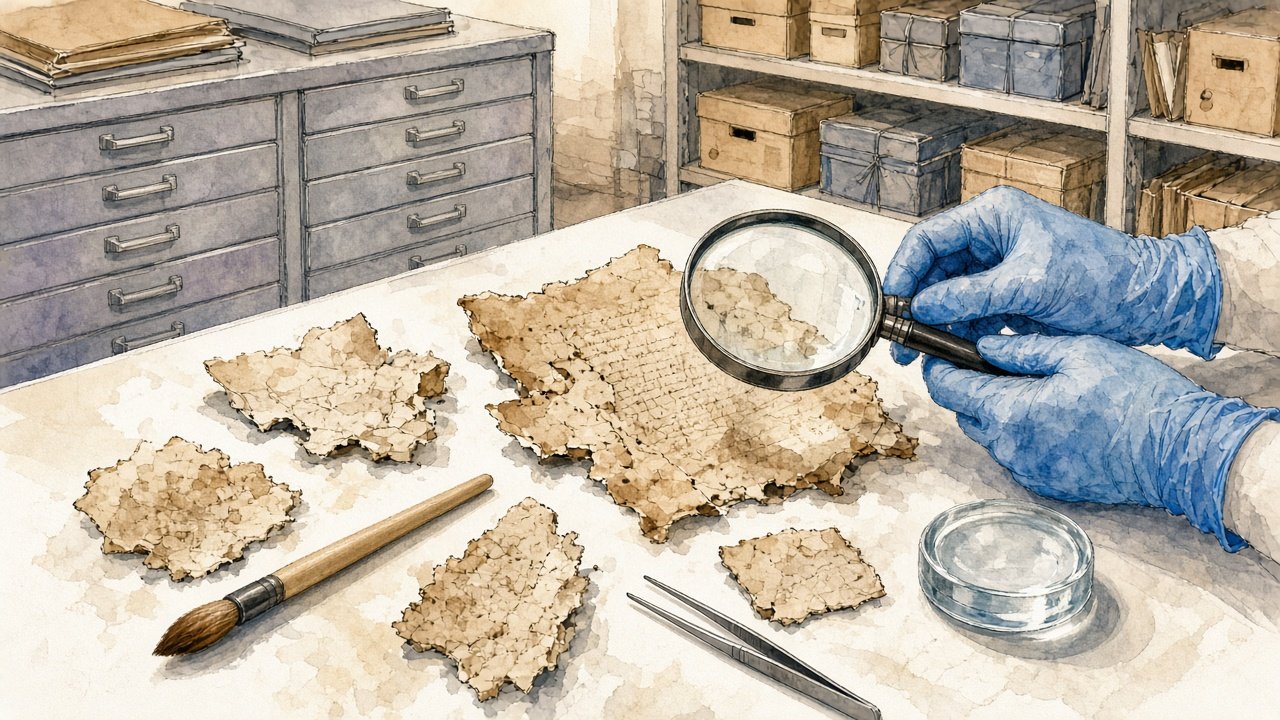
The confusion over Ben Naftali’s name, which Dotan noted, has been resolved by a small manuscript from the Cairo Geniza now in the public and university library of Geneva. Ofer published it in 5770 (2009–10) in the catalogue of the Geneva Geniza collection, which had been discovered in 2005 and had come to public notice in 2006. The manuscript, Geneva Geniza MS 80, is a complete small booklet of five leaves. Its first part gives the number of verses in each weekly portion and each book of the Bible, and its second contains a short liturgical poem.52 The list of verse counts ends with the statement that “this count was written by Rabbi Samuel from the mouth of my master and teacher Rabbi Moses ben David ben Jacob ben Naftali, of blessed memory”.53
Ofer draws several conclusions from this colophon. First, it confirms the name that Mishael gives, Moses ben David. Second, it shows that Jacob, the name by which Levita and others knew the Masorete, was the name of his grandfather, which explains how the confusion arose. Third, it indicates that “Ben Naftali” was a family name, borne by a line that went back at least three generations before Moses ben David, so that it is parallel to the name “Ben Asher”, which was likewise borne by several generations of Masoretes.54 He concludes that the attribution of the differences to Jacob ben Naftali is an error and that Mishael’s testimony, being close in time to the two Masoretes, should be preferred.55 He also argues that Rabbi Samuel was a pupil of Ben Naftali who wrote down the verse counts from his teacher’s dictation, and that the surviving booklet is a later copy made by one of Samuel’s own pupils.56
The verse counts themselves show Ben Naftali dealing with known difficulties in the Masoretic tradition. The total given for the Torah is 5,845 verses and for the whole Bible 23,203. In the last weekly portion of Genesis most manuscripts give a count of 84 verses, although the portion as transmitted contains 85, so that the sum of the counts for the twelve portions of Genesis falls one short of the total for the book. Ben Naftali’s list gives 107 verses rather than 106 for the preceding portion, so that the total for Genesis comes out correctly. Ofer suggests that Ben Naftali’s main concern may have been to reconcile the overall count for the book, but he notes that he has not found any manuscript evidence for a different division of verses in these portions.57 Ofer tentatively identifies the author of the poem in the booklet with Aaron ha-Kohen, a gaon of the Land of Israel whose tenure began around 933, which would agree with the estimated date of Ben Naftali; but he stresses that the name was common among priestly families and that the identification is far from certain.58
Assessment
The Book of Differences is a small work with a large influence. It preserves the only reliable record of the readings of Moses ben David ben Naftali, and it provides the standard by which the great Tiberian codices are classified.59 Its author, a Karaite scholar working in Jerusalem around the turn of the tenth and eleventh centuries, recorded the differences between two masters whom he regarded as equally authoritative, and the work itself shows how narrow those differences had become: the vowels and accents were almost entirely fixed, and the disputes concerned mainly the minor gaʿya and a few details of spelling, word division and dagesh.60
The later history of the work illustrates how such a record could be both used and misused. The preference for Ben Asher, which Maimonides strengthened and David Kimhi applied explicitly to the differences, made the Book of Differences a guide to what should be avoided as much as to what should be followed, and the name of Ben Naftali became attached to readings that had nothing to do with him.61 The edition by Lipschütz restored the evidence for his actual practice, and the Geneva booklet published by Ofer has now confirmed his full name, clarified the family to which he belonged and shown him at work on the counting of verses.62 Taken together, these sources allow Ben Naftali to be seen, as Dotan put it, as one of those who shaped the Tiberian Bible, rather than as the author of a rival system.63
Notes
- Aron Dotan, “Masorah”, in Encyclopaedia Judaica, 2nd edn, at Encyclopedia.com, §6.2.4. *
- Dotan, “Masorah”, §6.2.4. *
- Geoffrey Khan, The Tiberian Pronunciation Tradition of Biblical Hebrew, vol. 1 (Cambridge: Open Book Publishers, 2020), pp. 93–94, 107. *
- Khan, Tiberian Pronunciation Tradition, p. 107. *
- Khan, Tiberian Pronunciation Tradition, pp. 93–94 n. 116. *
- Yosef Ofer, “Minyan pesuqe ha-miqra shel Ben Naftali” (in Hebrew), in David Rosenthal (ed.), The Cairo Genizah Collection in Geneva: Catalogue and Studies (in Hebrew; Jerusalem, 5770 [2009–10]), pp. 208–221, p. 209 n. 7. *
- Khan, Tiberian Pronunciation Tradition, pp. 107–108. *
- Ofer, “Minyan pesuqe ha-miqra shel Ben Naftali”, p. 208 n. 1. *
- Dotan, “Masorah”, §6.2.1. *
- Ofer, “Minyan pesuqe ha-miqra shel Ben Naftali”, p. 209 and nn. 6–7. *
- Ofer, “Minyan pesuqe ha-miqra shel Ben Naftali”, pp. 209–210 and nn. 12–15. *
- Ofer, “Minyan pesuqe ha-miqra shel Ben Naftali”, p. 210 n. 17. *
- Dotan, “Masorah”, §6.2.4. *
- Ofer, “Minyan pesuqe ha-miqra shel Ben Naftali”, p. 209 and n. 11. *
- Dotan, “Masorah”, §6.2.4. *
- Ofer, “Minyan pesuqe ha-miqra shel Ben Naftali”, p. 208 n. 1. *
- Khan, Tiberian Pronunciation Tradition, pp. 93–94. *
- Ofer, “Minyan pesuqe ha-miqra shel Ben Naftali”, p. 208. *
- Khan, Tiberian Pronunciation Tradition, p. 94. *
- Khan, Tiberian Pronunciation Tradition, p. 101. *
- Khan, Tiberian Pronunciation Tradition, pp. 102–103, 545. *
- Khan, Tiberian Pronunciation Tradition, p. 379. *
- Khan, Tiberian Pronunciation Tradition, p. 101. *
- Khan, Tiberian Pronunciation Tradition, pp. 379–380. *
- Khan, Tiberian Pronunciation Tradition, pp. 399–400. *
- Khan, Tiberian Pronunciation Tradition, p. 406. *
- Khan, Tiberian Pronunciation Tradition, p. 363. *
- Khan, Tiberian Pronunciation Tradition, p. 393. *
- Khan, Tiberian Pronunciation Tradition, pp. 554–555. *
- Khan, Tiberian Pronunciation Tradition, p. 173. *
- Khan, Tiberian Pronunciation Tradition, pp. 96–97. *
- Dotan, “Masorah”, §6.2.5. *
- Khan, Tiberian Pronunciation Tradition, pp. 93–95. *
- Khan, Tiberian Pronunciation Tradition, p. 97. *
- Khan, Tiberian Pronunciation Tradition, p. 95. *
- Khan, Tiberian Pronunciation Tradition, pp. 26–29. *
- Khan, Tiberian Pronunciation Tradition, pp. 25–26. *
- Dotan, “Masorah”, §6.2.3. *
- Khan, Tiberian Pronunciation Tradition, p. 29. *
- Ofer, “Minyan pesuqe ha-miqra shel Ben Naftali”, p. 209 and n. 9. *
- Khan, Tiberian Pronunciation Tradition, pp. 95–96. *
- Khan, Tiberian Pronunciation Tradition, pp. 96–97. *
- Khan, Tiberian Pronunciation Tradition, p. 96. *
- Dotan, “Masorah”, §6.2.5. *
- Dotan, “Masorah”, §6.2.5. *
- Ofer, “Minyan pesuqe ha-miqra shel Ben Naftali”, p. 209 n. 9. *
- Dotan, “Masorah”, §6.2.4. *
- Khan, Tiberian Pronunciation Tradition, pp. 93–94 n. 116; Lazar Lipschütz (ed.), Kitāb al-Khilaf: Mishael ben Uzziel’s Treatise on the Differences between Ben Asher and Ben Naphtali (Jerusalem: Magnes Press, 1965), catalogue record at the Internet Archive; Lazar Lipschütz, “Kitāb al-Khilaf, the Book of the Ḥillufim”, Textus 4 (1964), pp. 1–29, record at the Hebrew University Bible Project. *
- Lipschütz (ed.), Kitāb al-Khilaf. *
- Lipschütz, “Kitāb al-Khilaf”. *
- Khan, Tiberian Pronunciation Tradition, pp. 25–29. *
- Ofer, “Minyan pesuqe ha-miqra shel Ben Naftali”, pp. 211–214. *
- Ofer, “Minyan pesuqe ha-miqra shel Ben Naftali”, pp. 209, 213. *
- Ofer, “Minyan pesuqe ha-miqra shel Ben Naftali”, p. 210. *
- Ofer, “Minyan pesuqe ha-miqra shel Ben Naftali”, p. 210. *
- Ofer, “Minyan pesuqe ha-miqra shel Ben Naftali”, p. 214. *
- Ofer, “Minyan pesuqe ha-miqra shel Ben Naftali”, pp. 213–215. *
- Ofer, “Minyan pesuqe ha-miqra shel Ben Naftali”, p. 214 n. 24. *
- Dotan, “Masorah”, §6.2.4; Khan, Tiberian Pronunciation Tradition, pp. 26–29. *
- Khan, Tiberian Pronunciation Tradition, pp. 93–97. *
- Dotan, “Masorah”, §6.2.5; Khan, Tiberian Pronunciation Tradition, p. 96. *
- Ofer, “Minyan pesuqe ha-miqra shel Ben Naftali”, pp. 209–215. *
- Dotan, “Masorah”, §6.2.5. *