

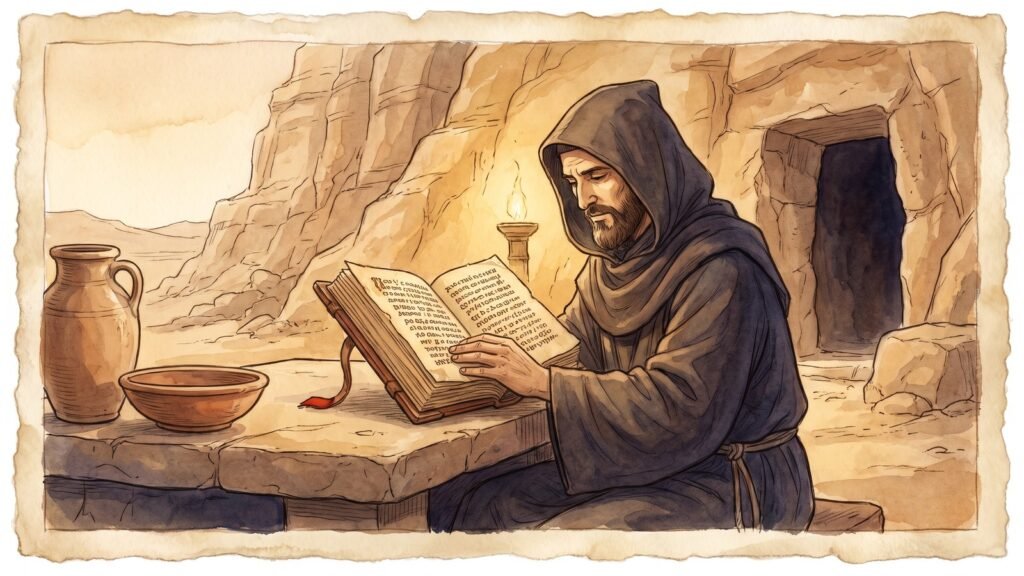
In December 1945, below the limestone cliffs of the Jabal al-Tarif on the eastern side of the Nile, a few kilometres from the town of Nag Hammadi, a group of villagers digging for nitrate-rich soil uncovered a sealed earthenware jar. Inside lay a set of papyrus books bound in leather, written in Coptic, the last form of the ancient Egyptian language. The find became known as the Nag Hammadi library, and it transformed the study of early Christian diversity.1 Yet the codices from the jar were only one part of a far larger body of Coptic literature, the greater part of which consisted of the Bible itself. The Coptic versions of the Old and New Testaments, made from Greek in the third and fourth centuries, were among the first translations of Christian scripture into a vernacular language of the Roman East, and they were read, copied and memorised in the monasteries of Egypt for centuries before and after the books from Nag Hammadi were laid in the ground. This article follows both stories: the making of the Coptic Bible, and the discovery, dispersal and study of the codices from the jar.
At a glance
- 3rd century: Greek scriptural books begin to be translated into Coptic, the last stage of the Egyptian language.
- c. 270: Antony hears the Gospel read in a village church and withdraws to the desert.
- c. 323: Pachomius founds a monastic community at Tabennesi in Upper Egypt.
- 4th century: Sahidic, Bohairic and other dialect versions circulate in codex form.
- 341–348: Dates on documents recycled as cartonnage in the Nag Hammadi bindings.
- 367: Athanasius’ Festal Letter 39 lists the canonical books and warns against apocrypha.
- c. 465: Death of Shenoute, abbot of the White Monastery and master of Sahidic prose.
- 11th century onward: Bohairic becomes the liturgical standard of the Coptic Church.
- December 1945: A sealed jar containing thirteen codices is found below the Jabal al-Tarif.
- 1952: Codex I is bought for the Jung Institute in Zurich; it later returns to Cairo.
- 1972–1977: The facsimile edition of the Nag Hammadi codices is published.
- 1977: The Nag Hammadi Library in English appears.
- 2015: The Göttingen project on the Coptic-Sahidic Old Testament begins.
The Language of Late Egypt
From Demotic to Coptic
By the Roman period the Egyptian language had been written for more than three thousand years, successively in hieroglyphic, hieratic and Demotic script. Demotic, the cursive script of everyday documents in the Ptolemaic and Roman periods, was difficult to learn and did not mark vowels. From the first centuries of the Christian era, scribes began to write Egyptian in the Greek alphabet, adding a small number of letters taken from Demotic to represent sounds that Greek lacked, among them the sounds written in later Coptic as shai, fai, khai, hori, janja and gangia, together with the syllabic sign ti.2 The earliest experiments, often called Old Coptic, appear in magical and astrological texts, where the exact pronunciation of a spell mattered. By the third century the system had settled into a recognisable script, and the language written in it is known to modern scholars as Coptic.3
The name itself has a long history. The Greek word Aigyptios, “Egyptian”, passed into Arabic after the conquest of the seventh century as qibt, and from there into European languages as “Copt”. In origin, therefore, Coptic simply means Egyptian, and it was used for the Christian population of Egypt and their language once Arabic had become the language of government. The script, written left to right like Greek, drew a large share of its vocabulary from Greek as well, particularly in religious, legal and administrative matters. A Coptic text of the fourth century might therefore contain Egyptian verbs and grammar side by side with Greek nouns such as ekklesia, “church”, graphe, “scripture”, and pneuma, “spirit”.
The Dialects
Coptic was not a single uniform language. The Nile valley stretched for more than a thousand kilometres from the Delta to the First Cataract, and the written forms of the language reflect regional differences in sound and grammar. Scholars distinguish several major literary dialects. Sahidic, associated with Upper Egypt and probably with the region of Thebes in origin, became the classical literary language of Coptic Christianity in the fourth and fifth centuries and was understood throughout the valley. Bohairic, the dialect of the western Delta and of the monasteries of the Wadi Natrun, rose in importance in the early Islamic period, and from about the eleventh century it became the standard liturgical language of the Coptic Church, as it remains today. Between these stood a number of smaller written dialects, among them Akhmimic, Lycopolitan (sometimes called Subakhmimic), Fayyumic and the dialect of the region of Oxyrhynchus, often called Mesokemic.4
The existence of these dialects meant that the same biblical book could be translated more than once, and that a translation made in one region could be adapted for use in another. For the textual historian the result is a rich but complicated body of evidence. A verse of the Gospel of John may survive in Sahidic, Bohairic, Lycopolitan and Fayyumic forms, each reflecting a different stage and place of transmission, and each in turn reflecting, at one remove, the Greek text from which it was made.
The Beginnings of the Coptic Bible
Christianity in the Egyptian Countryside
Christianity reached Alexandria early, though the details of its arrival are obscure. The church of Alexandria, with its catechetical school and its theologians Clement and Origen, worked in Greek, and Greek remained the language of its bishops and of most of its theological writing. Outside Alexandria, however, most of the population of Egypt spoke Egyptian, and many could not read Greek. As Christianity spread through the towns and villages of the Nile valley in the third century, the need for scripture in the language of the people became pressing. The Coptic versions answered that need. There is no record of an official commission or a single translator, and the work seems to have been done piecemeal, book by book, in different places, by people whose names have not survived.5
One of the best-known witnesses to the reading of scripture in the countryside comes from the Life of Antony, written by Athanasius of Alexandria soon after the hermit’s death in 356. Athanasius relates that Antony, a young man of a Christian family in Middle Egypt, entered a church one day and heard the Gospel being read: “If you would be perfect, go and sell what you have and give to the poor, and come and follow me, and you shall have treasure in heaven.” He took the words as addressed to himself, gave away his property and began a life of ascetic withdrawal.6 Athanasius also states that Antony had not learned letters and that he spoke with visiting Greek philosophers through an interpreter.7 Whatever the exact degree of his literacy, the story shows the Gospel being read aloud in a village church to a congregation for whom Egyptian was the language of daily life, and it is reasonable to suppose that the reading was given or explained in Coptic. Anthony the Great became the model for generations of Egyptian monks, and his story, told in Greek and quickly translated into Latin and Coptic, carried the ideal of the desert across the Christian world.8
Pachomius and the Monastic Reader
The monastic movement played a decisive part in the history of the Coptic Bible. Around 323, Pachomius, a former soldier who had been baptised after his discharge, founded a community at Tabennesi, a deserted village in the region of the bend of the Nile, not far from the place where the Nag Hammadi codices would later be found. His community, known as the Koinonia, grew rapidly into a federation of monasteries for men and women, with its centre at Pbow. The rules of Pachomius, preserved most fully in a Latin translation made by Jerome from a Greek version of the Coptic original, required that a newcomer who could not read be taught to do so, and that he learn by heart portions of scripture, including the Psalter and the New Testament.9
Such rules made the monasteries of Upper Egypt into places where the scriptures were not only kept but internalised. The monks recited the Psalms at work and at prayer, and they quoted the Bible constantly in their letters and instructions. Since the great majority of them were native Egyptians, the scriptures they memorised were, for the most part, Coptic scriptures. The demand for books grew with the communities, and the monasteries became centres of copying. Much of what survives of early Coptic biblical literature probably passed at some point through monastic hands.
Shenoute and the White Monastery
The greatest writer of Coptic literature, Shenoute, was abbot of a monastery near Atripe, opposite the town of Panopolis (modern Akhmim), known today as the White Monastery from the pale limestone of its church. He led the community from the 380s until his death, traditionally placed around 465, and he wrote a large body of sermons, letters and rules in Sahidic. His prose is dense with biblical citation and allusion, and it shows how completely the Sahidic Bible had become the medium of thought for an Egyptian Christian writer of the fifth century.10
The library of the White Monastery survived until the early modern period, but its books were dispersed in the eighteenth and nineteenth centuries. Leaves and quires from its codices are now scattered among libraries and museums in Cairo, Naples, Paris, London, Vienna, Berlin, Oxford, Manchester and elsewhere. Reconstructing the original codices from these fragments has been one of the long tasks of Coptic studies, and much of the evidence for the Sahidic Old Testament comes from leaves that once belonged to this one library.
The Coptic Versions of the Bible
The Old Testament from the Greek
The Coptic Old Testament was translated not from Hebrew but from the Greek Bible of the church, the Septuagint. This has two consequences for the textual historian. First, the Coptic versions are witnesses to the Greek text rather than directly to the Hebrew, and their value for the study of the Hebrew Bible is indirect. Second, they can be of real importance for the history of the Septuagint itself, since they preserve forms of the Greek text current in Egypt in the third and fourth centuries, sometimes before the influence of later recensions such as that associated with Origen’s Hexapla.
The Sahidic Old Testament survives very unevenly. Some books, such as the Psalms, the Minor Prophets and parts of the Pentateuch, are well represented, while others survive only in fragments. No complete Sahidic Bible in a single manuscript is known. The evidence must therefore be gathered from hundreds of separate manuscripts and fragments. Since 2015 a long-term project of the Göttingen Academy of Sciences and Humanities has been working to produce a digital edition and English translation of the Coptic-Sahidic Old Testament, gathering the scattered manuscripts into a virtual manuscript room and building a complete critical text.11 The project follows the model of the New Testament Virtual Manuscript Room, linking images, transcriptions and edited text so that the evidence can be studied in one place.
The New Testament
The Coptic New Testament is better preserved. The Sahidic version was probably substantially complete by the early fourth century, and the Bohairic followed, although scholars disagree about how early the Bohairic translation was made. Both versions are generally regarded as witnesses to the type of Greek text that textual critics call Alexandrian, the text represented also by Codex Vaticanus and Codex Sinaiticus. The Sahidic version, for example, ends the Gospel of Mark at 16:8 in its earliest witnesses, or adds the shorter ending, while many later Greek manuscripts give the longer ending familiar from the Authorised Version. Because a translation can show what Greek text was read in a particular place and time, the Coptic versions are routinely cited in critical editions of the Greek New Testament, though with care, since Coptic grammar does not always allow a translator to reproduce small differences of Greek word order or particles.12
The standard editions of the Coptic New Testament for much of the twentieth century were those of George William Horner, an English clergyman and scholar who published the Bohairic New Testament in four volumes between 1898 and 1905 and the Sahidic New Testament in seven volumes between 1911 and 1924.13 Horner’s Sahidic edition had to be assembled from many fragmentary manuscripts, and it was overtaken in part by later discoveries, but it remains a monument of patient scholarship and is still consulted.
The Early Codices
Several early Coptic biblical manuscripts deserve particular mention. Among the Bodmer papyri, acquired by the Swiss collector Martin Bodmer in the 1950s, is a Bohairic codex of the Gospel of John and part of Genesis, usually known as Papyrus Bodmer III, which has been dated to the fourth century and is one of the earliest witnesses to the Bohairic dialect. The same group of manuscripts includes Sahidic biblical books. The Crosby-Schøyen Codex, a papyrus book in Sahidic containing, among other texts, the book of Jonah, 2 Maccabees and 1 Peter, has been dated to the third or fourth century and is among the oldest Coptic codices known. The Codex Glazier in the Morgan Library in New York, a small parchment book containing the first half of the Acts of the Apostles in the Mesokemic dialect, and the Scheide Codex of the Gospel of Matthew in the same dialect, now at Princeton, preserve forms of the text from Middle Egypt in the fourth or fifth century.14
From a later period come the great monastic collections. In 1910 farmers digging near the village of Hamuli in the Fayyum came upon the remains of the library of the Monastery of the Archangel Michael, a group of some fifty parchment codices, many with dated colophons from the ninth and tenth centuries. Most of them were acquired by J. Pierpont Morgan and are now in the Morgan Library. They include biblical books, lectionaries, homilies and lives of saints in Sahidic, and their colophons record the names of scribes, donors and the monasteries to which the books were given, offering a rare view of the book culture of Christian Egypt in the early Islamic centuries.
Canon and Lectionary
The contents of the Coptic Bible were shaped by the canon of the church of Alexandria. In 367, Athanasius of Alexandria issued his thirty-ninth Festal Letter, the annual letter by which the bishop announced the date of Easter. In it he listed the books of the Old and New Testaments that were to be received as canonical, naming for the New Testament the twenty-seven books accepted in most churches today. He added a group of books, among them the Wisdom of Solomon, the Wisdom of Sirach, Esther, Judith and Tobit, together with the Didache and the Shepherd of Hermas, which were not in the canon but could be read by catechumens. He then warned against the books called apocrypha, which he described as an invention of heretics who wrote them when they wished and gave them the appearance of antiquity.15 The letter survives in Greek fragments and, more fully, in Coptic, and the Coptic translation was evidently read in the monasteries of Upper Egypt. It has played a part in modern discussion of the Nag Hammadi codices, as will be seen below.
Over the centuries the reading of scripture in Coptic churches was organised into lectionaries, books that arranged passages according to the liturgical year. Many later Coptic manuscripts are of this kind, often with Bohairic text and Arabic translation in parallel columns. They show the long afterlife of the early versions in worship, at a time when Arabic had become the everyday language of Egyptian Christians and Coptic was increasingly confined to the liturgy.16
The Discovery at Nag Hammadi
The Jar below the Cliff
The circumstances of the Nag Hammadi discovery were reconstructed in the 1970s by the American scholar James M. Robinson, who visited the region repeatedly and interviewed the men involved.17 According to the account he gathered, the find was made in December 1945 by Muhammad Ali al-Samman and his brothers, from the village of al-Qasr, who were digging for sabakh, a soft soil used as fertiliser, at the foot of the Jabal al-Tarif. They found a large jar, sealed with a bowl. Muhammad Ali hesitated to break it, fearing that it might hold a jinn, but in the hope that it contained gold he smashed it with his mattock. Inside were a number of books bound in leather.18
Robinson’s account goes on to describe how some loose leaves were burnt in an oven by Muhammad Ali’s mother, how the brothers were drawn into a blood feud that made them wary of the police, and how the books passed through the hands of a local priest, a teacher and dealers in Cairo. Details of the story rest on the recollections of the discoverers given many years later, and some scholars have questioned parts of it, but its general outline, a chance find by local men followed by a gradual and partly clandestine sale, is consistent with what is known of the later history of the codices.19
From the Cliff to Cairo
One codex was sold by a teacher, Raghib Andrawus, to the Coptic Museum in Cairo in 1946.20 Most of the others came into the possession of a Cairo antiquities dealer and were the subject of protracted negotiations; the Egyptian government eventually took custody of them, and they were transferred to the Coptic Museum, where they were declared national property in the 1950s. The French scholar Jean Doresse, who saw some of the codices in Cairo in 1947 and 1948, was among the first to recognise their importance and to publish reports of their contents.
One codex took a different path. The book now known as Codex I was taken out of Egypt and offered for sale in Europe. In 1952 it was bought on behalf of the C. G. Jung Institute in Zurich and named the Jung Codex in honour of the psychologist, who had a long interest in Gnosticism. After its contents had been published by an international team, the leaves of the Jung Codex were returned to Cairo in stages during the 1970s, so that the codices from the jar were reunited in the Coptic Museum, where they remain.21
Thirteen Books
The find consists of twelve codices and some leaves from a thirteenth, which had been tucked inside the cover of Codex VI. They are papyrus books of single-quire or multiple-quire construction, bound in covers of tooled leather, some with flaps and ties of the kind still seen on the covers today. Together they contain fifty-two tractates. Because some works appear in more than one copy and a few are not otherwise known, scholars usually speak of about forty-six distinct writings, of which some forty were previously unknown.22
All the texts are in Coptic, most in Sahidic, some in a form of Lycopolitan, and most if not all of them are translations from Greek originals that were composed in the second and third centuries. The codices themselves are later. Their bindings were stiffened with cartonnage, layers of waste papyrus glued together, and when this was taken apart it was found to contain fragments of letters, accounts and contracts. Some carry dates, the latest falling in 348, and on that basis the manufacture of at least some of the codices has been placed in the second half of the fourth century.23 Several of the cartonnage documents mention names and terms that some scholars have linked with the Pachomian monasteries of the region, a point to which we shall return.
The Contents of the Codices
A Diverse Library
The Nag Hammadi codices are often described as a “Gnostic library”, but their contents are more varied than that phrase suggests. Many of the treatises belong to the Christian movements that early heresiologists such as Irenaeus called Gnostic, and some belong to the particular tradition that modern scholars call Sethian, from its veneration of Seth, the son of Adam, as a revealer. Others are associated with the school of the second-century teacher Valentinus. But the codices also contain texts that are neither Sethian nor Valentinian: wisdom sayings, philosophical treatises, Hermetic writings associated with the god Hermes Trismegistus, and even a Coptic translation of a passage from Plato’s Republic (588a–589b) on the image of the soul.2425
Among the best-known works are the Gospel of Thomas, the Apocryphon of John, the Gospel of Truth and the Gospel of Philip. Other titles include the Hypostasis of the Archons, On the Origin of the World, the Apocalypse of Adam, the Thunder, Perfect Mind, the Exegesis on the Soul, the Teachings of Silvanus, the Sentences of Sextus and the Discourse on the Eighth and Ninth. The diversity of the collection has led many scholars to think that whoever assembled or owned the codices did not belong to a single sect, but read widely in literature that interested them for spiritual or ascetic reasons.
The Gospel of Thomas
The Gospel of Thomas, the second tractate of Codex II, is a collection of one hundred and fourteen sayings attributed to Jesus, introduced with the words “These are the secret sayings which the living Jesus spoke and which Didymos Judas Thomas wrote down.” It contains no narrative of the life, death or resurrection of Jesus. About half of the sayings have parallels in the Synoptic Gospels; others are unknown elsewhere. Before 1945, three Greek fragments of the same work had been found among the papyri of Oxyrhynchus and published in 1897 and 1904, but they had not been identified with certainty as parts of a Gospel of Thomas until the Coptic text made the identification possible.26
The date of the Gospel of Thomas and its relation to the canonical Gospels are among the most debated questions in the study of early Christianity. Some scholars argue that it preserves sayings traditions independent of the Synoptic Gospels and possibly early in origin; others hold that it depends on the Synoptics and reflects second-century developments. The Greek fragments show that the work existed in Greek by around 200, and the Coptic version, which differs from the Greek in places, shows that it continued to be copied and adapted in the fourth century.
The Apocryphon of John and the Sethian Writings
The Apocryphon, or Secret Book, of John is the most important Sethian text. It survives in four copies, three at Nag Hammadi (in Codices II, III and IV) and one in the Berlin Codex, Papyrus Berolinensis 8502, a Coptic manuscript bought in Cairo in 1896 but not published until 1955, partly because of the delays caused by two world wars.27 The work presents itself as a revelation given by the risen Christ to the apostle John. It describes the emanation of a series of divine beings from an unknowable supreme God, the fall of Sophia, Wisdom, and the creation of the material world by an ignorant and arrogant lesser god, Yaldabaoth, whom the text identifies with the God of Genesis. It then retells the stories of Adam and Eve, the flood and the generations of humanity as a struggle between the powers of the creator and the saving knowledge that comes from above.28
The existence of two different recensions, a shorter one in Codex III and the Berlin Codex and a longer one in Codices II and IV, shows that the text was revised in transmission, as the books of the Bible themselves were. For the study of transmission the Apocryphon of John is a useful example of how a work could circulate in several versions in the same language and region, and how Coptic scribes copied, corrected and adapted texts translated from Greek.
Valentinian Texts
The Gospel of Truth, preserved in Codex I and in a fragmentary copy in Codex XII, is a meditative homily on the knowledge of the Father brought by Jesus. Irenaeus of Lyon, writing around 180, mentioned a “Gospel of Truth” used by the followers of Valentinus, and many scholars have identified the Nag Hammadi text with that work, some suggesting that Valentinus himself may have written it. The Gospel of Philip, in Codex II, is a loosely ordered collection of excerpts and reflections on sacraments, including baptism, anointing and a rite called the bridal chamber. It is famous for passages concerning Mary Magdalene, which have often been quoted out of context in popular literature. Read in their setting, they belong to a theological discussion of spiritual union rather than to biography.29
Beyond Nag Hammadi
The Nag Hammadi codices did not stand alone. Two other Coptic codices with comparable contents had been known since the eighteenth and nineteenth centuries, the Askew Codex, containing the Pistis Sophia, and the Bruce Codex, containing the Books of Jeu, both now in London and Oxford. The Berlin Codex, mentioned above, contains a Gospel of Mary as well as the Apocryphon of John. In 2006 the National Geographic Society published the Codex Tchacos, a papyrus codex found in Middle Egypt in the 1970s and long kept in poor conditions, which contained the Gospel of Judas, a work mentioned by Irenaeus, together with copies of texts also known from Nag Hammadi.30 The history of the Codex Tchacos, which passed through the antiquities market and suffered serious damage before it was conserved, illustrates in a different way the risks to which such manuscripts are exposed once they leave their place of discovery.
Who Owned the Codices?
The Monastic Hypothesis
The question of who made and owned the Nag Hammadi codices, and why they were buried, has been discussed since the find became known. The place of discovery lies close to the sites of early Pachomian monasteries, including Chenoboskion and Pbow, and the cartonnage in the bindings includes documents that some scholars have read as connected with monastic communities, including letters addressed to persons called “father” and mentions of names known in a Pachomian context. On this basis it was suggested as early as the 1950s that the codices had belonged to monks.31
In 1978 Frederik Wisse argued that the codices might have been read by monks for ascetic edification, without their owners necessarily adhering to any particular Gnostic system.32 More recently, Hugo Lundhaug and Lance Jenott, in a detailed study published in 2015, argued that the codices were most plausibly produced and used in a Pachomian or similar monastic setting, pointing to features of the bookmaking, the scribal notes, the cartonnage and the themes of the texts, which they compared with the ascetic and visionary literature known to have been read in Egyptian monasteries.33 Other scholars have been more cautious, noting that the identification of the cartonnage documents as monastic is not always secure, and that the codices might have been owned by individuals or small circles of readers outside the monasteries.
The Festal Letter and the Burial
A popular explanation for the burial of the codices connects it with Athanasius’ Festal Letter of 367. According to this view, the letter was read in the Pachomian monasteries, where the abbot Theodore is known to have had it translated and placed in the monastery as a rule, and monks who owned books that the letter condemned as apocryphal hid them in a jar in the hope of retrieving them later.34 The theory is attractive because it links a known event with a datable archaeological find, but it cannot be proven. The codices may have been buried for other reasons, as grave goods, for instance, or for safekeeping in a time of disturbance, or simply because they were no longer wanted but were regarded as too valuable or too sacred to destroy. The practice of placing worn or unwanted religious texts in a protected place is known from many traditions, including the Jewish Cairo Genizah, and it is possible that the jar at the Jabal al-Tarif served a similar purpose.
Publication and Scholarship
The International Committee
For a quarter of a century after their discovery, the Nag Hammadi codices were largely inaccessible to most scholars. Publication proceeded slowly, hindered by questions of ownership, by political events in Egypt, including the Suez crisis of 1956, and by the difficulty of handling fragile papyrus. In 1970 UNESCO and the Egyptian Ministry of Culture set up an international committee to oversee publication. Robinson, as secretary of the committee and director of the Coptic Gnostic Library project at the Institute for Antiquity and Christianity in Claremont, California, organised the conservation and photographing of the codices and the production of a complete photographic facsimile, published by Brill in Leiden between 1972 and 1977.35
In 1977 Robinson and his collaborators published The Nag Hammadi Library in English, a single volume containing translations of all the tractates, which made the texts available to a wide public for the first time.36 Critical editions of the individual codices followed in the series of the Coptic Gnostic Library, and parallel French and German projects, centred at Laval University in Quebec and in Berlin, produced their own editions and commentaries. The coincidence that the codices were found within two years of the first Dead Sea Scrolls has often been noted. The two finds, though very different in character, together reshaped the study of Judaism and Christianity in the ancient world in the second half of the twentieth century.
What the Codices Changed
Before 1945 knowledge of the Christian groups that the church fathers called Gnostic depended almost entirely on the descriptions of their opponents, chiefly Irenaeus, Hippolytus, Tertullian and Epiphanius. The Nag Hammadi codices made it possible to read some of these groups in their own words. The result was a reconsideration of the very category of Gnosticism. Some scholars now argue that the term groups together movements too different to be treated as a single religion, and prefer to speak more precisely of Sethian, Valentinian and other traditions. Others continue to find the category useful for a family of ideas about creation, salvation and knowledge.37 Either way, the codices showed that early Christianity in Egypt and elsewhere was more diverse than the later orthodox historians had allowed, and that this diversity extended into the fourth century and into the Coptic-speaking world.
The codices are also important for the history of the book. They are among the earliest surviving examples of leather-bound codices with their original covers, and they show the techniques of papyrus bookmaking in fourth-century Egypt in exceptional detail. The study of their quires, sewing and covers has contributed to the wider understanding of the transition from scroll to codex, a transition in which Christians played a prominent part, as the Chester Beatty papyri and the Bodmer papyri also show.
The Coptic Bible and the Wider Christian World
One Version among Many
The Coptic versions belong to a family of early translations made as Christianity spread beyond the Greek and Latin-speaking world. In Syria the Peshitta served the Syriac-speaking churches; in the Latin West the early Latin versions were followed by Jerome’s Vulgate; in the fourth century Ulfilas made a Gothic Bible; in the early fifth century Mesrop Mashtots invented an alphabet for Armenian so that the Bible could be translated; and in the kingdom of Aksum the scriptures were rendered into Ge’ez, as the Garima Gospels attest. The Coptic case differs from most of these in one respect: there was no single founding figure. The Coptic Bible arose out of the needs of a Christian population that already possessed a long literary tradition and that adapted the Greek alphabet to its own language before the work of translation began.
The Ethiopian and Nubian churches looked to Alexandria for their bishops, and Coptic influence reached them through ecclesiastical connections. Coptic manuscripts have been found in Nubia, and the Ethiopian church long received its metropolitan from Egypt. The Coptic versions also shaped the Arabic translations made by Egyptian Christians from the tenth century onward, several of which were translated from Coptic rather than directly from Greek.
Reading the Versions Today
For textual critics the Coptic versions present both opportunities and difficulties. They are early, they come from a region where the Greek text was carefully transmitted, and they survive in some manuscripts that are older than most Greek witnesses of the same books. At the same time, the differences between Greek and Coptic grammar mean that a translation does not always reveal the exact wording of its source. Coptic has no case endings, uses a definite article in different ways from Greek and has a verbal system organised around a set of conjugation bases, so that a single Coptic construction may correspond to several Greek forms. Editors of the Greek New Testament therefore cite the Coptic versions only where the evidence is clear.38
The digital projects of recent years have made the scattered manuscripts more accessible than ever before. Leaves of a single codex that are now in five or six countries can be viewed side by side, and the textual relationships among the Sahidic manuscripts can be studied systematically.39 The same is true, in a different way, of the Nag Hammadi codices, whose images and translations are now widely available. In both cases, modern scholarship has worked to reassemble books and libraries that were dispersed by time, by the antiquities trade and by the accidents of discovery.
Conclusion
The Coptic Bible and the Nag Hammadi codices are two parts of a single literary culture. Both were written in the same script, in the same dialects and often in the same region of Upper Egypt, and both were read by people who had made the language of the Pharaohs into a language of Christian scripture and devotion. The biblical versions were copied continuously for more than a thousand years and survive in hundreds of manuscripts, many of them fragmentary. The codices from the jar were copied for a shorter time, buried, and recovered by chance. Together they show the range of what was read in Christian Egypt in the fourth century: the canonical scriptures defined by the bishop of Alexandria, and alongside them a wider literature of revelation, wisdom and speculation that the church of the following centuries largely set aside. The work of reconstructing that world, from fragments scattered across the libraries of Europe and America and from thirteen books found below a cliff in 1945, continues.
Notes
- Grokipedia, “Nag Hammadi library”. ↩
- Grokipedia, “Coptic script”. ↩
- Grokipedia, “Coptic language”. ↩
- Grokipedia, “Coptic language”. ↩
- Bruce M. Metzger, The Early Versions of the New Testament: Their Origin, Transmission, and Limitations (Oxford: Clarendon Press, 1977), chapter on the Coptic versions. ↩
- Athanasius, Life of Antony 2–3, English translation. ↩
- Athanasius, Life of Antony 1 and 72–73, on Antony’s lack of letters and his conversations with Greek philosophers through an interpreter. ↩
- Grokipedia, “Anthony the Great”. ↩
- Grokipedia, “Pachomius the Great”; on the requirement of reading and memorisation see the Rules of Pachomius, Praecepta 139–140, in Jerome’s Latin version. ↩
- Grokipedia, “Shenoute”. ↩
- Göttingen Academy of Sciences and Humanities, Digital Edition and Translation of the Coptic-Sahidic Old Testament, project portal and virtual manuscript room. ↩
- Bruce M. Metzger, The Early Versions of the New Testament: Their Origin, Transmission, and Limitations (Oxford: Clarendon Press, 1977), chapter on the Coptic versions. ↩
- George William Horner, The Coptic Version of the New Testament in the Northern Dialect, 4 vols (Oxford, 1898–1905), and The Coptic Version of the New Testament in the Southern Dialect, 7 vols (Oxford, 1911–1924). ↩
- Bruce M. Metzger, The Early Versions of the New Testament: Their Origin, Transmission, and Limitations (Oxford: Clarendon Press, 1977), chapter on the Coptic versions. ↩
- Athanasius of Alexandria, Festal Letter 39 (AD 367), English translation. ↩
- Grokipedia, “Coptic Orthodox Church”. ↩
- Grokipedia, “James M. Robinson”. ↩
- James M. Robinson, “From the Cliff to Cairo: The Story of the Discoverers and the Middlemen of the Nag Hammadi Codices”, in Bernard Barc (ed.), Colloque international sur les textes de Nag Hammadi (Québec and Louvain, 1981), 21–58. ↩
- James M. Robinson, “From the Cliff to Cairo: The Story of the Discoverers and the Middlemen of the Nag Hammadi Codices”, in Bernard Barc (ed.), Colloque international sur les textes de Nag Hammadi (Québec and Louvain, 1981), 21–58. ↩
- Grokipedia, “Coptic Museum”. ↩
- Grokipedia, “Nag Hammadi library”. ↩
- James M. Robinson (general editor), The Nag Hammadi Library in English (Leiden: Brill; San Francisco: Harper & Row, 1977; 3rd revised edition 1988), introduction. ↩
- John W. B. Barns, “Greek and Coptic Papyri from the Covers of the Nag Hammadi Codices”, in Martin Krause (ed.), Essays on the Nag Hammadi Texts in Honour of Pahor Labib (Leiden: Brill, 1975), 9–18; J. W. B. Barns, G. M. Browne and J. C. Shelton, Nag Hammadi Codices: Greek and Coptic Papyri from the Cartonnage of the Covers (Leiden: Brill, 1981). ↩
- Grokipedia, “Nag Hammadi library”. ↩
- Grokipedia, “Gnosticism”. ↩
- Grokipedia, “Gospel of Thomas”. ↩
- Walter C. Till, Die gnostischen Schriften des koptischen Papyrus Berolinensis 8502 (Berlin: Akademie-Verlag, 1955). ↩
- Grokipedia, “Apocryphon of John”. ↩
- Grokipedia, “Gospel of Truth” and “Gospel of Philip”. ↩
- Grokipedia, “Codex Tchacos” and “Gospel of Judas”. ↩
- John W. B. Barns, “Greek and Coptic Papyri from the Covers of the Nag Hammadi Codices”, in Martin Krause (ed.), Essays on the Nag Hammadi Texts in Honour of Pahor Labib (Leiden: Brill, 1975), 9–18; J. W. B. Barns, G. M. Browne and J. C. Shelton, Nag Hammadi Codices: Greek and Coptic Papyri from the Cartonnage of the Covers (Leiden: Brill, 1981). ↩
- Frederik Wisse, “Gnosticism and Early Monasticism in Egypt”, in Barbara Aland (ed.), Gnosis: Festschrift für Hans Jonas (Göttingen: Vandenhoeck & Ruprecht, 1978), 431–440. ↩
- Hugo Lundhaug and Lance Jenott, The Monastic Origins of the Nag Hammadi Codices (Tübingen: Mohr Siebeck, 2015). ↩
- Athanasius of Alexandria, Festal Letter 39 (AD 367), English translation. ↩
- Grokipedia, “James M. Robinson”. ↩
- James M. Robinson (general editor), The Nag Hammadi Library in English (Leiden: Brill; San Francisco: Harper & Row, 1977; 3rd revised edition 1988), introduction. ↩
- Grokipedia, “Gnosticism”. ↩
- Bruce M. Metzger, The Early Versions of the New Testament: Their Origin, Transmission, and Limitations (Oxford: Clarendon Press, 1977), chapter on the Coptic versions. ↩
- Göttingen Academy of Sciences and Humanities, Digital Edition and Translation of the Coptic-Sahidic Old Testament, project portal and virtual manuscript room. ↩