

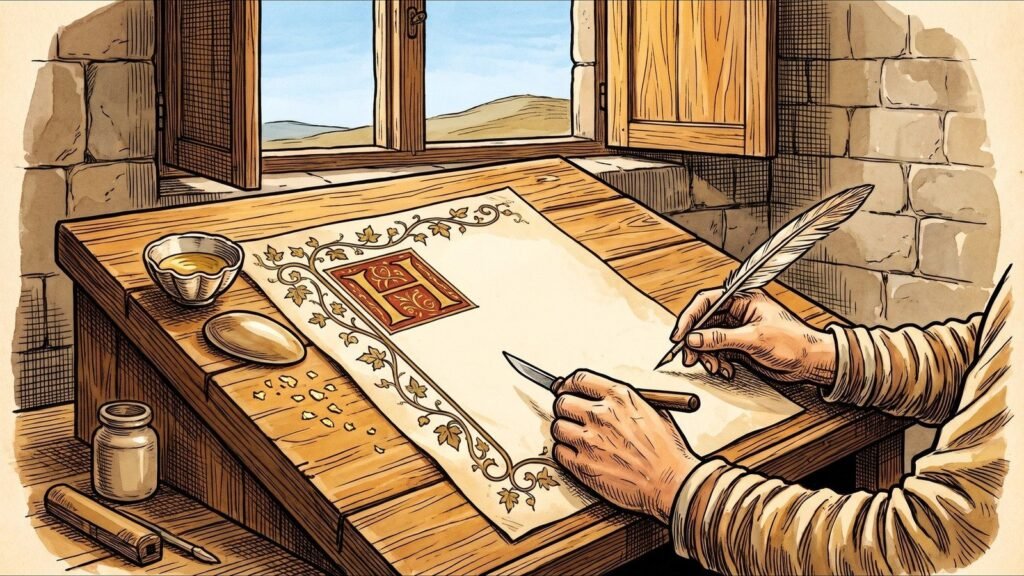
Among the illuminated Hebrew manuscripts of the Middle Ages, few combine as much learning, ornament and personal testimony as the codex known today as the Farhi Bible. It was written and decorated over some seventeen years, between 1366 and the early 1380s, by a single man: Elisha ben Abraham Benvenisti, called Cresques, a Jew of the island of Majorca. Elisha was not a professional scribe in the ordinary sense. He was a learned member of a prominent family, and, according to an identification now widely accepted, he was also the master mapmaker of the Crown of Aragon, the Cresques Abraham to whom the celebrated Catalan Atlas is attributed. The book he made for himself and his descendants is at once a Bible, a family library and a statement of identity.123
The manuscript takes its modern name not from its maker but from a later owner, Hayyim Farhi of Damascus, the head of a powerful Syrian Jewish family in the Ottoman period. In the twentieth century it entered the collection of David Solomon Sassoon, where it was catalogued as Sassoon MS 368. Unlike most of the Sassoon manuscripts it has never been sold at public auction, and it remains in private hands. For decades its study depended on a set of photographs made by Bezalel Narkiss and a small number of scholars who were allowed to see it. Even so, the work of Katrin Kogman-Appel and others has made it one of the best understood Hebrew books of fourteenth-century Iberia.4567
This article describes the maker, the contents and the decoration of the Farhi Bible, its place among the Sephardi Bibles of its time, its Masoretic and scholarly apparatus, and the history of the book from the persecutions of 1391 to its present obscurity.
At a glance
- 11 July 1325: Elisha ben Abraham Benvenisti, known as Cresques, is born into a learned Jewish family of Majorca.
- 1366: Elisha begins the codex that will become known as the Farhi Bible.
- c. 1375: The Catalan Atlas, attributed to Cresques Abraham of Majorca, is made for the Crown of Aragon.
- 19 November 1382: The colophon dates completion to 13 Kislev 5143; some scholars give 1383 for the end of the work.
- Contents: A complete Hebrew Bible with about thirty carpet pages, Temple implements and 194 pages of historical, calendrical, Masoretic and exegetical texts.
- 1387: Elisha dies; his will survives in the Majorcan archives.
- 1391: Anti-Jewish riots reach Majorca; his family is baptised.
- 19th century: The book belongs to Hayyim Farhi of Damascus, whose name it now carries.
- Today: Sassoon MS 368, still in private hands and seldom seen by scholars.
Elisha ben Abraham Cresques
Elisha names himself and his ancestry in the colophon at the front of the book: Elisha, son of Rabbi Abraham Benvenisti, son of Rabbi Elisha, known by the name Cresques. The double naming is typical of Jews in the Crown of Aragon, who often carried a Hebrew name used in religious contexts and a Romance name, here Cresques, used in daily life and in dealings with Christian authorities. In Latin and Catalan documents the same man appears as Cresques Abraham, that is, Cresques son of Abraham. Archival research has established his date of birth as 11 July 1325 and his death in 1387; his will and a number of related family documents survive in the archives of Majorca.8910
The family belonged to the educated elite of the Jewish community of Palma, the island’s capital. Elisha’s forebears included rabbis, and he himself received a traditional education in Hebrew, Bible and rabbinic literature. His father is recorded as having donated a seat in the synagogue in his honour in recognition of his skill as a Hebrew scribe. The evidence of the Farhi Bible itself shows that his education went well beyond the training of a craftsman. The calendrical tables he composed, the chronological texts he collected and the Masoretic lists he compiled presuppose a level of scholarly instruction that a painter of pictures would not ordinarily have had.111213
Majorca in the fourteenth century was a mixed society. The island had been conquered from its Muslim rulers by James I of Aragon in 1229, and its Christian, Jewish and Muslim inhabitants lived side by side in a busy commercial port that traded with North Africa, Italy, southern France and the eastern Mediterranean. Elisha’s wife, Settadar, was probably of North African origin. The Jewish community lived in its own quarter, the call, and was subject to the special taxes and restrictions placed on Jews throughout the Crown of Aragon, including the round badge they were obliged to wear. Elisha’s position at court exempted him from the badge, but not his household or his community.141516
The mapmaker of the Crown of Aragon
The identification of Elisha with the cartographer Cresques Abraham was made by the Catalan historian Jaume Riera i Sans on the basis of the Majorcan archives. Royal documents describe Cresques Abraham as magister mapamundorum et buxolarum, master of world maps and of compasses, a title given to him by King Peter IV of Aragon. He is the only mapmaker documented as working for the Crown of Aragon in his time, and his son Jafudà Cresques continued the trade after him. The archival Cresques and the Elisha of the Farhi colophon share a name, a father, a city, a period and a set of skills in drawing and decoration; the conclusion that they are the same man is now the standard view.171819
The work for which Cresques Abraham is chiefly remembered is the Catalan Atlas, a large world map painted on parchment panels around 1375 and soon afterwards in the library of the kings of France, where it remains in the Bibliothèque nationale de France. The atlas combines the coastal accuracy of the Mediterranean sea charts made for sailors with the encyclopaedic content of the medieval world map. It shows the routes of caravans across the Sahara, the kingdom of Mali and its ruler, the lands of the Mongol khans, and a wealth of historical and legendary detail, set out in Catalan captions. It also contained a calendar wheel for finding the golden number, the position of a year within the nineteen-year lunar cycle, which was needed to calculate the date of Easter.2021
The connection between the mapmaker and the maker of the Farhi Bible is not only biographical. Kogman-Appel has shown that the two bodies of work share an intellectual profile. The atlas places geography inside a framework of history and calendar; the Farhi Bible places the biblical text inside a framework of chronology, calendar and measurement of the earth. The cartographer’s ability to construct a device for the Christian computus and the Jewish scholar’s ability to set out the calculation of the Hebrew leap years rest on the same knowledge of lunar and solar cycles. Read together, the atlas and the codex reveal a man who moved between Jewish and Christian worlds of learning and used each to make sense of the other.222324
The colophon
The Farhi Bible opens not with the biblical text but with its maker’s statement. Medieval Hebrew colophons normally stand at the end of a book, after the last words of the text. Elisha placed his at the beginning, on the opening pages of the codex, inside a painted polylobed arch. In it he declares that he completed the book on Wednesday, 13 Kislev in the year 5143 of the creation of the world, a date that corresponds to 19 November 1382. Some scholars, taking account of later additions and decoration, give 1383 as the end of the work, and the manuscript is often dated 1366 to 1382 or 1366 to 1383.252627
The colophon also explains why the book was made. Elisha writes that he gathered its contents like a harvester, from here and from there, so that neither he nor his offspring would forget them, and he prays that he may live to read in it, he and his children and his children’s children until the last generation. He calls the book a mikdashyah, a sanctuary of the Lord, the name given by Sephardi Jews of his time to complete Bibles of the kind. The Farhi Bible is therefore a private book in a strong sense. It was not commissioned by a patron, sold to a client or given to a synagogue; it was a work made by a father for his family, meant to carry learning down through the generations.2829
Elisha signed the book a second time inside the codex, as its illuminator, so that the authorship of both the writing and the decoration is attested by his own hand. The combination of scribe, compiler and artist in one person is very unusual among Hebrew manuscripts of the period, where the work was normally divided between a scribe, a Masorete and a painter, as it was in the Cervera Bible of 1300.303132
The manuscript and its contents
The core of the codex is a complete Hebrew Bible in the twenty-four books of the Jewish canon. Around and before it, however, Elisha assembled a large body of additional material. Smarthistory’s account counts some 194 pages of texts beyond the Bible, devoted to Jewish and general history, the calendar, Hebrew grammar and pronunciation, Masorah, biblical commentary and Jewish law. These are written in Elisha’s own hand and decorated in the same style as the Bible, so that they form an integral part of the book rather than later additions.3334
Kogman-Appel has described this collection as Elisha’s bookcase: a set of texts that together reflect the intellectual equipment of a learned layman in fourteenth-century Majorca. The texts are not original compositions. They are excerpts, abridgements and adaptations of earlier works, chosen and arranged by Elisha himself. The choice of what to include reveals both his interests and his sense of what his descendants would need to know.35
Calendar and chronology
The first pages after the colophon are given to the calendar. Elisha introduces the section in his own words, explaining that he has set out the secret of intercalation, sod ha-ibbur, in the book so that he might have it before him arranged like a set table. There follow tables for the calculation of leap years and new moons, in which Elisha used the letters of his own name to designate certain years in the cycle, and a list of readings for the festivals. The section closes with a short account of how the Sages determined the calendar by observing the moon in the days of the Temple, and a summary of the method of calculation devised afterwards.3637
The Jewish calendar combines lunar months with solar years by adding a thirteenth month seven times in every nineteen years. In the early Middle Ages the method of intercalation was regarded as esoteric knowledge, transmitted orally among scholars. By the fourteenth century it was no longer secret, but its complexity still confined it to those with scientific training. Most Jews relied on calendars prepared by others. Elisha’s ability to compose his own tables, and the fact that he chose to place them at the head of his Bible, shows how central the reckoning of time was to his conception of learning. The same interest appears in a treatise on astrology by Abraham ibn Ezra that his son Jafudà bought at the auction of the library of the Majorcan Jewish physician Leo Mosconi in 1377.383940
A second section, of about twenty-one pages, is devoted to history. It opens with a chronology of the patriarchs based in part on Seder Olam, the ancient rabbinic chronicle from which Jews derived the custom of dating years from the creation of the world. It continues with material from Seder Olam Zuta on the exilarchs of Babylonia and their Davidic descent, a list of the prophets, a list of the sages of the Mishnah and Talmud and of the Geonim, and an account of the transmission of tradition that leads into the Middle Ages, drawing on the Epistle of Sherira Gaon and the Book of Tradition of Abraham ibn Daud. Elisha added the birth dates of the sons of Jacob, a version of the midrash on the ten exiles of Israel and a list of fast days.41
Elisha’s historical interest was not confined to Jewish history. He listed the Chaldean rulers and the kings of Persia, recorded the victory of Alexander over the Persians and noted episodes from Alexander’s career. The historical section concludes with a short text on the length of the earth, giving measurements for the different parts of the known world according to the biblical division of the nations. In a book made by a cartographer, the placing of a geographical text at the end of a chronology is striking. Here, as on the Catalan Atlas, time and space are treated together, and the history of peoples is mapped onto the surface of the world.4243
Masorah and language
One of Elisha’s main concerns was the Masorah and the study of the biblical text. A substantial section of the book treats the order of the books of the Bible and of the weekly readings of the Torah, the vocalisation and accentuation of the text, and the Masoretic tradition that governed its copying. It begins with a list of the pericopes, the portions into which the Torah is divided for reading in synagogue, each marked by a mnemonic word or phrase whose numerical value equals the number of its verses. A fuller version follows, giving for each pericope its traditional title, its mnemonic, and counts of its sedarim, verses, words and letters.44
The counts of sedarim are of particular interest. The sedarim are the units of the ancient Palestinian custom of reading the Torah over about three years, a cycle that had long been abandoned in favour of the Babylonian annual cycle. Medieval Castilian Bibles commonly mark the sedarim in their margins, but the practice was not general elsewhere, and the Bible in the Farhi codex itself does not mark them. Elisha’s inclusion of these counts shows that he drew on Masoretic sources that preserved the older system and that he regarded such data as part of the knowledge a learned reader should possess.45
Other sections deal with grammar and pronunciation, drawing on the tradition of the Diqduqe ha-Teamim of Aaron ben Asher and on Masoretic lists of the type collected in the work known as Okhlah we-Okhlah. Elisha also included texts on the plene and defective spellings of the Torah, on the corrections of the scribes and on other features of the text which the Masoretes had recorded. Kogman-Appel notes that some of this material reflects the interest in the Masorah shown by the great commentators, including Rashi and Abraham ibn Ezra, who used Masoretic notes as a source for interpretation.4647
The most personal of the language aids is a Hebrew dictionary written in the margins of more than one hundred and twenty pages. It is not a scholarly lexicon of Hebrew roots but a glossary that explains Hebrew words by their equivalents in the Romance vernacular, identified as Occitan, the language spoken in Elisha’s household. Its purpose seems to have been practical: to ensure that children and grandchildren who might no longer master Hebrew would still be able to read and understand the Bible. In the light of what happened to the family after Elisha’s death, the provision appears almost prophetic.484950
Exegesis and law
The remaining texts include biblical commentary, gematria and matters of Jewish law. Among them are notes on the numerical values of words and phrases and excerpts on matters of Jewish law. Like the rest of the collection, these are not systematic treatises but a selection made for use. Taken together, they show the range of a cultivated Jewish layman’s reading in the late fourteenth century: Bible and Masorah, grammar and calendar, chronology and history, law and lore.5152
The decoration
The Farhi Bible is one of the most lavishly decorated Hebrew manuscripts of medieval Iberia. Its most remarkable feature is the number of its carpet pages. Many Sephardi Bibles open with one or two such pages, full-page compositions of geometric and vegetal ornament without text or with only a frame of biblical verses. The Farhi Bible has about thirty, each with a different design. They are placed at the beginning of the book, after the colophon, and they set the tone for the whole manuscript.535455
The ornament of the carpet pages draws above all on the art of the Islamic West. Interlaced bands form circles, stars and polygons against backgrounds of gold scrolling vines, in a manner close to the decoration of contemporary Qurans, Nasrid architecture in Granada and the woodwork and stucco of the Maghrib. On some pages the central field is framed above and below by horizontal bands carrying biblical verses in praise of the Torah, in the way that Quran manuscripts frame the opening of a sura with bands of calligraphy. The polylobed arch around the colophon itself recalls the form of a mihrab, which also served as a frame for colophons in Islamic manuscripts.5657
Elisha did not work in a single tradition. Alongside the Islamic repertoire he used the palette and devices of Gothic illumination: pink, red and white tones, scrolling foliage in the corners of the pages, and diaper backgrounds of small repeating squares. Kogman-Appel’s study of Sephardi Bible decoration places the Farhi Bible at a point where the two traditions are combined with unusual freedom, and where the choice of motifs serves a deliberate statement about the identity of the book and its owner.5859
The sanctuary and its vessels
In the middle of the codex Elisha painted two facing pages of the implements of the Temple in Jerusalem: the menorah, given a full page, together with the altar, the table of the shewbread, an oil jar and other vessels, all in gold over diapered grounds of red, pink, green and blue. Such depictions are found in more than twenty Sephardi Bibles, including the Cervera Bible, and they are linked to the conception of the Bible as a mikdashyah, a sanctuary that takes the place of the destroyed Temple. In a book whose maker called it a sanctuary in his colophon, the painted vessels make that idea visible at its centre.6061
The codex also contains a plan of the Temple and a map of the Holy Land, with the city of Jericho drawn as a series of concentric walls. The Jericho motif, sometimes associated with the labyrinth, appears in several Hebrew manuscripts of the period. In the work of a cartographer, a map of the land within the Bible takes on further significance. It is one of the points at which Elisha’s professional skill and his private devotion meet.626364
Script and layout
Elisha wrote the Bible in a fine square Sephardi script, with Masoretic notes in smaller script. The decoration of the text pages is restrained compared with the carpet pages, but the consistency of the hand and of the layout throughout the book shows that Elisha planned the whole codex as a single project from the start.6566
The Farhi Bible among the Sephardi Bibles
The decorated Bibles of medieval Iberia form a distinctive group, beginning in the thirteenth century in Castile and continuing until the expulsions at the end of the fifteenth. The Cervera Bible of 1300, the Kennicott Bible of 1476 and the Lisbon Bible are among its best known members. These books share a set of features: carpet pages at the beginning or end, depictions of the Temple implements, Masorah written in micrography, and a strong debt to the art of Islamic Spain. The Farhi Bible belongs to this tradition but stands out within it in three ways.6768
First, it is the work of one man rather than of a team, and that man was not a hired craftsman but the book’s owner. Second, it contains far more additional material than any other Bible of the group, turning the book into a compendium of learning. Third, it was made in Majorca by a court cartographer, so that it stands at a meeting point between Hebrew book art and the Majorcan school of chart-making. These features make it an unusually rich witness to the world of a learned Jew in the Crown of Aragon in the generation before 1391.697071
Its text of the Bible has received less attention than its decoration and its additional texts. Like other Sephardi Bibles it follows the Tiberian Masoretic tradition, and its Masoretic notes and lists are a source for the history of that tradition in late medieval Spain. Because the manuscript has been so difficult to consult, it has not been used in modern critical editions of the Hebrew Bible, and its textual value remains largely unexplored.7273
1391 and after
Elisha died in 1387. Four years later, in the summer of 1391, a wave of anti-Jewish violence spread from Seville through the cities of Castile and Aragon. In August it reached Majorca, where the Jewish quarter of Palma was attacked and many Jews were killed. Large numbers of the survivors accepted baptism under threat. Elisha’s whole family was among them. His son Jafudà took the name Jaume Ribes and continued to work as a mapmaker; his widow Settadar took the name Anna.7475
The fortunes of the family declined after the riots. Archival documents show that Anna gave one Bible as security for a debt and sold another, described as decorated with the Temple of Solomon, to a convert named Bernat de Mon Ros. Whether either of these books was the Farhi Bible is not known. What is clear is that Elisha’s hope that his descendants would read in his book until the last generation was not fulfilled. It is doubtful that the codex was ever used for the education of his grandchildren, who were raised as Christians.7677
The route by which the manuscript left Majorca is not recorded. Like many Hebrew books of Spain, it presumably travelled with Jews who left the Iberian Peninsula, either after 1391 or at the time of the expulsions. By the nineteenth century it was in Damascus, in the possession of the Farhi family, one of the leading Jewish families of Ottoman Syria, whose members had served as bankers and advisers to the governors of the province. The book became known by the name of Hayyim Farhi, the family’s best known figure, and was kept by the family as a treasured heirloom.7879
In the Sassoon collection
In the early twentieth century the codex was acquired by David Solomon Sassoon, the collector whose library of Hebrew manuscripts was among the largest in private hands. He described it in his catalogue Ohel Dawid, published in 1932, as manuscript 368, and the book has been known in scholarship as Sassoon MS 368 ever since. Most of the Sassoon collection was dispersed in a series of sales from the 1970s onwards, and its most famous item, the Codex Sassoon, was sold in 2023. The Farhi Bible was not among the books sold. It remains in the possession of the Sassoon family and is reported to be kept outside Britain.808182
The consequences for scholarship have been considerable. The manuscript has rarely been available for direct study. The principal visual record is a set of colour slides made decades ago by Bezalel Narkiss and now held in the Center for Jewish Art at the Hebrew University of Jerusalem. Much of what is known about the decoration and the texts depends on these slides and on the descriptions of the few scholars who have seen the book itself.8384
Modern study
The modern study of the Farhi Bible developed along two paths that converged only recently. Historians of Hebrew book art, beginning with Narkiss and his colleagues, described its decoration within the context of Sephardi illumination. Historians of cartography and of the Jews of Majorca, notably Gabriel Llompart and Jaume Riera i Sans, reconstructed the life of Cresques Abraham and his son from the archives. Riera’s identification of the mapmaker with the maker of the Farhi Bible linked the two fields.858687
Katrin Kogman-Appel brought these strands together. In her study of the decoration of Hebrew Bibles in Spain, published in 2004, she analysed the ornament of the Farhi Bible in relation to Islamic and Gothic art. Later articles examined the texts Elisha collected and his scholarly interests, and in 2020 she published a monograph on the intellectual profile of Elisha ben Abraham Cresques that reads the Catalan Atlas and the Farhi Bible as products of the same mind. The result is a rare case in which a medieval Jewish artist and scholar can be studied through a substantial body of his own work.88899091
Several questions remain open. The precise sources of many of Elisha’s texts have not been identified. The relation between the hand of the Farhi Bible and the Catalan captions of the atlas, and the division of labour between Elisha and his son in the cartographic workshop, are still debated. And without access to the manuscript itself, the full study of its biblical text and Masorah cannot be undertaken.9293
Assessment
The Farhi Bible is more than a fine example of Sephardi book art. It is a portrait of its maker. In it Elisha ben Abraham Cresques set down what he regarded as the essential knowledge of a Jew of his time and place: the text of the Bible with its Masorah, the calendar by which Jewish life was ordered, the chronology that placed Israel within the history of the nations, the languages in which the text was read and understood, and the ornament that made the book a sanctuary.9495
It is also a document of a world on the edge of destruction. The book was finished a few years before the riots of 1391 that brought the Jewish community of Majorca to an end and turned Elisha’s family into Christians. His colophon’s prayer that his descendants might read in it to the last generation stands in painful contrast to what followed. That the book nevertheless survived, crossed the Mediterranean, passed through Damascus and London and remains intact today is a measure of the value that later generations of Jews placed on it, even when they knew nothing of its maker.969798
For the history of the Masoretic tradition, the Farhi Bible shows how a learned layman in late medieval Spain understood and used the Masorah: not only as an apparatus in the margins of the text, but as part of a wider body of knowledge about the Bible, its divisions and its language. Elisha’s lists of pericopes, verses, words and letters, his attention to the old triennial sedarim, and his vernacular glossary for his children together show how the work of the Masoretes was received and passed on, and how it could be adapted for a family facing an uncertain future.99100
Notes
- Ariel Fein, “Elisha ben Abraham Cresques and the Farhi Bible”, Smarthistory (online essay, with the colophon in translation). ↩
- Katrin Kogman-Appel, “The Scholarly Interests of a Scribe and Mapmaker in Fourteenth-Century Majorca: Elisha ben Abraham Bevenisti Cresques’s Bookcase”, in Javier del Barco (ed.), The Late Medieval Hebrew Book in the Western Mediterranean (Leiden: Brill, 2015), 148–181. ↩
- Katrin Kogman-Appel, Catalan Maps and Jewish Books: The Intellectual Profile of Elisha ben Abraham Cresques (1325–1387) (Turnhout: Brepols, 2020); The Masoretes, “Katrin Kogman-Appel”. ↩
- Ariel Fein, “Elisha ben Abraham Cresques and the Farhi Bible”, Smarthistory (online essay, with the colophon in translation). ↩
- David S. Sassoon, Ohel Dawid: Descriptive Catalogue of the Hebrew and Samaritan Manuscripts in the Sassoon Library, London (London: Oxford University Press, 1932), no. 368; The Masoretes, “David Solomon Sassoon”. ↩
- Grokipedia, “David Solomon Sassoon”; The Masoretes, “The Codex Sassoon”. ↩
- Bezalel Narkiss, Hebrew Illuminated Manuscripts (Jerusalem: Keter, 1969); The Masoretes, “Bezalel Narkiss”. ↩
- Ariel Fein, “Elisha ben Abraham Cresques and the Farhi Bible”, Smarthistory (online essay, with the colophon in translation). ↩
- Katrin Kogman-Appel, “The Scholarly Interests of a Scribe and Mapmaker in Fourteenth-Century Majorca: Elisha ben Abraham Bevenisti Cresques’s Bookcase”, in Javier del Barco (ed.), The Late Medieval Hebrew Book in the Western Mediterranean (Leiden: Brill, 2015), 148–181. ↩
- Gabriel Llompart i Moragues, “El testamento del cartógrafo Cresques Abraham y otros documentos familiares”, Estudis Baleàrics 64/65 (1999–2000), 99–115. ↩
- Ariel Fein, “Elisha ben Abraham Cresques and the Farhi Bible”, Smarthistory (online essay, with the colophon in translation). ↩
- Katrin Kogman-Appel, “The Scholarly Interests of a Scribe and Mapmaker in Fourteenth-Century Majorca: Elisha ben Abraham Bevenisti Cresques’s Bookcase”, in Javier del Barco (ed.), The Late Medieval Hebrew Book in the Western Mediterranean (Leiden: Brill, 2015), 148–181. ↩
- Grokipedia, “Peter IV of Aragon”; Grokipedia, “Palma de Mallorca”. ↩
- Ariel Fein, “Elisha ben Abraham Cresques and the Farhi Bible”, Smarthistory (online essay, with the colophon in translation). ↩
- Grokipedia, “Peter IV of Aragon”; Grokipedia, “Palma de Mallorca”. ↩
- Jocelyn N. Hillgarth, Readers and Books in Majorca, 1229–1550, 2 vols (Paris: CNRS, 1991). ↩
- Jaume Riera i Sans, “Cresques Abraham, jueu de Mallorca, mestre de mapamundis i de brúixoles”, in L’Atles Català de Cresques Abraham (Barcelona: Diàfora, 1975), 14–22. ↩
- Gabriel Llompart i Moragues, “El testamento del cartógrafo Cresques Abraham y otros documentos familiares”, Estudis Baleàrics 64/65 (1999–2000), 99–115. ↩
- Grokipedia, “Abraham Cresques”; Grokipedia, “Catalan Atlas”. ↩
- Katrin Kogman-Appel, Catalan Maps and Jewish Books: The Intellectual Profile of Elisha ben Abraham Cresques (1325–1387) (Turnhout: Brepols, 2020); The Masoretes, “Katrin Kogman-Appel”. ↩
- Grokipedia, “Abraham Cresques”; Grokipedia, “Catalan Atlas”. ↩
- Katrin Kogman-Appel, “The Scholarly Interests of a Scribe and Mapmaker in Fourteenth-Century Majorca: Elisha ben Abraham Bevenisti Cresques’s Bookcase”, in Javier del Barco (ed.), The Late Medieval Hebrew Book in the Western Mediterranean (Leiden: Brill, 2015), 148–181. ↩
- Katrin Kogman-Appel, Catalan Maps and Jewish Books: The Intellectual Profile of Elisha ben Abraham Cresques (1325–1387) (Turnhout: Brepols, 2020); The Masoretes, “Katrin Kogman-Appel”. ↩
- Katrin Kogman-Appel, “Observations on the Work of Elisha ben Abraham Cresques”, Ars Judaica 10 (2014). ↩
- Ariel Fein, “Elisha ben Abraham Cresques and the Farhi Bible”, Smarthistory (online essay, with the colophon in translation). ↩
- Katrin Kogman-Appel, “The Scholarly Interests of a Scribe and Mapmaker in Fourteenth-Century Majorca: Elisha ben Abraham Bevenisti Cresques’s Bookcase”, in Javier del Barco (ed.), The Late Medieval Hebrew Book in the Western Mediterranean (Leiden: Brill, 2015), 148–181. ↩
- Katrin Kogman-Appel, Jewish Book Art between Islam and Christianity: The Decoration of Hebrew Bibles in Medieval Spain (Leiden: Brill, 2004), 150–154, 163–164. ↩
- Ariel Fein, “Elisha ben Abraham Cresques and the Farhi Bible”, Smarthistory (online essay, with the colophon in translation). ↩
- Katrin Kogman-Appel, “The Scholarly Interests of a Scribe and Mapmaker in Fourteenth-Century Majorca: Elisha ben Abraham Bevenisti Cresques’s Bookcase”, in Javier del Barco (ed.), The Late Medieval Hebrew Book in the Western Mediterranean (Leiden: Brill, 2015), 148–181. ↩
- Katrin Kogman-Appel, “The Scholarly Interests of a Scribe and Mapmaker in Fourteenth-Century Majorca: Elisha ben Abraham Bevenisti Cresques’s Bookcase”, in Javier del Barco (ed.), The Late Medieval Hebrew Book in the Western Mediterranean (Leiden: Brill, 2015), 148–181. ↩
- Katrin Kogman-Appel, Jewish Book Art between Islam and Christianity: The Decoration of Hebrew Bibles in Medieval Spain (Leiden: Brill, 2004), 150–154, 163–164. ↩
- The Masoretes, “The Cervera Bible of 1300”; The Masoretes, “The Kennicott Bible”. ↩
- Ariel Fein, “Elisha ben Abraham Cresques and the Farhi Bible”, Smarthistory (online essay, with the colophon in translation). ↩
- Katrin Kogman-Appel, “The Scholarly Interests of a Scribe and Mapmaker in Fourteenth-Century Majorca: Elisha ben Abraham Bevenisti Cresques’s Bookcase”, in Javier del Barco (ed.), The Late Medieval Hebrew Book in the Western Mediterranean (Leiden: Brill, 2015), 148–181. ↩
- Katrin Kogman-Appel, “The Scholarly Interests of a Scribe and Mapmaker in Fourteenth-Century Majorca: Elisha ben Abraham Bevenisti Cresques’s Bookcase”, in Javier del Barco (ed.), The Late Medieval Hebrew Book in the Western Mediterranean (Leiden: Brill, 2015), 148–181. ↩
- Katrin Kogman-Appel, “The Scholarly Interests of a Scribe and Mapmaker in Fourteenth-Century Majorca: Elisha ben Abraham Bevenisti Cresques’s Bookcase”, in Javier del Barco (ed.), The Late Medieval Hebrew Book in the Western Mediterranean (Leiden: Brill, 2015), 148–181. ↩
- Elisheva Carlebach, Palaces of Time: Jewish Calendar and Culture in Early Modern Europe (Cambridge, MA: Harvard University Press, 2011), 11–25; Sacha Stern, Calendar and Community (Oxford: Oxford University Press, 2001). ↩
- The Masoretes, “Abraham ibn Ezra”; The Masoretes, “Aaron ben Asher”. ↩
- Katrin Kogman-Appel, “The Scholarly Interests of a Scribe and Mapmaker in Fourteenth-Century Majorca: Elisha ben Abraham Bevenisti Cresques’s Bookcase”, in Javier del Barco (ed.), The Late Medieval Hebrew Book in the Western Mediterranean (Leiden: Brill, 2015), 148–181. ↩
- Katrin Kogman-Appel, “The Scholarly Interests of a Scribe and Mapmaker in Fourteenth-Century Majorca: Elisha ben Abraham Bevenisti Cresques’s Bookcase”, in Javier del Barco (ed.), The Late Medieval Hebrew Book in the Western Mediterranean (Leiden: Brill, 2015), 148–181. ↩
- Katrin Kogman-Appel, Catalan Maps and Jewish Books: The Intellectual Profile of Elisha ben Abraham Cresques (1325–1387) (Turnhout: Brepols, 2020); The Masoretes, “Katrin Kogman-Appel”. ↩
- Katrin Kogman-Appel, “The Scholarly Interests of a Scribe and Mapmaker in Fourteenth-Century Majorca: Elisha ben Abraham Bevenisti Cresques’s Bookcase”, in Javier del Barco (ed.), The Late Medieval Hebrew Book in the Western Mediterranean (Leiden: Brill, 2015), 148–181. ↩
- Katrin Kogman-Appel, “The Scholarly Interests of a Scribe and Mapmaker in Fourteenth-Century Majorca: Elisha ben Abraham Bevenisti Cresques’s Bookcase”, in Javier del Barco (ed.), The Late Medieval Hebrew Book in the Western Mediterranean (Leiden: Brill, 2015), 148–181. ↩
- Katrin Kogman-Appel, “The Scholarly Interests of a Scribe and Mapmaker in Fourteenth-Century Majorca: Elisha ben Abraham Bevenisti Cresques’s Bookcase”, in Javier del Barco (ed.), The Late Medieval Hebrew Book in the Western Mediterranean (Leiden: Brill, 2015), 148–181. ↩
- The Masoretes, “Abraham ibn Ezra”; The Masoretes, “Aaron ben Asher”. ↩
- Ariel Fein, “Elisha ben Abraham Cresques and the Farhi Bible”, Smarthistory (online essay, with the colophon in translation). ↩
- Katrin Kogman-Appel, “The Scholarly Interests of a Scribe and Mapmaker in Fourteenth-Century Majorca: Elisha ben Abraham Bevenisti Cresques’s Bookcase”, in Javier del Barco (ed.), The Late Medieval Hebrew Book in the Western Mediterranean (Leiden: Brill, 2015), 148–181. ↩
- Grokipedia, “Occitan language”. ↩
- Katrin Kogman-Appel, “The Scholarly Interests of a Scribe and Mapmaker in Fourteenth-Century Majorca: Elisha ben Abraham Bevenisti Cresques’s Bookcase”, in Javier del Barco (ed.), The Late Medieval Hebrew Book in the Western Mediterranean (Leiden: Brill, 2015), 148–181. ↩
- Katrin Kogman-Appel, Jewish Book Art between Islam and Christianity: The Decoration of Hebrew Bibles in Medieval Spain (Leiden: Brill, 2004), 150–154, 163–164. ↩
- Ariel Fein, “Elisha ben Abraham Cresques and the Farhi Bible”, Smarthistory (online essay, with the colophon in translation). ↩
- Katrin Kogman-Appel, Jewish Book Art between Islam and Christianity: The Decoration of Hebrew Bibles in Medieval Spain (Leiden: Brill, 2004), 150–154, 163–164. ↩
- Grokipedia, “Carpet page”; The Masoretes, “Biblical Micrography and the Masorah Figurata”. ↩
- Ariel Fein, “Elisha ben Abraham Cresques and the Farhi Bible”, Smarthistory (online essay, with the colophon in translation). ↩
- Katrin Kogman-Appel, Jewish Book Art between Islam and Christianity: The Decoration of Hebrew Bibles in Medieval Spain (Leiden: Brill, 2004), 150–154, 163–164. ↩
- Katrin Kogman-Appel, Jewish Book Art between Islam and Christianity: The Decoration of Hebrew Bibles in Medieval Spain (Leiden: Brill, 2004), 150–154, 163–164. ↩
- Katrin Kogman-Appel, “Observations on the Work of Elisha ben Abraham Cresques”, Ars Judaica 10 (2014). ↩
- Ariel Fein, “Elisha ben Abraham Cresques and the Farhi Bible”, Smarthistory (online essay, with the colophon in translation). ↩
- The Masoretes, “The Cervera Bible of 1300”; The Masoretes, “The Kennicott Bible”. ↩
- Katrin Kogman-Appel, “The Scholarly Interests of a Scribe and Mapmaker in Fourteenth-Century Majorca: Elisha ben Abraham Bevenisti Cresques’s Bookcase”, in Javier del Barco (ed.), The Late Medieval Hebrew Book in the Western Mediterranean (Leiden: Brill, 2015), 148–181. ↩
- Katrin Kogman-Appel, Catalan Maps and Jewish Books: The Intellectual Profile of Elisha ben Abraham Cresques (1325–1387) (Turnhout: Brepols, 2020); The Masoretes, “Katrin Kogman-Appel”. ↩
- Farhi family history site, “The Farhi Bible” (description and history of ownership). ↩
- Katrin Kogman-Appel, Jewish Book Art between Islam and Christianity: The Decoration of Hebrew Bibles in Medieval Spain (Leiden: Brill, 2004), 150–154, 163–164. ↩
- Grokipedia, “Carpet page”; The Masoretes, “Biblical Micrography and the Masorah Figurata”. ↩
- Katrin Kogman-Appel, Jewish Book Art between Islam and Christianity: The Decoration of Hebrew Bibles in Medieval Spain (Leiden: Brill, 2004), 150–154, 163–164. ↩
- The Masoretes, “The Cervera Bible of 1300”; The Masoretes, “The Kennicott Bible”. ↩
- Katrin Kogman-Appel, “The Scholarly Interests of a Scribe and Mapmaker in Fourteenth-Century Majorca: Elisha ben Abraham Bevenisti Cresques’s Bookcase”, in Javier del Barco (ed.), The Late Medieval Hebrew Book in the Western Mediterranean (Leiden: Brill, 2015), 148–181. ↩
- Katrin Kogman-Appel, Catalan Maps and Jewish Books: The Intellectual Profile of Elisha ben Abraham Cresques (1325–1387) (Turnhout: Brepols, 2020); The Masoretes, “Katrin Kogman-Appel”. ↩
- Katrin Kogman-Appel, Jewish Book Art between Islam and Christianity: The Decoration of Hebrew Bibles in Medieval Spain (Leiden: Brill, 2004), 150–154, 163–164. ↩
- Katrin Kogman-Appel, “The Scholarly Interests of a Scribe and Mapmaker in Fourteenth-Century Majorca: Elisha ben Abraham Bevenisti Cresques’s Bookcase”, in Javier del Barco (ed.), The Late Medieval Hebrew Book in the Western Mediterranean (Leiden: Brill, 2015), 148–181. ↩
- David S. Sassoon, Ohel Dawid: Descriptive Catalogue of the Hebrew and Samaritan Manuscripts in the Sassoon Library, London (London: Oxford University Press, 1932), no. 368; The Masoretes, “David Solomon Sassoon”. ↩
- Gabriel Llompart i Moragues, “El testamento del cartógrafo Cresques Abraham y otros documentos familiares”, Estudis Baleàrics 64/65 (1999–2000), 99–115. ↩
- Grokipedia, “Massacre of 1391”; The Masoretes, “Sephardi Jews”. ↩
- Katrin Kogman-Appel, “The Scholarly Interests of a Scribe and Mapmaker in Fourteenth-Century Majorca: Elisha ben Abraham Bevenisti Cresques’s Bookcase”, in Javier del Barco (ed.), The Late Medieval Hebrew Book in the Western Mediterranean (Leiden: Brill, 2015), 148–181. ↩
- Gabriel Llompart i Moragues, “El testamento del cartógrafo Cresques Abraham y otros documentos familiares”, Estudis Baleàrics 64/65 (1999–2000), 99–115. ↩
- Ariel Fein, “Elisha ben Abraham Cresques and the Farhi Bible”, Smarthistory (online essay, with the colophon in translation). ↩
- Farhi family history site, “The Farhi Bible” (description and history of ownership). ↩
- Ariel Fein, “Elisha ben Abraham Cresques and the Farhi Bible”, Smarthistory (online essay, with the colophon in translation). ↩
- David S. Sassoon, Ohel Dawid: Descriptive Catalogue of the Hebrew and Samaritan Manuscripts in the Sassoon Library, London (London: Oxford University Press, 1932), no. 368; The Masoretes, “David Solomon Sassoon”. ↩
- Grokipedia, “David Solomon Sassoon”; The Masoretes, “The Codex Sassoon”. ↩
- Ariel Fein, “Elisha ben Abraham Cresques and the Farhi Bible”, Smarthistory (online essay, with the colophon in translation). ↩
- Bezalel Narkiss, Hebrew Illuminated Manuscripts (Jerusalem: Keter, 1969); The Masoretes, “Bezalel Narkiss”. ↩
- Jaume Riera i Sans, “Cresques Abraham, jueu de Mallorca, mestre de mapamundis i de brúixoles”, in L’Atles Català de Cresques Abraham (Barcelona: Diàfora, 1975), 14–22. ↩
- Gabriel Llompart i Moragues, “El testamento del cartógrafo Cresques Abraham y otros documentos familiares”, Estudis Baleàrics 64/65 (1999–2000), 99–115. ↩
- Bezalel Narkiss, Hebrew Illuminated Manuscripts (Jerusalem: Keter, 1969); The Masoretes, “Bezalel Narkiss”. ↩
- Katrin Kogman-Appel, “The Scholarly Interests of a Scribe and Mapmaker in Fourteenth-Century Majorca: Elisha ben Abraham Bevenisti Cresques’s Bookcase”, in Javier del Barco (ed.), The Late Medieval Hebrew Book in the Western Mediterranean (Leiden: Brill, 2015), 148–181. ↩
- Katrin Kogman-Appel, Catalan Maps and Jewish Books: The Intellectual Profile of Elisha ben Abraham Cresques (1325–1387) (Turnhout: Brepols, 2020); The Masoretes, “Katrin Kogman-Appel”. ↩
- Katrin Kogman-Appel, Jewish Book Art between Islam and Christianity: The Decoration of Hebrew Bibles in Medieval Spain (Leiden: Brill, 2004), 150–154, 163–164. ↩
- Katrin Kogman-Appel, “Observations on the Work of Elisha ben Abraham Cresques”, Ars Judaica 10 (2014). ↩
- Katrin Kogman-Appel, “The Scholarly Interests of a Scribe and Mapmaker in Fourteenth-Century Majorca: Elisha ben Abraham Bevenisti Cresques’s Bookcase”, in Javier del Barco (ed.), The Late Medieval Hebrew Book in the Western Mediterranean (Leiden: Brill, 2015), 148–181. ↩
- Katrin Kogman-Appel, Catalan Maps and Jewish Books: The Intellectual Profile of Elisha ben Abraham Cresques (1325–1387) (Turnhout: Brepols, 2020); The Masoretes, “Katrin Kogman-Appel”. ↩
- Ariel Fein, “Elisha ben Abraham Cresques and the Farhi Bible”, Smarthistory (online essay, with the colophon in translation). ↩
- Katrin Kogman-Appel, “The Scholarly Interests of a Scribe and Mapmaker in Fourteenth-Century Majorca: Elisha ben Abraham Bevenisti Cresques’s Bookcase”, in Javier del Barco (ed.), The Late Medieval Hebrew Book in the Western Mediterranean (Leiden: Brill, 2015), 148–181. ↩
- Ariel Fein, “Elisha ben Abraham Cresques and the Farhi Bible”, Smarthistory (online essay, with the colophon in translation). ↩
- Farhi family history site, “The Farhi Bible” (description and history of ownership). ↩
- Grokipedia, “Massacre of 1391”; The Masoretes, “Sephardi Jews”. ↩
- Katrin Kogman-Appel, “The Scholarly Interests of a Scribe and Mapmaker in Fourteenth-Century Majorca: Elisha ben Abraham Bevenisti Cresques’s Bookcase”, in Javier del Barco (ed.), The Late Medieval Hebrew Book in the Western Mediterranean (Leiden: Brill, 2015), 148–181. ↩
- The Masoretes, “Abraham ibn Ezra”; The Masoretes, “Aaron ben Asher”. ↩