


In twelfth-century Egypt a jurist who had looked at many Torah scrolls admitted that he could not trust what he had seen. Maimonides, in the chapter of the Mishneh Torah that teaches how a scroll must be written, says that he has seen great confusion about the open and closed passages, and about the form of the songs, in all the scrolls before him, and that even the masters of the tradition who had tried to list those features were divided about which copies to rely on. He therefore wrote the list himself, and he named the book he trusted: a volume renowned in Egypt, containing all twenty-four books, which had been kept for many years in Jerusalem so that scrolls could be checked from it, and which everyone relied upon because it had been corrected by ben Asher, who had spent many years writing it precisely and had checked it many times.1 Later scholarship, as Sarah Lind notes, following Moshe Goshen-Gottstein, identifies that book with the Aleppo Codex.2 The hub note on the layout of the biblical songs sets out the principal patterns in brief. This essay follows the confusion Maimonides saw into the rooms where scribes actually laid the songs on the page, and into the later argument about whether that layout belongs to the Masorah at all.
At a glance
- Talmudic pattern: “half brick upon a whole brick,” except the lists of Haman’s sons and the kings of Canaan
- Song of the Sea: thirty lines in tractate Soferim; brickwork already in the Ashkar-Gilson scroll (seventh or eighth century)
- Song of Deborah: sixty-four lines in some Soferim texts, sixty-five in others
- Haazinu: seventy line-openings in Soferim (seventy-two with blank lines, according to the GRA); sixty-seven lines in the Aleppo Codex, followed by Maimonides; thirty-seven in the Leningrad Codex
- Song of David: no fixed measure; a skilled scribe spaces by the beginnings, pauses and ends of the verses
- Validity: a song written as prose, or prose written as a song, disqualifies a Torah scroll
- Masorah: no Tiberian masoretic notes on the layout, according to Lind and Breuer
Great Confusion in the Scrolls
The legal stakes were high, which is why the confusion mattered. In the same chapter Maimonides rules that if a scribe changes the form of the songs — Touger’s note explains that he means the song sung after the crossing of the sea, and the song Haazinu — the scroll is disqualified and may not be corrected, and the whole column must be removed. The same penalty attaches to writing an open passage as closed, or a closed passage as open.3 The form of a song was not an ornament around the text. It was a condition of use.
Since I have seen great confusion about these matters in all the scrolls I have seen, and similarly, the masters of the tradition who have written down and composed [texts] to make it known [which passages] are p’tuchot and which are s’tumot are divided with regard to the scrolls on which to rely, I saw fit to write down the entire list of all the passages in the Torah that are s’tumot and p’tuchot, and also the form of the songs.
Maimonides, Mishneh Torah, Laws of the Torah Scroll 8, trans. Eliyahu Touger4
He then describes the book on which he relied, the renowned volume in Egypt, formerly in Jerusalem, corrected by ben Asher.5 The chapter is therefore doing two jobs at once. It legislates for open and closed sections and for the songs, and it chooses a model. Lind, reviewing Dominique Barthélemy’s study of the same problem, stresses a distinction that the legislation can hide. The copying of a Torah scroll for reading in the service is highly prescribed. The copying of a Masoretic manuscript for study is not bound by the same rules, even when the scribe is influenced by them.6 Maimonides was writing the law of the scroll, and he was writing it from a codex. The later journal essays on Meiri’s Kiryat Sefer and on the Bologna Torah Scroll follow the legal afterlife of the framing lines. What follows here is the layout itself, and the evidence that the great Tiberian codices did not treat it as they treated the words and the notes.
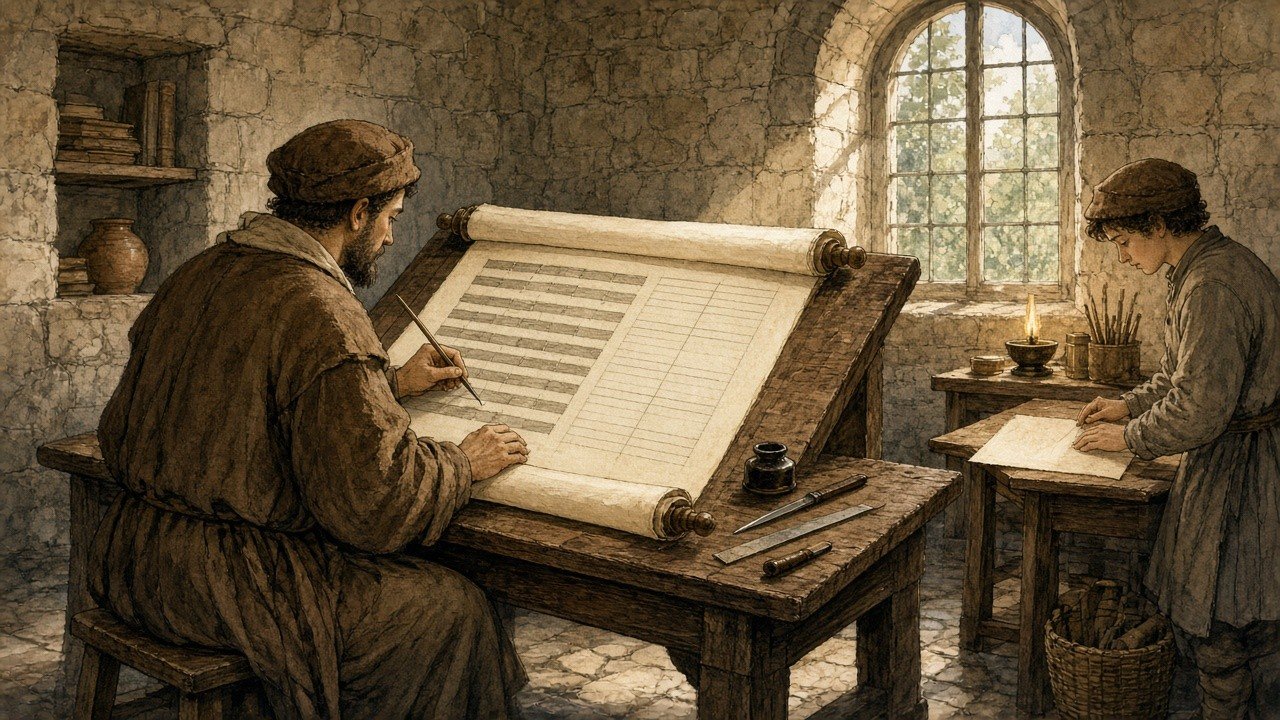
Half a Brick upon a Whole Brick
The Babylonian Talmud states the graphic principle in a single, vivid sentence. All the songs in the Bible, Rabbi Hanina bar Pappa reports in the name of Rabbi Sheila of the village of Timarta, are written in the form of a half brick arranged upon a whole brick and a whole brick arranged upon a half brick. The Davidson translation explains: each line of the song is divided into a stitch of text, the half brick, which is separated by a blank space, the whole brick, from the concluding stitch of that line, and the next line inverts the sequence. Two songs are excepted: the list of Haman’s sons, and the song listing the kings of Canaan who were defeated by Joshua. Those two are written as a half brick upon a half brick and a whole brick upon a whole brick, so that one stitch of text stands over another, and one blank space over another. The reason given is that they should never rise from their downfall. Just as a wall built in that manner will not stand, so these should have no recovery.7
The image is architectural, and it is meant to be. A staggered wall holds. A wall whose joints run in a straight line up the face does not. The Talmud is not only telling a scribe where to leave a gap. It is telling him what kind of wall he is building, and, in the two lists, why the wall should fail.
The same page of Megillah adds a rule of reading that belongs to the same care. When the Megillah is read, the names of the ten sons of Haman, and the word “ten,” must be said in one breath.8 Layout and voice are here two faces of one tradition. The exceptions are not a relaxation of the rule. They are a different pattern, with a midrash attached, and they remind the reader that “song,” in this technical sense, can include a list.
What Tractate Soferim Adds
The Talmud, as Lind notes, gives no instruction for Haazinu.9 The details that later scribes needed, and sometimes argued over, are gathered in tractate Soferim, a minor tractate independent of the Talmud, frequently dated to the eighth or ninth century but made up of several parts, some of them later.10 In chapter 12, Rabbi Zeira, quoting Rabbi Jeremiah in the name of Rab, says that the Song at the Sea and the Song of Deborah are written in the form of a half-brick over a whole brick, and a whole brick over a half-brick. The Soncino translator notes that the Hebrew word for the “brick” may also mean a blank space.11 The same chapter then assigns thirty lines to the Song at the Sea, and lists the opening word of each, beginning with az, “then.” For the Song of Deborah it gives a mark of sixty-four lines, according to the Gaon of Vilna’s text, or sixty-five in the other witnesses used by Cohen, and again it lists the openings.12
Haazinu is treated differently. Soferim specifies a blank line before and after the poem, and it lists the first word of each of its lines. A Soncino note records the resulting arithmetic: the number is seventy-two according to the GRA, who apparently includes the two blank lines; Maimonides and others give the number as seventy.13 Lind, working from the same tractate, puts the listing of line beginnings at seventy, and the total with the blank lines at seventy-two, and then points out that Maimonides, for all that later notes may say “seventy,” did not in fact follow Soferim’s list. He followed the Aleppo Codex, where the poem is written in sixty-seven lines, and he adopted Aleppo’s five-line prose epilogue as well.14 The disagreement is not a slip to be smoothed away. It is the record of a lawbook choosing a manuscript over a tractate.
For the Song of David, in 2 Samuel 22 and in Psalm 18, Soferim refuses to give a number at all. “The Sages have not prescribed a limit,” the Soncino text reads, “but a skilled scribe spaces them out symmetrically according to the beginnings, the middle pauses, and the endings of the verses. A similar arrangement is also followed throughout the Psalms and in Job and Proverbs.”15 Lind quotes the same ruling, and uses it to describe what a “skilled scribe” was supposed to do when there was no brickwork pattern to copy: one verse to a line, with a gap dividing the verse in two, at the places that express the poem’s sense.16 The contrast is sharp. For the Song of the Sea the tradition hands the scribe a wall to build. For the poetical books it hands him a skill to exercise.
The layout could also unmake a scroll. Soferim rules that if Haazinu was arranged like a shirah, or a shirah like Haazinu, or if continuous lines were written in broken ones or vice versa, or if the breaking up was not done according to the rule, the scroll may not be used for the lection.17 Lind notes that shirah is sometimes taken here as the Song of the Sea, though the text has no article, and that it seems more likely to refer to all the songs mentioned in the Talmud.18 Either way, the tractate is drawing a line between two kinds of writing. To confuse them is to take the scroll out of public use.
Is Haazinu a Song?
That line is the starting point of a modern argument that changes what the gaps mean. Mordechai Breuer, as Lind presents him, pointed to the Soferim ruling, among other indicators, as evidence that Haazinu was not regarded as a “song” at all. The true songs, on this view, were the Song of the Sea, the Song of Deborah, and the two lists. Haazinu was to be written like the poetical books — the books whose Hebrew titles form the acronym emet — one verse to a line, with a gap in the middle.19 A highly structured format later developed for Haazinu in the Torah scroll, but that, for Breuer, is a later scribal habit, not proof that the poem had been classed with the brickwork songs.
The difference is not only a matter of labels. In the true songs, Lind reports Breuer as saying, the spaces help the reader through the text. They have a prosodic and interpretive purpose. In the poetical books and in Haazinu, medieval scribes often knew that a gap was required and still placed it to make a visual pattern, to adorn the poem, without treating the exact point of division as the primary concern. At the time the relevant section of Soferim was written, there was evidently quite a range of skill in scribal practice.20 A later ruling of the Shulhan Arukh, which Lind quotes, seems to live with that range. If the scribe wrote the poem like other writing, or other writing like a poem, the scroll is invalid; but this holds only if he wrote the poem like other writing, without spreading it out. If he merely changed the placement of the gaps from the customary, the scroll is not invalid.21 The law still cares that a song not be written as prose. It no longer treats every departure from the customary gaps as fatal.
The hub page is right to insist that this question be kept in view. A two-column page of Haazinu can look, to a modern eye, like “the song layout.” The older sources do not all see it that way. The Song of Deborah, meanwhile, belongs to the book of Judges. It is a brickwork song, and Soferim spends a paragraph on its line openings, but it is not a song of the Torah.
What the Codices Actually Do
The law of the scroll, moreover, does not begin and end with the poem itself. Lind describes a tradition, universally followed in Torah scrolls though not identical in every source, of writing Deuteronomy 32 in three parts whose formats are prescribed: a group of prose lines, the poem, and another group of prose lines. In a scroll, the first group of prose lines before Haazinu should begin at the top of the column with a specified word of Deuteronomy 31:28, the last word in a mnemonic for six words that should open columns at various places in the Torah. For the six prose lines themselves a further mnemonic indicates the first word of each line. Later masorahs of Sephardi and Yemenite manuscripts record these directions, and some of them specify that the requirement applies to a Sefer Torah — that is, to a scroll written for the service, not necessarily to a codex written for study. Abulafia, Maimonides and Lonzano also list the words.22 Soferim, Lind points out, has nothing to say about these prose frames, despite a modern implication that its instructions include all the specifications of the layout. It is only on the lines of the poem itself that the tractate gives an instruction, and that is to specify the first word of each line. This, she suggests, may be why Maimonides could say, in an earlier chapter, that in the matter of the prose lines a scroll is not disqualified if it does not follow the halakhah, even as, for the poem, he chose Aleppo over Soferim.23
The Masoretic codices were not Torah scrolls, and their scribes were not bound by the law of the scroll. They were, however, influenced by it to different degrees, and the differences are the evidence Lind wants a modern editor to face.
Barthélemy, as she summarises him, held up a Pentateuch copied by Solomon ben Buya’a, the manuscript known as B17, as a nearly perfect realisation of the scheme in codex form: six prose lines before Haazinu, a blank line, and a marginal ayin signalling seventy lines.24 In the Aleppo Codex the same scribe wrote the poem in sixty-seven lines. Barthélemy speculated that, when Ben Buya’a came to write his great Bible, he omitted four line openings from his list — the 7th, 8th, 41st and 42nd — and was left with longer lines, so that the poem ran to sixty-seven instead of seventy. Aleppo still has a large ayin, the numeral seventy, in the line before the poem, just as B17 does. The wider lines then forced changes in the prose that follows, and Maimonides adopted both the sixty-seven lines and the five-line epilogue of Aleppo, a choice that later writers noticed.25 Menahem di Lonzano, reporting Abraham Abulafia, wondered whether Maimonides’s five-line list was not a copying error, and insisted that the careful early books, and the Sephardi custom, kept six lines after the poem, the last of them ending with hayyeikhem.26 One tradition had become law because a jurist trusted one book.
The Leningrad Codex is the extreme case. Its scribe fitted Haazinu into two columns on facing pages, as in a scroll, with blank lines before and after, but in thirty-seven lines, and with line openings that seldom agree with Soferim. Breuer said it had “no system at all.” Lind observes that the number is exactly half of Soferim’s seventy, and that most of those half-lines — thirty-five of them, in her count — still begin where the traditional ones do. The beginning of the line, she notes after Breuer, is more important than the end. So while Leningrad is far from the halakhic scheme, it is not a page without a memory of it.27 For an immediate grasp of the sense of the text, she adds, the sixty-seven- or seventy-line layout, without the division errors, is far better.28
Breuer also noted, and Lind repeats, that the main codices — Aleppo, Leningrad, B17, the Damascus Pentateuch and Sassoon 1053 — each divide the poem differently, and that no Tiberian Masorah addresses the layout of the songs. The layout notes in later Yemenite and Sephardi manuscripts do not come from the Tiberian Masoretes. Barthélemy thought those later notes most likely came from Sura, more directly in the Yemenite tradition and indirectly in the Sephardi, even when the dedications of the manuscripts claimed dependence on Maimonides’s model.29 The layout of the songs was a scribal tradition carried beside the Masorah, not part of it.
That is Lind’s central warning to the makers of a printed Bible. Carmel McCarthy, editing Deuteronomy for Biblia Hebraica Quinta, decided that although BHQ is intended as a diplomatic edition of Leningrad, the “erratic presentation” of the Song in that manuscript, and the antiquity of the halakhic rubrics, justified printing a format that would “best represent the Masoretic intention as a whole,” not a diplomatic rendering of Leningrad.30 Lind’s reply is careful and firm. For the four songs mentioned in the Talmud, Breuer was willing to say that their arrangements are according to the Masorah, because of their uniformity among the classical manuscripts, even without Tiberian notes. Haazinu is not one of those songs, and the classical manuscripts are not uniform in their presentation of it. For poems that the Talmud does not treat, there is no Tiberian Masorah. One cannot really speak of “Masoretic intention” in the sense McCarthy needed.31 McCarthy was a student of Barthélemy, Lind notes, and her argument for following halakhic guidelines is for the most part taken from his work. What BHQ prints is therefore not a private experiment. It is a considered attempt to let a diplomatic edition of Leningrad make an exception at the one place where Leningrad’s page, in this view, conceals a more ancient scribal intention. Lind’s objection is that the intention, if it is Haazinu’s, is not Masoretic in the strict sense, and that the classical copies do not agree. A diplomatic edition, on this view, should not correct Leningrad’s unusual Haazinu in the name of a plan that the Tiberian Masoretes did not write down.32

A Scroll Older than the Codices
The staggered pattern is older than any of these books. A sheet of a Torah scroll now known as the Ashkar-Gilson manuscript preserves part of the book of Exodus and lays out the Song of the Sea in brickwork. Paul Sanders, in the first full publication of the sheet, describes it, together with a better preserved companion called the London Manuscript, as the remnant of a seventh- or eighth-century Torah scroll of exceptionally high quality, written on gevil. The Ashkar-Gilson sheet displays excerpts from Exodus 13:19–16:1; the London sheet, from 9:18–13:2. One complete column was lost between them. The original scroll, Sanders infers from the size of the surviving sheets, was more than fifty centimetres high. The Ashkar-Gilson fragment shows parts of four columns. The second and third are forty-two lines high; the third, almost twice as wide as the others, contains the Song of the Sea, laid out in a pattern resembling brickwork, with five written lines and a blank line above the song, and a blank line and five written lines below it. Fuad Ashkar and Albert Gilson bought the sheet, with other Hebrew fragments, in Beirut in 1972, and later gave it to Duke University. J. Charlesworth first dated it palaeographically between the sixth and eighth centuries; carbon-14 analyses narrowed the date to the seventh or eighth. The sheet is on extended loan at the Shrine of the Book in the Israel Museum, Jerusalem. The London Manuscript, once kept at Jews’ College in London, is now in a private collection in New York. Both sheets may have come from the Cairo Genizah.33
The sheet belongs, Sanders writes, to the “silent era,” the centuries between the writing of the latest Dead Sea Scrolls and the production of the oldest extant codices of the Hebrew Bible, a period from which few Hebrew biblical manuscripts survive. Its fragmentary state is the likely reason it had received less attention than it deserved. The few scholars who had known of it had already described it as valuable.34 Sanders argues that the significance of the scroll is even greater than its date. Several unique details, he writes, suggest that the Tiberian Masoretes consulted the scroll to which these sheets belonged when they set about producing model codices of the Bible, and that significant features of the Aleppo and Leningrad codices indicate that their copyists were influenced by this very scroll. The layout of the Song of the Sea in Ashkar-Gilson is, he says, the earliest of its kind so far discovered, and the text of the song is hardly damaged.35 A notice from Duke University’s Rubenstein Library, written in 2010 when the fragment was already on display in Jerusalem, records that it had been reunited there with another fragment from the same scroll.36 The Center for Online Judaic Studies, excerpting a later essay by Sanders, adds a chronological contrast that the JHS article’s description already prepares: in the Dead Sea Scrolls the Song of the Sea does not yet have this special layout, but the layout appears in Ashkar-Gilson, and it is already the later arrangement, without deviation. The Masoretic copyists, the same notice says, transmitted the song with utmost care, in a symmetric brickwork, with two blank spaces in the even lines and one in the odd lines.37
A seventh- or eighth-century Torah scroll is not a Tiberian codex, and Sanders’s suggestion that the Masoretes consulted it is an argument, not a colophon. It is, however, the best early witness we now have that the brickwork of the Song of the Sea was already a scribal fact in the “silent era” between the last of the Qumran scrolls and the first of the great vocalised Bibles. Maimonides, looking at confused scrolls in Egypt, reached back to a model that had itself been corrected in Tiberias. The Ashkar-Gilson sheet lets a modern reader reach one step further back, to a scroll that may have stood somewhere in that line.
A Tradition beside the Notes
The hub page is the place to look up the line counts and the principal manuscripts at a glance. What the sources will not allow is a single, tidy picture in which “the Masoretes” designed the songs as they designed the vowels. The Talmud gave a pattern and two exceptions, and a reason for the exceptions. Soferim counted the lines of some songs, listed their openings, and refused to count others. It also treated Haazinu as a kind of writing that must not be confused with a shirah. Maimonides, faced with confusion, wrote the form of the songs into law from a codex that did not match Soferim’s seventy lines. The great Tiberian copies then went their several ways, and they left no masoretic note to tell a later scribe which way was required. A much older scroll, recovered in the twentieth century and now shown in Jerusalem, already knew the brickwork of the Song of the Sea.
A sofer who sits down to write Exodus 15 is still, in that sense, joining a wall that was begun long before the first Tiberian vowel was set beside a letter. A sofer who writes Haazinu is joining a more disputed wall, whose height has been given as seventy, seventy-two, sixty-seven or, in one famous codex, thirty-seven, and whose very name, “song,” is not agreed. The page will look, in either case, unlike the prose around it. That unlikeness is the point. It is also the reason Maimonides, in a country full of scrolls, went looking for one book he could trust.
Notes
- Maimonides, Mishneh Torah, Laws of Tefillin, Mezuzah and the Torah Scroll 8, trans. Eliyahu Touger, at sefaria.org. *
- Sarah Lind, “The Layout of the Song of Moses (Deut 32) in Masoretic Manuscripts and Biblia Hebraica Quinta,” The Bible Translator 64, no. 2 (2013): 159–172, at translation.bible, 162 n. 3. *
- Maimonides, Mishneh Torah, Sefer Torah 8. *
- Maimonides, Mishneh Torah, Sefer Torah 8. *
- Maimonides, Mishneh Torah, Sefer Torah 8. *
- Lind, “Layout of the Song of Moses”, 161. *
- Babylonian Talmud, Megillah 16b, William Davidson translation, at sefaria.org. *
- b. Megillah 16b. *
- Lind, “Layout of the Song of Moses”, 161. *
- Lind, “Layout of the Song of Moses”, 161. *
- Tractate Soferim 12, trans. A. Cohen, in The Minor Tractates of the Talmud (London: Soncino Press, 1965), at sefaria.org. *
- Tractate Soferim 12. *
- Tractate Soferim 12. *
- Lind, “Layout of the Song of Moses”, 162. *
- Tractate Soferim 13, trans. A. Cohen, in The Minor Tractates of the Talmud (London: Soncino Press, 1965), at sefaria.org. *
- Lind, “Layout of the Song of Moses”, 167–168. *
- Tractate Soferim 1, trans. A. Cohen, in The Minor Tractates of the Talmud (London: Soncino Press, 1965), at sefaria.org. *
- Lind, “Layout of the Song of Moses”, 168 n. 10. *
- Lind, “Layout of the Song of Moses”, 167–168. *
- Lind, “Layout of the Song of Moses”, 168. *
- Lind, “Layout of the Song of Moses”, 168. *
- Lind, “Layout of the Song of Moses”, 161–162. *
- Lind, “Layout of the Song of Moses”, 162. *
- Lind, “Layout of the Song of Moses”, 163. *
- Lind, “Layout of the Song of Moses”, 162–163. *
- Lind, “Layout of the Song of Moses”, 162. *
- Lind, “Layout of the Song of Moses”, 165–167. *
- Lind, “Layout of the Song of Moses”, 167. *
- Lind, “Layout of the Song of Moses”, 169–170. *
- Lind, “Layout of the Song of Moses”, 169. *
- Lind, “Layout of the Song of Moses”, 169. *
- Lind, “Layout of the Song of Moses”, 169–170. *
- Paul Sanders, “The Ashkar-Gilson Manuscript: Remnant of a Proto-Masoretic Model Scroll of the Torah,” Journal of Hebrew Scriptures 14 (2014), article 7, doi.org/10.5508/jhs.2014.v14.a7. *
- Sanders, “Ashkar-Gilson Manuscript”. *
- Sanders, “Ashkar-Gilson Manuscript”. *
- “Ashkar-Gilson Manuscript in the News,” David M. Rubenstein Rare Book and Manuscript Library, Duke University, 5 March 2010, at blogs.library.duke.edu. *
- “Ashkar-Gilson Hebrew Manuscript, 7th–8th century CE,” Center for Online Judaic Studies, excerpting Paul Sanders, “Missing Link in Hebrew Bible Formation,” Biblical Archaeology Review 41, no. 6 (Nov/Dec 2015), at cojs.org. *