


In the month of Shevat in the year 1393 of the Seleucid reckoning, early in 1082, a marriage contract was drawn up, probably in Cairo, between two of the most prominent Jewish families in Egypt. The groom was David ben Daniel, the nasi and head of the Jews, son of the gaon Daniel ben Azariah. The bride was Nashiya, daughter of Moses ha-Kohen, from a leading Karaite family, and she brought with her a dowry of something like nine hundred gold dinars, perhaps more.1 The court attested it, and thirteen names stand in the list of witnesses.2 The contract survives, only in part, among the fragments that the Cairo Genizah gave to Cambridge, and it still carries the clauses on which the marriage had been negotiated: the groom would not force his Karaite wife to give up her principles, and she would keep the Rabbanite festivals with him.3
A Contract for Two Calendars
The translated text is more specific than any summary. Alongside the usual provisions about the dowry, and a clause that half of it would return to her father’s house if Nashiya died childless, “in accordance with the custom of the rabbis of the land of Israel,” the groom bound himself in three particular ways.4
He also accepted upon himself that he will not force his wife Nāshiya to sit with him alongside a Sabbath candle, nor to eat the fat of a rump, nor to profane her festivals.
Marriage contract of David ben Daniel and Nashiya, Cambridge, T-S 24.1, trans. Avi Steinhart5
Each of the three clauses names a line on which the two forms of Judaism divided. Karaites, as the Jewish Encyclopedia summarised a century ago, allowed no light or fire on the Sabbath, a rule that they shared with the Samaritans and with the Book of Jubilees.6 Daniel Lasker, writing on Karaite law, names the prohibition of the fat tail, which Rabbanites permit, as the most prominent of the Karaite differences in the laws of forbidden fats.7 And the festivals followed different calendars, because the Rabbanites calculated the months while the Karaites watched the moon and the barley.8 The bracketed words in the translation make the point explicit: Nashiya would keep her festivals “according to the Karaite calendar” and observe his “according to the Rabbanite calendar” with him.9
It was not the only such document. Judith Olszowy-Schlanger, after months spent reading thousands of fragments in the Taylor-Schechter Collection, identified nearly fifty Karaite marriage and betrothal contracts, written in Egypt or in the Land of Israel between the tenth century and the beginning of the thirteenth.10 Their very form shows how close the communities stood and how carefully they marked their distance. Karaite contracts were written in Hebrew, in a monumental square script like that of a Bible codex, while Rabbanite contracts were written in Aramaic in a quasi-cursive hand. Yet the Karaite formulas borrowed from the Talmud and from the Aramaic contracts of the Rabbanites, which led Olszowy-Schlanger to conclude that polemical attitudes did not rule out cultural borrowing.11 Both bride and groom in a Karaite contract bound themselves to keep the Karaite calendar.12
Lasker states the general pattern. Karaites and Rabbanites married each other, usually after some kind of pre-nuptial agreement about the religious character of the household, especially in the formative period of the ninth to eleventh centuries, and in Egypt the practice continued for centuries.13 A household in Fatimid Cairo could thus hold two calendars, two Sabbath customs and two sets of dietary rules under one roof. What it held in common, and never needed to negotiate, was the text of the Bible.
Searching Scripture Well
The movement that Nashiya’s family belonged to had begun perhaps two and a half centuries before her wedding, and its beginnings are less clear than its later history suggests. Lasker notes that Anan ben David, an eighth-century candidate for the office of exilarch in Iraq who failed to win it, is often thought of as the founder of Karaism. Current research understands the process as more complex. In the seventh to ninth centuries, he writes, a number of Jewish groups did not accept the authority of the Talmud; these groups, including Anan’s own following, eventually coalesced into Karaism, which seems to have emerged in the mid-ninth century, and Anan was later given a prominent role in its history retroactively.14
The motto attributed to Anan expresses the Karaite attitude even if its attribution is doubtful: “search Scriptures well and do not rely on my opinion.”15 The emphasis on close study of the Bible alone, to determine how the commandments should be kept, is the heart of the matter. But Lasker warns against the caricature of the Karaites as simple literalists. They knew that many details of the law are not in the Torah, and they had their own concept of tradition, which they called sevel ha-yerushah, “the burden of inheritance,” or ha‘ataqah, “transmission.” The difference was that they did not regard their interpretations as Sinaitic.16
Shaye Cohen, writing about the very different world of the first century, gives a sense of how unusual this was. The rabbis who gathered at Yavneh after 70, he argued, aimed not to expel those with whom they disagreed but to end sectarianism and to create a society that tolerated vigorous debate within the fold. Jewish society from the end of the first century until the rise of the Karaites, in his judgement, was not torn by sectarian divisions.17 He noticed, too, how a rabbinic admission that the disciples of Hillel and Shammai had “multiplied disputes in Israel and became as two Torahs” would later be exploited by the Karaites.18 Karaism was, in that long perspective, the first sustained schism in seven centuries.
Fat, Fire and the New Moon
Lasker’s analysis of what made the Karaites a distinct group is a process of elimination. Theology does not separate them: if one takes Maimonides’ thirteen principles as a benchmark, Karaites could uphold twelve and a half of them, rejecting only the half of the eighth that asserts the authority of the Oral Torah. Social and economic class does not separate them either; in the early period many Karaites belonged to the financial, social and intellectual elite. Ethnic origin is shared. The determining factor is the way of life, the halakha, and the differences in practice flowed largely from different readings of the same verses.19
The best-known example is meat and milk. The rabbinic prohibition rests on the thrice-repeated verse, “Do not cook a goat in its mother’s milk.” Anan read it as a law about first fruits, taking gedi not as “kid” but as produce, and tevashel as “ripen.” Later Karaites rejected that reading; Ya‘qub al-Qirqisani, Saadia’s contemporary in tenth-century Iraq, dismissed it as allegorising, and Karaites generally took the verse to mean what it says, extending it by their own exegesis only to milk and meat of the same species.20 A Karaite kitchen, Lasker notes, has no separate utensils for meat and dairy.21
The calendar was the clearest sign of schism. By the ninth century the Rabbanite calendar no longer depended on witnesses to the new moon or on the state of the crops, but on mathematical calculation. When Saadia Gaon in Babylonia and Aaron ben Meir, the gaon of the Land of Israel, fought the last internal Rabbanite calendar controversy in the tenth century, they argued over how the calendar should be calculated, not whether. The Karaites refused that accommodation to dispersion. The months must still be fixed by observation, they held, citing Genesis 1:14, “let them be for signs and for seasons”; and the command to keep Passover in the month of aviv meant the month of the ripening barley.22 Olszowy-Schlanger found the consequence written into Karaite marriage contracts: the Karaites fixed the new month by the appearance of the moon and Passover by the ripening of barley in the Land of Israel, and both partners promised to keep that calendar.23
The calendar dispute even turned on a vowel. Leviticus 23:4 speaks of the festivals “which you shall proclaim (them) in their appointed season.” The rabbis, Lasker explains, noticed that the word otam, “them,” could just as well be vocalised atem, “you,” and took it to mean that the human court decided when the festivals fell; that reading underlies the postponements, the dehiyyot, which keep the New Year off a Sunday, Wednesday or Friday. The Karaites stressed the last words of the verse, “in their appointed season,” and allowed no postponements, so that a Friday New Year could mean a Day of Atonement on Sunday, immediately after the Sabbath.24 The Masoretic pointing of the word is the same in every copy. What divided the communities was whether a reader might hear another vowel behind it.
A Synagogue without Chairs
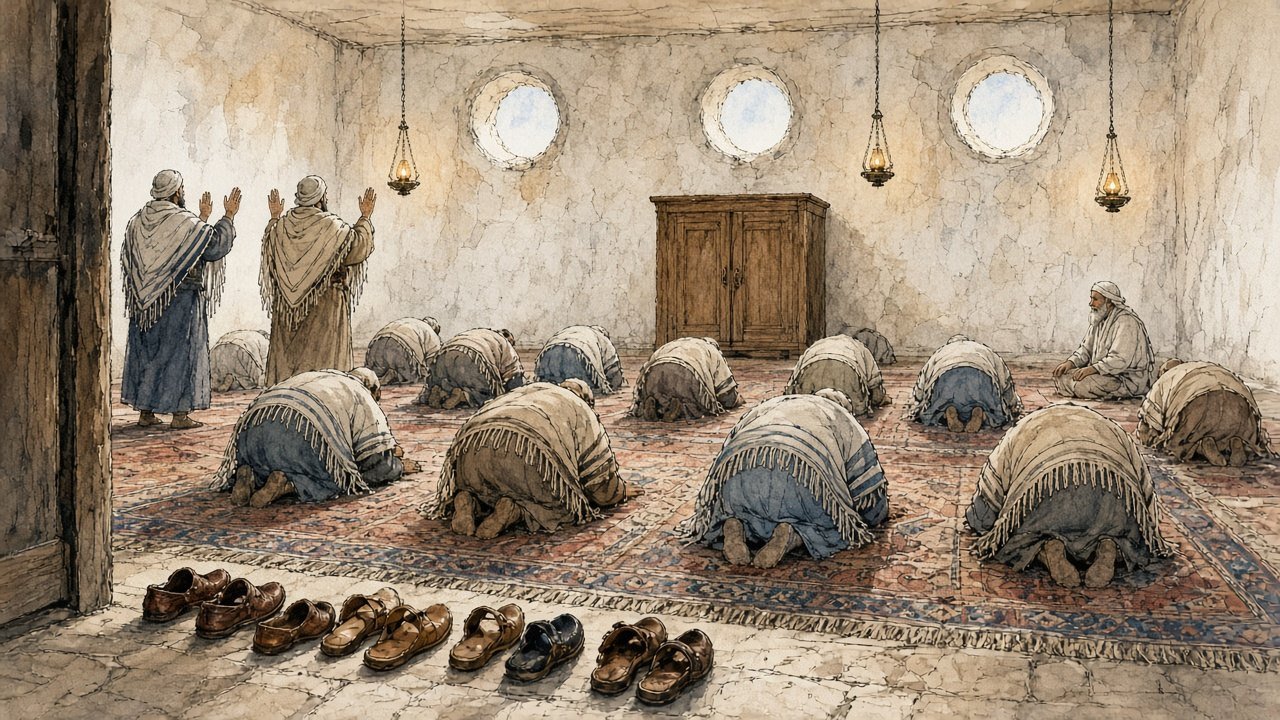
The two communities also prayed differently, and Lasker’s description reads like a guide for a visitor crossing the fence. Rabbanites pray three times a day, finding the pattern in Daniel and in the Psalms; Karaites pray twice, morning and evening, reading 1 Chronicles 23:30 together with the two daily sacrifices.25 The structure of Rabbanite prayer is post-biblical, while early Karaite prayer consisted only of biblical verses, mostly from the Psalms, which the Karaites regarded as the prayer book revealed to David; later Karaite liturgy added compositions of its own, some borrowed from the Rabbanite prayer book, but the two liturgies remain entirely different in structure and content.26 Karaite worshippers remove their shoes before entering the synagogue, as Moses and Joshua were told to do, and pray with full prostration. Their synagogues have no chairs; when they are not standing or bowing, they sit on the floor.27
The difference reached the scribe’s workbench. Both communities wear fringes, though tied differently. But the Karaites do not wear tefillin, reading the command to bind “a sign” on the arm and a “memorial” between the eyes figuratively, as a charge to keep the Ten Commandments constantly in mind; and they do not fix the Rabbanite mezuzah to their doorposts, placing a small reminder of the Ten Commandments there instead.28 Lasker draws the moral: the supposedly “literalist” Karaites read these verses figuratively, while the supposedly “non-literalist” Rabbanites took them literally.29 For the history of the text, the consequence is that a whole branch of Rabbanite scribal craft, the writing of tefillin and mezuzot, had no Karaite counterpart, while the precise copying of Bible codices was a craft in which Karaite scribes were renowned.30
Polemic in the Academies
The great Rabbanite opponent of the Karaites was Saadia ben Joseph al-Fayyumi, who became head of the academy of Sura, and whose work on the Bible is the subject of the journal’s essay on Saadya Gaon and the birth of Masoretic scholarship. The Jewish Encyclopedia dates his polemics against the Karaites to 915, with a return to the subject in 926 and probably later, and observes that he was afterwards attacked by all the leading Karaite writers.31 It also records an earlier Palestinian polemicist, Jacob ben Ephraim, who wrote in Arabic against Karaism at the beginning of the tenth century, and pupils of Saadia who carried on the fight in Hebrew and called forth Karaite replies.32 The same article lists the Karaite scholars of what it calls the “great noontide” of the tenth and eleventh centuries: al-Qirqisani, Sahl ibn Masliah, Salmon ben Jeroham, Yefet ben Eli, David al-Fasi, Abu al-Faraj Harun, Yusuf al-Basir and Abu al-Faraj Furqan.33 The older reference work also preserves the memory of the ascetics who went to Jerusalem to live as “mourners for Zion,” though its picture of them as heirs of the Essenes belongs to its own age.34
Two centuries after Saadia, Maimonides, living in Egypt among the largest Karaite community of the East, took a more pastoral line. In his Laws of Rebels he distinguished the person who consciously denied the Oral Law from those born into the movement. “The children of these errant people and their grandchildren whose parents led them away and they were born among these Karaites and raised according to their conception,” he wrote, “are considered as children captured and raised by them.” It was appropriate, he concluded, to draw them back “with words of peace.”35 The Jewish Encyclopedia notes that he permitted Rabbanites to circumcise Karaite children on the Sabbath according to the rabbinic rite, while working to keep Karaite customs out of his own congregation, and that his code was quoted as an authority, under the bare title “the Compilation,” in Karaite legal works of the period.36
One Text for Both
For all the polemic, neither side ever produced a different Bible. Emanuel Tov states the long view plainly. Since the first century the consonantal proto-Masoretic text, and later the full Masoretic Text, “was accepted as authoritative by all streams of the Jewish people.” It is the only text quoted in rabbinic literature, apart from negligible deviations, “and Karaite works.”37 The quarrels between Rabbanites and Karaites were about the meaning of the text and the authority of tradition, not about its letters.
Rafael Zer, a scholar of the Masorah, puts the point more sharply. The Karaites never had their own version of Scripture. When the movement arose in the ninth century, the Tiberian text was already finished down to its letters, vowels and accents, and the Karaites saw no reason to change it, because their dispute with the Rabbanites concerned the Oral Law.38 Zer cites Geoffrey Khan’s work on the Karaite transcriptions of the Bible into Arabic script, which shows that Karaite readers disagreed with Rabbanites over the pronunciation of certain vowels and followed the qere wherever it differed from the written form. But those disputes, Zer adds, did not find their way into the biblical manuscripts, which the Karaites preserved with devotion, changing nothing from the text they copied.39 Even their Masoretic notes stayed in the Aramaic of the older tradition, despite Karaite objections to Aramaic, as Khan has shown that the early Karaites adopted Masoretic terminology and much else from the Judaism that preceded them.40
The result was that the most exact copies of the shared text could pass from one community to the other without anyone needing to check them for heresy. One of the clearest examples is the most famous of all.
The Crown in a Karaite Synagogue
The Aleppo Codex has no colophon. What it had, at its beginning, was a dedication written in the eleventh century, and Yosef Ofer quotes it: “This complete codex of twenty four books which was written by our master and Rabbi Shlomo, known as ben Buya’a the swift scribe,” and pointed and annotated by Aharon ben Asher, “was dedicated by the great leader … Israel of the city of Basra … to Jerusalem the holy city.” Ofer states that the dedication records the gift of the manuscript to the Karaite synagogue in Jerusalem.41 Both the scribe and the Masorete are named with the blessing for the dead, so the dedication came after their lifetimes.42
The other great Ben Asher manuscript followed a similar road. The codex of the Prophets whose colophon names Moshe ben Asher, the father of Aharon, as its scribe and Masorete, dated 895, is described by Ofer simply as “a manuscript of the Prophets kept in the Karaite synagogue in Cairo.”43 Ofer notes that some scholars doubt the colophon’s authenticity, and suppose that it is a copy of words that Moshe ben Asher once wrote elsewhere.44 The journal’s essays on the Aleppo Codex and on the Tiberian Masorah and the schools of Ben Asher and Ben Naphtali describe these books and their readings.
It was this codex, once in Jerusalem and by his day in Egypt, that Maimonides named as the book on which everyone relied, because Ben Asher had corrected it and checked it many times.45 A Rabbanite legal authority, in other words, wrote the layout of the Torah scroll into law from a book whose known history ran through a Karaite synagogue. That fact has been the starting point of a long argument.
Was the Masorete a Karaite?
The question whether Aharon ben Asher himself was a Karaite has been asked, as Zer puts it, ever since Simhah Pinsker argued in 1860 that he was, and there has been no final verdict.46 A milestone came when Benjamin Klar read the name “Ben Asher” at the head of Esa Meshali, an anti-Karaite polemical poem by Saadia Gaon, and took the case to be closed. Aron Dotan then tried to refute Klar and to argue that Ben Asher was a Rabbanite,47 first in Hebrew in 1957 and then in the English monograph Ben Asher’s Creed in 1977.48
Dotan’s strongest argument, in Zer’s summary, was that Maimonides approved the Ben Asher text.49 He also argued that to call Ben Asher a Karaite undermined one of the foundations on which the received text of Scripture rests, since rabbinic law defines a Karaite as a heretic. Zer replies that this is not a valid argument at all: “We must relate to the facts and their meaning alone.”50 He takes issue as well with Khan’s remark that it was “now generally believed” that the Ben Asher family were not Karaites, and makes a historical point that matters for the whole subject. In the ninth and tenth centuries, Zer writes, one cannot speak of a “Karaite family” or a “Rabbanite family,” because the growth of Karaism came through a mass movement of Rabbanites to the Karaite side, so that many families were divided in two.51 The marriage contracts of Fatimid Egypt show the same mingling from the other direction.
Others found evidence inside the codex. Israel Yeivin concluded in 1962 that the way the Aleppo Codex vocalises certain written forms proved, in his words, “that the vocalizer of A was most certainly a Karaite”; Zer judges the proof indecisive, because the same vocalisation appears in manuscripts that are unquestionably Rabbanite, including the Cairo Codex of the Prophets and Sassoon 1053.52 Dominique Barthélemy agreed that the Masorete was a Karaite, but argued that Maimonides could not have relied on a Karaite when he fixed the layout of the songs, and so concluded that Ben Asher was not the Masorete of the Aleppo Codex at all.53 Zer’s own evidence comes from the Masorah magna of the codex: a note on Job 8:8 explaining that the first generation “lacked many precepts,” which were “accomplished by Moses our Lord,” and a note on Psalm 119 that asks “why?” and leaves the question unanswered. The title “Moses our lord,” Zer argues, does not appear in early rabbinic literature, and the view that the commandments were given gradually is explicit in early Karaite writing.54 He concludes that the Masorete must have understood that he was copying anti-Rabbanite polemical notes into his margins, and so must have been a Karaite.55
Zer also offers a reason why Maimonides could rely on such a book. Maimonides, he notes, treated the Karaites of his day as the Mishnah treated the Samaritans, trusting them in matters where their expertise was not in doubt. And his wording describes Ben Asher not as an authority on the text but as a precise corrector who checked his codex “many times as they transmitted,” a faithful copy of the tradition handed down.56 Zer adds a caution of his own: it is not certain that Maimonides even knew Ben Asher’s creed. The treatise Hidayat al-Qari, the “Guide for the Reader,” was copied for centuries in Rabbanite communities as a Rabbanite work, and only recently has it become clear that its author was a Karaite.57 The journal’s essay on the Hidayat al-Qari tells that story. The debate is not settled by this essay, and need not be. What it shows is how little the boundary between the communities mattered at the level of the letters, the vowels and the accents.

Fences and Neighbours
The boundary mattered elsewhere. When Benjamin of Tudela reached Constantinople in the twelfth century, he found the Jews of the city living across an arm of the sea in the quarter called Pera. “In the Jewish quarter are about 2,000 Rabbanite Jews and about 500 Karaites,” he wrote, “and a fence divides them.” Among them were silk-workers and rich merchants, and they bore, he said, much hatred from the Greeks with cheerfulness.58 In Cyprus he noted Rabbanites and Karaites, and also heretics whom both excommunicated.59 In New Ascalon there were about two hundred Rabbanite Jews and about forty Karaites; in Damascus three thousand Jews, a hundred Karaites and four hundred Samaritans, with “peace between them,” though they did not intermarry.60
Lasker places these communities in a longer history. After the formative period in the Land of Israel, which he calls the Golden Age of Karaism, the centre of Karaite life moved to the Byzantine Empire, where it flourished from the eleventh to the fifteenth century and drew closer to Rabbanite beliefs and practices. In the early modern period Karaite communities appeared in Crimea and in Troki, Halicz and Lutsk, speaking a Turkic language written in Hebrew letters beside Yiddish-speaking Rabbanite neighbours. Even then they paid their taxes through the Rabbanite Council of Four Lands.61 The journal’s essay on Abraham Firkovich follows one Crimean Karaite whose collecting brought great Masoretic codices to Saint Petersburg.
In the nineteenth century, Lasker writes, the Karaites of the Russian Empire began to assert a separate identity, and in the twentieth some denied any affinity with Jews, a claim that served them during the Holocaust. Most Karaites today are of Egyptian origin, live in Israel, and identify as part of the Jewish people.62 The communities that a fence divided in Pera now pray in their own synagogues in Ramla and Ashdod.63
A Shared Inheritance
The hub page on Rabbanites and Karaites sets out the larger frame of the division. The documents gathered here add its texture. A Rabbanite nasi in Cairo promised his Karaite bride that she need not sit by a Sabbath candle.64 Karaite scribes wrote their marriage contracts in Hebrew in the square hand of a Bible codex, while borrowing formulas from the Talmud they rejected.65 Saadia wrote poems and treatises against the Karaites,66 and Maimonides, two centuries later, called for words of peace.67 And through all of it the two communities read, copied and corrected the same text, so faithfully that the most authoritative codex of the Bible could be dedicated to a Karaite synagogue and then serve a Rabbanite jurist as his model, while scholars still argue about the faith of the man who pointed it.68
Zer’s phrase for the Masorete of the Aleppo Codex, a precise “scanner” of the traditional text, is perhaps the best description of what both communities wanted from their scribes.69 They disagreed about the oral law, about the calendar and about what could be eaten at a wedding feast. On the letters of the book itself they had nothing to argue about.
Notes
- “Legal document: T-S 24.1,” Princeton Geniza Project, description after Cambridge University Digital Library and S. D. Goitein, A Mediterranean Society, vol. 3; English translation by Avi Steinhart from Goitein’s edition, at geniza.princeton.edu. *
- Princeton Geniza Project, T-S 24.1. *
- “Cairo Genizah: Legal document: ketubba,” Cambridge University Library, T-S 24.1, at cudl.lib.cam.ac.uk. *
- Princeton Geniza Project, T-S 24.1. *
- Princeton Geniza Project, T-S 24.1. *
- Kaufmann Kohler and Abraham de Harkavy, “Karaites and Karaism,” Jewish Encyclopedia (New York: Funk and Wagnalls, 1901–1906), at jewishencyclopedia.com. *
- Daniel J. Lasker, “Biblical Exegesis as a Source of Jewish Pluralism: The Case of the Karaites,” TheTorah.com, 6 June 2017, at thetorah.com. *
- Lasker, “Biblical Exegesis as a Source of Jewish Pluralism”. *
- Princeton Geniza Project, T-S 24.1. *
- Judith Olszowy-Schlanger, “Karaite Ketubbot,” Genizah Fragments 31 (April 1996), reprinted as “Throwback Thursday: Karaite ketubbot,” Genizah Research Unit blog, Cambridge University Library, 30 September 2021, at genizahfragments.lib.cam.ac.uk. *
- Olszowy-Schlanger, “Karaite Ketubbot”. *
- Olszowy-Schlanger, “Karaite Ketubbot”. *
- Lasker, “Biblical Exegesis as a Source of Jewish Pluralism”. *
- Lasker, “Biblical Exegesis as a Source of Jewish Pluralism”. *
- Lasker, “Biblical Exegesis as a Source of Jewish Pluralism”. *
- Lasker, “Biblical Exegesis as a Source of Jewish Pluralism”. *
- Shaye J. D. Cohen, “The Significance of Yavneh: Pharisees, Rabbis, and the End of Jewish Sectarianism,” Hebrew Union College Annual 55 (1984): 27–53, at cojs.org. *
- S. Cohen, “Significance of Yavneh”. *
- Lasker, “Biblical Exegesis as a Source of Jewish Pluralism”. *
- Lasker, “Biblical Exegesis as a Source of Jewish Pluralism”. *
- Lasker, “Biblical Exegesis as a Source of Jewish Pluralism”. *
- Lasker, “Biblical Exegesis as a Source of Jewish Pluralism”. *
- Olszowy-Schlanger, “Karaite Ketubbot”. *
- Lasker, “Biblical Exegesis as a Source of Jewish Pluralism”. *
- Lasker, “Biblical Exegesis as a Source of Jewish Pluralism”. *
- Lasker, “Biblical Exegesis as a Source of Jewish Pluralism”. *
- Lasker, “Biblical Exegesis as a Source of Jewish Pluralism”. *
- Lasker, “Biblical Exegesis as a Source of Jewish Pluralism”. *
- Lasker, “Biblical Exegesis as a Source of Jewish Pluralism”. *
- Rafael Isaac (Singer) Zer, “Was the Masorete of the Aleppo Codex of Rabbanite or of Karaite Origin?,” trans. Nehemia Gordon, Textus 24 (2009): 239–262, at bibleproject.huji.ac.il, 245 n. 16. *
- Kohler and Harkavy, “Karaites and Karaism”. *
- Kohler and Harkavy, “Karaites and Karaism”. *
- Kohler and Harkavy, “Karaites and Karaism”. *
- Kohler and Harkavy, “Karaites and Karaism”. *
- Maimonides, Mishneh Torah, Laws of Rebels 3:3, trans. Eliyahu Touger, at sefaria.org. *
- Kohler and Harkavy, “Karaites and Karaism”. *
- Emanuel Tov, “The Bible and the Masoretic Text,” TheTorah.com, at thetorah.com. *
- Zer, “Rabbanite or Karaite Origin?”, 243. *
- Zer, “Rabbanite or Karaite Origin?”, 243–244 n. 11. *
- Zer, “Rabbanite or Karaite Origin?”, 243–244. *
- Yosef Ofer, The Masora on Scripture and Its Methods (Berlin: De Gruyter, 2019), chapter 1 in the publisher’s preview, at pageplace.de, 7. *
- Ofer, Masora on Scripture, 7. *
- Ofer, Masora on Scripture, 8. *
- Ofer, Masora on Scripture, 8. *
- Zer, “Rabbanite or Karaite Origin?”, 241–242. *
- Zer, “Rabbanite or Karaite Origin?”, 239. *
- Zer, “Rabbanite or Karaite Origin?”, 239–240. *
- Zer, “Rabbanite or Karaite Origin?”, 239 n. 2; Aron Dotan, Ben Asher’s Creed: A Study of the History of the Controversy, Masoretic Studies 3 (Missoula, MT: Scholars Press for the Society of Biblical Literature and the International Organization for Masoretic Studies, 1977), catalogue record at cris.tau.ac.il. *
- Zer, “Rabbanite or Karaite Origin?”, 240. *
- Zer, “Rabbanite or Karaite Origin?”, 240. *
- Zer, “Rabbanite or Karaite Origin?”, 240 n. 4. *
- Zer, “Rabbanite or Karaite Origin?”, 246 and n. 19. *
- Zer, “Rabbanite or Karaite Origin?”, 246–247 n. 20. *
- Zer, “Rabbanite or Karaite Origin?”, 248–250. *
- Zer, “Rabbanite or Karaite Origin?”, 261. *
- Zer, “Rabbanite or Karaite Origin?”, 242–244. *
- Zer, “Rabbanite or Karaite Origin?”, 244 n. 15. *
- The Itinerary of Benjamin of Tudela, ed. and trans. Marcus Nathan Adler (London: Henry Frowde, Oxford University Press, 1907), at archive.org, 14. *
- Adler, Itinerary of Benjamin of Tudela, 14–15. *
- Adler, Itinerary of Benjamin of Tudela, 28, 30. *
- Lasker, “Biblical Exegesis as a Source of Jewish Pluralism”. *
- Lasker, “Biblical Exegesis as a Source of Jewish Pluralism”. *
- Lasker, “Biblical Exegesis as a Source of Jewish Pluralism”. *
- Princeton Geniza Project, T-S 24.1. *
- Olszowy-Schlanger, “Karaite Ketubbot”. *
- Kohler and Harkavy, “Karaites and Karaism”. *
- Maimonides, Mishneh Torah, Rebels 3:3. *
- Ofer, Masora on Scripture, 7; Zer, “Rabbanite or Karaite Origin?”, 261. *
- Zer, “Rabbanite or Karaite Origin?”, 244. *