

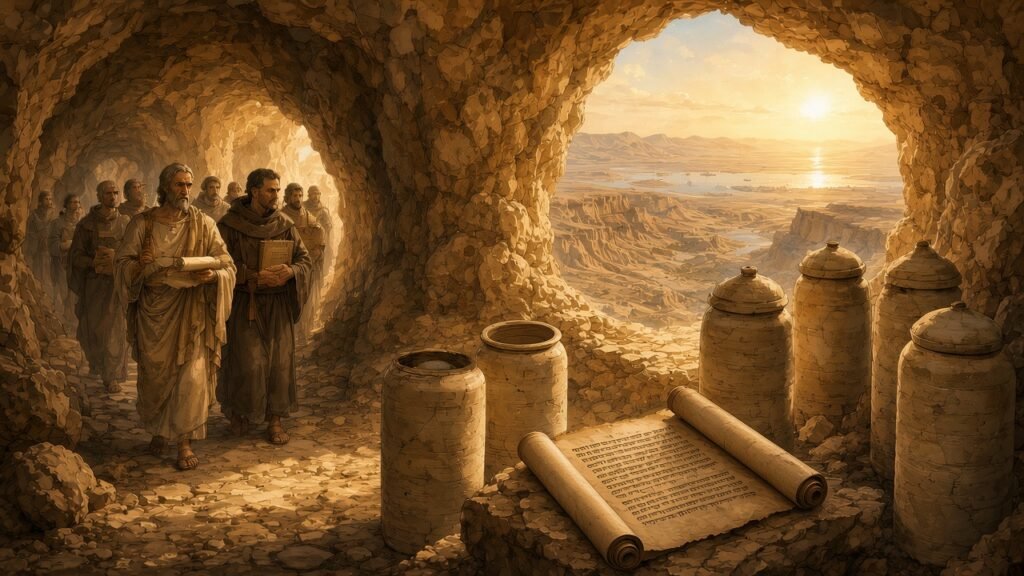
The Bible makes a remarkable claim about itself. It presents its message not only as inspired by God but as protected by him, so that what he caused to be written would remain available to those who seek it. “The green grass dries up, the blossom withers, but the word of our God endures forever,” wrote the prophet Isaiah (Isaiah 40:8). Many centuries later the apostle Peter quoted those words and applied them to the good news that had been declared to Christians (1 Peter 1:24–25). This article examines that claim in the light of history. It considers what the Scriptures themselves say about the preservation of God’s word, how scribes and copyists handed the text down, what the manuscript discoveries of the last two centuries have revealed, how the text survived deliberate attempts to destroy it, how translators brought it to ordinary people at great personal cost, and how modern textual scholarship has confirmed the reliability of the text we read today.1
At a glance
- *The promise:* Isaiah 40:8, 1 Peter 1:24–25 and Psalm 12:6–7 present the preservation of God’s word as an expression of his own purpose.
- *Hebrew Scriptures:* Generations of scribes, culminating in the Masoretes of the sixth to tenth centuries CE, copied the text with extraordinary care.
- *Dead Sea Scrolls:* Discovered from 1947 onwards, they include the Great Isaiah Scroll, copied about a thousand years before the oldest complete Masoretic manuscripts, yet substantially the same text.
- *Greek Scriptures:* More than 5,800 Greek manuscripts are catalogued, some dating to the second and third centuries CE, far more than for any other ancient writing.
- *Persecution:* Antiochus IV Epiphanes in the second century BCE and the emperor Diocletian in 303 CE ordered copies of the Scriptures destroyed, yet the text survived.
- *Translation:* John Wycliffe and William Tyndale brought the Bible into English despite official opposition, and Tyndale was executed in 1536.
- *Scholarship:* Modern textual criticism, using thousands of manuscripts, has established a text that agrees with the originals in all matters of teaching.
The Promise of Preservation
The Word That Endures
The fortieth chapter of Isaiah opens a section of the prophecy addressed to Jewish exiles who would one day be in Babylon. In contrast with the frailty of human life, which is compared to grass that withers under the hot wind, the prophet sets the permanence of what God has spoken. “All people are just like green grass. All their loyal love is like the blossom of the field. The green grass dries up, the blossom withers, when the breath of Jehovah blows on it. Surely the people are green grass. The green grass dries up, the blossom withers, but the word of our God endures forever” (Isaiah 40:6–8).
The point of the passage is that God’s promises will certainly be fulfilled. The exiles could rely on what Jehovah had said about their return because his word does not fail. Yet the statement also implies that the word itself would continue to exist. A promise that was lost could not be relied upon. The record of what God had said, and of what he had done, would need to remain available to the people who were expected to trust it.
Peter took up this passage when writing to Christians scattered through the provinces of Asia Minor. After urging them to love one another intensely, he reminded them that they had been given a new birth “through the word of the living and enduring God.” He then quoted Isaiah, “All flesh is like grass, and all its glory is like a blossom of the field; the grass withers, and the flower falls off, but the word of Jehovah endures forever.” And he added, “this ‘word’ is the good news that was declared to you” (1 Peter 1:23–25). The New World Translation uses the divine name in this quotation because the passage in Isaiah contains it.2 For Peter, the enduring word included the message about Jesus Christ that the apostles were then preaching and that would soon be recorded in writing.
Refined Seven Times
The twelfth Psalm contrasts the deceitful words of men with the reliable words of God. “The sayings of Jehovah are pure; they are like silver refined in an earthen furnace, purified seven times.” The next verse continues, “You will guard them, O Jehovah; you will protect each one from this generation forever” (Psalm 12:6–7).
Scholars have discussed whether the pronoun “them” in verse 7 refers to the sayings of verse 6 or to the afflicted people mentioned in verse 5. The Hebrew allows either reading, and translations differ.3 Either way, the psalm sets the purity and reliability of what Jehovah says against a background of human falsehood, and it attributes to him the power to guard what is his. The image of silver refined seven times, the number of completeness in Hebrew usage, describes words that contain no impurity at all.
A Purpose Expressed in Scripture
Other passages express the same conviction. Jesus said, “Heaven and earth will pass away, but my words will by no means pass away” (Matthew 24:35). He also said that “not one smallest letter or one stroke of a letter” would pass away from the Law until all things had taken place (Matthew 5:18). When the apostle Paul wrote to Timothy, he said that “all Scripture is inspired of God and beneficial for teaching, for reproving, for setting things straight, for disciplining in righteousness” (2 Timothy 3:16–17). Such statements would mean little if the Scriptures could not be known. Paul also wrote that “all the things that were written beforehand were written for our instruction, so that through our endurance and through the comfort from the Scriptures we might have hope” (Romans 15:4). This site’s article “Divine Inspiration Behind All Scripture” considers the claim of inspiration in more detail.
The Bible’s own account shows that the written word was meant to be kept and read. Moses wrote the words of the Law and gave instructions that the book be placed beside the ark of the covenant “as a witness” (Deuteronomy 31:24–26). Every king of Israel was to write for himself a copy of the Law and read it all the days of his life (Deuteronomy 17:18–19). The Law was to be read aloud to the whole nation every seven years at the Festival of Booths (Deuteronomy 31:10–12). These instructions provided for the making and the public use of copies, and so for the transmission of the text from one generation to the next.
Preservation Without Miracle
The Bible does not claim that every copy would be free of error, nor does it promise that no manuscript would ever be lost. The original documents written by Moses, the prophets and the apostles have not survived. What the Bible indicates is that God would see to it that his message remained available, intact in substance, to those who wished to know him. The history of the text shows how this was achieved through ordinary means: the diligence of copyists, the number and spread of manuscripts, the work of translators, and, in recent times, the discovery and study of ancient copies. Jehovah’s Witnesses view this outcome as evidence of God’s guiding hand rather than of chance.1
The contrast with other ancient literature is striking. Many works of Greek and Roman authors that were highly valued in their own day are now lost altogether or survive only in fragments. Large parts of the histories of Livy and Tacitus are missing. Of the plays of Aeschylus and Sophocles, only a small fraction survive. Yet the Bible, a collection of books written over some sixteen centuries by about forty writers, has come down to us complete, and its text is attested by an abundance of manuscript evidence far greater than for any other work of antiquity.4
A Record Written Down
The process of writing itself was part of the provision. The Bible records that Jehovah instructed Moses to write things down “as a memorial in the book” (Exodus 17:14). Jeremiah was told to write in a scroll all the words that God had spoken to him (Jeremiah 36:2), and when King Jehoiakim burned that scroll piece by piece in a brazier, Jeremiah dictated the message again to his secretary Baruch, “and many more words like these were added” (Jeremiah 36:27–32). The account is an early illustration of the principle that human hostility could not destroy what God had determined to preserve.
Habakkuk was told, “Write down the vision, and inscribe it plainly on tablets, so that the one reading aloud from it may do so easily” (Habakkuk 2:2). In the Greek Scriptures, the apostle John was told to write what he saw in a scroll and send it to the congregations (Revelation 1:11). Written records could be copied, checked and distributed, and in that form the inspired message could outlast the generation that first received it.
The Care of the Scribes
Copyists in Ancient Israel
Long before the Masoretes, the copying of the Scriptures was entrusted to trained scribes. The Bible mentions scribes in the royal court of David and Solomon and describes Ezra, who returned from Babylon in the fifth century BCE, as “a skilled copyist in the Law of Moses, which Jehovah the God of Israel had given” (Ezra 7:6). Ezra read the Law publicly to the people assembled in Jerusalem, and the Levites helped them to understand what was read (Nehemiah 8:1–8). Jewish tradition credits Ezra and his successors, sometimes called the men of the Great Assembly, with collecting and safeguarding the sacred books.5
The scribes who followed, known in Hebrew as soferim, a word connected with counting, took their title seriously. Rabbinic tradition explains that they counted the letters of the Torah, and it records that they knew which letter stood at the middle of the books.6 Their aim was to transmit the text exactly as they had received it. In this period scribal practices were not yet fully uniform, and the Dead Sea Scrolls show that more than one form of the text circulated. But a carefully guarded tradition, the forerunner of the Masoretic Text, was already being copied in Jerusalem in the last centuries before Christ.7
Rules for Writing a Scroll
By the early centuries of the Common Era, the rules for copying a Torah scroll had been formalised. The Talmud and the later tractate Soferim lay down detailed requirements. The scroll was to be written on the prepared skin of a clean animal, with ink of a prescribed kind. Each column was to have a set number of lines. The scribe had to copy from an authoritative exemplar and was not permitted to write even a single letter from memory. He was to pronounce each word aloud before writing it. Before writing any of the divine names he was to pause and consecrate himself to the task, and once a divine name had been written it could not be erased. A scroll found to contain more than a small number of errors was not to be corrected but withdrawn from use, and worn or defective scrolls were stored in a genizah rather than destroyed.8
These rules were refined further in the Middle Ages. The fourteenth-century scholar Menahem ha-Meiri compiled a guide to the correct writing of the Torah, Kiryat Sefer, which is discussed in this site’s article “Meiri’s Kiryat Sefer and the Laws of Writing a Torah Scroll“.9 The discipline reflected the conviction that the scribe was handling the word of God and that even a small change could alter the meaning of a sacred text.
The Masoretes
The scribes known as the Masoretes worked between about the sixth and the tenth centuries CE, chiefly in Tiberias in Galilee and in Babylonia. Their name comes from the Hebrew masorah, meaning tradition. Their task was not to revise the text but to preserve it, together with the traditional way of reading it aloud.10
The Masoretes received a consonantal text that had already been stabilised in the preceding centuries. To this they added three systems of signs. Vowel points indicated the pronunciation of each word, which until then had been passed on orally. Accent marks indicated how the text was to be chanted in the synagogue and also showed how the clauses of each verse related to one another. And marginal notes, collectively called the Masorah, recorded information about the text itself. The site’s article “The Vowel Point Controversy” describes the long debate over the origin of the vowel signs.
Counting Letters and Words
The marginal notes are one of the most remarkable features of the Masoretic tradition. In the side margins, the Masorah parva noted how many times an unusual word or form occurred in the Bible. In the upper and lower margins, the Masorah magna listed the passages concerned. At the end of each book, the Masoretes recorded the number of verses and identified the middle point of the book. For the Torah as a whole, they noted the middle verse, the middle word and the middle letter.10
Such statistics served a practical purpose. A copyist who had finished a book could check whether the number of verses agreed with the total recorded by the Masoretes. If a word occurred in a particular form only a certain number of times, a scribe who found an additional occurrence in his copy would know that an error had crept in. The system was a means of quality control, devised centuries before the printing press.
Respecting the Text They Received
The Masoretes did not alter the consonantal text even where they believed it to be difficult. Where the traditional reading differed from what was written, they left the written form, the ketiv, in the text and placed the form to be read, the qere, in the margin. This practice is explained in the site’s article “Ketiv and Qere“.11 Their notes also preserve a record of earlier scribal changes, the so-called tiqqune soferim or corrections of the scribes, in which certain expressions had been modified out of reverence. By recording these, the Masoretes in effect left evidence of the original wording for later generations.12
The Great Codices
The work of the Tiberian Masoretes reached its height with the Ben Asher family, whose last and most famous member, Aaron ben Moses ben Asher, lived in the first half of the tenth century. The Aleppo Codex, written about 930 CE, was pointed and annotated by Aaron ben Asher himself. The medieval scholar Maimonides regarded it as the most reliable copy available. Sadly, about a third of it, including most of the Torah, was lost after riots in Aleppo in 1947.13 This site’s article “The Aleppo Codex and the Tiberian Standard” tells its story.
The Leningrad Codex, copied in 1008 or 1009 CE, is the oldest complete manuscript of the Hebrew Scriptures. Its colophon states that it was corrected according to the books prepared by Aaron ben Asher. It forms the basis of the standard modern scholarly editions, Biblia Hebraica Stuttgartensia and Biblia Hebraica Quinta, which are used by translators throughout the world. Both were consulted in preparing the 2013 revision of the New World Translation.1415 See also “The Leningrad Codex“.
The Cairo Genizah
Another important source of evidence came to light at the end of the nineteenth century. The Ben Ezra Synagogue in Fustat, Old Cairo, had a genizah, a storeroom where worn-out sacred writings were placed so that they would not be destroyed. Because of the dry climate and the custom of never discarding texts that might contain the divine name, the room accumulated some three hundred thousand manuscript fragments over nearly a thousand years. In 1896 and 1897 the Cambridge scholar Solomon Schechter arranged for the bulk of this material to be brought to Cambridge, and other portions went to libraries around the world.16
The Genizah fragments include thousands of pieces of biblical manuscripts, some of them older than the Aleppo Codex, together with Masoretic lists, early pointed texts using Palestinian and Babylonian vowel systems, and fragments of the Greek translation of Aquila. They allow scholars to watch the Masoretic tradition taking shape and to confirm that the Ben Asher text was the culmination of a long and careful process rather than a late innovation. The Genizah is itself a reminder that the reverence of the scribes for the written word extended even to copies that were no longer usable.16
How Reliable Was the Process?
Until the middle of the twentieth century, the oldest substantial Hebrew manuscripts of the Scriptures dated from the ninth and tenth centuries CE. Critics sometimes suggested that the text might have changed significantly in the long centuries between the writing of the books and the copying of these manuscripts. There was little direct evidence with which to test the question. The discoveries in the Judean Desert changed that situation entirely.
The Witness of the Dead Sea Scrolls
A Discovery in the Desert
In the winter of 1946–47, Bedouin shepherds searching the cliffs near Khirbet Qumran, on the north-western shore of the Dead Sea, entered a cave and found clay jars containing ancient scrolls. Over the following decade, archaeologists and Bedouin explored eleven caves in the area and recovered the remains of roughly nine hundred manuscripts. Further finds were made at other sites in the Judean Desert, including Masada, Wadi Murabbaʽat and Nahal Hever.17
About a quarter of the Qumran manuscripts are copies of books of the Hebrew Scriptures. Every book is represented except Esther, although many survive only as small fragments. The Psalms, Deuteronomy and Isaiah are the most numerous, which suggests that they were among the books most read by the Jews of that time. Most of the biblical scrolls were copied between about 250 BCE and 68 CE.17
The Great Isaiah Scroll
The most famous of the scrolls is the Great Isaiah Scroll, known as 1QIsaiah a, found in Cave 1 in 1947. It is a leather scroll of seventeen sheets sewn together, about 7.3 metres long, containing all sixty-six chapters of Isaiah. It is generally dated to the second century BCE, perhaps between about 150 and 100 BCE.18 It is therefore roughly a thousand years older than the Aleppo and Leningrad codices. This site’s article “The Isaiah Scroll (1QIsaiah a)” describes it in detail.
When scholars compared the scroll with the Masoretic Text, they found that the two agree to a remarkable degree. The differences consist mainly of variations in spelling, since the Qumran scribe often added letters to indicate vowels, together with grammatical variants, the occasional omission or addition of a word, and some scribal slips, a number of which were corrected by the scribe or a later hand. There are a small number of variants that affect meaning, and some of these have been adopted by modern translations, but the text is in substance the same book that the Masoretes copied a millennium later.18
A second Isaiah manuscript from Cave 1, known as 1QIsaiah b, is less complete but even closer to the Masoretic Text. Its agreement with the medieval manuscripts, sometimes letter for letter, demonstrates that the textual tradition later preserved by the Masoretes was already being copied with great precision in the period before Christ.19
What the Comparison Shows
The significance of these findings for the question of preservation is considerable. The scrolls give scholars a direct view of the biblical text as it stood in the time of Jesus and before. They show that the Masoretes and their predecessors did not create a new text or alter the books to suit later beliefs. Instead, they faithfully transmitted a text whose ancestors are visible in the caves of Qumran.
The appendix to the New World Translation notes that some 220 biblical manuscripts or fragments were found among the Dead Sea Scrolls, more than a thousand years older than the Leningrad Codex, and it draws this conclusion: “A comparison of the Dead Sea Scrolls with the Leningrad Codex confirms a vital point: While the Dead Sea Scrolls contain some variations in wording, none of those variations affect the message itself.”15 Where the scrolls do differ in a way that matters for translation, scholars can weigh their readings against the other witnesses. At Isaiah 53:11, for example, the Isaiah scrolls and the Greek Septuagint add the word “light” after “he will see”, a reading adopted by some modern translations, while others, including the New World Translation, follow the Masoretic Text, “he will see and be satisfied”.20 Such examples show how comparison of ancient witnesses allows the original wording to be examined in detail rather than taken on trust.
Other Scroll Evidence
The Isaiah Scroll is only one of many biblical manuscripts from the Judean Desert. The Psalms Scroll from Cave 11, discussed in “The Psalms Scroll, Cave 11“, preserves many psalms written in square script, with the divine name in paleo-Hebrew letters. The scrolls from Masada, the fortress captured by the Romans in 73 or 74 CE, include fragments of Psalms, Leviticus, Deuteronomy and Ezekiel that are very close to the Masoretic Text. The scrolls from Wadi Murabbaʽat, dating to the time of the Bar Kokhba revolt in 132–135 CE, include a scroll of the Minor Prophets whose text is almost identical to that of the medieval manuscripts.17
Modern technology has added to what can be learned from these fragile documents. Multispectral imaging, described in this site’s article “Multispectral Imaging and the Dead Sea Scrolls“, has made faded letters legible again, and high-resolution photographs of the entire collection are now freely available through the Leon Levy Dead Sea Scrolls Digital Library.
Earlier Still
Two other discoveries carry the evidence back further. The Nash Papyrus, acquired in Egypt in 1902 and dated to the second or first century BCE, contains the Ten Commandments and the Shema of Deuteronomy 6:4–5. Before the Qumran finds, it was the oldest known Hebrew manuscript of any part of the Bible.21
Older still are the two small silver scrolls found in 1979 in a burial cave at Ketef Hinnom, just outside the Old City of Jerusalem. Dated to the late seventh or early sixth century BCE, before the Babylonian destruction of Jerusalem, they contain a form of the priestly blessing found at Numbers 6:24–26, including the divine name. They are the oldest surviving artefacts that quote a passage of the Bible.22 See also “The Ketef Hinnom Scrolls“.
The Septuagint as a Witness
The Greek translation of the Hebrew Scriptures known as the Septuagint, begun in Alexandria in the third century BCE, provides further evidence of the text as it existed before Christ. Because it was translated from Hebrew manuscripts much older than the Masoretic codices, it can sometimes show what an early Hebrew text read. Its widespread use among Greek-speaking Jews, and later among Christians, also meant that the Hebrew Scriptures were preserved in a second language and in many more copies. This site’s article “The Septuagint and the Letter of Aristeas” explains its origins. The writers of the Greek Scriptures often quoted from it, and some of its oldest fragments, such as Papyrus Fouad 266 and the Greek Minor Prophets scroll from Nahal Hever, are discussed in this site’s article “The Nahal Hever Greek Minor Prophets Scroll“.23
Other ancient versions added their own testimony. The Samaritan Pentateuch preserves the five books of Moses in a form transmitted independently by the Samaritan community, the Aramaic Targums paraphrased the text for Jews who no longer spoke Hebrew, and the Syriac Peshitta and Latin Vulgate translated it for Christian communities in the East and West. Taken together, these witnesses allow scholars to compare independent lines of transmission. Where they agree, as they do in the overwhelming majority of passages, there is strong confidence in the text.7
The Samaritan Pentateuch
Another ancient witness to the Hebrew text comes from the Samaritans, a community that accepted only the first five books of the Bible as Scripture. Their copy of those books, known as the Samaritan Pentateuch, was handed down separately from the Jewish copies for well over two thousand years and is written in a script descended from the old paleo-Hebrew alphabet.24 Because the Samaritans and the Jews were often in conflict, the two communities had no motive to adjust their texts to agree with each other (John 4:9).
When scholars compare the Samaritan Pentateuch with the Masoretic Text, they find about six thousand differences. Most of these are matters of spelling, grammar or the addition of words that clarify a passage. A smaller number reflect the particular beliefs of the Samaritans, the best known being a change in favour of Mount Gerizim as the place of worship.24 Some readings that the Samaritan text shares with the Septuagint and with certain Dead Sea Scrolls show that a range of copies existed in the period before the Common Era.25
The significance of the Samaritan Pentateuch lies less in its differences than in its overall agreement. A text that was copied by a separate and often hostile community for so long still presents the same history, the same laws and the same promises as the Jewish copies. Its variations can be identified and explained, and they do not alter the message of the books. For students of the text, it is a further independent confirmation that the Law given through Moses has come down substantially intact (Deuteronomy 31:24–26).
The Scrolls and the Masoretic Text Together
The Dead Sea Scrolls did not replace the Masoretic Text as the basis for translating the Hebrew Scriptures. Instead, they confirmed its general reliability while also providing readings that help scholars in a limited number of places. Modern editions of the Hebrew Bible continue to use a medieval Masoretic manuscript as their base text and record readings from the scrolls in their notes.26 The New World Translation follows the same general approach, using the Masoretic Text while consulting the scrolls, the Septuagint and other ancient witnesses where they shed light on a passage.27
This combination of witnesses gives a strong foundation for confidence. The scrolls show what the text looked like a thousand years before the great Masoretic codices. The Masoretic Text shows the care with which a single tradition was preserved through the medieval period. The Septuagint and the Samaritan Pentateuch show how the text was understood and copied in other communities. Each line of evidence can be tested against the others, and together they show that the Hebrew Scriptures have been transmitted with remarkable faithfulness.
The Wealth of Greek Scriptures Manuscripts
Copies in the Early Congregations
The books of the Greek Scriptures were written in the second half of the first century CE. From the beginning, they were copied and circulated. Paul instructed the congregation in Colossae, “when this letter has been read among you, arrange for it to be read also in the congregation of the Laodiceans” (Colossians 4:16). Peter referred to Paul’s letters as a known collection and placed them alongside “the rest of the Scriptures” (2 Peter 3:15–16). The appendix to the New World Translation notes that, “following the tradition of the Jewish scribes, early Christians made copies of those books.”15
Early Christian copyists were often not professional scribes, and the first copies were made in the codex, or book form, rather than the scroll that was usual for literature. The codex was cheaper, easier to carry and easier to consult, and Christians adopted it with remarkable speed. A codex could also hold a collection of writings, such as the four Gospels or the letters of Paul, which helped to keep the inspired books together.28
An Abundance of Witnesses
The number of surviving manuscripts of the Greek Scriptures is without parallel in ancient literature. The Institute for New Testament Textual Research in Münster, which maintains the official list, has catalogued more than 5,800 Greek manuscripts, ranging from small papyrus fragments to complete Bibles.29 They include some 140 papyri, more than 300 majuscule manuscripts written in capital letters, nearly 3,000 minuscule manuscripts written in a later cursive hand, and about 2,500 lectionaries, which contain the passages read in church services. In addition, there are many thousands of manuscripts of early translations into Latin, Syriac, Coptic, Armenian, Georgian, Ethiopic and other languages, and the Greek Scriptures are quoted so extensively by early Christian writers that almost the entire text could be reconstructed from their quotations alone.30
By comparison, the works of most classical authors survive in a handful of manuscripts, often copied many centuries after the author’s death. The Bible scholar F. F. Bruce wrote, “The evidence for our New Testament writings is ever so much greater than the evidence for many writings of classical authors, the authenticity of which no one dreams of questioning.”15 The Center for the Study of New Testament Manuscripts, discussed in this site’s article “CSNTM and the Digital Preservation of NT Manuscripts“, has photographed thousands of these manuscripts so that scholars anywhere can examine them.
The Early Papyri
The oldest manuscripts are written on papyrus and were mostly found in Egypt, where the dry climate preserved them. The best known is the Rylands Library Papyrus P52, a small fragment of the Gospel of John containing parts of John 18:31–33 on one side and John 18:37–38 on the other. It is usually dated to the first half of the second century CE, within a few decades of the writing of the Gospel, although some scholars prefer a somewhat later date.31 See “P52, the Rylands Fragment of the Gospel of John“.
The Chester Beatty Papyri, published in the 1930s, include P45, a third-century codex of the Gospels and Acts, P46, a codex of Paul’s letters dated about 200 CE, and P47, containing part of Revelation.32 The Bodmer Papyri, acquired in the 1950s, include P66, a nearly complete copy of John from about 200 CE, and P75, which contains much of Luke and John and is dated to the late second or early third century. The text of P75 is remarkably close to that of Codex Vaticanus, copied more than a century later, which shows that a carefully preserved form of the text was being transmitted in Egypt from an early date.33 These collections are discussed in “The Chester Beatty Biblical Papyri” and “The Bodmer Papyri and the Earliest New Testament Codices“.
The Fourth-Century Codices
In the fourth century, after the end of the persecutions, Christians were able to produce complete Bibles on fine parchment. Codex Vaticanus, kept in the Vatican Library since at least the fifteenth century, and Codex Sinaiticus, discovered at St Catherine’s Monastery at the foot of Mount Sinai in the nineteenth century, are the two oldest nearly complete copies of the Bible in Greek. Both date from the fourth century.34 Codex Alexandrinus, from the fifth century, was presented to King Charles I of England in 1627 and is now in the British Library.35 This site’s articles on “Codex Sinaiticus and the Sinai Manuscript Tradition” and “Codex Alexandrinus and the Fifth-Century Bible” describe these manuscripts.
Early Translations and Quotations
The Greek Scriptures did not depend on Greek manuscripts alone. As the good news spread, the inspired writings were translated into the languages of the peoples who accepted it. Old Latin versions were in use in North Africa and Europe by the late second century, and Jerome’s Latin Vulgate, completed about 405 CE, became the Bible of the Western church for more than a thousand years. Syriac translations served Christians in Mesopotamia and Syria, and Coptic versions in several dialects were made for the Christians of Egypt in the third and fourth centuries. In the fourth and fifth centuries came translations into Gothic, Armenian, Georgian and Ethiopic.1530
These early versions were translated from Greek manuscripts that are often older than any that now survive, so they provide independent testimony to the text. A reading supported by the Greek papyri, the Old Latin, the Coptic and the Syriac, for example, is unlikely to be the invention of a single copyist. Because the translations were made in different regions and passed down by different communities, they also show that no central authority could have altered the text everywhere at once.
The writings of early Christian authors provide a further line of evidence. Writers such as Irenaeus in Gaul, Clement of Alexandria, Tertullian in Carthage, Origen and Eusebius quoted the Greek Scriptures extensively. Their quotations show which readings were known in their time and place, and some of them, written in the second century, are older than most surviving manuscripts. Origen also compared Hebrew and Greek texts of the Hebrew Scriptures in his monumental Hexapla, described in “The Hexapla of Origen“, an early example of careful textual study.30 The Muratorian Fragment, a list of the books accepted as Scripture that is usually dated to the late second century, shows that the collection of the Greek Scriptures was already recognised at that time.36
Preserved Through Persecution
Antiochus IV Epiphanes
The Scriptures have repeatedly been the target of rulers who sought to destroy them. One of the earliest recorded attempts was made by the Seleucid king Antiochus IV Epiphanes, who ruled Syria from 175 to 164 BCE. In 167 BCE, determined to impose Greek religion and customs on the Jews, he desecrated the temple in Jerusalem, set up an altar to Zeus, and forbade the practice of the Jewish religion.37
The historical book of First Maccabees, though not part of the inspired canon, describes what followed. “The books of the law which they found they tore to pieces and burned with fire. Where the book of the covenant was found in the possession of any one, or if any one adhered to the law, the decree of the king condemned him to death” (1 Maccabees 1:56-57).38 The persecution provoked the Maccabean Revolt, and in 164 BCE the temple was cleansed and rededicated. Despite the king’s efforts, copies of the Scriptures survived in sufficient numbers that, within a generation or two, scribes at Qumran and elsewhere were copying them in abundance. Some of the Dead Sea Scrolls were made within decades of the persecution.
The Great Persecution Under Diocletian
The most systematic attempt to destroy the Christian Scriptures came under the Roman emperor Diocletian. In February 303 CE, an imperial edict ordered that churches be demolished and the Scriptures handed over and burned. Further edicts followed, and the persecution continued in parts of the empire for about ten years.39
The church historian Eusebius of Caesarea, who lived through these events, wrote that he saw “with our own eyes the houses of prayer thrown down to their very foundations, and the inspired and sacred Scriptures consigned to the fire in the midst of the market-places.”40 Christian officials were ordered to surrender their books, and those who did so were later called traditores, “those who handed over”, the origin of the English word “traitor”. Records of the confiscations survive. At Cirta in North Africa, an official report from 303 lists the books and other property seized from the Christian meeting place.39
The Diocletianic Persecution failed in its aim. The appendix to the New World Translation observes, “Despite attempts by Roman Emperor Diocletian and others to destroy all early Christian literature, thousands of ancient fragments and manuscripts have been preserved until our day.”15 Many Christians hid their copies or risked their lives to protect them, and the Scriptures existed in so many copies, spread across so many provinces and in several languages, that no decree could locate and destroy them all. Within a few decades of the persecution, the great codices Vaticanus and Sinaiticus were being produced. Early papyri that predate the persecution, such as those in the Chester Beatty and Bodmer collections, survived in Egypt and allow scholars to compare the text before and after it.
Other Attempts to Suppress the Scriptures
Later centuries saw other efforts to restrict access to the Bible. In the Middle Ages, church councils at Toulouse in 1229 and Tarragona in 1234 forbade lay people to possess the Scriptures in the common language, and translations into the vernacular were viewed with suspicion in many places.41 Copies were burned during campaigns against groups such as the Waldenses. Yet these restrictions could not prevent the Scriptures from being copied, and in time they could not prevent the Bible from being translated into the languages of the people. The history of the English Bible provides a clear example.
The Bible for the People
John Wycliffe
In fourteenth-century England, the Bible was available almost only in Latin, a language that most people could not read or understand. John Wycliffe, an Oxford scholar who died in 1384, held that the Scriptures were the supreme authority for Christians and that every person should be able to read them in his own language. Under his influence, and with the work of associates such as Nicholas Hereford and John Purvey, the whole Bible was translated from the Latin Vulgate into English. An early, very literal version appeared about 1382, and a revised, more readable version was completed in the years after Wycliffe’s death.42
The translation was copied by hand, since printing had not yet reached Europe, and it circulated widely despite opposition. In 1407 or 1409 the Constitutions of Oxford, issued under Archbishop Thomas Arundel, forbade anyone to translate any text of Scripture into English, or to read such a translation, without the approval of the bishop. Owning an English Bible could bring a charge of heresy. In 1415 the Council of Constance condemned Wycliffe’s teachings, and in 1428 his remains were dug up, burned and the ashes thrown into the River Swift.43
Yet the Wycliffite Bible survived. About 250 manuscripts are known today, more than for any other medieval English text, and some of them were owned by members of the nobility and even the royal family.42 This site’s article “The Wycliffite Bible and the First Complete English Translation” examines this work in detail, and Grokipedia’s article on Wycliffe’s Bible provides further background.
Printing and the Original Languages
Two developments in the fifteenth and sixteenth centuries transformed the situation. The first was the invention of printing with movable type, which allowed books to be produced in large numbers at much lower cost. The Gutenberg Bible, a Latin edition, was printed at Mainz in the 1450s. The first complete printed Hebrew Bible appeared at Soncino in Italy in 1488, and the Rabbinic Bible of Daniel Bomberg, printed at Venice in 1524–25 with the text edited by Jacob ben Hayyim, became the standard Hebrew text for centuries.44
The second development was renewed interest in the original languages. In 1516 the Dutch scholar Erasmus published at Basel the first printed edition of the Greek Scriptures to be placed on the market, accompanied by his own Latin translation. It was based on a small number of late manuscripts, but later editions improved on it, and it made the Greek text available to translators across Europe.45 See “Erasmus and the Basel Greek New Testament“.
William Tyndale
William Tyndale, an Oxford-educated scholar and priest born about 1494, resolved to translate the Scriptures into English directly from the Hebrew and Greek. According to an account recorded by the martyrologist John Foxe, Tyndale told a learned opponent, “If God spare my life, ere many years I will cause a boy that driveth the plough shall know more of the Scripture than thou dost.”46
Finding no support in England, Tyndale went to Germany. His translation of the Greek Scriptures was printed at Worms in 1526, after an earlier attempt at Cologne had been interrupted. Copies were smuggled into England in bales of cloth and other goods. The authorities bought up and burned as many as they could find, and the Bishop of London, Cuthbert Tunstall, had copies publicly burned at St Paul’s Cross. Ironically, the money paid for these copies helped Tyndale to finance a revised edition.47 Of the first full edition of perhaps three thousand copies, only three are known to survive, a testimony to how thoroughly the authorities sought to destroy them.
Tyndale went on to translate the Pentateuch from Hebrew, published in 1530, and the book of Jonah, together with other parts of the Hebrew Scriptures. In his Pentateuch he used the divine name, in the form “Iehouah”, in several places, including Genesis 15:2 and Exodus 6:3.2 He published a revised edition of his Greek Scriptures in 1534.
In 1535 Tyndale was betrayed by an Englishman named Henry Phillips, who had gained his confidence, and was arrested in Antwerp. He was imprisoned in the castle of Vilvoorde near Brussels for well over a year, condemned as a heretic, and in October 1536 he was strangled and his body burned. Foxe records that his last words were, “Lord, open the King of England’s eyes.”46
Tyndale's Legacy
Within a few years, the situation in England had changed. In 1535 Miles Coverdale published the first complete printed English Bible, drawing heavily on Tyndale’s work. In 1537 the Matthew Bible, edited by John Rogers and containing all that Tyndale had translated, was licensed by King Henry VIII, and in 1539 the Great Bible, a revision by Coverdale, was ordered to be placed in every parish church in England.48 The Geneva Bible of 1560, produced by English Protestant exiles, and the Bishops’ Bible of 1568 followed. This period is described in “The English Bibles Between Tyndale and 1611“.
The King James Version of 1611, which became the dominant English Bible for more than three centuries, owed a great deal to Tyndale. Scholars estimate that a very high proportion of its wording in the Greek Scriptures, often put at around eighty per cent or more, comes directly from his translation.49 Phrases such as “let there be light”, “the powers that be” and “the salt of the earth” entered the English language through his work. The man whose books were burned and who was himself put to death gave the English-speaking world a Bible that has been read by countless millions.
The Bible in Many Languages
The English story is one example of a wider pattern. In the same century, Martin Luther’s German translation, completed in 1534, and translations in French, Spanish, Italian, Dutch, Czech and other languages made the Scriptures available across Europe, often in the face of similar opposition. In the following centuries, Bible societies and missionaries translated the Scriptures into hundreds of languages in Africa, Asia, the Americas and the Pacific. Today the complete Bible is available in more than seven hundred languages, and portions of it in several thousand.50
Jehovah’s Witnesses have taken part in this work. The New World Translation of the Holy Scriptures, first published in English in complete form in 1961, has been published in whole or in part in 352 languages, and it is freely available online and in printed form.51 For Jehovah’s Witnesses, this wide distribution is a fulfilment of the Bible’s own prophecy that the good news of the Kingdom would be preached “in all the inhabited earth for a witness to all the nations” (Matthew 24:14), and it reflects God’s purpose that “all sorts of people should be saved and come to an accurate knowledge of truth” (1 Timothy 2:3–4).
Modern Textual Scholarship
Comparing the Copies
No two handwritten manuscripts of any length are exactly alike. Copyists occasionally skipped a line when two lines ended with the same word, confused letters that looked similar, repeated a word, or altered spelling to suit the conventions of their time and place. Sometimes a scribe added a marginal note to the text, or harmonised a passage with a parallel account. The study of these differences, and of the methods by which the original wording can be recovered, is called textual criticism.52
The appendix to the New World Translation illustrates the principle with a simple comparison. “The situation could be likened to that of a teacher who asks 100 students to copy a chapter of a book. Even if the original chapter was later lost, a comparison of the 100 copies would still reveal the original text. While each student might make some errors, it is highly unlikely that all the students would make exactly the same ones. Similarly, when scholars compare the thousands of fragments and copies of ancient Bible books available to them, they can detect copyist error and determine the original wording.”15
The very abundance of manuscripts that produces a large number of variant readings is also what makes it possible to identify them. Most variants are trivial, involving spelling, word order or the presence or absence of an article, and many cannot even be represented in translation. Only a small proportion affect meaning, and of those, the original reading can usually be determined with confidence by comparing the manuscripts, the early translations and the quotations of early writers.52
The Hebrew Text
For the Hebrew Scriptures, modern scholarship builds on the Masoretic Text as preserved in the Leningrad and Aleppo codices, while taking account of the Dead Sea Scrolls, the Samaritan Pentateuch, the Septuagint and the other ancient versions. The New World Translation of the Hebrew Scriptures, first published between 1953 and 1960, was based on the Biblia Hebraica of Rudolf Kittel. The appendix explains that later editions, Biblia Hebraica Stuttgartensia and Biblia Hebraica Quinta, “reproduce the Leningrad Codex in the main text along with footnotes that contain comparative wording from other sources, including the Samaritan Pentateuch, the Dead Sea Scrolls, the Greek Septuagint, the Aramaic Targums, the Latin Vulgate, and the Syriac Peshitta,” and that both were consulted for the 2013 revision.15
The scholar William Henry Green summed up the result of such study in words that the New World Translation appendix quotes, “It may be safely said that no other work of antiquity has been so accurately transmitted.”15 The Dead Sea Scrolls, discovered half a century after Green wrote, confirmed his assessment.
The Greek Text
For the Greek Scriptures, the printed editions of the sixteenth century, including those of Erasmus and the later “Textus Receptus” or received text, were based on a relatively small number of late manuscripts. During the eighteenth and nineteenth centuries, scholars such as Johann Jakob Griesbach, Karl Lachmann, Constantin von Tischendorf and Samuel Prideaux Tregelles collected and compared the older manuscripts that had become available. Tischendorf’s discovery of Codex Sinaiticus at St Catherine’s Monastery in 1844 and 1859 was one of the most important events in this process.34
In 1881 the Cambridge scholars Brooke Foss Westcott and Fenton John Anthony Hort published The New Testament in the Original Greek, which drew especially on Codex Vaticanus and Codex Sinaiticus. Their work is described in this site’s article “Westcott and Hort and the New Critical Text” and in Grokipedia’s article on Westcott and Hort.53 The appendix to the New World Translation explains that the New World Bible Translation Committee used the Westcott and Hort text as the basis of its translation in the mid-twentieth century, together with early papyri, and that the 2013 revision took into account the more recent master texts of Nestle and Aland and of the United Bible Societies.15 The Novum Testamentum Graece, now in its twenty-eighth edition, is the most widely used critical edition today.54 Since 2012 its editors at Münster have also been producing the Editio Critica Maior, which uses computer-assisted methods to trace the relationships among the manuscripts in unprecedented detail.29
Later Additions Identified
One result of this research has been the identification of a small number of passages that were added to the text by later copyists. The appendix to the New World Translation lists verses found in older translations such as the King James Version that are not found in the earliest and most reliable manuscripts, among them Matthew 17:21, Matthew 18:11, Mark 9:44 and Acts 8:37. Because verse numbering was fixed in the sixteenth century, the omission of these verses leaves gaps in the numbering of modern Bibles.15
The best-known example is the addition at 1 John 5:7–8 about the Father, the Word and the Holy Spirit, known as the Comma Johanneum, which appears in no Greek manuscript before the medieval period and was evidently added to Latin manuscripts several centuries after John wrote. Erasmus omitted it from his first two editions and included it only in his third edition of 1522, and from there it passed into the Textus Receptus and the King James Version. Modern critical texts, and the New World Translation, omit it.4555 The longer ending of Mark, Mark 16:9–20, and the account of the woman caught in adultery at John 7:53 to 8:11 are likewise absent from the oldest manuscripts, Codex Vaticanus and Codex Sinaiticus among them. The appendix to the New World Translation states that “it is evident that none of these verses were included in the original manuscripts,” and they have not been included in the 2013 revision.1555
Identifying such additions is itself part of the preservation of the text. Precisely because the early manuscripts survive, it is possible to see what the inspired writers wrote and to distinguish it from what was added afterwards.
The Conclusion of the Evidence
After more than two centuries of intensive study, scholars of widely differing views agree that the text of the Bible has been transmitted with exceptional fidelity. Variant readings remain, and scholars continue to discuss them, but no teaching of the Scriptures depends on a doubtful reading. F. F. Bruce wrote of the Greek Scriptures, “If the New Testament were a collection of secular writings, their authenticity would generally be regarded as beyond all doubt.”15 Sir Frederic Kenyon, a former director of the British Museum and an authority on ancient manuscripts, concluded that the Christian can take the whole Bible in his hand and say without fear or hesitation that he holds in it the true word of God, handed down without essential loss from generation to generation throughout the centuries.56
Manuscripts Still Coming to Light
The work of discovering manuscripts did not end with the Dead Sea Scrolls. Papyrus fragments of the Greek Scriptures continue to be identified in museum collections and in material from Egypt, and the official list of Greek papyri has grown steadily during the past century.57 Each new fragment is compared with the existing evidence, and the general pattern has been the same. The new finds add detail to the history of the text, but they confirm the text already known rather than overturning it.
Modern technology has also made the evidence more accessible than at any earlier time. Major codices such as Codex Sinaiticus and the Leningrad Codex have been photographed in high resolution and made available for study, allowing scholars around the world to examine the pages without handling the fragile originals.58 Imaging techniques have even made it possible to read faded or erased writing. In 2015, digital analysis allowed researchers to read a charred scroll from En-gedi containing words from the book of Leviticus, a text that proved to be identical in its consonants to the Masoretic Text.59
These developments show that the evidence for the Bible’s text is open to examination. Anyone with an interest can view many of the most important manuscripts and compare them with modern translations. The result is a growing body of evidence that points in one direction. The words recorded by the writers of the Bible have been transmitted with care, and the text that readers hold today is a faithful representation of what those writers wrote (Psalm 119:89).
A Word That Endures
The Hand Behind the History
Viewed as a whole, the history of the Bible’s transmission is remarkable. A collection of books written on perishable materials, in a small and often oppressed nation, over a period of some sixteen centuries, has survived the loss of every original document, the destruction of Jerusalem twice, the decrees of kings and emperors, the burning of copies, and the execution of translators. It has been copied more often, translated into more languages and distributed more widely than any other book. And the evidence of thousands of manuscripts, some reaching back to within a few decades of the original writings, shows that its message has come down to us intact.
The New World Translation appendix opens its account of the Bible’s history with these words: “The Author and Originator of the Bible is also its Preserver. He is the One who caused this statement to be recorded, ‘The word of our God endures forever.'”15 From that perspective, the history traced in this article is not merely a record of human diligence, although it is certainly that. It is the outworking of a divine purpose. Scribes, Masoretes, copyists, translators and scholars each played their part, but the result reflects the determination of the One who inspired the Scriptures to see that they would remain available to all who seek him.
Why It Matters
The preservation of the Bible has practical significance for those who read it. If the text had been corrupted beyond recovery, no one could be confident that its promises were genuine or that its counsel reflected God’s will. Because the text has been preserved, readers can approach it as Jesus did, confident that “your word is truth” (John 17:17). They can trust its record of God’s dealings with mankind, its moral guidance, and its promises for the future, including the promise of a time when God “will wipe out every tear from their eyes, and death will be no more” (Revelation 21:3–4).
Paul wrote that “the word of God is alive and exerts power and is sharper than any two-edged sword” (Hebrews 4:12). A word that is alive in this sense must first be available. The long history of its preservation means that, today, almost anyone on earth can read the Bible in a language he understands. The question that remains is whether each reader will take the opportunity. As the psalmist wrote, “Your word is a lamp to my foot, and a light for my path” (Psalm 119:105).
The promise recorded by Isaiah has stood the test of more than twenty-five centuries. Empires have risen and fallen, languages have changed beyond recognition, and countless books have been lost forever. Yet the prophet’s words remain as true as when they were first written, “The green grass dries up, the blossom withers, but the word of our God endures forever” (Isaiah 40:8).
Notes
- New World Translation of the Holy Scriptures (Study Edition), Appendix A3, “How the Bible Came to Us“; see also “Divine Inspiration Behind All Scripture“. ↩
- New World Translation of the Holy Scriptures (Study Edition), Appendix A4, “The Divine Name in the Hebrew Scriptures“, and Appendix A5, “The Divine Name in the Christian Greek Scriptures“. ↩
- New World Translation of the Holy Scriptures (Study Edition), Psalm 12 with footnotes. ↩
- “Textual criticism“, Grokipedia. ↩
- “Masoretic Text“, Grokipedia. ↩
- Babylonian Talmud, Kiddushin 30a; Christian D. Ginsburg, Introduction to the Massoretico-Critical Edition of the Hebrew Bible (London, Trinitarian Bible Society, 1897). ↩
- Emanuel Tov, Textual Criticism of the Hebrew Bible, 3rd ed. (Minneapolis, Fortress, 2012). ↩
- Tractate Soferim; Babylonian Talmud, Menahot 29b–30a and Shabbat 103a–105a; see also “Tiqqune Soferim“. ↩
- “Meiri’s Kiryat Sefer and the Laws of Writing a Torah Scroll“, masoretes.online. ↩
- “Masoretes“, Grokipedia; Israel Yeivin, Introduction to the Tiberian Masorah (Missoula, Scholars Press, 1980). ↩
- “Qere and Ketiv“, Grokipedia. ↩
- “Tiqqune Soferim, the Eighteen Corrections of the Scribes“, masoretes.online. ↩
- “Aleppo Codex“, Grokipedia. ↩
- “Leningrad Codex” and “Biblia Hebraica Stuttgartensia“, Grokipedia. ↩
- New World Translation of the Holy Scriptures (Study Edition), Appendix A3, “How the Bible Came to Us“. ↩
- Stefan C. Reif, A Jewish Archive from Old Cairo, The History of Cambridge University’s Genizah Collection (Richmond, Curzon, 2000); Paul E. Kahle, The Cairo Geniza, 2nd ed. (Oxford, Blackwell, 1959). ↩
- “Dead Sea Scrolls“, Grokipedia; Leon Levy Dead Sea Scrolls Digital Library. ↩
- “The Isaiah Scroll (1QIsaiah a)“, masoretes.online; Millar Burrows, ed., The Dead Sea Scrolls of St. Mark’s Monastery, vol. 1 (New Haven, ASOR, 1950). ↩
- Eleazar L. Sukenik, The Dead Sea Scrolls of the Hebrew University (Jerusalem, Magnes, 1955). ↩
- New World Translation of the Holy Scriptures, Isaiah chapter 53; Tov, Textual Criticism of the Hebrew Bible (2012). ↩
- “Nash Papyrus“, Grokipedia. ↩
- “Ketef Hinnom“, Grokipedia; Gabriel Barkay and others, “The Amulets from Ketef Hinnom, A New Edition and Evaluation”, Bulletin of the American Schools of Oriental Research 334 (2004), 41–71. ↩
- “Septuagint“, Grokipedia; Emanuel Tov, The Greek Minor Prophets Scroll from Nahal Hever, DJD VIII (Oxford, Clarendon, 1990). ↩
- “Samaritan Pentateuch“, Grokipedia. ↩
- “Dead Sea Scrolls“, Grokipedia; Emanuel Tov, Textual Criticism of the Hebrew Bible, 3rd ed. (Minneapolis, Fortress Press, 2012), 74–93. ↩
- “Biblia Hebraica Stuttgartensia“, Grokipedia. ↩
- New World Translation of the Holy Scriptures (Study Edition), Appendix A3, “How the Bible Came to Us“. ↩
- Larry W. Hurtado, The Earliest Christian Artifacts, Manuscripts and Christian Origins (Grand Rapids, Eerdmans, 2006). ↩
- Institute for New Testament Textual Research, New Testament Virtual Manuscript Room, Münster. ↩
- Bruce M. Metzger and Bart D. Ehrman, The Text of the New Testament, 4th ed. (New York, Oxford University Press, 2005). ↩
- “Rylands Library Papyrus P52“, Grokipedia. ↩
- “Chester Beatty Papyri“, Grokipedia. ↩
- Kurt Aland and Barbara Aland, The Text of the New Testament, 2nd ed. (Grand Rapids, Eerdmans, 1989); see also “The Bodmer Papyri“. ↩
- “Codex Vaticanus” and “Codex Sinaiticus“, Grokipedia. ↩
- “Codex Alexandrinus“, Grokipedia. ↩
- “The Muratorian Fragment“, masoretes.online. ↩
- “Antiochus IV Epiphanes“, Grokipedia. ↩
- 1 Maccabees 1:56–57, Revised Standard Version translation; see also “Maccabean Revolt“, Grokipedia. ↩
- “Diocletianic Persecution“, Grokipedia; Gesta apud Zenophilum, in Optatus of Milevis, appendix. ↩
- Eusebius, Ecclesiastical History 8.2; see “Eusebius“, Grokipedia. ↩
- Council of Toulouse (1229), canon 14; Council of Tarragona (1234), canon 2. ↩
- “John Wycliffe” and “Wycliffe’s Bible“, Grokipedia; see also “The Wycliffite Bible“. ↩
- “Council of Constance“, Grokipedia; David Daniell, The Bible in English (New Haven, Yale University Press, 2003). ↩
- “Masoretic Text“, Grokipedia; Ginsburg, Introduction (1897). ↩
- “Erasmus“, Grokipedia; see also “Erasmus and the Basel Greek New Testament“. ↩
- John Foxe, Acts and Monuments (1563 and later editions); “William Tyndale“, Grokipedia. ↩
- David Daniell, William Tyndale, A Biography (New Haven, Yale University Press, 1994); “Tyndale Bible“, Grokipedia. ↩
- “The English Bibles Between Tyndale and 1611“, masoretes.online. ↩
- “King James Version“, Grokipedia; Daniell, The Bible in English (2003). ↩
- United Bible Societies and Wycliffe Global Alliance, annual Scripture access statistics. ↩
- “Online Bible“, jw.org. ↩
- “Textual criticism“, Grokipedia; Metzger and Ehrman, The Text of the New Testament (2005). ↩
- “Westcott and Hort“, Grokipedia; see also “Westcott and Hort and the New Critical Text“. ↩
- “Novum Testamentum Graece“, Grokipedia. ↩
- Bruce M. Metzger, A Textual Commentary on the Greek New Testament, 2nd ed. (Stuttgart, Deutsche Bibelgesellschaft, 1994). ↩
- Frederic G. Kenyon, Our Bible and the Ancient Manuscripts (London, Eyre and Spottiswoode, 1895; rev. ed. 1939). ↩
- “Textual criticism“, Grokipedia. ↩
- “Codex Sinaiticus” and “Leningrad Codex“, Grokipedia. ↩
- Michael Segal and others, “An Early Leviticus Scroll from En-Gedi”, Textus 26 (2016), 1–29; W. Brent Seales and others, “From damage to discovery via virtual unwrapping”, Science Advances 2 (2016). ↩