Tool
Reed or quill (sofer) · pencil for learners
Reed or quill (sofer) · pencil for learners
Surface
Parchment traditionally · paper is fine here
Parchment traditionally · paper is fine here
Rule
Consistent height · even spacing · calm speed
Consistent height · even spacing · calm speed
Spirit
Care is a form of reverence
Care is a form of reverence
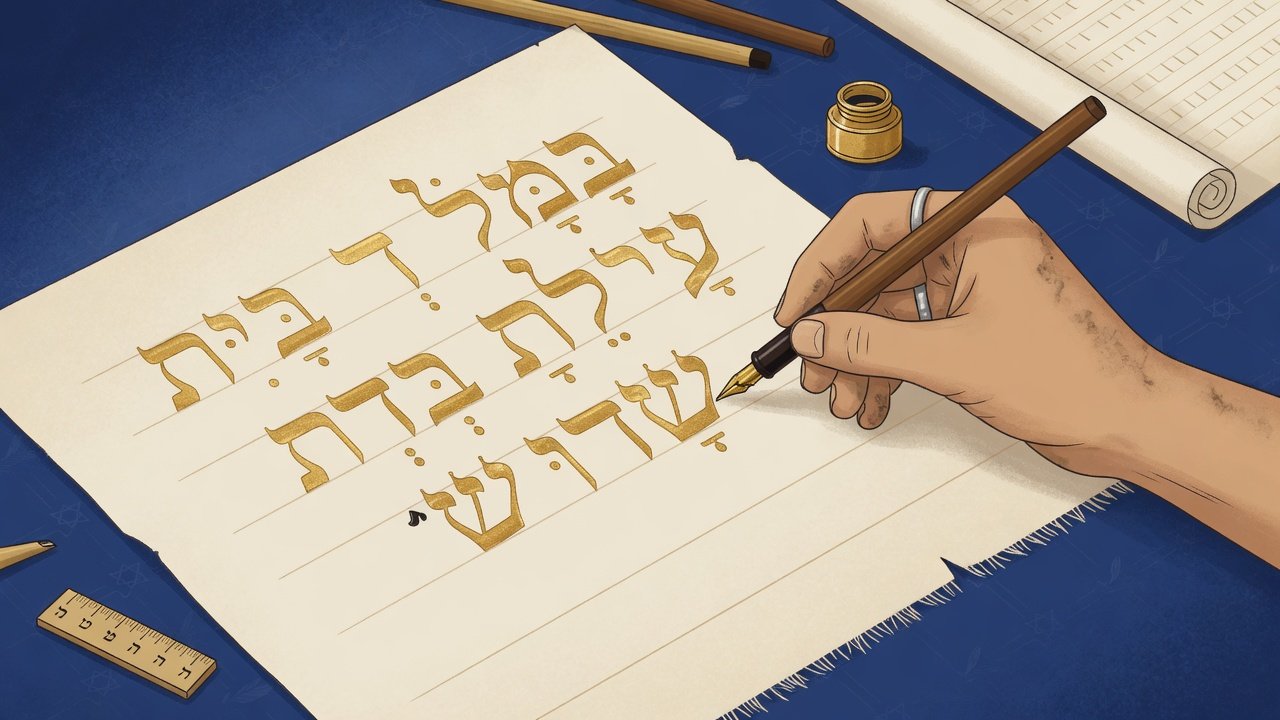
I. What soferim care about
A sofer (scribe) writing a Torah scroll follows detailed rules: kosher parchment, special ink, letter forms that remain readable for generations. You will not write a Torah scroll in this course—but you can borrow the sofer’s habits: sit tall, move slowly, and check your work.
Beautiful letters are not vanity. They are hospitality for the reader’s eyes.
II. Basic stroke ideas
Horizontal crowns
Many letters wear a top bar. Keep it level, like a roof line.
Vertical posts
Downstrokes should feel firm and parallel—fence posts, not spaghetti.
Negative space
The white inside a bet or mem matters as much as the ink.
Even rhythm
Leave similar gaps between letters so a word looks like a team, not a crowd.
III. Practice grid — trace with your eyes, then your hand
Copy each letter three times on paper. Start with large size (2–3 cm tall). Shrink only after the big versions look steady.
אAleph
בBet
שShin
לLamed
וVav
םFinal Mem
תTav
יYod
Word challenge: Copy the Hebrew word for “peace,” שָׁלוֹם (shalom). Do not worry about perfect vowels yet—focus on letter height.
IV. Video: watching a careful hand
Watch for posture and slow rhythm more than speed.
V. Bridge to scholarship
When you are ready for history: Soferim, Scribes & Copying, and Writing Materials.