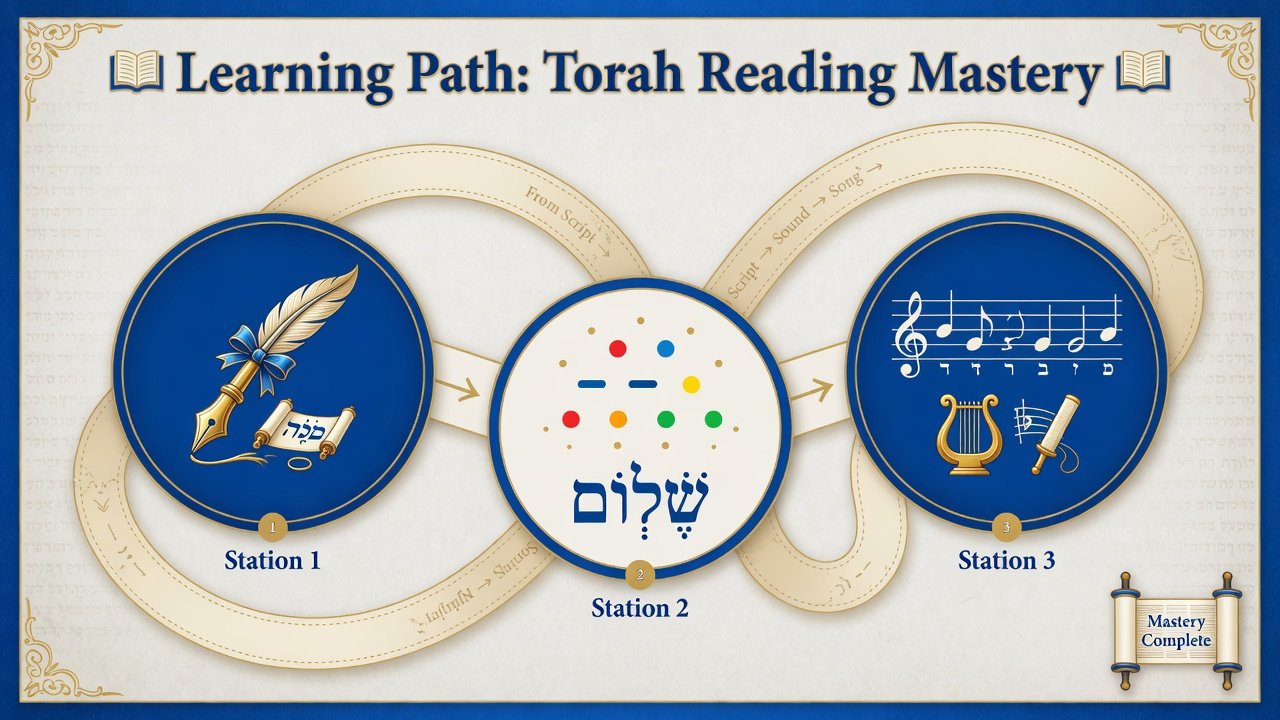
Know what you will learn and how to pace yourself.
Friendly · accurate · never snobby
Pencil · blank paper · optional headphones
~10 minutes to read
I. Why three crafts belong together
Imagine a Torah scroll. The letters are large, black, and carefully shaped—that is calligraphy. Now open a printed Hebrew Bible or a modern study edition: tiny dots and dashes hug the letters—that is niqqud, the vowel system. In synagogue, when the reader chants the weekly portion, special marks above and below the words guide the melody—that is cantillation (also called teʿamim or “trop”).
The Masoretes of Tiberias (roughly 7th–10th centuries) perfected systems for vowels and accents so the sacred text could be read the same way across far-flung communities. You do not need to become a Masorete to enjoy their gifts. You only need curiosity.
Think of letters as the bones, vowel dots as the breath, and cantillation marks as the song. Bones + breath + song = a living verse.
II. What success looks like
| After this course | You will be able to… |
|---|---|
| Alphabet | Name most letters and recognize their shapes (including final forms). |
| Calligraphy | Copy simple letter strokes with better spacing and confidence. |
| Niqqud | Identify the main vowel signs and sound out easy pointed words. |
| Cantillation | Explain why trop exists and spot a few important marks. |
| Reading | Walk through Genesis 1:1 with letters, vowels, and melody marks together. |
III. A short video warm-up
This overview introduces the Hebrew alphabet in a clear, classroom style. Watch once for fun; return after Lesson 2.
External educational video. If it fails to load, continue with the written lessons—you will not be stuck.
IV. Try this (2 minutes)
- Write your first name in English.
- Beside it, draw three simple shapes: a square, a circle, and a zigzag.
- Say out loud: “Letters are shapes that carry sound.”
Hebrew letters are just another beautiful family of shapes. You already train your eye every day when you read English.
V. How lessons are built
- Story — why the idea matters in Jewish and Christian transmission history.
- Show — large Hebrew examples, pictures, and sometimes video.
- Try — a short activity for hands or ears.
- Bridge — optional links into the site’s scholarly notes.