al-Khaṭṭ al-Mansūb (Proportioned Script)
Ibn Muqla (886–940 CE, Baghdad)
Rhombic Dot (Nuqṭa) & Circle Diameter
The Six Pens (al-Aqlām al-Sittah) + Kufic
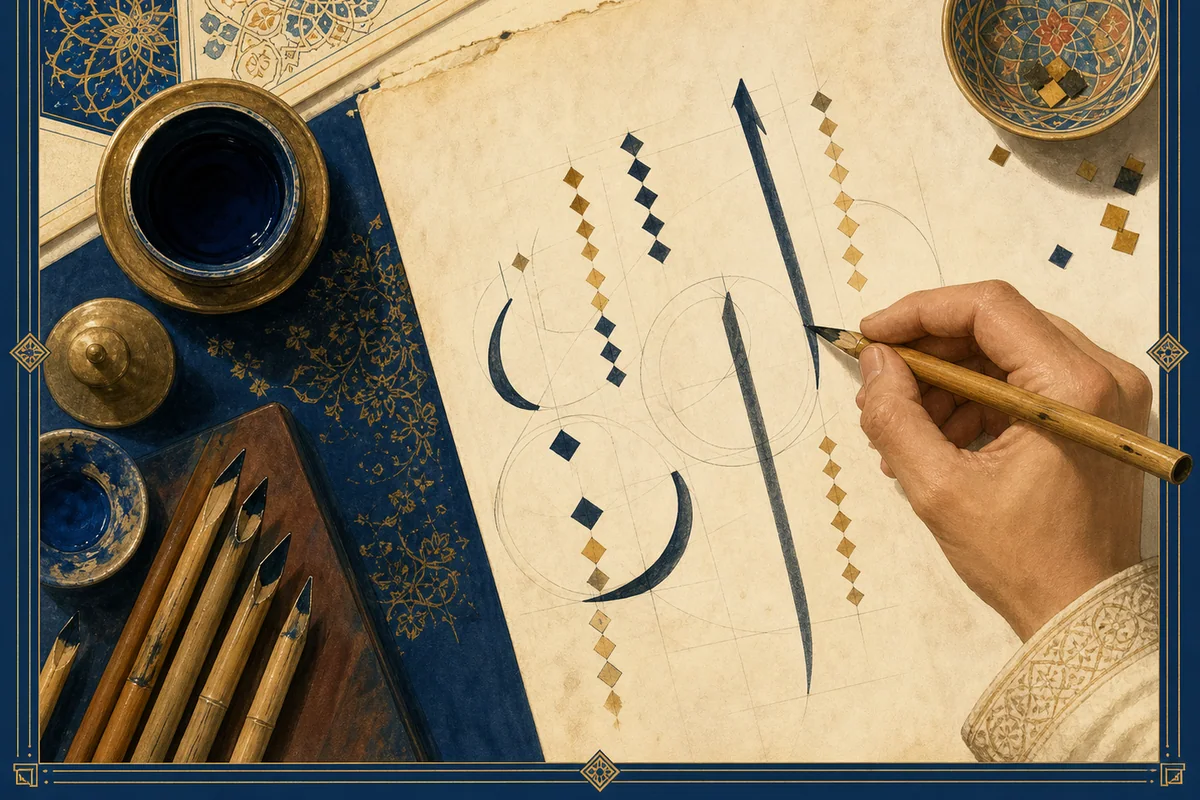
1. Ibn Muqla & The Proportioned Script (*al-Khaṭṭ al-Mansūb*)
In the early 10th century, the vizier and master scribe Abū ʿAlī Muḥammad ibn Muqla (886–940 CE) revolutionized Arabic calligraphy by establishing a mathematical and geometric system to standardize all letterforms. Known as al-Khaṭṭ al-Mansūb (The Proportioned Script), this system made script a discipline of pure sacred geometry.
Alif (أ)
The universal baseline unit. The Alif's height forms the diameter of the fundamental reference circle within which all other letters of the Arabic alphabet are inscribed.
2. The Three Geometric Principles of Ibn Muqla
1. The Rhombic Dot (*Nuqṭa*)
Created by applying the square-cut nib of the reed pen (*qalam*) onto parchment at a ~45° angle. The side length equals the nib width; all letter heights and curves are measured in integer multiples of this dot.
2. The Standard Alif
The letter Alif is written as a straight vertical stroke whose height is fixed (typically 7 Nuqtas in Thuluth, 5 in Naskh). The Alif establishes the standard module for the entire script.
3. The Circumscribed Circle
A circle is drawn with the Alif as its diameter. The curvature of every sub-baseline letter bowl (e.g., the crescent of *Jīm*, *Sīn*, *Lām*, or *Nūn*) must conform precisely to segments of this master circle.
3. The Six Canonical Pens (*al-Aqlām al-Sittah*)
| Script Name | Alif Height (Nuqtas) | Distinctive Geometric Characteristics | Primary Use |
|---|---|---|---|
| Thuluth (ثُلُث) | 7 Nuqtas | Majestic, curvilinear, vertical shafts with leftward hook (*tarwīs*) | Monumental architectural inscriptions, Quranic chapter headers |
| Naskh (نَسْخ) | 5 Nuqtas | Balanced, highly legible, horizontal proportions, small descenders | Book copying, Quranic text, administrative correspondence |
| Muḥaqqaq (مُحَقَّق) | 8 to 9 Nuqtas | Grand, stately, horizontal sweeping descenders without upward hooks | Large monumental folio Qur'ans (e.g., Mamluk and Ilkhanid folios) |
| Rayḥānī (رَيْحَانِي) | 5 Nuqtas | Miniature version of Muhaqqaq with delicate sharp flourishes | Pocket and small-format illuminated manuscripts |
| Tawqīʿ (تَوْقِيع) | 6 Nuqtas | Rounded ligatures connecting letters normally unconnected to the left | Royal diplomas, chancery edicts, colophons |
| Riqāʿ (رِقَاع) | 4 Nuqtas | Compact, rapid, rounded loops and close spacing | Everyday notes, administrative drafts, personal letters |
All course illustrations are original works created for The House of Geometry.